Did you ever wish you could talk with your trauma, anxiety, or intuition? We are all influenced by hidden aspects of ourselves that we cannot access. Some of them exert a negative influence that we want to resolve, others have a positive impact that we need to optimize. We may want to talk with the parts of ourselves that are hurt and wounded, or seek the guidance of the parts of ourselves that are wise. Whatever it may be, communicating with your unconscious is a door to self-knowledge, wisdom, and healing. Using Carl Jung’s method of active imagination, we explore how to make that happen.
Communication with Your Unconscious

Whether you are aware of it or not, you are always in communication with your unconscious. Whenever we fall asleep, our unconscious paints dreamscapes impregnated by rich symbols and intricate patterns. Whenever we feel inexplicably drawn to certain decisions, environments, or people, our unconscious is informing our desires. Our behavioral patterns, thinking habits, and fantasies are firmly anchored in unconscious content. Even our physical bodies are heavily impressed by unconscious material, as evident in studies of somatic psychology. The unconscious is always speaking to us, but we seldom listen.
The communication goes on passively, right beneath the surface of our awareness. Mindful of our passivity, Carl Jung devised a method of intentionally engaging the unconscious in a conversation. Through this method, known as active imagination, you can learn to have a dialogue with your unconscious in the way you would with a friend.
How to Start a Conversation
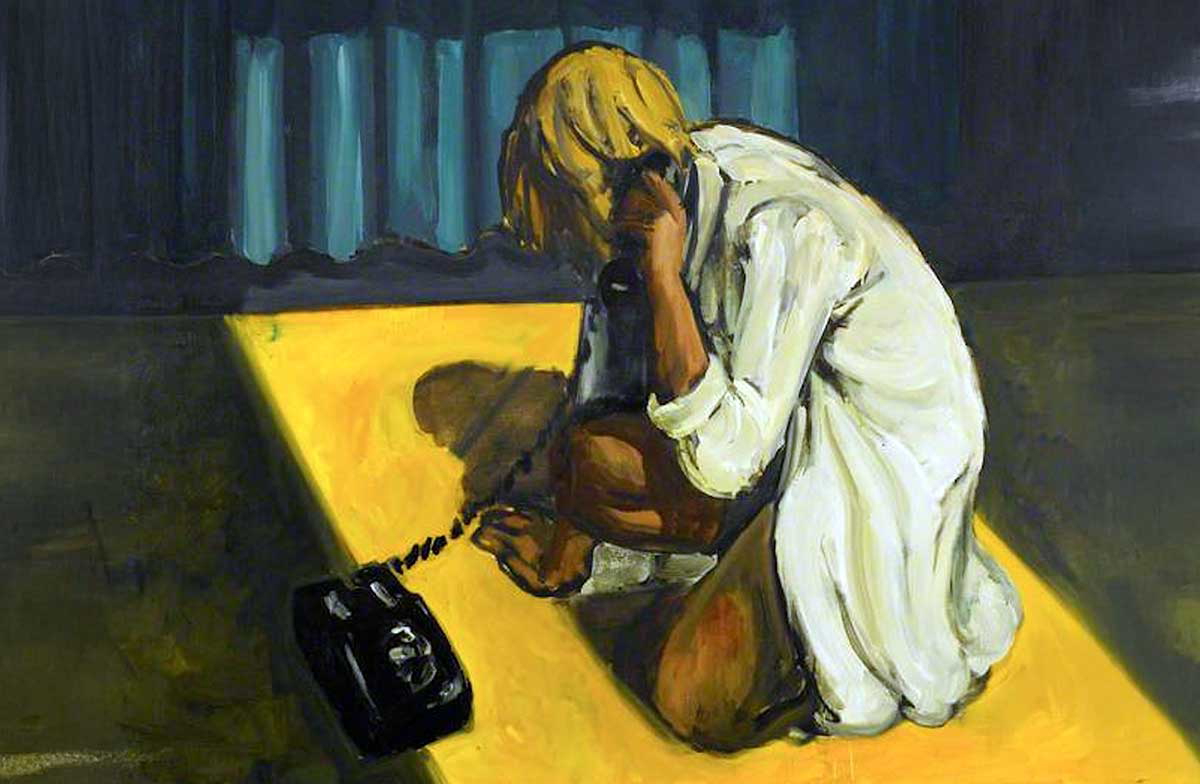
A conversation with your unconscious must start with an invitation. In the same way you would dial the number of a friend to talk to them, you must set the intention to start a call, as it were, with your unconscious, or more specifically, with the contents of your unconscious. More often than not, these contents manifest as personified figures. For instance, grief or loss may manifest in your dreams as a wailing widow or a crying child. Alternatively, your intuition can assume the form of an old wise man or woman. In the same way the contents of our unconscious are personified in dreams, they are also personified in active imagination. These figures will be your interlocutors in your conversation with the unconscious, depending on which aspect of yourself you wish to explore.

In Inner Work, Jungian analyst Robert Johnson explained that “the first step in active imagination is to invite the creatures of the unconscious to come up to the surface and make contact with us” (Johnson, 1986). The invitation is an active intention, followed by a state of complete receptivity. To use our analogy, after dialing the number, we must wait until someone picks up and starts the conversation. The key to active imagination is to allow the conversation to start from the other end of the line, without influencing it with our thoughts or expectations. To do so, we must try to clear our minds as much as we can, creating what Jung called ‘a vacuum of consciousness’, and set aside any expectations we may have of what may show up. Most importantly, we must learn to be patient.

In the beginning, it may take some time for anything to appear in our imagination, and it definitely becomes challenging to remain still and undistracted for long periods. Our restlessness can drive us to two counterintuitive decisions: 1) to take hold of the steering wheel of our imagination and actively conjure an image, or 2) to give up the exercise altogether. In these moments, we must persevere and wait for our imagination to spontaneously occur, without interfering with the process. If it’s too challenging to keep your mind at rest, Johnson advised to use a starting point as an invitation.
This starting point could be a feeling, an object, a memory, or a person related to the aspect of yourself you wish to explore in the active imagination session. By holding it in your attention, it serves as an anchor that keeps your mind from wandering away and reinforces your intention. Once a figure appears in your imagination, the conversation has officially begun.
How to Navigate a Conversation

Navigating a conversation with your unconscious requires a balance of receptivity and activity. Once a figure appears in your imagination, try to withdraw any critical judgments you may have about what you are witnessing. Don’t assume what it is, what it is trying to express, or what it symbolizes. Simply observe your imagination with an attitude of curiosity, without trying to understand what is happening. Jung continuously likened active imagination to a playful activity. When we are playing, we take everything with an air of lightness and curiosity, remaining open to all possibilities.

Although we should maintain a state of receptivity towards the figures manifesting in our imagination, we can still ask them questions. Johnson suggested the following conversation starters: “Who are you? What do you want? What do you have to say?” (Johnson, 1986). Active imagination is not as different as you may think from having an ordinary conversation with your friends – you can say absolutely anything you want in the dialogue as long as you are giving them space to reply and not forcing a certain answer out of them.
How You Can Benefit from the Experience

You can benefit from a conversation with your unconscious by analyzing and integrating it into your daily life. After the active imagination session, you must record everything that happened, including the reactions or emotions the inner figure aroused in you. Once you have recorded the conversation, try to explore its meaningful import in light of the dialogue itself, your reactions, and the associations it may trigger. Once you’ve reflected on the conversation, think of ways to integrate its core message into your daily life.
What perspective or course of action is your unconscious urging you to adopt? What practical steps can you take in your daily life to address what your unconscious has communicated? These are all questions that can help you reap the fruits of active imagination. Now that you know how to have a conversation with your unconscious, which aspects of yourself would you like to talk to?