December 25th, Christmas Day, can feel like a day that the world stops. Shops are closed, workers stop, and most people stay home with family and friends. For this reason, it may seem surprising that some important historical events have occurred on Christmas Day. Sometimes this is directly related to the Christmas spirit, and sometimes it is just a coincidence. Discover six interesting historical events that have happened on Christmas Day.
1. Coronation of William the Conqueror as King of England (1066)
While it might seem a strange choice to us today, Christmas Day was a popular day for coronations in the 11th and 12th centuries. Charlemagne was crowned Holy Roman Emperor on Christmas Day, 800. Baldwin of Boulogne was crowned the first king of Jerusalem on Christmas Day, 1100. Count Roger II of Sicily was crowned the first king of Sicily on Christmas Day, 1130. Henry III was crowned Holy Roman Emperor on Christmas Day, 1046. Boleslaw II the Generous was crowned King of Poland on Christmas Day, 1076.
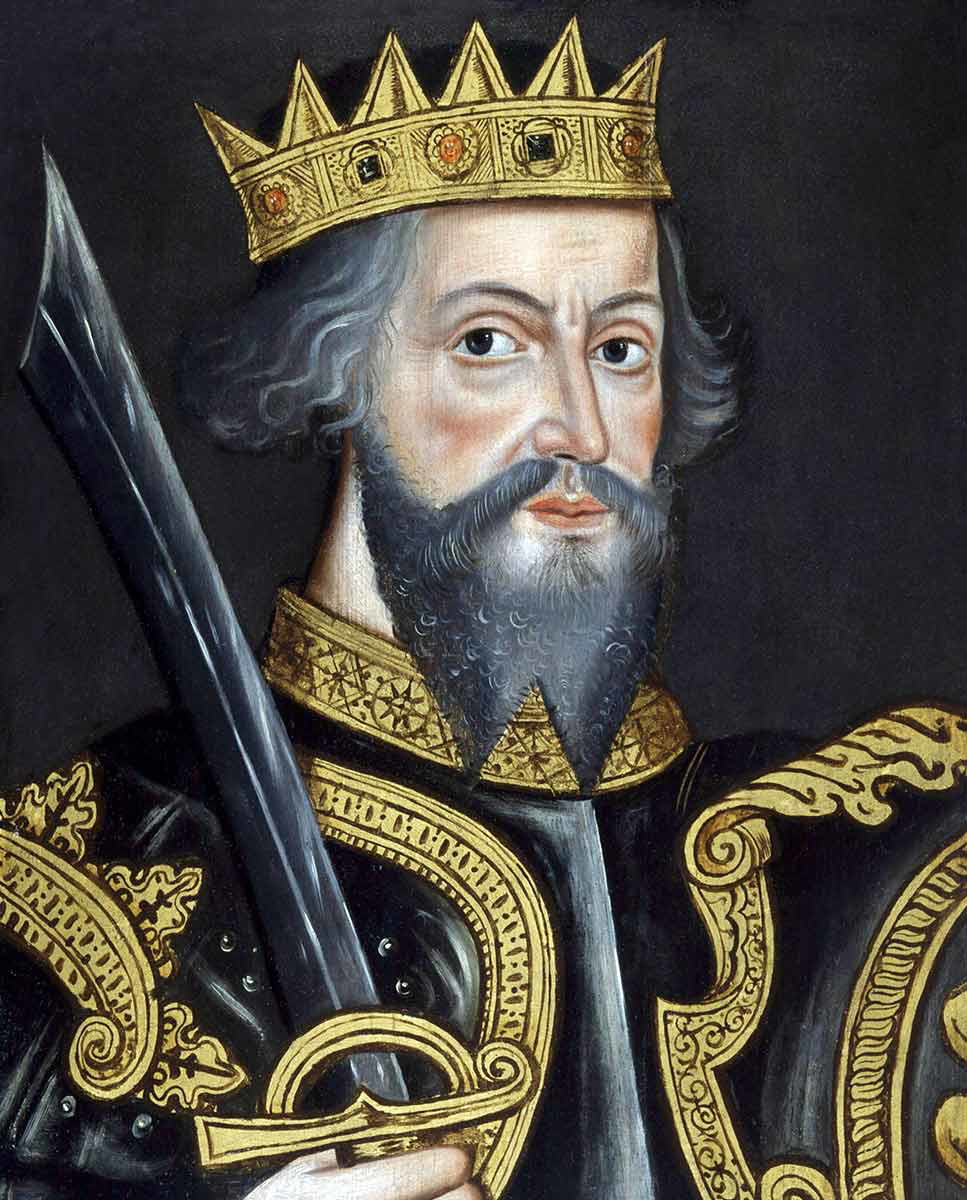
Last but not least, William the Conqueror was crowned king of England on Christmas Day, 1066. The event took place at Westminster Abbey, setting the precedent for future English and British kings, except for King Edward V and King Edward VIII, neither of whom was crowned at all.
Our most reliable source of information about William’s Coronation is a poem, Hastingae Proelio, written by Guy, the Bishop of Amiens, celebrating the Norman victory at the Battle of Hastings. In the finale of this poetic epic, Guy gives a detailed description not only of the battle and its aftermath but also of the coronation ceremony.
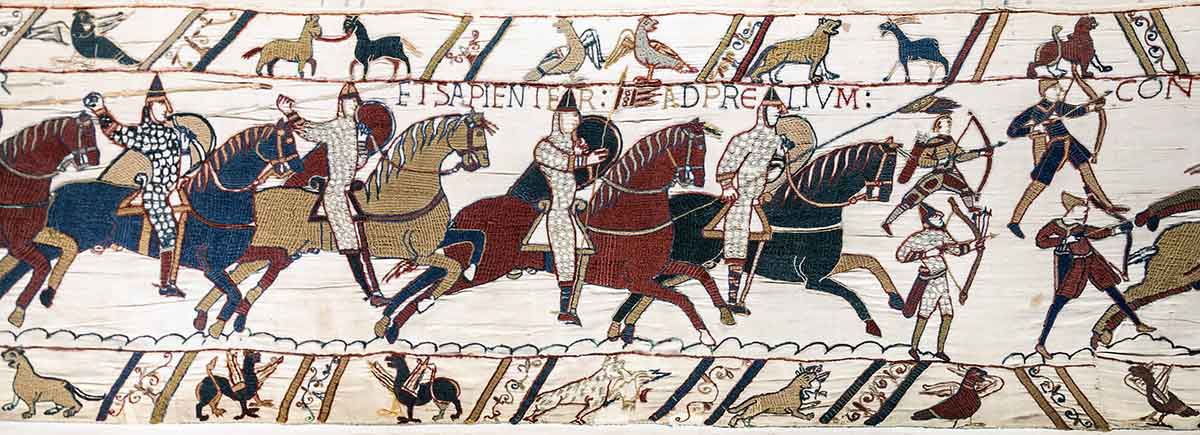
According to Guy, the day began with a procession from the nearby Palace of Westminster. William was preceded by the two leading churchmen of the era: the Archbishop of Canterbury, Stigand, and the Archbishop of York, Ealdred. Ealdred also officiated at the coronation. The pair was accompanied by Geoffrey de Mountbray, the Norman Bishop of Coutances.
After the arrival of the procession at Westminster Abbey, William was seated on a raised dais. The idea was that the king should be raised both physically and symbolically above his subjects. All the traditional aspects of an English coronation followed: the chanting of the Kyrie, the anointing of the King with oil, and the swearing of the coronation oath. William promised that he would “Rule all his people as well as the best of kings before him, if they would be loyal to him.”
The coronation concluded with the customary investiture with the regalia and the enthronement of the king. Finally, Mass was said, and a blessing was given.
A few years later, during Eastertide of 1070, William was crowned for a second time at Winchester Cathedral. Three papal legates were sent to confirm the Roman Catholic Church’s acceptance of his rule.
2. Election of Pius IV as Pope (1559)
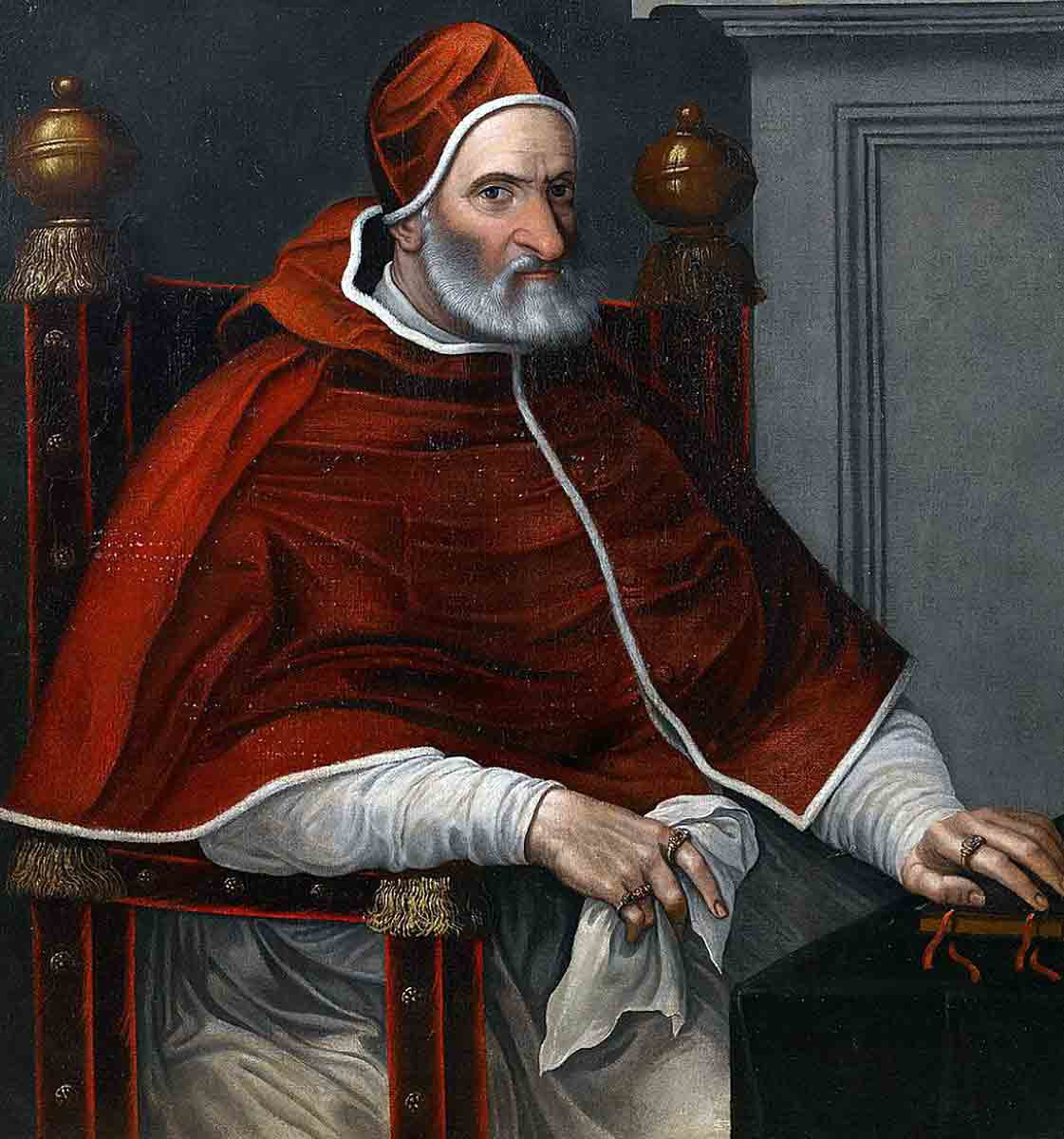
It is rare for a new pope to be elected on Christmas Day. Since the end of the Papacy of Saint Peter nearly 2,000 years ago, there is only one recorded occasion of a new Pope being elected on the 25th of December: Pope Pius IV (Giovanni Angelo Medici), who reigned as Bishop of Rome from Christmas Day 1559 until his death.
The previous pope, Paul IV, died on August 18, 1599, and cardinals were summoned to conclave to choose a new pope on September 5th. What followed was the longest conclave of the 16th century, lasting 112 days. There is no time limit on the election of a new Pope, and theoretically, it should take as long as God wills it to take. The longest conclave ever began in 1268 and took two and a half years, and fairly long conclaves are now common.
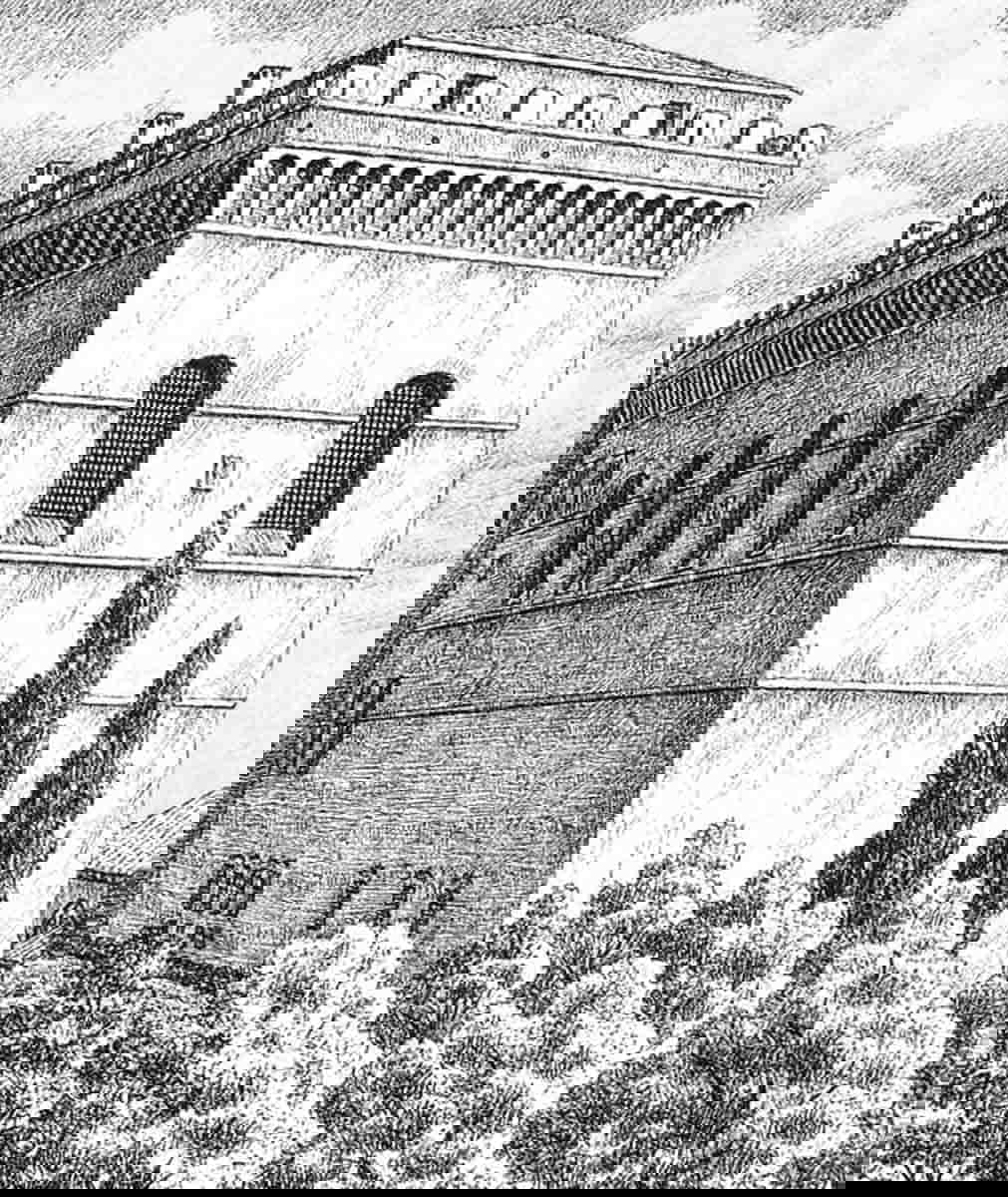
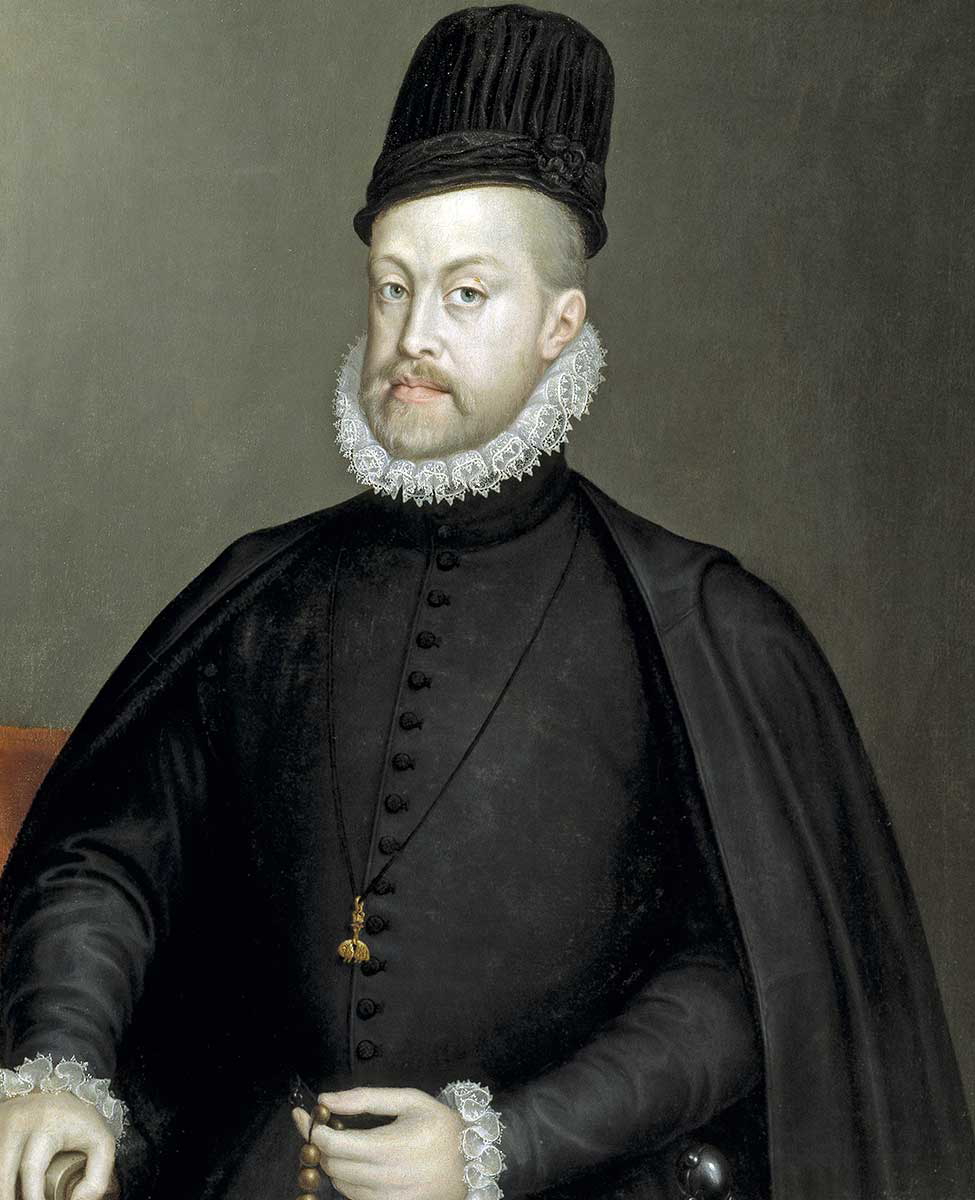
At the time, there were 55 cardinals in Europe, and 47 traveled to the Vatican to participate. Prestigious names in the group included Jean du Bellay (Dean), Francois de Tournon (Sub-Dean), the Cardinal of Santa Fiora (Camerlengo), Robert de Lenoncourt (Protopriest), and Allesandro Farnese (Protodeacon). The cardinals split into factions, with the most powerful being the Spanish faction of 17 cardinals headed by Cardinal Sforza. Eager to please King Philip II of Spain, they preferred Cardinal Carpi or Cardinal Morone for the job. There were also slightly smaller French and Italian factions.
From September 5th until December 24th, 68 fruitless ballots were held, as a two-thirds majority is required to elect a new Pope. A common strategy at the beginning of a conclave was for a whole faction to split the numbers by voting for a random series of minor candidates. This was a delaying strategy: a foolproof way of putting off the election until more votes could be secured. Meanwhile, the number of cardinals present dropped to 44.
Giovani Angelo Medici received a steady number of votes throughout the election process, but these began to increase rapidly towards the middle of December. We know that he voted, on various occasions, for a wide selection of other cardinals. Francis de Tournon, Rodolfo Pio di Capri, Pedro Pacheco de Vilena, Ercole Gonzaga, and Ippolito d’Este are just a few of the men he thought appropriate for the job.
We don’t know exactly what happened on the morning of December 25, 1559, but we do know that another vote was cast after Christmas morning Mass. Suddenly, but finally, the vote was practically unanimous. Giovani Angelo Medici received every vote except his own. 44 pieces of paper were collected; 43 of those had his name written on them.
Giovani Angelo Medici was installed on January 6, the following year, on the Feast of Epiphany, the last of the twelve days of Christmas. He took a papal name, Pius IV. After six years in office, he died on December 9, 1565. The new conclave took just two weeks to choose his successor on January 7.
5. The Death of Lettice Knollys (1634)
Countless historical figures have suffered the misfortune of dying on Christmas Day. The Spanish King, Henry III of Castile; the Bishop of Rome, Pope Adrian I; the American actor, W.C. Fields; the silent movie star, Charlie Chaplin. Most recently, the death of the singer George Michael was announced on Christmas evening, 2016.
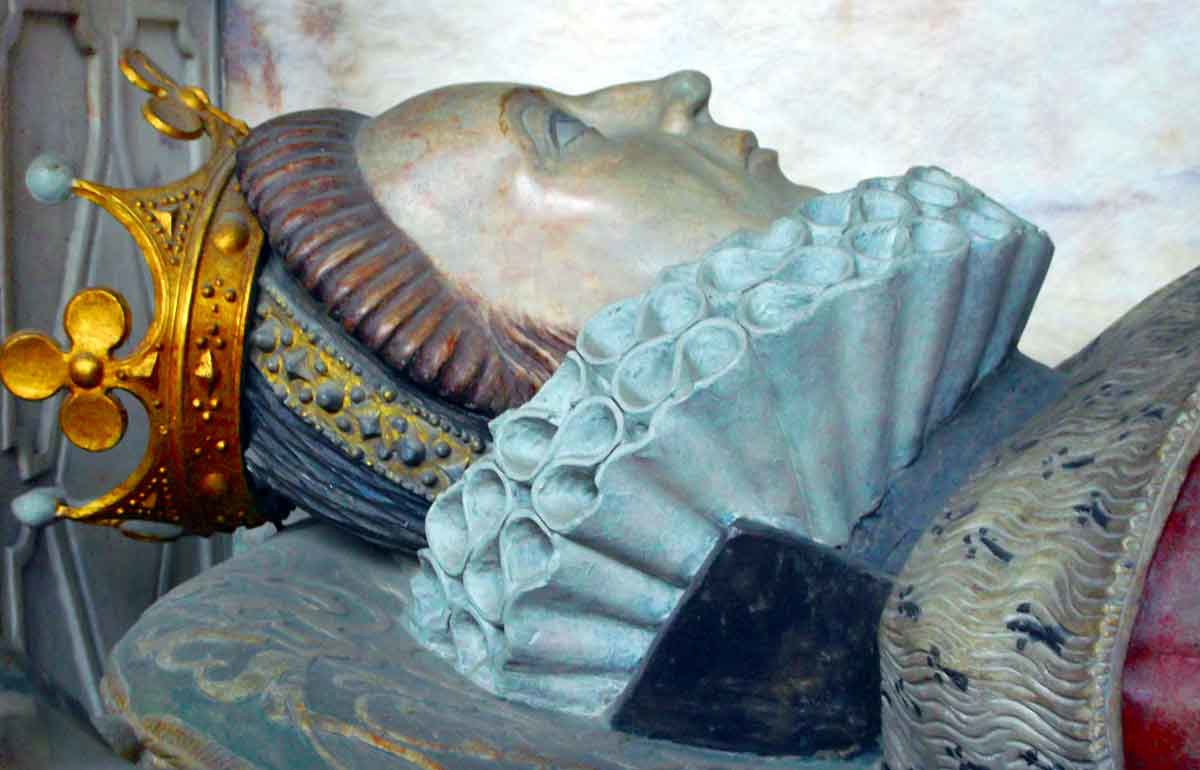
Noble woman Lettice Knollys also succumbed to old age on December 25, 1634. She was a grandniece of the former Queen Anne Boleyn and a relation and close childhood friend of the future Queen, Princess Elizabeth. She married three times: first to Walter Devereux (1st Earl of Essex) and thirdly to the younger Christopher Blunt. It was her second marriage, her union with Robert Dudley, that incurred the unrelenting jealousy and hate of Queen Elizabeth I. Lettice Knolly’s romance with Robert Dudley, and her lifelong banishment from Queen Elizabeth’s royal court, is what she is now best remembered for.
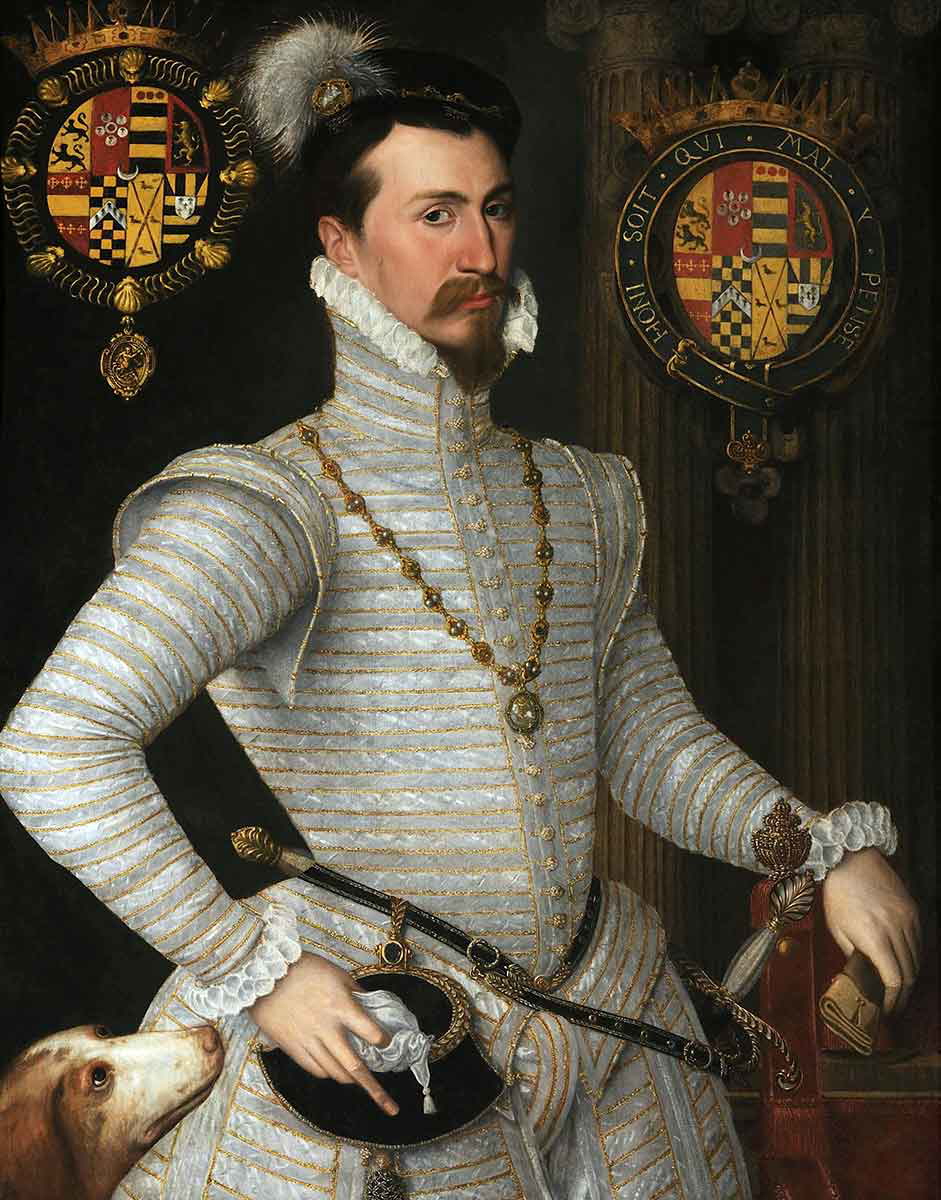
It was almost unheard of for a woman of her era, especially one who had mothered six children, but Lettice was still fit and well at 90. She was said to have walked more than a mile a day for her health. She was born in 1543 during the reign of King Henry VIII and died in 1634 during the reign of King Charles I, seeing six royal coronations.
Lettice Knollys wished to be buried “At Warwick by my dear lord and husband, the Earl of Leicester, with whom I desire to be entombed.” Her final request was respected and carried out, and she now rests in the Chapel of Collegiate Church of Saint Mary, Warwick, beside her husband and opposite the tomb of her son, the young Lord Denbigh.
4. The Birth of Christmas Evans (1766)
Quite a few famous historical figures have been born on Christmas Day. English organist and composer, Orlando Gibbons (1583); world-famous physicist and astronomer, Isaac Newton (1642); leader of the Papal States and Bishop of Rome, Pope Pius VI (1717); American model and actress, Evelyn Nesbit (1884); the first female General of the Salvation Army, Evangeline Booth (1865); and actor and star of Casablanca, Humphrey Bogart (1899).
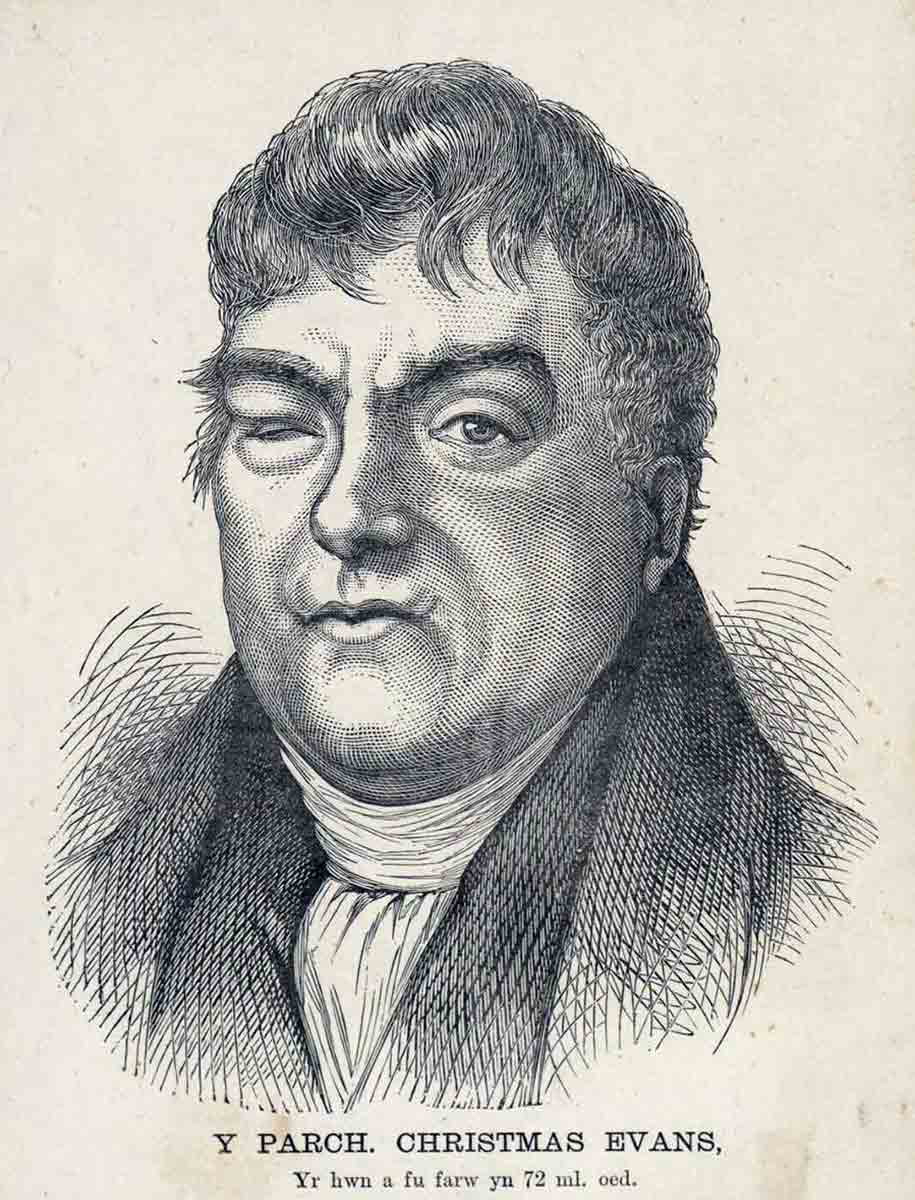
Another Christmas baby was the 18th-century Baptist Minister, Christmas Evans, in 1766. While not internationally famous, he is a household name in many parts of Britain, especially in Wales. Christmas Evans was, according to the Welsh Congregationalist Minister David Lloyd-Jones, “The greatest preacher that the Baptists have ever had in Great Britain.”
Christmas Evans had something of a rags-to-riches story. He had no education as a child, grew up unable to read or write, and worked as a laborer at a local farm. Life took a drastic turn for the better at the age of 17 when he was introduced to the Presbyterian Minister, David Davis. Christmas became David’s servant, and it was in this household that he learned not only to read and write but also about religion. This opened the door for him to become one of the most popular Welsh speakers of his era.
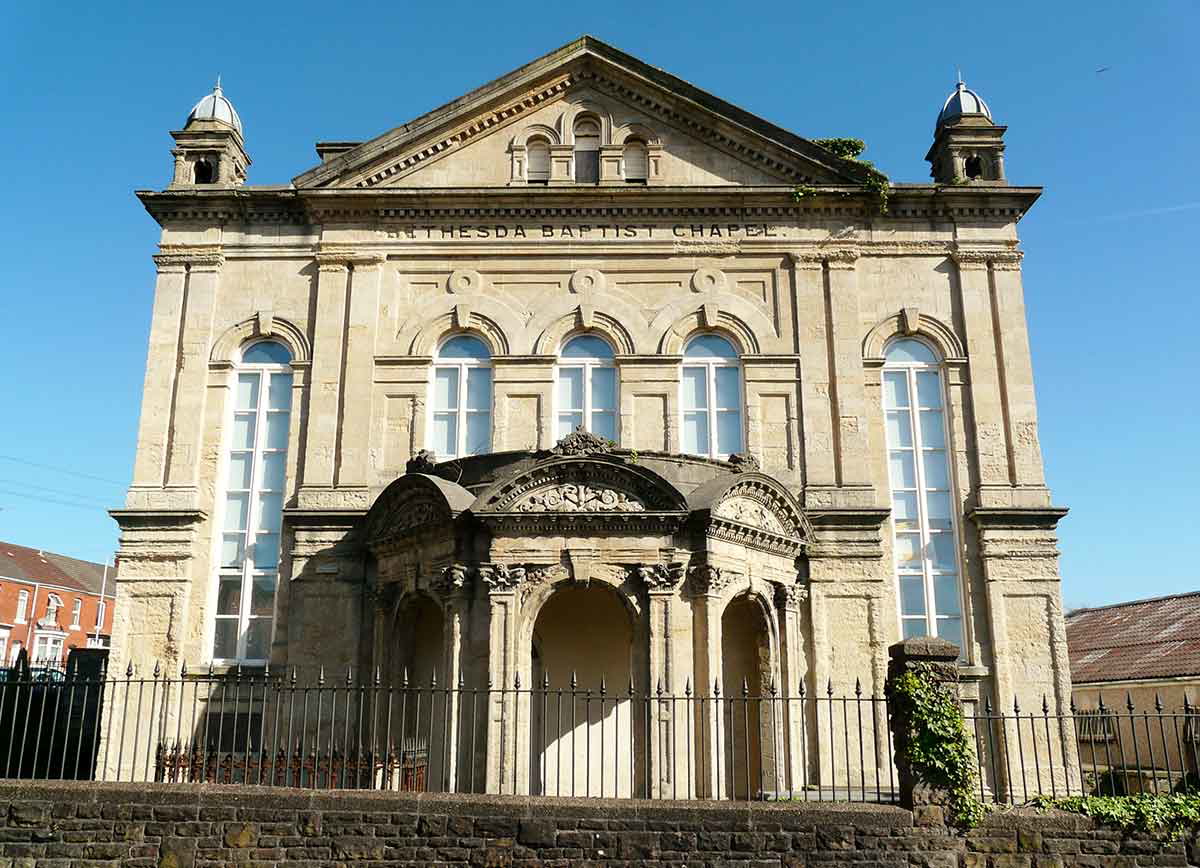
Christmas Evans died in July of 1838, at the very beginning of the reign of Queen Victoria. The number who attended his funeral was unprecedented, and it became one of the best-attended in Welsh history. Legend suggests that if you kiss his headstone on Christmas Day, you will have good luck for the coming year.
In 1909, Grenville Kleiser published a seven-volume work entitled The World’s Greatest Sermons. Christmas Evans’ famous sermon, The World As A Graveyard, was the only entry in the collection by a Welsh preacher.
5. President Johnson’s Confederate Pardon (1868)
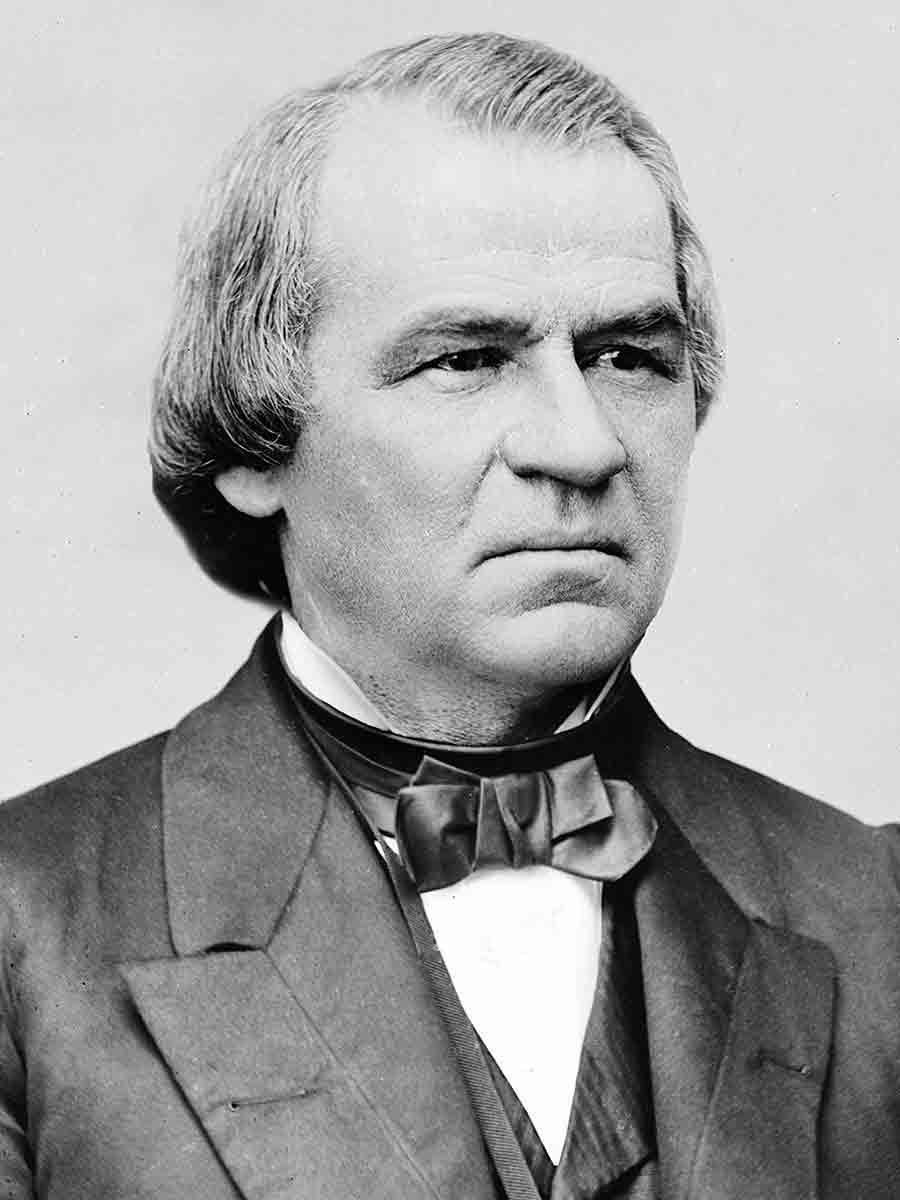
It may have been the Christmas spirit that inspired U.S. President Andrew Johnson to unconditionally pardon all Confederate troops of the charge of treason on Christmas Day, 1868.
How to deal with Confederate fighters had been a contentious issue since the end of the war. President Lincoln outlined plans for reconstructing the South in December 1863, which included amnesty for all former Confederates. It required an oath of allegiance, the abandonment of slave ownership, and the restoration of confiscated properties. But Congress opposed the plans as too lenient, so the plans were abandoned. During his presidency, Lincoln only issued 64 pardons for war-related offences.
When Andrew Johnson took office in 1865, he seemed hostile toward Confederate leaders and seemed to prefer punishment and prosecution. This led to many southern leaders fleeing the United States for Mexico, Canada, and Europe. Nevertheless, he offered a broad amnesty in May 1865, requiring an oath to the United States and a promise to obey the new laws. But many people were excluded, such as members of the Confederate government, anyone in the military above a certain rank, and anyone with a certain amount of wealth. Nevertheless, 12,652 pardons were issued.
Nevertheless, on his last Christmas before leaving office, Johnson seems to have had a change of heart and granted a blanket pardon to “all and every person” who had fought for the Confederates as an unconditional act of forgiveness that would reconcile the nation.
6. The Christmas Truce of WWI (1914)
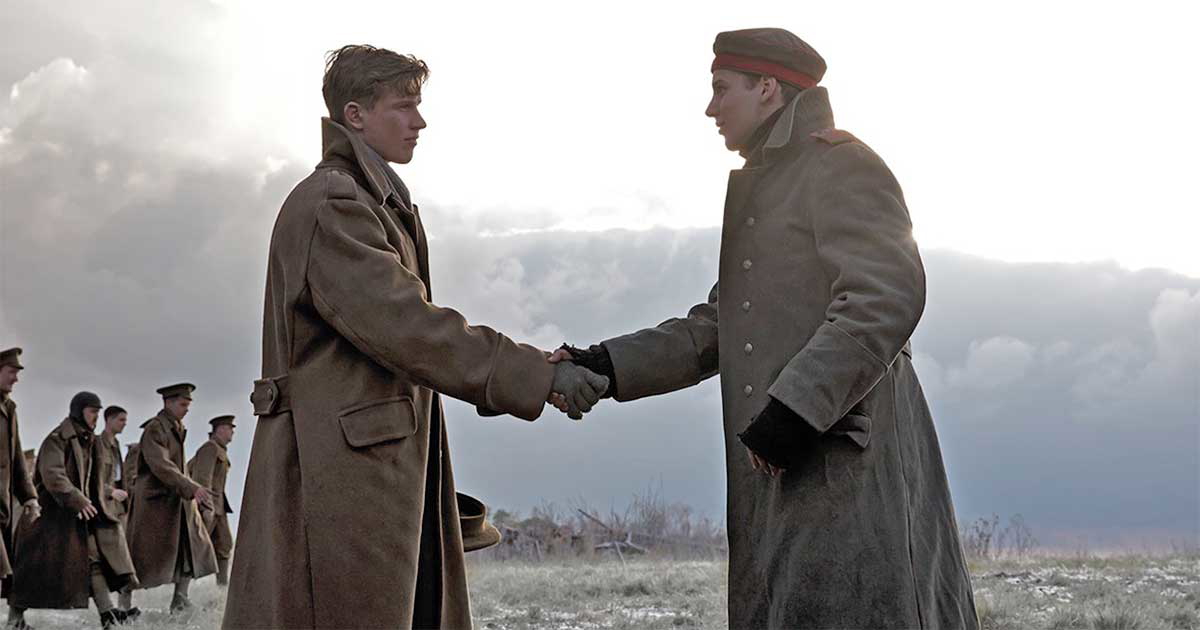
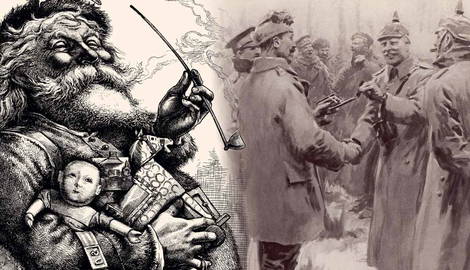
Where can one begin when describing the Christmas Truce of 1914? There is little that can be said to do justice to its meaning or significance. Never has there been a greater example of the overwhelming and uniting power of the Christmas spirit. The Encyclopaedia Britannica explains the event in a few sentences: “The Christmas Truce (December 24th-25th, 1914) was an unofficial and impromptu ceasefire that occurred along the Western Front during World War I.”
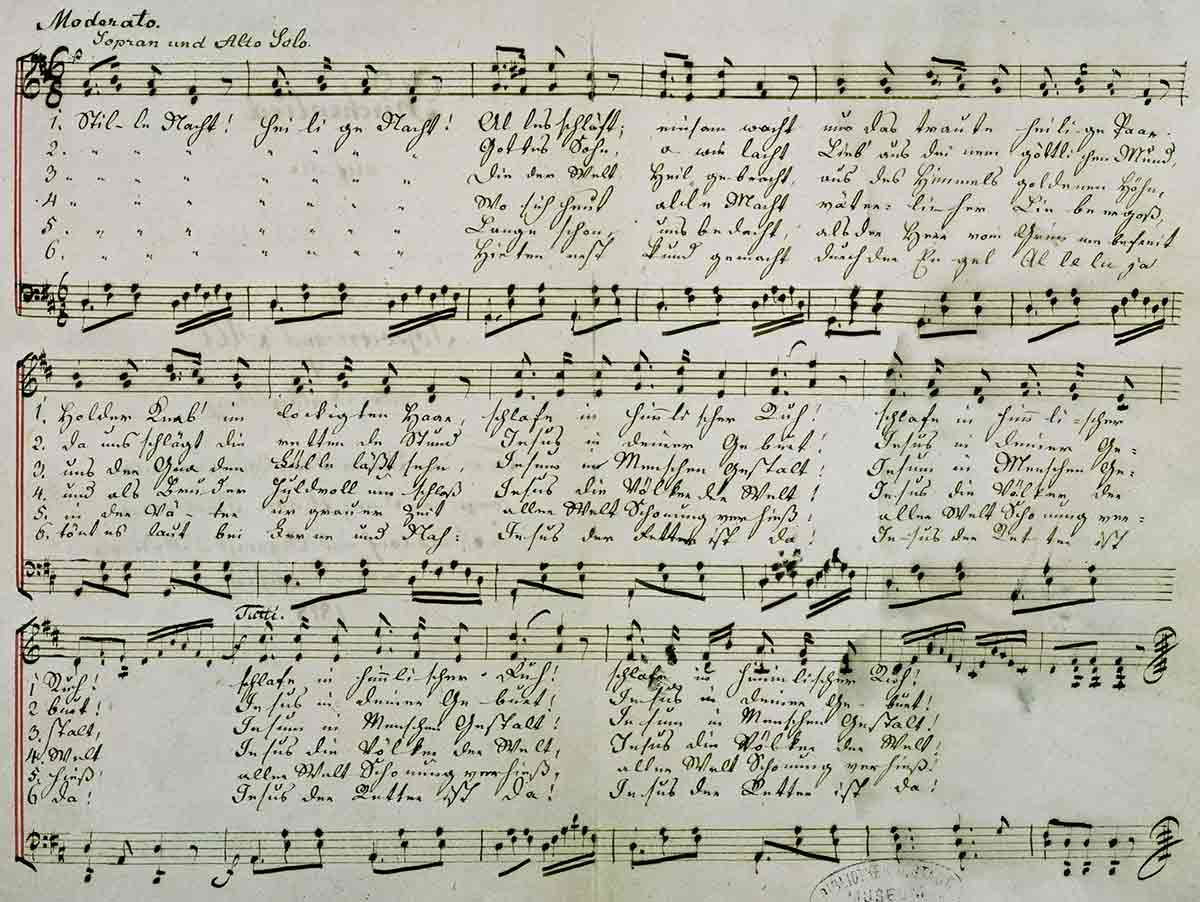
The truce is thought to have started on Christmas Eve in 1914. Late in the evening, German troops began to sing Christmas carols, starting with Silent Night, or Stille Nacht. Members of the British Expeditionary Force (BEF), in the trenches directly opposite, were inspired to stop and listen. After a while, the British joined in, and English and German lyrics blended together. Lanterns were lit, and verbal messages were passed between the opposing trenches.
The following day, early on Christmas morning, British and German soldiers met in no-man’s-land. The truce began with the most respectful and important acts of burying the dead and repairing supplies.
It was afterward that the simple festivities began. Not only did the men wish each other a Merry Christmas, but they also exchanged gifts, showed photographs of loved ones, shared food, talked of life back home, and even played games of football.
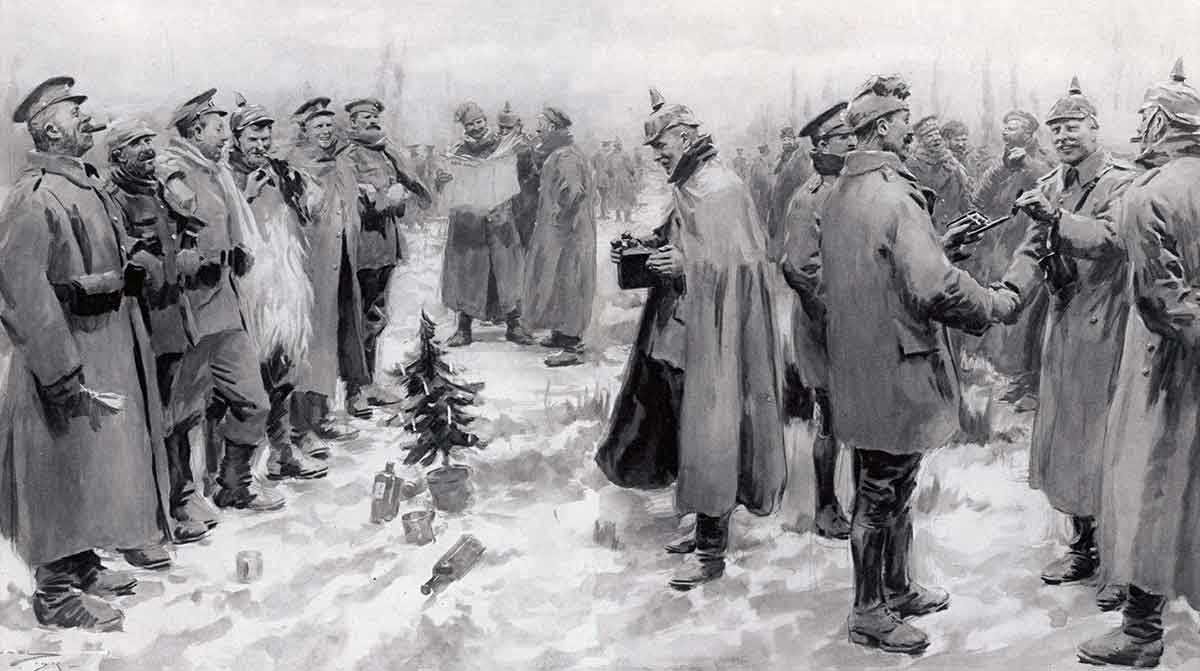
While the truce persisted until New Year’s Day in some areas, violence quickly returned to the Western Front. But while short, its impact should not be underestimated. Many officers feared that the truce would cause a rapid decrease in fighting spirit. There were worries, especially in areas where the truce continued into January, that it might actually end the war.
Despite the attempts of the soldiers, plans for a second truce on Christmas Day of 1915 were abruptly quashed. There were no further widespread ceasefires on the Western Front until the armistice of November 1918. Extra efforts were taken by both British and German officers to prevent any further contact between their men.