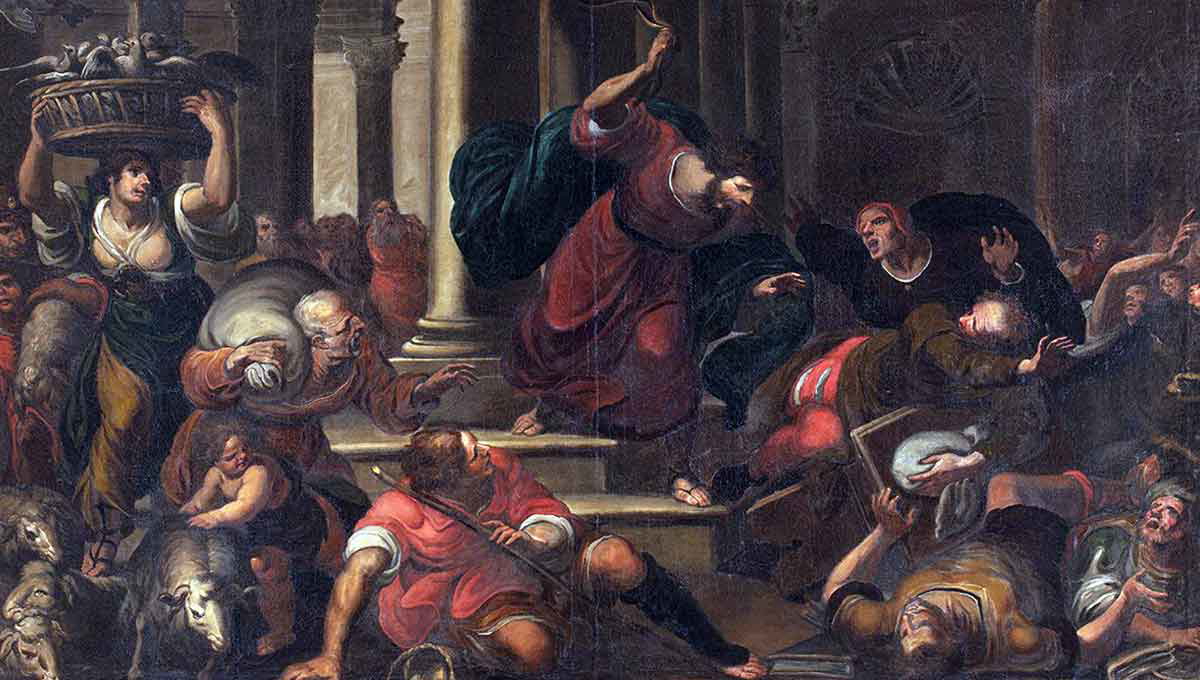
Right after the Triumphal Entry, Jesus seems to forget about his message of peace and love when he tosses out the merchants who were selling goods in the Temple Courts.
Riding on a lowly donkey the day before, Jesus now completely loses it to the point of flipping tables over. This article will explore why Jesus could act so violently if he was also called the ‘Prince of Peace’.
Did Jesus Bring a Message of Peace or Judgment?

It surely seemed – just the day before – when he was calmly riding into Jerusalem on the back of a colt that his was a message of peace. The crowds loved that version of Jesus. He was a loving miracle-worker, who they likened to a light shining in darkness.
But there was also another side to Jesus Christ. This is the dark truth of what eventually got him killed.
Jesus: “Do not suppose that I have come to bring peace to the earth. I did not come to bring peace, but a sword.” – Matthew 10:34
Jesus was often very unpopular in the eyes of people for some of the statements and movements he made. Some of which would even raise the eyebrows of his most devoted followers today.
The truth that’s a hard pill to swallow in modern times is this: The message of Jesus was not only one of peace.
Jesus and His Moments of Anger

At the start of Holy Week we read about what happened on Monday morning. Interestingly, the Gospel according to John has these events happening at the very start of Jesus’ ministry – and it’s even more violent than the other accounts.
“In the temple courts he found people selling cattle, sheep and doves, and others sitting at tables exchanging money. So he made a whip out of cords, and drove all from the temple courts, both sheep and cattle; he scattered the coins of the money changers and overturned their tables. To those who sold doves he said, “Get these out of here! Stop turning my Father’s house into a market!” – John 2:14-16
The Scriptures claim that Jesus was tempted in every way, just as we are, but he never sinned (Hebrews 4:15). Therefore, the question is: How could these violent acts of Jesus not be seen as sin?
The Bible and Righteous Anger

In John’s description of the Temple scene, verse 17 stands out: “His disciples remembered a Psalm of David (Psalm 69:9) where it is written: “Zeal for your house will consume me.”
One might conclude that the emotions of zeal, passion, or even anger are not bad in and of themselves.
For example: Instead of calling his followers to be “peace-keepers” (as in, let people walk all over you to keep the peace); Jesus told them to be “peace-makers” (as in, fight for peace at all costs). There’s a big difference here.
Ephesians 4:26 – in the ESV version – says: “Be angry and do not sin”. Another translation, the MSG, says: “Go ahead and be angry. You do well to be angry—but don’t use your anger as fuel for revenge.”
Anger is relevant here as an example because it’s the emotion that led Jesus to expel those merchants from the Temple.
Is God Violent?
According to the picture portrayed in the pages of the Bible, God is not really who people have made him out to be. God does get angry, but his anger is righteous. Like light that causes darkness to flee, the truth of God cannot coexist with some things. According to the Bible, there are actions and situations that deeply disturb God’s heart because they go against his design.
Jesus was really moved when he entered the Temple and saw the money-hungry sellers there because it went against God’s design. What was supposed to be the place where God could dwell among his people was turned into a marketplace.
As for why Jesus used violence, perhaps our idea of Jesus needs to be challenged. C.S. Lewis famously said: “My idea of God is not a divine idea. It has to be shattered time after time. He shatters it Himself.”