Art and fashion run hand in hand, as artists reflect the trends of their era, and designers take inspiration from works of art. Yet some dresses and accessories from art history sometimes become so beloved and influential they create trends even centuries after their creation. Read on to learn about six most iconic outfits from art history, their backstories, and the ideas of artists who depicted them.
1. “Girl with a Pearl Earring” by Johannes Vermeer
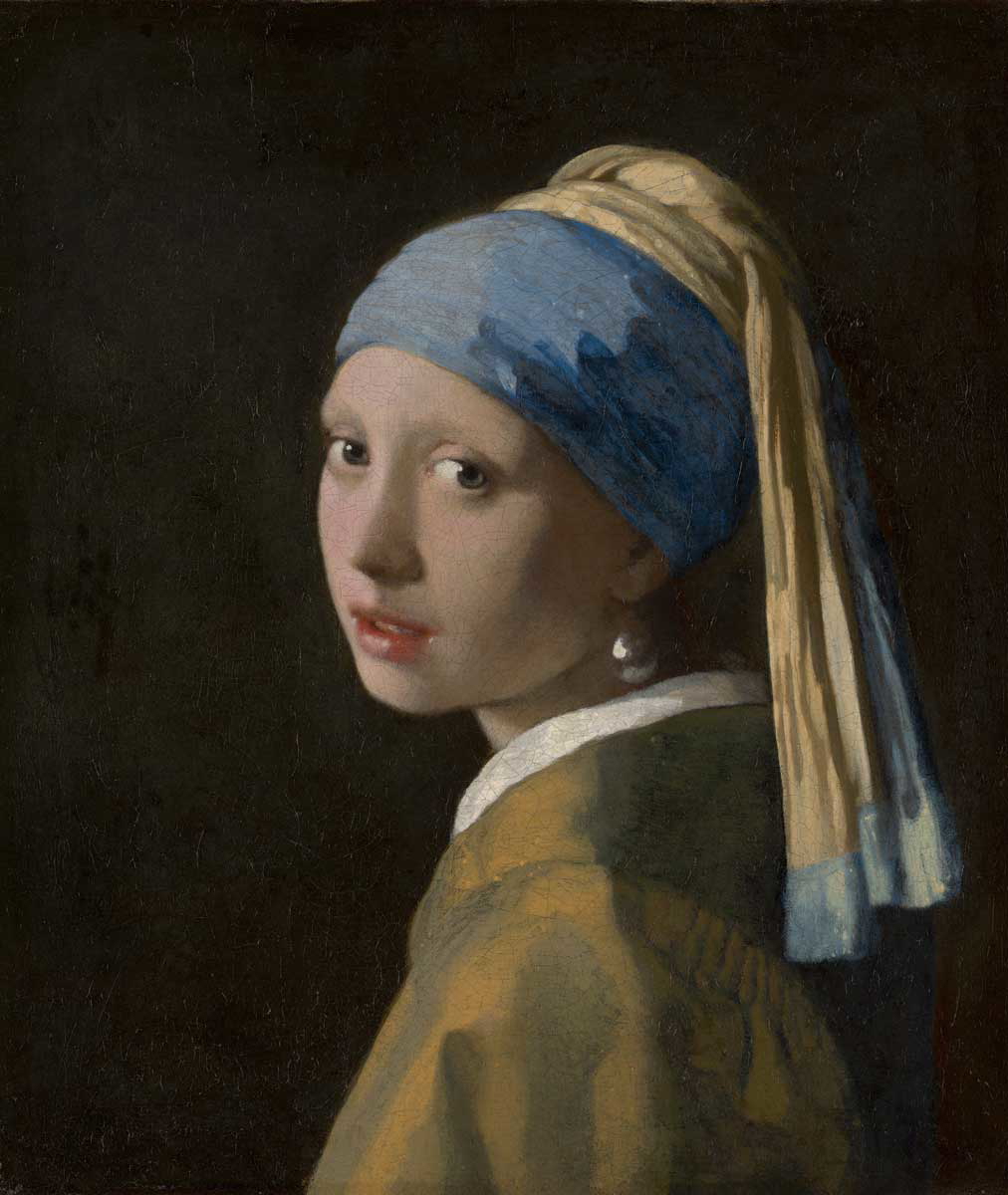
Many guesses have been made about the identity of Vermeer’s Girl with Pearl Earring. However, even if the artist had a model, it is unlikely that the image bore any likeness at all—judging by the painting’s format, this was not a portrait but a tronie, a character head genre popular in the Flemish Baroque era as a study in characters and representations. Her pleated yellow jacket, worn over a white undershirt, was pretty standard for Vermeer’s time. What is unusual here is the blue and yellow headscarf over the woman’s head. Most likely, this was a reference to Oriental costume, intended to give the character an exotic look.
The large pearl in the character’s ear is perhaps the most remarkable element of the composition. In Vermeer’s era, pearls were rare and expensive, as artisans did not yet learn how to cultivate them and had to rely solely on natural resources. Starting from the 16th century, less affluent women began wearing fake pearls made from painted glass. Pearl jewelry was a frequent occurrence in Vermeer paintings, with some other paintings including similar-sized earrings worn by affluent women.
2. “The Arnolfini Portrait” by Jan van Eyck
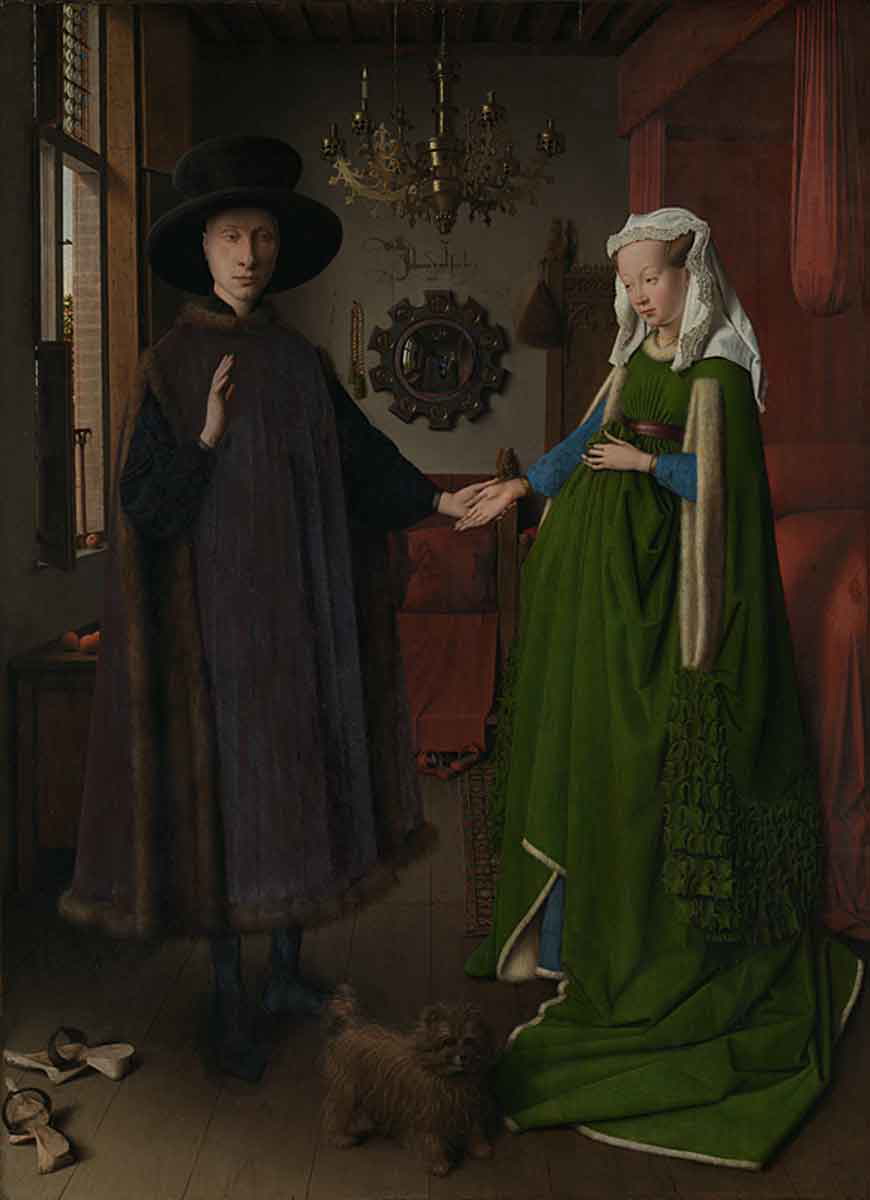
Jan van Eyck’s famous portrait became one of the most iconic fashion references, instantly recognizable from afar. Despite centuries of studies, historians still don’t understand the true meaning and intention of the portrait. According to historical records, Giovanna Arnolfini died a year before the portrait was painted, so possibly, this was a memorial work commissioned by her grieving husband.
The Arnolfini family were successful merchants who lived in the rich commercial center of Bruge, Belgium. The couple’s outfits reflected their status: the woman’s dress was made from high-quality wool dyed a rich green. In the 15th century, such work was available only to the tiniest percent of European society. The neckline and sleeves were lined with light-colored fur, further emphasizing the affluence of the Arnolfinis.
The cut of the dress and the position of the woman’s hands for a long time were wrongly interpreted as a sign of pregnancy. First of all, a slightly protruding stomach could be found in many artworks of the era. Most likely, it was the standard of feminine beauty that indicated her ability to bear children. Second, the volume in front of the woman’s stomach was clearly created by the fabric folds of the dress’ long train. Such overuse of expensive fabric was another loud marker of status.
3. “Ophelia” by John Everett Millais
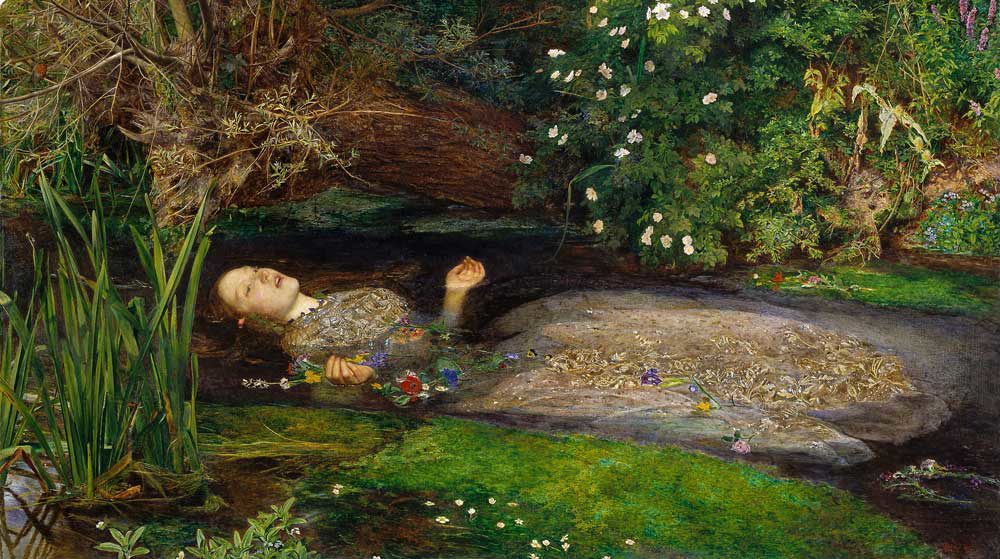
The attempt to count exactly how many photoshoots and campaigns were inspired by Millais’s Ophelia would be utterly useless. For more than a century, Ophelia has remained one of the most popular and recognizable historical art images. In the original Shakespearian text, the young Ophelia, losing her mind over her father’s death, falls into a river, and her voluminous dress, soaking up the water, drags her to the bottom. Literature historians still debate whether her death was a suicide or an accident.
While posing for Ophelia, Elizabeth Siddall spent hours in a bathtub full of cold water and nearly died from pneumonia. The silver dress she was wearing came from a second-hand shop, where Millais purchased it for 4 pounds (approximately $580 in today’s currency). He referred to it in his notes as an ancient dress—all flowered over in silver embroidery, old and dirty. The price should not confuse you: since all garments were made by hand and meant to last for decades, they cost much more than today, even on second-hand markets.
4. “The Portrait of Anne Boleyn” by an Anonymous Artist
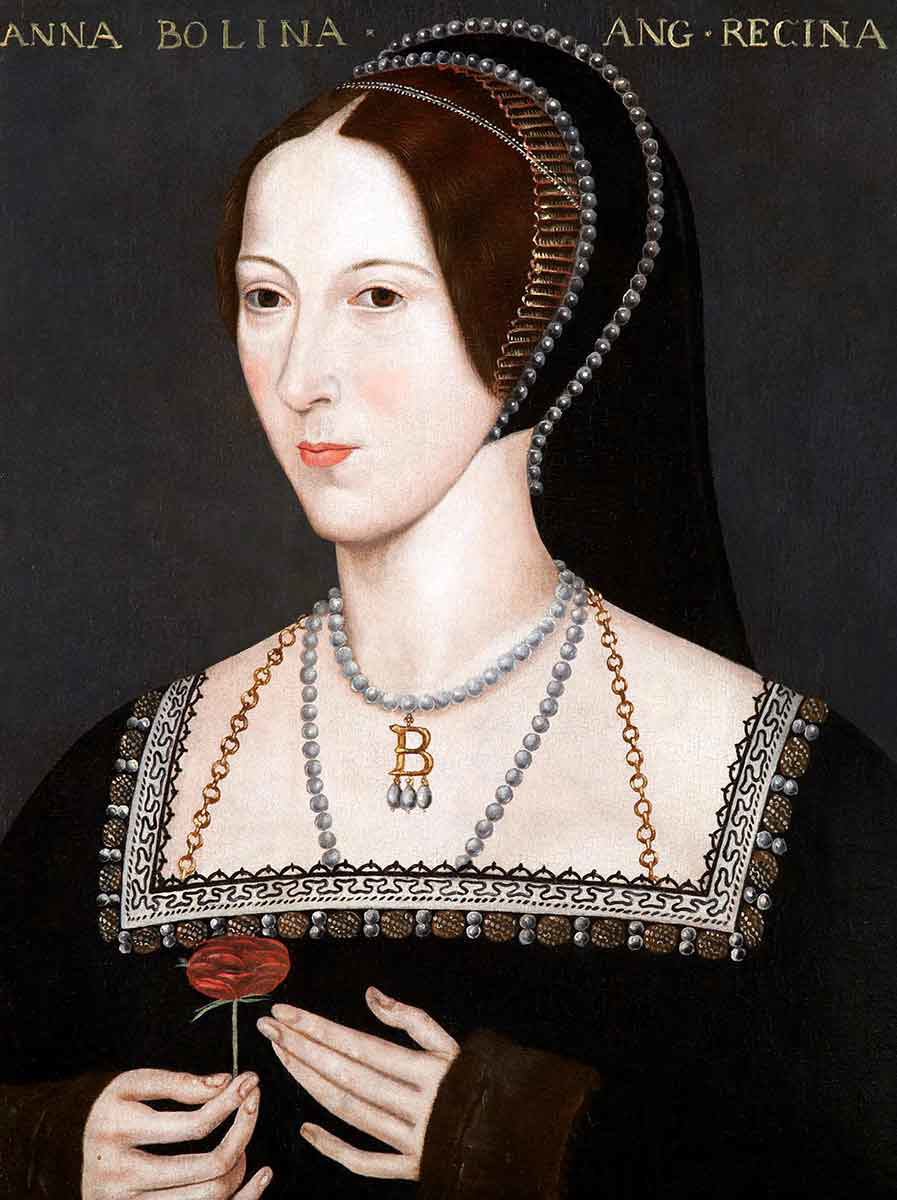
Although the name of the artist who painted the famous portrait of Anne Boleyn was lost to history, her remarkable outfit remained in the history of fashion. Curiously, no one actually knows for sure what Anne Boleyn, the second wife of the notorious King Henry VIII, looked like. After executing his second wife to marry the third one, Henry VIII ordered the destruction of all her portraits. All existing images were most likely copies of a single work that was lost and painted after the King’s death.
Still, Boleyn posthumously became a fashion icon when designers noted the square-cut bodice of her dress and, more importantly, the pearl necklace with her initials given to her by her then-husband. The fate of the original necklace is unknown: it was either passed to her daughter and lost to history, or it was disassembled and turned into a new gift for a new wife. Still, recently, variations of this necklace have appeared in many designer collections from brands like Balenciaga or Tiffany.
5. “Portrait of Madame X” by John Singer Sargent
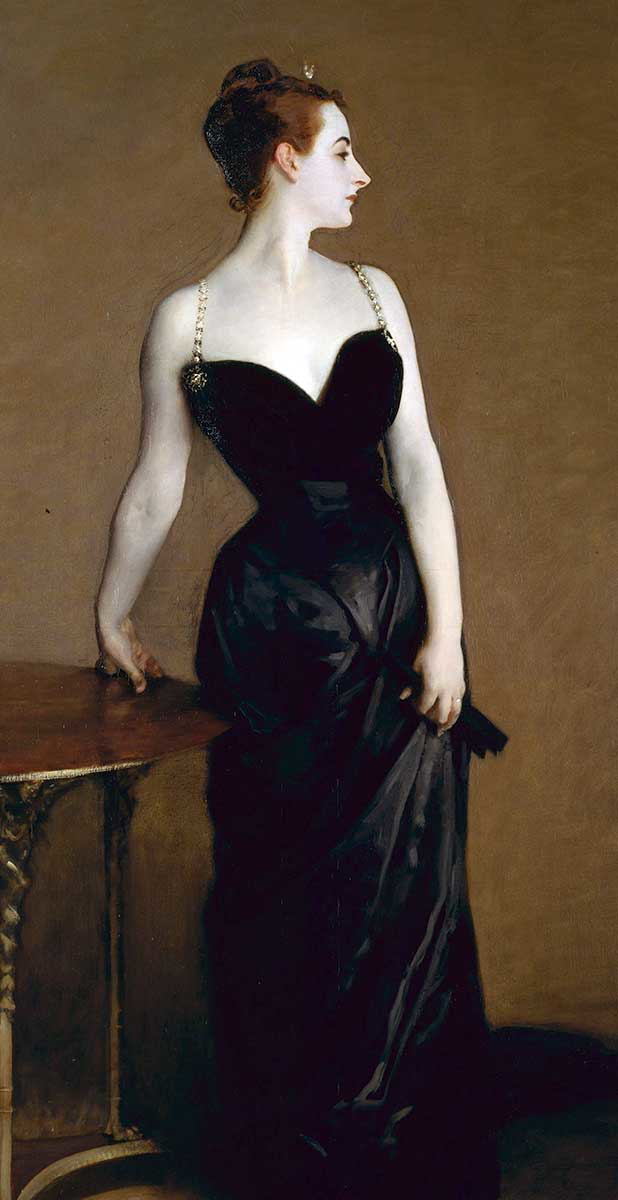
Contrary to the standard practice of commissioning portraits from artists, it was John Singer Sargent who approached his clients first. The Portrait of Madame X, famous for the scandal it caused, was one such case. The model’s name was Virginie Amélie Avegno Gautreau, and she was the much younger wife of a prominent Parisian banker. Gautreau was a carefree socialite and, worse of all, a French Creole. Her ancestry was perhaps the most scandalous aspect of her biography for a society obsessed with racial purity.
Sargent was not only a painter but a stylist. He rummaged through his clients’ wardrobes, looking for the perfect outfit that often went contrary to the model’s wishes. Still, a Sargent painting was synonymous with quality and prestige, and many clients were ready to follow his rules. Sargent’s choice of dress, however, did not mean that he always reflected his clients’ outfits accurately. He almost never painted patterns and often changed the cut or the structure of painted garments. Walter Sickert, notorious for his inability to say anything nice about his colleagues, called Sargent’s style “the school of wriggle and chiffon.”
Unfortunately, the iconic black dress with a heart-shaped bodice did not survive. Originally, Sargent painted one of the dress straps as falling from her shoulder, but he had to repaint it after a dramatic reaction from the conservative public. Over the centuries, fashion designers and photographers endlessly referenced the dress. It remains one of the most universally adored designs seen in paintings.
6. “Ellen Terry as Lady Macbeth” by John Singer Sargent
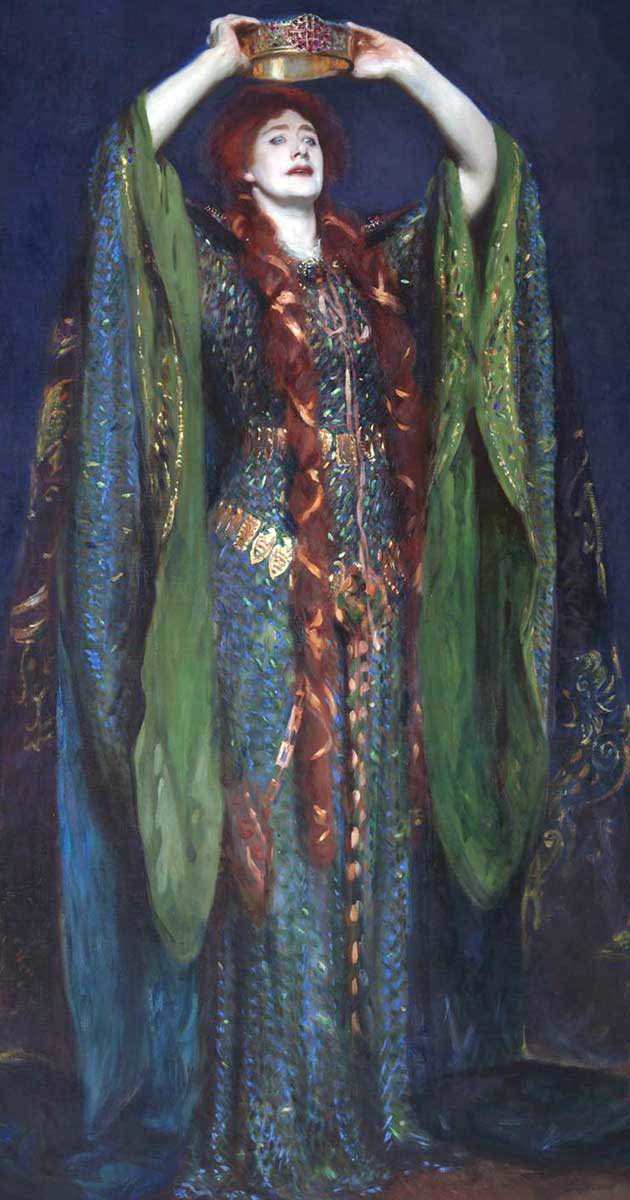
John Singer Sargent frequented theaters and cultural events. He was deeply immersed in London’s social life. Ellen Terry was the most famous Shakespearean actress in London at the time, and Sargent was among those who attended the opening night of the new production of Macbeth that featured Terry. The quality of stage decorations and costume design was so immense that Sargent became obsessed and decided to paint Terry’s portrait.
The dress for Lady Macbeth was made specifically for Terry and was embroidered with real green beetle wings. This type of decoration was appropriated by the Westerners from Indian culture during the years of colonization. Beetle wing decoration became particularly prominent in the 19th century when the iridescent fragments were used as sequins. However, such dresses were extremely expensive and even daring to wear; thus, they were popular among the most eccentric women of the time. In the case of Ellen Terry’s stage appearance, the beetle wings made the dress glow in the bright stage lights.
The cut of the dress was influenced by the Aesthetic movement and the type of dress popular in the Middle Ages. The base of the dress was crocheted in a way that resembled chain mail. According to theater historians, Ellen Terry participated in the dress design since she always paid significant attention to her stage costumes. The dress survived and is currently on display in Ellen Terry’s museum.