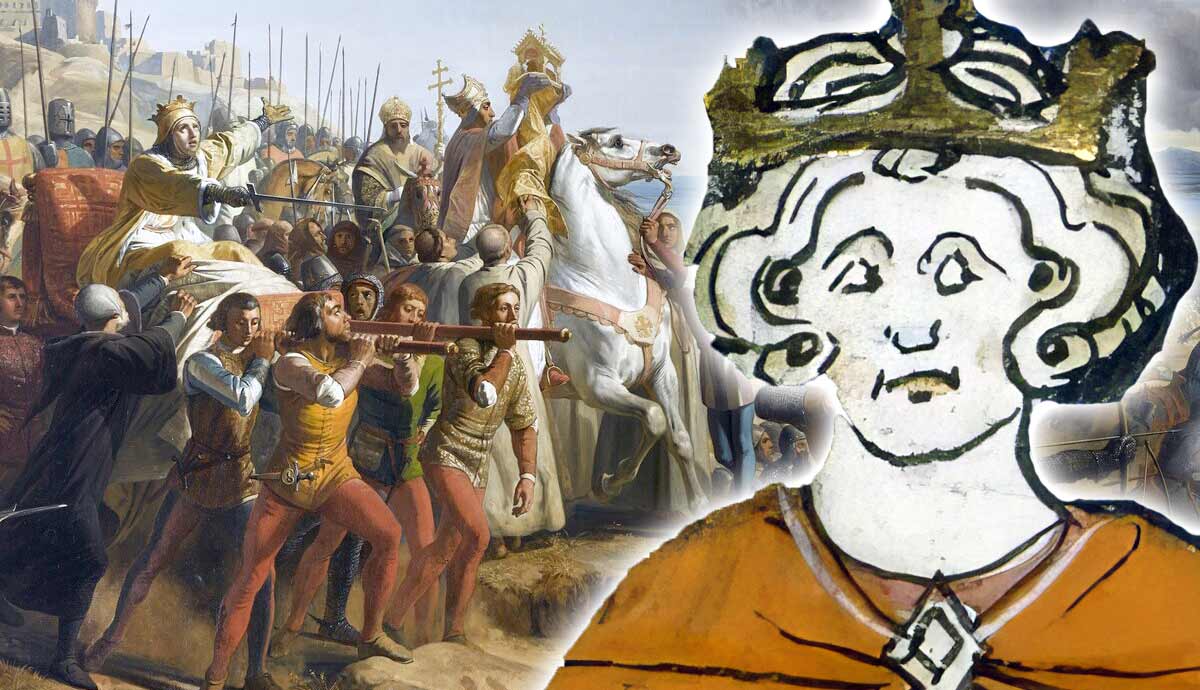
Baldwin IV, known as the ‘Leper King’ of Jerusalem, ruled his fragile kingdom with unexpected strength for over a decade. Afflicted by leprosy from a young age, he nevertheless held together a realm threatened externally by Saladin and internally by factional rivalries. His authority, resilience, and political control kept powerful nobles in check and invasion at bay. Yet when Baldwin died in 1185 aged just 24, the delicate balance he had maintained collapsed, exposing deep divisions that would soon cost Jerusalem its survival.
The Death of Baldwin IV

Crippled by leprosy since his teens, Baldwin IV had been a surprisingly effective king. His illness elicited compassion from his subjects, and their loyalty to their sick king was a key factor in the success of his kingship.
In 1185, Baldwin finally succumbed to his illness and died. He was buried close to his father in the Church of the Holy Sepulchre.
Within two years of Baldwin’s death, the kingdom he had striven so hard to defend had fallen into the hands of his longstanding Muslim rival, Saladin.
Events leading up to the Leper King’s death help explain why, after his passing, the kingdom fell, and the city was lost to Christendom forever.
Baldwin IV and Guy of Lusignan

Baldwin IV, the Leper King who defied a death sentence, was diagnosed shortly after his coronation in 1174. It was understood that he would not father any children to succeed him. His elder sister, Sybilla, and his younger half-sister, Isabella, were therefore central to the succession.
Sybilla married William of Montferrat in 1177, and by him she bore a son named Baldwin. Montferrat died shortly before the child’s birth, and Sybilla later married a second husband, Guy of Lusignan.
By 1183, Baldwin became too ill to rule and needed a regent to govern alongside him. Guy, as his brother-in-law and the husband of the heiress to the kingdom, was the natural choice. Guy proved to be a poor military commander whom the nobles refused to follow, and Baldwin removed him from his post within weeks of his appointment.
Guy’s unpopularity meant that the prospect of him succeeding to his brother-in-law’s throne was deeply contentious. Most vocal amongst those in opposition to Guy was Raymond III of Tripoli, a cousin of Baldwin IV and a man who served as his regent on several occasions.
To ensure Guy would not succeed him and thus tear the kingdom apart, Baldwin attempted to have Guy’s marriage to Sybilla annulled. But Guy’s disobedience, along with Sybilla’s refusal to leave the husband she loved, thwarted Baldwin’s plans.
King Baldwin V, the King’s Nephew

With Guy out of the picture, the desperately ill Baldwin IV had to reconsider his succession. Agnes of Courtenay, Baldwin’s mother, was a strong influence over her son. She suggested that Baldwin appoint his nephew, Sybilla’s son, as his successor.
Acting on his mother’s advice, Baldwin addressed the matter by having his nephew crowned as his co-ruler. It also denied Guy the throne and was welcomed by the nobility. In November 1183, the coronation was celebrated in Jerusalem, and both kings appeared in their crowns.
Baldwin V would rule alongside a regent, Raymond III of Tripoli, who would once again relieve the burden of kingship from Baldwin IV until his death. Although Baldwin IV knew that it was not ideal for his young nephew to rule as sole king, he hoped that Raymond’s competence and experience would allow the kingdom to survive until Baldwin V came of age.
Although Baldwin IV’s plans did come to fruition, they would not last long. Baldwin V died in August 1186, a mere 17 months after his uncle.
Guy Becomes King

Upon the boy’s death, the throne passed to his mother, Sybilla. The nobles, however, still opposed Guy. They agreed to crown her only on the condition that she divorce him. Sybilla agreed, but only if she could choose her next husband to rule alongside her.
With the divorce agreed, Sybilla celebrated her coronation in September 1186. When asked whom she chose to rule alongside her, she remarried Guy and had him crowned alongside her.
A disgruntled Raymond left Jerusalem. He failed to garner enough support to mount a concerted effort to challenge Sybilla and Guy’s rule, since most of the nobles reluctantly agreed to work with Guy. Undoubtedly, they wanted to avoid civil war, but it was difficult to remove an anointed and crowned king.
Guy began his reign in the same way Baldwin IV’s had begun, with the looming threat of Saladin. But in 1186, Saladin was in a much stronger position and had serious designs on Jerusalem. Having acquired the crown, Guy was about to face his greatest and most challenging test.
The Muslims Unify Under Saladin

Saladin, the first sultan of both Egypt and Syria, had spent much of Baldwin IV’s reign establishing and consolidating his position. He waged war not only against Baldwin IV but also against fellow Muslims in Syria. Saladin made significant conquests at the expense of his Muslim rivals, including the prominent cities of Damascus and Aleppo.
Saladin had the added advantage of being able to call upon reinforcements from Egypt for his Syrian campaigns. Egypt was immensely wealthy and the envy of the Christians.
Saladin claimed he had been sent by God and that his victories against the Crusaders and fellow Muslims were evidence of divine approval. He began uniting the Muslims in Syria under his leadership with the intention of removing the Franks from Jerusalem and the remaining Crusader States, including Antioch and Tripoli. He convinced his co-religionists that he could expel the Franks from Syria once and for all.
When the Crusaders embarked on the First Crusade (1096–1099), they faced a divided Islam. By 1187, Saladin had created a sense of unity among the Muslims in Syria and could now move against the new king of Jerusalem, unpopular among his own people and ruling over a divided kingdom.
The Road to Hattin

In early 1187, Reynald of Châtillon gave Saladin a perfect pretext for invading the Kingdom of Jerusalem. Reynald attacked a Muslim pilgrim caravan, breaking a fragile peace that had been established with Saladin.
Saladin sought revenge and vowed to kill Reynald for this insult. He entered the kingdom and sent raiding parties to ravage the lands around Frankish-held Acre. Gerard de Ridefort, Grand Master of the Knights Templar, went out with a small force to meet the invaders. The Battle of Cresson took place in May 1187 and saw the Templar force decimated by a numerically superior Muslim army. Only Gerard and a handful of knights survived.
In response, King Guy assembled the Frankish forces at the Springs of Sepphoris, demoralized by this recent disaster. The Muslim army then turned towards Tiberias to besiege the castle there, commanded by Eschiva, the wife of Raymond of Tripoli. Guy called an assembly and decided to march to relieve her, beginning the 26-kilometer march to Tiberias. Unbeknownst to Guy, the Crusader army had fallen into Saladin’s trap.
The Battle of Hattin, July 4, 1187

The march from the Springs of Sepphoris removed Guy’s army from an abundant water supply. Their march in the blistering summer sun was arduous and dry. As they made their way on July 3, it became clear they would not reach Tiberias by nightfall. The most important necessity for an army is water, and they had none.
It was decided to detour towards the Springs of Kafr Hattin, camp overnight, and march to Tiberias the following day. However, Saladin thwarted their plans. The Muslims blocked the route to the water source, and Guy’s dehydrated army was forced to camp near the village of Meskenah. Desperate for water, their Muslim foes taunted the Franks, pouring water onto the ground before their eyes and lighting fires to intensify their thirst.
On the morning of July 4, 1187, Guy drew up his battle lines. Pelted by arrows and smoke from burning fires, the Franks were weakened by thirst.
Raymond of Tripoli, no friend of Guy, led an unsuccessful charge early in the battle. Rather than returning to reform his lines, Raymond fled and headed for Tripoli.
Guy’s troops were massacred at the Battle of Hattin, and the king himself was captured. Had he been able to garner greater support from the nobles, including Raymond of Tripoli, the outcome may have been different. But Guy’s unpopularity meant he was unable to fully unify the nobles under his leadership.
The Fall of Jerusalem 1187

With most of its army destroyed at Hattin, the kingdom was defended by a small garrison. Saladin marched to Jerusalem and laid siege to the city. On October 2, 1187, he secured its surrender.
Balian of Ibelin led the defense and agreed to surrender the city only if Saladin allowed the inhabitants to ransom themselves. He threatened to destroy Islamic holy sites and kill Muslim hostages should the sultan refuse. The pragmatic sultan accepted Balian’s conditions.
Only around 18,000 Christian inhabitants were able to pay their ransom, many thanks to financial contributions from Balian and the Church. Approximately 15,000 Christians were taken into slavery.
Saladin was able to take advantage first of a minor king and then of an unpopular king on Jerusalem’s throne. Guy had called for reinforcements before Hattin, but these failed to materialize. His unpopularity and inability to secure the nobles’ cooperation ultimately cost him his throne.
Baldwin IV’s death did not simply remove a king; it removed the authority that had held a fragile kingdom together. Under his rule, rival factions were restrained, and Saladin’s advances checked. Without him, the unity fractured. Guy of Lusignan proved unable to command the loyalty of the nobles or unite them under his leadership, while Saladin had forged a powerful and unified Muslim force in Syria. When Jerusalem fell in 1187, it was the result not only of external strength but of internal division and failed leadership.