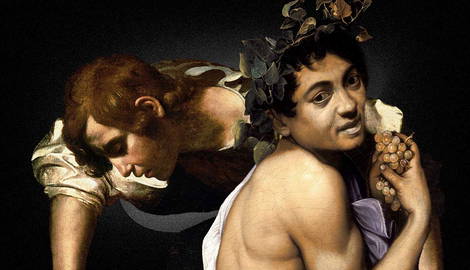

Caravaggio painted the God Bacchus twice; once as a sickly youth and again as a vibrant albeit rustic persona. Caravaggio didn’t just paint gods and monsters—his mythological portraits pulse with emotion. These are intimate, unsettling reflections of humanity, caught in moments of beauty, madness, and mortality.
1. Medusa (1599)
Medusa’s legend is known throughout the entire world; the story of a Gorgon (monster) that turns its victims into stone with one look. Like many ancient myths, Medusa has conflicting details. However, despite these differing details, the outcome remains the same: Medusa is beheaded.
In some interpretations, Medusa is a horrifying figure who is held prisoner by the goddess Athena because the god Poseidon impregnated her while she was in Athena’s temple. The hero Perseus comes to behead the terrifying Gorgon, uses her head as a weapon for his other tasks, and then gifts it to Athena, who attaches it to her cape to represent both protection and fear.
In other versions, Medusa was a beautiful maiden who served the Goddess Athena in her temple. Over time, Medusa attracted the attention of the god of the seas, Poseidon, who then violently raped her in Athena’s temple, resulting in a pregnancy.
Possibly to protect her from future attacks, Athena transformed Medusa’s beautiful hair into locks of snakes that turn whoever looks at Medusa into stone.
With a legend as dramatic as this, artists have drawn, sculpted, and painted what Medusa would have looked like throughout the centuries. The Baroque master, Michelangelo Merisi da Caravaggio, is just one of hundreds of artists to depict the unfortunate Gorgon.
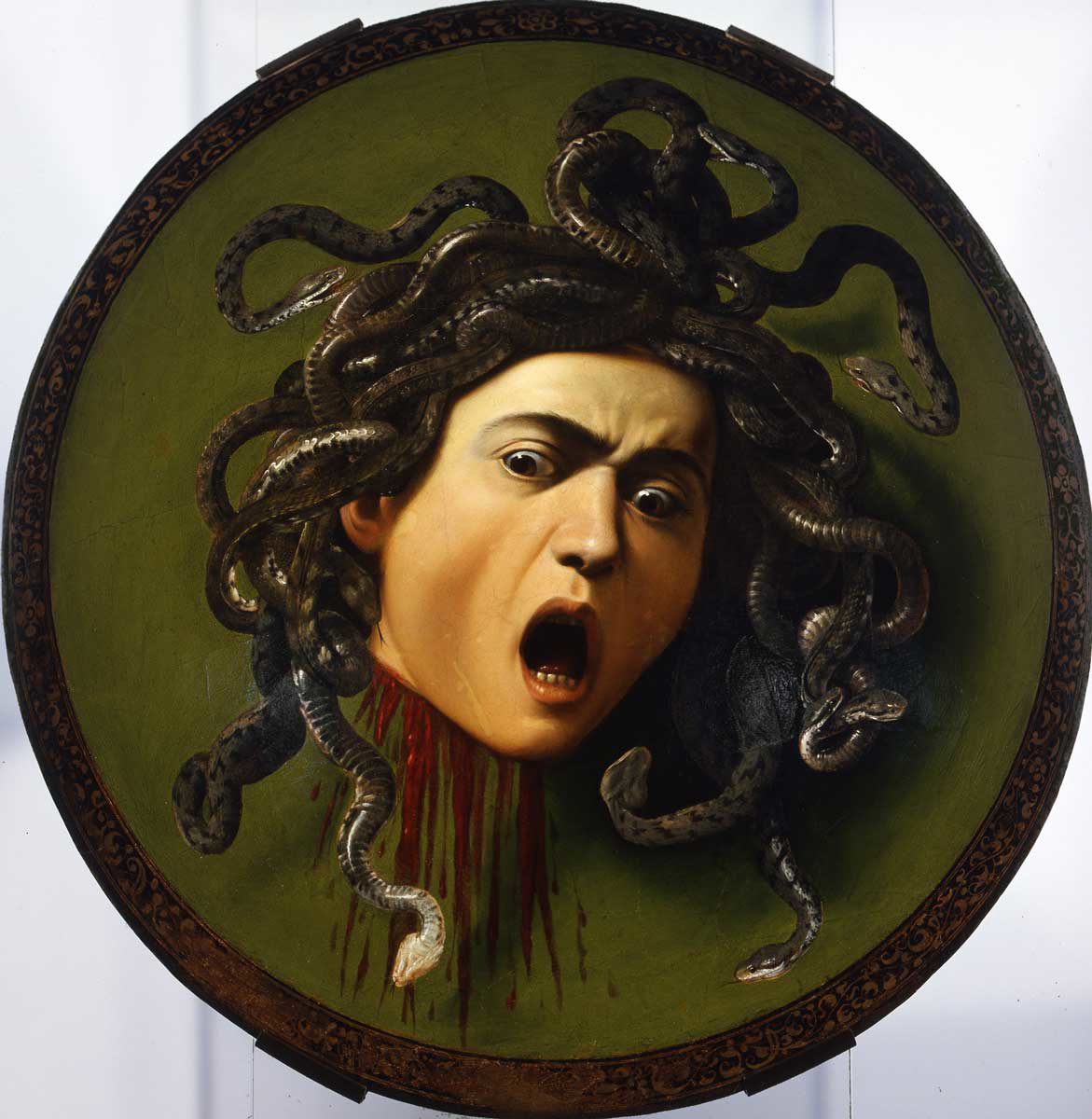
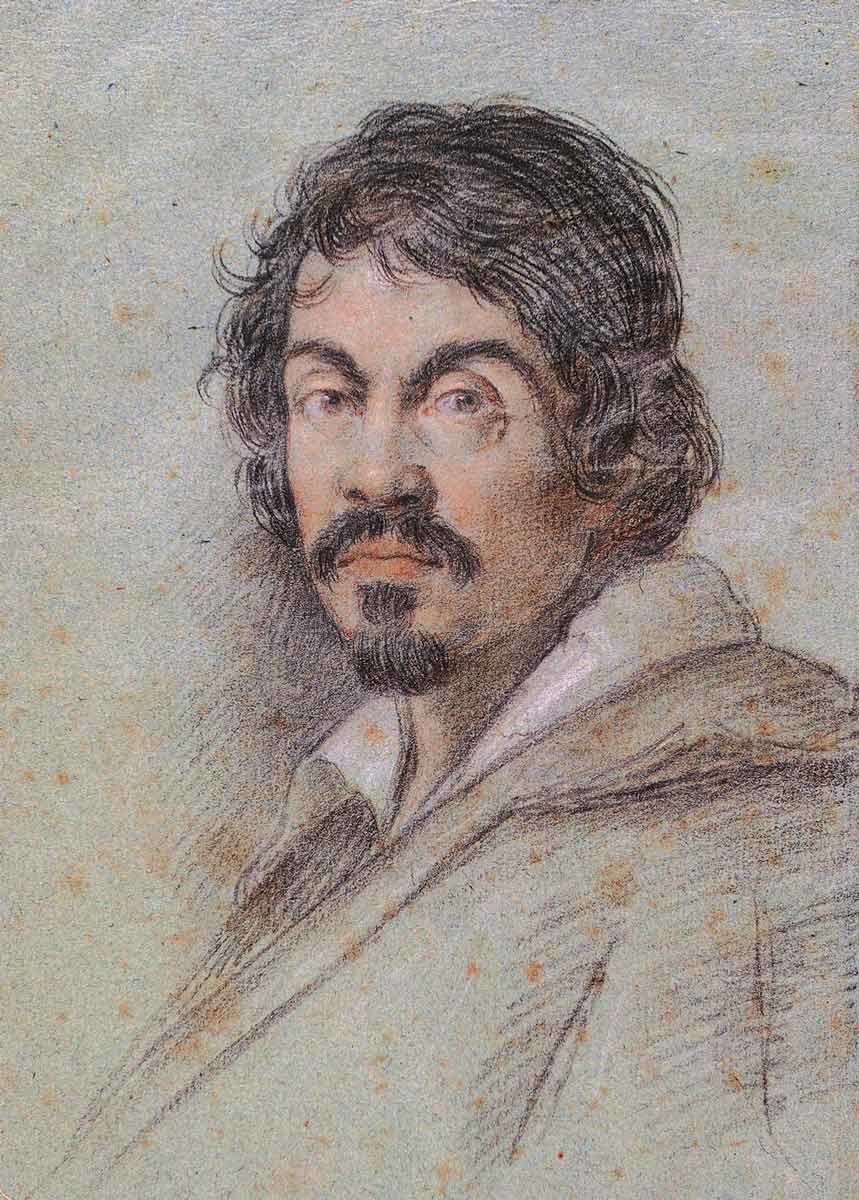
Caravaggio’s Medusa depicts the moment following decapitation, and it is also a self-portrait of the artist. By blending the lines between male and female appearance, Caravaggio shows us that base emotions such as fear and shock, and mortality, know no gender; he seamlessly blends the male and female to depict genuine human sensations. What we, as the viewer, are witnesses to is a fleeting moment in time that, true to Caravaggio’s style, packs a plethora of emotions into one moment.
Set against a forest green background, Caravaggio’s Medusa is striking as the gorgon screams in terror. The snakes in her hair wiggle and squirm this way and that, perhaps attempting to run away from the blood violently cascading from the neck wound. Painted on a shield, the convex curve of the objects allows Medusa’s face to jut out to the viewer, enhancing the realism of the horror. Caravaggio painted Medusa on a shield, symbolizing her slayer, Perseus, who uses the shield to reflect Medusa’s image back at her. This gives Perseus the opportunity to cut off her head before she turns to stone due to her own curse. Medusa’s eyes are gazing downward as she looks at her reflection in the mirror, blood spouting everywhere, her eyebrows scrunched in a terrifying confusion as her fate slowly becomes clear.
2. Young Sick Bacchus (1593)
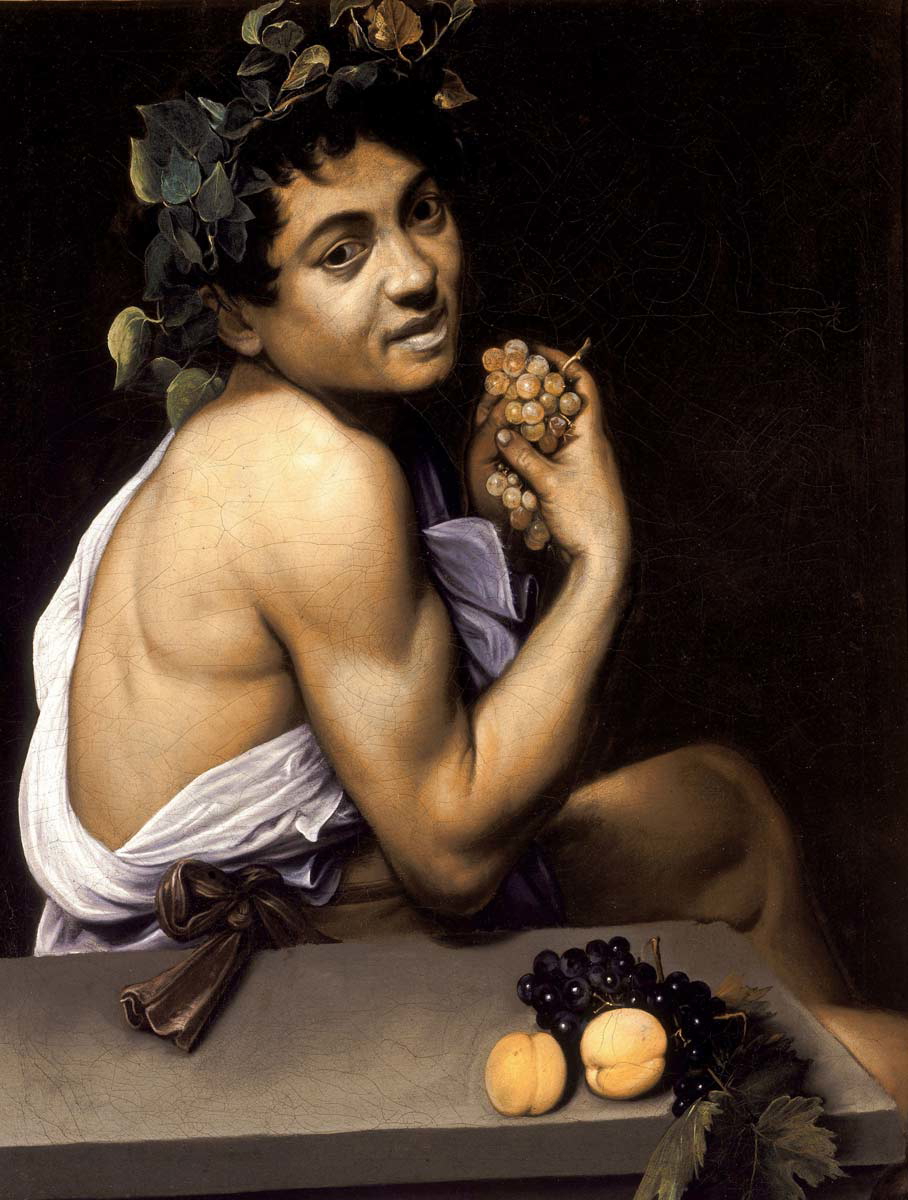
Bacchus (Dionysus) is the god of wine-making, orchards and fruits, vegetation, fertility, festivity, insanity, ritual madness, religious ecstasy, and theater. He is most often depicted as a joyous figure who brings happiness and frivolity to whatever setting he is in. However, if angered, he could also be a vengeful god capable of driving people to madness. Essentially, compared to other gods and goddesses, Bacchus was the one you wanted to be around most.
Caravaggio’s depiction of the god of wine is in contrast to other depictions because Caravaggio’s Bacchus is sick. Like many other paintings in Caravaggio’s oeuvre, the artist inserted a self-portrait of himself in this rendering of the drunken, raucous god. According to many art historians, Caravaggio painted this Young Sick Bacchus while recovering from a bout of malaria.
Caravaggio’s Bacchus is indeed sickly. His lips are blueish-green, and his eyes are engaging yet lifeless as he holds a bunch of grapes that range from ripe to rotten in his hand. The range of liveliness in the grapes is meant to represent the various stages of life, a reminder of mortality or, as it is classically called, memento mori. The grapes, in this way, echo the sickly body of Bacchus, suggesting the fleeting sensation and state of youth and beauty in humans.
Although this Bacchus appears muscular and youthful, his skin is yellow and pale, and his fingernails are dirty. This is distinctive of Caravaggio’s style as he would take his models, and even himself, and paint them as if they were, not idealizing their appearance to adhere to some standard of classical beauty.
3. Narcissus (1599)
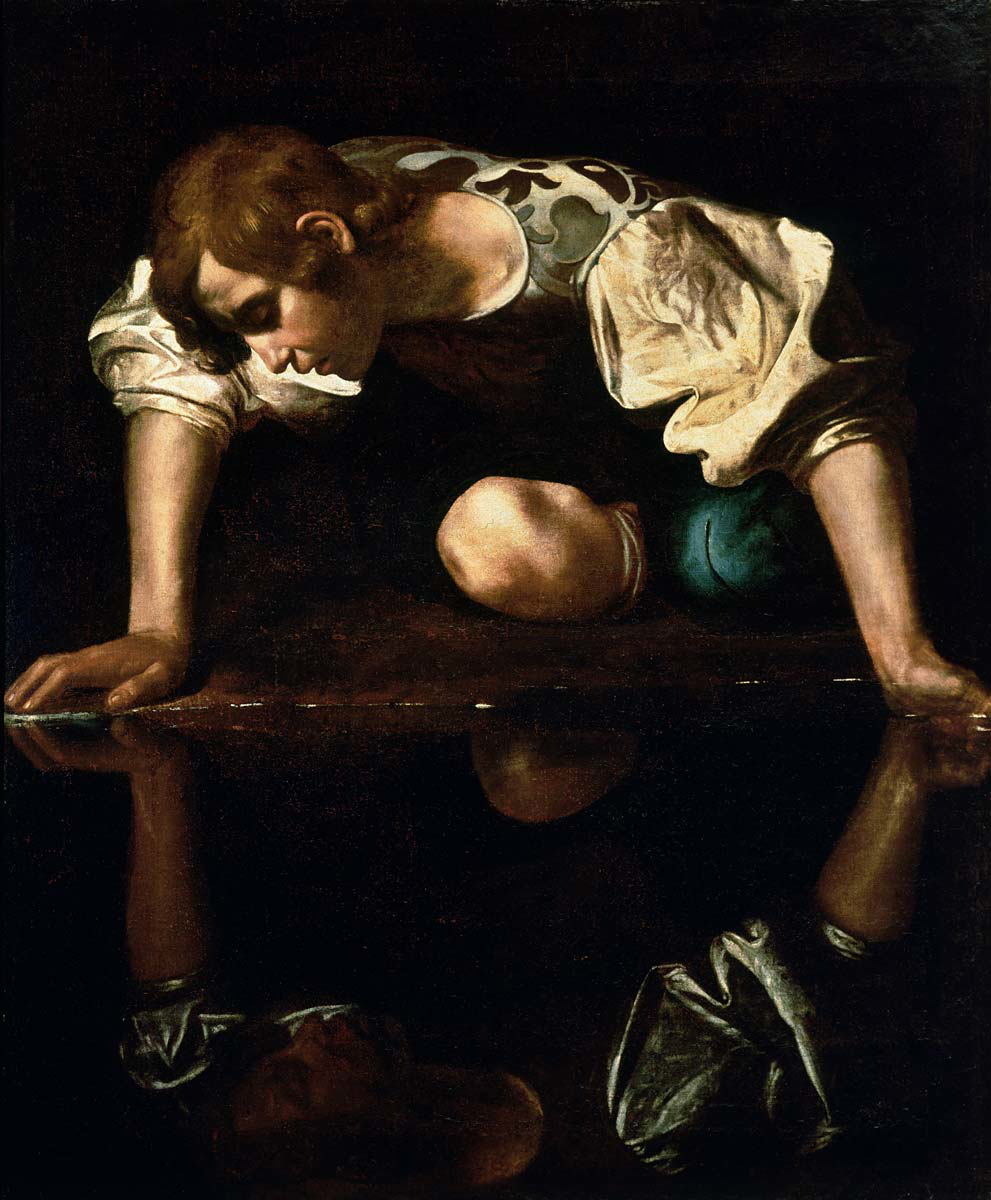
Like many of the others on this list, the story of Narcissus is detailed in Ovid’s Metamorphoses. Ovid tells us that Narcissus had rejected all advances from both men and women who approached him and instead fell in love with his own reflection in a pool of water.
Because of this obsession with himself, Narcissus became the inspiration for the term narcissism, a self-centered personality or, at the extreme end of the spectrum, the basis of narcissistic personality disorder. This disorder is characterized by grandiosity, excessive need for attention and admiration, and an impaired ability to empathize with others. If anyone reading has been in a relationship with a narcissist, they’ll know that, much like the nymph Echo who longed for Narcissus’s love, it is a suffocating feeling in which the other feels they cannot compete with the narcissist themselves, and they are correct. That kind of love is toxic and detrimental to everyone around the narcissist.
Caravaggio’s Narcissus depicts a youthful boy on his hands and knees staring longingly into a pool of water, where his reflection stares back at him, yearning to reach out and touch each other. Instead of placing Narcissus in a field with nymphs, flowers, and bystanders surrounding him, like many early Renaissance painters, Caravaggio has placed him on a stark black background.
By doing so, Caravaggio forces the viewer to look only at Narcissus and his features: the musculature of his body, the shadows dancing around him, and the fabric of his clothes. The viewer can also grasp the intense psychological drama of this moment, where Narcissus falls in love with himself. Narcissus’s expression is not overtly enthusiastic or unhappy; instead, the viewer is presented with a tense and absolutely absorbed emotion that borders on obsession and madness. Some could describe it as love at first sight.
As Narcissus delicately bends over the shimmering water’s surface, reaching to touch his mesmerizing reflection, his tenderness is palpable. His fingertips skim the cool, liquid texture, revealing an almost reverent admiration for his own image. Yet, amidst this gentle interaction lies a sense of tragedy. Narcissus gazes longingly at the vivid likeness, feeling an overwhelming pull toward something that appears so intimately accessible yet remains agonizingly out of reach.
This poignant moment serves as a reminder of the complex relationship between love and despair, illustrating how the desire for beauty and connection can quickly transform into an encounter with doom, blurring the lines between admiration and obsession.
4. Bacchus (1596)
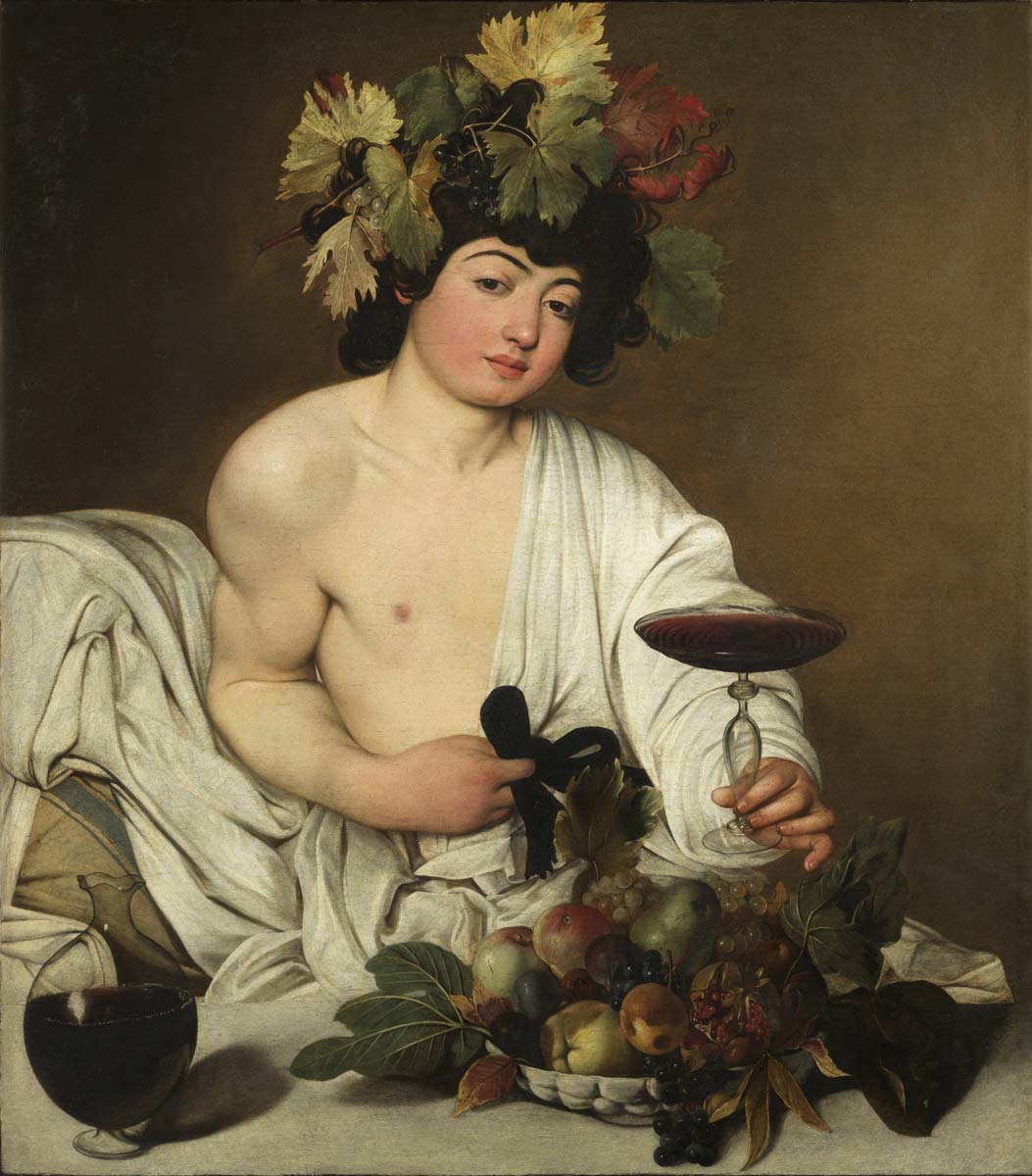
Compared to Caravaggio’s Young Sick Bacchus, this Bacchus from 1596 is a vibrant, though tangible representation of the god of wine. The young Bacchus teases the viewer by drawing us inward, only exposing one side of his body to the viewer. This Bacchus is directly facing the viewer, graciously offering us a glass of wine while seductively gazing at us.
While this Bacchus is more idealized than Caravaggio’s sick Bacchus, this depiction is still a long cry away from the beautiful images of gods and goddesses by Da Vinci or Titian. A closer look will reveal that this Bacchus has dirt under his nails and pale skin flushed at the extremities and face. This realistic depiction of Bacchus questions earlier ideas of divine beauty. This may be Caravaggio’s greatest talent: to make the sacred profane, or more simply, to make the divine mundane and thus bring these otherworldly ideals, personas, etc., to the everyday individual.
The fruit surrounding Bacchus consists of apples, grapes, pomegranates, and others that feature the varying stages of vitality in a fruit’s life cycle. These different stages of liveliness in the fruits represent life’s fleeting moments and how quickly life can slip by us mortals. It is easy to see here where and why the art of the Dutch Golden Age employed the theme of “vanitas,” with a clear nod to Caravaggio’s tenebrosity.
Bacchus represents pleasure, enjoyment, and the ways in which we humans escape our realities. However, unlike Bacchus, we have a time limit on the pleasures of life. Therefore, we must take our moments of pleasure seriously, and we must accept that offering of wine that Bacchus presents us.