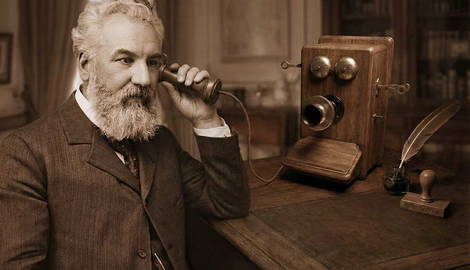
The invention of the telephone transformed human history, and for 150 years, Alexander Graham Bell has been widely lauded as its sole inventor. History is rarely straightforward, and in this case, there was a race to patent. Technicalities with timing, issues with corruption, and charges of theft leave the “facts” open to interpretation.
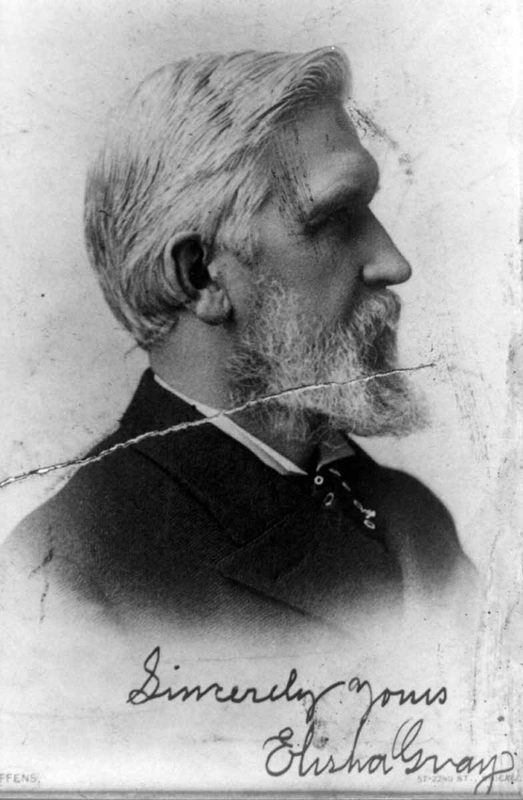
And perhaps the credit for the invention should really go to a man named Elisha Gray…
Alexander Graham Bell, Elisha Gray, and the World’s Most Famous Patent
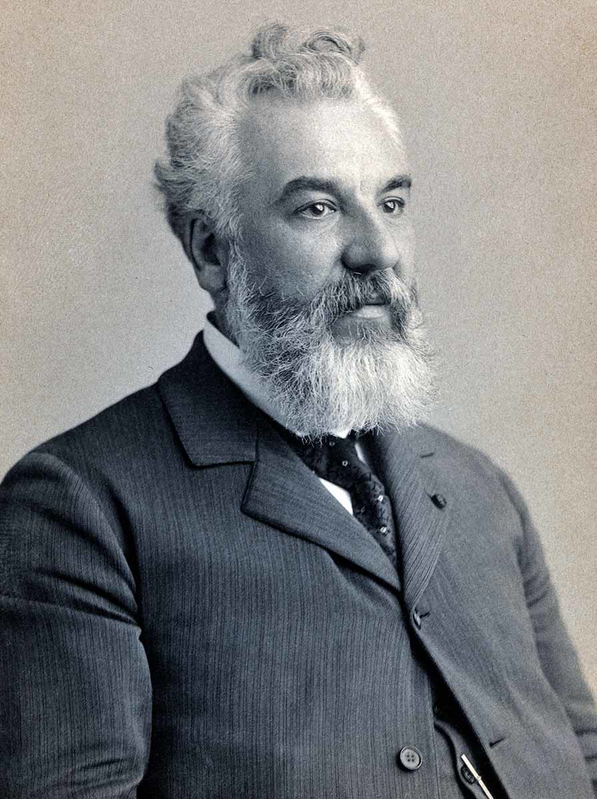
On February 14, 1876, two crucial legal documents were filed with the US Patent Office in Washington, DC. One was a patent application delivered by Alexander Graham Bell’s attorney, and the other was a caveat, a statement of intent delivered by Elisha Gray’s lawyer. Both documents stated an intent to invent the telephone.
According to popular belief, Bell was able to claim the rights to the telephone simply because his lawyer arrived at the office first. This belief, however, came from an incorrect assumption. Bell’s lawyer did not arrive first, nor would it have mattered. The system was based on the first to invent, not the first to file.
According to Gray, his caveat was filed before Bell’s application and therefore sat at the bottom of the in-basket. Meanwhile, Bell’s lawyer had requested that his receipt be filed immediately. Thus, the order in which they appeared in front of patent examiner Zenas Wilber was not necessarily the order in which they were submitted.
Wilber claimed, under oath, that he found Bell’s receipt ahead of Gray’s and determined Bell’s application to have been delivered earlier. He admitted that he failed to investigate further.
The issue with timing, however, wasn’t the real scandal.
The Variable Resistance Breakthrough and the Liquid Transmitter
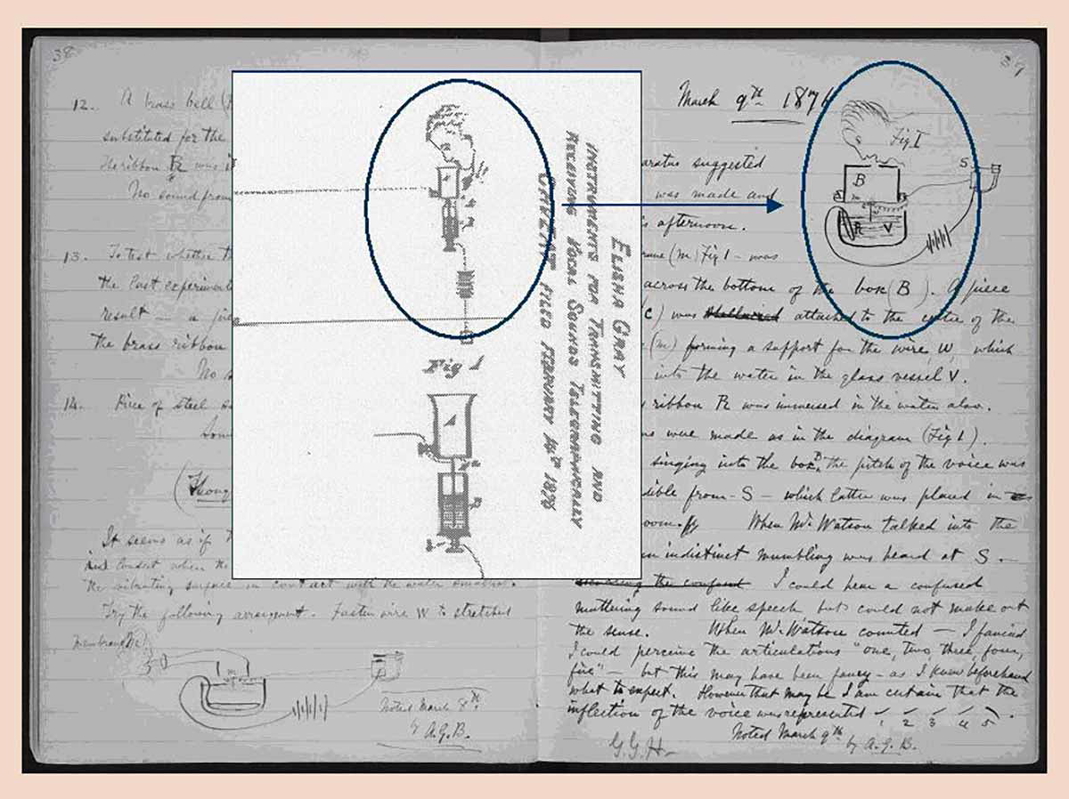
Gray’s caveat included a diagram for a liquid transmitter. This device has a short wire attached to an acoustic membrane. While one end of the wire is in water, it creates a variable resistance in response to an incident sound wave. This results in an undulating current, which causes the receiver to reproduce the original sound with a much higher degree of accuracy.
It has been suggested that Bell’s design lacked this refinement and that an addition was made to the patent after Bell had illegally seen Gray’s caveat. Bell’s invention, the following month, suspiciously included this form of transmitting sound, replacing his previous idea of the “harmonic telegraph.” On March 10, Bell publicly demonstrated the first working telephone, declaring into the receiver the famous words, “Mr Watson, come here. I want to see you.”
While suspicions were certainly present, Bell and Gray met in June and seemed to put legal matters behind them, managing to conduct an amicable and professional relationship.
Corruption and the Confessions of Zenas Wilber
According to Seth Shulman in his book, The Telephone Gambit, which details the events, Zenas Wilber was an alcoholic who owed money to Marcellus Bailey, Bell’s attorney. This was a violation of the Patent Office regulations, and to pay Bailey back, Wilber showed him Gray’s caveat. Bailey originally assumed that Gray had submitted a design for a harmonic telegraph. When he saw that Gray had submitted a caveat for a telephone, Bailey contacted Bell, who was in Boston at the time, and advised him to come to Washington, DC immediately.
When Bell arrived, Wilber showed him the patent, and Bell gave him $100. Bell then amended his patent to include forms of “transmitting vocal or other sounds telegraphically.” Days later, Bell drew a diagram in his books that was very similar to the diagram Gray had drawn in his application. His application was accepted, and Gray’s was denied.
Six Hundred Lawsuits and the Supreme Court Verdict
In 1877, Bell, along with Gardiner Hubbard and Thomas Sanders, founded the Bell Telephone Company. Much of the company’s financial success was due to its aggressive, litigation-heavy reputation. In the two decades since its founding, it battled nearly 600 patent lawsuits, several of which went to the Supreme Court.
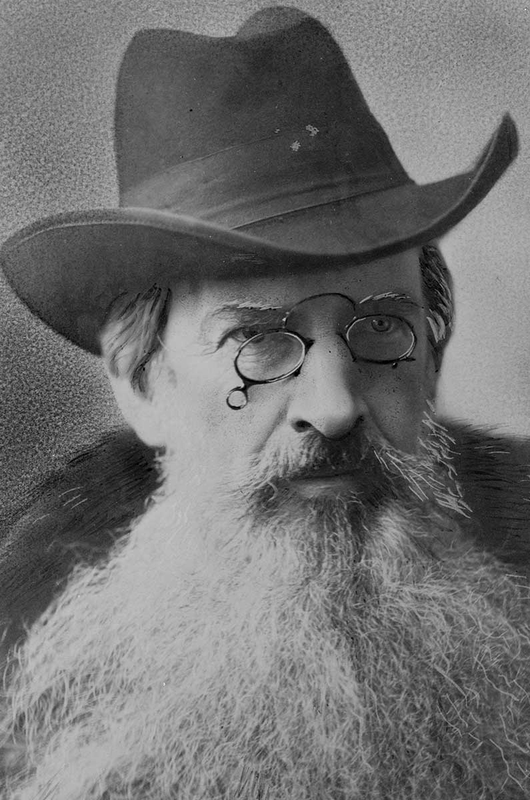
In 1878, Western Union hired Elisha Gray and Thomas Edison in a bid to challenge the Bell Telephone Company. Although the latter company held the patent to the telephone, Western Union held certain better components, and claimed Bell’s telephone patent was a case of fraud. The Bell Telephone Company sued for patent infringement, and on November 10, 1879, the court ruled in its favor.
In 1888, the Supreme Court found that claims of fraud against Bell’s patent could not be sustained, and claims of a prior telephone invention by Daniel Drawbaugh were found lacking. In another case, a few years later, the government brought a lawsuit to annul the patent, but the suit was tainted with corruption and conflict of interest, leading to its failure in 1897.
The aggressive reputation of the company from a business and legal perspective, however, can hardly be attributed to Bell. He removed himself from running the business and left it in the hands of his partners. He kept only ten shares in the business and gave the rest of his shares to his wife, Mabel, who was the daughter of Gardiner Hubbard, and whom he married on July 11, 1877.
The situation left a bitter taste in Bell’s mouth, and he went back to his previous vocation of working with the deaf, vowing never to enter the telephone business ever again.
The 150 Year Legacy of a Stolen Idea
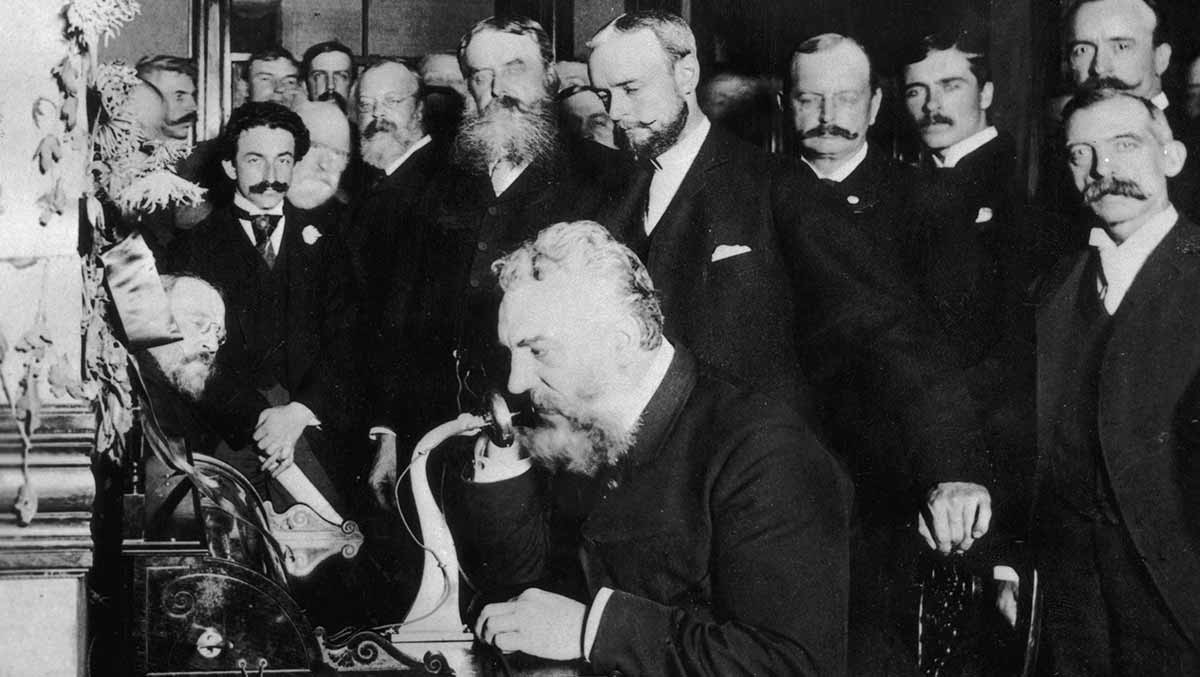
Modern interpretations of the events favor the idea that Bell’s methods were not entirely legal. Unsurprisingly, Elisha Gray’s claims have gained popular interest in the media, as the public has always had a particular affection for a good underdog story. The debate isn’t completely one-sided, however, and Bell does have his defenders.
Dr. Benjamin Brown, professor emeritus of physics in the Klingler College of Arts and Sciences at Marquette University, believes his research settles the entire dispute, and evidence certainly shows Bell to have invented the telephone before Gray. A letter from Bell’s fiancé, Mabel, dated January 17, 1876, mentions that Bell had added the liquid telephone transmitter to his patent application.
There is also the lack of evidence for Gray’s attorneys’ claims that information was passed to Bell’s associate, George Brown, on January 26, 1876. Brown was the publisher of the Toronto Globe and kept detailed notes of daily submissions; his notes fail to mention any receipt of information about Gray’s telephone on that day. This helps disprove the notion of Gray’s chronological priority.
Furthermore, Zenas Wilber’s claims have been challenged. He submitted several affidavits which contradict each other, and in none of them is the mention that Bell’s patent application was changed after submission.
Thus, Dr. Benjamin Brown concludes that there was no act of plagiarism.
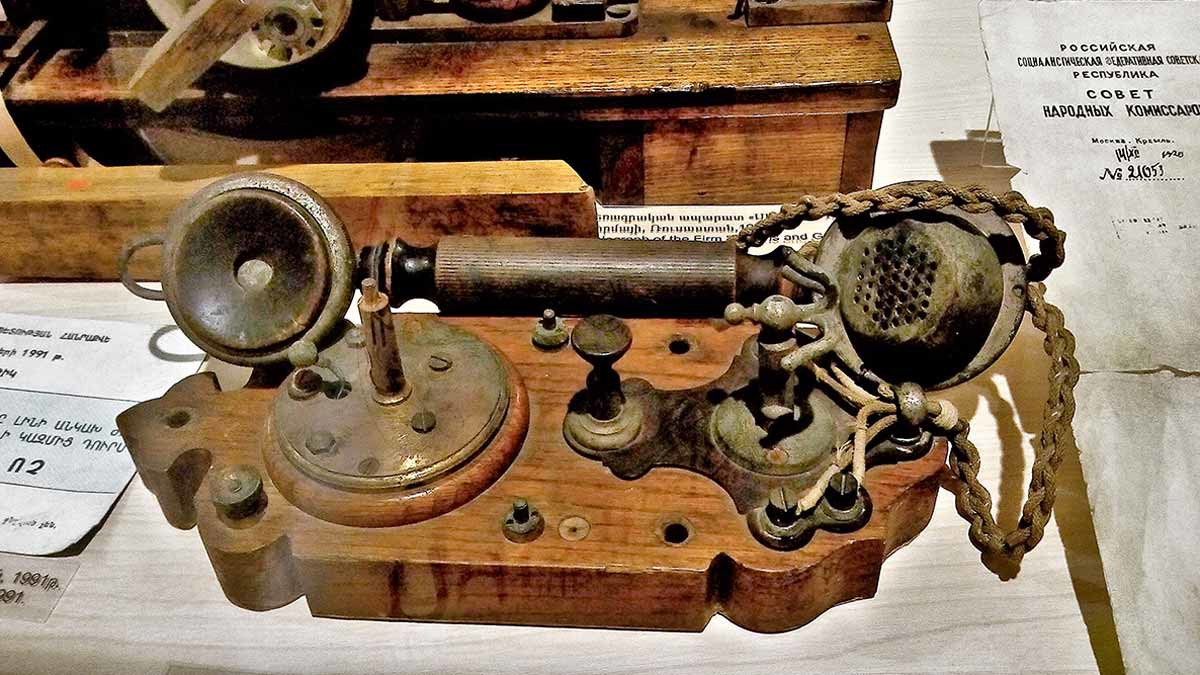
Whether or not a certain element of Bell’s invention was appropriated by illegal actions, there is no denying the revolutionary quality of his invention. The question, however, remains whether Alexander Graham Bell was a visionary who legally integrated ideas or an underhanded strategist who used legal loopholes to claim the honor (and profit) of inventing the telephone first.