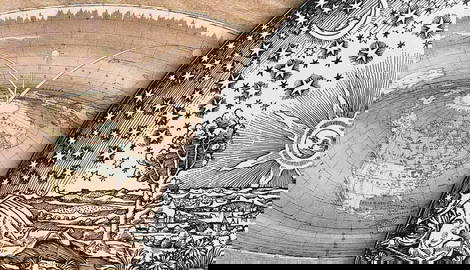
The Bible is the central guide for billions of people around the world who look to it for spiritual and moral guidance. Many also claim that it answers many scientific questions about the nature of the universe. One of these claims is that the Bible states that the world is flat, which contradicts well-established science. Is this true? Does the Bible actually state that the world is flat, and how has this idea been used to push agendas?
What Does Scripture Say?
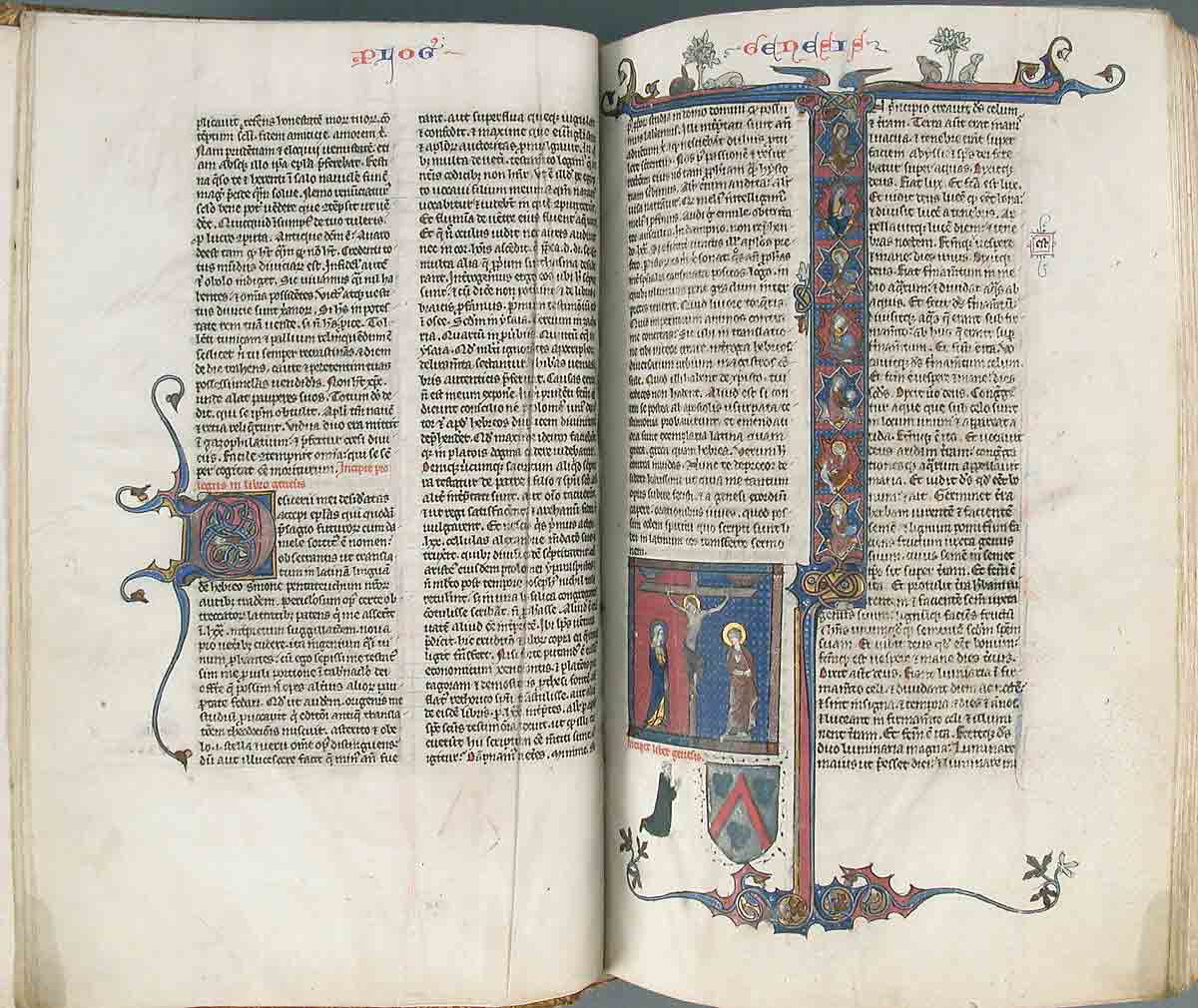
The simple answer is that the Bible does not explicitly state that the earth is flat, however, it also does not state that it is a sphere, or any other shape. The shape may be implied through some passages, but there are no direct statements in the Bible.
Taking a more nuanced look, the Bible is not a single book, but rather a collection of books written over the course of many centuries, collected into a single volume. The books are varied, including histories, law codes, prophesies, lamentations, poetry, and letters between believers asking and giving instructions. This means that it was written by a large number of authors over hundreds, if not thousands, of years, each with their own backgrounds, beliefs, motivations, and agendas. Some sections are didactic, such as the legally focused Deuteronomy and Leviticus, while others are more artistic, like the poetry of the Song of Solomon. Furthermore, the authors were more concerned with spiritual matters than scientific analysis.
So, which passages suggest that the Earth is flat? There are several, but three stand out:
Isaiah 40:22: “He sits enthroned above the circle of the earth, and its people are like grasshoppers.”
Job 26:10: “He marks out the horizon on the face of the waters for a boundary between light and darkness.”
Revelation 7:1: “After this I saw four angels standing at the four corners of the earth, holding back the four winds of the earth.”
For those who embrace a literal interpretation of Biblical scripture, these passages are proof that the Bible claims the world is flat. Some use these passages to discredit the Bible, stating that it is obviously flawed. Others take the opposite view and cite the Bible as proof that the round earth model is part of a modern conspiracy. Are either of these interpretations correct, or is there another explanation?
What Does it Mean?
While many interpret Biblical passages to be literal, many more, including devout Christians, believe that they contain metaphors and idioms which are not meant to be taken at face value. To compound the confusion, the Old Testament was written in ancient Hebrew and Aramaic, and the New Testament in ancient Greek. These ancient languages do not translate directly into modern English, and nuance can be lost in translation. There are also cultural phrases, which may have made sense to the original writer and the intended audience, but when taken literally thousands of years later, can come across as baffling.
The passages that support a flat-earth model can be understood as metaphor or poetry. On top of all of this, the books of the Bible were written for people who had a limited understanding of the natural world and had to be told in terms they would understand. The Bible’s main concern is spiritual matters, not scientific ones, so describing scientific principles was not its main purpose.
Isaiah 40:22 states that “He sits enthroned above the circle of the earth.” It is claimed to be a reference to a flat earth, but it is vague. The “circle” strongly implies something that surrounds or is all-encompassing, not necessarily the shape. Likewise, Job 26:10 says, “He marks out the horizon on the face of the waters.” This doesn’t really convey that the earth is flat at all, only mentioning that there is a horizon, which exists on a spherical planet, at least from the perspective of someone looking into the distance.

The most interesting reference is in Revelation 7:1, which says, “After this I saw four angels standing at the four corners of the earth, holding back the four winds of the earth.” A spherical earth would not have corners, so this is taken as proof that the Bible teaches the world is flat. Closer inspection tells a different story. The repeated use of the number four corresponds with the four cardinal directions, and just like today, the “four corners of the earth” was more than likely an idiom for the expanse of the planet and places far away, not actual locations.
Other passages may support a flat earth, such as Christ seeing all the kingdoms of the world from a mountain top when tempted by Satan, something that should be impossible on a curved earth. In reality, no mountain is tall enough to see every kingdom on earth, especially not in the region of the Levant. This passage was about Christ’s human nature being tempted rather than a physical description of the planet. Other phrases, such as the repeated use of “the ends of the earth,” imply there is a hard boundary for Earth’s landmass. This is also no doubt just an idiom that has the same meaning it does today, simply a place far away.
Did Christianity Ever Teach That the World Was Flat?

One of the great misconceptions about the past is that many believed that the earth was flat until Christopher Columbus sailed west from Europe and proved it to be round. This is blatantly untrue. The ancient Greeks knew that the world was a sphere since at least the 4th century BCE. Greek mathematician Eratosthenes calculated the circumference of a spherical earth and did so with a remarkable degree of accuracy. The philosopher Aristotle taught that the Earth was a sphere, and the educated classes of society widely accepted this.
After the fall of the Roman Empire in Western Europe, the Catholic Church filled the vacuum left behind. This included education, and church-sponsored educational centers sprang up around the continent. Contrary to the belief of many, the Church was not averse to science and used ancient philosophers as the basis for knowledge. The Aristotelian model of the universe was the accepted hypothesis of the structure of the planet, which was the mainstream position well into the Renaissance.

When Christopher Columbus proposed sailing west to reach Asia across the Atlantic Ocean, his expedition had trouble gaining support. This was not because people thought he would fall off the edge of the world. The biggest issue was funding, since few wanted to take the financial risk. The other issue was size. Columbus vastly underestimated the size of the Earth, and many educated people who knew about Eratosthenes’ calculations knew the expedition would run out of supplies before reaching their destination. They were correct, and Columbus was lucky that there were two continents between Europe and Asia.
So, no, at no point in history was it official Church policy or the general belief among the educated members of society that the Earth is flat. It’s impossible to say what the lower classes believed since they wrote down very little. When the Bible was read and Scripture taught, it was more concerned with spiritual matters rather than more mundane ideas such as the shape of the world.
The Modern Flat Earth Movement
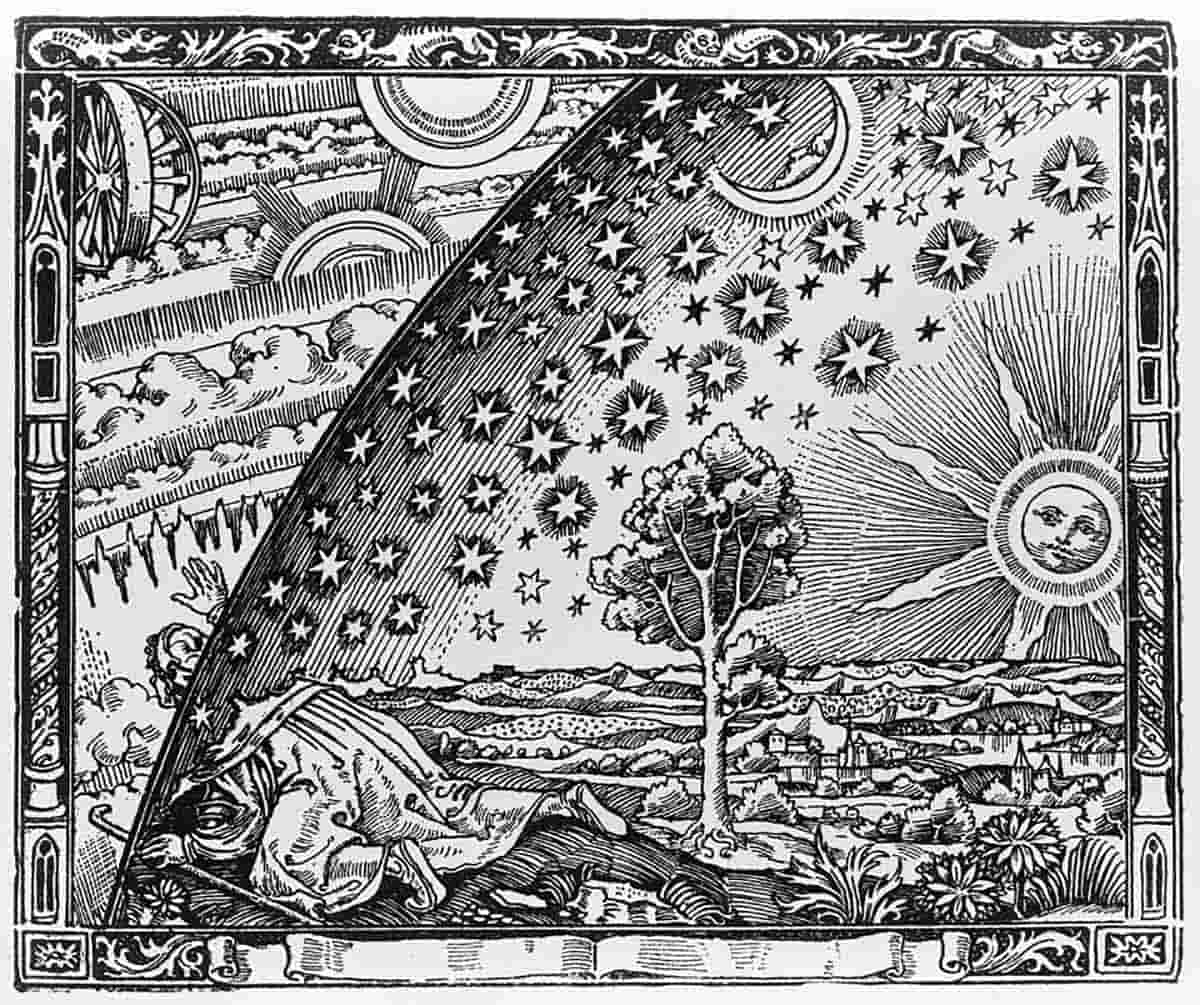
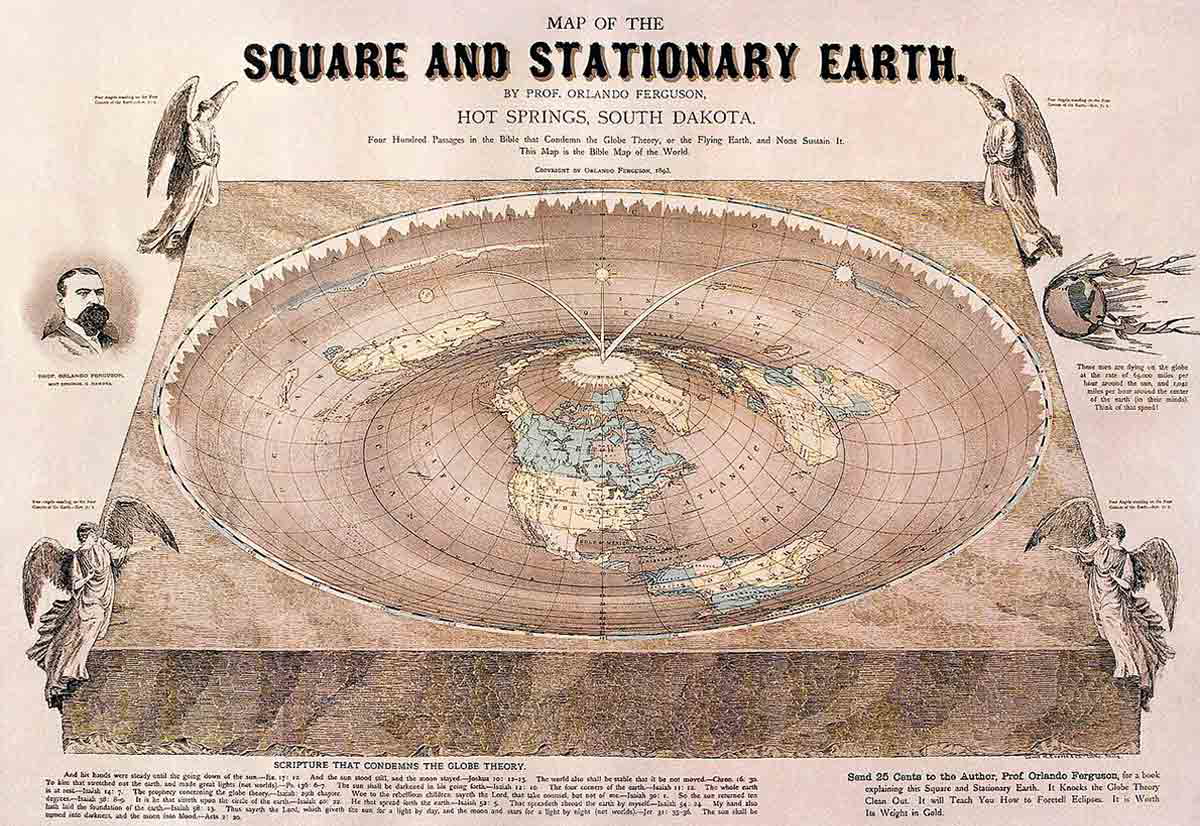
In the modern day, the Flat Earth movement seeks to overturn the widely accepted scientific consciousness, claiming that modern science is compromised or that the spherical round earth model is part of a larger conspiracy. The movement began in the 1800s when Samuel Rowbotham published a pamphlet, and later a book, titled “The Earth is Not a Globe.” It was based on the misinterpretation of a faulty study about water levels, though he went on to support his flat-earth theory by citing the Bible as well as human senses.
His work led to the formation of the Zetetic Society, which had a mission to prove the Earth was flat. The Society hosted many debates about the shape of the earth and gained some degree of public notoriety, but was never taken seriously by the scientific community or the public at large.

Interest in the flat Earth theory increased in the mid 20th century, coinciding with the Space Race. In the internet age, websites and social media have caused a spike in interest in the theory. Many are just trolls looking for a reaction, but there are a significant number of true believers. They make their case using pseudo-scientific arguments that rely on misunderstandings or misinterpretations of scientific principles. There is also a strong anti-authoritarian or anti-government streak to the ideology, with many core members convinced that anything promoted by the government or mainstream science is compromised and hiding the truth from the gullible masses.
The cornerstone of many current flat-earthers is a literal interpretation of the Bible, paying no heed to translation issues, the use of metaphor, idioms, or even simple poetic license. For them, the Bible is word-for-word literal, and any suggestion that it may not be so is simply dismissed as incorrect at best, or deliberately misleading at worst.