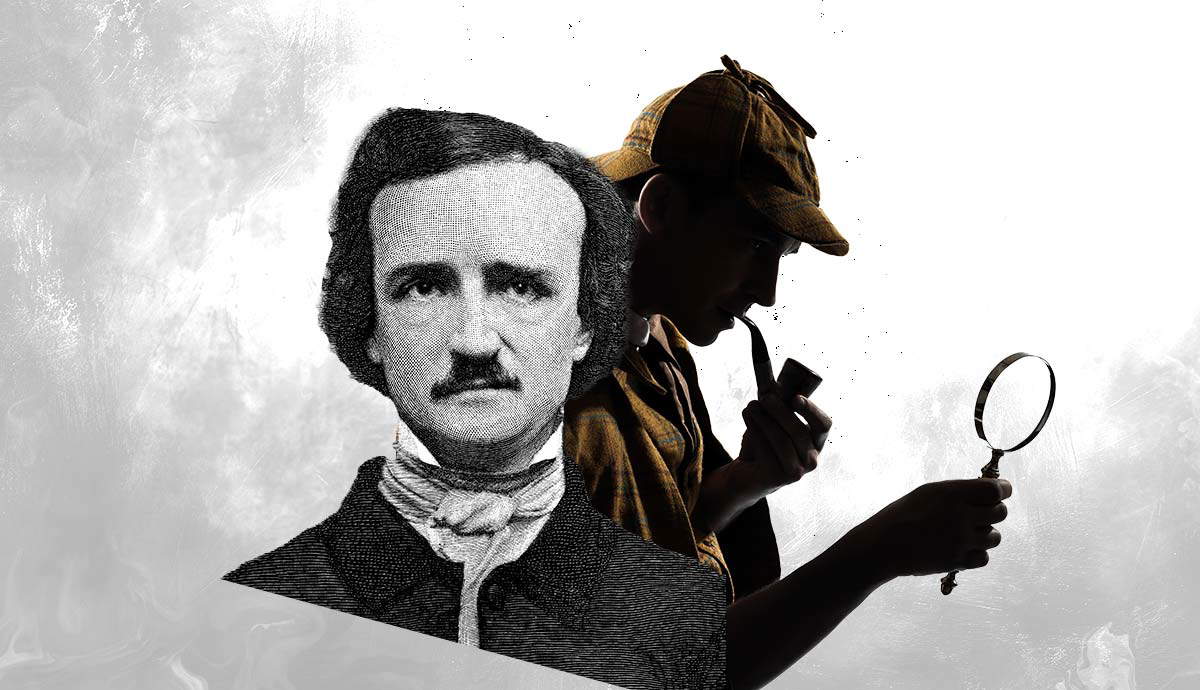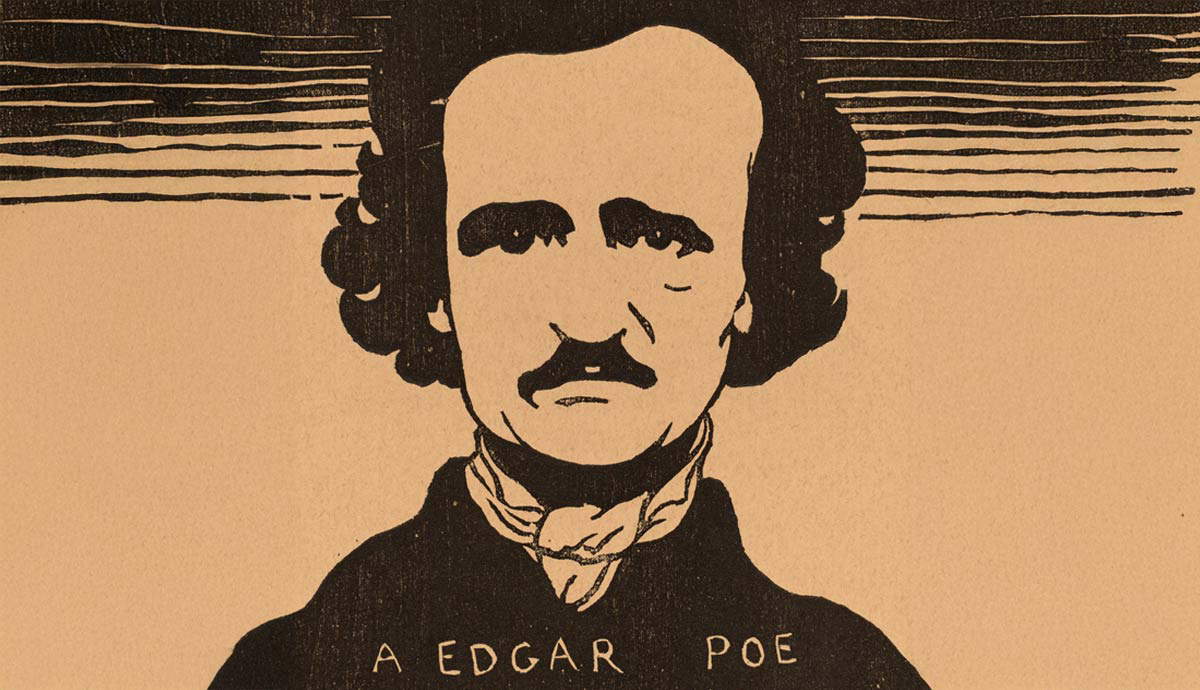
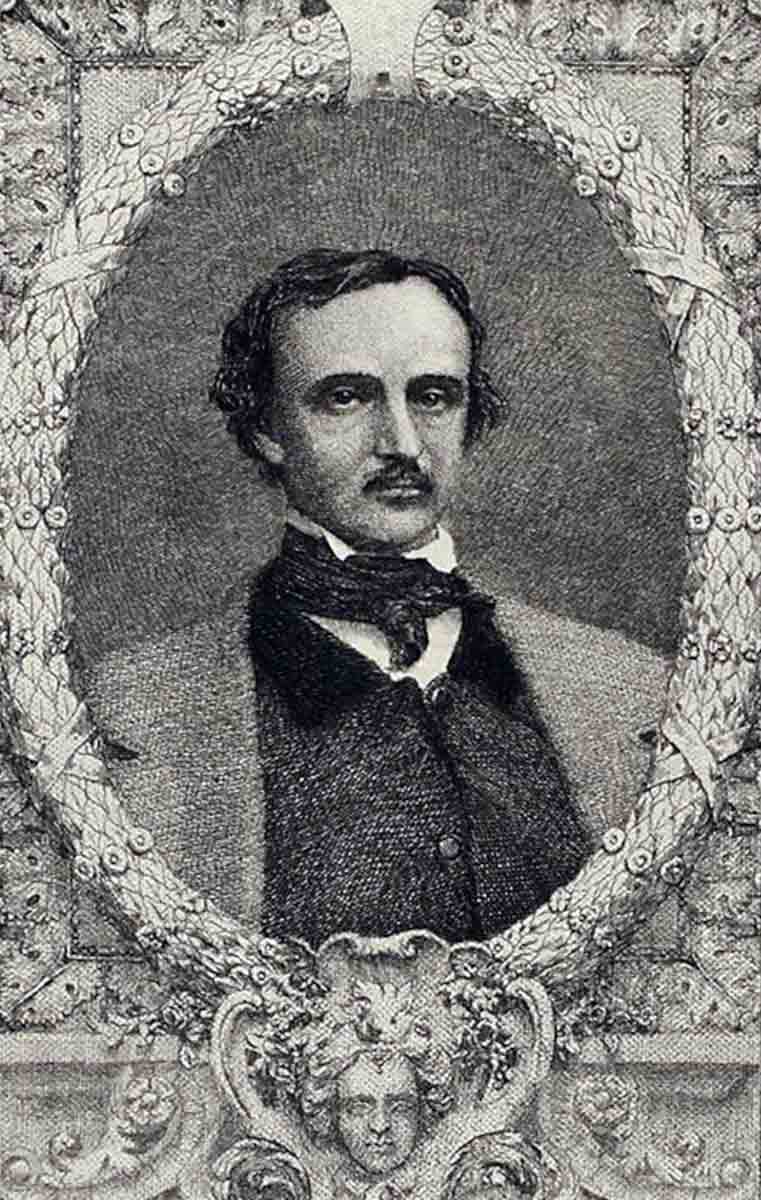
Poet, author, critic, and magazine editor, Edgar Allan Poe (1809-1849) is renowned as one of the 19th century’s most original writers, however brief and tempestuous his career was. His reputation in Europe—especially France—initially far surpassed his standing in his native America. Lauded for his acute psychological style and surreal, symbolist subject matter decades before the likes of Joseph Conrad, Franz Kafka, or Sigmund Freud, Poe fearlessly went in search of the human “heart of darkness,” not in deepest Africa, but in the wild, subterranean, sometimes mad mind.
Edgar Allan Poe: Motherless Child
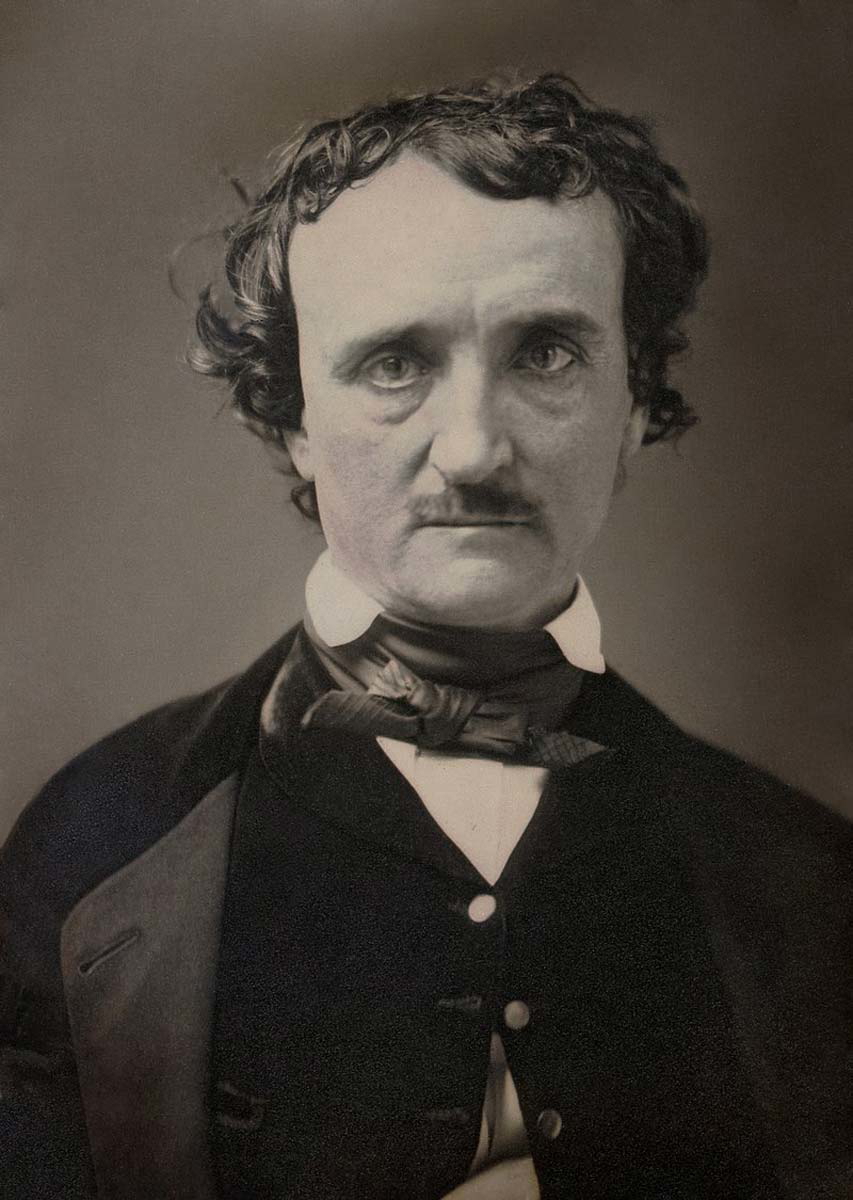
One doesn’t need to be a detective to imagine the devastating effects that the deaths of both his parents, David and Eliza Poe, had on their precocious and sensitive “Eddy.” When he was barely three years old, each died within months of the other, likely from abject hardship and/or tuberculosis, soon after David had deserted the family and fallen into drinking. In 1812, Edgar was unofficially adopted by the prosperous John and Frances Allan of Richmond, Virginia (thus his middle name). While Poe was close to Frances, who doted on him, the “sharp and exacting” John Allan would evolve into a regular nemesis, usually due to issues of money and Edgar’s impulsive career choices. Nevertheless, until he came of age, Poe enjoyed the graces of wealth and a good education, including during his new family’s stay in England from 1815-20, where his foster father opened a branch of his lucrative export business.
As he careened into adulthood, in many respects, Poe became his own worst enemy, whether in regard to money matters or his reckless and dissolute behavior. Like his real father, he would suffer a life-long battle with the liquor bottle, a vice that usually went hand-in-hand with his spendthrift (and unlucky) gambling habits. Like many an alcoholic, Poe was a Jekyll-and-Hyde case study 50 years before the Robert Stevenson novella—characteristically shy, polite, and genteel sober but angry and quarrelsome when drunk. Yet even during his “dry” spells, Poe was an early adopter of the “poison pen” literature review, and would instigate epic public feuds with colleagues and rivals alike. Ever a frustrated artist, Poe fought his entire life for the recognition and monetary success he felt was due him, yet only came in dribs and drabs.

In an awful déjà vu, in 1829, Poe’s foster mother died suddenly at the age of 43. That left him wholly in the care of John Allan, who was increasingly at odds with his willful young charge. By then an aspiring poet, Poe had developed a melancholy, anxious disposition that branded him as an outsider at his various schools, if not a misfit. In yet another of Poe’s maternal losses that would color his life’s work and worldview, he suffered another crushing blow in 1824 when Jane Stanard, the eccentric young mother of one of his friends, died, evidently a consequence of insanity. Jane had become a sympathetic and nurturing figure for the teenage Edgar, so much so that she would inspire one of his best-known poems, 1831’s “To Helen.”
Much can be—and has been—said about Poe’s intense, idealized relationships with the procession of women in his life. Alas, nearly all he would grievously lose, either due to an early demise or their romantic refusals. Such women would habitually make their fictional marks in his works, not only in his poetry but in short stories. In “Fall of the House of Usher” (1839), the sickly Madeline Usher wastes away to her eventual death, unintentionally and nightmarishly accelerated by the actions of her equally doomed brother, Roderick. In “Ligeia” (1838), which Poe called the “best story I have ever written,” the unnamed narrator not only looks on in vain as his beloved wife, the statuesque Lady Ligeia, suddenly dies, but watches helplessly as his new bride, the Lady Rowena, suffers the same cadaverous fate. Whether real or the febrile residue of an opium pipe dream, his Ligeia is resurrected, bodily transfigured from the departed Rowena.
Sergeant Poe
But before Poe settled into his literary vocation, he dabbled in one dead-end profession after another. He attended Thomas Jefferson’s new University of Virginia in Charlottesville, but was forced to withdraw due to his parsimonious father’s refusal to pay any more of his debts—especially from gambling.
Almost on a whim he joined the U.S. Army in 1827, rising to sergeant major, but he quickly grew tired of it. From frying pan into the fire, as it were, Poe then lobbied for and received admittance to West Point in 1830. While he enjoyed the academic benefits, Poe was ill-suited to the military discipline and regimentation; unable to obtain permission from his foster father to be freed from his commitment, he deliberately disobeyed orders, thus triggering a court-martial and expulsion from the Academy.
Roosting in Baltimore
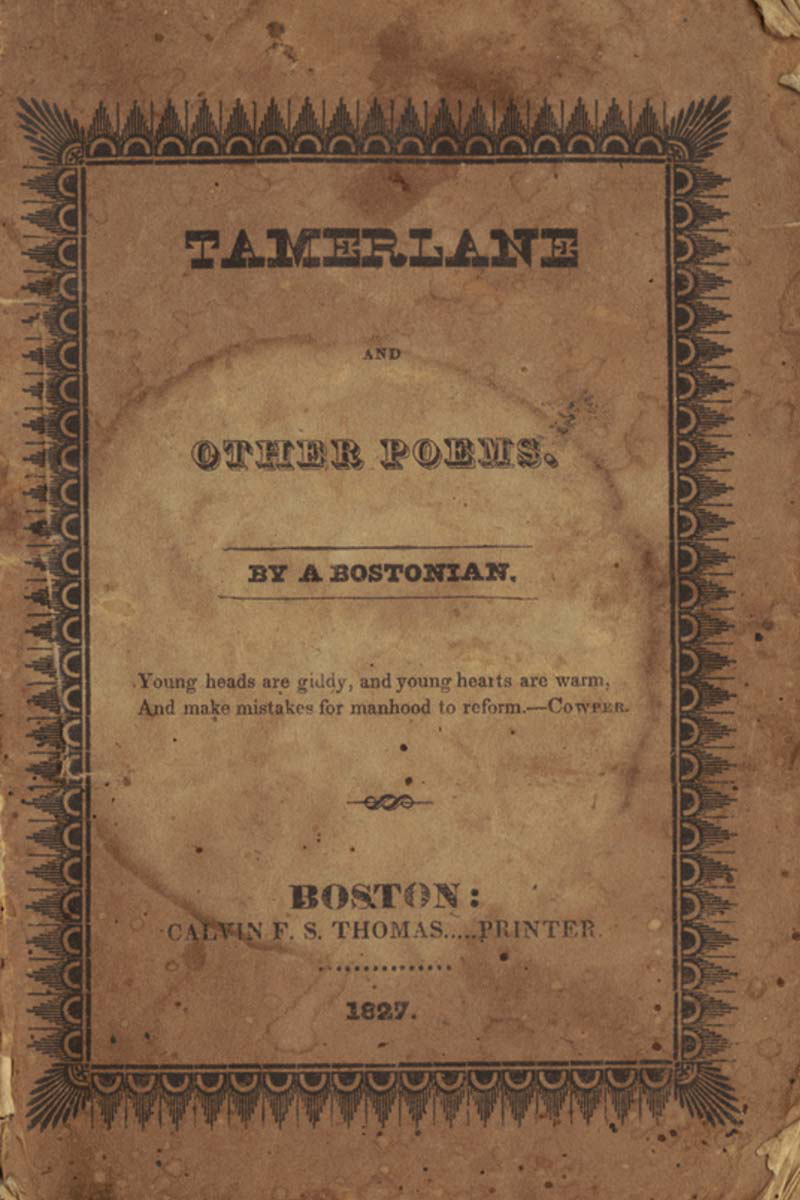
Even as he was forever burning his bridges, especially and most flammably with John Allan (now remarried), Poe nevertheless was finding and following his literary passion, however errantly. He published his slim first book of poetry (Tamerlane) in 1827, though it was uniformly ignored by the reading public. In 1831, he took up residence in Baltimore, where he began a close, undying relationship with another maternal figure, Maria Clemm, his late father’s widowed sister. As he recalibrated and renewed family ties, including with an older brother, Poe made his first serious moves into a full-time career as writer and editor. As one biographer put it, Poe was well on his way to becoming the “saddest and strangest figure in American literature.”
Odd indeed was Poe’s momentous decision to marry Maria Clemm’s 14-year-old daughter Virginia, in 1836. Charming, petite, and pleasantly plump Virginia was in most every way the opposite of her spindly, brooding husband, to whom she was devoted. While the relationship was initially “sisterly,” their love evidently turned the page into a conjugal one as she aged into adulthood. And, horror of horrors, Poe would also suffer the loss of his darling Virginia in time, almost assuredly the crowning blow in an already vexed and unhappy life.
In Baltimore, he embarked on a string of jobs as editor of East Coast literary magazines, typically coping with low pay (“salaried drudgery”) and long hours. Poe’s prickly pride and artistic frustrations, combined with his quick temper, would send him into one confrontation after another with his publishers, usually leading to his dismissal. To put a modern spin on Poe’s increasingly infamous public life, imagine the combative and comically uncurbed Larry David from TV’s Curb Your Enthusiasm in the mid-19th century, only played with the darkness and gloom of a Henrik Ibsen or Eugene O’Neill drama.
Taking Off
During this period in Baltimore and later back in Richmond, Poe began penning the works that would make his reputation and his great, belated legacy. In 1833, he won two cash prizes for his poetry and short stories, which helped allay his anxieties that he was frittering away his talents writing and editing what was frequently hack work. During one all-too-brief interlude in 1836, he wrote that “I have a fair prospect of future success—in a word, all is right.” Such sentiments belie the bitterness he must have felt after John Allan died in 1834, leaving his wayward foster son nothing in his will.
Poe found relative stability in both his family life and his new job as editor of the prestigious Southern Literary Messenger, where he also contributed topical articles and his caustic, controversial book reviews. He enlarged his creative purview, writing “The Unparalleled Adventure of One Hans Pfaall” in 1835, an early, elaborate science-fiction tale about a hot-air balloon voyage to the moon decades before Jules Verne. Yet, largely driven by the need to support his new family (now including Maria) on a meager wage, the high-strung Poe resumes his one-way flight into a fog of alcoholic binges.
While today alcoholism is viewed as a disease of sorts, often inherited, in Poe’s time, it was widely and unsympathetically seen as a damning character defect. At least partially due to his drinking, in early 1837, Poe was dismissed from his post at the Messenger, which became just one more revolving door for him to exit in a huff.
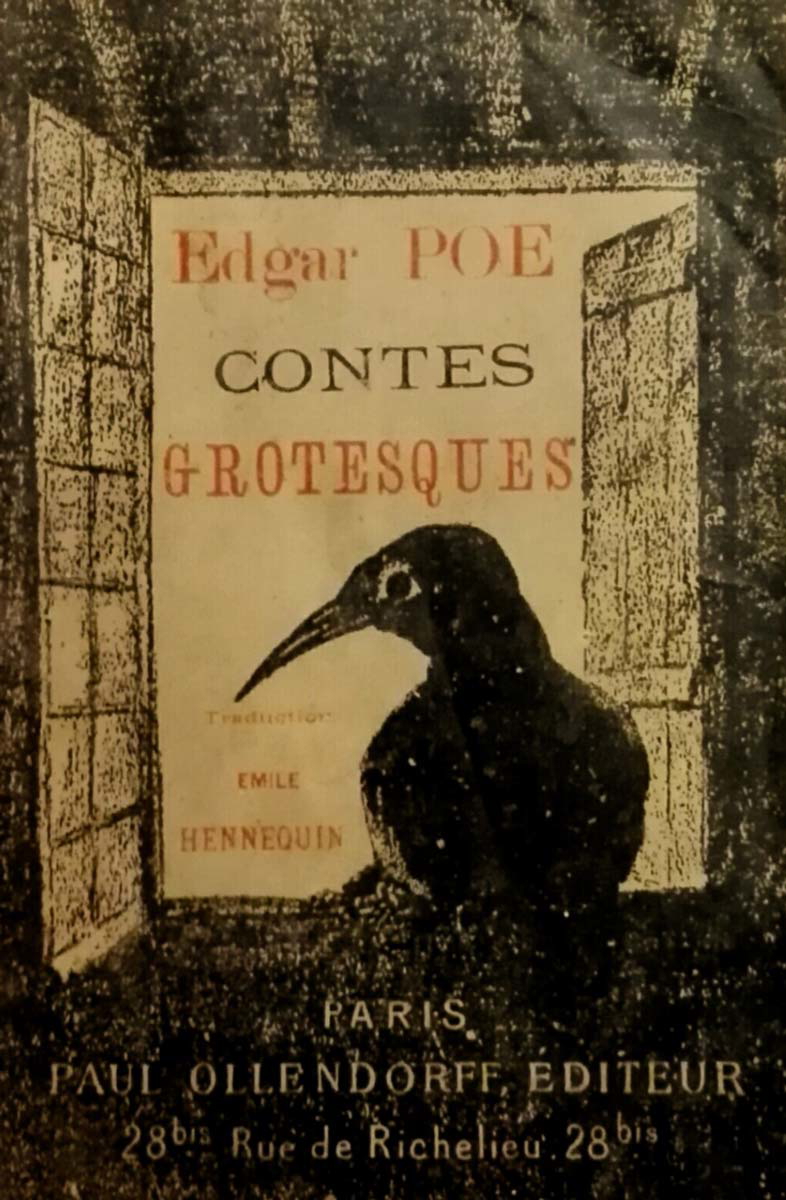
Poe and his family would spend much of the next six years in Philadelphia, where he again was able to find work as a magazine editor. More critically, the posts gave him outlets for a banner crop of short stories that have since gone on to world renown, including “House of Usher,” “Ligeia,” and “The Man That Was Used Up” (all published in 1840 as part of his two-volume collection called Tales of the Grotesque and Arabesque). This remarkably productive period would climax in 1843 with the publication of 17 of his poems in a local magazine, including “Lenore” and “The Conqueror Worm,” the latter of which was incorporated within “Ligeia.”
Enter Triumph and Tragedy

While gaining a level of recognition and readership with each publication, at the same time Poe was also attracting notoriety (and condemnation) for his morbid subjects and style, raising critical questions on his work still relevant today. Whether writing in detail about a savage killer who stuffs a woman head first up a chimney in “Murders in the Rue Morgue,” or a man who stabs his pet cat in the eye in “The Black Cat,” Poe’s lurid, often gruesome, stories are an acquired taste, and certainly not for the squeamish.
Recognition, however, did not lead to material fortune. Nor would Poe’s home life give him lasting solace. In 1842, his world was shaken once again when his beloved Virginia began suffering from coughing fits—the first deadly signs of consumption (tuberculosis today). She would wither away over the next five years while Poe and her mother could do nothing but offer comfort. Understandably, her illness and eventual death in 1847 would become chillingly manifest in Poe’s work, including in his medieval plague story, “The Masque of the Red Death.”

Despite his achievements in Philadelphia—augmented by his new popularity on the lecture circuit—in 1844 Poe decided to move his family to New York City, America’s publishing capital. This would be his professional “last stand,” and, ironically, where he would finally gain national celebrity. With the 1845 issue of his best-known poem, “The Raven,” along with his book of collected Tales (including “The Purloined Letter,”” Rue Morgue,” et al.), Poe at last took off as a literary sensation. Yet with each good notice, he would find a way to sabotage himself, whether by starting feuds with other writers or descending into drink. Well aware of his own notoriously self-destructive ways, he even labeled such human failings in his 1845 essay, “The Imp of the Perverse.”
Edgar Allan Poe’s Exit
Throughout his later life, Poe drew public allegations that he was going insane, a notion he stoked himself with Romantic-era ruminations on the blurry line between madness and genius. One might ask, in a crass, commercial, even irrational society, isn’t so-called “madness” the sane reaction? Isn’t it forced upon the sensitive and creative as an escape? This would be one of the chief arguments of those later championing Poe, such as the French poet/critic Charles Baudelaire.
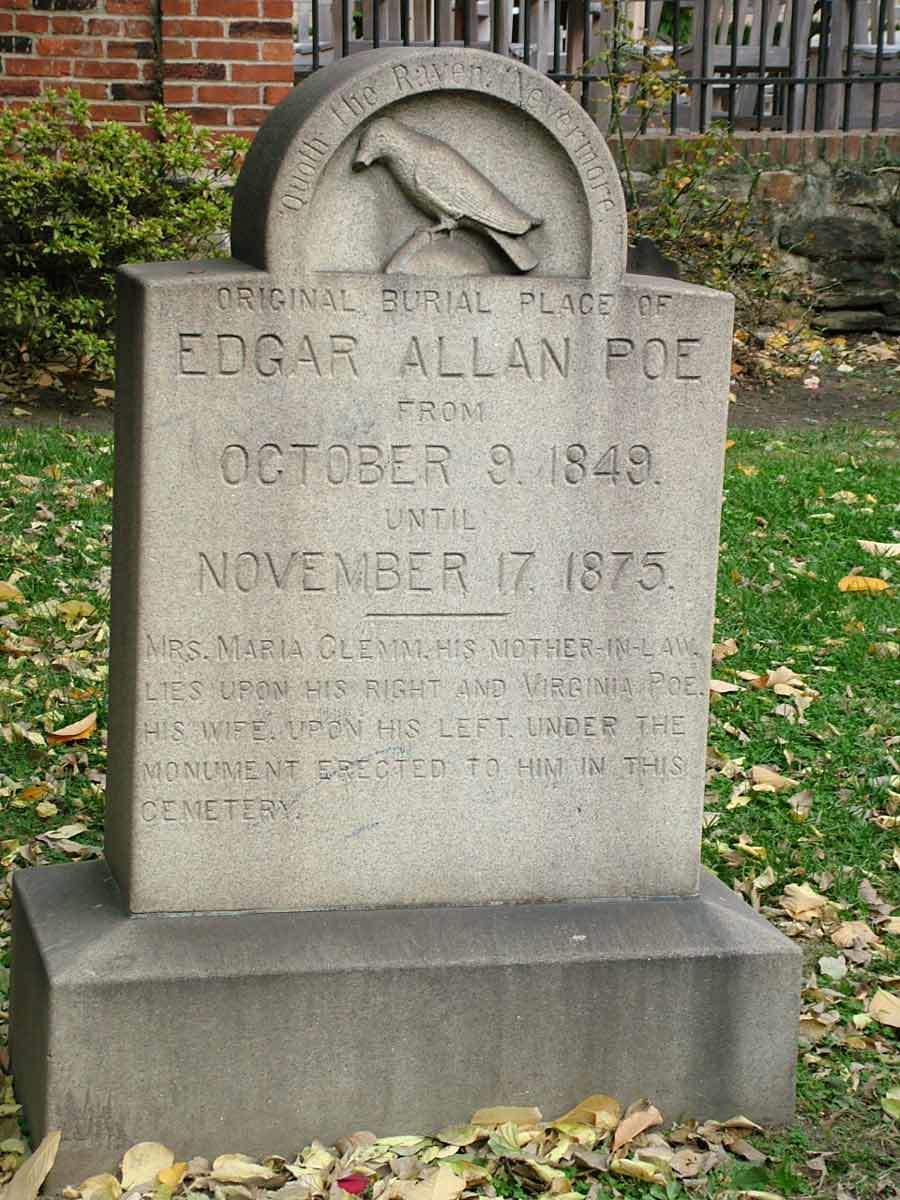
“The end” for Poe would arrive in haste. Once Virginia died, he embarked on desperate attempts to recapture the hearts of the women he once loved, courting one after another (sometimes simultaneously) in a panic. While visiting Baltimore in October of 1849, he foundered into another bender, collapsing in the street after days of drinking. He was found, delirious and hallucinating, and taken to a nearby hospital, where he died a few days later. First shamefully buried in an unmarked grave in the city, today he is memorialized at two sites, the oldest one marked with a headstone quoting his most memorable poetic refrain—“Quoth the Raven, Nevermore.”