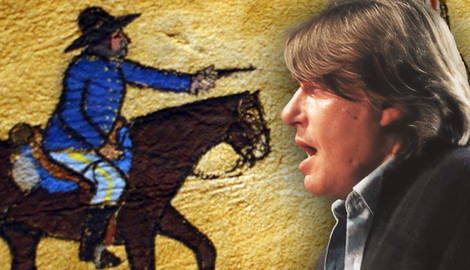
The Sand Creek Massacre was one of the most barbaric events in the history of the United States of America. On November 29, 1864, the 750 Cheyenne and Arapaho camped on a bend of the Sand Creek River in what is now Colorado were attacked by men of the Third Colorado Cavalry and the 1st Colorado Infantry Regiment of Volunteers under the command of Colonel John Chivington. Thousands of people were killed and maimed, including women, children, and the elderly. The attack was unprovoked, and it was pure butchery. More than a century later, Fabrizio De André, one of Italy’s most famous and beloved singer-songwriters, re-enacted the massacre in his song Sand Creek River. It is a powerful and extremely poetic piece in which the violence inflicted on the Cheyenne and Arapaho by the Third Colorado Calvary is evoked through the eyes of a Native American child.
Fabrizio De André
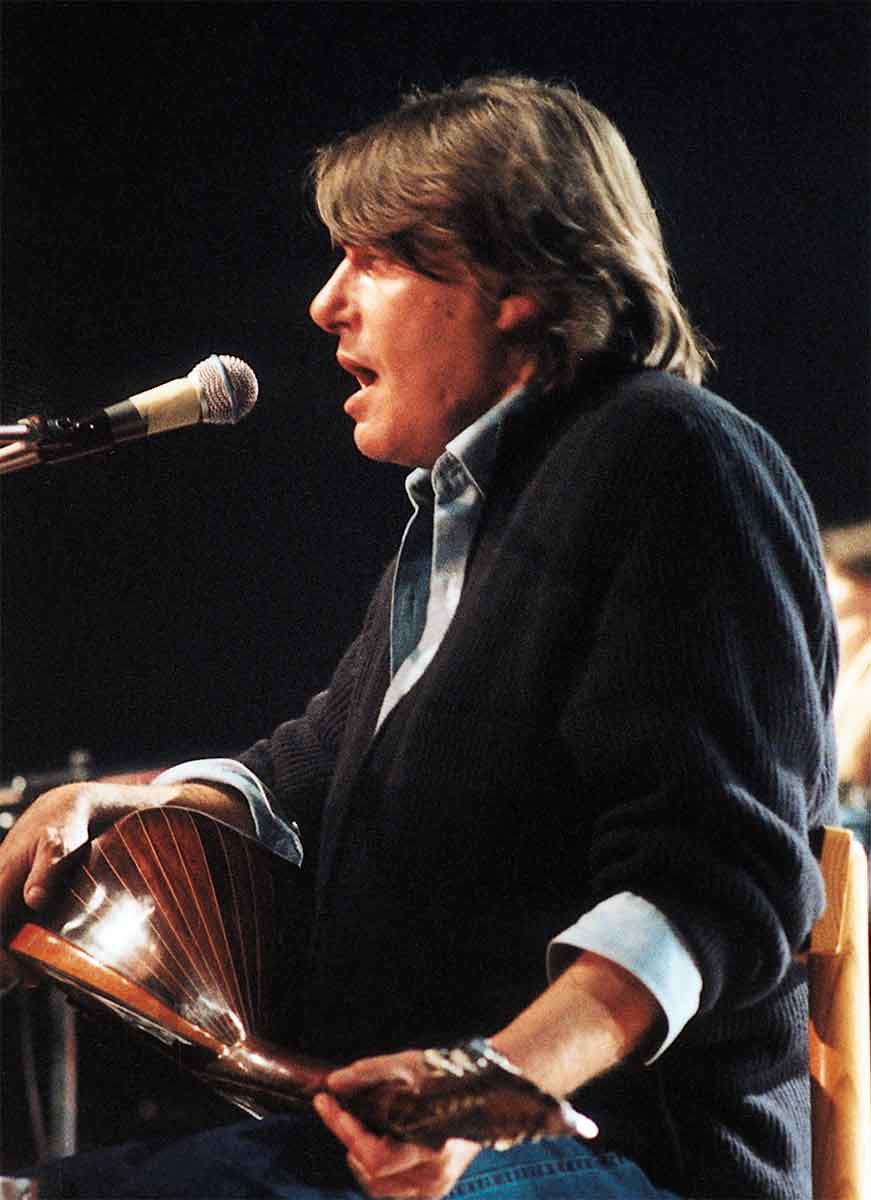
Fabrizio De André (1940-1999) is widely regarded as Italy’s greatest singer-songwriter, or cantautore, in Italian. In his hometown of Genoa, he is affectionately known as Faber. His friend Paolo Villaggio (1932-2017), a well-known Italian comedian and actor, gave him this nickname due to its phonetic similarity to De André’s name, as well as his fondness for Faber-Castell’s pencils and pastels.
Like the Cheyenne and Arapaho chiefs tragically killed during the Sand Creek Massacre in 1864, De André was a man of peace. He strongly believed in the power and necessity of non-violence as a means to resolve conflicts between nations and groups. His 1968 anti-war song, La Guerra di Piero (The War of Piero), which begins with the evocative line “You sleep buried in a field of grain,” continues to be taught and sung in Italian schools.

In Italian culture, particularly during the counterculture movements of the 1960s and 1970s, The War of Piero has played a role similar to that of Bob Dylan’s Blowin’ in the Wind in the United States. Many of De André’s songs feature outcasts and rebels, people who have been marginalized and misunderstood by society. He often describes and gives voice to thieves and prostitutes, as seen in his powerful and rhythmically intense song Bocca di Rosa (Rose-Mouth), as well as to starving men and figures from Christian history.
In 1981, De André recorded Fiume Sand Creek (Sand Creek River), which offers a unique take on the Sand Creek Massacre. For the album cover, he chose Frederic Sackrider Remington’s The Outlier (1909), depicting a Native American warrior sitting on his horse, rifle in hand, in front of a full moon in a nocturnal, dream-like scene.
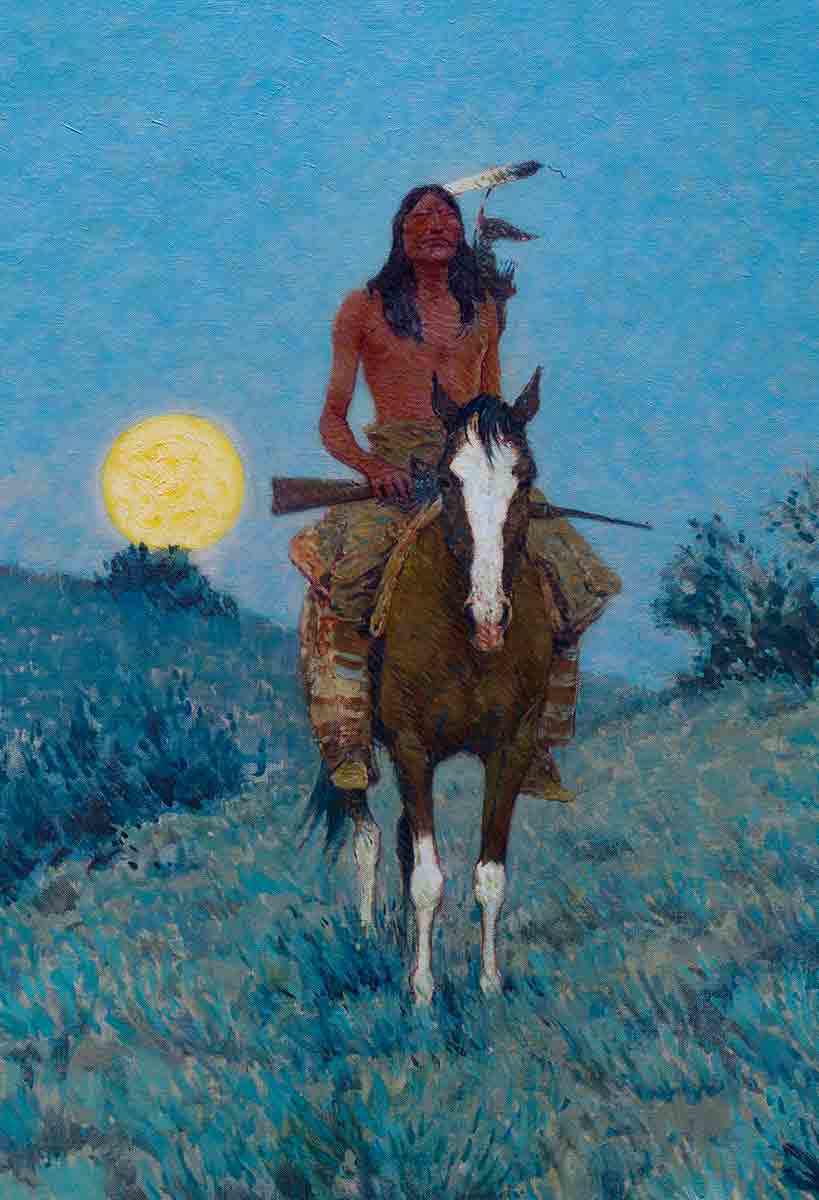
The selection of Remington’s painting for the cover is itself meaningful. On one hand, by drawing attention to Native Americans and Remington himself, who is widely regarded as one of the most esteemed (and controversial) chroniclers of the American West, De André makes Sand Creek River stand out among the album’s other songs. On the other, it serves as a reminder that Native Americans were more than just victims or “savages.” They were proud people, with rich and complex cultures and rituals, who fiercely resisted American encroachment and violence.
The Sand Creek Massacre
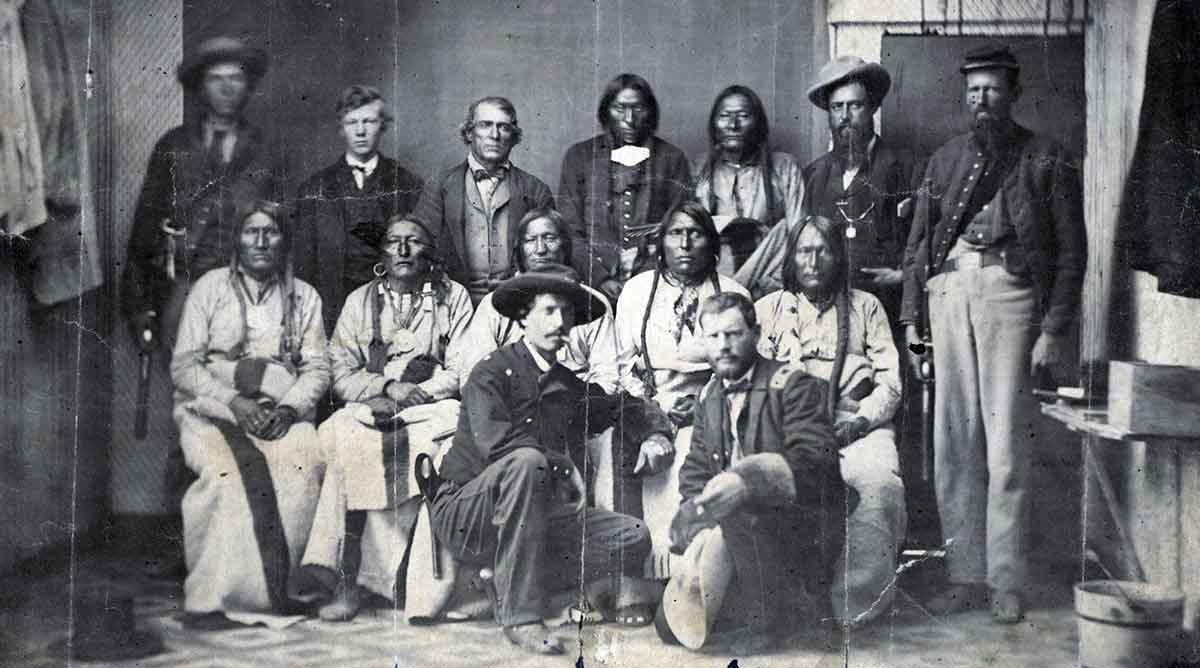
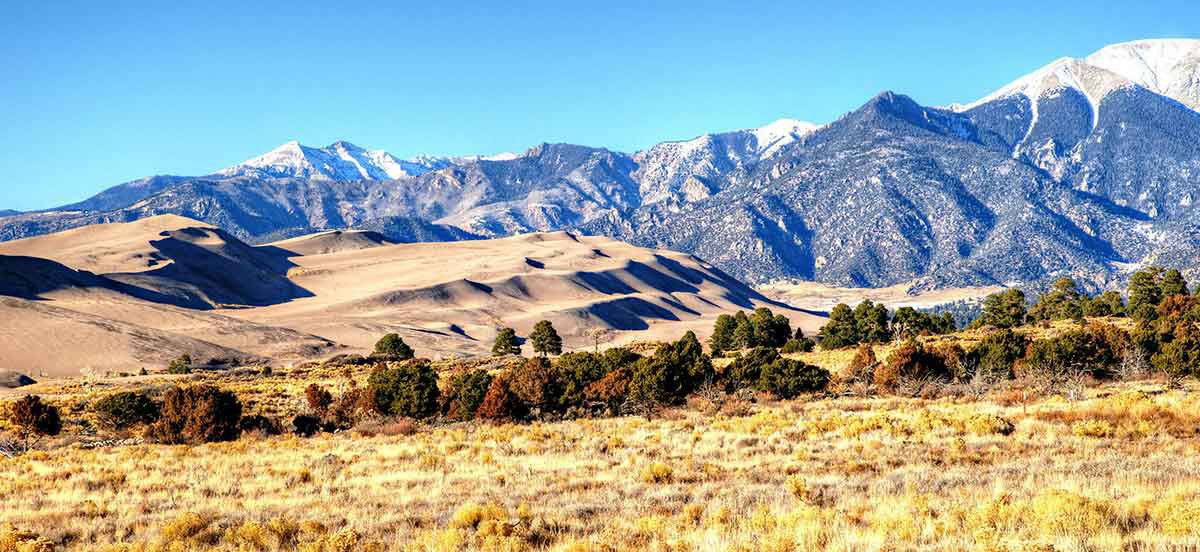
In 1864, about 750 Cheyenne and Arapaho men, women, and children were camped at the Big Sand Creek, some 50 miles north of Fort Lyon in present-day Kiowa Country, in southeastern Colorado. The leading chief of the Southern Cheyenne was Black Kettle (1803-1868), who was born into the Northern Só’taeo’o band of the Northern Cheyenne and later married into the Southern Cheyenne. A pragmatic man committed to peace, before the Sand Creek Massacre (also known as the Sand Creek Betrayal), he had attended several council meetings to advocate and secure peace for his people.
In 1864, Black Kettle led them to camp in a bend of the Big Sandy Creek following orders from the US Army. The encampment was ready to move to Fort Lyon, where they would be guaranteed to find safety and receive supplies, as promised in the proclamation issued by the Governor of the Territory of Colorado, John Evans (1814-1897).
Evans’s proclamation, however, was in direct conflict with the standing order that, throughout the Territory of Colorado, any Indigenous man, woman, or child could be shot and killed if seen approaching a Fort. The Cheyenne and Arapahos stationed at Big Sandy Creek were in a stalemate and a dangerously precarious situation. The grave dangers they were subject to became evident on the morning of November 29, 1864.
At around 6.30 AM, Colonel Chivington rode into the camp with 250 men of the Third Colorado Cavalry and gave orders to attack the peaceful camp. Two officers refused and told the men under their command to hold fire. They were Lieutenant Joseph Cramer (1838-1869), in charge of Company K of the First Colorado Calvary, and Captain Silas Soule (1838-1865), in charge of Company D. Born into a progressive family of abolitionists and himself an active abolitionist, Soule was assassinated two months after testifying before a US military commission.
The massacre lasted all morning. Children were shot on sight. Women were mutilated, scalped, and tortured. Robert Bent (also known as Ho-my-ike in Cheyenne), son of non-Indigenous William Bent and Cheyenne Owl Woman, testified of a woman “lying on the bank, whose leg had been broken. A soldier came up to her with a drawn sabre. She raised her arm to protect herself; he struck, breaking her arm. She rolled over, and raised her other arm; he struck, breaking that, and then left her without killing her.”
The soldiers chased those who tried to escape by following the river (although most of them survived), and did not leave the camp until December 1. For a day and a half, they checked the bodies for jewelry and other possessions they could use or sell, scalping and desecrating the dead.
Fiume Sand Creek (Sand Creek River)
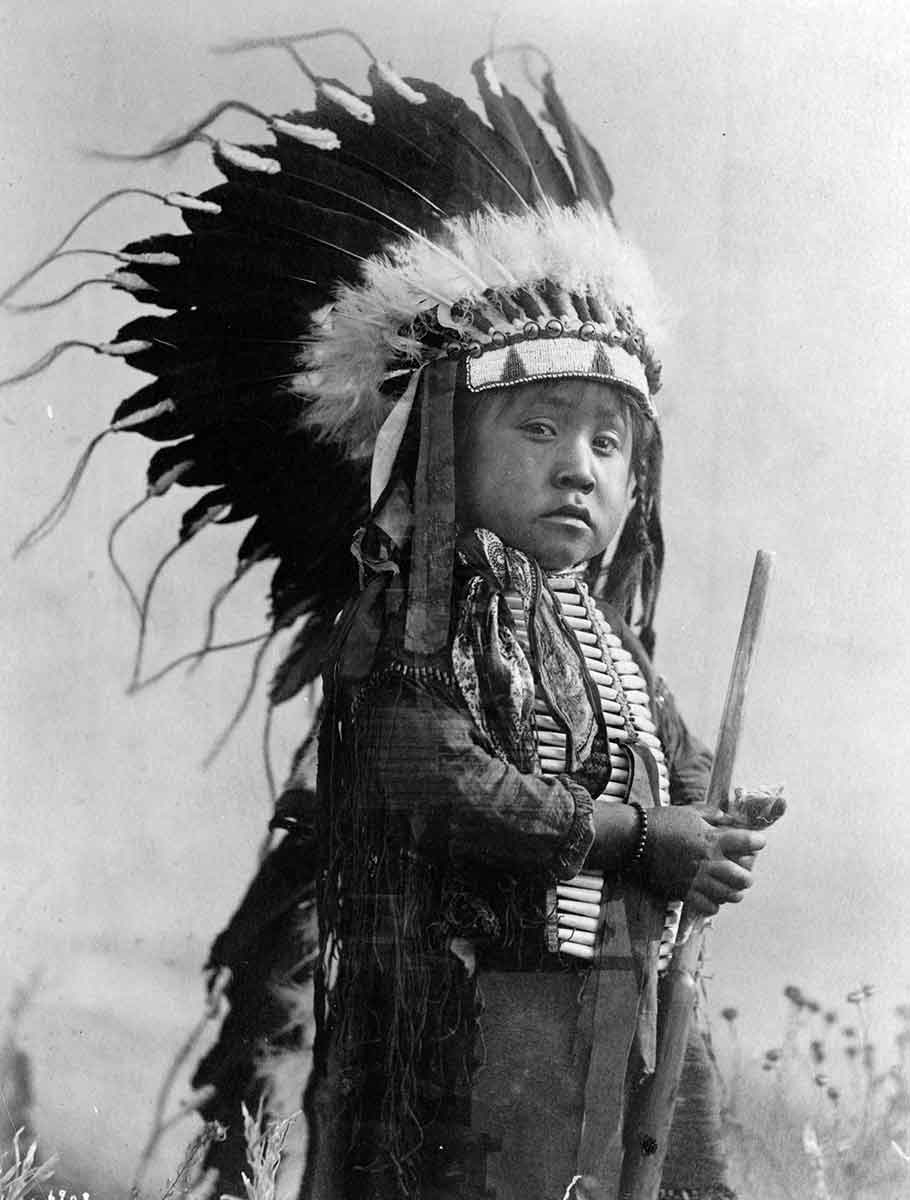
In 1879, Major Scott Anthony of the First Cavalry of Colorado recalled a scene he witnessed during the Sand Creek Massacre: “There was one little child, probably three years old, just big enough to walk through the sand. The Indians had gone ahead, and this little child was behind, following after them. The little fellow was perfectly naked, traveling in the sand. I saw one man get off his horse at a distance of about seventy-five yards and draw up his rifle and fire. He missed the child.” Two other soldiers fired at the child. Eventually, they struck him dead, and “the little fellow dropped.”
In Sand Creek River, De André recounts the Sand Creek Massacre through the eyes of one of the children who died there, a child who, after that terrible day, was found “asleep at the bottom of Sand Creek.”
The song is divided into five stanzas. Each stanza is linked to the next by a verse describing, concretely or metaphorically, the battle’s progression through the objects that fall into the river. The arrival of Chivington’s men is symbolized by the silver dollar dropped to the bottom of the Sand Creek: the massacre has just begun. As the Cheyenne and Arapaho run for their lives, fish “sing” at the bottom of Sand Creek.
The haunting verse, “Now the children sleep in the Sand Creek bed,” serves to bridge the third and fourth stanzas. In the final stanza, as the dead lie defiled on the ground among the overturned teepees, an arrow—a potent symbol of Indigenous defiance and resistance—is loosed toward the sky, but it eventually plants itself in the riverbed. The river, one of the song’s main characters, is used as both a literal and metaphorical witness, flowing through each stanza, absorbing the violence and bearing witness to the massacre unfolding along its banks.
“They took our hearts under a dark blanket
Under a moon that died young, we were sleeping without fear.
It was a 20-year-old general
Wearing a uniform as blue as his eyes,
It was a 20-year-old general
The son of thunder.”
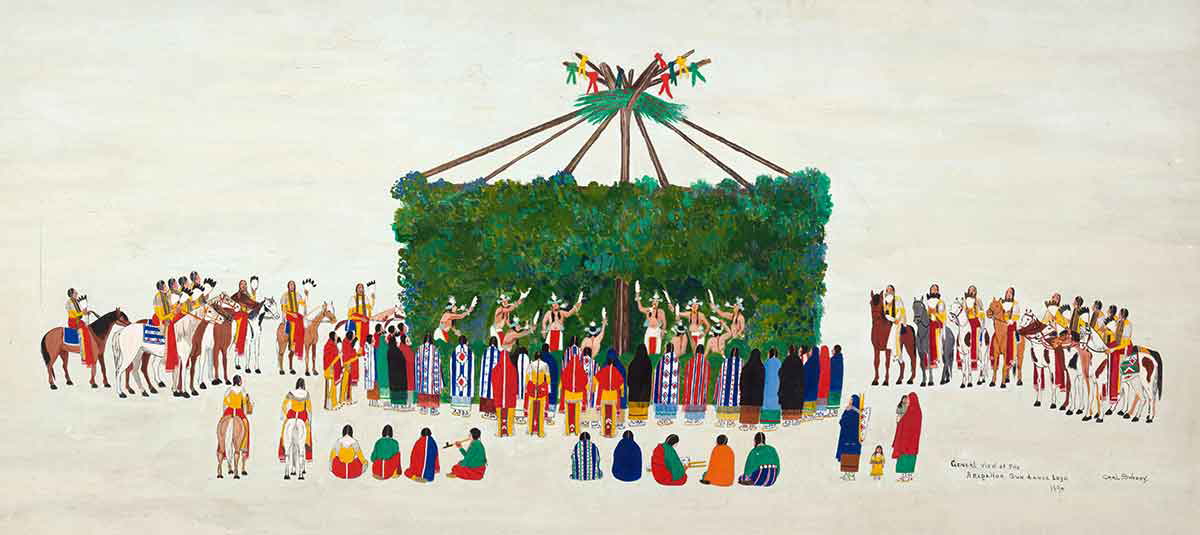
The Sand Creek Massacre is also known as the Chivington Massacre after John Chivington (1821-1894), the Colonel who gave the order to attack the Cheyenne and the Arapaho encamped at Sand Creek. De André describes him as a “20-year-old general,” but in reality, Chivington was already in his 40s. De André is seeking to reverse our expectations: he is telling us that in American history, the romantic figure of the blue-eyed 20-year-old general is actually a mass murderer who orders his man to butcher defenseless women and children.
It was early morning when Chivington’s soldiers attacked the camp. Men, women, and children were fast asleep, sleeping “without fear,” as De André writes in the first stanza. The soldiers’ arrival is announced by a “distant tune” that grows louder and louder. In a sick turn of events, music is here transformed into a harbinger of violence, betrayal, and death.
“Our warriors were far away on the bison track,
And that distant tune grew louder and louder.
I closed my eyes thrice,
I found myself still there.
I asked my grandpa, ‘Is this a dream?’
My grandpa said, yes.
Sometimes the fish sing at the bottom of Sand Creek”

The child narrator tries to “disappear” by closing his eyes three times, an instinctual, childlike defense against the harrowing experience he is witnessing. To no avail. Seeking comfort, he turns to his grandfather, who assures him that yes, it is just a dream. But as the massacre unfolds, the child starts bleeding from his nose. The dream, now a nightmare, refuses to dissolve and seeps into the child’s mind.
The more the battle rages, the more poetic, dream-like, almost sweet De André’s lyrics become. Death comes with nosebleeds and lightning. Death transforms people and the landscape. As the child slowly bleeds to death, he sees the snow-covered trees surrounding the camp bloom “with red stars”—possibly a symbol of both death and resurgence.
“I dreamed so vividly that I started to bleed from my nose,
Lightning in one ear, heaven in the other,
The smallest tears,
The biggest tears,
When the snowy tree
Blossomed with red stars.
Now the children sleep in the Sand Creek riverbed.”
The Aftermath of the Massacre

As we have seen, the first three stanzas of the song describe the arrival of Chivington’s soldiers at Sand Creek and the brutal attack they carried out against the Cheyenne and Arapaho. While the last stanza is identical to the first, thus taking us back to the beginning, the fourth stanza leads us deep into the Native American camp once the soldiers have left.
We are asked to bear witness to the death and devastation Chivington’s soldiers inflicted on the Arapaho and Cheyenne. Ironically, it is the most dramatic and complex stanza in the whole song. At first glance, the devastation seems to be filtered, once again, through the eyes of the child narrator: the fact that he shoots an arrow at the sky “so that it may breathe” is consistent with a child’s perspective.
“When the sun raised its head between the night’s shoulders,
There were only dogs and smoke and overturned tepees
I threw an arrow at the sky
So that it may breathe
I threw an arrow at the wind
So that it may bleed
Look for the third arrow on the bottom of Sand Creek.”
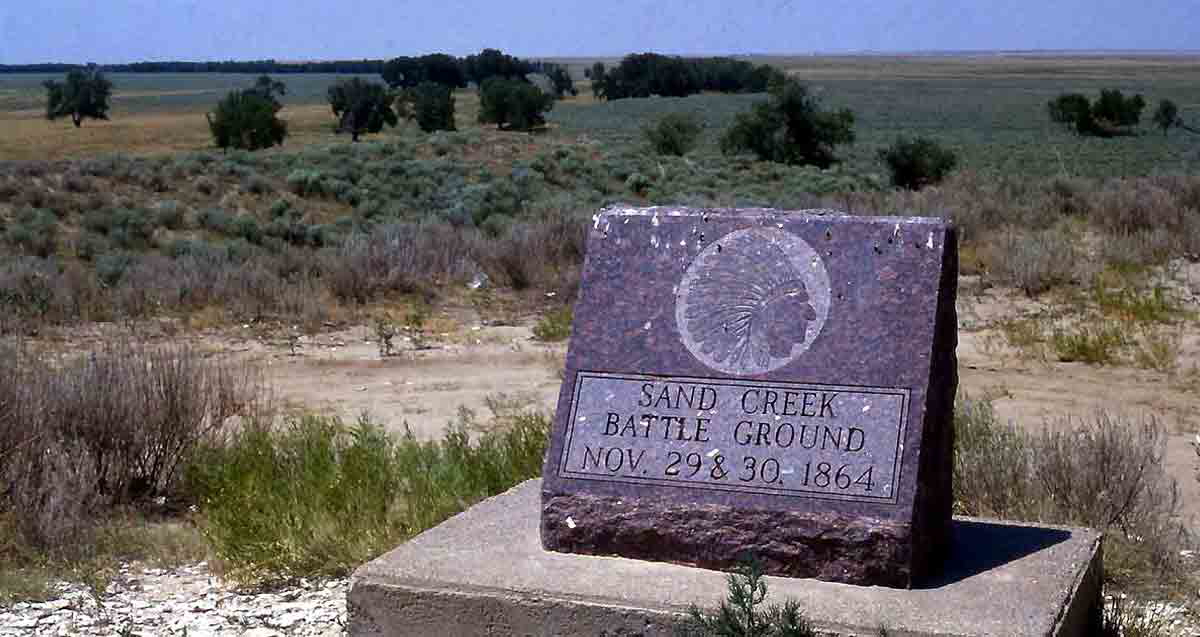
However, the scene described is extremely vivid and claustrophobic. The sky is like a cloak that traps human beings beneath it, preventing them from breathing fully. It almost seems as if the narrator of the stanza is a survivor (or an outsider), helplessly wandering among the smoke and overturned tepees, unable to breathe, overwhelmed by the devastation he is witnessing.
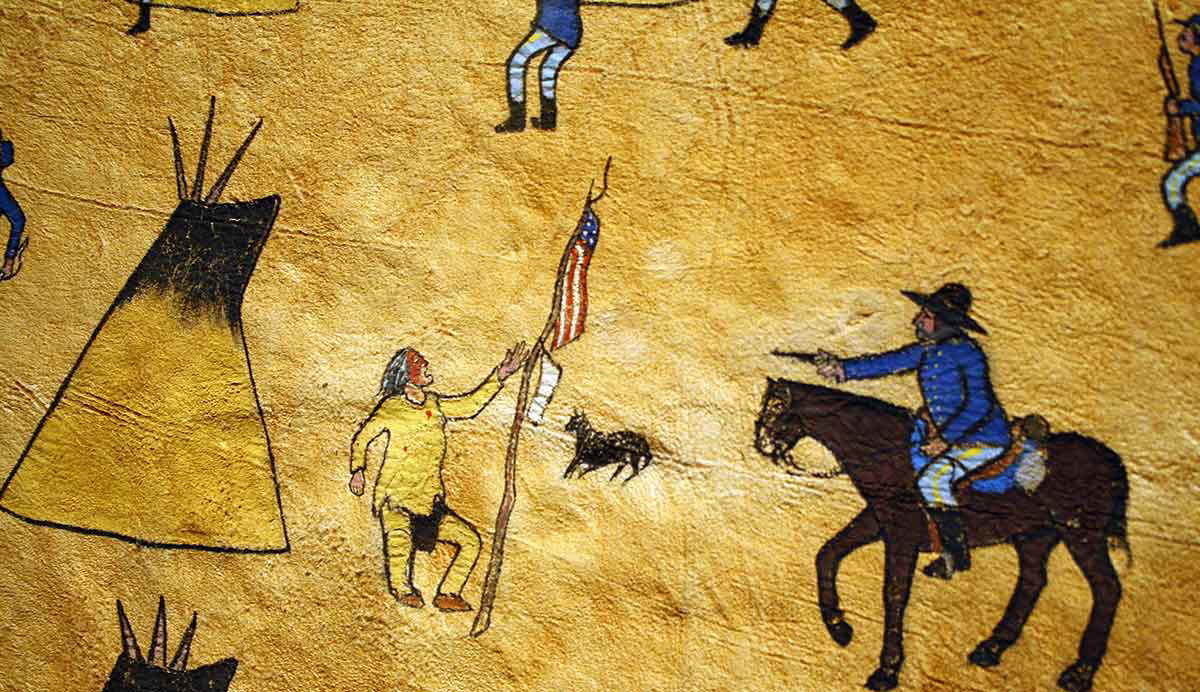
The men, women, and children who died at Big Sand Creek belonged to several Cheyenne and Arapaho tribes. Some of them, such as Chief Black Kettle’s band, were nearly exterminated. Several sources estimate that between 70 and 600 Cheyenne and Arapaho were killed and mutilated during the massacre. About two-thirds of them were women and children.
Black Kettle’s wife, Medicine Woman Later, was severely wounded, sustaining nine bullet wounds. Southern Cheyenne chief White Antelope (Wōkaī hwō’kō mǎs) was shot dead, his body brutally desecrated and his belongings stolen.
Some accounts, including that of George Bent, claim that he remained in his lodge and sang his death song before he was killed, while others describe him running toward the soldiers, either holding a gun or unarmed, shouting at them to lay down their weapons.
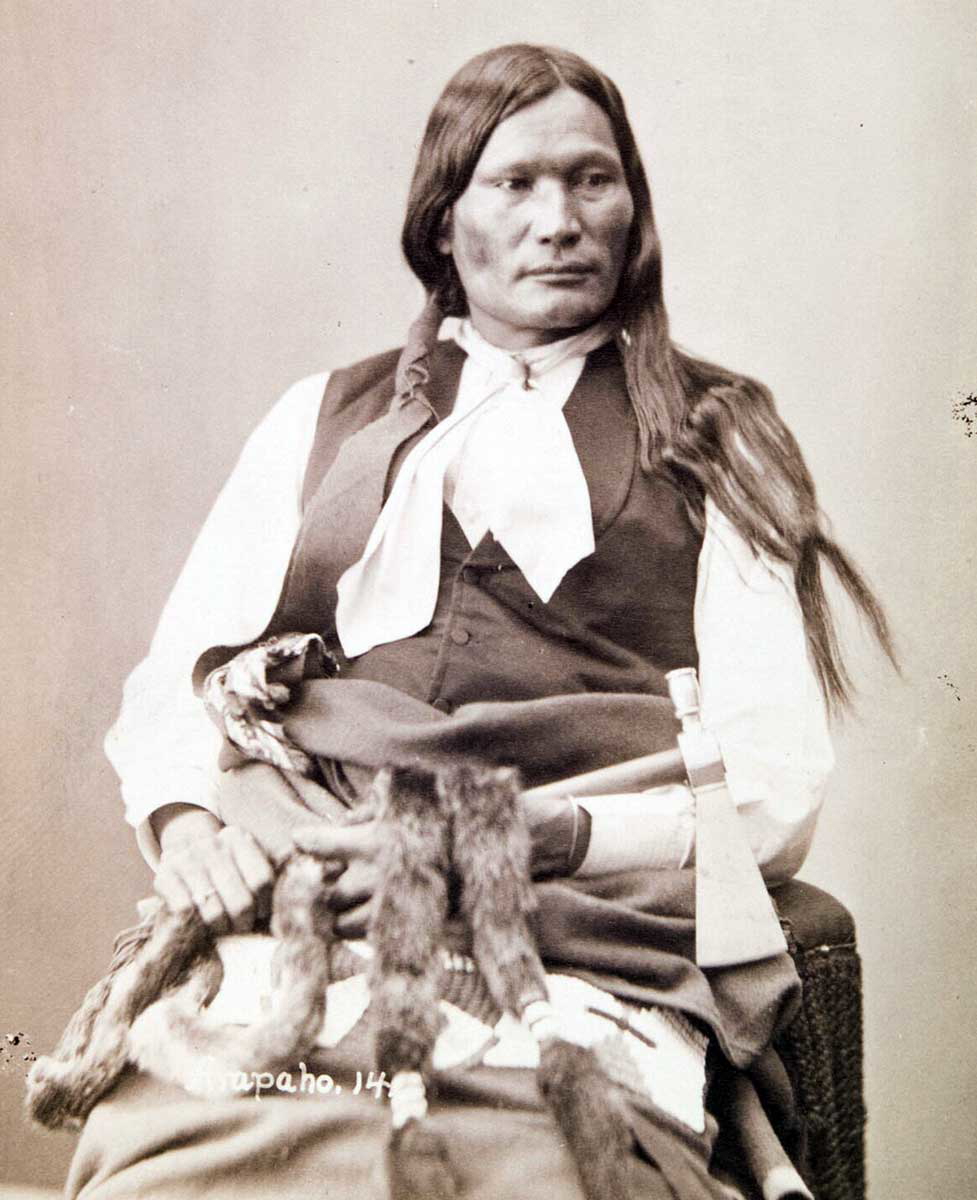
In addition to the trauma it caused among generations of Cheyenne and Arapaho, the massacre also had the effect of severely weakening the older, more peaceful Native American faction, opposed by the Dog Soldiers (Hotamétaneo’o). In fact, among the dead were eight members of the Council of 44, the council of Cheyenne chiefs responsible for peace negotiations. In addition to White Antelope, Ochinee (also known as Lone Bear and One Eye), Yellow Wolf (Ho’néoxheóvaestse), War Bonnet, Spotted Crow, Bear Robe, Big Man, and Bear Man were all killed.

The 1864 Sand Creek Massacre, one of the most brutal events in the history of 19th century United States, also served to “radicalize” many Cheyenne and Arapaho who until then had believed in the possibility of negotiating peace with the “white men.” In the months that followed, thousands of them joined the Dog Soldiers and carried out attacks on forts and stations throughout the Platte Valley and in Powder River country. Among them was the Northern Cheyenne warrior Roman Nose (Vóhko’xénéhe).
De André’s song, Fiume Sand Creek, was released in 1981, 117 years after the Sand Creek Massacre. By presenting the massacre through the eyes of a child, he goes beyond a mere recounting of historical facts. The child’s perspective, unclouded by ideology or context, serves to highlight the senselessness and the brutality of the soldiers’ violence. Sterile facts are transformed into an intimate and almost dream-like narrative. Fiume Sand Creek is both a tribute to the victims, particularly children, and a lament for the lives lost that day, as well as a reminder of the irreparable damage inflicted on future Cheyenne and Arapaho generations.