
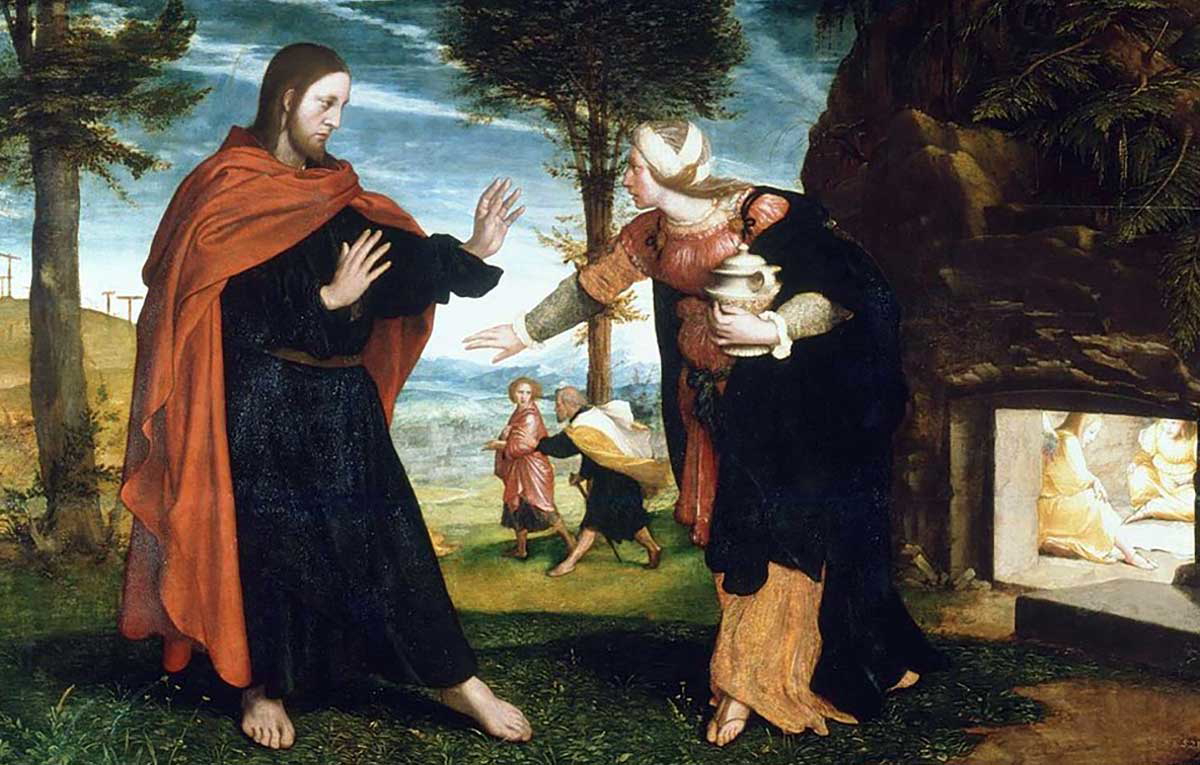
According to the Gospel of John, Mary Magdalene clung to the resurrected Jesus outside the tomb, when he turned to her and said something peculiar: ‘Noli Me Tangere’. These words would echo out throughout the following centuries, inspiring many artists and believers alike to respond creatively. This article will explore some of the interpretations of this mysterious phrase.
John 20:14-18, Noli Me Tangere

14 At this, she turned around and saw Jesus standing there, but she did not realize that it was Jesus.
15 He asked her, “Woman, why are you crying? Who is it you are looking for?”
Thinking he was the gardener, she said, “Sir, if you have carried him away, tell me where you have put him, and I will get him.”
16 Jesus said to her, “Mary.”
She turned toward him and cried out in Aramaic, “Rabboni!” (which means “Teacher”).
17 Jesus said, “Do not hold on to me, for I have not yet ascended to the Father. Go instead to my brothers and tell them, ‘I am ascending to my Father and your Father, to my God and your God.’”
18 Mary Magdalene went to the disciples with the news: “I have seen the Lord!” And she told them that he had said these things to her. (NIV)
Interpretations of the Mysterious Phrase
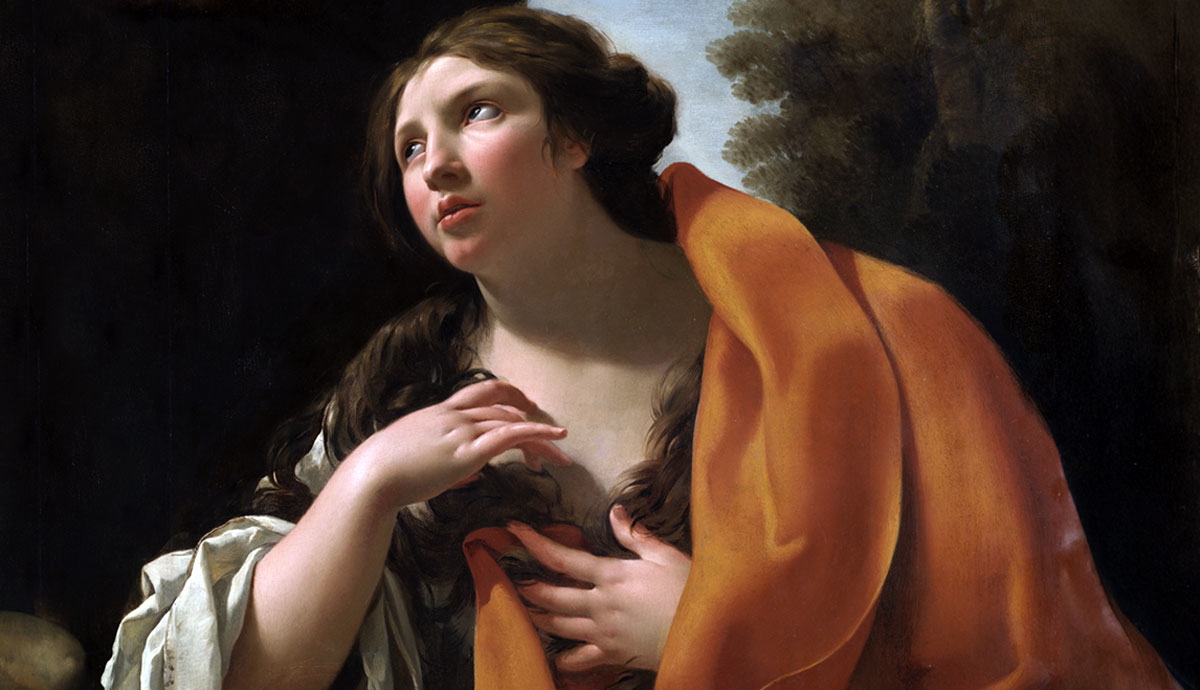
The words that Jesus said to Mary Magdalene outside His tomb have been the source of much debate, discussion, and creative interpretation through the centuries. The Gospel account and other secondary sources have complicated the meaning that Noli Me Tangere could possibly have. In simple terms, why did Jesus tell Mary to not hold onto Him? Is it a question of healthy detachment or the space between humanity and the divine?
If one chooses the latter, one agrees that “the risen and therefore divine body is out of bounds” (Barbara Baert). This perspective holds that after rising from the dead, Jesus is no longer a normal human being, but fully God.
It is not a theological or Biblical outlook, since the Gospels hold that Jesus was God incarnated from his birth. This matter is further complicated when the risen Christ allows Thomas to touch him (John 20:24-29).
The Space Between

Artistic depictions of Mary have misinterpreted Jesus’ statement and made her into a seductress. A more accurate description became prevalent in all kinds of Christian artworks through the centuries.
Perhaps the most famous example is Michelangelo’s ‘Creation of Adam’ where the man reaches out his hand lazily, while the Maker’s hand is fully extended – yet between them is a gaping space.
Some have said that the whole story of the Bible centers around the divide between mankind and God, caused by the Fall of Sin. This divide is crossed by Jesus, who became like a bridge, stepping in to fill the gap. See 2 Corinthians 5:18-20.
The Bible explains why Jesus says Noli Me Tangere, for he follows it up by saying: “ for I have not yet ascended to the Father”. Therefore, one might conclude that Jesus was saying – There is more to be done.
A Christian Perspective on Noli Me Tangere
The Bible tells one big story and when we read this mysterious phrase in context with the rest, its meaning becomes much clearer. How? This was not the only time when Jesus told those closest to Him to let go of Him.
John 16:5-7
“Now I am going to him who sent me. None of you asks me, ‘Where are you going?’ Rather, you are filled with grief because I have said these things. But very truly I tell you, it is for your good that I am going away.”
John 14:3-5
“If I go and prepare a place for you, I will come back and take you to be with me that you also may be where I am. You know the way to the place where I am going.” Thomas said to him, “Lord, we don’t know where you are going, so how can we know the way?”
Why Did Jesus Tell Mary to Let Go of Him?
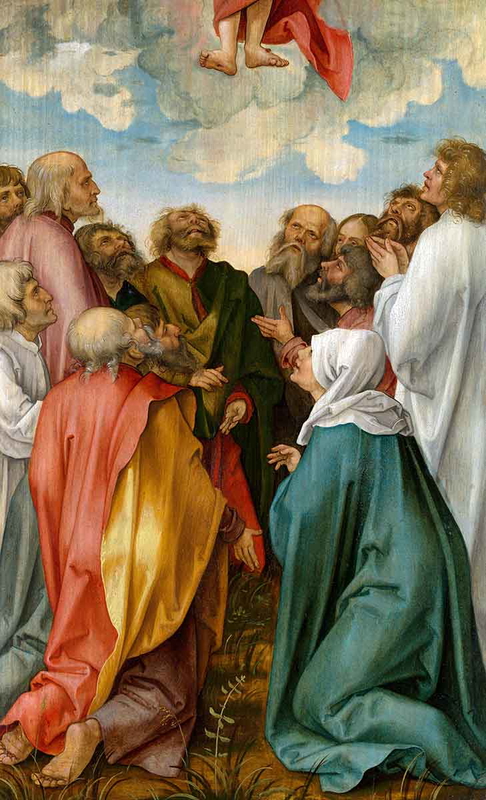
In conclusion, a more probable explanation is that Jesus did not say: “Do not touch me”, but that he said something along the lines of: “Don’t hold on to me. Let go of me. Don’t cling to me. Let me go.” Those close to Jesus never understood what Christians believe in now, because they had not yet seen the full picture. The story was not finished yet.
Again and again, Jesus was about the Father’s business while nobody understood. Even as a young boy, Luke 2:49 tells us that Jesus said to his earthly parents: “Why did you seek Me? Did you not know that I must be about My Father’s business?”
Noli Me Tangere is as Jesus said to Peter in Matthew 16:23: “Get behind me, Satan! You are a stumbling block to me; you do not have in mind the concerns of God, but merely human concerns.”