The Sutton Hoo helmet’s extraordinary craftsmanship and nearly unique design hint at much about the early Anglo-Saxon kings. Yet, so too can the nature of its final fate and resting place. A venerable symbol of warrior might that hints at an ancestral homeland and an ancient imperial power, it may have been a depiction of royalty as the divine, handed down for generations until its final owner buried it with him as a sign of changing times and a new cultural revolution sweeping through his people.
Craftsmanship and Expense
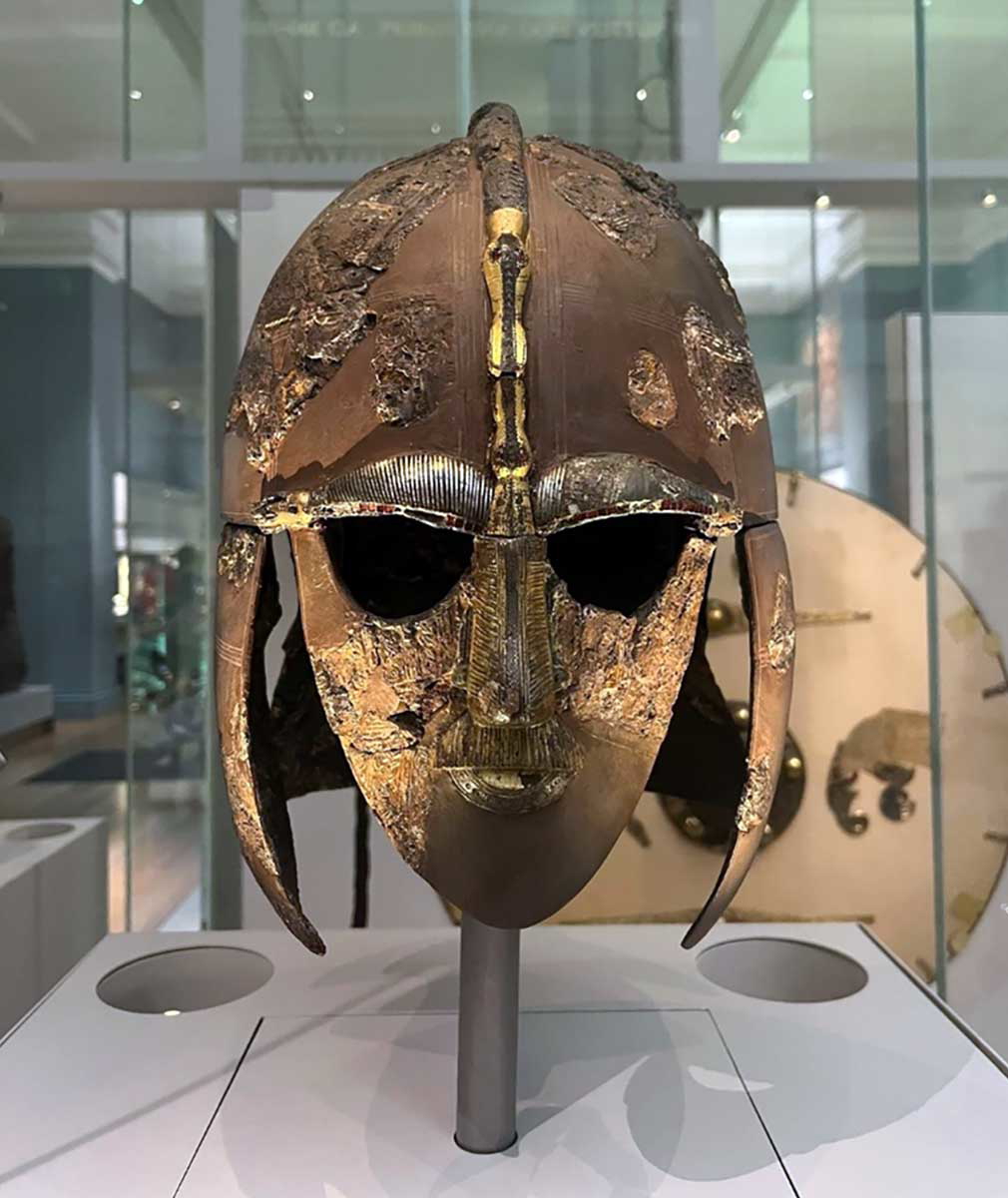
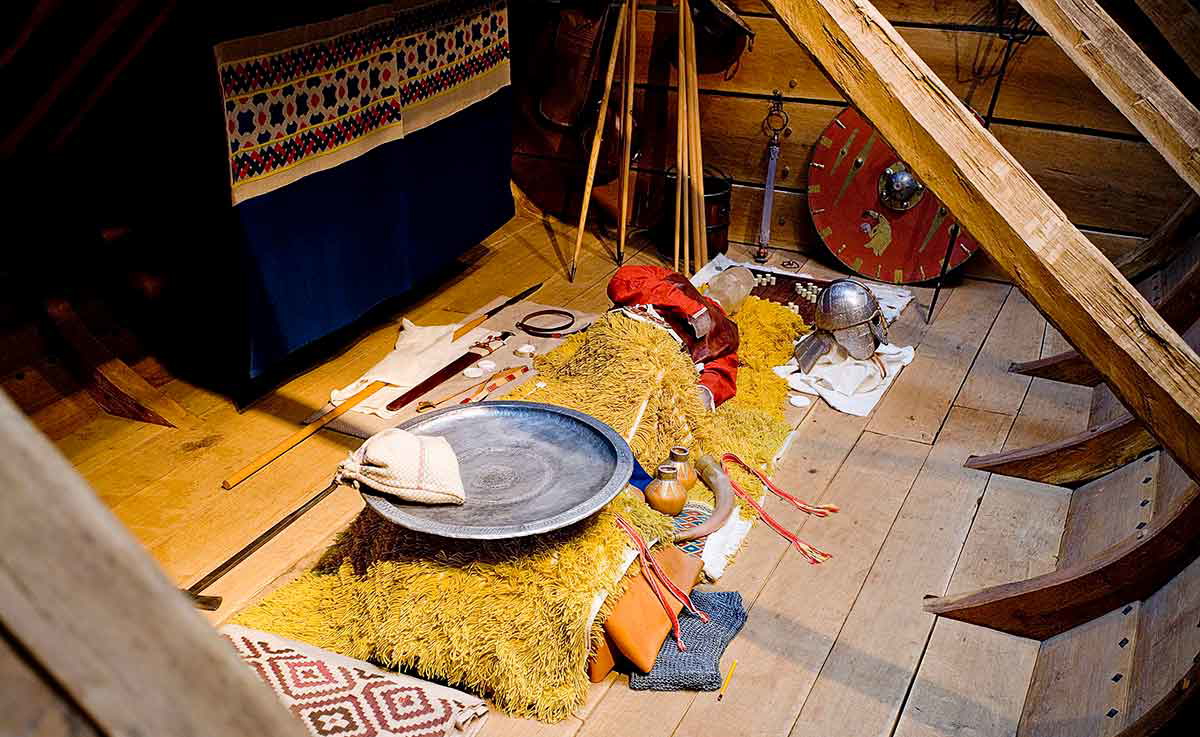
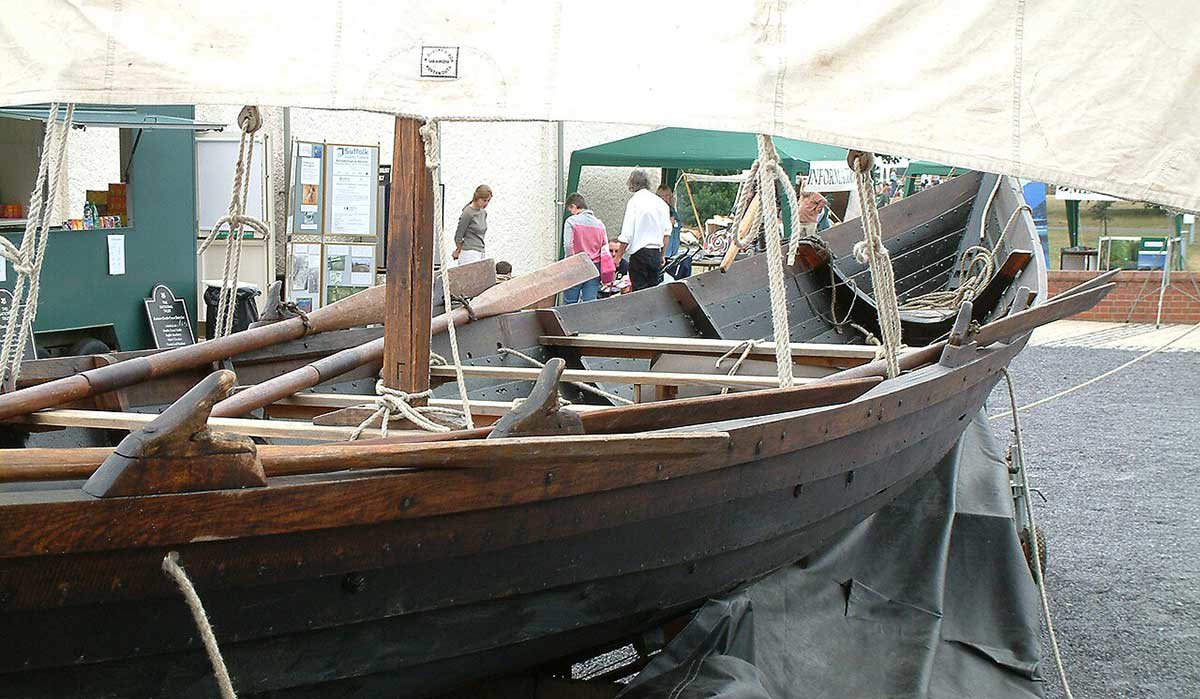
The Sutton Hoo helmet was part of a ship burial between 595-640 AD, close to Rendlesham, a royal settlement of the ancient Anglo-Saxon kingdom of East Anglia.
Due to the location and magnificence of the grave goods, it was almost certainly a royal burial. The grave’s likely occupant is King Raedwald (died circa 627) of the ruling Wuffingas Dynasty of East Anglia, or his son, Rægenhere, who predeceased him in battle. Chief among the spectacular items buried in the grave is the helmet. It is as much a piece of art as a piece of armor.
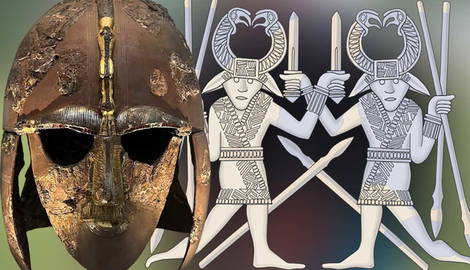
The helmet’s skullcap is made of a single piece of iron covered in tinned bronze with a crested ridge, or comb crest, running over the top. The faceplate, cheek, and neck guards were also made of iron covered in bronze and were attached to the cap by leather hinges. The faceplate bears the appearance of a mustachioed face, with the nose and eyebrows together forming a crest in the shape of a dragon. Similarly, the ends of the comb crest are adorned with intricate serpent heads, while both eyebrows end in the shape of wild boars.
The helmet was decorated with gold and silver plating and wiring, as well as red garnets fitted along the eyebrows and the eyes of the dragon, serpents, and boars. Then there are the intricate artworks embossed onto the helmet, depicting mythological creatures as well as scenes of battle and rituals, along with some more abstract shapes.
The helmet would have been fabulously expensive just in craftsmanship hours alone, to say nothing of the beautifully intricate decorations and the precious metals and jewelry used in its creation. It holds almost no equal in splendor in contemporary Anglo-Saxon helmets, though none of these other helmets were found in a funeral setting like that at Sutton Hoo. However, the helmet was no mere grave good or objet d’art.
The helmet is believed to be many years old when buried, although not quite the centenarian previously thought. It undoubtedly displayed the wealth and prestige of those who first had it made and those who kept it after as a magnificent heirloom. This was a helmet made to be seen, yet just as it was not merely made for the grave, it was also not just a replica.
Magnificent War Gear
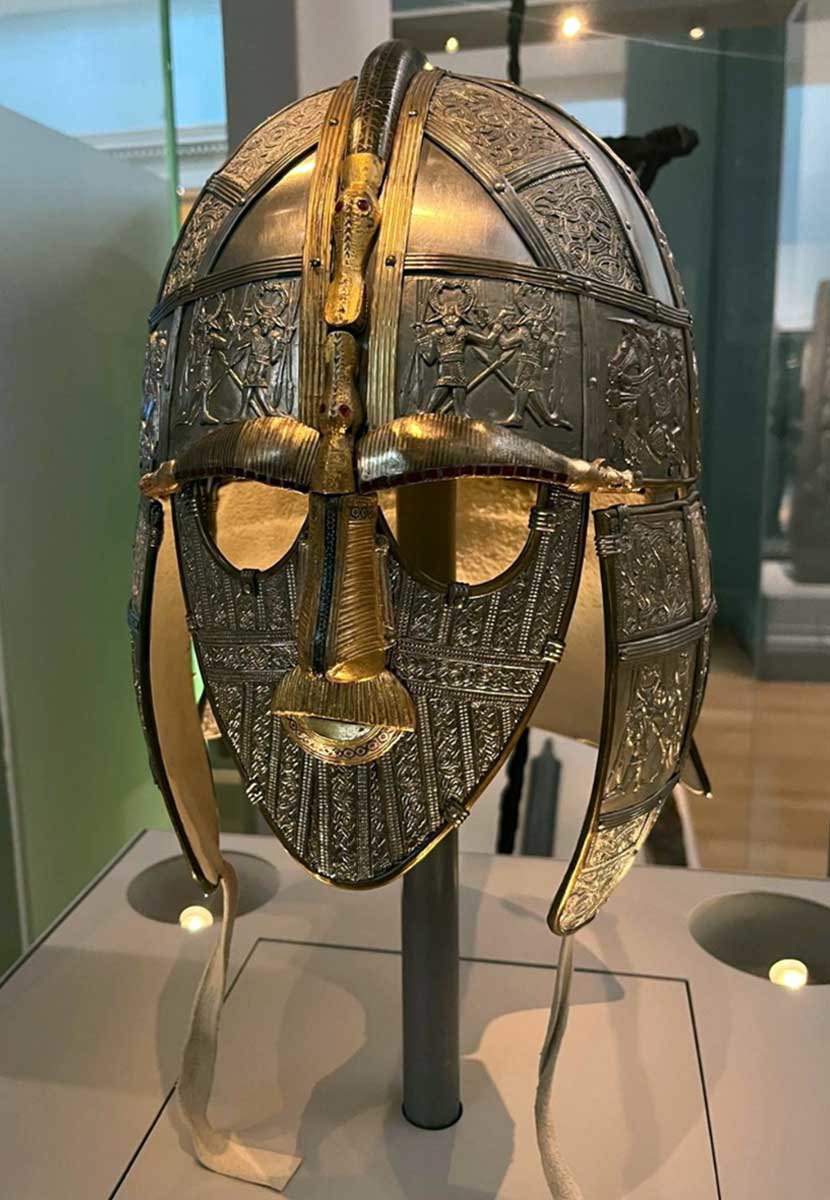
The intricacy and skill of the helmet’s craftsmanship were not just reserved for the decoration but also for its effectiveness as battlefield protection. The neck and cheek guards were designed to allow a full range of movement, granting protection without sacrificing mobility. Meanwhile, the cheek guards follow the natural curve of the face and could be tied together under the chin, thereby, in combination with the faceplate, fully protecting the head and face. All the while, the eye and mouth holes in the faceplate allowed for breathability and a range of vision greater than some late medieval helmets.
The Sutton Hoo helmet was, in other words, a top-of-the-range protection piece. It cannot be said for certain whether it was used in battle, but signs of repair and general wear and tear do indicate some use, if not in battle, then in some other way. In the martial natured Anglo-Saxon society, the helmet was not just symbolic of power but was a power in its own right.
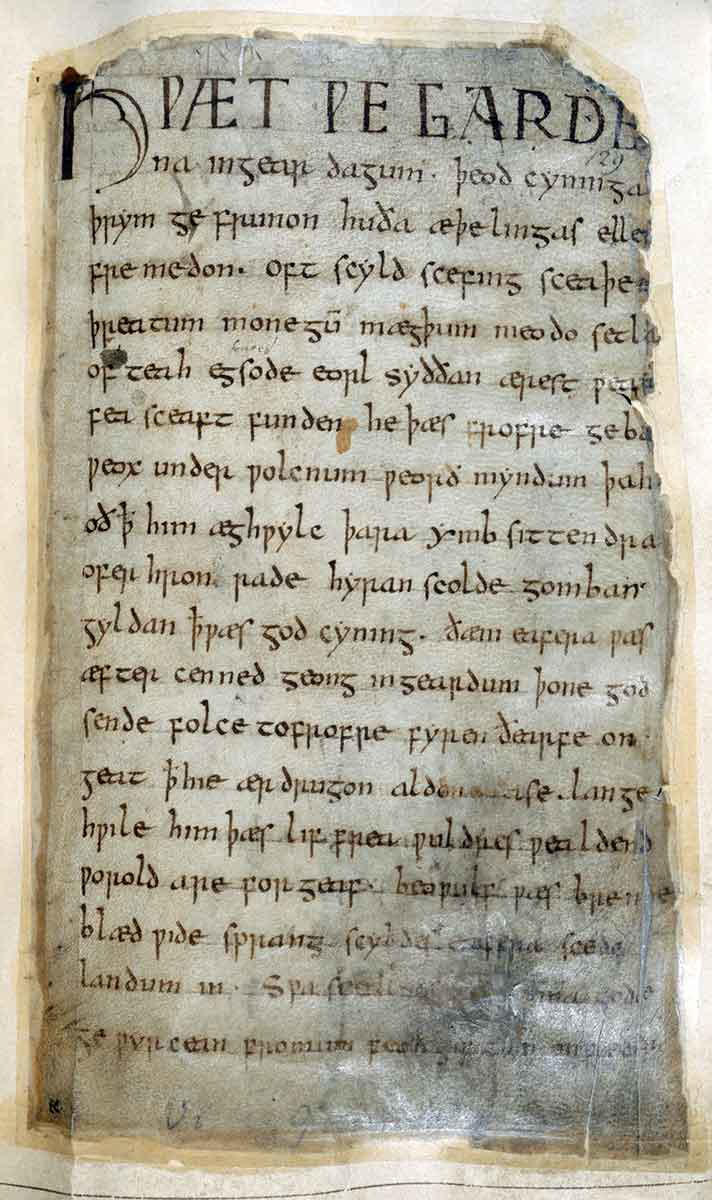
The epic poem Beowulf, hypothesized to have been first composed around a century after the Sutton Hoo burial and possibly drawing from older sources, goes into great detail regarding helmets. The helmets in Beowulf are described as having decoration like that of the Sutton Hoo helmet and are depicted as serving three purposes: battle protection, naturally; as gifts given by mighty rulers to valiant warriors; or as grave goods given in honor to renowned heroes and kings. The Sutton Hoo helmet is famously the latter and could well have been one or both of the former as well. Crucially, though, the Beowulf grave helmets and gifts are not replicas but battle-ready and tested, genuine items of war, some even noted for their service history.
Essentially, the Sutton Hoo helmet confirms the importance of helmets and their artistry in Anglo-Saxon England. This was a helmet that displayed wealth and social standing but in true warrior, rather than symbolic, terms, designed for kings and subjects who venerated warrior might. Yet the intricate carvings also suggest a fascinating link in the helmet’s origins, which may reveal other clues about the Anglo-Saxon kings.
Connection to the Ancestral Homeland
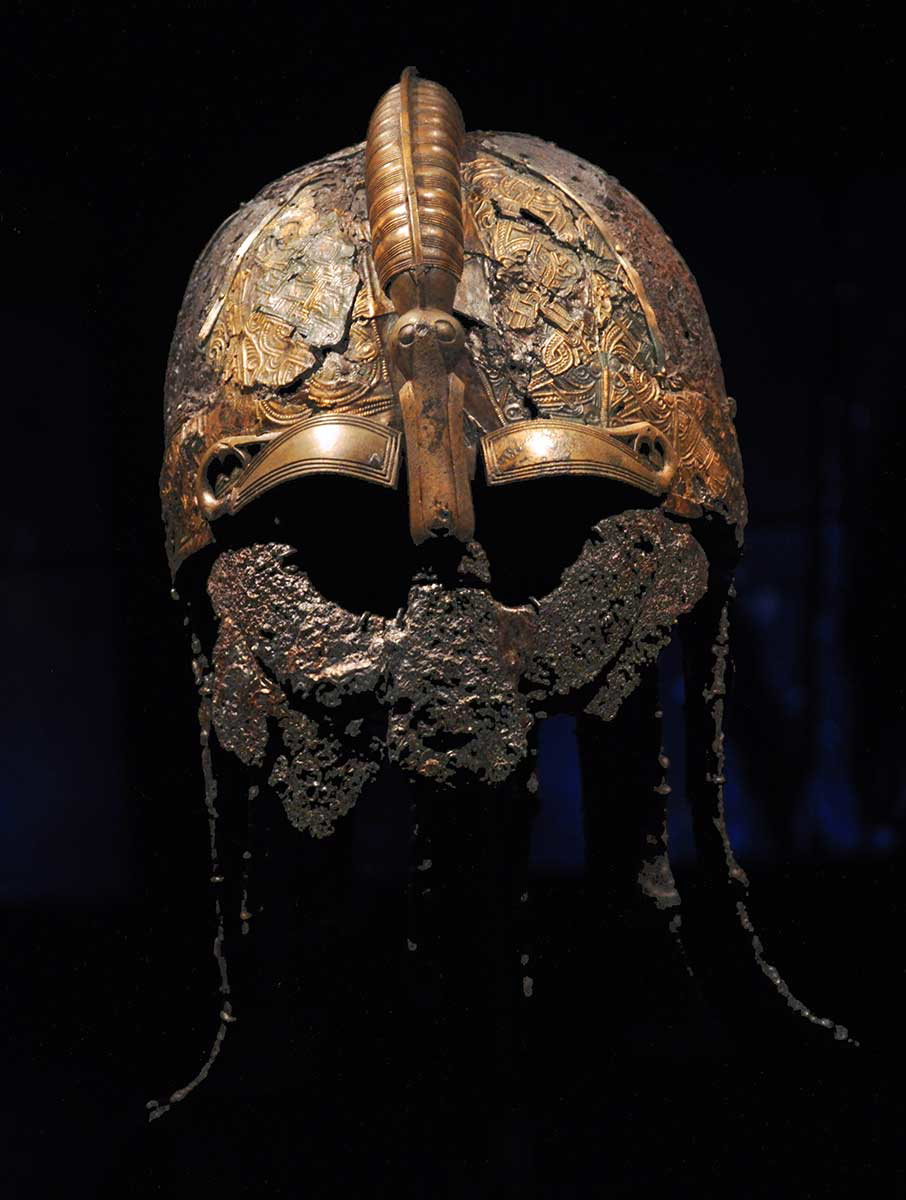
Fascinatingly, the Sutton Hoo helmet, in design and location, has much in common with other rediscovered helmets from a similar time period, not in England but Scandinavia. In particular, there are the Vendel and Valsgärde Helmets from Sweden, almost all of which are ridge helmets found in similar mound and ship burials like the Sutton Hoo helmet. The helmets also share many stylistic features, including crests along the comb, and eyebrows and nose designs featuring creatures both mythical and mundane.
Despite also being richly decorated with precious metals and garnet inlays, these helmets were also entirely battle-capable. Interestingly, the Sutton Hoo helmet is not alone in these similarities. Other Anglo-Saxon helmets from the time also share some similar designs with their Scandinavian counterparts, most notably the repeated depiction of boars. Yet the most fascinating shared feature, only possessed by the Sutton Hoo and Scandinavian helmets, is the scenes and motifs embossed upon them.
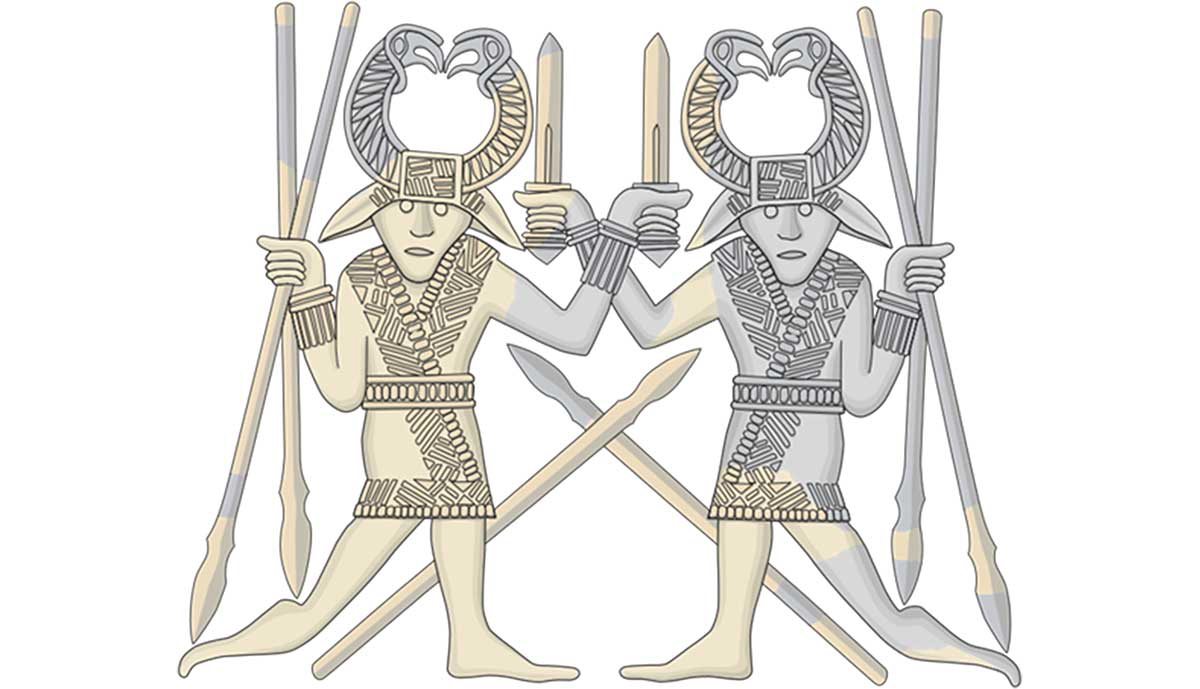
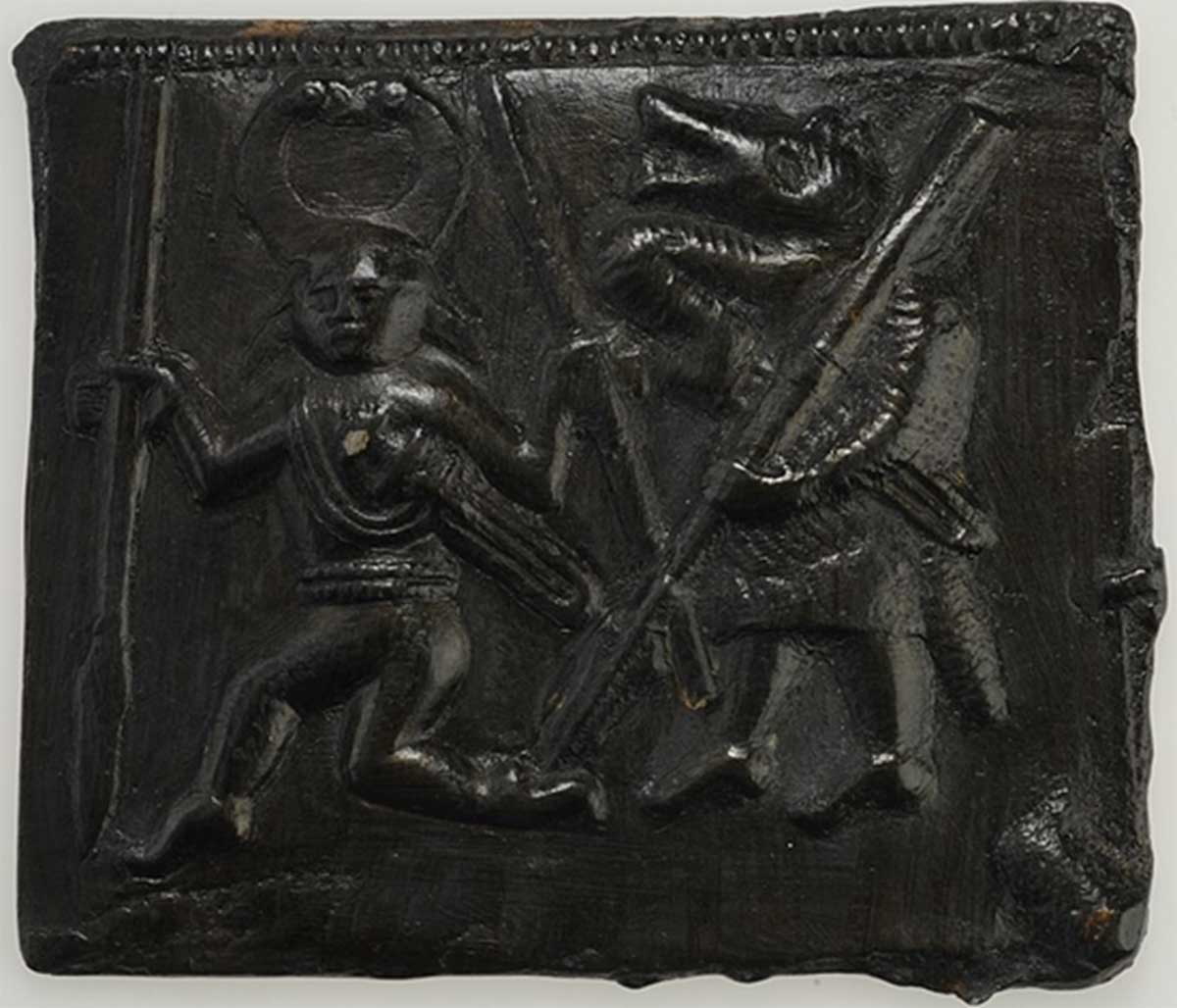
Not only are these designs done the same way, stamped onto the helmet using specialized die plates, but the images on them are astonishingly similar. The most notable is a repeated motif of spear-armed dancing warriors found both on the Sutton Hoo helmet and one of the Valsgärde helmets. They even appear on other contemporary artefacts, including the contemporary Torslunda plates from Sweden and a recently discovered cast die found in Denmark.
These artistic similarities clearly demonstrate that Anglo-Saxon culture still held strong connections with its ancestral homeland. Additionally, the identical way that the Sutton Hoo mirrored the Scandinavian helmets in becoming a grave good of status demonstrates that royal prestige and power continued to hold onto this cultural connection throughout the years.
Connection With Rome
Clearly then, the Anglo-Saxons continued to have contact with their Scandinavian homelands either through trade or possibly cultural exchange too. Indeed, some believe the Sutton Hoo helmet itself originated in Scandinavia. It may have been made to order, traded, given as a royal gift, or even brought over during the original migrations. Chronology makes the latter suggestion unlikely, but the idea of a Scandinavian origin cannot entirely be ruled out. At the very least, the helmet was made by Scandinavian artisans, or ones intimately familiar with their style, techniques, and contemporary artistry. Moreover, the shield found alongside the helmet in the ship burial is also believed to have been from Sweden.
Outside of the general design, artwork, and decoration, though, there are several crucial differences between the helmets. The Scandinavian helmets are generally made of multiple iron pieces rather than one. Additionally, unlike the Scandinavian helmets, the Sutton Hoo helmet’s comb crest is not solid iron, but a hollow tube filled with silver wiring. Meanwhile, the Sutton Hoo helmet contains other features more readily present in contemporary Anglo-Saxon helmets, in particular the prominent neck and cheek guards.
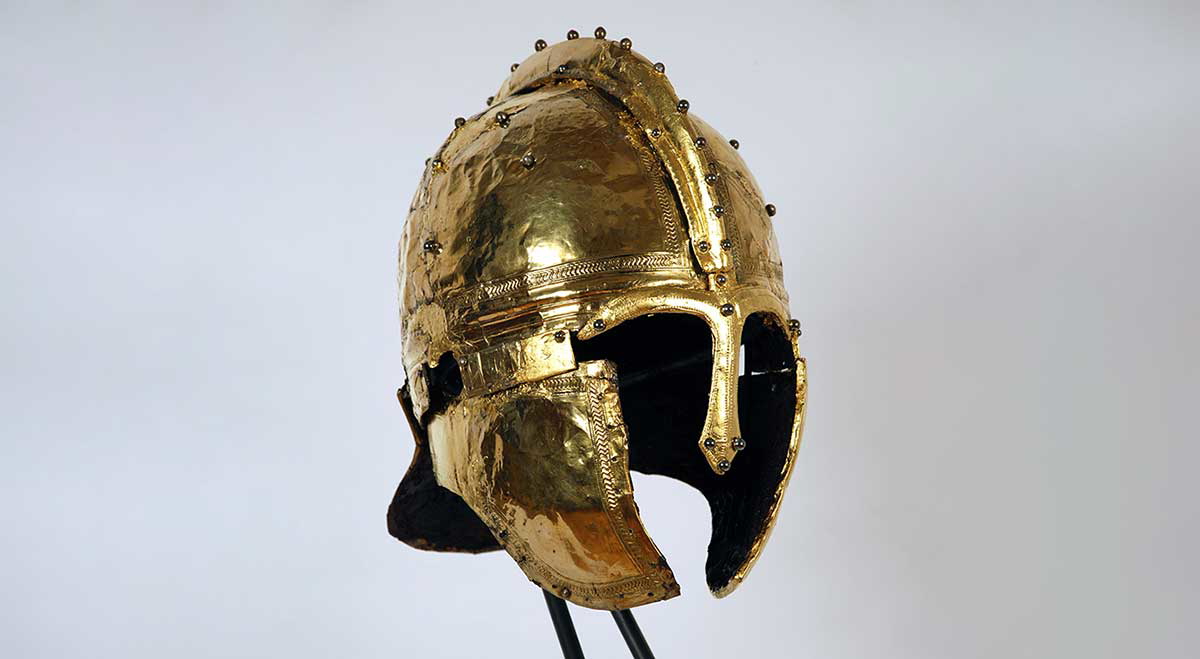
In fact, these features may have an older, more imperial origin. In truth, all the English and Scandinavian helmets were descended from late Roman helmets, adopted and adapted by Germanic tribes through trade, cultural contact, and military service. Some historians have suggested that the early Anglo-Saxon, Scandinavian, and Germanic helmets originated with helmets acquired by Germanic mercenaries serving in the Roman army. The mercenaries may have adorned their Roman helmets with Germanic decoration and mythical protection and returned adorned with headpieces displaying their victorious prowess.
A partial Roman inspiration would also help explain the cheek and neck guards featured more prominently in the English helmets. Both features are very common among late Roman infantry helmets, which are more prevalent in Britain than in Scandinavia, which was never part of the empire. Likewise, Roman cavalry helmets have been found in Britain that have masks and faces that may have inspired the faceplate of the Sutton Hoo helmet. Yet, the Sutton Hoo faceplate itself also requires closer examination.
Masquerade
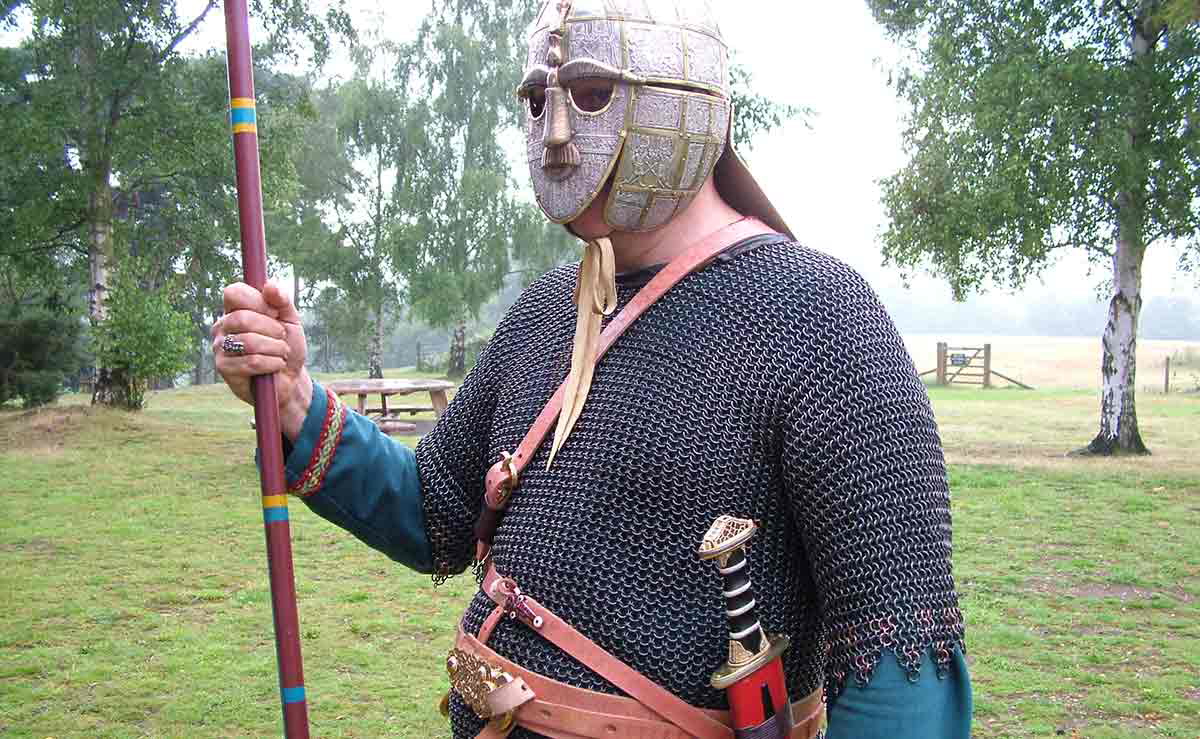
The Sutton Hoo faceplate is unique among English and Scandinavian helmets. Once again, Beowulf references helmets with “visors” and faceplates, known in Old English as “Grima.” Archaeologically, though, only rudimentary face coverings, nothing seemingly as comprehensive or magnificent as Sutton Hoo’s grima, and mere images of warriors with full face masks have been discovered. While contemporary Germanic helmets have noseguards and some have eyebrow crests or spectacle pieces to protect the eyes or prominent cheek guards, a full facemask has not been discovered. It also differs from the original Roman cavalry helmets, which generally bore proper faces, or at least stylized ones, wrought as a single piece. By contrast, Sutton Hoo’s grima is more abstract with its expressionless and ethereal features formed from animal and mythical decorations.
At the very least, it appears a full faceplate for a helmet was an item of extraordinary status, reserved mostly for poetry or the most powerful of royalty. However, the relative uniqueness and mysterious stylization raise further questions. Sutton Hoo’s grima would give the wearer greater presence as well as greater protection, distorting and amplifying their voice while intimidating foes with its implacable and indiscernible face. However, other contemporary helmets were content to use chainmail coverings or close cheek, nose, and eye guards to protect the face rather than a mask to intimidate foes. A full-on, fully fashioned facemask appears like comparative overkill, or suggests a further purpose.
Perhaps a mask may not have just covered the wearer’s face for protection, but also as a way of donning the guise of whoever the face was meant to be. A legendary hero or a more divine figure? In fact, a few key details and cultural indications suggest the helmet was perhaps a representation of the famous Germanic one-eyed god Odin, known to the Anglo-Saxons as Woden.
Aspect of Divinity
Despite their fine craftsmanship, the eyes and brows of the Sutton Hoo mask are not perfectly alike. Alongside minute differences in their size and symmetry, the garnets along the right eyebrow were overlaid on pieces of gold foil, while the ones along the left were not. This has the effect of making the right eye shine brightly even in daylight, while the left remains relatively dark. The difference between the eyebrows is too noticeable and too easy to fix to be an unintentional error. In the flickering firelight of an Anglo-Saxon hall, this effect would have been even more pronounced. The right eye would appear shimmering and bright, and the left a shadowed void, almost as though the face had only one eye, like Woden.
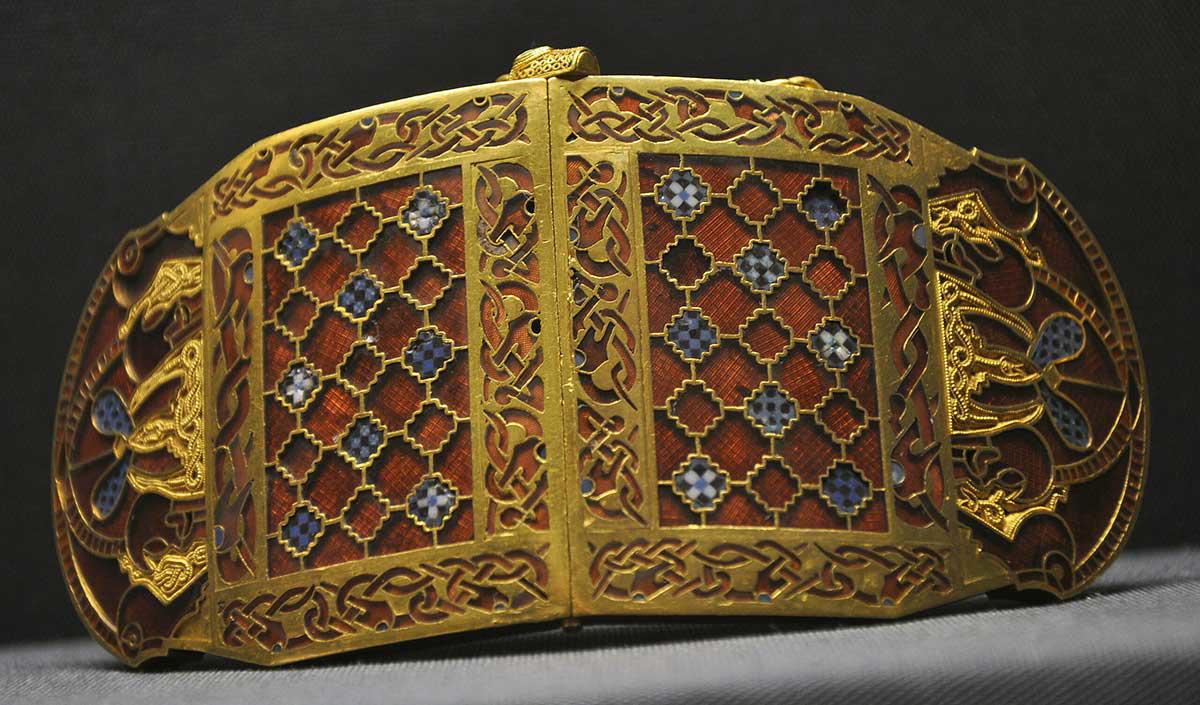
The helmet is not alone in its decorations, suggesting one eye. Other helmets include one of the Torslunda plate dancing figures, a serpent on a Valsgärde helmet, and a male figure on a purse lid, also in the Sutton Hoo ship grave. The motif appears too often throughout Germanic cultures at the time to be coincidental, but there are other direct connections between the helmet and Woden as well. The embossed images of the dancing warriors, akin to the Torslunda plates and Valsgärde helm, are widely believed to be performing worshipers of Woden. Moreover, information from Anglo-Saxon chronicles and royal genealogies suggests the East Anglian Wuffingas Dynasty claimed direct descent from Woden.
A helmet depicting the chief of the Germanic pantheon, and the possible ancestor of the royal family, would undoubtedly hold significance in any context. Perhaps the East Anglian king, or his champion, might have symbolically donned the helmet to become the avatar of Woden to inspire his troops and terrify his enemies. Or perhaps it was used to inspire awe among subjects during a royal ceremony or religious rite. It is believed that religious practice was dictated and enacted by royalty, so a king may well have looked to embody Woden in some religious ceremony or ritual.
Sadly, the truth is that this is largely speculation. The strength of the evidence is compelling enough to make most historians confident in some sort of Woden connection. However, as strong as the circumstances and tantalizing as the connected clues may be, the helmet’s actual purpose, either as Woden or not, cannot be proven beyond all doubt.
The Helmet’s End

For all that we can appreciate about the helmet’s grandeur, rarity, and cultural connections, all that can be said definitively is that it was buried in a grave. Yet, even the helmet’s final end reveals intriguing insights into social changes and royal power occurring at the time.
At the very least, whatever the helmet’s purpose in life, in death it revealed how highly regarded the deceased, either Raedwald or perhaps Rægenhere, were. Not idly would such a costly and magnificent item as the helmet, nor the other treasures alongside it, have been consigned to a grave. In this way, the helmet’s burial was a statement in itself, a testament to the deceased’s status to be buried with a prized royal heirloom.
Raedwald, according to later chroniclers, was the first king of East Anglia to convert to Christianity. However, the Sutton Hoo burial was a decidedly non-Christian Germanic pagan ship burial, while the helmet is overtly pagan in its symbolism and decoration, regardless of the potential Woden connection. Whoever was buried with the helmet was buried with all the trappings and ceremony of a Germanic pagan ruler. Despite his conversion, Raedwald appears to have also kept to some pagan traditions, maintaining a pagan altar alongside his Christian one and perhaps arranging for himself a pagan funeral.
Regardless of Raedwald’s religious convictions, though, it was clear that this was a time of cultural and religious flux. The new religion took some time to take hold; meanwhile, the old ways were still maintained, and ancient artifacts were revered in the memory of the glorious dead. Indeed, it is believed that even after Christianity was fully embraced by the Anglo-Saxons, they still included grave goods in the most prominent burials.
The question remains, though, why, when it was still usable, was such a prestigious artifact as the Sutton Hoo helmet consigned to the grave after many years of service? Perhaps the helmet was buried in the belief it no longer held any power with the adoption of Christianity. Or perhaps it was a symbolic gesture.
Conclusion

While this is all speculation, the symbolism and timing are too profound to dismiss outright. There are all manner of plausible theories as to why a helmet that was likely strongly tied to Anglo-Saxon royalty, their ancestral homelands, religion, and culture, was consigned to a grave. Perhaps it merely demonstrates that, despite Christianity’s arrival, pagan traditions still held some sway until the early to mid-7th century. East Anglia would have at least one or more fully pagan kings, though the royal graveyard of Sutton Hoo appears to have ceased being used after Raedwald’s passing.
With all the context around the helmet and the time period, there is an unshakeable sense of transition, of times changing from its final act. Perhaps, in one of the last acts performed at the royal burial site of Sutton Hoo, Raedwald was venerated with a mighty hero’s funeral and buried alongside the helmet that symbolized ancient royal power. Perhaps Raedwald was the one honoring his own son with this most magnificent heirloom while also demonstrating that such pagan items were a thing of the past.
In the end, the lessons from the Sutton Hoo helmet about Anglo-Saxon royal power can be seen in the helmet itself and how it was treated. It was lavishly designed, venerated for many years before reverently given up to the memory of a great man. In the martial culture of the Anglo-Saxons, it displayed wealth, status, and both spiritual and temporal power. It tells us too that the Anglo-Saxons still held a close cultural connection with their ancestral homeland and culture, and may have shared material and crafting expertise. Not to mention being a display of mythical creatures and spiritual protection so venerated that even when embracing a new religion, they still looked to its ancient power for one last journey to protect its final owner in the afterlife.