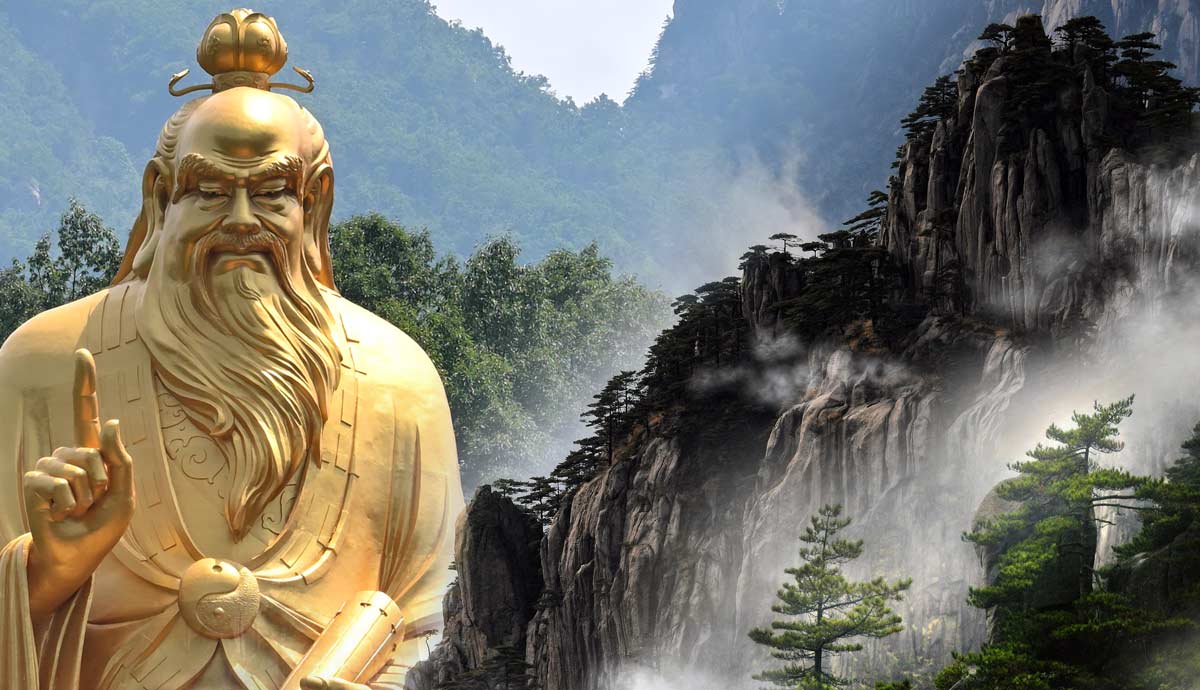
Taoism is one of China’s oldest spiritual traditions, dating to the 6th century BCE. Its influence on Chinese society cannot be overstated, as one of the two native philosophies of China, the other being Confucianism. Taoism, as we know it, is held to have been founded by a philosopher called Laozi. The word literally translates as “Old Philosopher/Master.” However, there isn’t enough historical record to verify his existence.
Taoism’s core philosophy, expressed simply, is “Go with the flow.” Life, health, and circumstances are always changing. To be the healthiest and happiest version of oneself possible, Taoism teaches that we should do our best to live in harmony with nature. The study of the cycles of nature, such as the day/night cycle, the seasons, and the natural rhythms of the body, forms some of the basis of Taoist thought and plays a key role in traditional Chinese medicine.
Taoist Texts
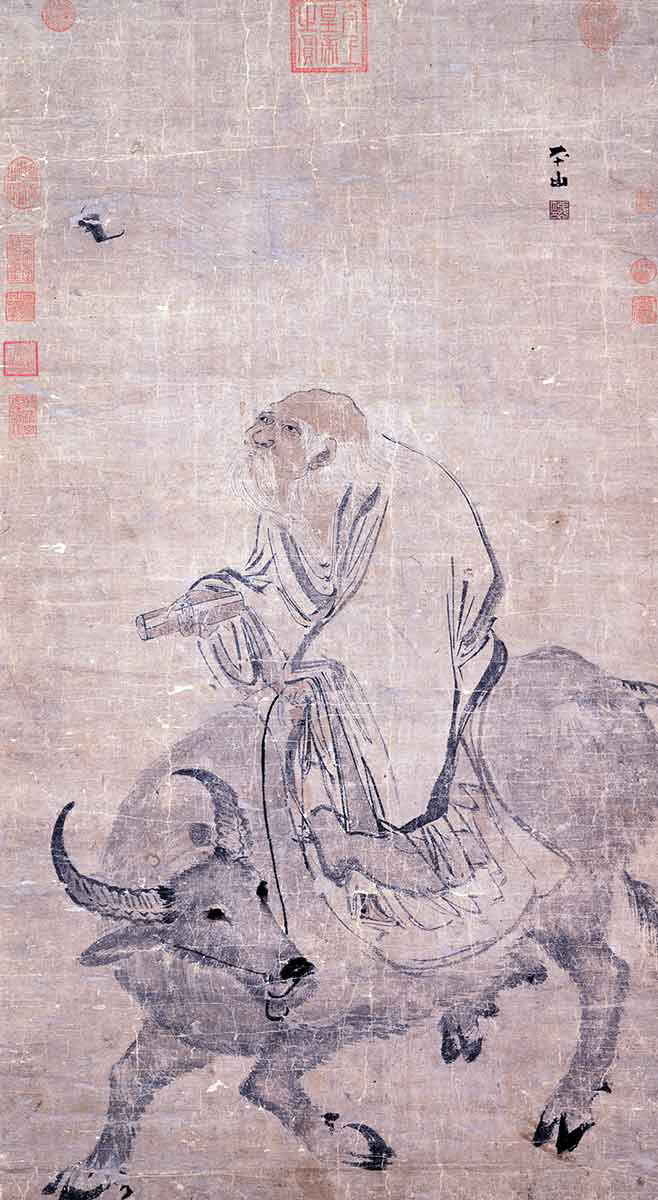
Taoism is a complex topic with millennia of history, far more than can be adequately explained in a single article. For anyone wanting to learn more about Taoism, the best resources are several texts featured in Taoist philosophy.
The first is the Tao Te Ching. Translated to “Book of the Way,” in it, Laozi outlines the Three Virtues of Taoism and explains his interpretation of the Tao. It was intended more for the ruling class than for commoners.
After reading Tao Te Ching, read the I Ching, or Book of Changes. This is a listing of 64 different combinations of the eight forces, or aspects of the Tao, that govern the universe, expressed as a set of two trigrams consisting of three broken or unbroken lines. Originally, this was intended as a method of divination to replace oracle bones (which were often seen as too hard to read). The hexagram descriptions are written vaguely, which allows them to be applied to a variety of situations.
For further reading, try the Zhuangzi. Although most of the contents are attributed to a philosopher named Zhang Zhou, it was actually compiled sometime during the Jin Dynasty (266-420 CE) by Guo Xiang. Zhunagzi is a collection of parables and anecdotes, most of which stress the need for spontaneity that comes naturally, ultimately leading to wu wei, the idea of acting without intent. One of the most famous stories in the Zhuangzi is The Butterfly-Dreaming Man, in which the character questions whether they are a person dreaming of being a butterfly or a butterfly dreaming of being a person.
What Is the Tao?
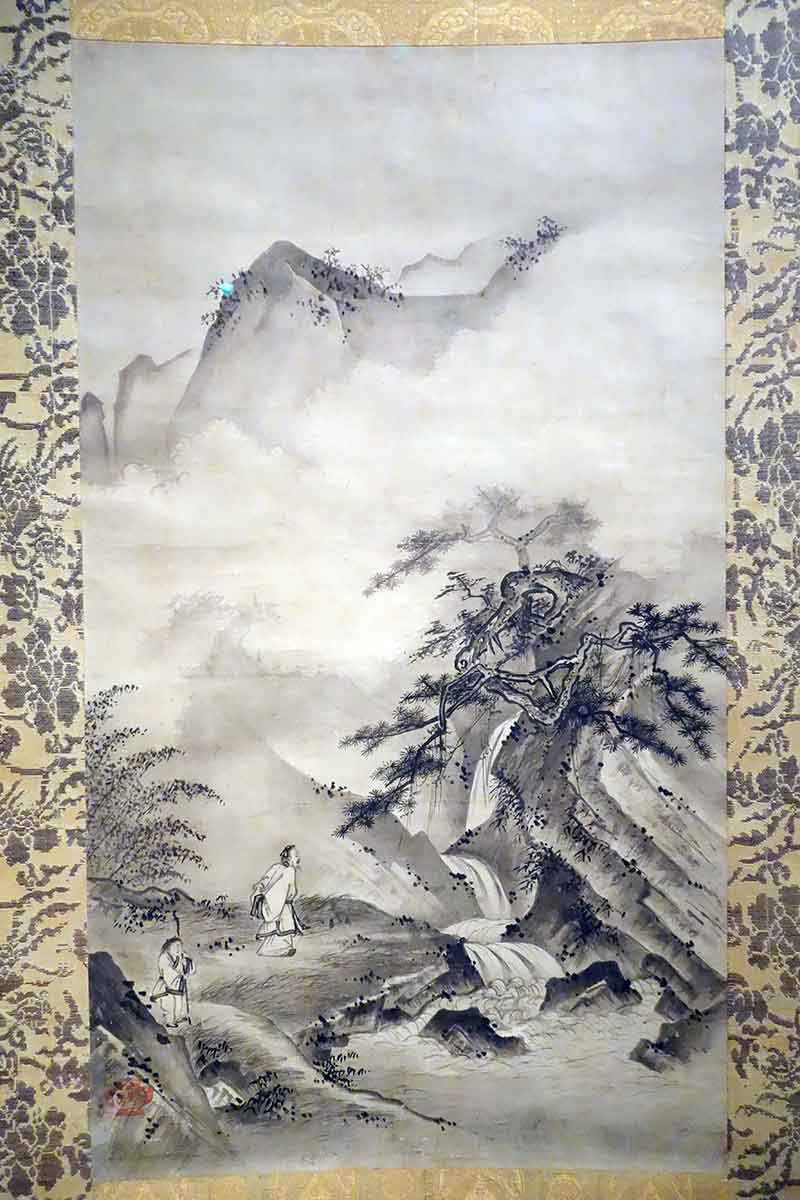
The word Tao/Dao is often translated as “way” or “path.” In this context, it can be taken to refer to the underlying force that gives rise to existence and the universe. The Tao cannot be adequately described through words alone, as the Tao Te Ching puts it in the very first passage, “The Tao that can be spoken of is not the true Tao.” However, different words are used to describe certain aspects of it. For example, the word wuji, loosely meaning “infinity,” is used in Tao Te Ching, meant to represent boundless and undifferentiated potential. It is represented by a white circle.
Taiji is described as the most fundamental underpinning of reality, according to Taoist belief, that we can perceive and define. It consists of the two groups of forces categorized under yin and yang, which we’ll discuss more shortly.
The Tao is often compared to water: it does not differentiate where it flows and offers no resistance against force, instead flowing around to fill whatever container it is placed in. Water is described as the softest substance that, over the course of countless years, erodes even the hardest rock. These metaphors are used to illustrate the characteristics people should adopt to live a fulfilling life: adaptability, generosity, and humility.
Yin and Yang
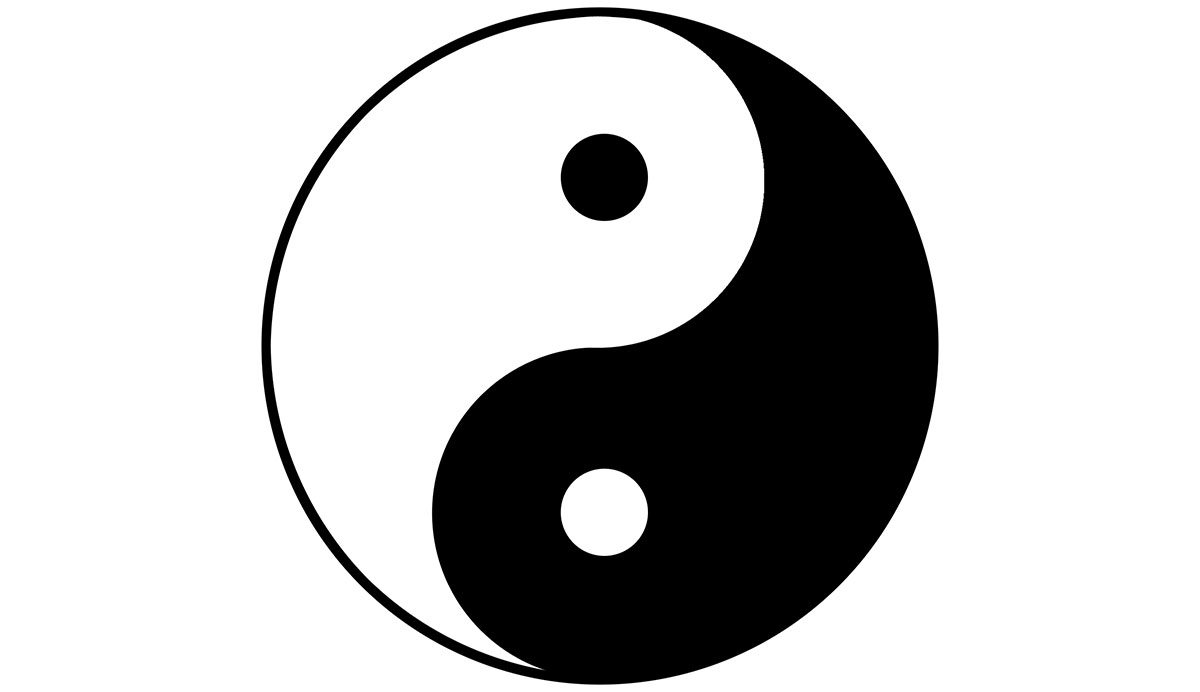
Even if you haven’t made a detailed study of Taoism, you’ve likely heard of the concepts of yin and yang. These are the two opposing sets of forces and aspects of reality that arise from the Tao. They both oppose and complement one another, waxing and waning according to the rhythms of the Tao.
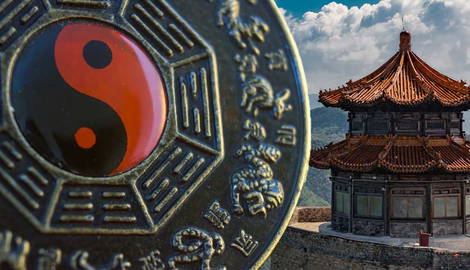
Yin represents darkness, passivity, recession, femininity, and similar concepts. Yang represents light, activity, expansion, and masculinity. Neither is considered to be inherently positive or negative; they are simply two complementary parts of the same whole. The symbol pictured above, called the taijitu, illustrates this idea: the dark half is yin and contains a white spot representing yang, and vice versa. Even when yin is in its absolute lowest state within yang, it is never entirely absent.
The concepts of yin and yang did not originate from Taoism, but were incorporated into it, as were the trigrams that come from the I Ching. The I Ching was written approximately 800 BCE, during the Zhou Dynasty, whereas most of Tao Te Ching was written in the 3rd century BCE, during the Warring States Period.
The Eight Trigrams
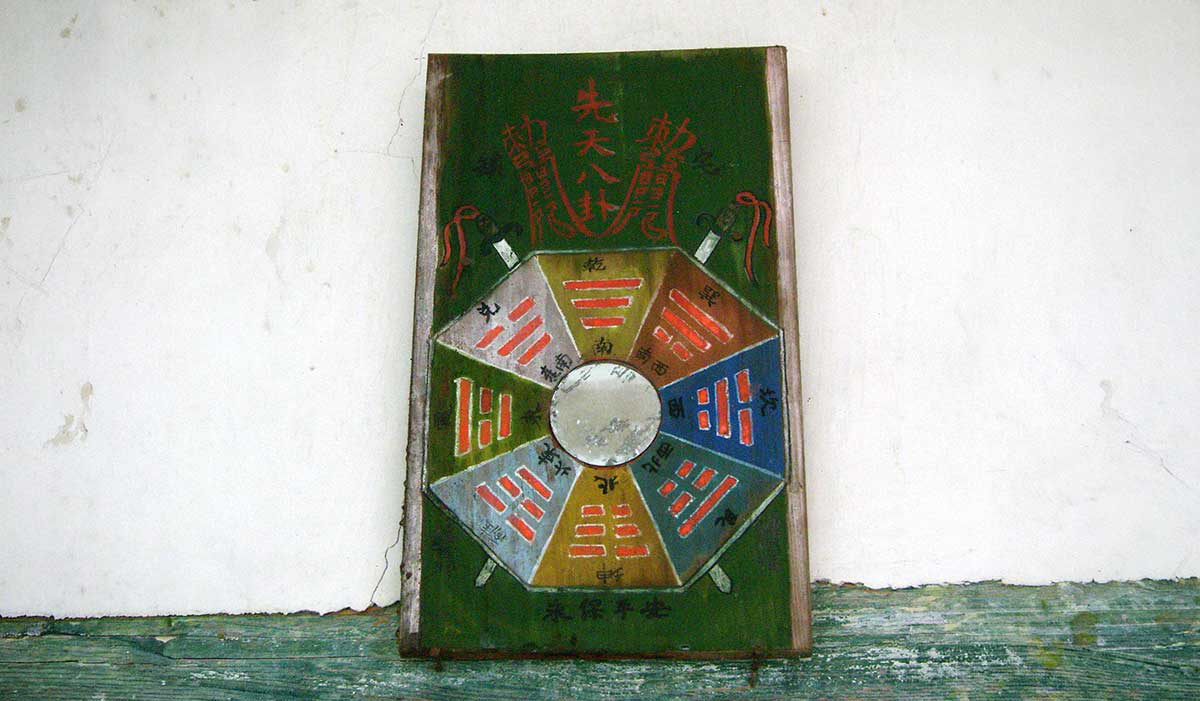
The Eight Trigrams, or Ba Gua, are physical and visual representations of how the forces of yin and yang interact. They each consist of three lines, either broken or unbroken. The bottom line, which is read first, represents the force governing Earth; the middle, human affairs, and the top one the heavens. It acts as a physical/visual representation of how yin and yang interact to create one of eight forces, which are paired. They are Heaven/Earth, Thunder/Wind, Mountain/Lake, and Fire/Water. Each of these is mapped to a direction in space as well as to a time of day and to a season.
Two variants of the bagua system exist: the Fuxi and the King Wen, named respectively after the mythological celestial ruler who first discovered the trigrams and the historical King Wen of the Western Zhou Dynasty. Two trigrams are used in I Ching divination, the lower one used for internal/human aspects, and the upper for external or natural law, creating 64 possible hexagrams.
Wu Xing
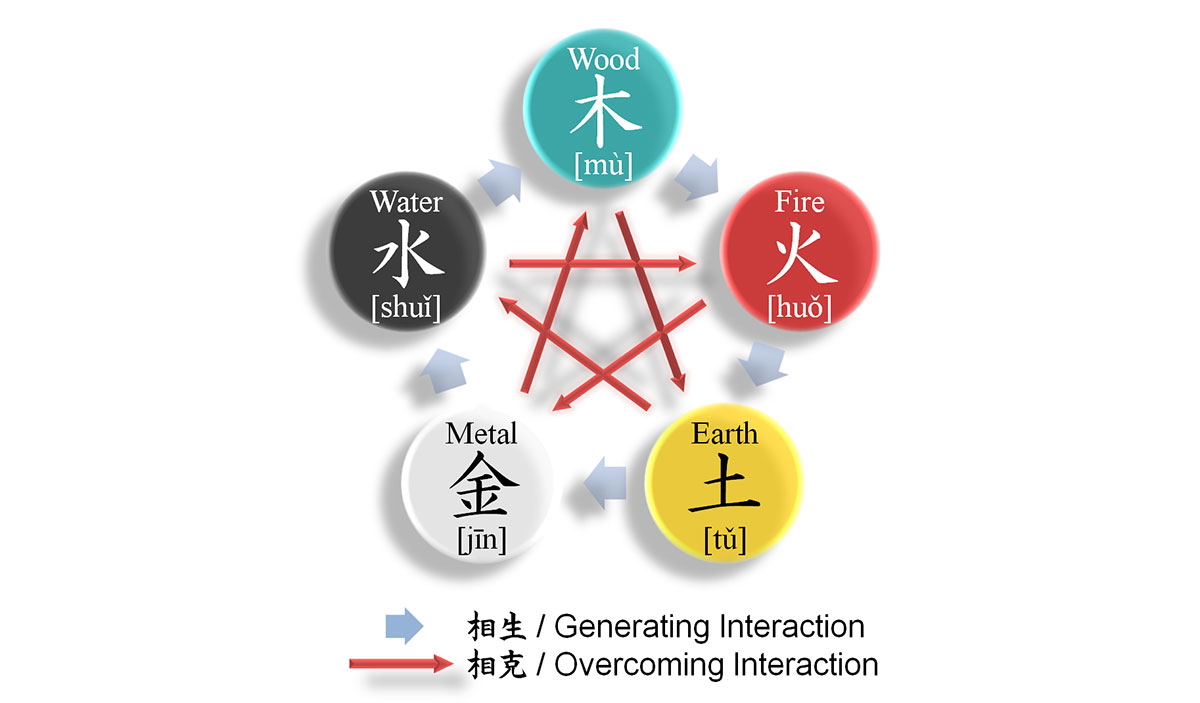
Later integrated into Taoist belief is the Wu Xing, or Five Agents. These are not mentioned in Tao Te Ching, but later in Shang Shu in the chapter titled “Great Plan” or Hongfan. “The nature of water is to soak and descend; of fire, to blaze and ascend; of wood, to be crooked and straight; of metal, to yield and change; while (that of) earth is seen in seed-sowing and in-gathering.” — Written during the Warring States Period, 477-223 BCE.
In Chinese belief, the dynamics and relationships between different phenomena of reality are emphasized more than the physical manifestations or building blocks, like Western elements. The Five Agents are water, wood, earth, fire, and metal, and they interact with one another in two different cycles with two variants: cultivating and controlling. For example, in the cultivating cycle, water nourishes wood, which feeds earth, which in turn produces metal, and then back to water. In the diagram above, this is represented by the clockwise arrows leading from one to the next. By contrast, the controlling cycle could run water to fire to metal to wood to earth.
Wu Xing carries across many concepts and expressions in the natural world; for example, the seasons. Winter is represented by water, spring by wood, the height of summer by fire, the transition to autumn by earth, and autumn by metal.
They relate to yin and yang by representing how these two forces flow and transform into one another: summer represents the Greater Yang, winter represents the Greater Yin.
Three Virtues of Taoism
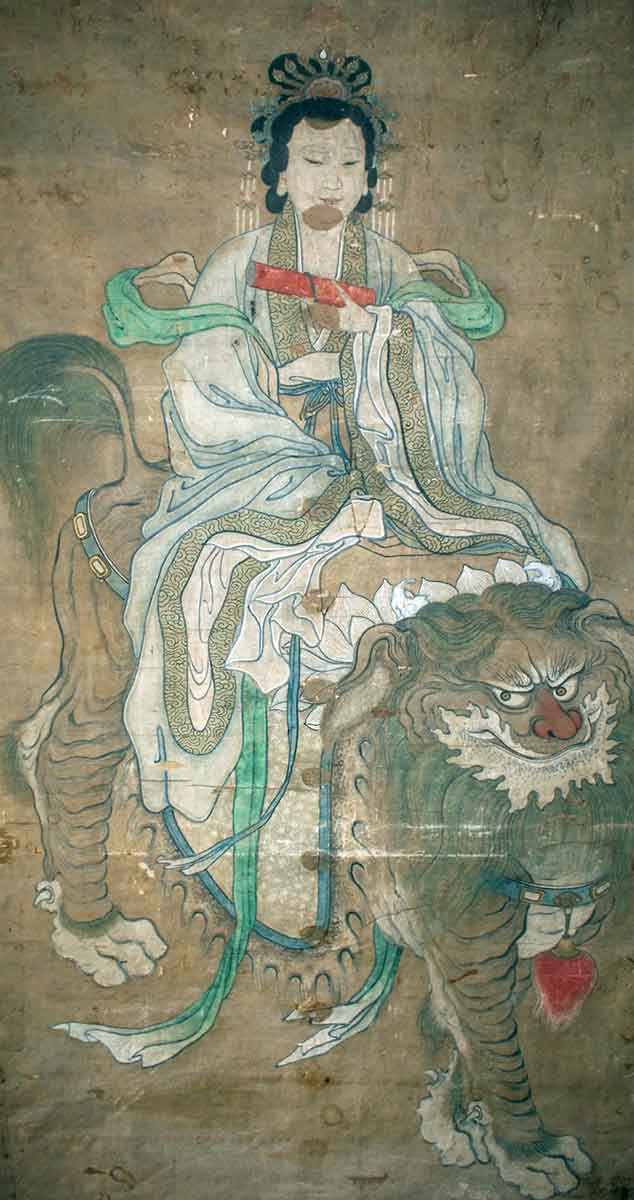
The Tao Te Ching lists three Chief Virtues (sanbao) by which one should live to be in accordance with the Tao. These are best expressed as compassion, frugality, and humility.
Compassion refers to an all-encompassing sense of empathy. In Chapter 67 of the text, Laozi explains that empathy toward others allows one to have the will to act to help them when needed. According to Taoist principles, one should treat the fortunes and misfortunes of others as though they were their own.
The second virtue is simplicity, or frugality: one should avoid living extravagantly because too much material wealth or complications in life muddy the choices that one can make and hamper the ideal of wu wei. It also leads to less material waste.
The third virtue of Taoism is humility, or more accurately, “not daring to be foremost in the world.” In other words, one is not to seek dominion over others and to be aware of one’s roots. The idea of respecting everyone, even if you become wealthier or more powerful through good fortune, is vital to being compassionate and generous.
Action Without Effort
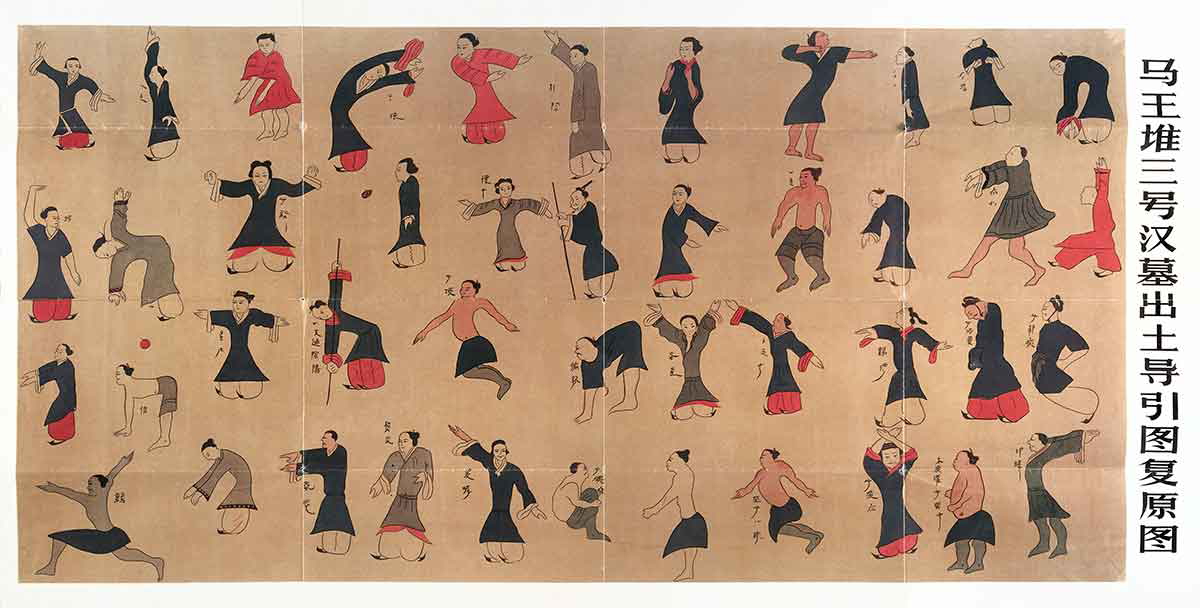
The goal, if there can be said to be such a thing in Taoism, is the state of wuwei. This refers to acting according to the flow of the universe. More practically, this means recognizing the timing of events and acting in accordance with them without trying to exert any undue control, just as, in chapter 43 of Derek Lin’s translation of Tao Te Ching, “The benefits of actions without attachment are rarely matched in the world.” This describes the so-called “flow state,” wherein people become so attuned to a task that they achieve it without conscious thought.
The state of wuwei comes from living in accordance with the Three Virtues. By accepting one’s circumstances as they are, and not seeking to change in a way that would infringe upon another person. Someone who lives in a state of wuwei becomes yielding, again like water, as explained in Tao Te Ching Chapter 76: “All living things, grass and trees, while alive, are soft and supple. When dead, become dry and brittle. Thus that which is hard and stiff is the follower of death. That which is soft and yielding is the follower of life.” This also applies to the physical body. Stretching and breathing exercises, as seen in taiji and qigong forms, are part of meditation. Taoists believe that living in a state of wuwei by following the Tao, one can live a longer and more harmonious life.