The term “Turquerie” was first used by famous French poet Molière (d. 1673) to describe actions that were cruel and savage. By the mid-18th century, it represented the European fascination with all things Ottoman. This fascination lasted until the French Revolution, when Turquerie became synonymous with the excesses of the Ancien Régime (the French monarchy’s rule).
Origins
By the mid–18th century, the Ottomans were in a state of economic, military, and political stagnation. As provincial governors and bureaucrats increased their power, the empire became more decentralized. The failure to follow technological advancements and modern military methods caused the Ottoman army to suffer losses against the European powers as well as Persia.
These events created a shift in the traditional Ottoman views of Europe as a place of underdevelopment and corruption. European advancements and innovations in science, arts, and technology encouraged the Ottomans to open up to the West. Likewise, Ottoman decline made Europe less wary of the Ottomans, who had been a military threat in previous centuries.
From 1718-1730, the Ottomans, under the influence of Grand Vizier Ibrahim Pasha and Sultan Ahmed III, experienced a period of cultural development and prosperity. This is today referred to as the “Tulip Period” because of the tulip mania during that time. As the Ottomans began to emulate European clothing and technologies, Europeans also became exposed to Ottoman culture.
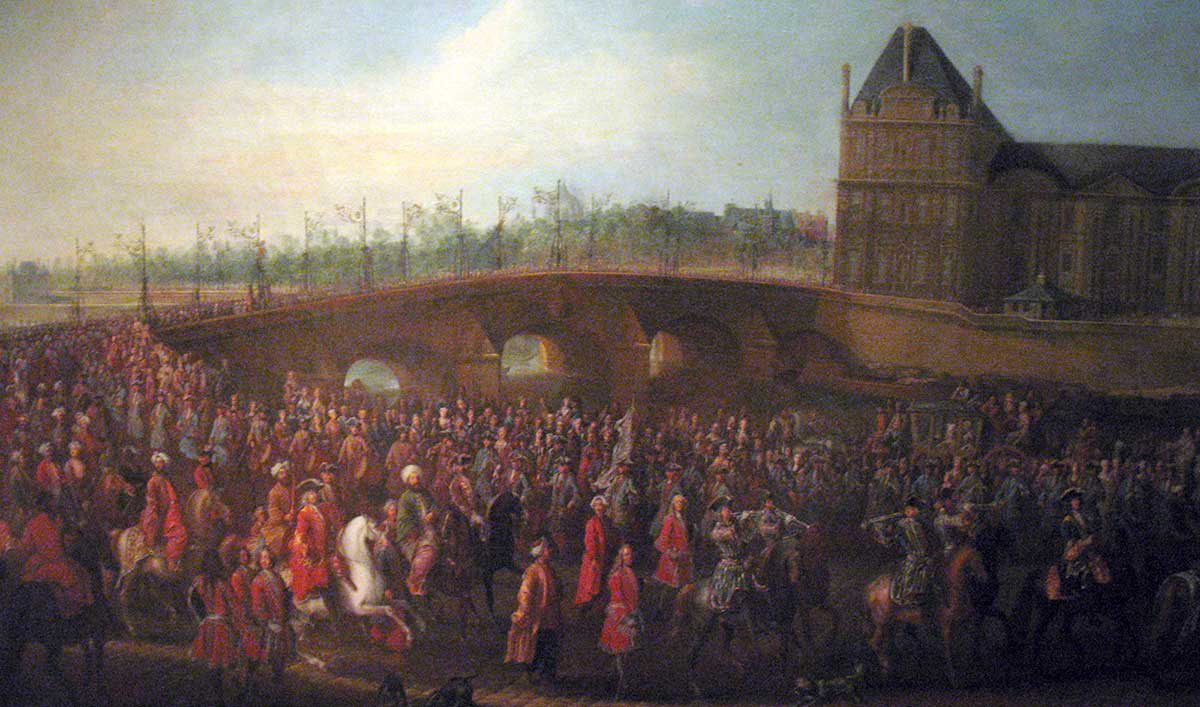
In 1720, Ottoman statesman Mehmet Çelebi was sent as ambassador in a delegation to Louis XV’s France. The arrival of the Turkish embassy was an event that attracted much curiosity and attention. Courtiers were surprised by the refined and good-mannered Ottomans, who inspired a cultural movement where Turkish/Ottoman or “oriental” aesthetics were used in art, architecture, fashion, and more. This movement became known as “Turquerie.”
Coffee Craze
Legend has it that the power of coffee was discovered by a farmer in Ethiopia, where the plant originated, after his goats ate the coffee cherry and were bursting with energy. It was introduced to the Ottomans around 1540, a few decades after they conquered Yemen (1517), where coffee was cultivated.
When the Ottomans began to engage in diplomatic missions with European powers, the coffee went along with them. In 1669, the coffee bean arrived in Paris with the delegation of Suleyman Aga. Three years later, the first coffee houses in Paris were opened, although initially, they weren’t very popular.
Coffeehouses—early versions of modern cafes—were an important part of coffee culture. In Ottoman Turkey, they were places where people gathered and discussed socio-political issues. This often led to their forced closure, and soon enough, European monarchs were faced with the same issue. Charles II of England (d. 1685) ordered the closure of coffeehouses under the pretext that people were exchanging revolutionary and anti-monarchical sentiments there.
Elsewhere in Europe, the drink received mixed receptions. In Italy, it was condemned as “Satan’s drink,” an Eastern concoction that a good Christian would not drink. However, Pope Clement VIII’s (d. 1543) approval of the beverage helped its spread across the country.
Coffee soon after became known as the “Turkish drink.” It was brewed in a coffeepot called a “cezve” (pronounced jezz-veh), as it still is today. To sweeten the taste, various spices, honey, and sugar were often added.
Fashion
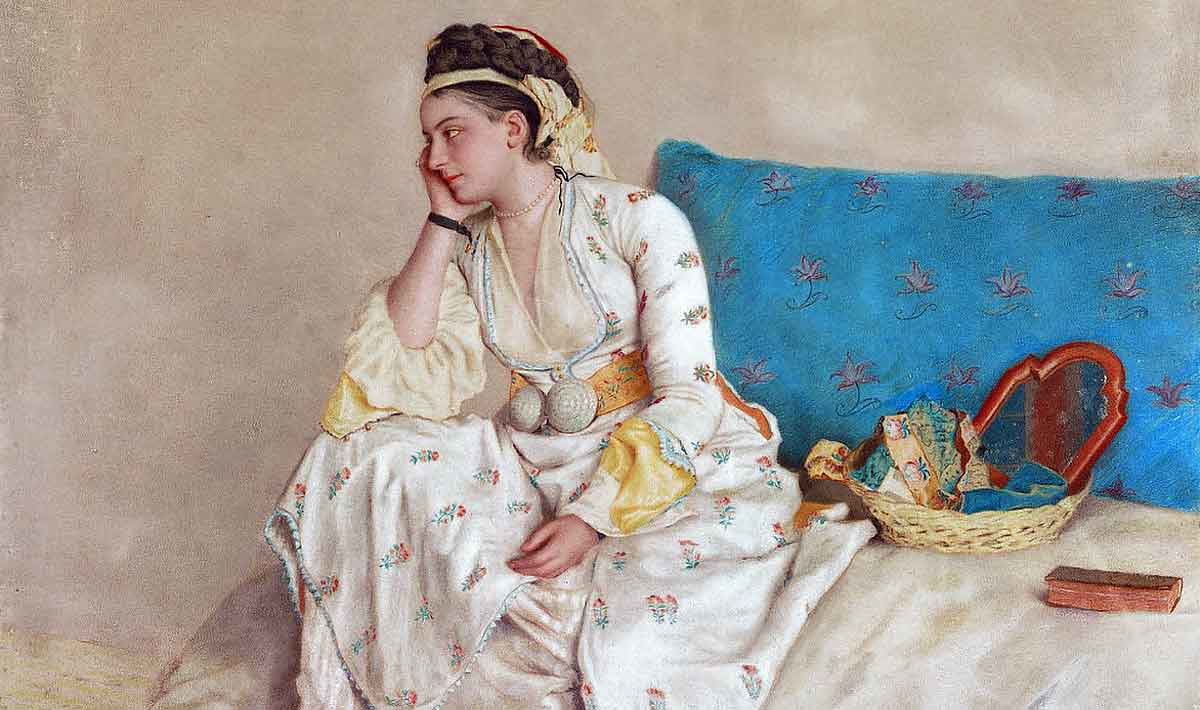
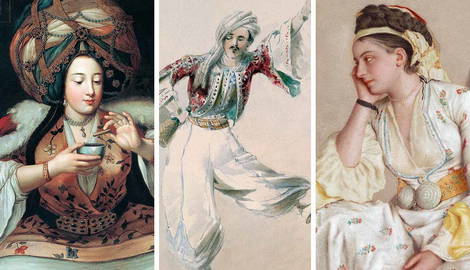
Dressing “a la Turque,” or “in Turkish style,” was a central component of the Turquerie movement. European fascination with Ottoman dress had previously come from its association with power and military conquest. After Ottoman ambassadors and travelers introduced Turkish fashions to European circles in the 18th century, it became much more of a fashion statement.
“Turkish costume” was mainly used in theater productions and in court entertainments, such as masquerade balls. To commemorate the historic marriage of French prince Louis and Maria Teresa in 1745, the French court held a masquerade party where courtiers dressed in what they considered “Turkish dress”: wrapped headdresses, jewels, and luxurious fabrics.
Lady Mary Wortley Montagu (d. 1762), wife of the British ambassador to the Ottoman Empire, played a large role in making Ottoman fashion more mainstream in the West. After returning to England, she continued to wear Turkish-style entaris (dresses) and was depicted in her portraits with turban-like headdresses and sable-lined overcoats.
Soon, the mantua, the most common dress for Western European women, developed a new form, called the “robe a la Turque.” This consisted of layered, patterned fabrics, and an overgarment, like a short-sleeved vest, worn over longer sleeves. The use of furs, trims, tassels, and gilded fabrics, all of which emphasized luxury, relaxation, and splendour, was also inspired by Ottoman dress.
Music
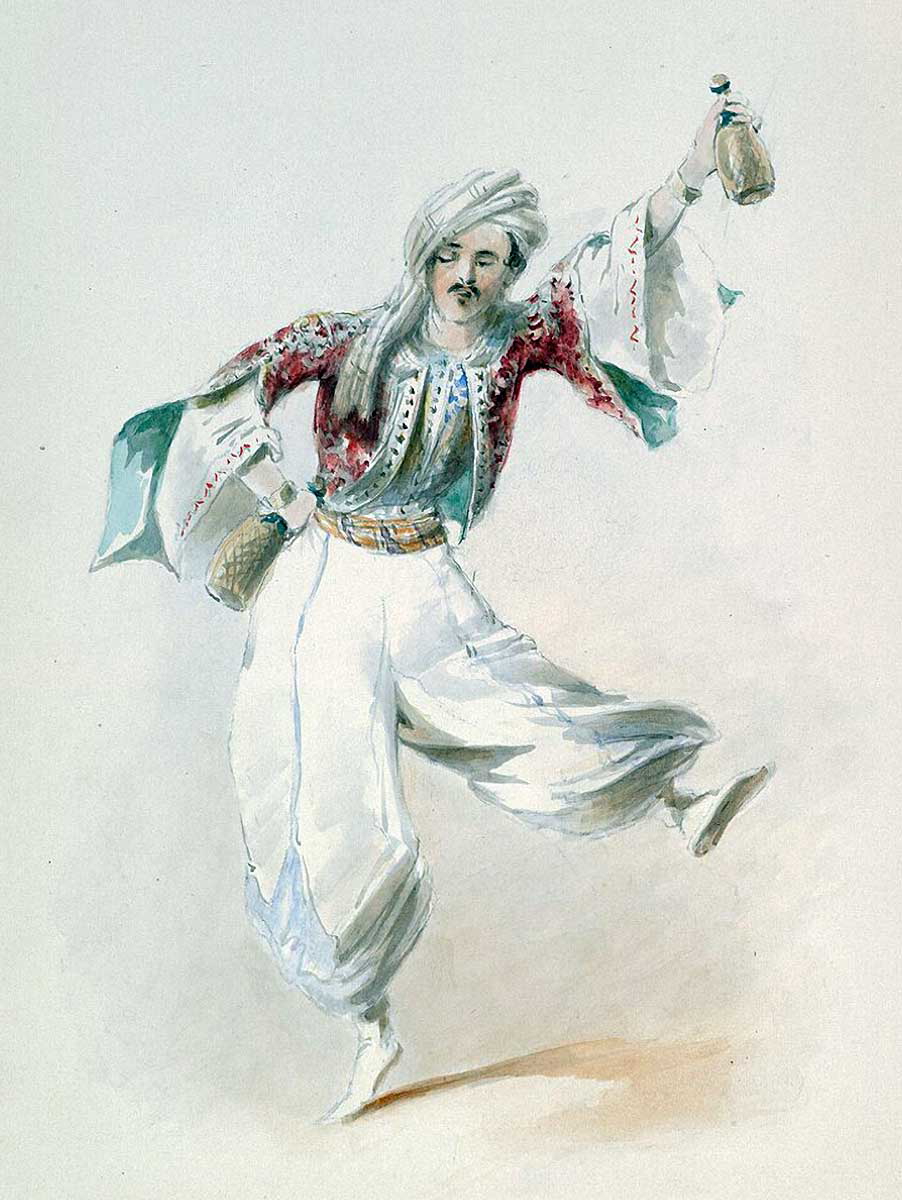
For centuries, Europe had seen the Ottomans as a military and cultural threat. Following Ottoman losses—from the Battle of Vienna (1529) to the Battle of Zenta (1697) against the Habsburgs—the illusion of Ottoman military supremacy began to fade. The military marching band, called the Mehteran, used for centuries by the Ottomans to intimidate their enemies, also began to represent less of a risk.
The beat of the mehteran’s music often mimicked the rhythm of soldiers marching. Mozart, one of the foremost composers of 18th-century classical music, based many of his compositions on the music of this marching band.
One of Mozart’s most notable and ever-popular piano pieces, the “Rondo a La Turca,” was a piece directly based on these Ottoman military marches. His 1782 opera Die Entführung aus dem Serail (Abduction from the Seraglio) also employed stereotypically “Turkish” elements. With the use of percussion instruments like drums, cymbals, and triangles, an upbeat and “oriental” sounding score was created.
Art
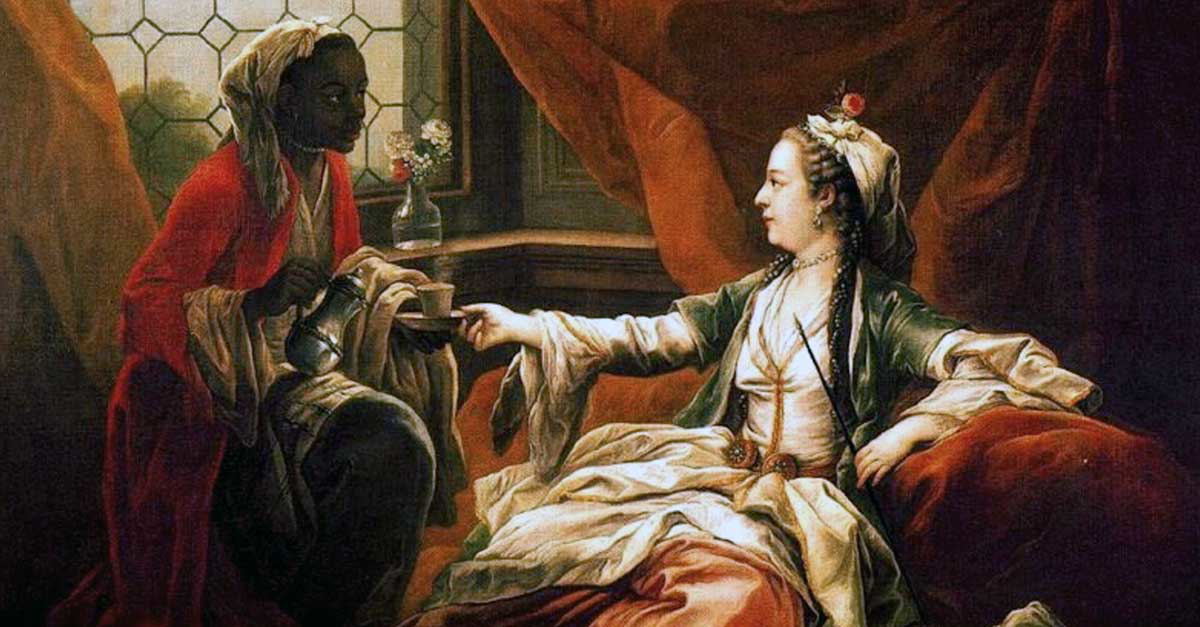
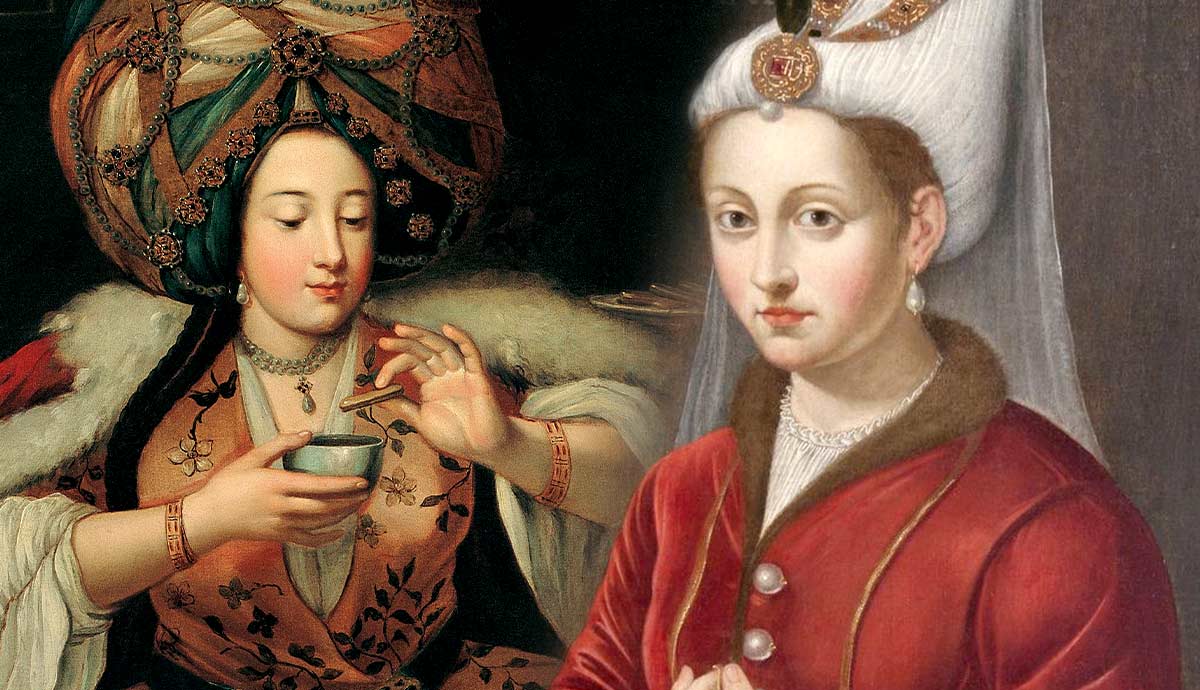
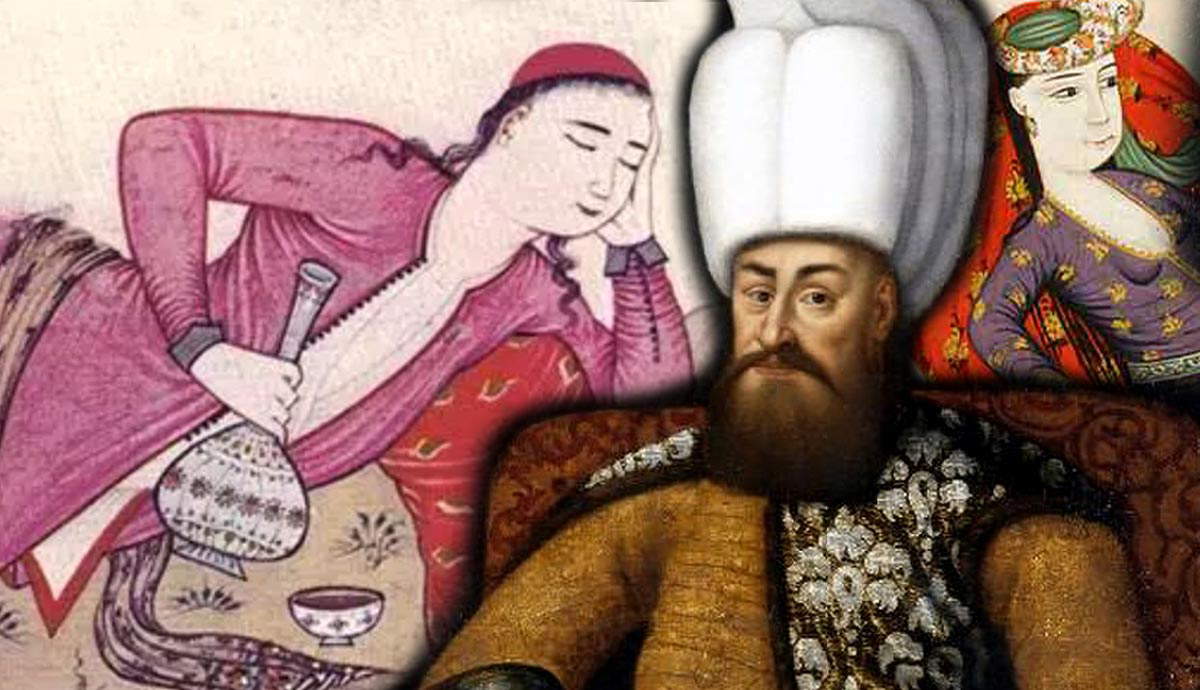
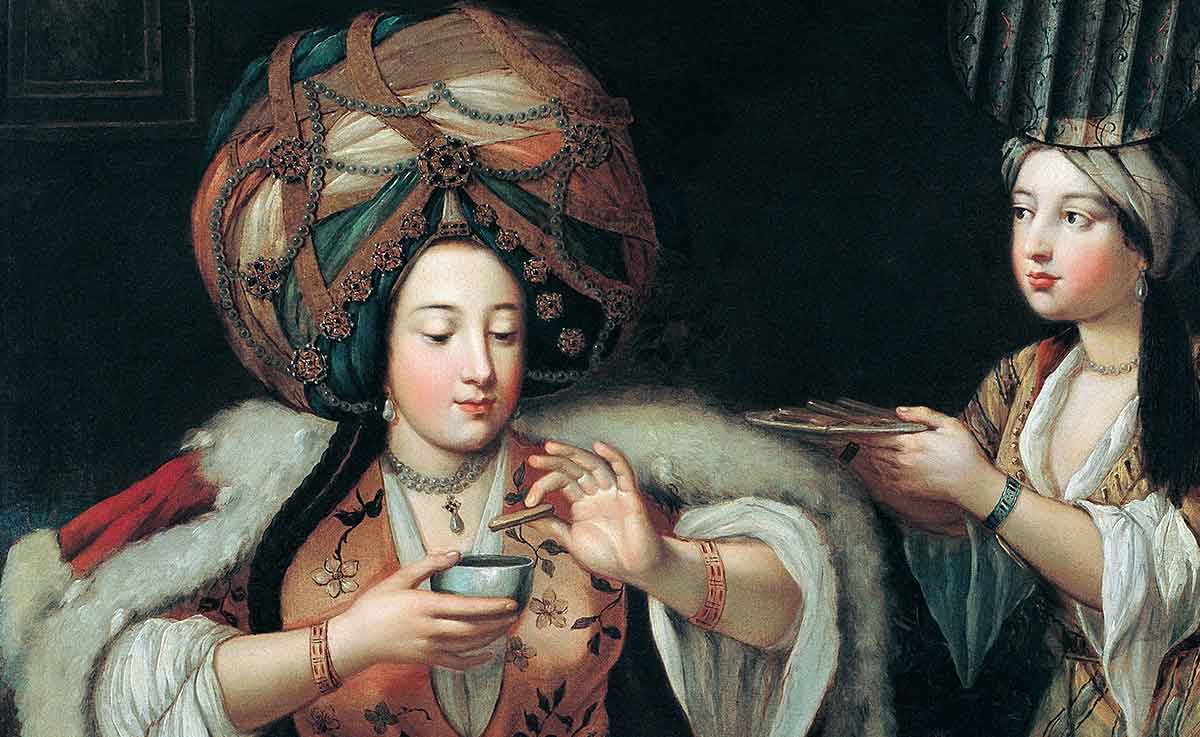
One of the most visible and iconic effects of turquerie can be seen in 18th-century art. The formality of Baroque painting contrasted with the relaxed “Turkish-style” portraits. Instead of being painted in stiff, formal positions, men and women were instead painted lounging around on divans, low Turkish seating. They were also depicted in caftans, entaris (women’s gowns), and trousers, often in the act of smoking or drinking coffee.
Decadence, exoticism, and consumption, all seen by Europeans as aspects of Ottoman culture, were emulated in portraiture, particularly in France. French artists like Jean Baptiste Vanmour, Antoine de Favray, and Jean-Auguste-Dominique Ingres’s paintings ranged from natural scenes, everyday occurrences—such as coffee drinking and bathhouse visits—to portraits of notable and celebrity figures.
It became very fashionable for elite figures to have their portraits painted in Turkish costume. The demand was such that Jean Etienne Leotard (1789), a Genevan painter who had lived in Istanbul, travelled around European courts in a beard and a turban. He was known as the “Turkish painter.” French ambassador Charles Gravier and Lady Mary Wortley Montagu, wife of the British ambassador, were important proponents of this turquerie craze.
Interior Design
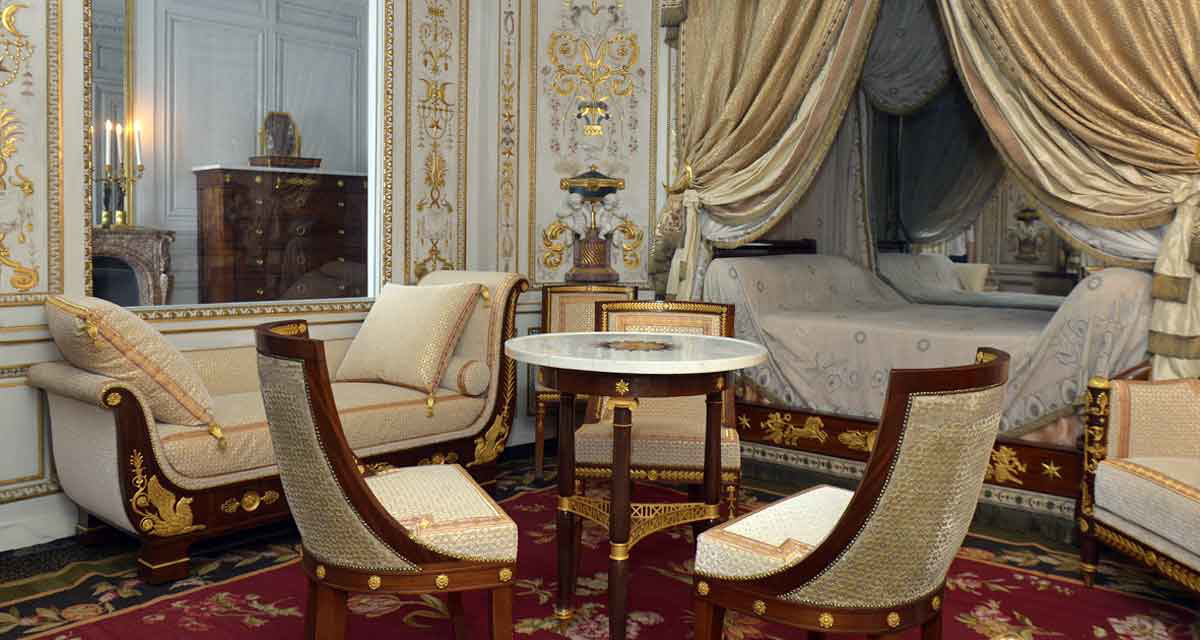
“Turkish style” in interior design came to exemplify comfort, pleasure, and luxury. Amongst the royal and elite class, it became fashionable to have “Turkish rooms.” These rooms had ornamental Ottoman figures painted on walls and panels. Intricate carving details mirroring those of the Islamic art were not only painted but also carved above doors. Crescent and star motifs, and gilding, were also used in furnishings.
Another aspect of turquerie in interior design was the “Turkish scene” depicting relaxed individuals, often in sensual poses, dressed in luxurious fabrics and traditional headwraps. These were depicted on objects like vases and even painted above doorframes. Marie Antoinette created such a room in the Palace of Versailles and Chateau de Fontainebleau. The latter housed her Turkish-style boudoir (private room) pictured above.
Through turquerie, the French monarchy found an additional way to demonstrate opulence and wealth in their court. Significantly, most of these were European reimaginations of what was “Turkish,” including crescents, turbans, and Islamic-style motifs. In the European imagination, “Turkish style” furnishings, like the foot stool and divan (low padded seating), maximized comfort.
Architecture
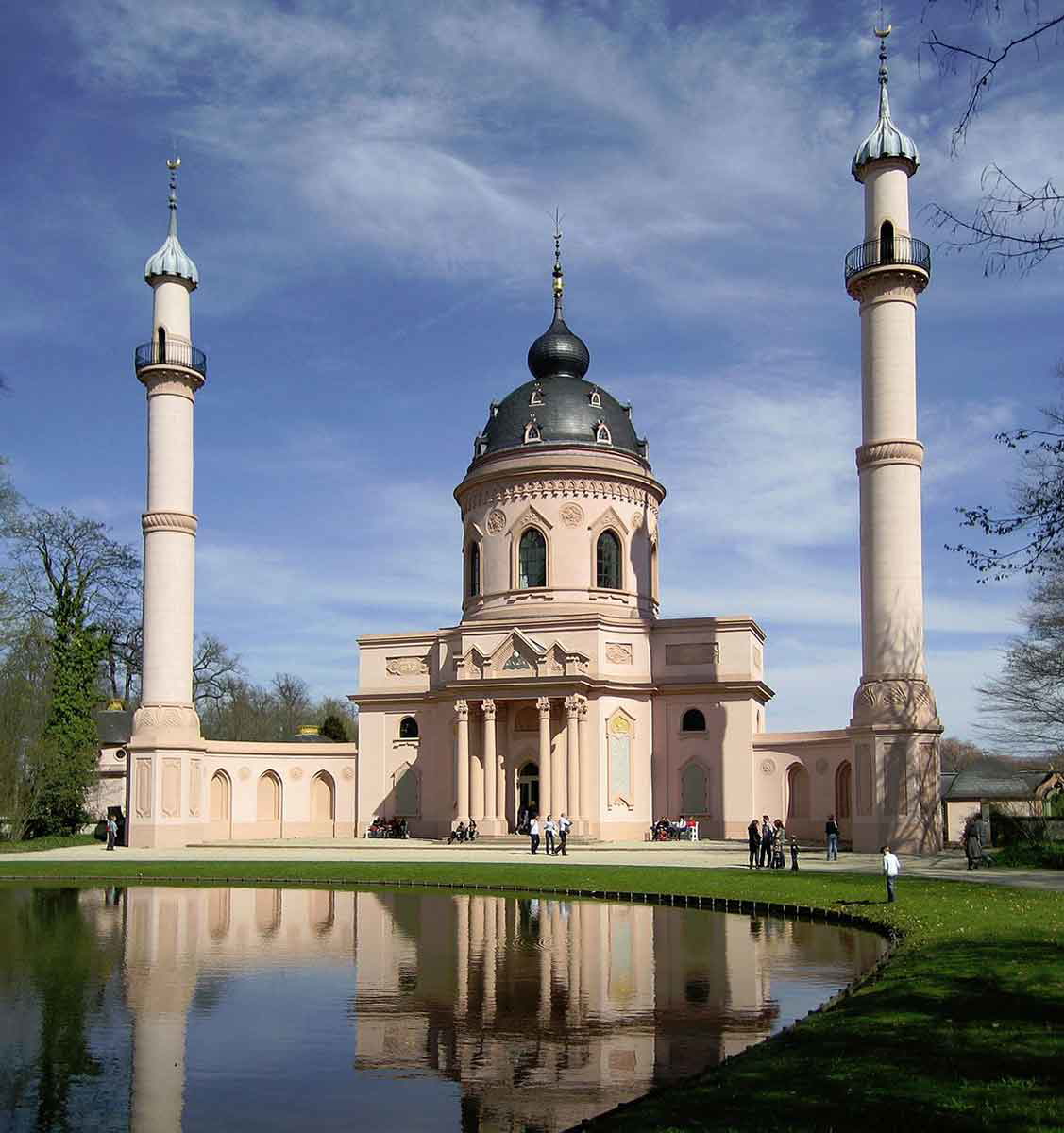
Turcophilia also made its mark in the public sphere. The Red Mosque, or Schwetzingen Garden Mosque, is perhaps the clearest example of this. Built around 1779-93, the building was not actually intended to function as a mosque, but rather, was a decorative structure. The exterior mimicked the symmetrical domed and minareted mosques in Turkey, while the interior was decorated with stars and a moon, and inscriptions in Arabic, the language of Islam.
Although it was inspired by Turkish styles, many elements of European architecture were kept. For instance, the courtyard was built at the rear of the structure, rather than in the front. Greco-Roman style columns also decorate the exterior of the building.
A similar mosque folly was built in the Royal Gardens (now called the Kew Gardens) in London. During the 1730s, Queen Caroline had architect William Kent build several structures, one of which was a mosque in the Ottoman style. By 1785, it was removed from the Gardens.
Architecture was perhaps the least influenced aspect of European culture. Rococo, Baroque, and Gothic styles continued to dominate the public sphere in Europe until the 19th century.