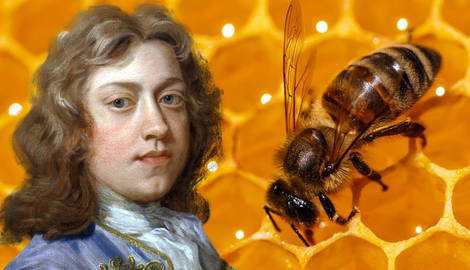
Bernard Mandeville’s Fable of the Bees shocked polite society and outraged some of the eighteenth century’s greatest thinkers. What was so shocking about a book that begins with a satirical poem about life in a beehive and goes on to anticipate the ‘invisible hand’ of the free market?
Bernard Mandeville

Bernard Mandeville was born on November 15, 1670, in the Netherlands. He came from a learned family; both his father and grandfather were physicians, and he too earned a medical degree in 1691. By 1693, Mandeville was living in London and working as a physician. Here he specialised in what were known as nervous disorders.
His reasons for moving abroad are unknown; however, it was probably a combination of escaping political problems in his home country and a desire to learn the English language. Mandeville’s father was involved in the Kosterman riot, which culminated in the destruction of the house of the Chief Bailiff. As a result, the family was banished from Rotterdam, and Mandeville moved to London. It was here that he learned the language so proficiently that the people around him believed him to be a native.
In England, Mandeville married and had children. He supported his family working as a physician and also wrote several political pamphlets, none of which were particularly successful in his time, save for The Fable of Bees (1723).
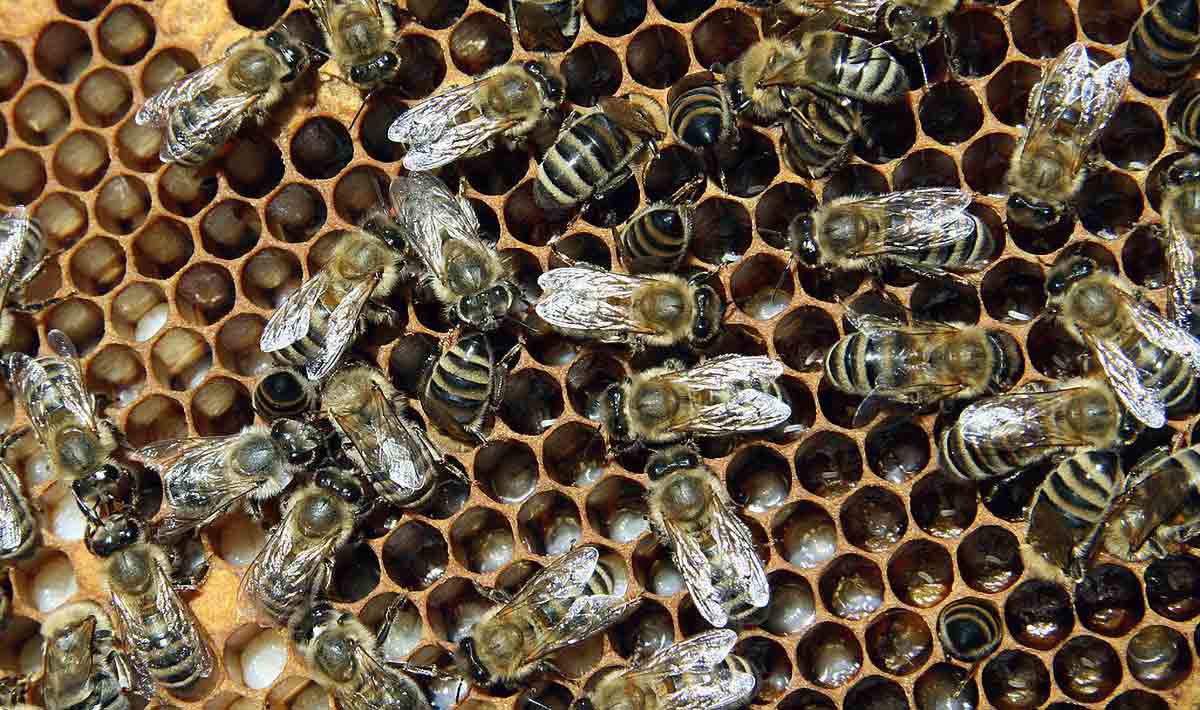
The precursor of this work was a shorter work of doggerel published under the title: The Grumbling Hive, Or Knaves Turn’d Honest (1705). In this poem, Mandeville tells the story of a thriving community of bees that is ruined by an attempt to rid itself of vices and become more honest and virtuous. The political message is that private vices result in public benefits. Any attempt, therefore, to rid a society of such vices will be disastrous for the community as a whole.
Mandeville republished the poem twice, once in 1714 and again in 1723. The new title for both editions was, in full: The Fable of the Bees: or Private Vices, Publick Benefits. Added to the bees poem were remarks by the author and some essays.
The Grumbling Hive
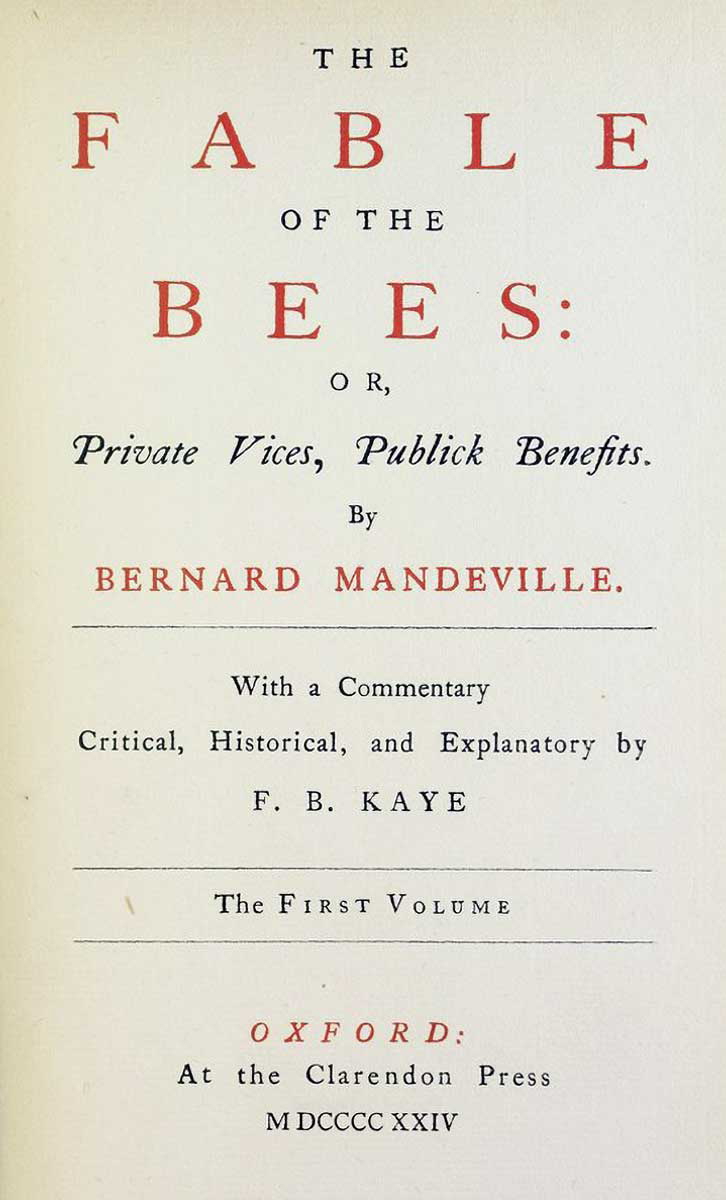
The grumbling hive poem begins with the following line: “A spacious hive well-stocked with bees, that lived in luxury and ease.” The hive is prosperous and happy. The bees live just as we do, with all the professions and activities humans have, and a just and benevolent king rules over them. There are many millions of bees living and working in the hive, with some occupying the top echelons of society living in comfort, while others toiling hard in more menial labor. In addition, various crooked bees rely on deceit to con and swindle their more good-natured neighbors. However, Mandeville notes in the poem that:
“These were called knaves, but bar the name,
The grave industries were the same:
All trades and places knew some cheat,
No calling was without deceit.”
In other words, every bee is corrupt in some way. Mandeville spends several verses going through the various types of jobs done by the bees, all of which have their knaves. Some lawyer bees delay hearings and exploit the law for their financial ends; there are doctor bees who seek fame and money over curing the sick; some priest bees are lazy, and there are soldier bees that are cowardly. In the hive, businesses commit fraud, and the justice system is easily bribed. However, despite laying out what seems like a litany of failings, Mandeville says, “Thus every part was full of vice, yet the whole mass a paradise.”
The hive is full of corruption, but this ends up working in the favour of the bees. What we might see as negative traits, such as avarice, fickleness, and pride, actually spurred the bees to work harder and drive the production of goods and services. “The worst of all the multitude did something for the common good.”
Down With the Cheats!

The hive thrives thanks to the vices of the bees. It is the envy of other hives and feared by those who might otherwise seek to wage war against them. Unfortunately, things start to go wrong. Although they are well aware of their own individual vices and deceitful natures, the bees start grumbling about the dishonesty of others. They complain especially when things go wrong.
Whenever a bad thing happens or some project fails, the bees blame the corruption of their compatriots and cry “Down with the cheats!” Eventually, the gods get tired of hearing these complaints, and Jove swears in anger that he’ll “rid the bawling hive of fraud.”
The hive now undergoes a massive alteration. Crime disappears, and so there is no need for courts or prisons. Lawyers, judges, jailers, and blacksmith bees are now out of a job. The vices of pride and envy are no longer found in the hive, and so the bees have no taste for extravagances. They only want plain and functional items, and this includes food. The bee gardeners do not attempt to grow food that the other bees might enjoy eating, but are content to harvest whatever grows naturally.
Because there is no demand for luxury goods, all foreign trade with other hives ceases. The hive also looks down on wars as vainglorious attempts at glory. As such, the army is not maintained.
This means the once prosperous hive that was the envy of its neighbours is now undefended. Many of the bees are killed in subsequent attacks from other hives. Only the strongest bees that, hardened by their frugal and difficult lives, fight with courage and integrity survive. These eventually go to live their simple yet hard lives not in a hive but in an old tree hollow.
Moral of the Story
Mandeville’s moral to his fable is clear: only fools strive to make an honest hive.
All animals, including human beings, are naturally only inclined to seek out those things that please them, without consideration of how their pursuit of pleasure might affect others. Accordingly, those animals best suited to living together in large numbers are those with the fewest appetites and with the least interest in the pursuit of pleasure. Human beings, whose appetites are many and varied, are then the least suited animal for communal living.
However, human beings do live together in large communities the world over. This is possible according to Mandeville because of political organization. Human beings can gain the advantages of working in a group as long as they have some way of controlling the members of the group. Teamwork necessitates that each member of the team works for the good of the group and not simply for their benefit. The question is how to get individuals to recognize that they are better off putting their short-term interests aside.
Before we look at Mandeville’s solution, it is worth noting that he is greatly influenced here by the writings of Thomas Hobbes. Mandeville is referring to a “state of nature” before civilized society. Hobbes infamously labeled this largely hypothetical state that predates even primitive human societies in chapter 13 of Leviathan (1651) as “solitary, poor, nasty, brutish and short.” According to Hobbes, it was to escape this brutish existence that human beings formed societies. They gave up certain freedoms in the state of nature but received a happier, more flourishing existence in return.
Mandeville wants to know what made human beings choose to give up their freedom to pursue happiness, blind to the needs of others.
Flattery Is Persuasive
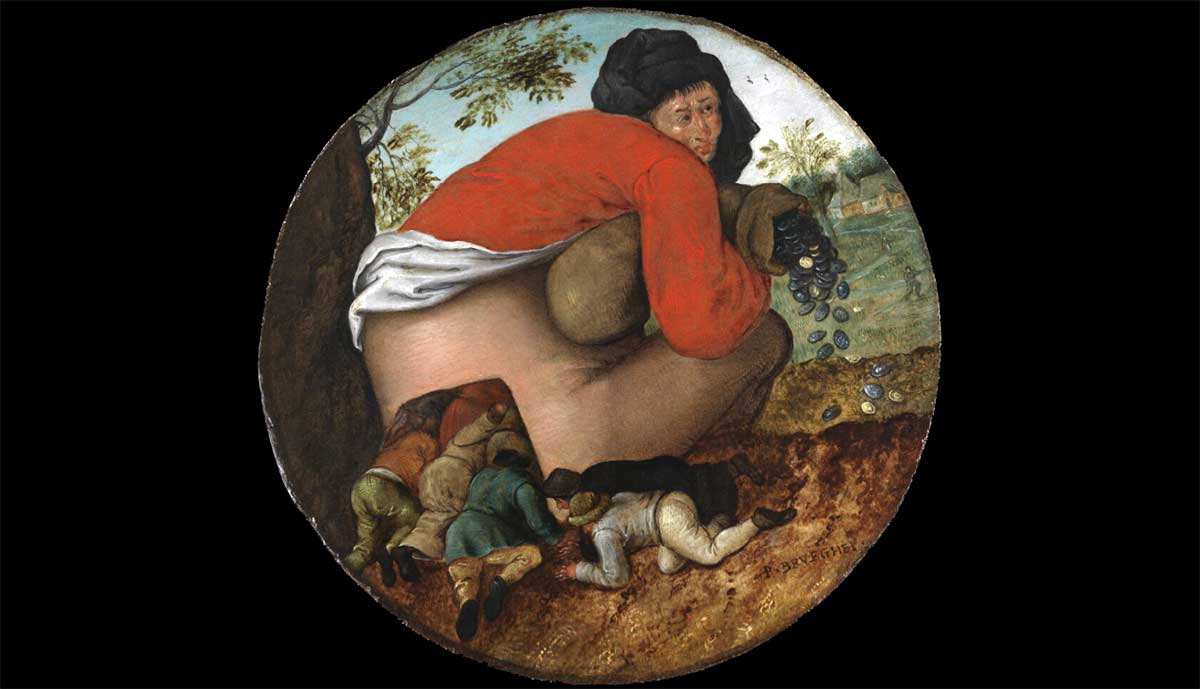
The problem for those wishing to form a society out of free people, who are driven by the blind pursuit of satisfaction, is that no one is going to willingly sacrifice their own pleasure for the benefit of others. Instead, Mandeville reasoned, there must be some way of making people believe that it was actually in their own interests to act for the good of all. According to Mandeville, flattery was the key.
There is no one so savage, he says, that they are not flattered by praise and, by such means, charmed into seeking out further praise. Neither, he says, are people so despicable that they can bear the contempt of others. Mandeville theorized that law-givers seeking to bring human beings out of the state of nature and into civilized societies used a mixture of flattery and contempt to persuade others to act how they needed them to act for communal living to be possible.
Human beings were exalted as far greater and superior to any of the other animals on the earth. Gratifying your own pleasures and acting upon your baser instincts was decried as brutish and animalistic. Those who could deny themselves immediate gratification were praised and flattered as good. At the same time, those who acted out of blind self-interest were condemned as little better than the brutes in the field. Over time, two classes emerged: one of the highest and noblest and another of the basest and most wretched. Those who could deny themselves immediate gratification and act in superior ways formed the higher class, while those who were more animalistic were relegated to the lower class.
Class Divisions

Mandeville is offering a theory of how the first political societies of human beings might have formed. It does not matter if his theory is correct. He is attempting to demonstrate how the idea of virtue and vice could have been introduced and become the basis of communal living. Mandeville wants to undermine the idea that things we call vices, such as pride, are actually bad in and of themselves. After all, the bees in his fable lived without vice, and their flourishing hive was destroyed.
However, he does not argue that vice ought to be praised. Quite the opposite. Personal vices should be kept secret, and flourishing societies ought to maintain a façade of loving virtue and despising vice. We can see this in his description of how class divisions arose and developed, which led to the enrichment of society.
We saw that Mandeville hypothesized the emergence of two classes, one populated by superior people capable of eschewing base self-gratification and the other by brutish people little better than animals. Virtue would be considered anything that puts the needs of others first, and vice would be anything that sought to gratify selfish pleasures. Hungry for praise and fearful of contempt, people would want to be seen as virtuous. Mandeville argued that over time, the noble class would flourish because everyone would look up to them and want to be a member.
There would, of course, be many people who could not control their selfish desires, but these could be hidden, and their reputations remain intact. In addition, many people would see the benefit of having people around them who put others’ needs ahead of their own. It would make good sense then to publicly encourage others to be less selfish. Accordingly, virtue would be praised and vices hidden.
Source of Pride

For Mandeville, pride is a driving force for most of humankind. This is why flattery is so successful at drawing human beings out of the state of nature. Once formed, societies flourish when the members put the common good ahead of their selfish desires. Those who can deny themselves immediate self-gratification at the expense of others are praised and included in the upper class of people. This is a source of pride for the members of this class.
It is the distinction between themselves and the lower class that is the source of their self-satisfaction. Low-class people are little better than animals, unable to see past the sating of their base appetites. High-class people consider themselves far removed from these people, and the farther removed they are, the more pride they take in themselves.
Accordingly, high-class people seek the trappings of an elevated life. They dress in fine clothes, live in fine houses, and so on. These things must be produced for them, which creates jobs and trains people to work in these professions. The more skilled these workers are, the more they are rewarded and can enjoy luxuries.
As a result, as societies grow, they grow more prosperous. Even the low-class people, Mandeville says, can see that they are better off in such a society, and they too extoll the virtues of virtue! Which we remember is putting the needs of others first and denying one’s own need for self-gratification.
Pride comes from being considered a rightful member of the higher class. Which, as Mandeville points out, might involve some deception if you are not virtuous. And this includes self-deception if you are not virtuous but want to take pride in being high class. We saw with the bees that they ignored their own vices but decried those of others.
Response to the Fable of the Bees

Mandeville’s book was considered shocking. The original poem, The Grumbling Hive, had been largely ignored when first published in 1705. And so it was most likely that Mandeville’s own notes and other essays included in the 1723 edition were the cause of the controversy.
The critique was that the text ran down religion and virtue in a way that was prejudicial to society. George Berkeley criticised the work in his Alciphron (1732). Jean-Jacques Rousseau also criticized Mandeville in Discourse on the Origin and Basis of Inequality Among Men (1754). Economist Adam Smith, in 1759, expressed disapproval in The Theory of Moral Sentiments. Dr Johnson was one of the few men of the time who had anything positive to say, claiming that it opened his eyes to the nature of real life.
Despite, or because of, the negative response to The Fable of the Bees, Mandeville’s ideas on virtue and economics were thrust into the public eye. His ideas certainly offended, but also provided food for thought. Modern scholars have appreciated the work for anticipating key economic ideas that would be developed in greater detail by other thinkers. This most notably includes Adam Smith’s concept of the ‘invisible hand,’ the idea that free markets can incentivize self-interested people to act in ways that benefit others without the intention of doing so.
Mandeville’s claims are difficult to argue against, but by the same token, they are equally difficult to argue for. It is unlikely that anyone not already sympathetic to his way of thinking will be convinced by his ideas. Therefore, the philosophical worth of the book remains in doubt. Some have praised the literary merits of the work, whereas others have, with some justification, dismissed the initial poem upon which the text as a whole is based as mere doggerel.