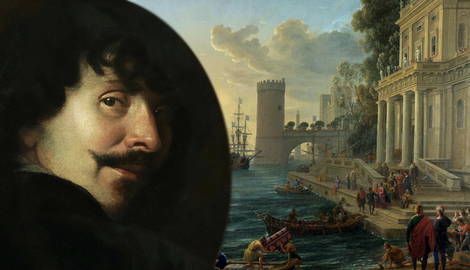

Claude Lorrain spent most of his working life in Rome. There he made his obsessive studies of the effects of light on the Campagna region. The scenes for many of his paintings deal with classical myth and history. His work is typified by the contrast of the eternity of nature and the human realm subject to time and decay. Dealing with mortality, his oeuvre is often remarked upon for its elegiac and emotional qualities.
Who Was Claude Lorrain?
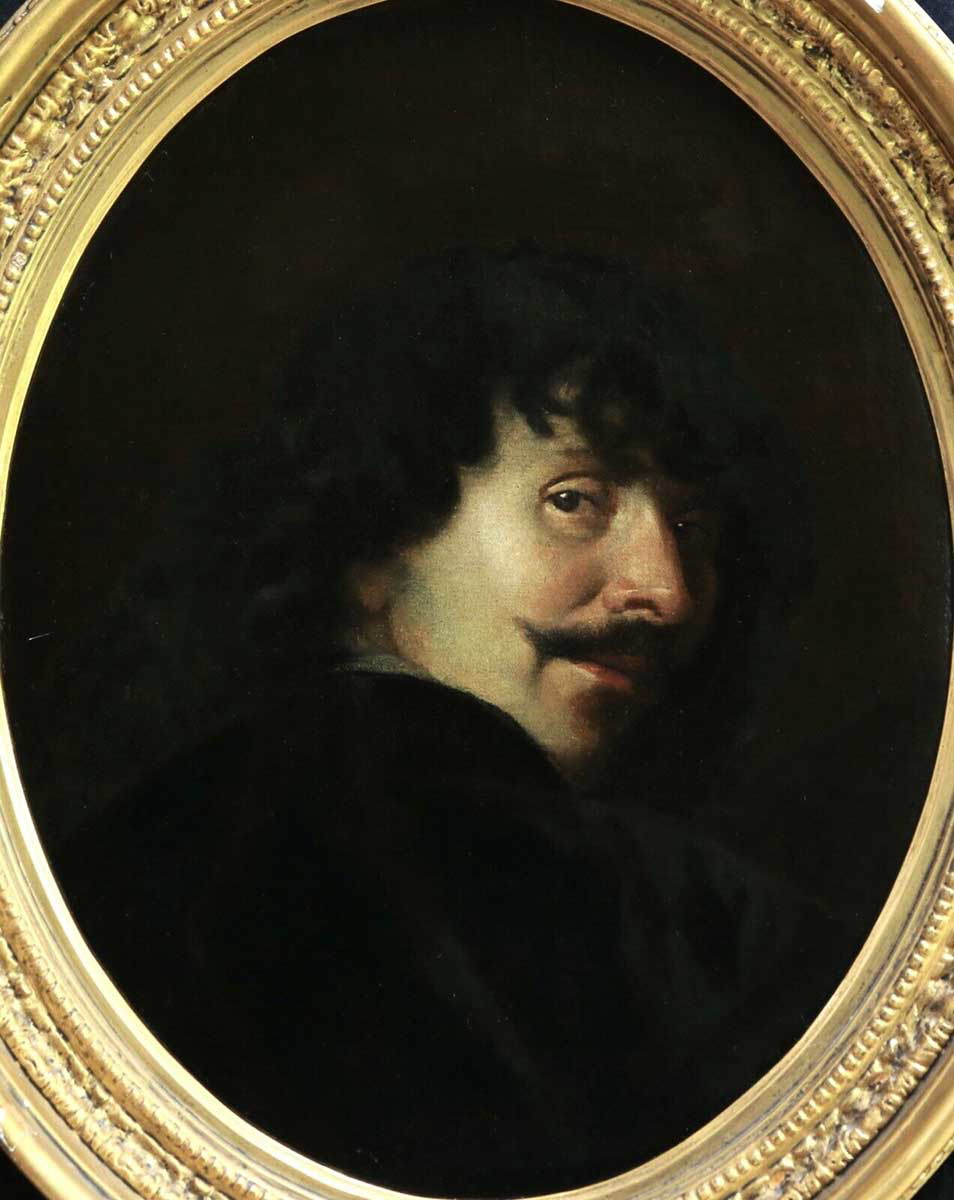
Claude Lorrain, born Claude Gellée (c. 1600-82), was a Frenchman who spent almost all of his career in Rome. He was the most renowned landscape artist working in Italy, and helped to elevate the genre previously considered a lower form of art. All Claude scholars refer to an emotional impact intrinsic to his depictions of nature—often panoramic vistas containing in miniature the actions of humans. Hilliard T. Goldfarb writes of Claude’s landscapes as “a poetic means of expression” and as “informal, lyrical, and atmospheric…” A later landscape artist, John Constable, once remarked that Claude Lorrain was “the most perfect landscape painter the world ever saw,” adding that he painted “the calm sunshine of the heart.”
So, what is it in Claude’s art that has provoked such praise? Can “mere” landscape art have an emotional impact? And, if so, how does Claude achieve this through his depictions of nature? This article will try to look at Claude’s art both generally and specifically by choosing three of his paintings to elucidate the general observations.
Nature and the Human
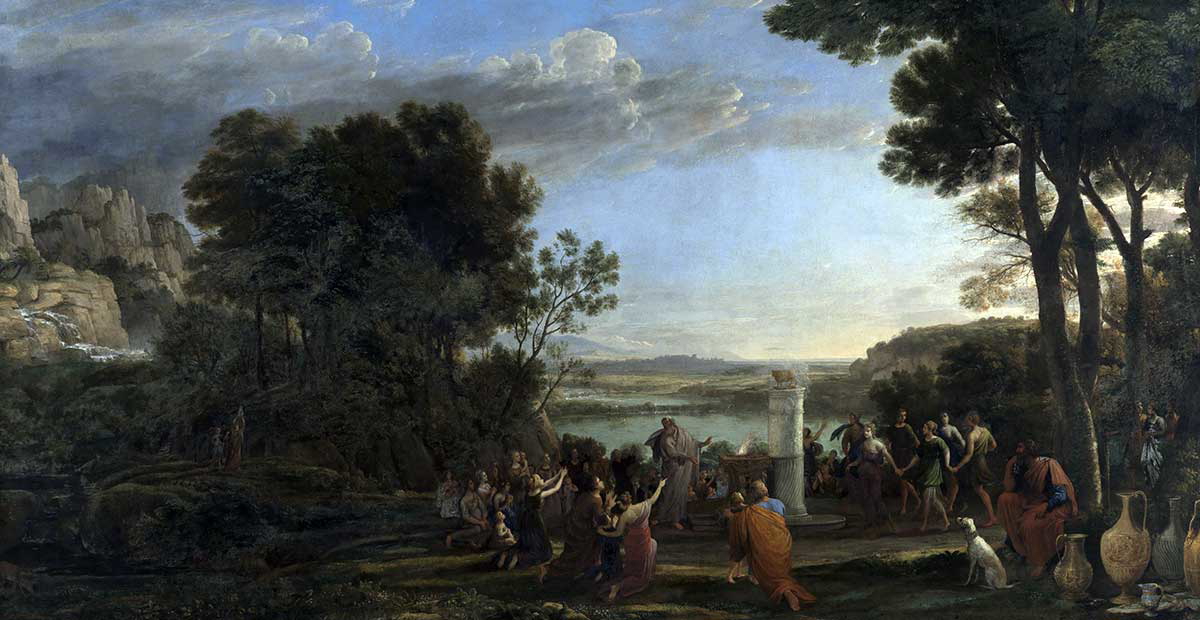
Claude’s paintings were classified as lontananze by his Italian contemporaries. Literally and roughly, this term means “distant views.” Indeed, most of his canvases portray a panoramic nature that progresses from the usual copse of trees in the foreground through to a vast natural space populated mostly by trees and water. Claude’s nature as he represents it is not only literally distant. It is an unknowable, mysterious, and eternal counterpoint to the human events that he portrays. The mortality and contingency of humans and their deeds are implicit.
These landscapes play on the tension of presence and remoteness. On the one hand, there is a sublime nature, while on the other this sublimity relativizes even the monumental cultural achievements of humanity—often embodied in the architectural elements overtaken or re-taken by nature.
Lontananze not only describes these “distant views” of nature but it also refers to the separation from, or diminution of, human affairs. There is almost always a distance from the narratives, the overt subjects of the paintings. There is no direct embroilment of the viewer nor an emotional affect from these events, yet Claude’s paintings are reputed for their emotional impact. This emotional value consists in the physical and conceptual diminution of the human within the context of the richness of an often-silent nature.
Nature is the pure eternal presence that the artist opposes to the mutable, the mortal, and the transient. But nature is not always unheeding in Claude. There are works that evince the “pathetic fallacy”: a seeming ascription to natural elements of human attributes, as some paintings share in the ructions of some of the narratives. However, this “persona” of nature—which could be termed “empathy” to a certain degree—remains the universal and indestructible context for finite actions by finite beings.
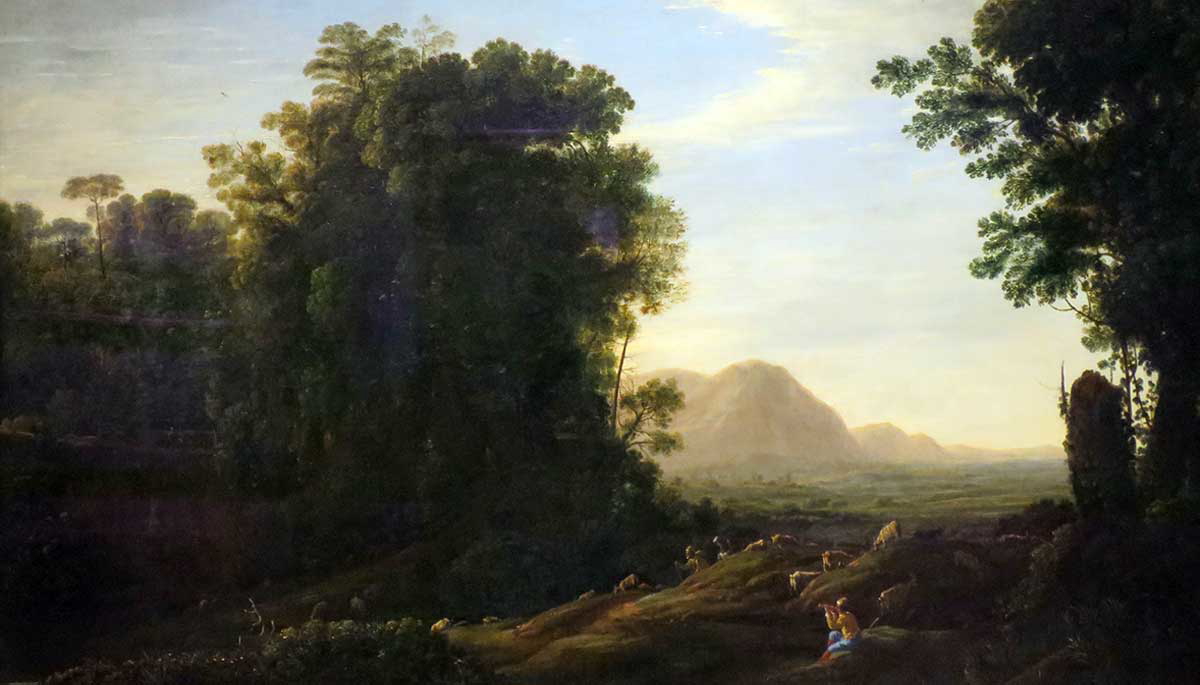
Hubert Damisch has written on the mechanics of the organization of the Claudean picture space and has noted that the artist placed his horizon and vanishing point two-fifths of the way up the picture plane. This, as Damisch says, is slightly lower than the canonical Albertian Renaissance recommendation of placing the vanishing point at the height of a fictive man with his feet on the baseline. In placing his own lower, Claude subverts the antique and Renaissance conception of “man as the measure of all things.” Claudean nature, instead, overwhelms the understanding of humanity and relegates it to the status of a mere factor of nature.
At root, his depiction of nature in itself constrains nature, and its sublimity and diminution of the works of humanity is his own oblique attempt at the mastery of the illusionistic representation of nature. In effect, he is re-casting humanity as central, though inflected and complicated by mortality.
Time and History
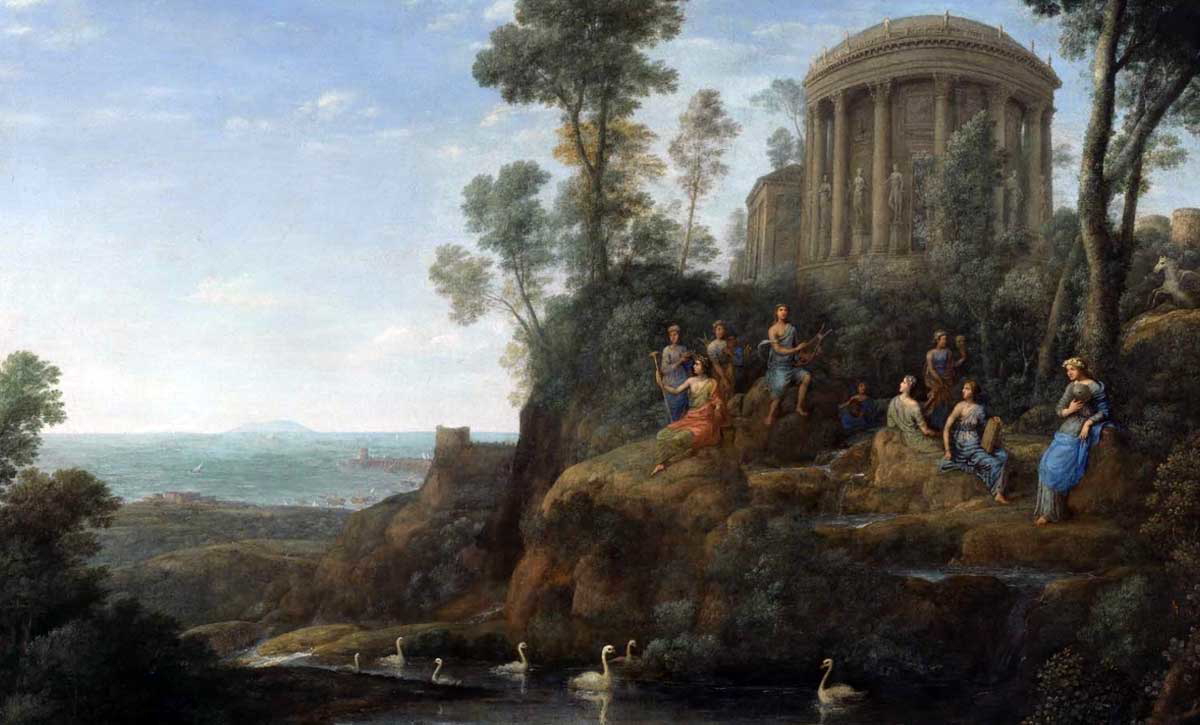
Marcel Roethlisberger has written of Claude’s manifold references to the passage of time. He notes that natural elements such as the sun, clouds, rippling water, the goings of peasants and animals, birds in flight, cascades of water, and the relative states of buildings all index what is seen as Claude’s overriding theme, the motives of which Roethlisberger says are “blended together ever so harmoniously.” Roethlisberger cites Claude’s incidental weather as connoting history, destiny, the seasons, and the centuries descending down to the artist’s time from the “gilded antiquity” that he paints.
Yet, it is in the combination of Claude’s incidental weather with antiquity that a mutability is established within antiquity. These scenes—often mythological—are not only a rendering of a relentless and irretrievable time, but perhaps also a visual comment on historiography, or the fitting of the past into a story, itself. Each repetition of these historical and/or mythological events re-makes the event by virtue of the subjective choices of the narrator/artist. These are depictions of the process of story-telling integral to history writing.
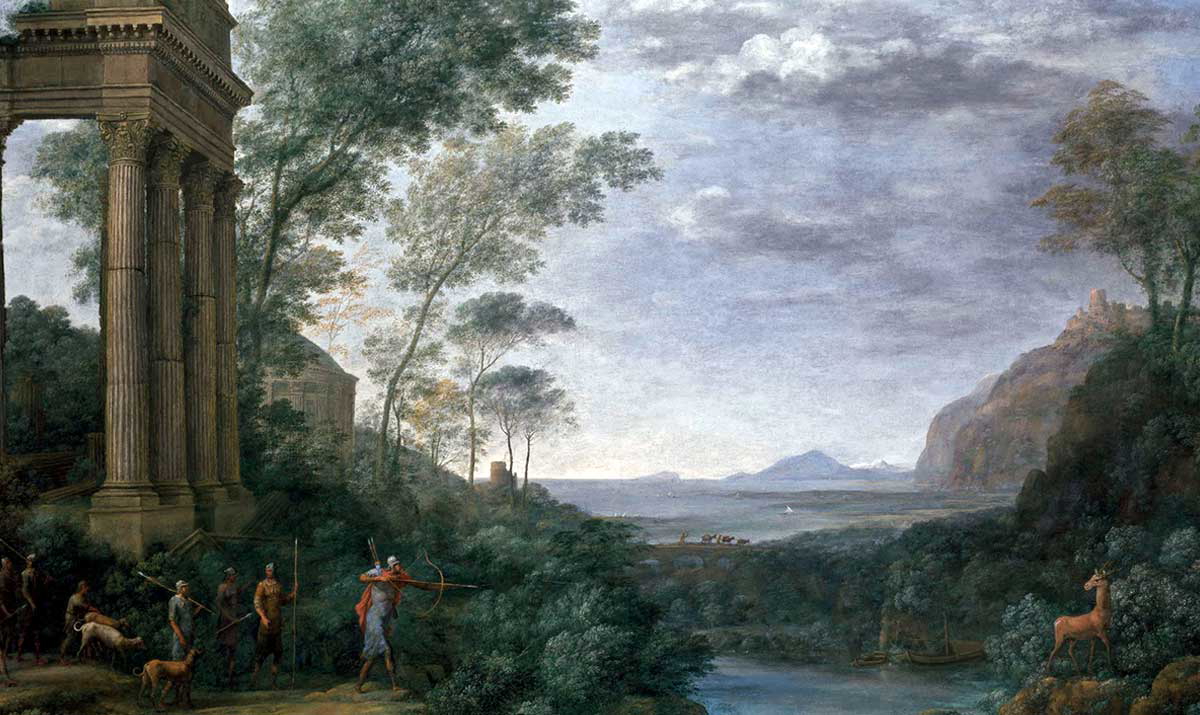
For example, Claude clothes his accounts—his figures and internal stories—in landscapes that are at once empathetic and relativistic of the perceived “momentousness” of human action. Sometimes, the trees sway under storm clouds, as in Landscape with Ascanius Shooting the Stag of Sylvia, as if the war of the Latins and the newly arrived Trojan party will rack nature itself. But the profuse richness and growth of that nature is in contrast to human action. Nature is the inexorable, the eternal, and makes minnows of protagonists in Claude’s oeuvre.
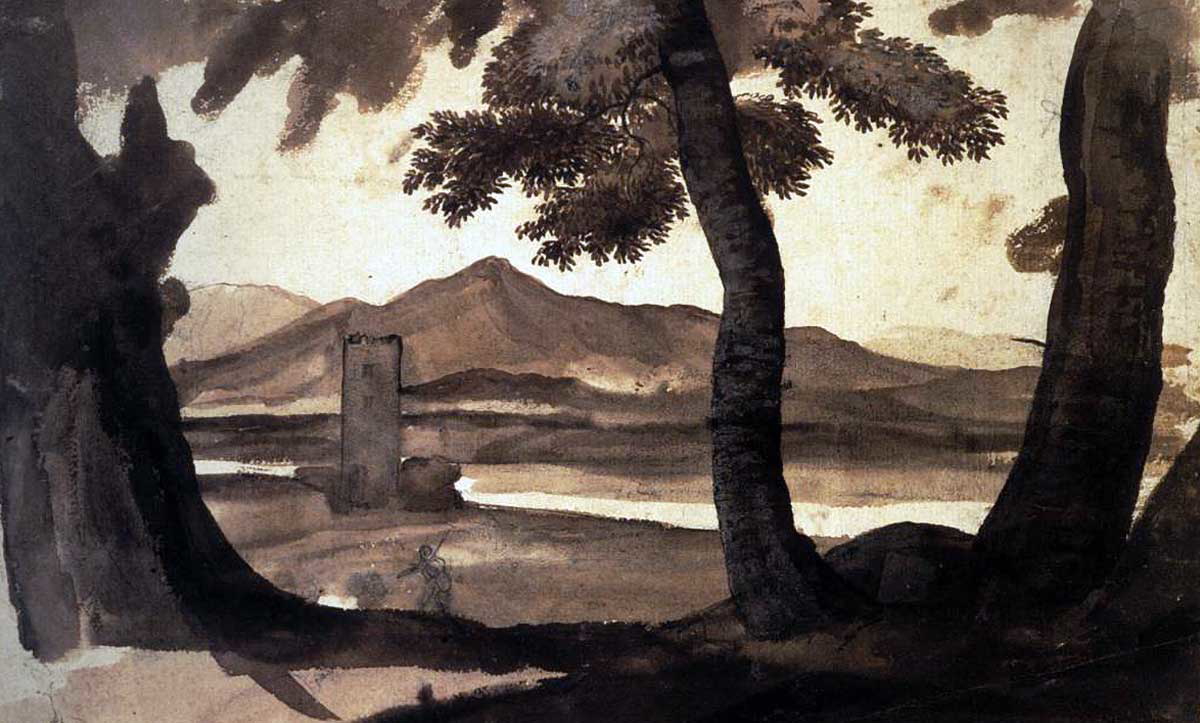
Further, Roethlisberger says that the vast Claudean spaces are “inseparable from the expanses of time” and that this is the source of the deep emotional resonance with these paintings. Time’s emotional impact automatically dredges up the fact of mortality, of growth and decay, of the emergence and dissolution of cultures and empires. Most of all—given the many exquisite representations of countrysides and ports, the mythological antique “golden age” of peace and plenty is invoked with nostalgia. Claude’s images of landscapes in peace, or in turbulence that mirrors human affairs only serve to reinforce the nostalgia for that mythic and impossible era.
Claude’s images are just that, however: images. They appeal to and incite visual delectation and emotional investment through visuality. Although they almost always take subjects from mythological or biblical narratives, they are largely not to be “read” as narratives or mere visual renditions of a text. They can be read as such but, in exclusively so doing, the spectator loses the main thread of Claude’s painting. Epochal or foundational events are made minuscule in scale and importance. Claude does not so much paint these events as he paints the journey of time which both contextualizes and qualifies them—and thereby transcends them.
Claude obsessively studied his craft in the Roman Campagna—the site of many of these epochal events in the classical canon of myth. This landscape, an eternal presence from which the stories of Aeneas and Psyche had long since faded, would have been to Claude suggestive of the irrevocability of time, as well as a reminder of these stories.
It is also instructive to know that Claude mainly painted at dawn and dusk in the Campagna. Whether he grew obsessed with time because of this or his obsession with time prompted this is immaterial. The fact remains that, as Roethlisberger says, the dimension of time is more integral to his work than it is to any other artist of his generation or to any artist of any generation.
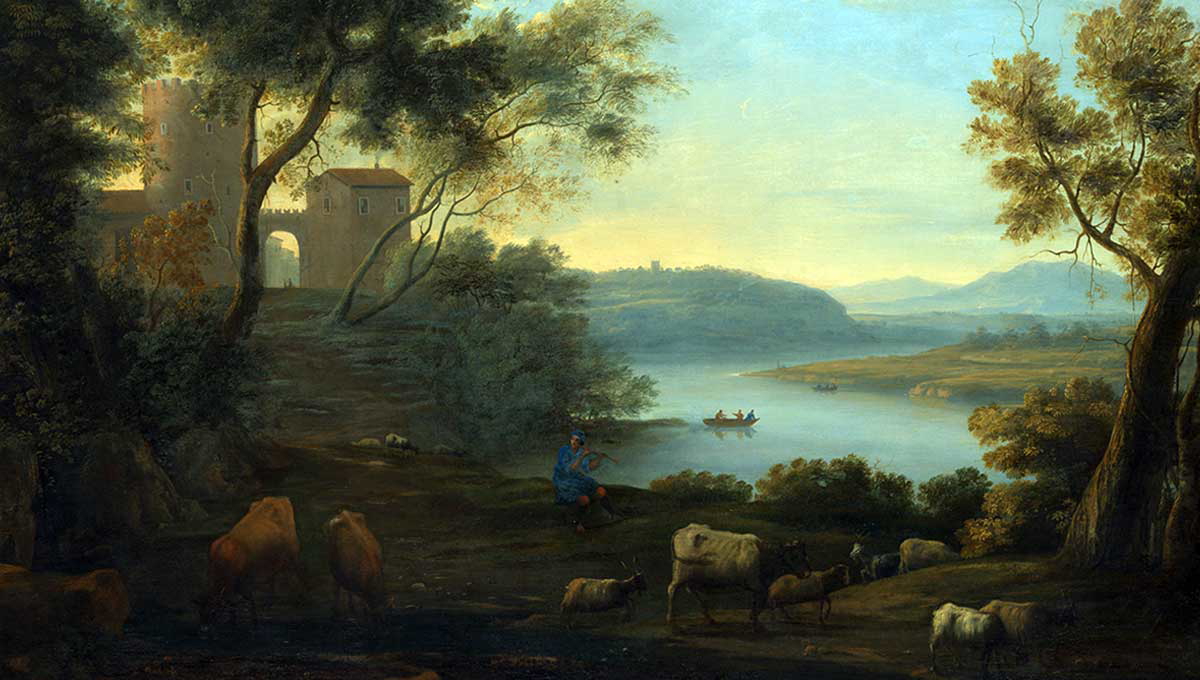
Roethlisberger writes that the artistic convention of the representation of time as a “static entity” is subverted by the sense of “flux” and passage in the works of Claude. In essence, he is right. Indeed, not only was time’s stasis seen in much art and thought before and after Claude’s era, but it was frequently personified, as, for example, an old man, as the dancing seasons, as destiny, etc. However, Claudean time is not typified by the notion of “flux.” The artist certainly painted time as passage, as an irretrievable flow—and often literalizing this characteristic in the painting of rivers, streams, and bridges. The implication of disorder intrinsic to the concept of flux is inimical to Claude’s portrayal of time. Even in Landscape with Ascanius Shooting the Stag of Sylvia, where he depicts a violent act that will lead to war and storm clouds roiling in the sky prefiguring that war, Claude’s restricted color palette and narrow tonal range ensures the unity of his conception of time and nature. The character of the unified tonality puts the action into a context of being absorbed by the passage of time.
The Embarkation of the Queen of Sheba (1648)
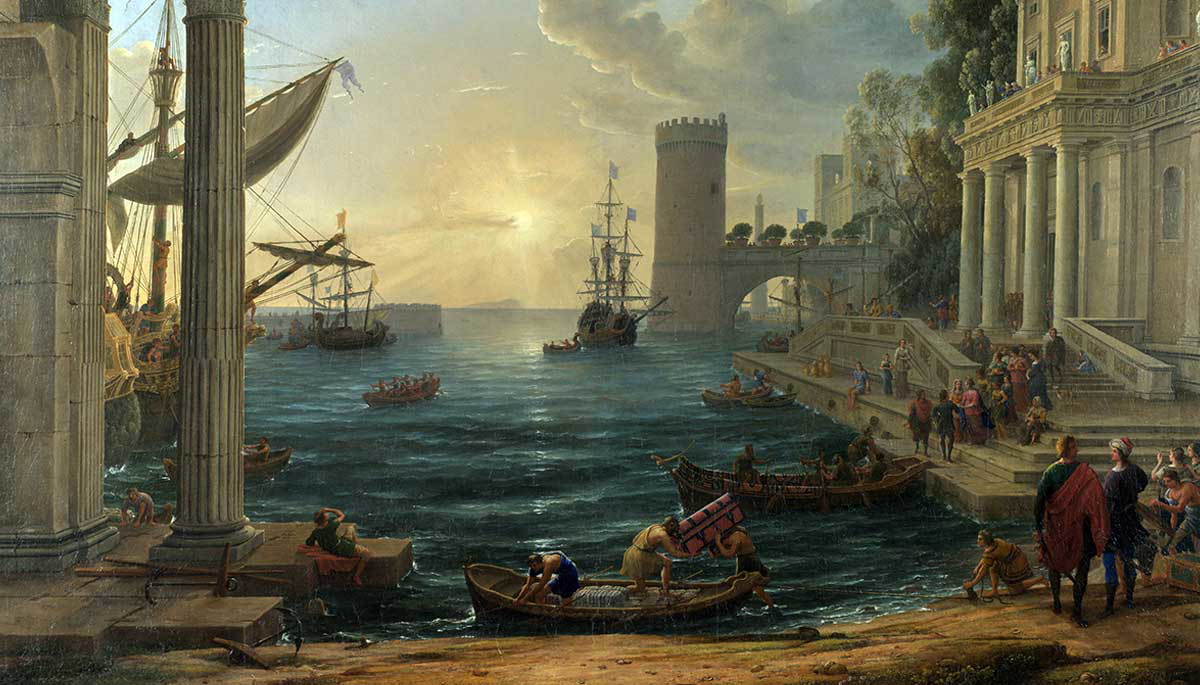
The Embarkation of the Queen of Sheba was commissioned by the general of the Papal army, Frédéric Maurice de la Tour d’Auvergne, Duc de Bouillon. Its biblical subject is the departure of the Queen of Sheba on a visit to King Solomon in order to trial his wisdom.
Our sighting of the queen in this port scene is distant. If the viewer is to be an implicit presence within this pictorial world, it makes two possibilities. One marks a social division—if we are to be included among the men loading luggage, or perhaps with the reclining man of the left foreground looking over with his hand raised to shield his eyes from the morning sun. On the other hand, and on the other side of the foreground, we could be associated with the two standing figures that are in discussion. These two men have a higher social status and are dressed accordingly. Their discussion is analogous to that of the spectators of the picture itself—except that the two men are presumably anticipating the future event of the meeting of the monarchs.
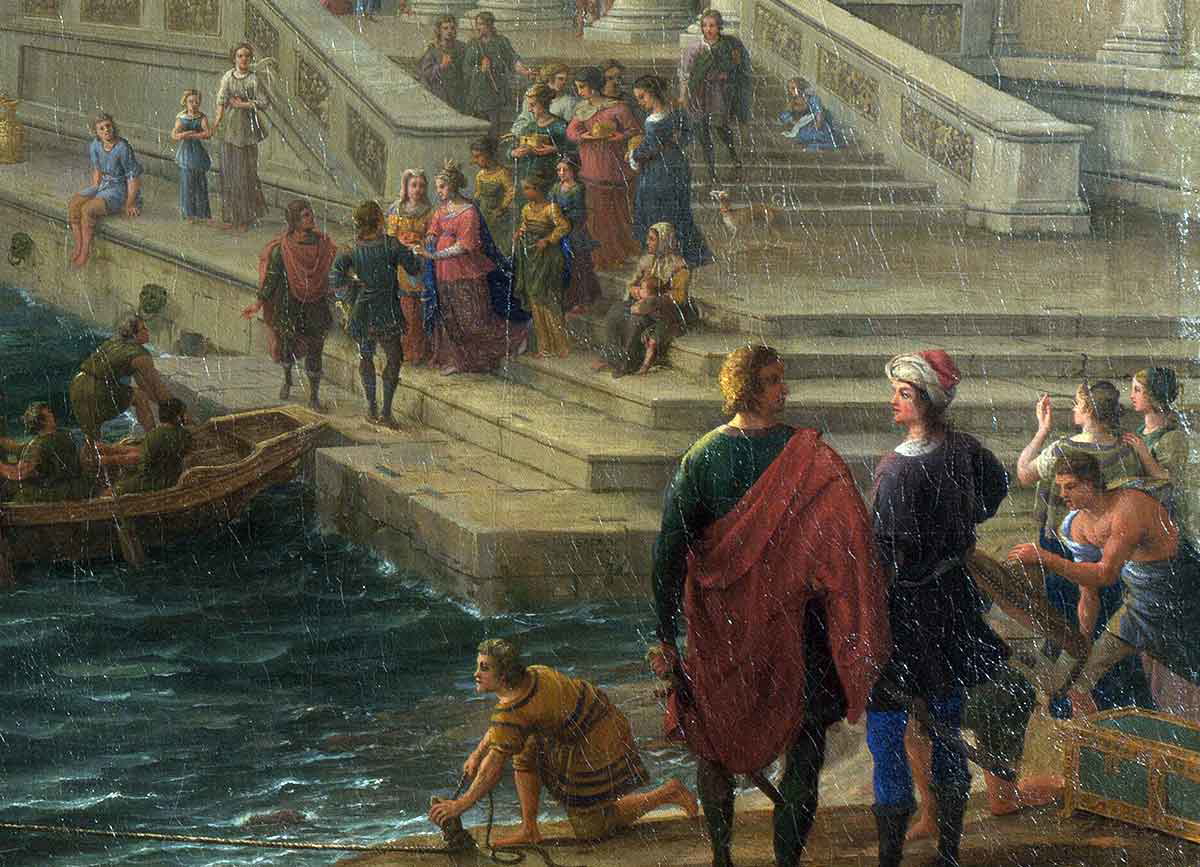
If the viewer is not implied to be present within the scene, his or her distance from the queen and her retinue shows the temporal passage from the mythic time of antiquity down to Claude’s time, and beyond to ours. Futurity is a theme that pervades the scene and is also exemplified by the rising sun. The sun is almost exactly central in the composition and, just as it illuminates this scene, Claude represents this biblical story through his mastery of tone and the compositional division of left from right.
The scene is both based on the mythic Christian past and the imagined; Sheba’s embarkation is not described in the relevant text, 1 Kings, chapter 10. Therefore, it is a fabrication upon a fabrication, but Claude actualizes it in a representation complicated by the sense of immateriality evidenced in the pervasive direct sunlight and the decomposition of the architecture of the left foreground. As is usual for Claude, the transience of human activity, of even its artifacts, is highlighted, especially by the dominance of the morning sky that is intensified by the low horizon line.
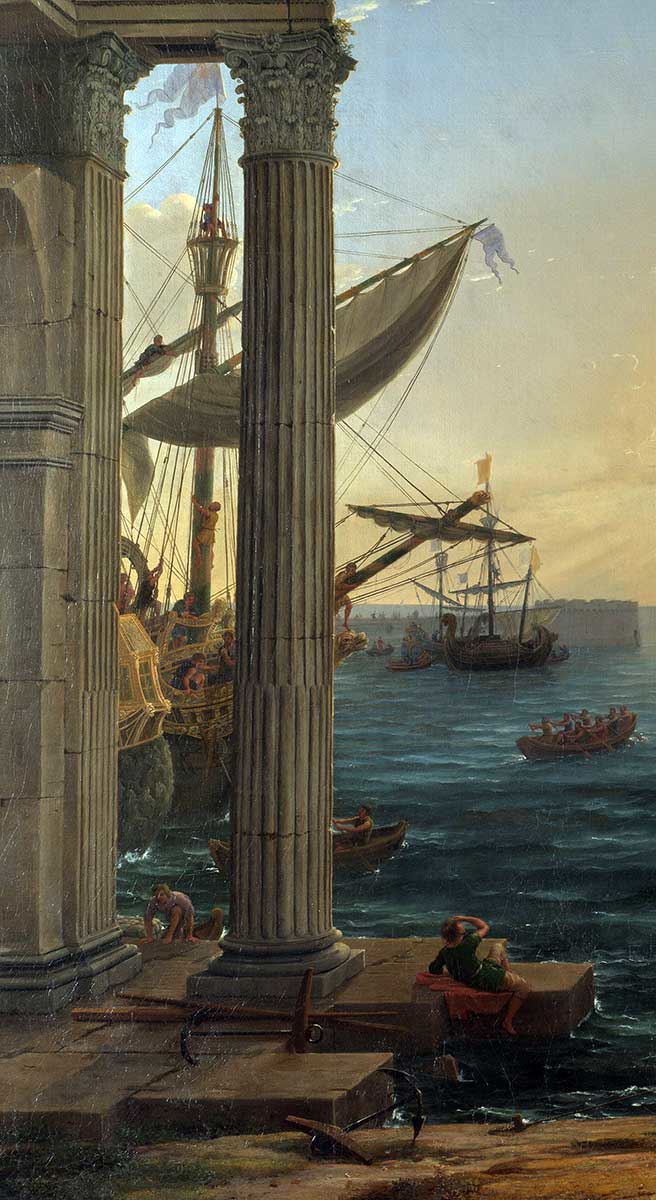
The image is replete with vistas that index time and humanity’s place in it. Passages, porticoes, and stairs all direct the attention to the immateriality of the works of humanity. The Corinthian columns of the left foreground are ruins, reclaimed by time and nature. There is a left-right dichotomy in the composition of the picture that again signals the mortality of human cultures. The dilapidated Corinthian column on the left marks the future of the pristinely kept royal palace from which the queen emerges. The upper reaches of the clouds have a formation that loosely resembles a natural pediment, linking the two sides of the composition, from the palace to the broken colonnade. This presages nature’s reclamation of all products of human imagination and craft.
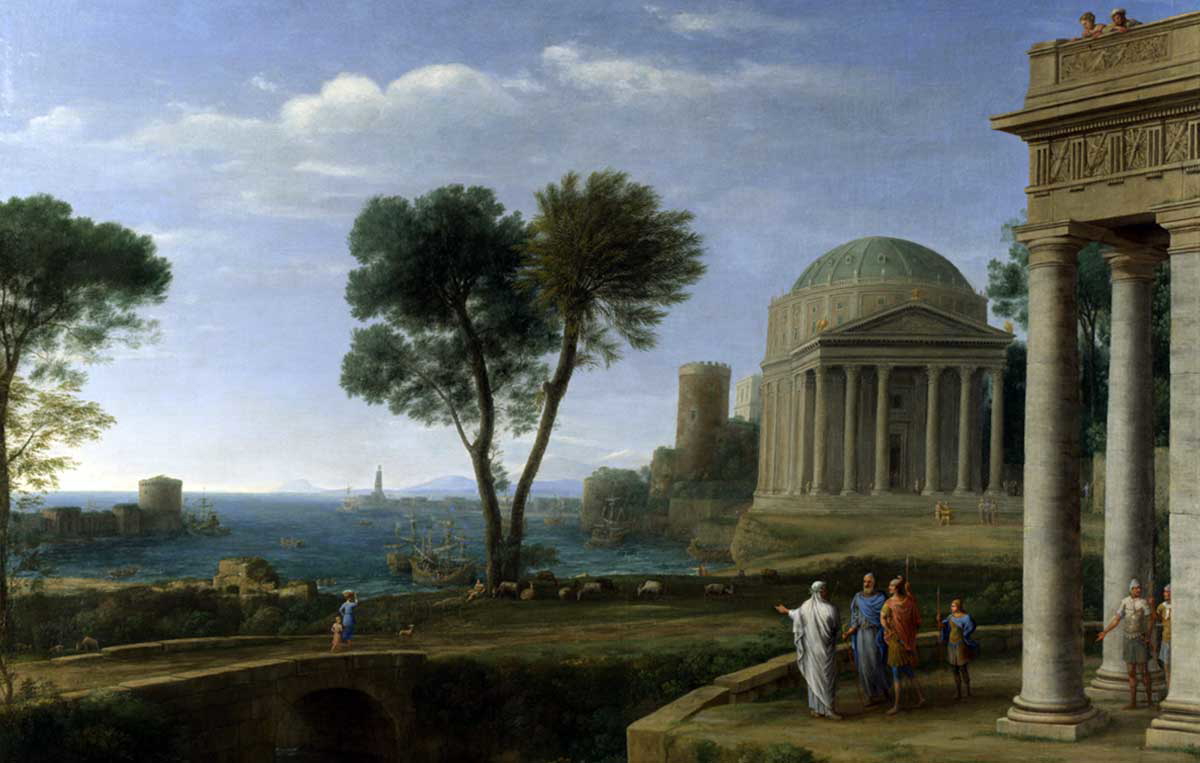
The rippling of the waters of the port is a typical motif used by Claude to point to the quick succession of time’s moments. As Roethlisberger observes, Claude’s conception is very aptly summed up by the antique Roman poet Ovid in his Metamorphoses: “Moments of time flee and follow, and are ever new.”
An alternative interpretation of Claude’s painting of Sheba setting out in the morning sun is that it refers to the prospective encounter with Solomon. The queen embarked to test and query the king’s reputed knowledge and justice. The book of Kings relates this encounter, and that the queen was so impressed that she presented Solomon with rare spices and 150 gold coins. In the context of the story, Claude’s rising sun can be seen as a premonition and a manifestation of Solomon’s enlightenment. However, when making this cautious relation, we must acknowledge that Claude was widely seen in his own time as “unlettered” and made the visual aspect of his art predominate. But that would not preclude the artist from at least hearing the story related to him, if he did not read it himself.
Landscape with Psyche Outside the Palace of Cupid (1664)
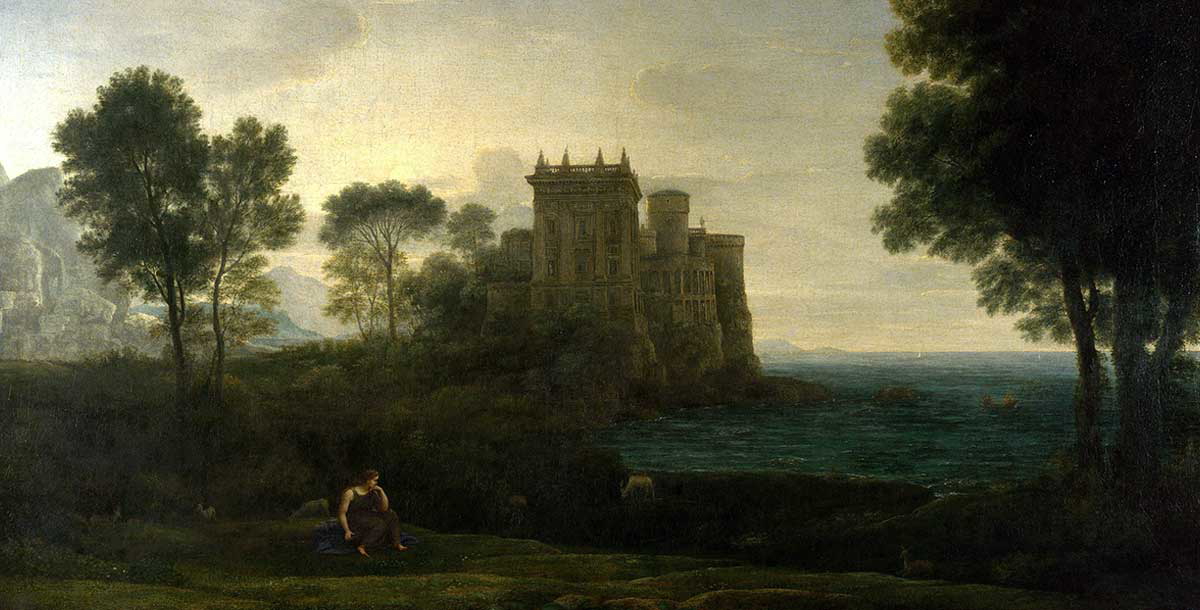
Landscape with Psyche Outside the Palace of Cupid is a painting from later in Claude’s long career and was commissioned by one of his most faithful patrons, Lorenzo Onofrio Colonna. The subject is taken from the ancient poet Apuleius, who relates the love between Cupid, a god of love, and the nymph, Psyche. Scholars disagree as to whether Claude’s painting marks a time before they meet or after Cupid’s abandonment of Psyche. Apuleius writes that Psyche is wafted by Zephyrus, the god of the west wind, to a “deep valley, where she was laid in a soft grassy bed of most sweet and fragrant flowers.” After she rests, she sees “in the middest and very heart of the woods, well nigh at the fall of the river…a princely edifice.”
The pictorial evidence for Claude’s scene being after the abandonment seems compelling. The entire image—with its muted color, along with the expression and pose of Psyche—is clad in a melancholy that both looks back to her loss and forward to her death. Psyche has been rejected; Apuleius writes that she grieved the loss before drowning herself in the nearest running water.
The evening light is muted in Claude’s image. The setting sun is low, and the clouds are darkening over the castle. All of this, along with Psyche’s pose, is a traditional artistic expression of melancholy—with her elbow on her knee and the back of her hand under her chin referring to closure and valediction. The valediction is two-fold and moves from past to future—a farewell to Cupid and the imminent farewell to life. In her depression, Psyche looks out to the waters that she will die in, and which are painted in dark hues of greens and blues that convey the coldness of death.
Psyche, from Landscape with Psyche Outside the Palace of Cupid, by Claude Lorrain, 1664. Source: The National Gallery
Psyche’s position is encircled by trees and bushes. Her fate seems inevitable to her. The last of the evening light ebbs from the grassy glade in front of her. As surely as the day closes, so will her eyes for the final time. Her eyes are wide, as if this is the moment of her resolution, and she is about to rise from her melancholic state to commit the ultimate act. The palace is also a fortress and symbolizes the intractable will of Cupid and the resultant finality of Psyche’s fate.