Ancient Greece was a place where intellectual thought and science could take root. From these ideas, the Greeks built incredible structures that came to symbolize elegance and proportion, backed by mathematical precision and aesthetic beauty.
While some of these buildings still stand, sadly, the steady march of time has taken its toll, and much of the grandeur of these buildings exists only in the imagination or as artistic reconstructions in books and on screens.
Nevertheless, the iconic impact these structures have had on the Greek world and those who are fascinated by its history still exists. Here are 7 of the most famous buildings from Ancient Greece.
1. The Parthenon
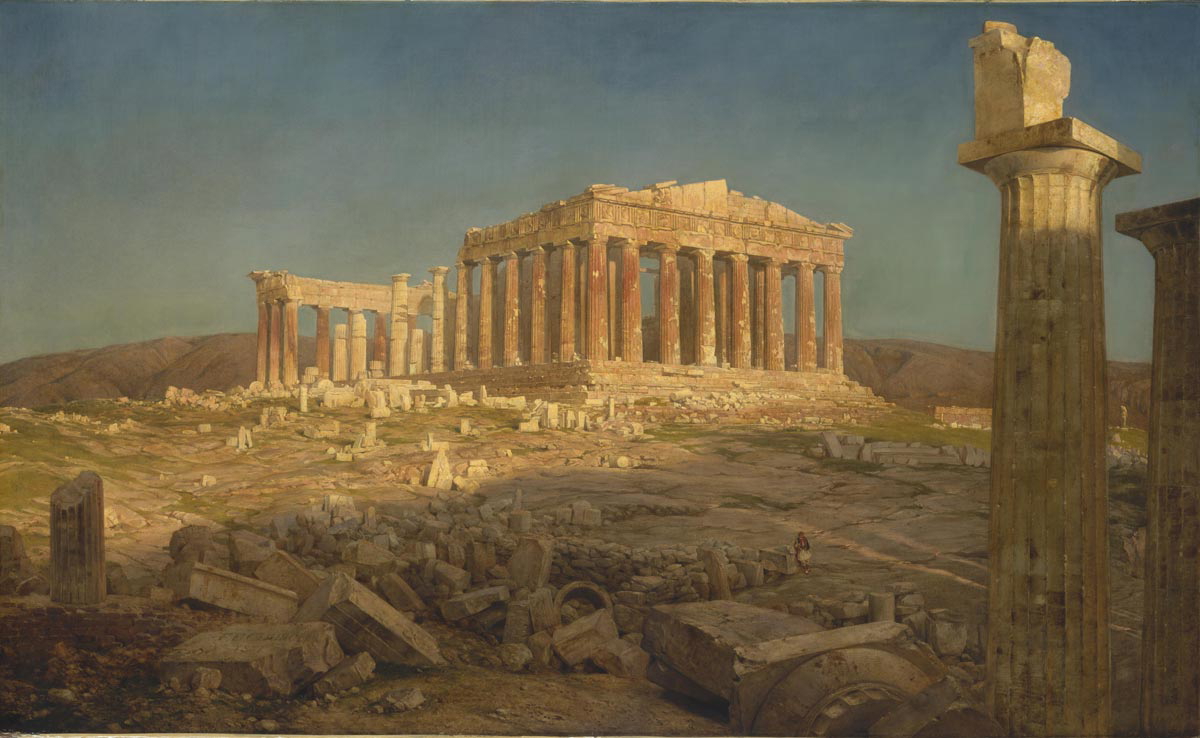
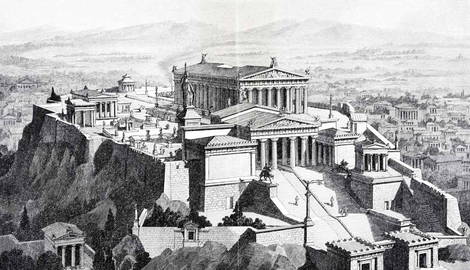
Easily the most famous building from Ancient Greece, and likely still the most famous building in Greece to this day, the Parthenon sits atop a flat-topped hill, the Acropolis, in Athens, and offers a commanding view of the sprawling city below. The centerpiece of the Acropolis is, of course, the Parthenon, which is an ancient temple dedicated to the goddess Athena. Symbolizing the high point of classical Greek architecture, the Parthenon, in modern thought, has also come to represent democracy and the birth of Western Civilization.
After the wars with Persia, Athenian statesman Pericles commissioned the massive building projects on the Acropolis, and construction of the Parthenon began in 447 BCE and finished in 438 BCE, although decorative work on the building’s exterior continued until 432 BCE.
The temple was home to a 40-foot-tall statue of Athena, which disappeared sometime in the first millennium. Its fate remains unknown, and it may have been destroyed. After the decline of Ancient Greece, the Parthenon was converted into a church, and this may explain the disappearance of the statue. Copies, however, were made by the Romans. In more modern history, a full-scale replica of the statue, along with the Parthenon, was built in Nashville, Tennessee.
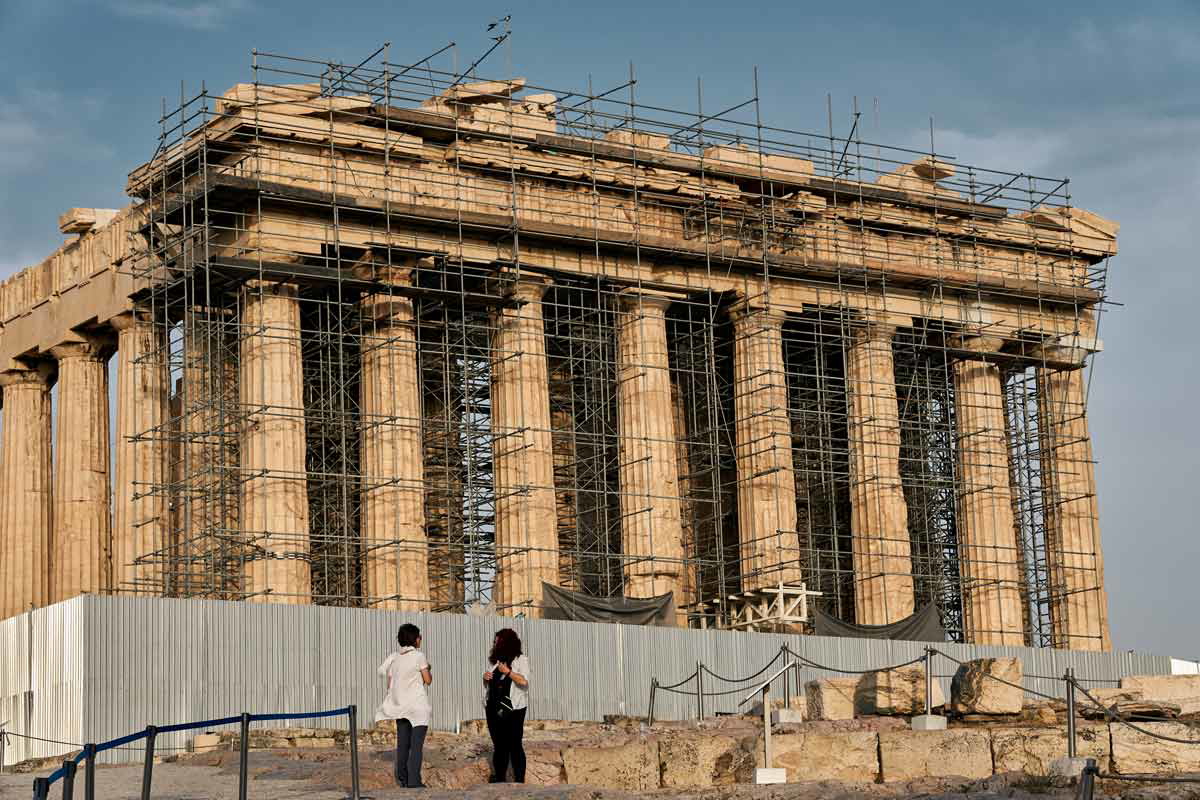
In modern times, the temple has seen its fair share of strife. Wars over the centuries caused damage to the building, and in 1981, an earthquake caused more damage, while pollution and acid rain have taken their toll on the marble and stonework.
Since 1975, however, the Parthenon has been the subject of great efforts in restoration work, and it still stands today as a centerpiece of Greek history and identity.
2. Temple of Olympian Zeus
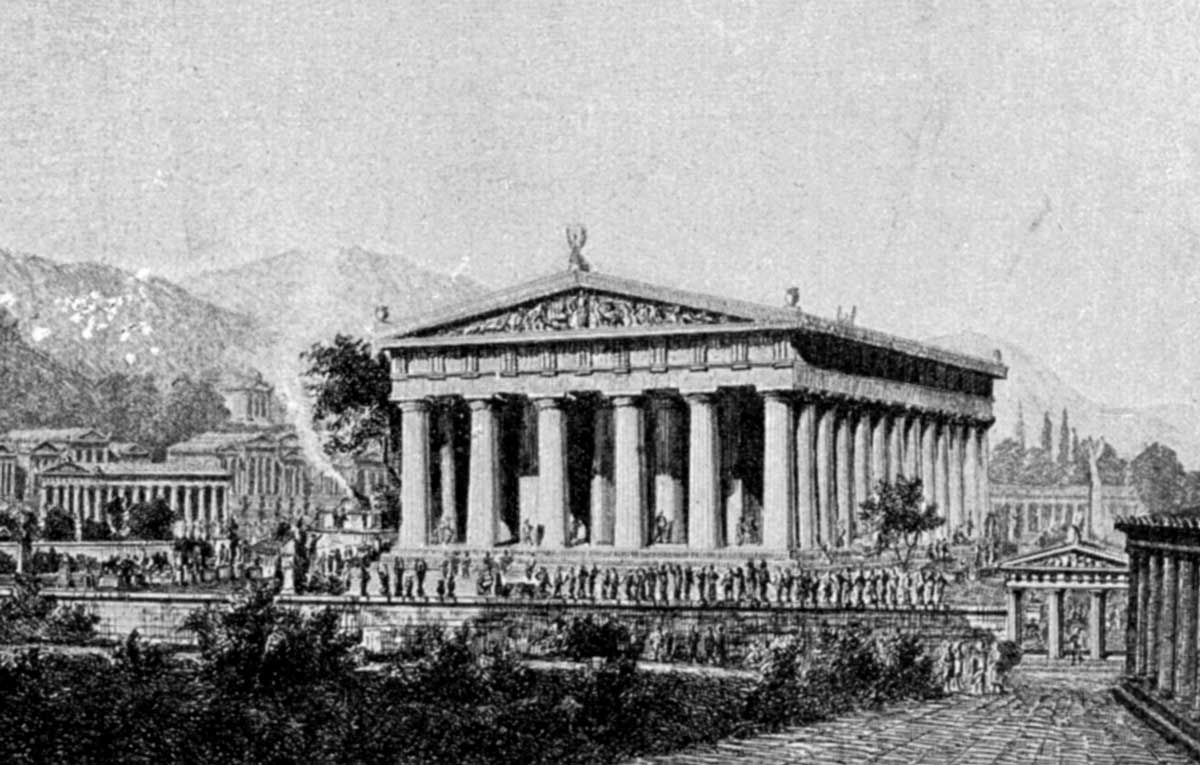
In the 6th century BCE, during the rule of the Athenian tyrants, construction began on a colossal building that was envisioned to be the greatest temple in the world. The tyrants, however, would never see its completion. The building was not finished until the rule of the Roman emperor, Hadrian, 638 years after the first stone was laid!
Consisting of 104 colossal pillars, each 56 feet high, the temple was indeed grand and housed a massive statue of its namesake, the god Zeus. It was (and still is) located southeast of the Acropolis of Athens, and its foundations were laid on top of another temple which had stood in that location. The project was abandoned in 510 BCE, and picked up again in 174 BCE, only to grind to a halt ten years later.
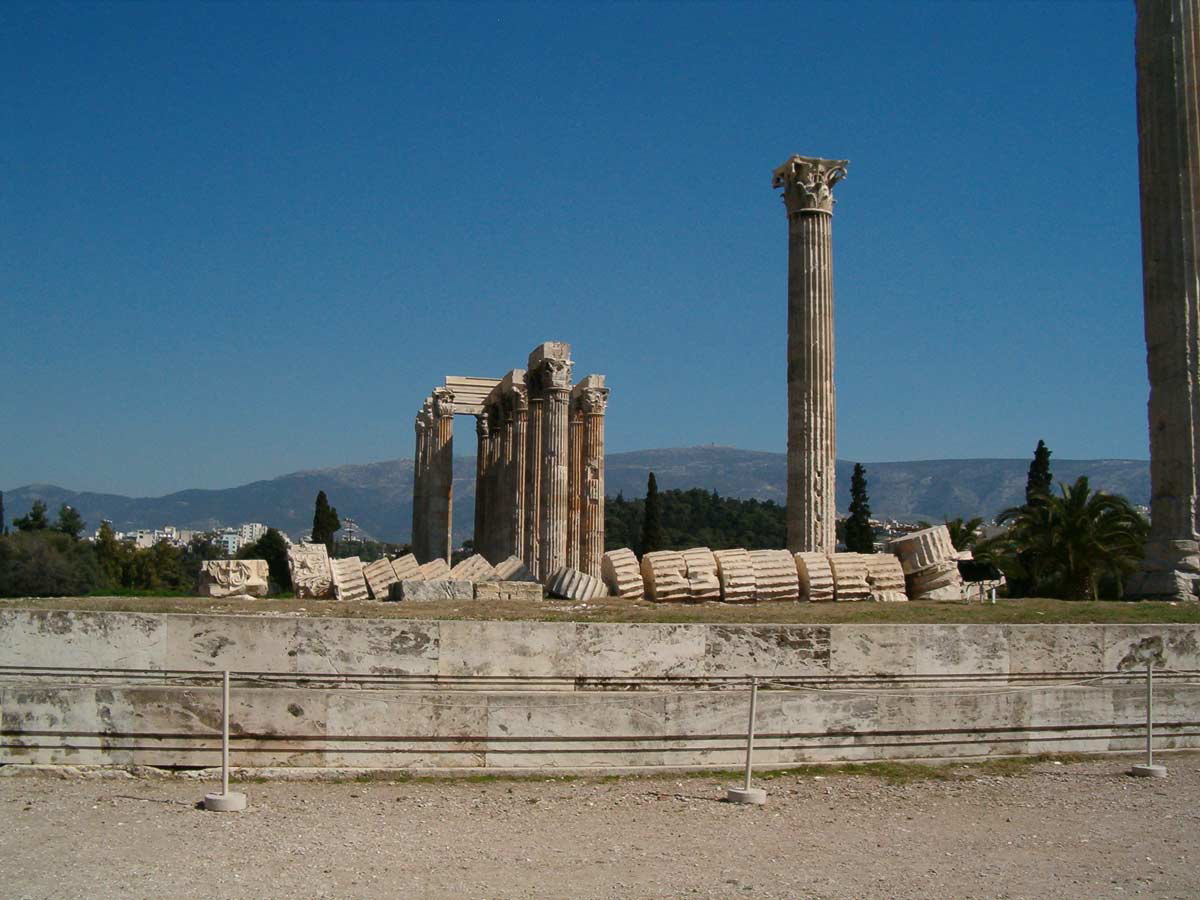
In 86 BCE, the Romans sacked Athens, and some of the columns from the incomplete temple were transported back to Rome and became part of the Temple of Jupiter on the Capitoline Hill. The Romans later reinitiated the building project, and the Temple of Zeus was completed in the 2nd Century CE, but its glory was short-lived. A little more than a century later, in 267 CE, the temple was damaged by a marauding Germanic tribe, the Heruli. The temple fell into disuse and, over the centuries, was scavenged for building material.
Today, only 15 columns remain standing, with a sixteenth column lying where it fell. Nevertheless, its previous glory is easy to imagine, and the site is a well-protected open-air museum.
3. The Temple of Hephaestus
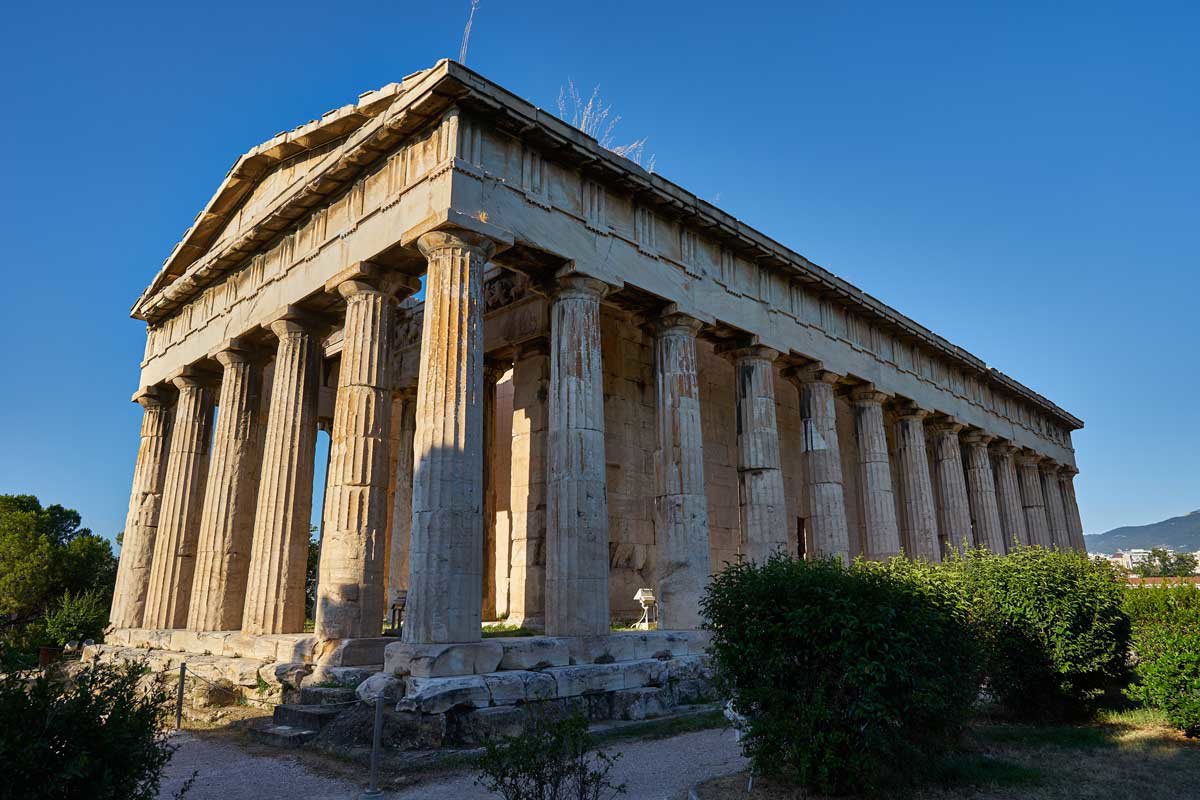
The Temple of Hephaestus or the “Hephaisteion,” located on the north-west side of the Agora of Athens, is a Doric temple that still stands mostly intact today, and is a grand example of ancient Greek architecture. Construction of the temple began in 449 BCE and took several decades to be finished.
In ancient times, the temple played host to a number of important festivals and held particular religious significance for metal-workers, as Hephaestus was the god of fire, crafts, metal-working, and blacksmiths.
Around the 7th century CE, the temple was converted into a Christian church, and it remained so until 1834, after which it was used as a museum until 1934. Since then, the building has had the status of an ancient monument, and archaeological research has been allowed to take place at the site.
Like many temples from ancient Greece, the Temple of Hephaestus is decorated with friezes that depict events from Greek mythology, and includes stunning imagery of Theseus battling the Pallantides, and centaurs in combat with Lapiths.
4. The Ancient Theater of Epidaurus
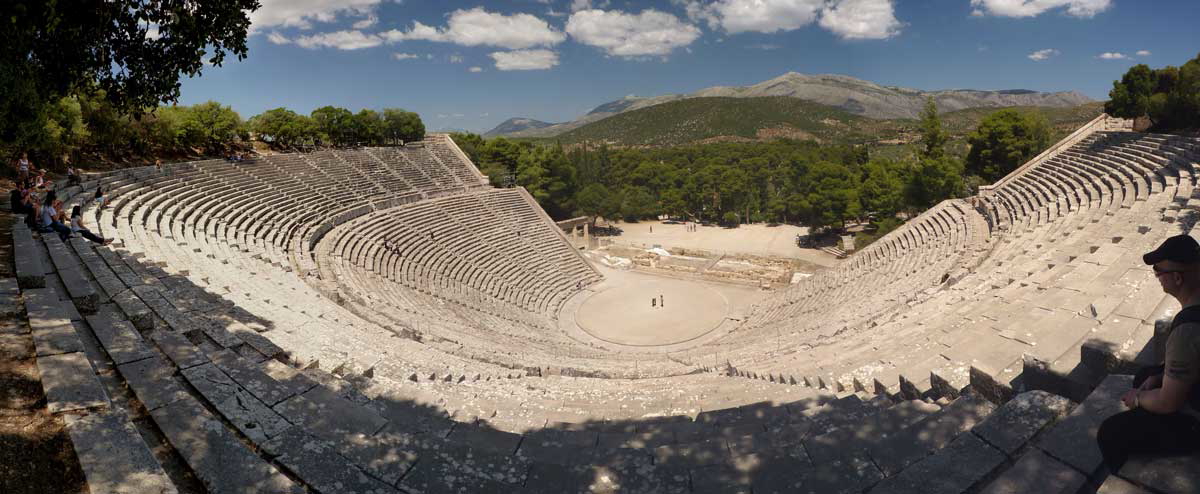
The ancient Greeks were well-known for their love of culture and the arts. Central to this were plays designed to entertain the masses. Great amphitheaters were built all over Greece, and the Theater of Epidaurus, constructed in the 4th century BCE, stands as arguably the most famous example. It was built into the side of a mountain and overlooks the Sanctuary of Asklepius, which was a major healing center in Ancient Greece.
The structure is massive, with the highest part of the concave reaching almost 200 feet above the stage, which measures 65 feet in width.
Some of what makes the Theater of Epidaurus so famous is its remarkable state of preservation. In fact, the theater is still in use today. It hosts the Epidaurus Festival during the summer months, in which ancient dramas and other plays are put on. In 1960 and 1961, famous soprano Maria Callas performed there.
5. The Erechtheion
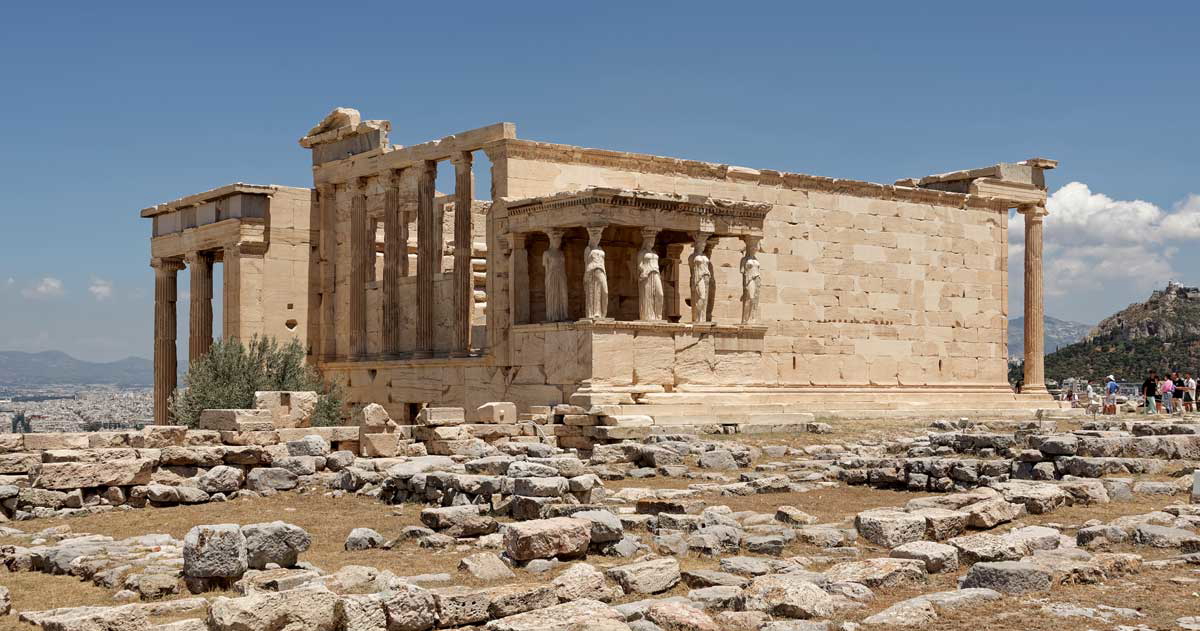
Another masterpiece adorning the Acropolis in Athens, the Erechtheion was constructed in the 5th century BCE and sits on the north side of the temple complex. Also known as the Temple of Athena Polias, it was primarily dedicated to the goddess Athena.
The temple is famous for its asymmetric shape, which does not conform to Classical Greek architecture at the time it was built. The reason for this is subject to conjecture, and it may have been a result of the irregular ground at the site. It is also suggested that the building may represent a smaller part of a larger symmetrical building, which has since crumbled to dust. Whatever the case, the temple is an excellent example of Ionic architecture and influenced architecture in the periods that followed, including the Hellenistic, Roman, and Greek Revivalist eras.
A major feature of the Erechtheion is the caryatids, which are columns carved in the shape of female figures. The six located on the Erechtheion are known as the Korai. They are easily the most photographed part of the building and form an iconic part of the Acropolis complex.
6. The Temple of Apollo at Delphi
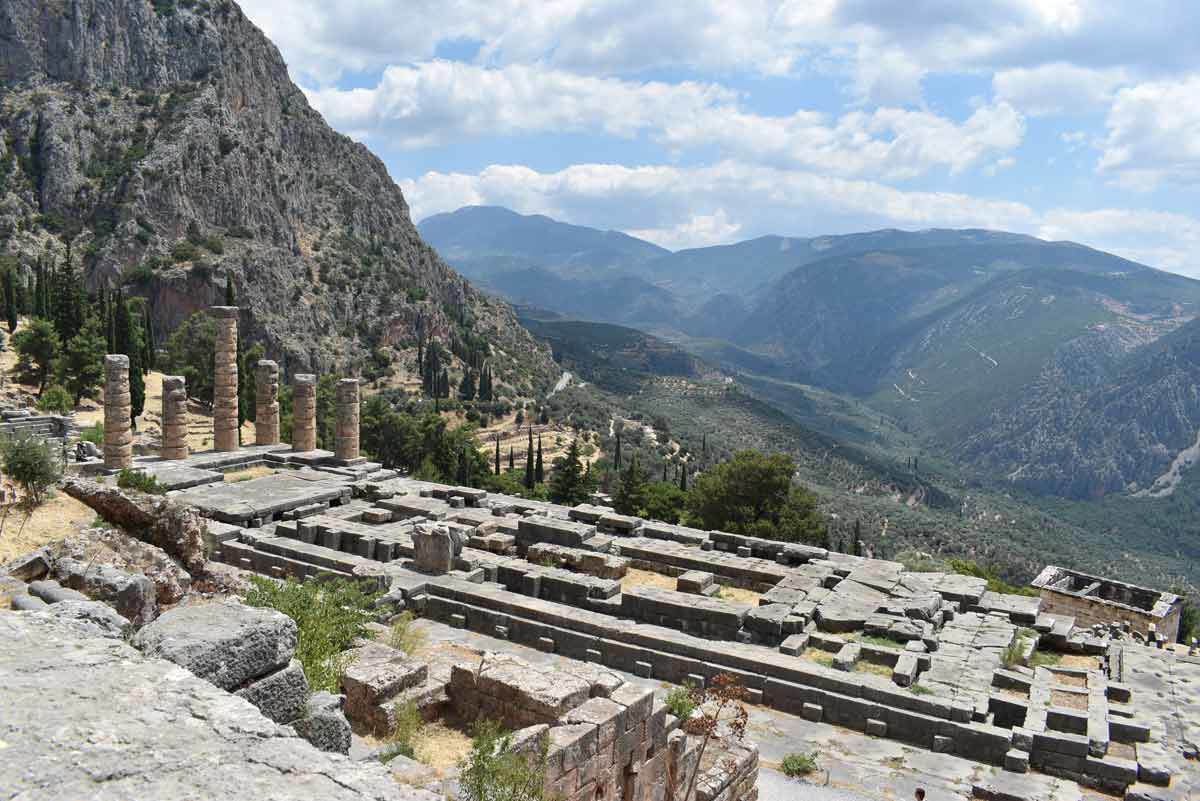
Home to the Pythia, the famous Oracle of Delphi, the Temple of Apollo is located on Mount Parnassus in Central Greece and is part of what is known as the Panhellenic Sanctuary at Delphi. The ruins that exist today are the remains of the fifth temple built on the site. It was a Doric building originally constructed in the 6th century BCE, but was damaged and reconstructed after an earthquake in 300 BCE.
While the temple was dedicated to Apollo, for three months of the year, it served as a hub for the worship of Dionysus. Drawing in vast numbers of pilgrims was, of course, the Oracle. People from all over the Greek world and beyond would journey to the temple to seek the wisdom of the women who were able to foretell the future. The temple also served as a center for healing, as this was one of Apollo’s domains.
Modern excavation began at the end of the 19th century, and modern geological surveys have discovered fault zones in the ground below. Hydrocarbon gases emitted during tectonic events could have delivered psychoactive effects to the Oracles.
7. The Stadium at Olympia
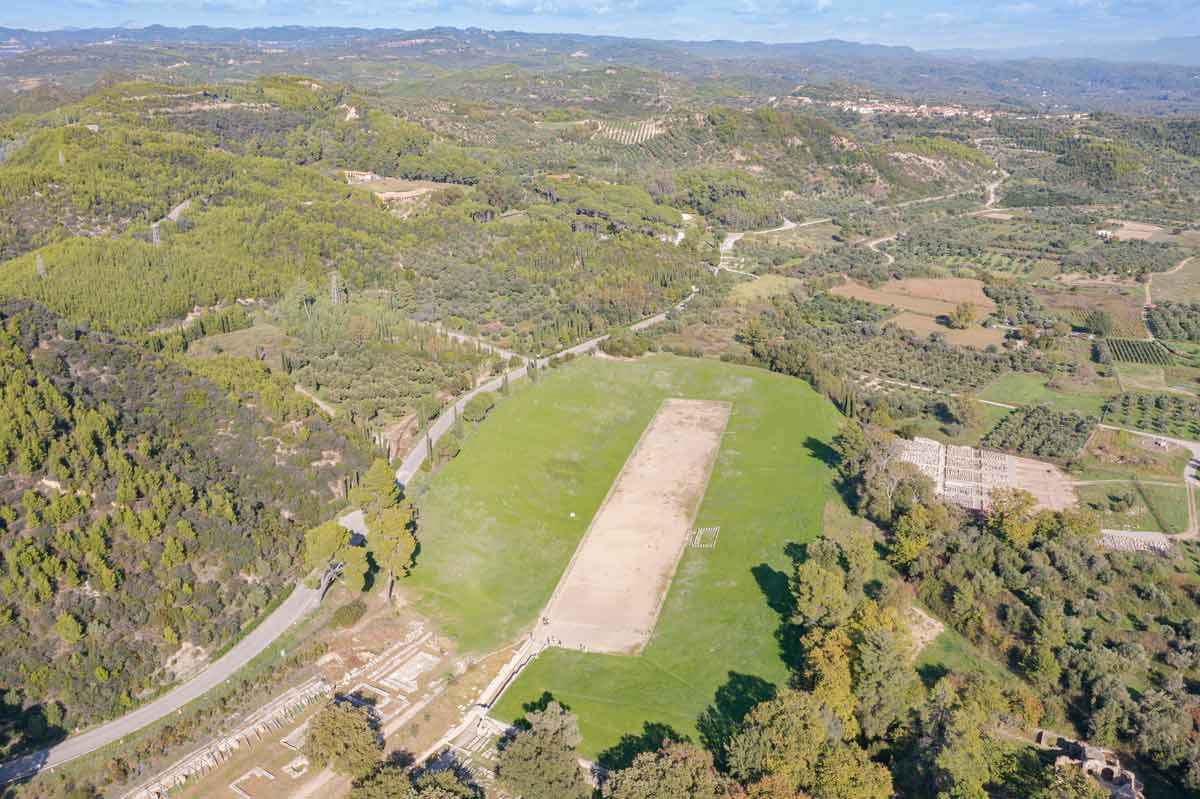
Uniting the Greek world every four years, the Stadium at Olympia hosted the ancient Olympic Games, wherein freeborn Greek men would showcase their athletic abilities in competition with one another. At the same stadium, the Heraean Games took place, where unmarried young women competed in foot races.
Central to the stadium is the racetrack, which is over 650 feet long and 100 feet wide, around which seating existed for around 20,000 people. Most of the seating was built out of hard-packed clay. To the east of the stadium is the sanctuary of Zeus, the god whom the games honored.
In more modern history, the site was used for the shot put events at the 2004 Summer Olympics, which were held in Athens.