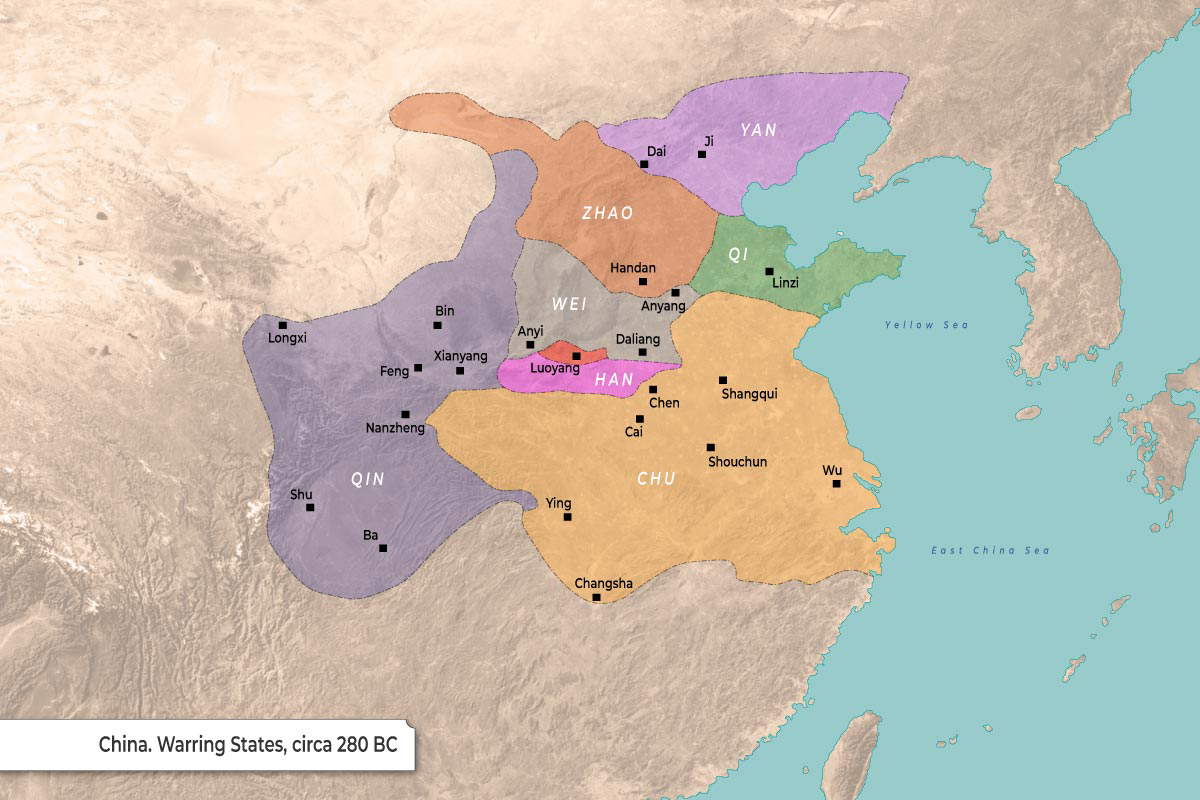
The Qin Dynasty (221–206 BCE) was the first imperial dynasty of China, established after the state of Qin conquered the other major states to end the Warring States period. Founded by Qin Shi Huang, the dynasty unified the country under a highly centralized, legalist government and standardized Chinese writing, currency, and measurements. Although it lasted only 15 years, its administrative structures and massive building projects, including the early Great Wall and the Terracotta Army, laid the foundation for all subsequent Chinese empires.
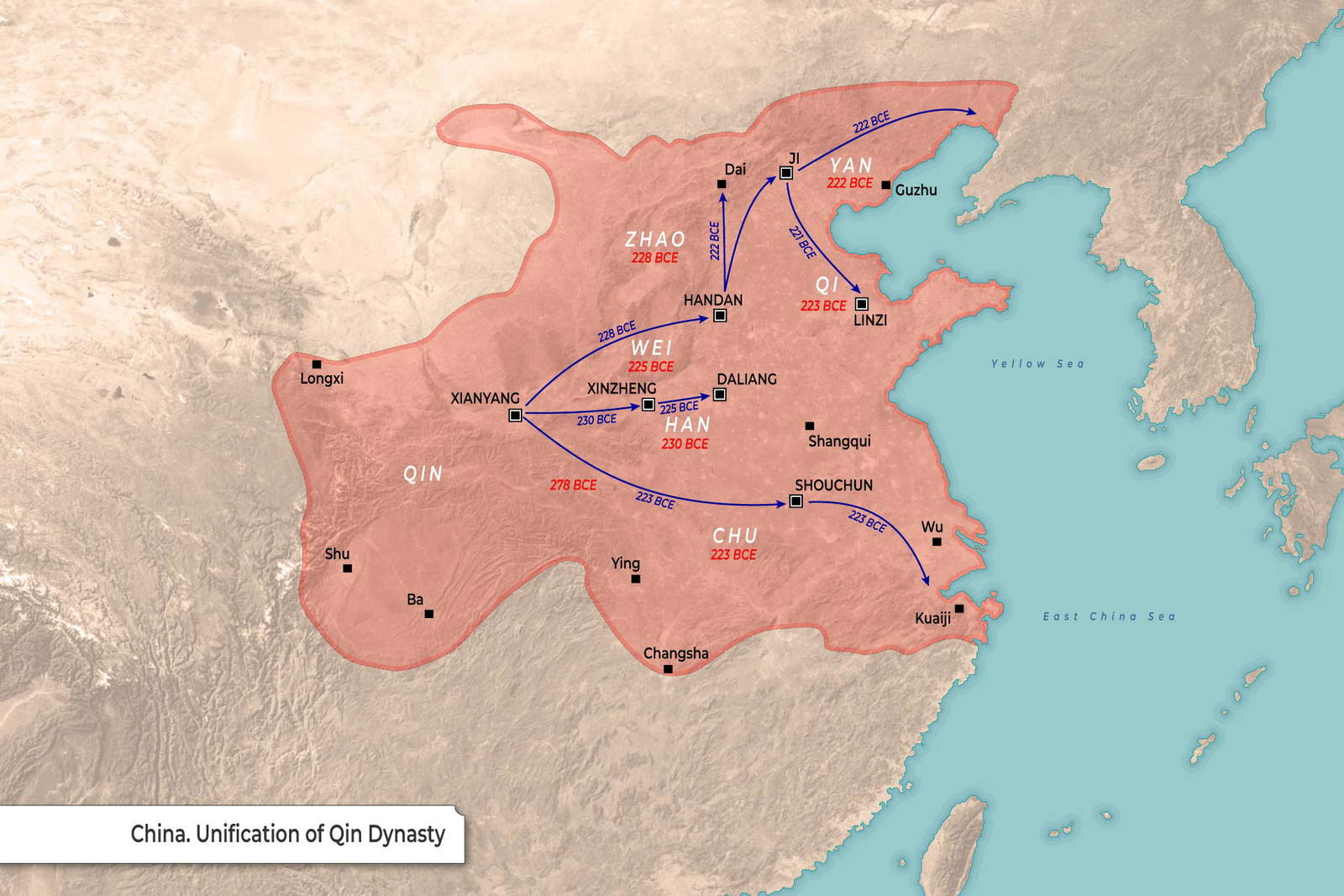
This map shows the territorial unification of China under the Qin Dynasty.
- The map uses a single red-orange shaded area to represent the newly consolidated empire, removing the distinct state borders from the prior era.
- Blue arrows trace the directional paths of Qin’s military campaigns, originating from the western capital of Xianyang and pushing eastward and southward.
- Dates in BCE are provided alongside the state names and campaign arrows to denote the chronological timeline of each state’s defeat.
- Conquered capital cities are marked with a distinct square icon containing a dot, differentiating them from other regional settlements.
| State / Region | Conquest Year | Marked Cities |
| Qin (Base) | N/A |
Xianyang, Longxi, Shu, Ba
|
| Han |
230 BCE
|
Xinzheng
|
| Zhao |
228 BCE
|
Handan, Dai
|
| Wei |
225 BCE
|
Daliang
|
| Chu |
223 BCE
|
Shouchun, Ying, Changsha, Shangqui, Wu, Kuaiji
|
| Yan |
222 BCE
|
Ji, Guzhu
|
| Qi |
221 BCE
|
Linzi
|