
Part of Plato’s genius lies in his appeal to learners at every stage of philosophical inquiry. He provides clear demonstrations for beginners, while writing with such subtlety to complicate this clarity for those already “initiated” into this way of thinking. The divided line is one such instance of this. It is the second in a triad (the analogy of the sun, the divided line, and the allegory of the cave) that lays out the basis of his metaphysics: the whole of reality stems from the forms and their genesis from the good.
The Sun and the Good: The Visible and the Intelligible
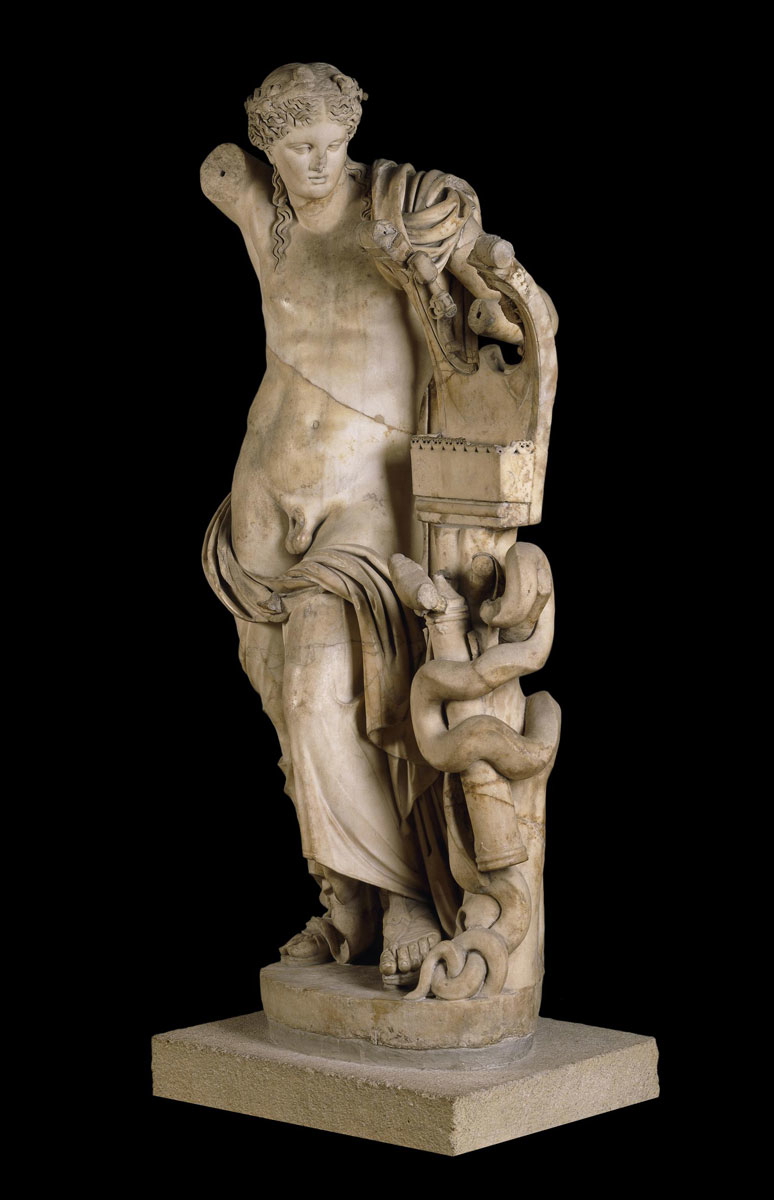
What is the good? It is a difficult question to answer, but from Plato’s first analogy of the sun, we gained some insight. As the sun is the cause of light and vision, the good is the cause of knowledge and truth (Plato, 1961, 508e-509a). Because of this, it cannot be fully defined with language and images. This ineffability is the cause of Socrates’ hesitancy to give a positive account (Plato, 1961, 506e). After Glaucon implores him to omit nothing, Socrates confesses he must omit a great deal but will try.
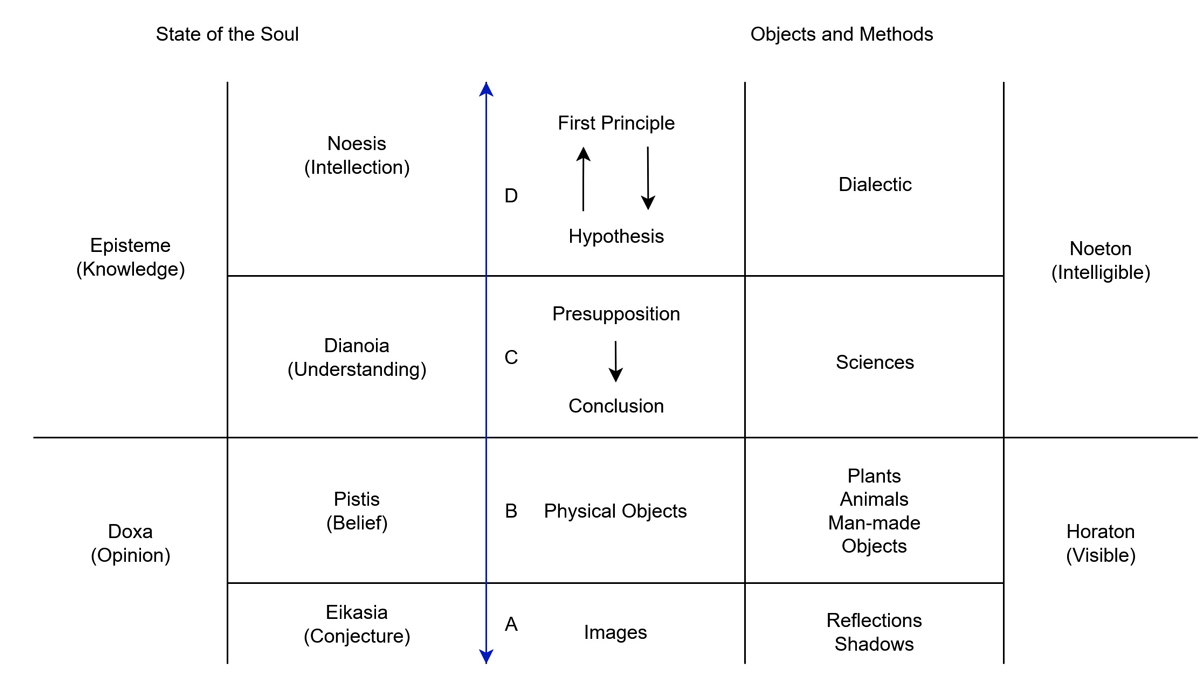
We are invited to draw a line and bisect it into unequal parts. These represent the visible realm (horaton) as furnished by the sun, and the intelligible realm (noeton) as furnished by the good. We are told to bisect these sections once more along the same ratio. This yields four sections that we can refer to as A, B, C, and D. We are told further that the length of each section is in proportion to its degree of clarity (Plato, 1961, 509e). There are multiple ways to represent the line depending upon interpretation. We could fault Plato for not being more explicit, but as we will see, there may be an intention behind this difficulty.
After an examination of each section, we will come to see a hierarchical path reveal itself, leading the soul from obscurity at one end to utmost clarity at the other. We ascend from the murkiest depths of the visible realm into the heights of the intelligible realm toward the good which lies outside being (Plato, 1961, 509b).
Section A: Eikasia (Conjecture)
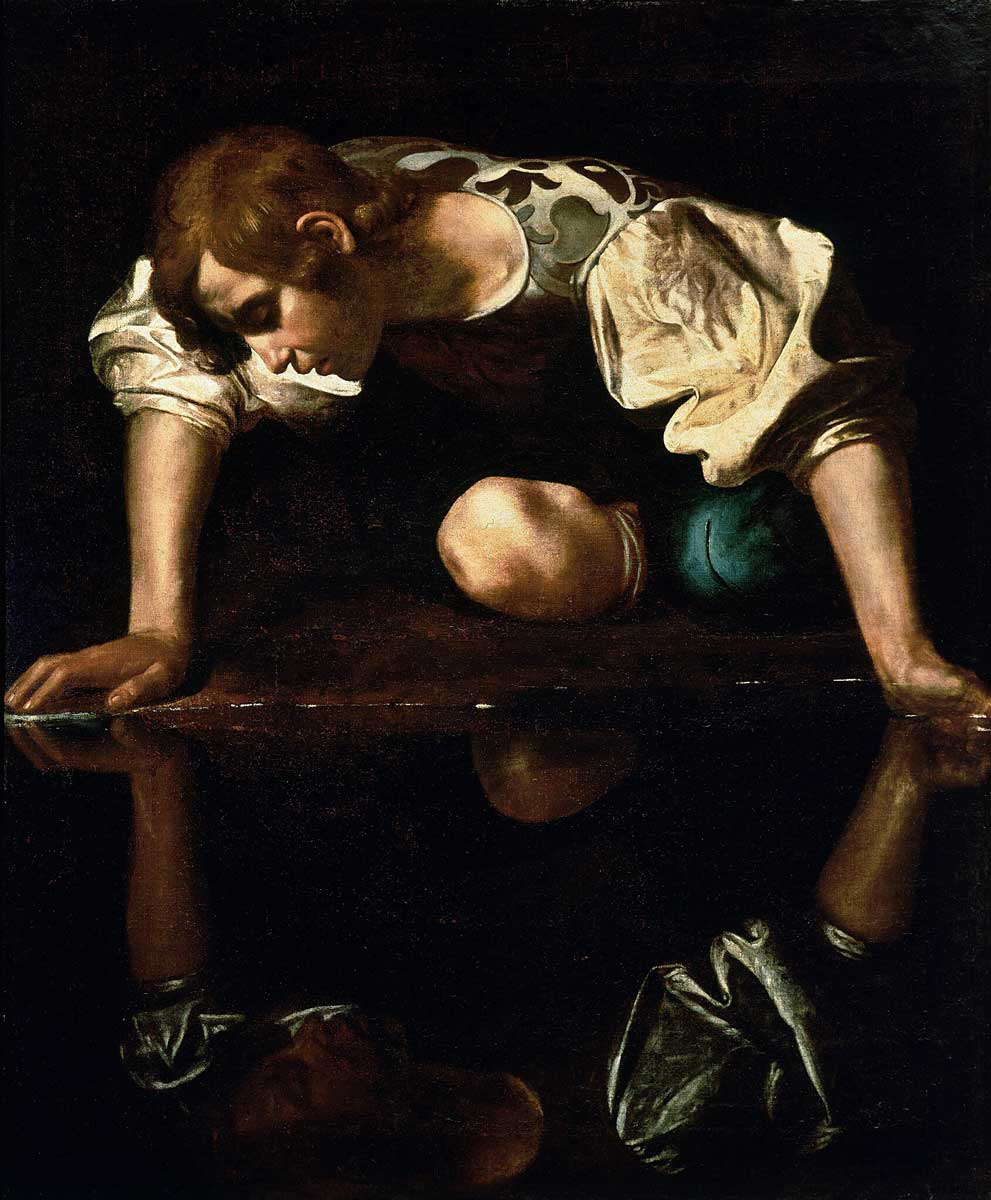
Section A is the lowest section in Plato’s hierarchy, furthest removed from the good. It is populated by images of the physical world. The difference between an image and an original is that it lacks aspects of the original. This is why Socrates stipulates that these images are shadows first, then reflections of physical objects. Shadows lack color and detail, while these attributes are present in reflections. With an increase in clarity and definition, there is a corresponding increase in the degree of reality.
It is interesting to speculate what other entities besides shadows and reflections may be indicated as Socrates adds “and everything of that kind” (Plato, 1961, 509e). From this addition, we could take Plato to mean many artistic forms such as poetry, painting, and rhetoric.
The metaphysical nature of each section of the line has a corresponding state of the soul. For Section A, the Greek word used is eikasia. It is translated by Paul Shorey as conjecture, or picture-thinking (Plato, 1961, 511e). Here, we accept the images without recognizing them as images. Eventually, we may be struck by the lack of depth in an image, which leads us organically into the next section to seek the originals of these images.
Section B: Pistis (Belief)
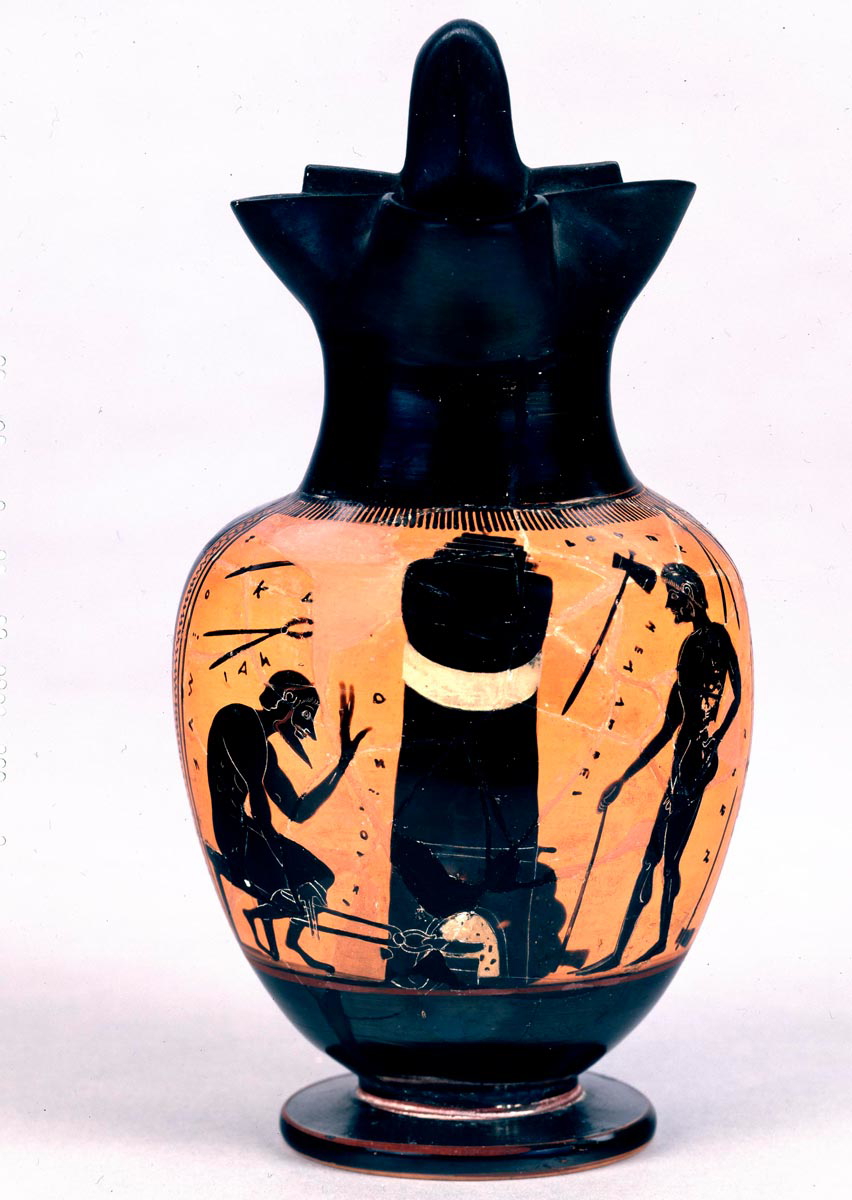
The objects of section B include the whole of the physical world: plants, animals, and things made by humans. The objects of Section A were shadows and reflections of these objects. Possessing greater clarity, this section is the longer of the two in the visible realm.
After noticing the insufficiency of images, we are drawn toward the original object. We now take it as real and recognize the former as an image. We are filled with many more qualities we did not have before, and are convinced by its concreteness.
The affective state in the soul is represented by the word pistis. Shorrey translates it as belief. Like eikasia, we still have not inquired into the nature of the object, but our confidence in its reality has increased (Nettleship, 1898, p.247).
This might be best represented by Socrates’s inquiry into the knowledge of the craftsmen in the Apology (Plato, 1961, 22d). He found they did possess practical understanding; however, their confidence in this area led them to think they also knew about everything outside their field. As Socrates questions them, a lack in their understanding is revealed in the same way an image lacks the qualities of an object. Though the craftsmen react quite hostilely, this lack of understanding may motivate the rest of us to seek a still higher understanding than both eikasia and pistis.
Section C: Dianoia (Understanding)
As we begin the intelligible section, one noticeable change is that we are no longer given objects. Instead, the soul’s constitution and its orientation are emphasized. The image in A imitates the physical object in B, and now we treat that same physical object as an image (something lacking qualities of reality), imitating something not visible, but intelligible. How we investigate the intelligible determines whether the soul is in section C or further up in section D. If we make use of arbitrary presuppositions and images to proceed down to a conclusion, then we are in C. If we make use of presuppositions to work up toward a first principle (see next section) and make no use of images, then we are in D (Plato, 1961, 510b).
These last two sections are the ground for intense scholarly debate. Glaucon himself is confused, and Socrates provides the example of geometry (Plato, 1961, 510c-d). In Euclid’s Elements, we are presented with axioms: self-evident statements taken together to form propositions. Here, we are not inquiring into the nature of “point” or “line,” but assuming they are known and move down to a conclusion from there.
Plato names this state of the soul “dianoia” or understanding. It may treat the visible world as an image to investigate the intelligible, but it still requires visibility for its demonstrations. The geometer uses figures and diagrams to illustrate their conclusions. Though geometry is the only science mentioned by name, there is no reason to restrict this section to it alone, as Socrates indicates (Plato, 1961, 510c). Arithmetic uses “even” and “odd,” biology, “species” or “gene,” physics, “spacetime,” psychology, “mind,” philosophy, “morality,” and aesthetics, “beauty.” Any way of thinking which proceeds from arbitrary presuppositions down to a particular, definite conclusion would suffice.
Section D: Noesis (Intellection)
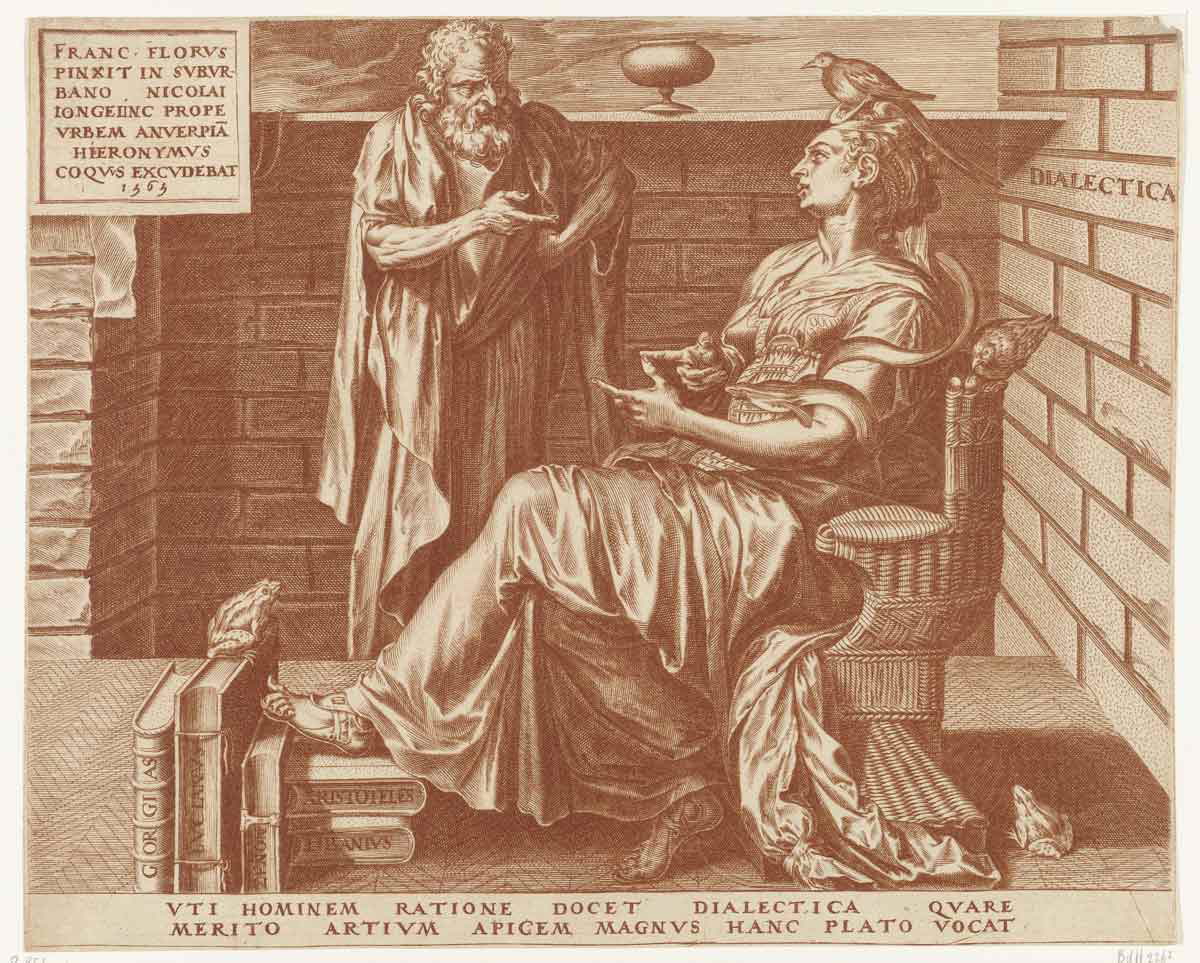
The final section of the divided line is the most abstract of all, and the hardest to grasp. It represents a way of thinking that makes use of reason alone to reach toward a first principle: the foundation of all presuppositions. This investigation is done through a logic of Plato’s invention called dialectic. The nature of dialectic cannot be fully explored here, but we will explain it as it relates to the divided line.
Socrates describes dialectic as treating presuppositions not as self-evident certainties like in Euclid, but as hypotheses (Plato, 1961, 511c). Plato uses hypothesis literally, as in something we place under ourselves to better reach the first principle. We are not assuming things like “diagonal” or “justice” to come to a conclusion, but looking up toward the basis for all such forms. It is a holistic activity aimed toward the unity of all knowledge.
Only after grasping this first principle can we then proceed “downward” to re-examine those assumptions and come to a conclusion. The constitution of the soul associated with this portion of the line is named “noesis,” which Shorrey translates as intellection or reason.
The Possibility of Noesis
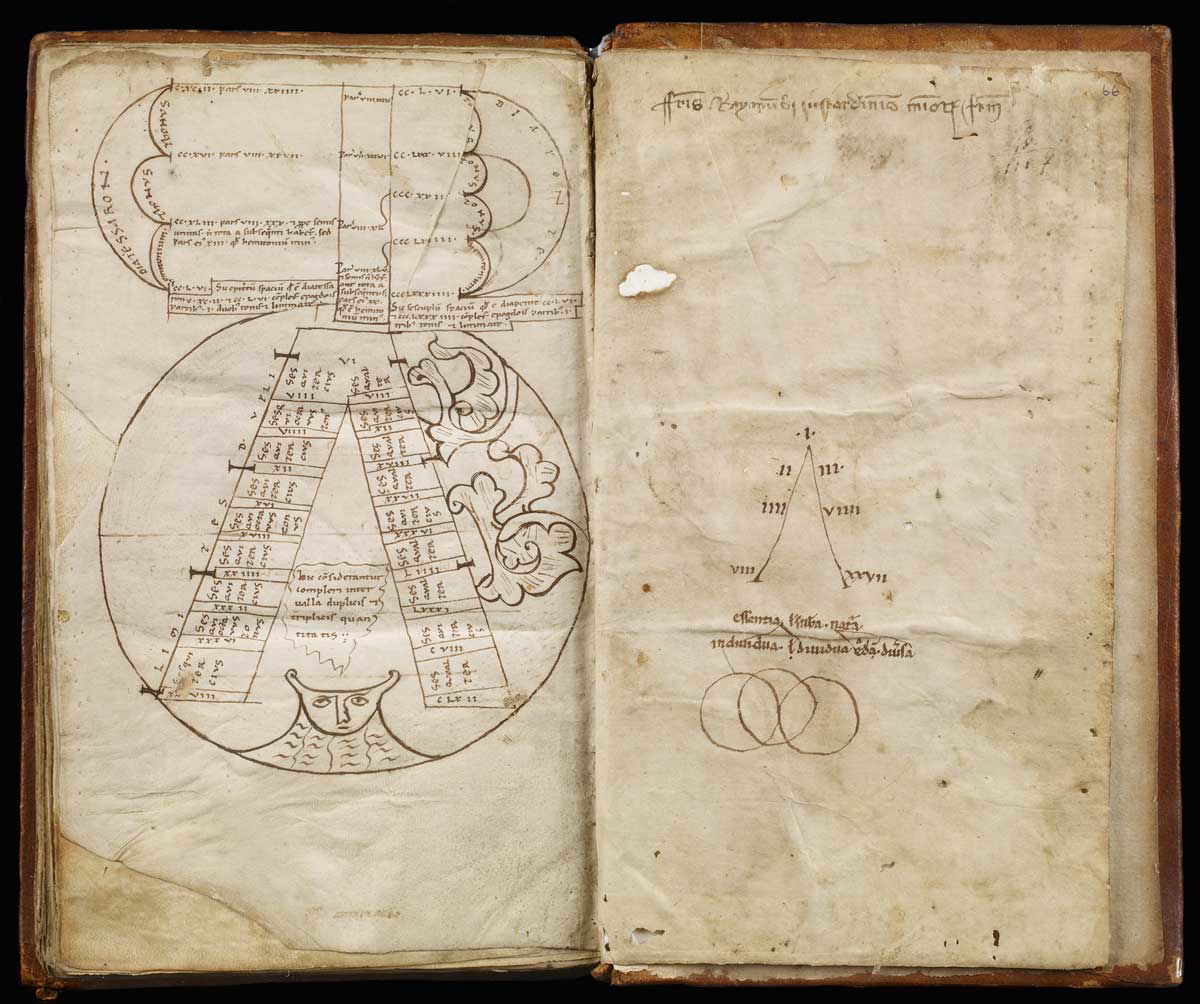
This last section of the line places great demands on us: enough to question its possibility. For an answer to this, we can look at the divided line itself. Isn’t it an image as well? Yes, and no. In the Meno, Socrates “proves” his demonstration by drawing a figure in the sand (Plato, 1961, 82b). Why doesn’t he do so here? It could be that Plato wants the reader to proceed through reason as much as possible. Thus, you should take both the diagram above and any other diagrams of the divided line with a grain of salt.
There are also some possible contradictions in his description of the line. Brumbaugh goes so far as to say: “Taking Plato’s statements about it in any normal sense, the figure he describes cannot possibly be constructed” (Brumbaugh, 1952, p.529).
If there is a first principle, everything is ordered in accordance with it, and there is a unity to all the different kinds of knowledge. There is a purposive pattern to the universe. For Plato, that first principle is what he calls the good. In a way, noesis isn’t “possible” in the sense of “being complete.” Because the good is outside being, the work of noesis cannot be completed. Regardless, we can strive toward the good as far as possible, passing the task on to those who come after us.
Bibliography
Brumbaugh, R. S. (1952). Plato’s Divided Line. The Review of Metaphysics, 5(4), 529–534. http://www.jstor.org/stable/20123288
Nettleship, R. L., & Benson, G. R. (1898). Lectures on the Republic of Plato, Edited by G.
R. Benson. (Originally issued as vol. II. of Philosophical Lectures and Remains.).
Plato. (1961). Complete works. Bollingen Series.