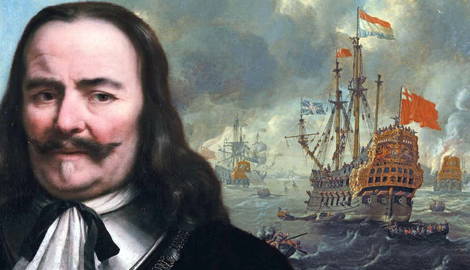

When the Dutch fleet destroyed 13 English warships anchored on the Medway in Kent, they inflicted one of the worst defeats in English naval history. The victory demonstrated the prowess of the 17th century Dutch navy and ensured the Second Anglo-Dutch War ended on favorable terms for the Dutch.
The Second Anglo-Dutch War
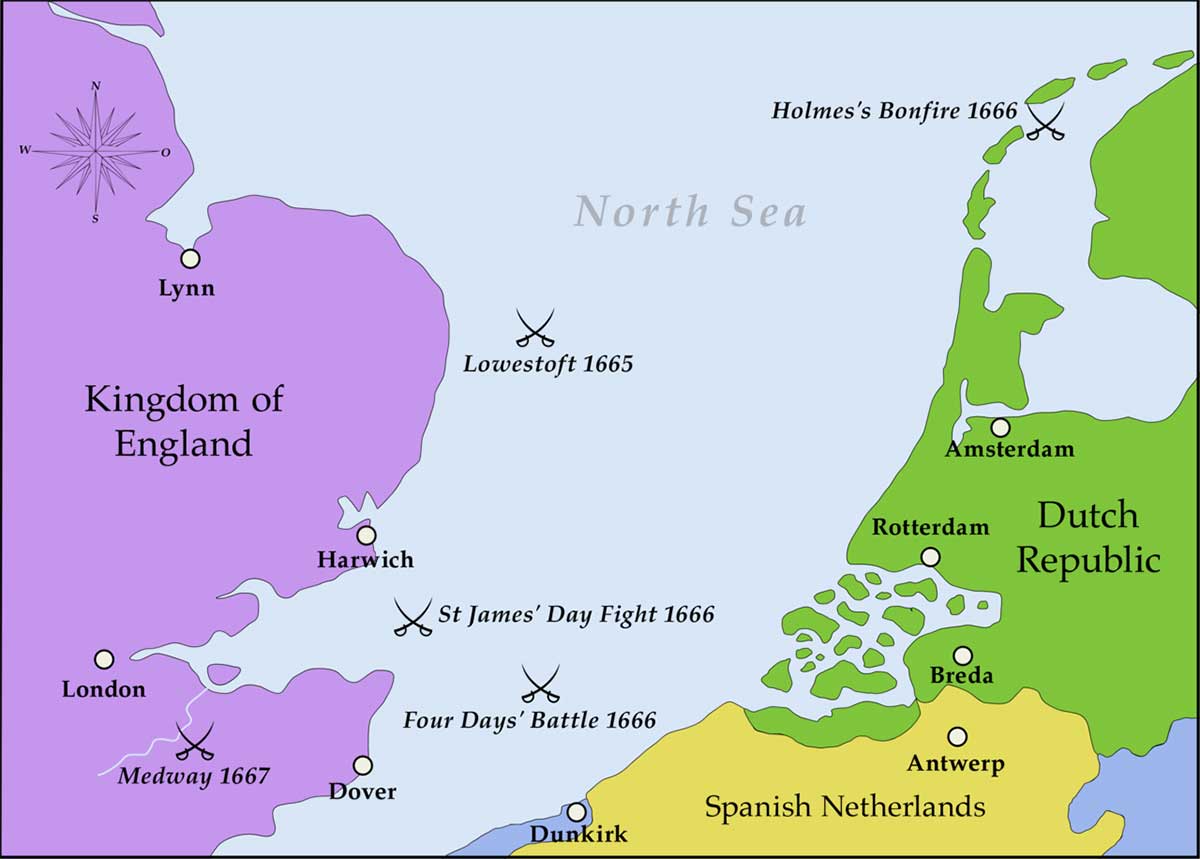
The Second Anglo-Dutch War was a continuation of the 17th century Anglo-Dutch rivalry over trade routes and overseas possessions. It did not start with one battle. Instead, the English began raiding Dutch outposts in the Americas and Africa. When the Dutch retaliated, King Charles II formally declared war with the intention of weakening Dutch control over its maritime trade routes. The Dutch Grand Pensionary, Johan de Witt, began mobilizing his forces to stop English attacks on Dutch merchantmen and try to recapture the lost colonies.
In 1665 and 1666, the English and Dutch engaged in a series of ruthless naval engagements that saw both fleets suffer heavy losses. Both navies had considerable experience after years of battling the Spanish or French. They also relied on privateers to attack each others’ shipping. At one point, the English managed to push the Dutch fleet out of the Channel entirely and raided the Vlie estuary, destroying 140 Dutch merchantmen. This gave the English a temporary upper hand, but the Dutch were not out of the fight.
In 1665, London was hit with a massive plague that devastated the Crown’s finances.The following year witnessed the Great Fire of London. By early 1667, the English government could no longer afford to pay its sailors or maintain its fleet. Charles II made the fateful decision to lay up his heavy warships at Chatham, relying on small “flying fleets” and ongoing peace negotiations at Breda. This returned the advantage to the Dutch, who began planning to strike at what remained of the English fleet at anchor.
Michiel de Ruyter and George Monck
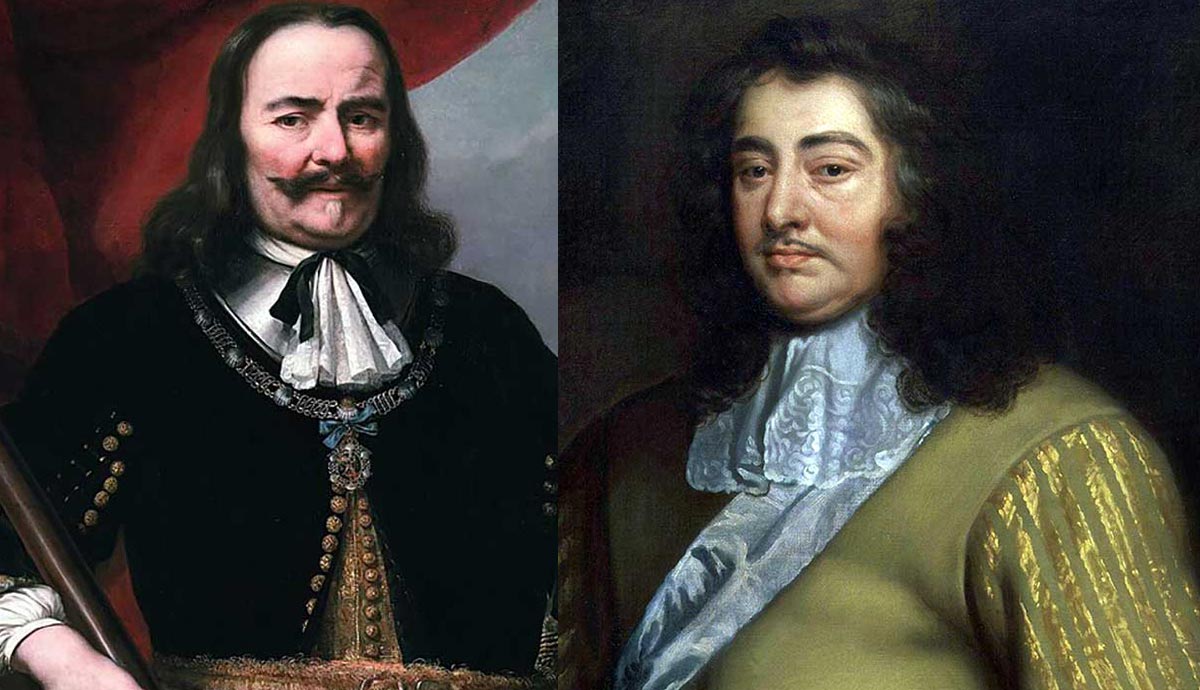
The Dutch hero of the war was Admiral Michiel de Ruyter. A sailor since he was eleven years old, he was a veteran of the First Anglo-Dutch War. For years, he protected Dutch merchantmen from the Spanish, pirates, and English privateers. In 1664, he took several ships on orders from the Dutch Republic and retook several outposts on the West African coast before returning to the Netherlands. Upon his return in 1665, De Ruyter accepted supreme command of the Dutch fleet and was named Lieutenant-Admiral of Holland after his predecessor was killed during the Battle of Lowestoft.
In June 1666, de Ruyter achieved a hard-fought, major victory over the English fleet in one of the longest naval battles in history. Although the English were not destroyed, it was a significant victory for the Dutch. It established his reputation as one of the best naval commanders in the 17th century. Around the Netherlands, he was known as “Bestevaêr,” or “Grandfather.” When the Dutch Admiralty began planning to destroy what remained of the English fleet at anchor, de Ruyter intended to lead the attack personally.
General-at-Sea George Monck commanded English naval forces in the Medway. A veteran soldier of the English Civil War, he was celebrated as the architect of the Restoration and a trusted leader during national crises. After commanding English ships at sea for many years, he was recalled from the fleet by the King to help manage the chaos following the Great Fire of London, a task he performed with efficiency.
Opposing Forces
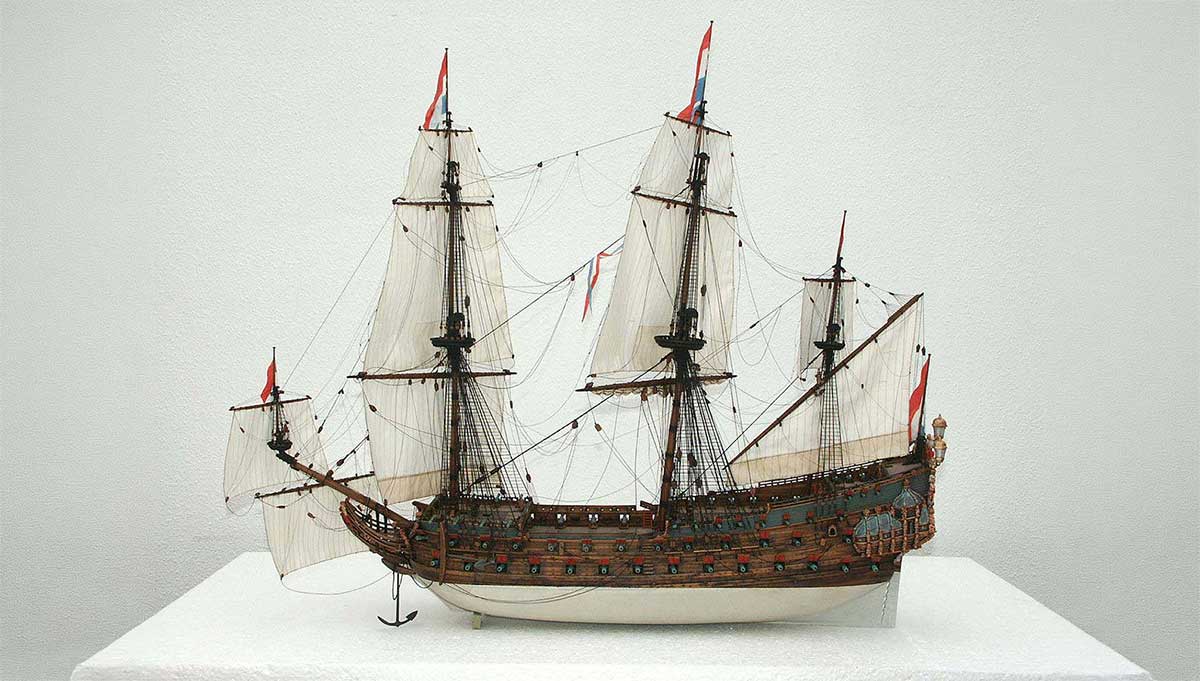
By 1667, the two countries were in negotiations to end the war. However, discussions had deadlocked because Charles II feared that an unfavorable deal would weaken his position at home. Johan de Witt became irritated and he hoped that another major naval victory would strengthen his hand at the negotiating table. He ordered Admiral de Ruyter to take as much of the Dutch fleet to sea as possible, without telling other senior members of the Dutch Admiralty what the plan was. De Ruyter was to take his ships into the mouth of the Thames and destroy what remained of the English fleet at anchor.
To accomplish this task, he had at his disposal a formidable fleet of 62 large warships, 15 smaller vessels, and 12 fireships. 17,500 men manned these vessels. In addition to the ships’ crews, a large contingent of Dutch marines was on hand to assault fortifications and board enemy vessels. The Dutch were the first nation to create an independent marine corps for this purpose. Admiral de Ruyter sailed aboard the 80-gun De Zeven Provinciën and he was assisted by Admiral Willem Joseph van Ghent and the politician Cornelis de Witt, who supervised the fleet at the behest of his brother Johan.
The English were poorly prepared for this attack. General-at-sea Monck had seen most of his ships laid up because the government could not afford to maintain them. A few guard vessels were anchored near the main dockyards at Chatham, but they were ill-prepared for the onslaught. There were fortifications on the banks of the Medway and the Thames, these were also poorly manned and lacked gunpowder and munitions for an extended fight.
The Dutch Approach
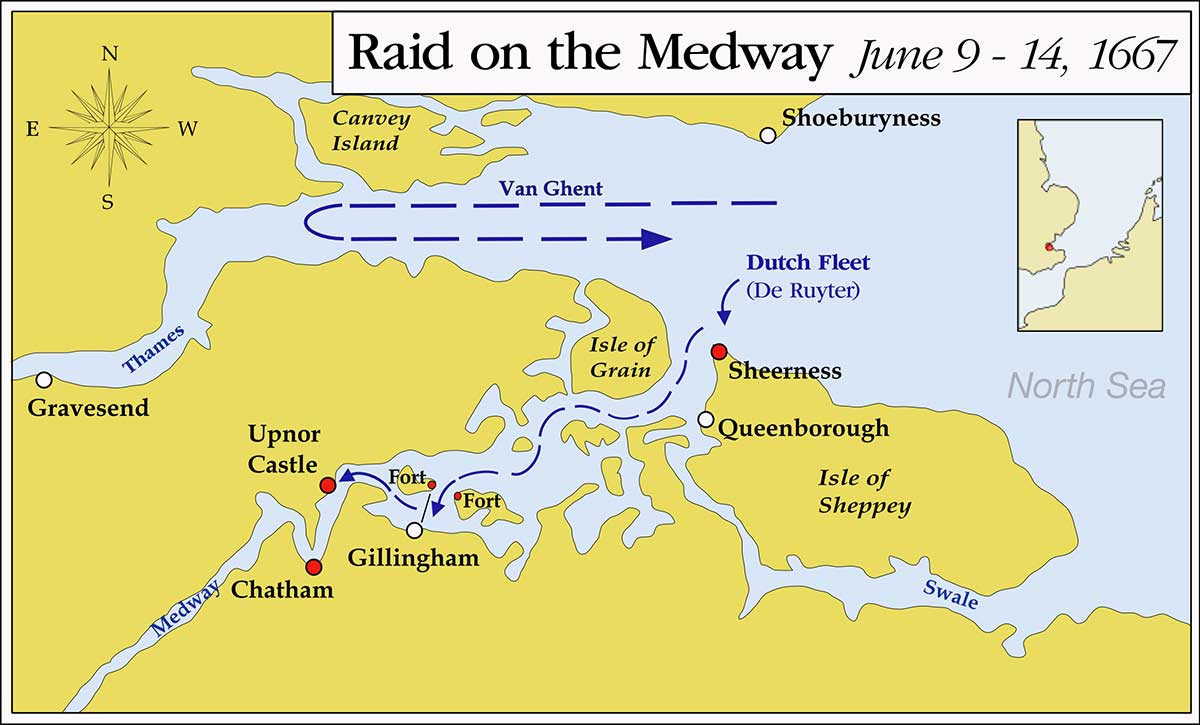
England received warnings from its spy network in continental Europe that the Dutch fleet was preparing to sail towards the English coast. However, the English authorities disregarded these warnings and there was no attempt to re-equip the English fleet on the Medway. The Dutch maintained good operational security; most ship captains were only made aware of their target while at sea. De Ruyter was supported by several English defectors, who knew the river well.
Upon reaching the mouth of the Thames, De Ruyter left his heaviest ships as a covering force and blockade. A specialized “flying squadron” of smaller, more maneuverable ships under Willem Joseph van Ghent was designated for the actual inland raid. Ashore, the English were caught completely unaware. Charles believed that peace was imminent and the treasury could not pay soldiers and sailors enough to man their posts full-time. By the time messages from lookouts regarding the arrival of the Dutch fleet arrived in London, it was too late to save what remained of England’s navy.
Before entering the Medway, the Dutch bombarded the fort at Sheerness on the Isle of Sheppey. The English garrison, underpaid and demoralized, deserted the post, allowing the Dutch to land marines and seize the site on June 10. The Dutch maintained discipline and refrained from looting or burning homes when they landed detachments on the banks of the Medway. As they got closer to the Chatham dockyards, de Ruyter’s ships faced no meaningful resistance from the English.
The Battle
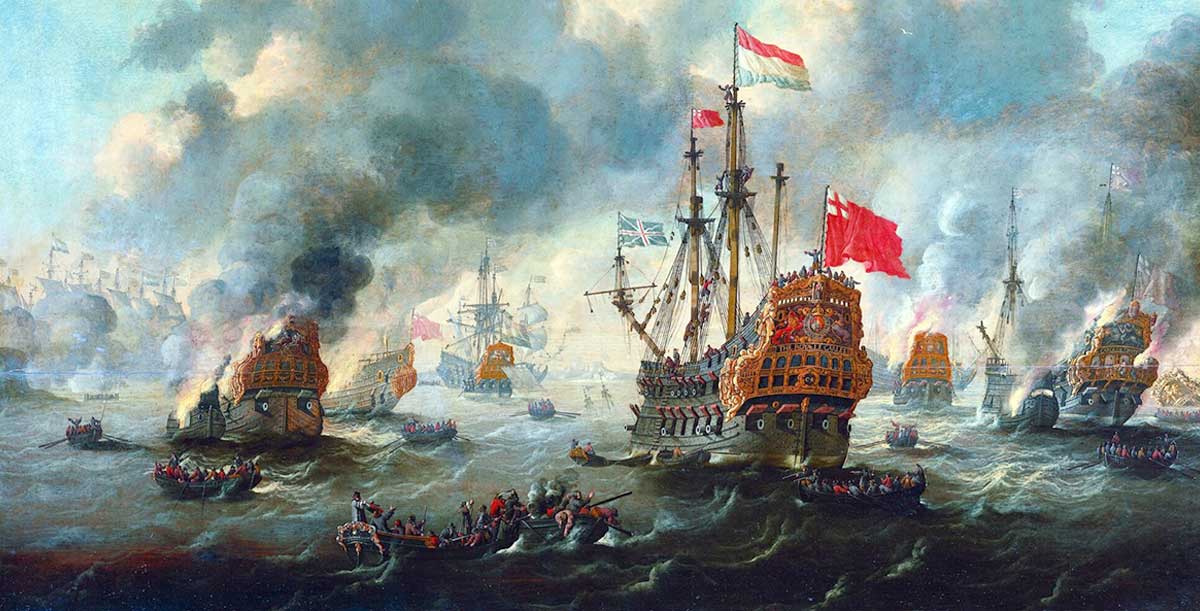
On June 22, Dutch forces completed their approach to the dockyards at Chatham. The centerpiece of the English defense was a massive iron chain stretched across the river at Gillingham. Despite English efforts to block the channel by sinking their own merchant ships, the Dutch attacked with determination. Several fireships broke the chain and Dutch vessels surged through the gap. A number of English guardships were destroyed almost immediately and the Dutch fleet began targeting HMS Royal Charles. Resistance proved to be insufficient to stop de Ruyter’s ships.
The next day, de Ruyter continued his advance upstream and found that the English had at last begun preparing defenses. Upnor Castle’s batteries began firing on the Dutch while other shore batteries tried to turn the Dutch back. However, most English ships were still undermanned, meaning that they could not meaningfully resist the Dutch. Admiral Monck ordered the Royal James, Royal Oak, and Loyal London to be scuttled in shallow water. Before this could happen, Dutch crews managed to light the ships on fire, permanently destroying them. De Ruyter then managed to pull his fleet back before they became trapped in the river.
The losses were heavily lopsided in favor of the Dutch. The English losses were as follows: two ships captured, 13 ships destroyed in combat, 30 ships scuttled by their own crews, and 500 men killed or wounded. The Dutch expended 8 fireships and lost between 50-100 men. Despite Admiral Monck’s best efforts, the English defenses were very weak because the Crown could not pay most of its sailors. The only meaningful resistance came from English batteries on shore.
Aftermath and Legacy of the Raid
After the battle, the Dutch kept their ships at the mouth of the Thames, exacerbating the English financial struggle. The difficulties that England faced caused a mass exodus from London and left Charles II on the brink of bankruptcy. As a result, the English agreed to sign terms that generally favored the Dutch. The Treaty of Breda ensured that the Dutch dominated several Atlantic trade routes. It also solidified Dutch naval dominance in northern Europe for many years. Charles II’s financial problems persisted, and in 1672 he was obliged to suspend debt repayments in the Stop of the Exchequer.
The defeat at the Medway was one of the most devastating defeats in British military history. The destruction of the fleet at Chatham had the same psychological effect on the English people as the Japanese assault on the Russian fleet at Port Arthur in 1904. For the Netherlands, the battle was a stunning victory and validated their confidence in Admiral de Ruyter’s abilities. The Dutch use of marines to support their raid was a major step in the evolution of amphibious operations.
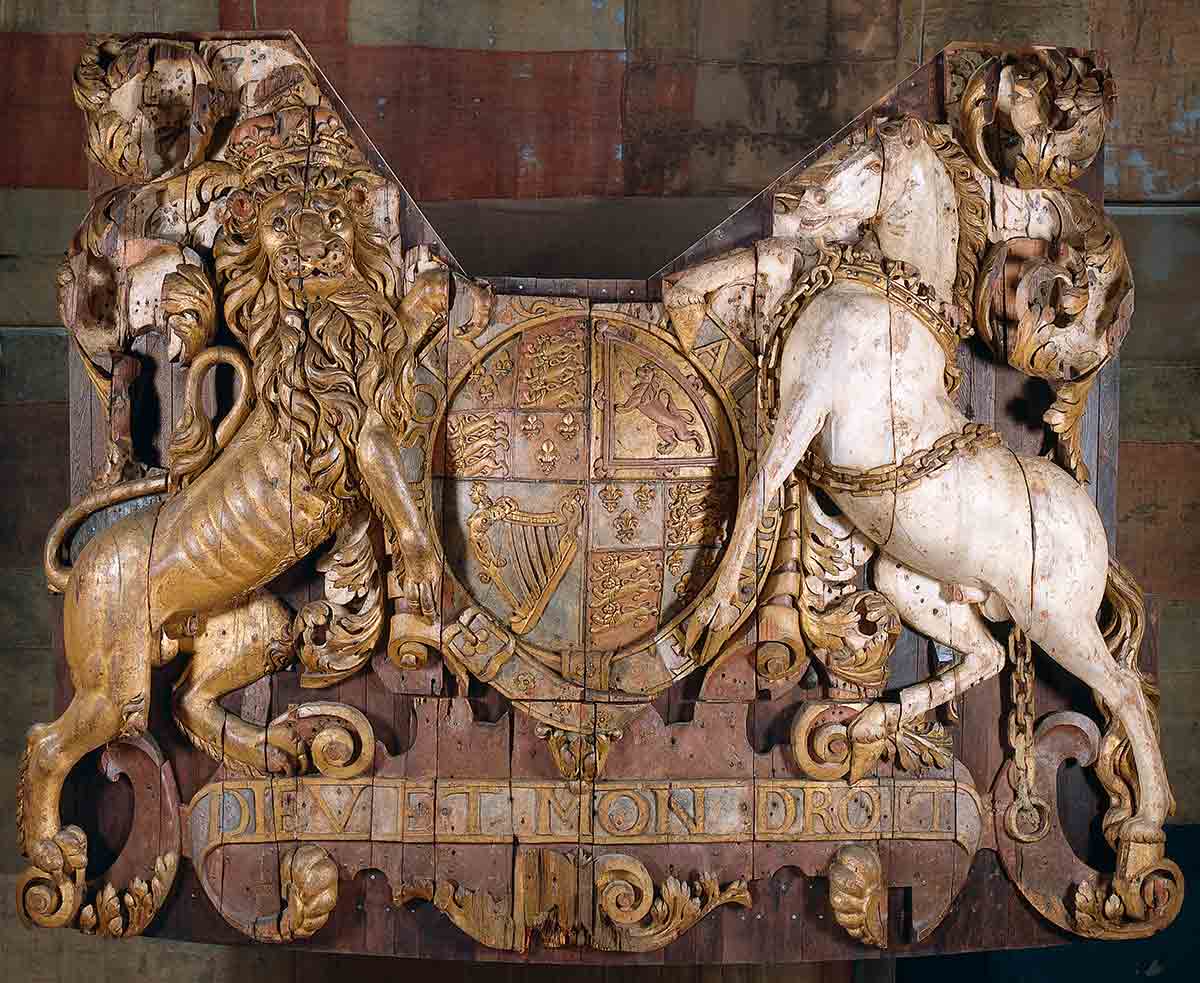
The captured stern piece (transom) of the English flagship HMS Royal Charles remains on display at the Rijksmuseum in Amsterdam to this day, serving as a lasting physical symbol of the victory. In 2016, a Dutch movie about de Ruyter was released and became a hit with Dutch audiences. Additionally, reenactments of the battle have been staged with both English and Dutch actors. In the UK, the battle has mostly been forgotten, except by military historians and British naval officers hoping to draw lessons from Charles II’s lack of preparedness. The humiliation was quickly forgotten as the Royal Navy gained control of the seas in the 18th century.