The Renaissance was one of the most decisive periods in the history of art, marking the transition from the medieval world to modernity. Innovations such as linear perspective, anatomical study, and a heightened concern for realism reshaped visual representation and laid the foundations of modern art. This article presents thirteen of the most famous Renaissance paintings, focusing on their artistic significance, conceptual depth, and enduring influence. You will also find out where you can see them today.
| Painting & Artist | Location | Key Theme / Feature |
| The Holy Trinity, Masaccio | Santa Maria Novella, Florence | Groundbreaking use of linear perspective; includes a memento mori. |
| The Arnolfini Portrait, Jan van Eyck | National Gallery, London | Early Northern Renaissance realism; notable for its convex mirror and oil technique. |
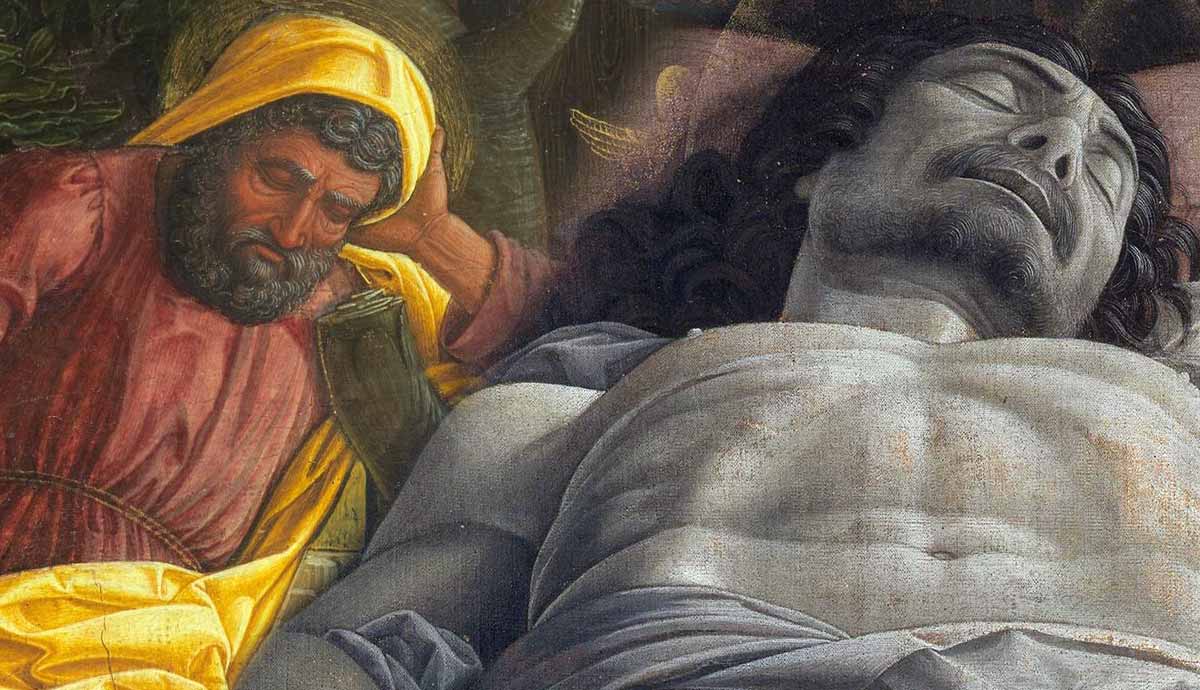
| Lamentation Over the Dead Christ, Mantegna | Brera Gallery, Milan | Intense, dramatic foreshortening of Christ’s body from a feet-first angle. |
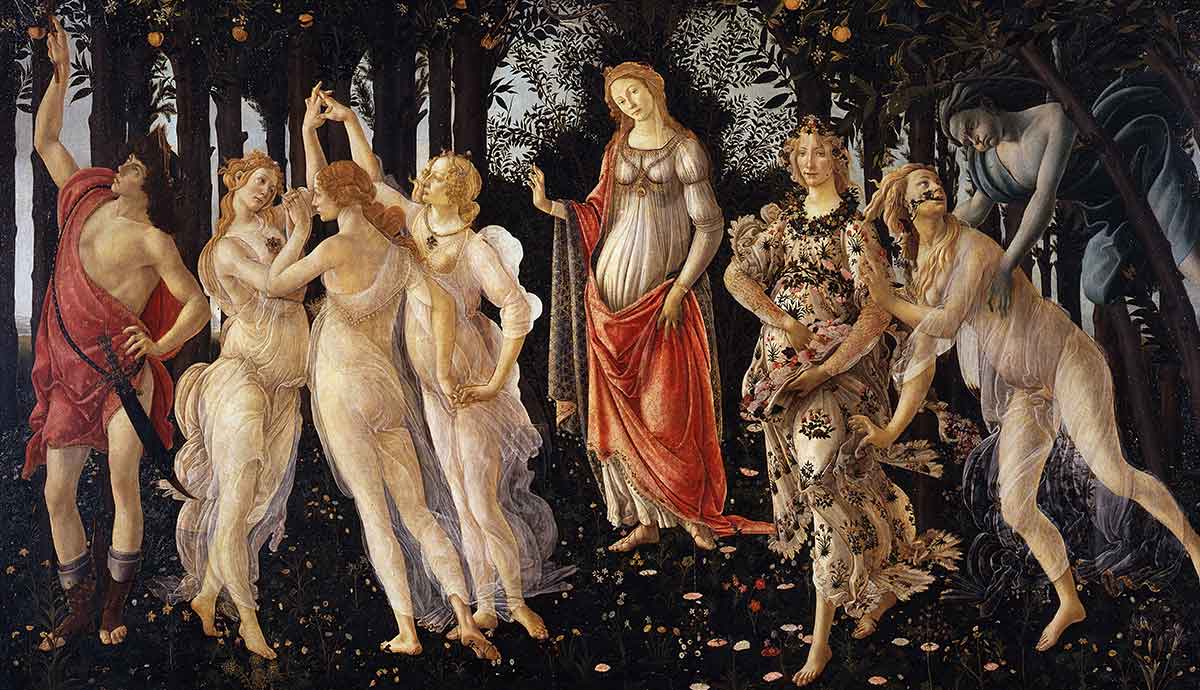
| Primavera, Sandro Botticelli | Uffizi Gallery, Florence | Mythological allegory of Spring featuring Venus in a “secret” orange grove. |
| The Birth of Venus, Sandro Botticelli | Uffizi Gallery, Florence | Venus emerging from the sea on a shell; based on the classical Venus Pudica pose. |
| The Garden of Earthly Delights, Hieronymus Bosch | Prado Museum, Madrid | Enigmatic triptych depicting Eden, earthly pleasures, and a surreal Hell. |
| The Last Supper, Leonardo da Vinci | Santa Maria delle Grazie, Milan | Captures the emotional reaction of the Apostles to Christ’s prophecy of betrayal. |
| Self-Portrait with Fur-Trimmed Robe, Albrecht Dürer | Alte Pinakothek, Munich | Frontal, Christ-like self-depiction emphasizing the artist’s divine spark. |
| Mona Lisa, Leonardo da Vinci | Louvre Museum, Paris | Famous for the sfumato technique and the sitter’s mysterious, inner expression. |
| The Creation of Adam, Michelangelo | Sistine Chapel, Vatican | Iconic moment of divine energy transfer via nearly touching fingers. |
| The School of Athens, Raphael | Stanza della Segnatura, Vatican | Celebration of classical philosophy; depicts Plato and Aristotle in a grand hall. |
| The Sistine Madonna, Raphael | Gemäldegalerie, Dresden | Apparition of the Virgin on clouds; famous for the two cherubs at the bottom. |
| Venus of Urbino, Titian | Uffizi Gallery, Florence | Allegory of marriage and fidelity set in a contemporary Venetian interior. |
1. “The Holy Trinity” by Masaccio, Santa Maria Novella, Florence
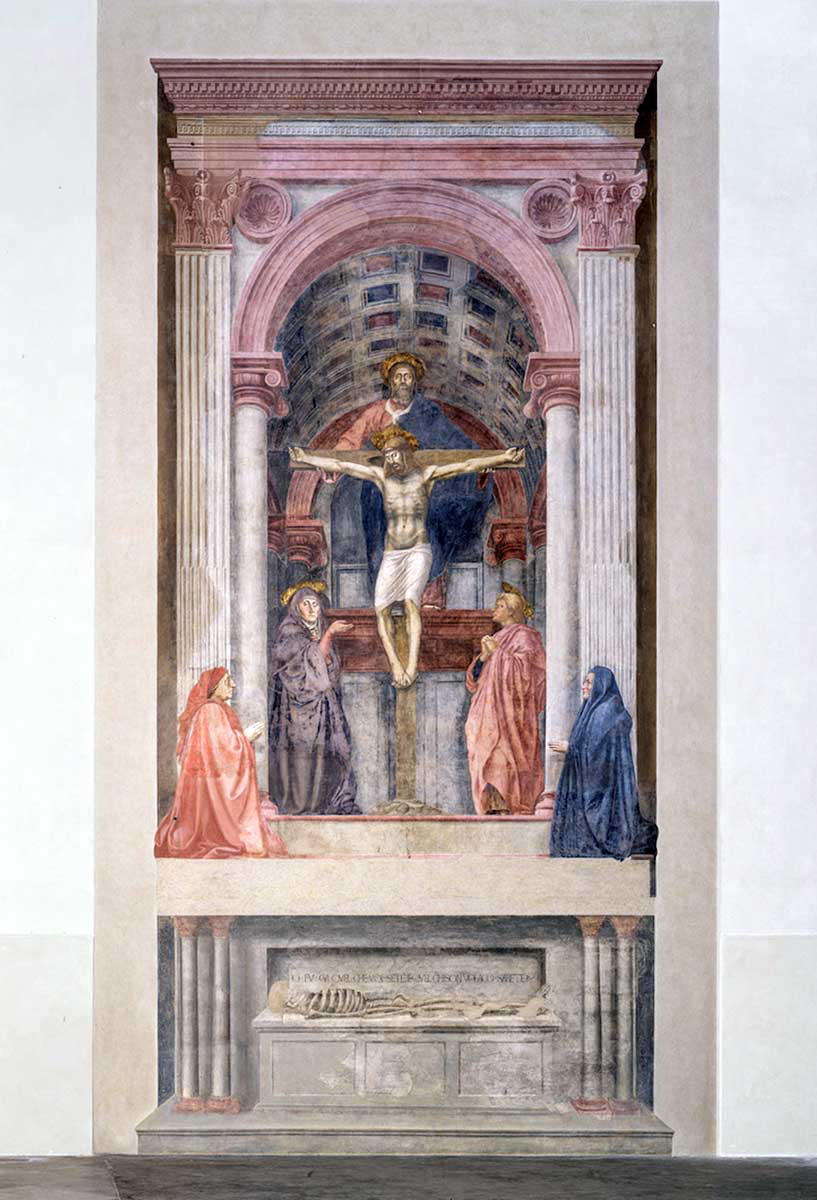
This is an early Renaissance fresco painting of the Holy Trinity by the Italian painter Tommaso Guidi, known as Masaccio. It is located in Santa Maria Novella in Florence and dates to around 1425–26. The fresco is situated in the third arcade of the left nave and was discovered in good condition during a restoration of the church in the 18th century. It appears that Giorgio Vasari covered it in 1570 with a stone altar and a painting of the Madonna del Rosario, now displayed in the Bardi Chapel. Masaccio’s fresco was removed and relocated to the inner wall of the façade, and during a second restoration in 1952, it was returned to its original position.
It is one of the most important examples of Renaissance perspective, applying the theories of Brunelleschi and Alberti. The Eternal Father is depicted, the Holy Spirit in the form of a dove, and Christ crucified, flanked by the Virgin Mary and Saint John. Below and on either side are the figures of the work’s donors: an elderly merchant and his wife. Finally, in the lower section, a skeleton representing Death is depicted, accompanied by the words: What you are, I once was; what I am, you will become.
Masaccio’s painting conveys a strong sense of three-dimensional space, a revolutionary element for its time. As E. H. Gombrich characteristically notes: “…his revolution is not limited merely to the trick of perspective… imagine the astonishment—and perhaps the disappointment—of the Florentines before this fresco. Instead of delicate grace and fluid, easy curves, they saw heavy, massive figures and solid forms; instead of graceful details, they were confronted with a bare tomb and a skeleton.”
2. “The Arnolfini Portrait” by Jan van Eyck, National Gallery, London
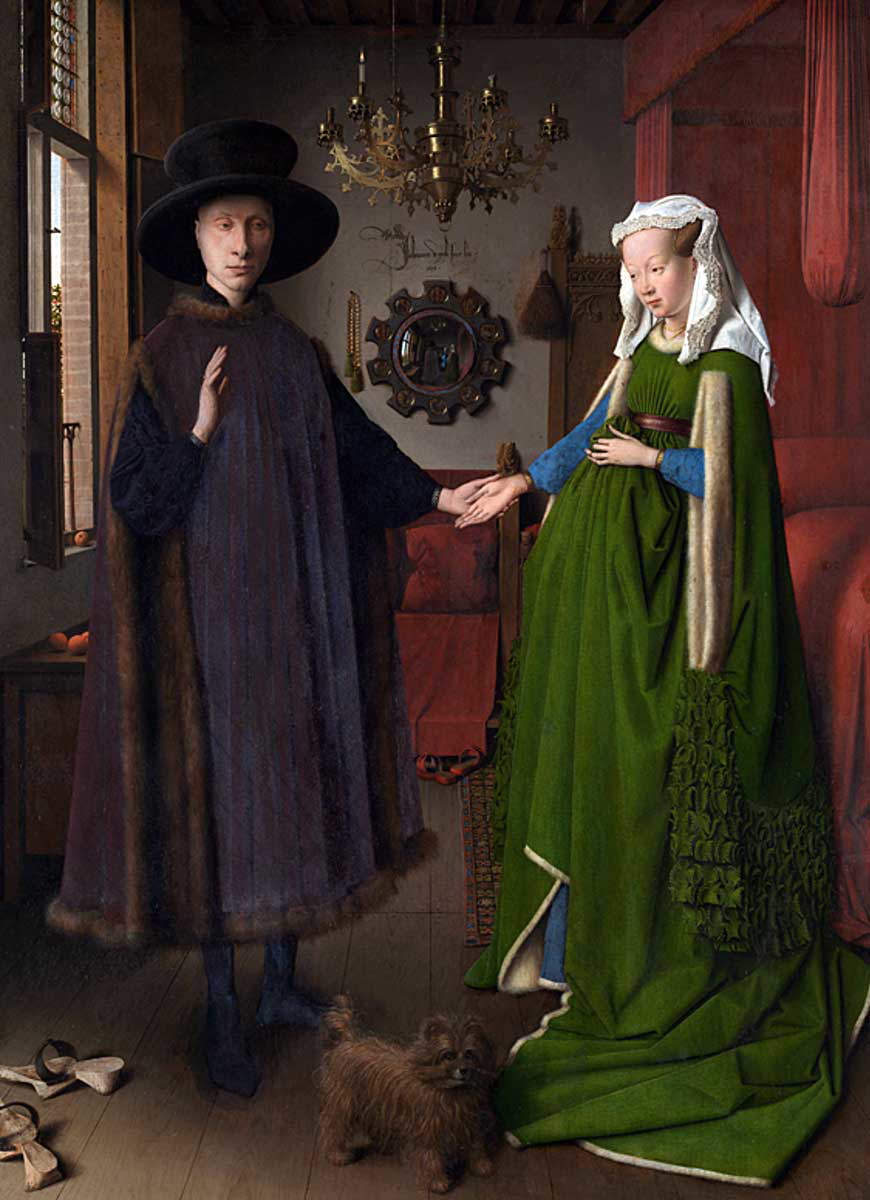
This famous painting is a representative example of the Early Renaissance in Northern Europe. It is the work of the Flemish painter Jan van Eyck, the most important artist of the Northern Renaissance. It has been exhibited at the National Gallery in London since 1842.
It is a double portrait and represents the culmination of the artist’s painting. It depicts the Italian merchant Giovanni Arnolfini with his probable future wife Jeanne de Chenany in a private room. For many years, the prevailing view was that it represented a marriage ceremony; however, opinions are divided. It is likely that the woman is his second wife, and that the couple were friends of the painter. Nevertheless, the work functions, in a sense, as an official document of their union. The painter himself is depicted in the convex mirror and is also referenced in the Latin inscription above it: Johannes de Eyck fuit hic (meaning Jan van Eyck was here).
The striking realism in the rendering of details continues to astonish viewers to this day. Van Eyck does not follow the visual rules that were beginning to be established at the same time in Florence; instead, he paints what he sees slowly and methodically, paying close attention to detail. He is also believed to have invented oil painting, enabling him to work at his desired pace without the paint drying immediately.
3. “Lamentation Over the Dead Christ” by Mantegna, Brera Gallery, Milan
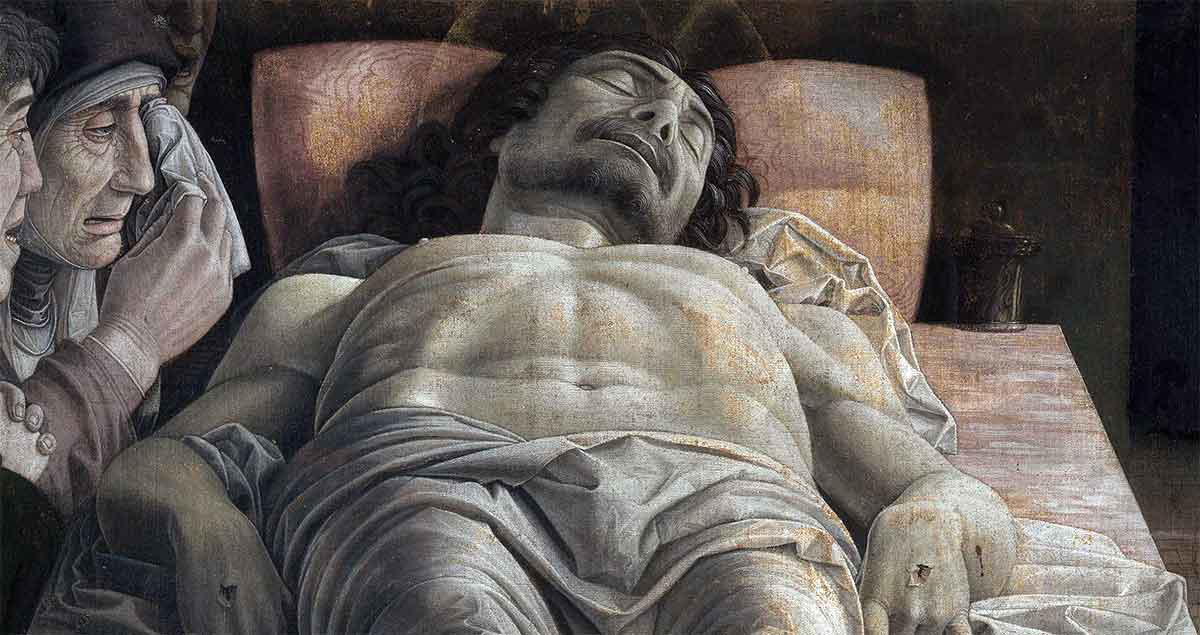
This is a characteristic work by the Italian Renaissance painter Andrea Mantegna, now on display at the Brera Gallery in Milan after passing through many owners. It is known that the work was painted for the artist’s personal chapel; however, after his death, it was sold by his son, Lodovico, to Cardinal Sigismondo Gonzaga. A complex sequence of ownership changes followed, until it finally entered the gallery, where it has been on display since approximately 1824. With this work, Mantegna demonstrates his unparalleled mastery of perspective, unprecedented for his time.
The painting depicts the body of the dead Christ laid on a pink marble slab that alludes to the Stone of Unction, the holy relic which was kept in the Church of the Holy Apostles until the Fall of Constantinople. Christ’s body is surrounded by the Virgin Mary, Mary Magdalene, and Saint John, who mourn His death. A jar of ointment is visible, resting on the slab near Christ’s head, indicating that his body has already been anointed.
The viewer sees Christ’s recumbent body from a completely unexpected angle, intensifying the focus on the dramatic center of the scene. Every realistic detail is reinforced by linear drawing and the use of chiaroscuro, forcing the gaze to linger on the rigidity of the dead body and the visible wounds. The other three figures are rendered with realism and austere restraint, emphasizing the human dimension of the divine drama. Through this powerful perspective, Mantegna succeeded in presenting a condensed version of the Passion. It is justly considered one of the most iconic symbols of the Italian Renaissance.
4. “Primavera” by Sandro Botticelli, Uffizi Gallery, Florence
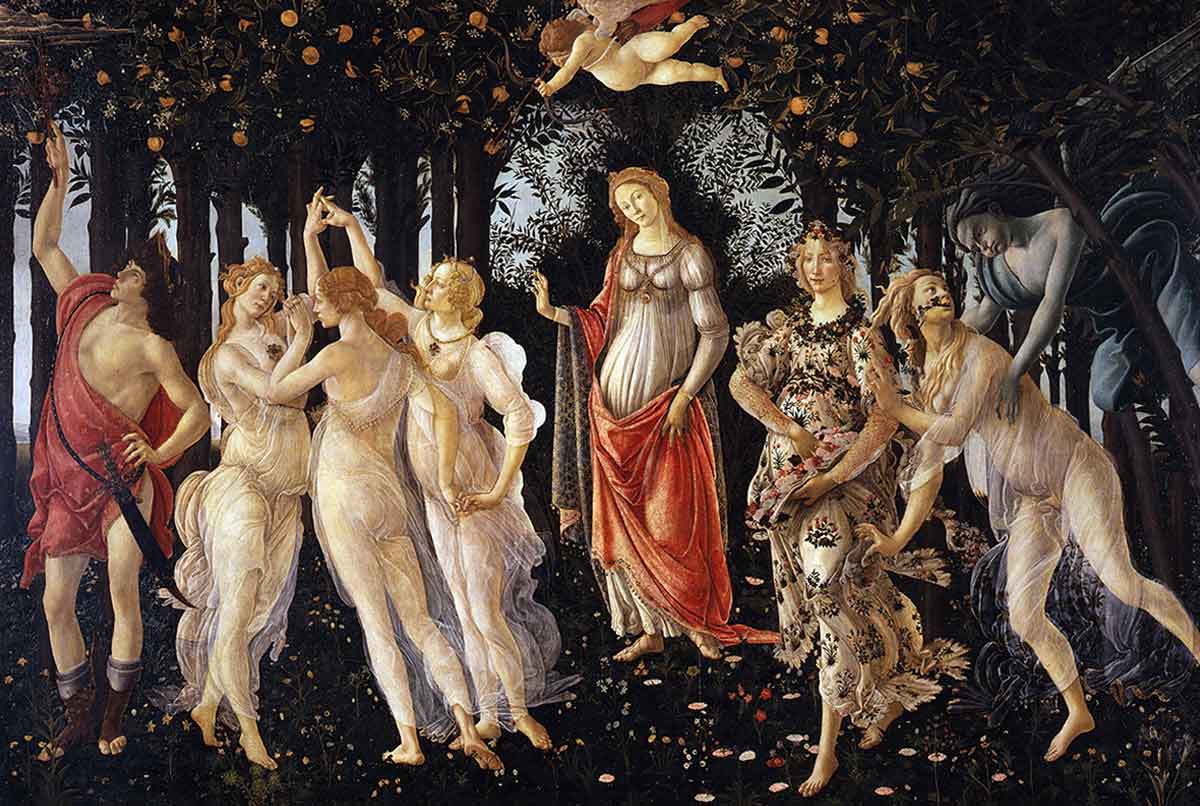
The famous painting Primavera, or Allegory of Spring, by the Florentine painter Sandro Botticelli dates to around 1481–82 and is now exhibited at the Uffizi Gallery in Florence. The title was first used by Giorgio Vasari, who saw the painting at the Villa di Castello near Florence in 1550. During his visit, Vasari described the painting as depicting Venus adorned with flowers by the Three Graces, symbolizing Spring, from which the modern title derives. The scene takes place in a “secret” garden, where mythological figures take part in a kind of ritual.
At the center stands Venus before a myrtle tree, her sacred plant, indicating that the scene unfolds in her garden. Above her hovers Cupid, blindfolded, shooting one of his arrows at one of the Three Graces, who dance rhythmically in a rhythmic circle. On the right, Zephyrus, the spring wind, seizes the nymph Chloris. Frightened, she turns away in an attempt to escape, while flowers emerge from her mouth, signaling her transformation into Flora, the goddess of flowers. Flora scatters blossoms from her hands with serene joy. To the left, Mercury raises his caduceus to dispel clouds, affirming his role as guardian of Venus’s domain.
Behind the figures, a dense grove of orange trees forms a decorative backdrop, while a carpet of grass dotted with hundreds of meticulously rendered flowers creates the impression that the figures are floating. They appear to hover lightly above the ground, while simultaneously conveying a sense of movement, as if dancing.
5. “The Birth of Venus” by Sandro Botticelli, Uffizi Gallery, Florence
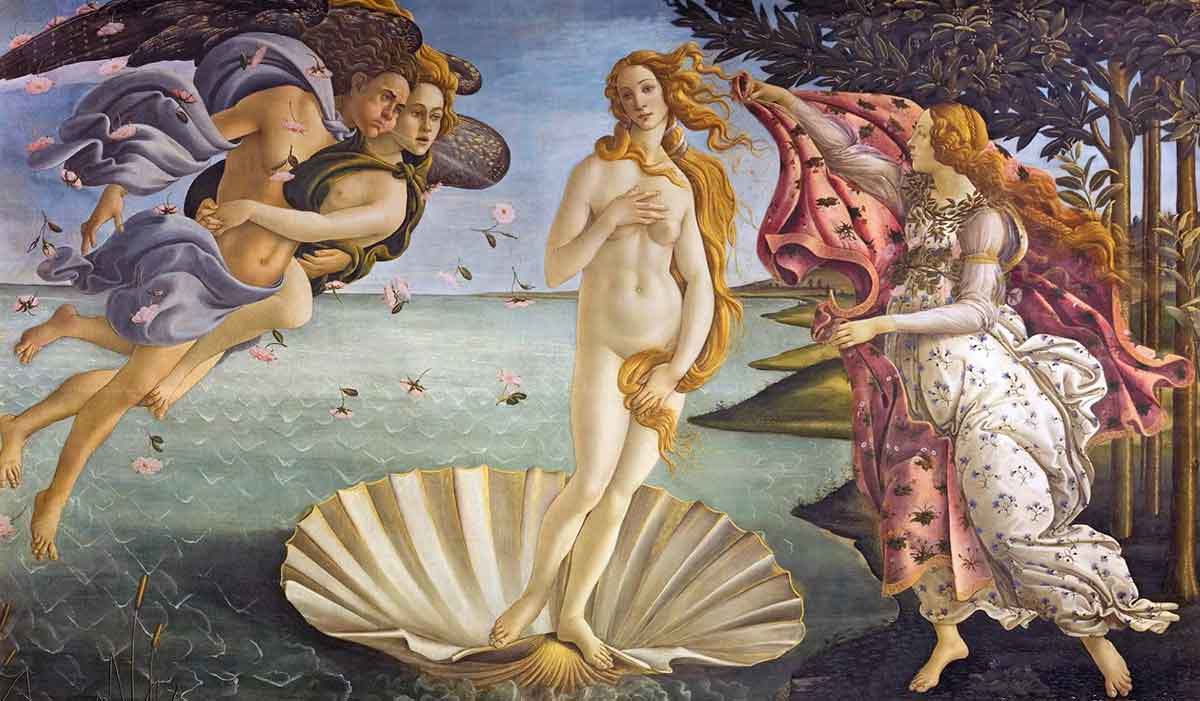
This is the famous mythological painting by Botticelli, executed in tempera on canvas. It is now on display at the Uffizi Gallery in Florence. According to E. H. Gombrich and many other scholars, the subject of the image is immediately understandable. The central nude female figure represents Venus, the Greek goddess of beauty, emerging from the sea within a shell. Her pose recalls the ancient model of the Venus Pudica.
On the left, two figures are shown blowing the shell toward the shore. The male figure is Zephyrus, the winged god of the west wind in Greek mythology. Beside him is a female figure who blows alongside him and, according to Vasari, may be identified as Aura, a minor deity of the breeze in Greek mythology. As Venus prepares to step onto land, a female figure awaits her on the right. She may be one of the three Horae, minor goddesses of the seasons and attendants of Venus; the floral decoration of her dress suggests she is the Hora of Spring. Other scholars identify her as Flora, the Roman goddess of spring and flowers, who covers Venus with a purple mantle adorned with blossoms. In line with this interpretation, the secondary female figures are associated with Botticelli’s Primavera.
6. “The Garden of Earthly Delights” by Bosch, Prado Museum, Madrid
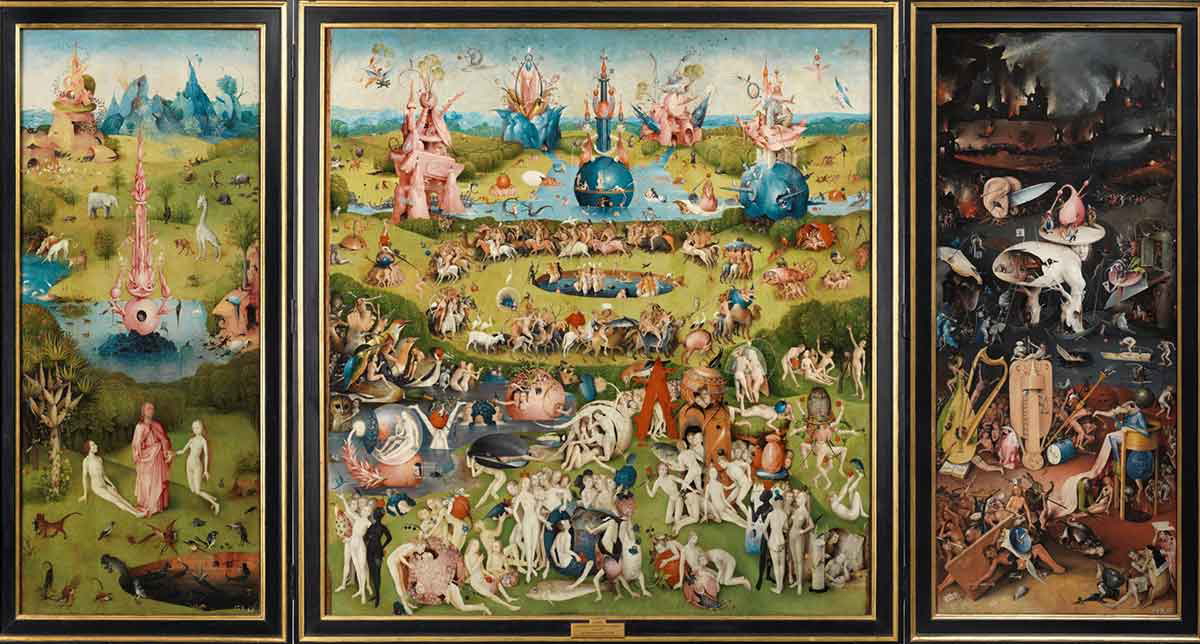
The Garden of Earthly Delights is a triptych, representative of the Northern Renaissance, by the Flemish painter Hieronymus Bosch, dated between 1490 and 1511. It is a monumental painting, nearly four meters wide and two meters high, and has been exhibited at the Prado Museum in Madrid since 1939. It depicts Paradise with Adam and Eve (left panel), earthly pleasures with numerous nude figures (central panel), and Hell with fantastical punishments of various types of sinners (right panel). On the exterior panels, the viewer sees God creating the Earth. The work constitutes a powerful narrative on morality and sin.
Many art historians believe that the triptych is meant to be “read” from left to right: the creation of Eve followed by the Fall of humanity, and finally their descent into Hell as punishment. However, there are many conflicting interpretations of the central panel. Some believe it depicts a sinful outburst, while others argue that it represents humanity’s innocence before the Fall. Each part of the triptych can be seen as its own story, as a unified whole, or even analyzed as smaller autonomous narratives. What is certain is that it is one of the most enigmatic, symbolic, and popular works of Renaissance painting.
7. “The Last Supper” by da Vinci, Santa Maria delle Grazie, Milan
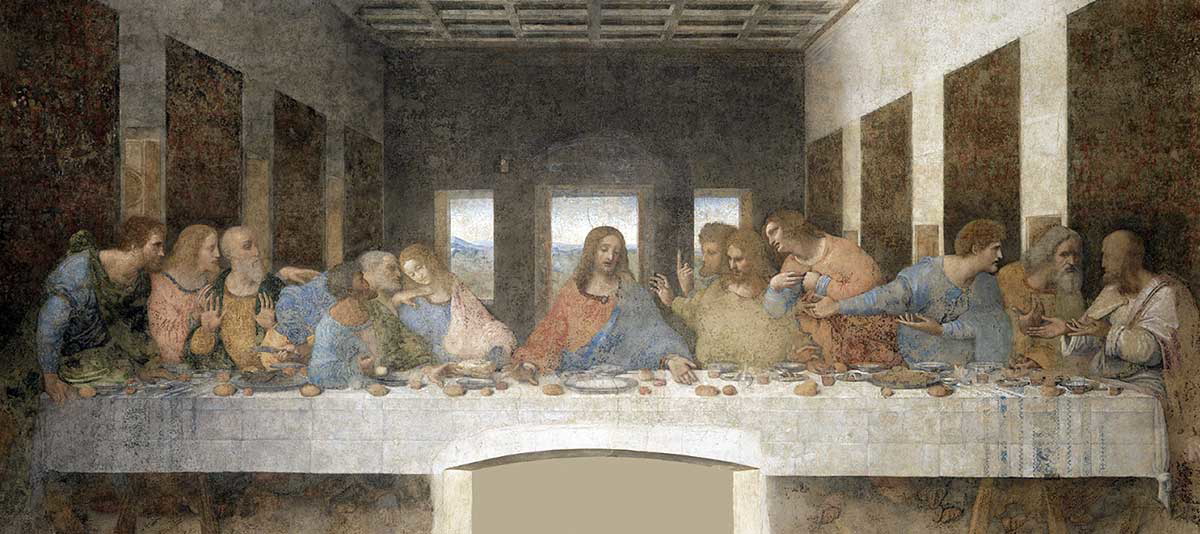
One of the most representative works of the renowned Florentine Renaissance artist Leonardo da Vinci is the wall painting The Last Supper, which dominates the refectory of the monastery of Santa Maria delle Grazie in Milan and dates to 1495–98. The work was commissioned by Ludovico Sforza, Duke of Milan and Leonardo’s principal patron.
The scene Leonardo chose to depict is the dramatic moment of Christ’s revelation that one of His disciples will betray Him. The twelve Apostles are arranged horizontally in groups of three on either side of the central figure of Christ. From left to right, they are: Bartholomew, James the Lesser, Andrew (first group); Judas Iscariot, Peter, John (second group); Jesus (central figure); Thomas, James the Greater, Philip (third group); Matthew, Jude Thaddeus, Simon the Zealot (fourth group).
Leonardo succeeded in pictorially rendering and giving “movement” to words, gestures, and the motions of the soul (moti dell’animo), as he himself called them. A distinctive feature of the work is the unusual painting technique the artist chose: instead of the traditional buon fresco, Leonardo used a combination of the secco process and mixing oil and tempera on a dry plaster wall. This choice, however, proved to be the main cause of the extensive deterioration of the painting shortly after its completion.
8. “Self-Portrait with Fur-Trimmed Robe” (1500) by Dürer, Alte Pinakothek, Munich
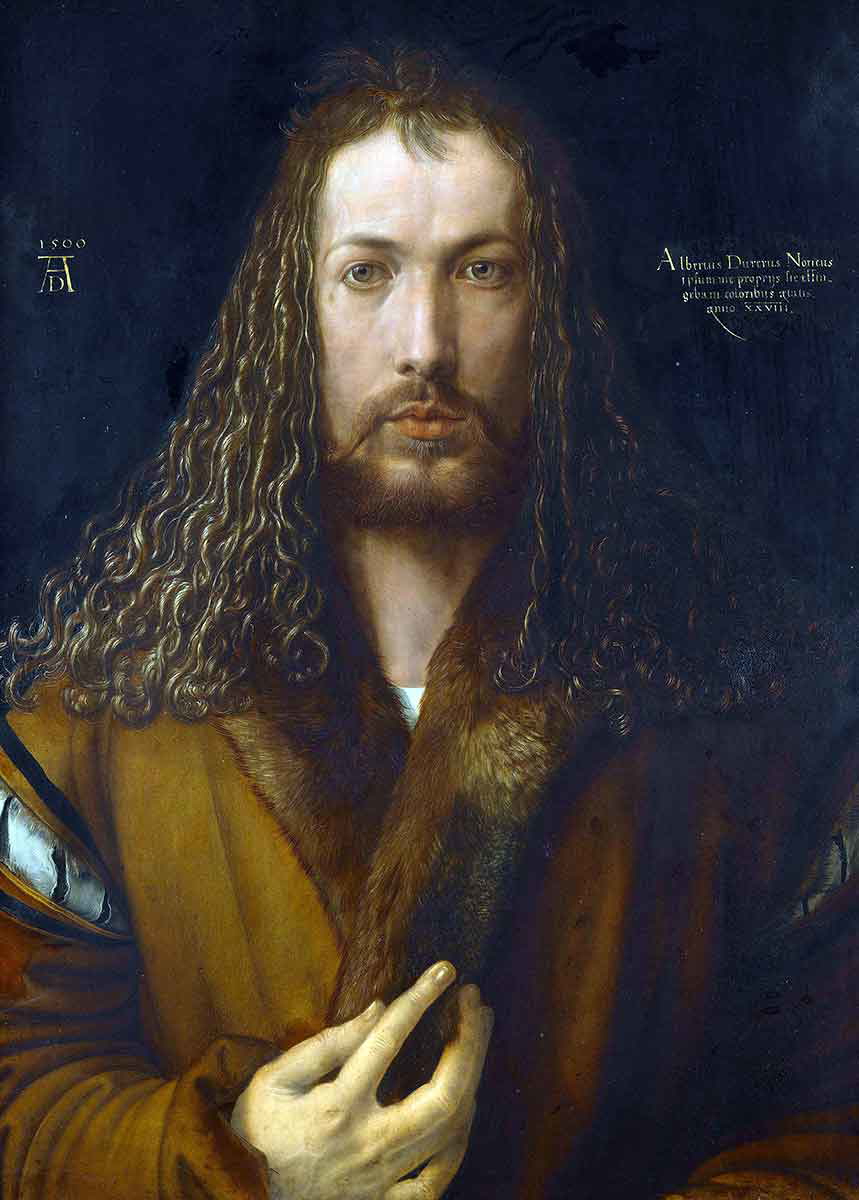
This is the famous painting by the German painter and engraver Albrecht Dürer, a representative of the German Renaissance. The work dates to 1500 and is exhibited at the Alte Pinakothek in Munich. It is a self-portrait, as confirmed by the Latin inscription on the right: Albertus Durerus Noricus ipsum me propriis sic effingebam coloribus aetatis anno XXVIII (meaning I, Albrecht Dürer of Nuremberg, portrayed myself in appropriate colors at the age of twenty-eight). On the left, the year of execution and the monogram A.D. are visible. The portrait clearly references images of Christ in a gesture of blessing with a raised hand. The direct frontal pose is highly unusual for the period and appears to be the element that captivates most viewers.
9. “Mona Lisa” by Leonardo da Vinci, Louvre Museum, Paris
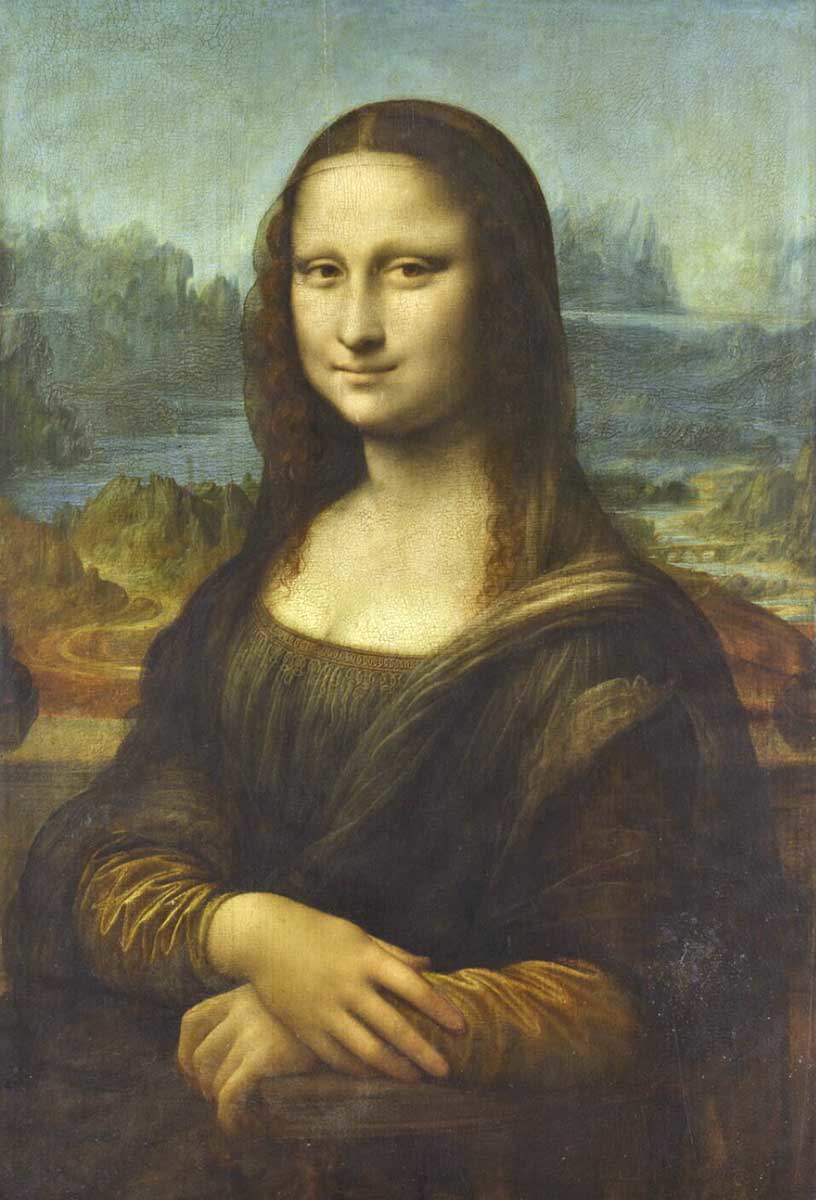
The most famous painting by Leonardo da Vinci, and perhaps in the entire world, is the Mona Lisa, displayed at the Louvre Museum in Paris. Each visitor has only a few seconds to see the painting in order to avoid excessive crowding. The work dates to the artist’s second Florentine period (1503–1504), but its completion extends to 1510–1515 in Rome, at the request of Giuliano de’ Medici. It is possible that Leonardo worked on it until his death in 1519.
This small-scale female portrait became the most enigmatic and famous work of art in the world, enveloped in an aura of mystery. Numerous conflicting interpretations have been proposed regarding almost every aspect of the painting. Along with the dramatic history of its theft, its fame soared. The most widely accepted view is that the sitter is Lisa Gherardini (Lisa del Giocondo). Moreover, the sfumato technique in this painting appears to have reached its peak, enhancing the inner life of the figure. The enigmatic smile is perhaps the most recognizable in art history, and the painting’s value is indisputably priceless.
10. “The Creation of Adam” by Michelangelo, Sistine Chapel, Vatican
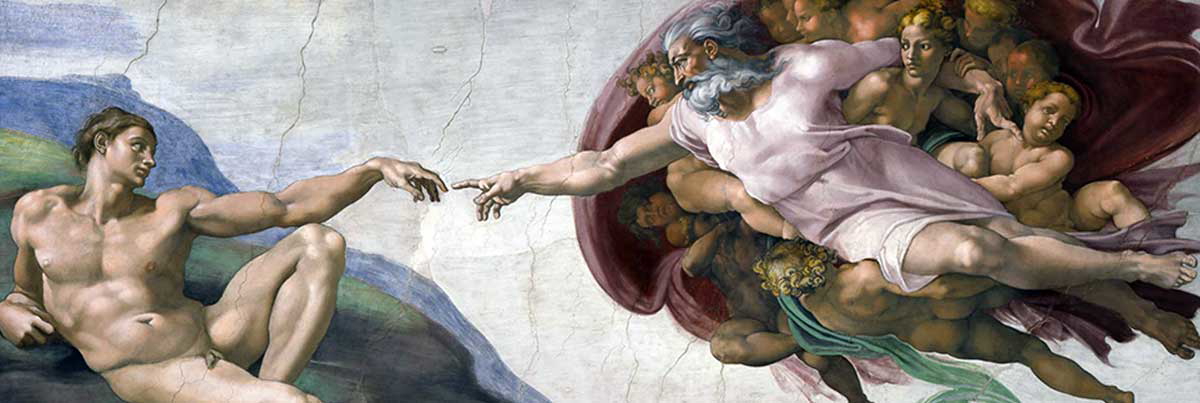
Perhaps the most famous fresco on the ceiling of the papal chapel of the Vatican, the Sistine Chapel, was painted by the renowned Italian artist Michelangelo di Lodovico Buonarroti Simoni, best known as only Michelangelo. The commission for the decoration of the Sistine Chapel ceiling was given to the artist in 1508 by Pope Julius II. The iconographic program included nine central scenes depicting episodes from Genesis; twelve Prophets and Sibyls seated on monumental thrones; the ancestors of Christ depicted in the spandrels and lunettes; and four corner pendentives illustrating episodes from the salvation of the people of Israel.
The Creation of Adam, one of the nine central scenes, illustrates Genesis 1:27: “God created man in his own image; in the image of God he created him.” As Giorgio Vasari writes in his description of Adam, “beauty, pose, and outline possess such quality that Adam seems as though he were shaped at that very moment by the Creator himself, and not by the brush of a mere mortal.”
Adam is depicted reclining and extending his finger toward God, who, accompanied by angels, reaches out toward Adam. Their fingers nearly touch; it is this minimal space between them that creates the sensation of a void charged with life, where divine energy is concentrated, and which truly seems to represent the moment when the breath of life is transmitted to the first human being. At the same time, the perfectly rendered bodies, with their intense sculptural modeling, appear profoundly real. It is no coincidence that this scene is among the most powerful and expressive in Michelangelo’s masterpiece.
11. “The School of Athens” by Raphael, Stanza della Segnatura, Vatican
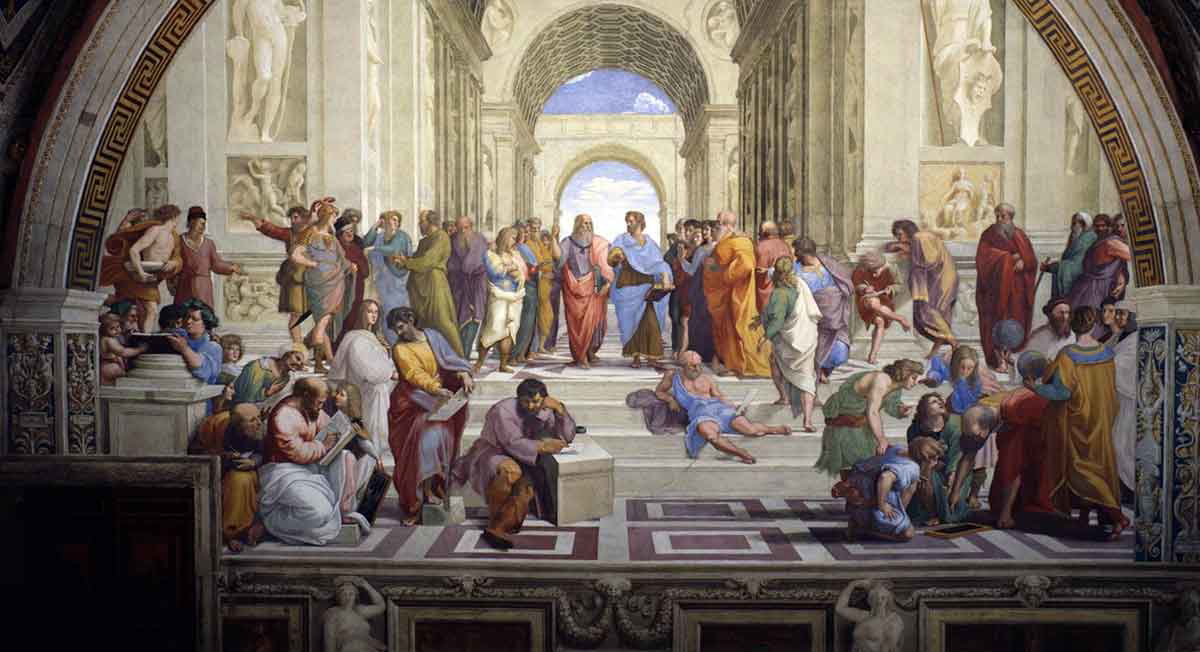
This is a large-scale fresco painting by the celebrated Italian painter Raphael, a masterpiece of the High Renaissance, dating to 1509. It decorates the wall of the so-called Stanza della Segnatura (the study and library of Pope Julius II) in the Apostolic Palace of the Vatican. It appears that the title The School of Athens was not given by Raphael himself, as above the fresco, he inscribed the phrase Causarum Cognitio (meaning Knowledge of causes), a philosophical conclusion drawn from Aristotle’s Metaphysics and Physics.
Within a majestic classical architectural setting inspired by Bramante’s designs for the new St. Peter’s, philosophers, scientists, and artists of antiquity are depicted. At the center stand Plato, pointing upward toward the sky, and Aristotle, with his hand extended toward the earth. Raphael chose to arrange the figures into groups engaged in philosophical discussion, while at the same time, the sages of antiquity appear to be portrayed with the features of contemporary figures.
12. “The Sistine Madonna” by Raphael, Gemäldegalerie Alte Meister, Dresden
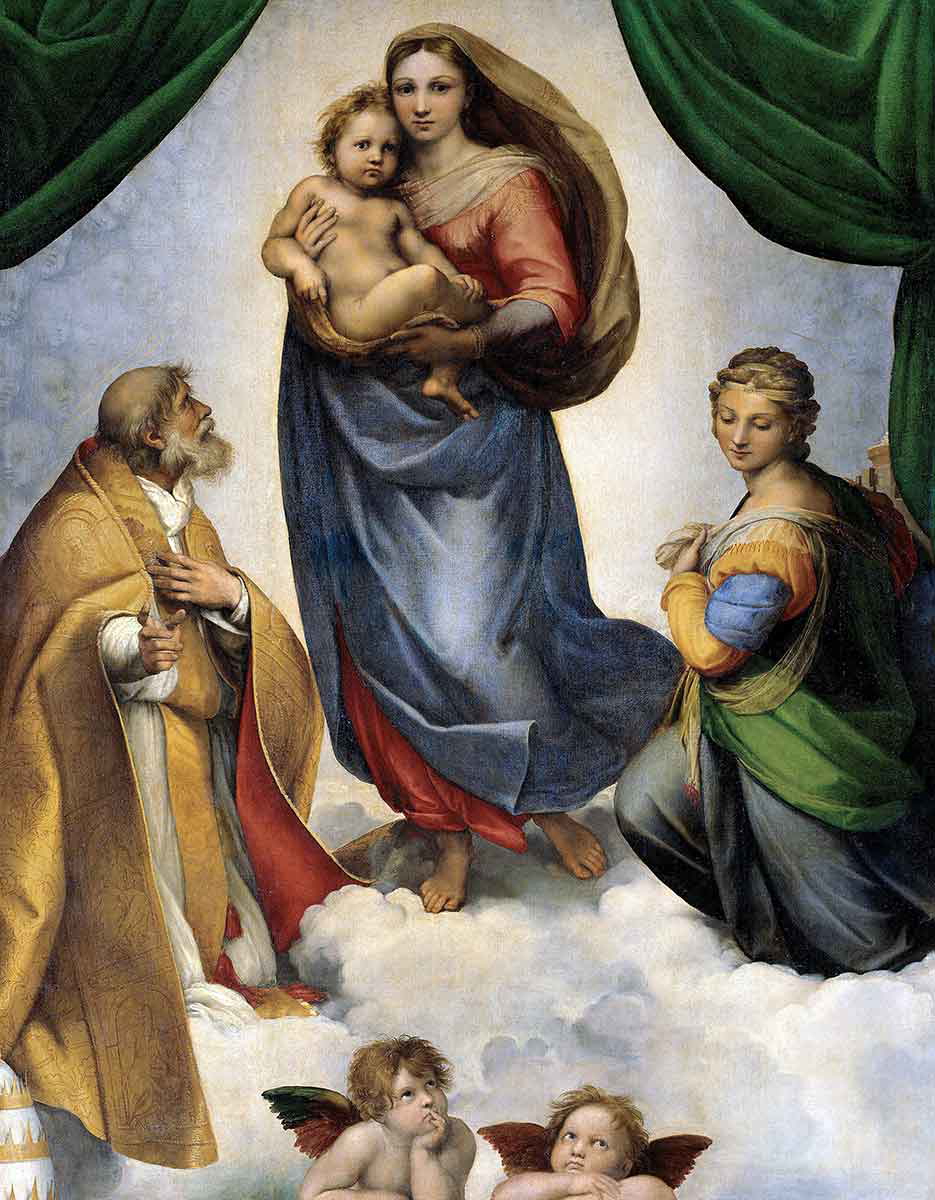
One of the most famous oil paintings by Raphael, often called the prince of Renaissance painters, dates to 1513 and is exhibited at the Dresden Gallery. The commission likely came from Pope Julius II himself and was intended for the church of the monastery of San Sisto in Piacenza, where it was placed on the high altar in 1514.
It depicts the apparition of saints upon clouds. At the center, the Virgin Mary, holding the Christ Child, advances toward the earthly realm, bringing Christ into the world. Pope Sixtus II kneels on the left, guiding her, while Saint Barbara kneels humbly on the right. Both saints were venerated on the high altar of the monastery of San Sisto in Piacenza, which explains their inclusion. At the bottom of the composition, Raphael depicted two cherubs among the clouds, perhaps the most famous angels in the history of art.
13. “Venus of Urbino” by Titian, Uffizi Gallery, Florence
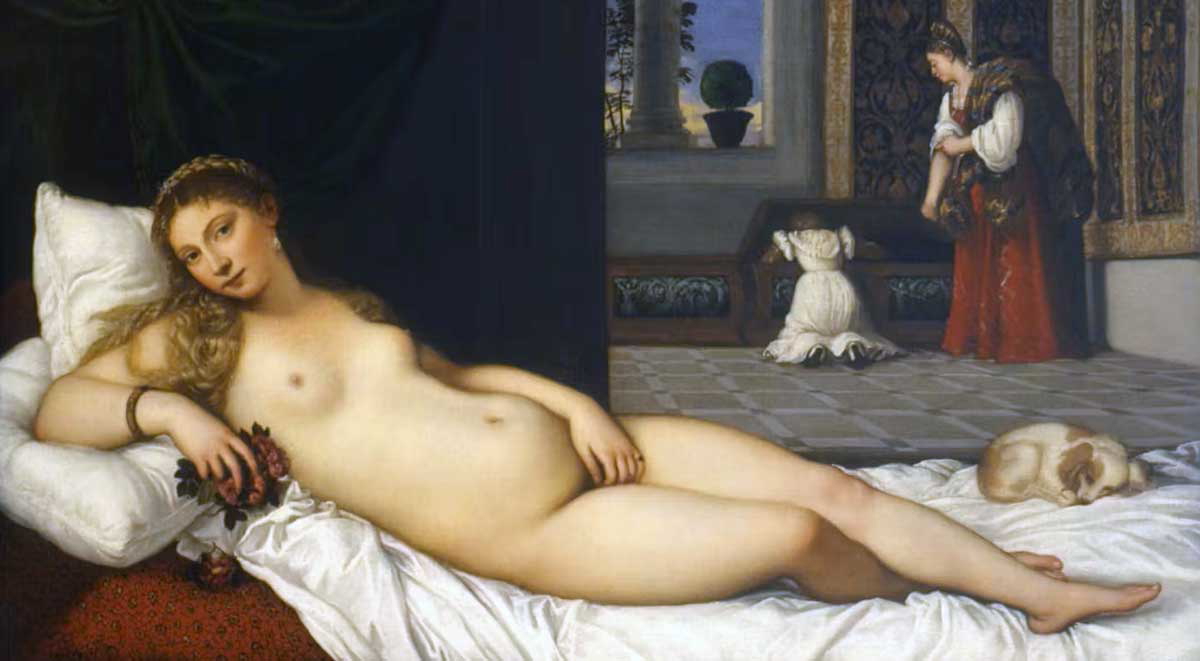
Venus of Urbino is one of the most famous paintings by the Venetian Renaissance painter Titian, dating to 1538. It is exhibited at the Uffizi Gallery in Florence. While its nudity draws from the classical Venus Pudica tradition, the painting is widely understood as an allegory of marriage. Scholars link it to the Venetian wedding custom of il toccamano, as the presence of the faithful dog and the bridal chests (cassoni) suggests the figure is a young bride representing marital commitment and consent. Set within a characteristic 16th-century Venetian interior, all elements are carefully chosen, signifying love, desire, pleasure, and commitment. The rendering of the central figure confirms the artist’s mastery in depicting the softness of skin and the quality of materials, lending the work intensity and character.