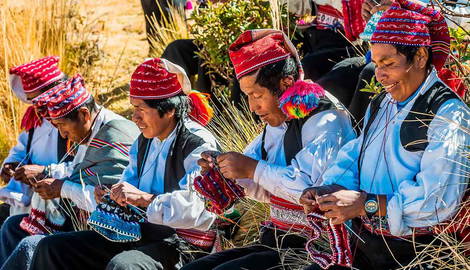

Textile traditions remain in many pockets of the Andes, often combining ancient techniques with innovations introduced by the Spanish colonizers. While these textiles are most often woven using various styles of looms, on one tiny island surrounded by the waters of Lake Titicaca, the islanders produce hand-knit hats that are just as renowned as the region’s fine woven shawls and scarves. And they’re all made by men.
History: Intika to Taquile

Taquile sits inside Lake Titicaca, the highest navigable lake in the world, nearly 13,000 feet above sea level. The island, just a few miles long and not even two miles wide, has been inhabited for over 1,000 years. Like the other pre-Inca cultures of the Andes, Taquile’s earliest residents farmed potatoes, corn, and quinoa and dabbled in textiles and ceramics. It was likely part of the Aymara polity, though what language was originally spoken is unclear.
As the Inca Empire expanded in the 15th century, Taquile Island was incorporated, but its inhabitants were permitted to retain much of their own culture and traditions. While the Inca made inroads in improving the island’s infrastructure—some ruins of which are still visible today—and shared the secrets of terrace farming, the everyday lives of the island’s inhabitants likely remained relatively unchanged. The Inca policy of resettling loyal citizens in newly conquered lands, mitma, likely led to the adoption of Quechua as the dominant language, which remains true today.
The same cannot be said of the Spanish colonizers, who attempted to impose Western dress, cultural practices, and political systems on the island. The encomienda system was instituted, forcing laborers to abandon their communal style of living in order to produce for the crown.
Even the name of the island was changed. It’s believed that prior to colonization, the Quechua name Intika was used for the island; the name Taquile comes from the Spaniard who purchased the land, Pedro González de Taquila. Yet, due to their isolation, the island’s inhabitants were still able to retain more of their traditions and customs than other groups.
Today, Taquile is home to approximately 2,200 people and remains accessible only by boat; visitors can take a 2.5-hour ride from the nearest city, Puno. Though its residents speak primarily Quechua, some have learned Spanish. There is little electricity or running water. Its residents still practice the community-based governance and economy of the original inhabitants. Notably, while Western dress has been adopted even in some more remote communities in the Andes, the people of Taquile largely continue to wear their traditional attire, combining Spanish peasant-style clothes with Indigenous garments—which they’ve been making for themselves for centuries.
Textile Traditions From Ancient to Modern
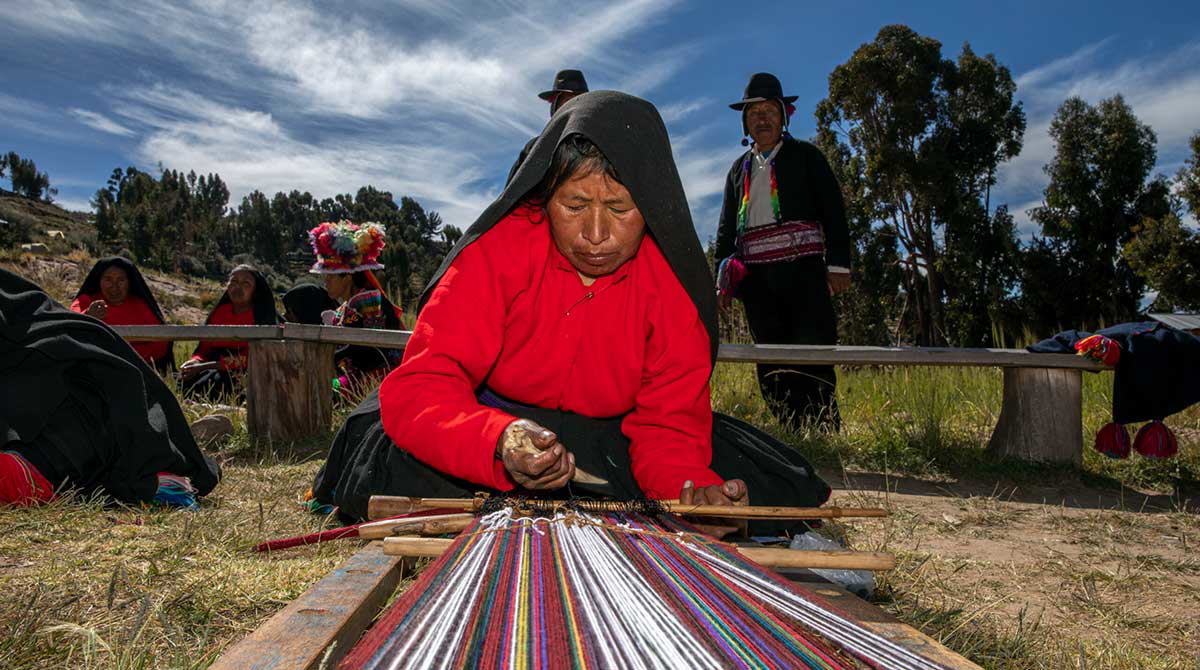
Two types of textile traditions are practiced on the island, and like so much of its history, reflect both its ancient roots and the imposition of Western culture: from the ancient peoples of the land, weaving, and from the colonizers, knitting. Both types of textiles use yarns spun, primarily by women, though some men also spin, on spindles and dyed with natural local dyes. Camelid fibers, particularly alpaca, used in the pre-colonial era, are still used. Still, sheep’s wool, introduced by the Spanish, and even synthetic fibers have also made their way into textile production.
Weaving, an ancient tradition at least 12,000 years old, occupies both men and women on Taquile island, though what and how they weave differs. Women primarily use the staked ground loom the island’s people have been using since before the conquest. This style of weaving employs finer spun yarns to produce finer fabric for chumpis (traditional belts), chuspas (bags for carrying coca leaf), and special occasion garments. In contrast, the men use treadle looms introduced by the Spanish to produce coarser fabric with heavier yarns, largely for everyday wear.
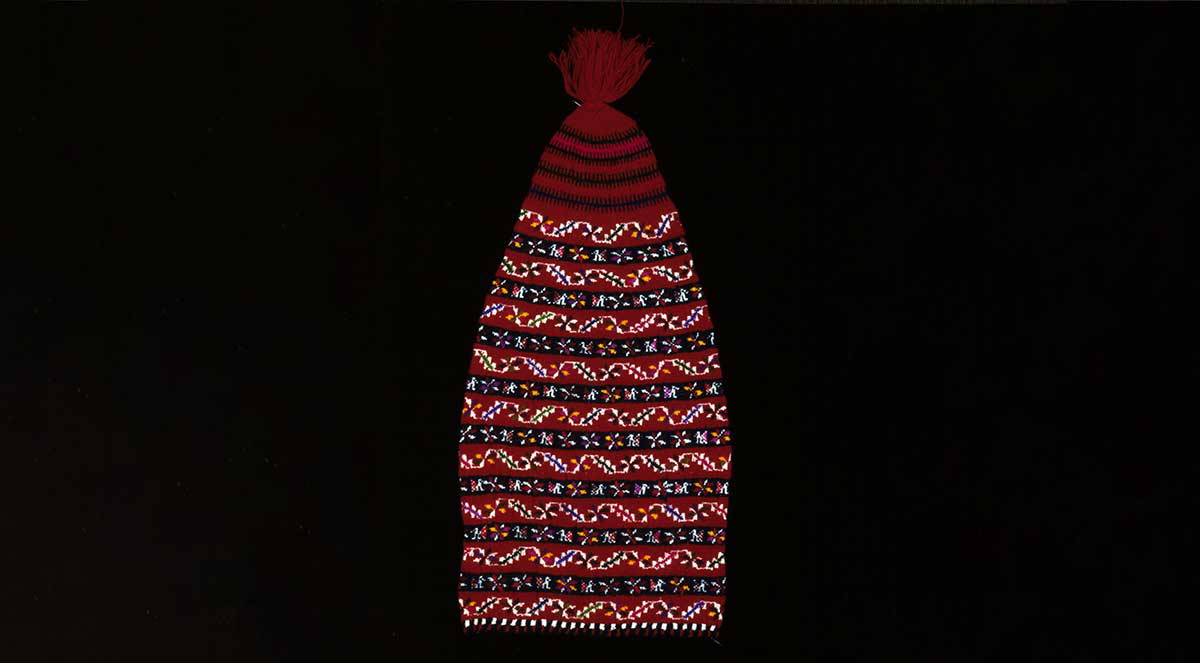
Knitting, dating back “just” 1,500 years or so, is a much more recent innovation in textile production. Unlike weaving, it’s believed that knitting did not develop independently in various cultures but largely originated in the Middle East, making its way to Europe by the 13th century. The technique was introduced to the “new world” by the Spanish colonizers.
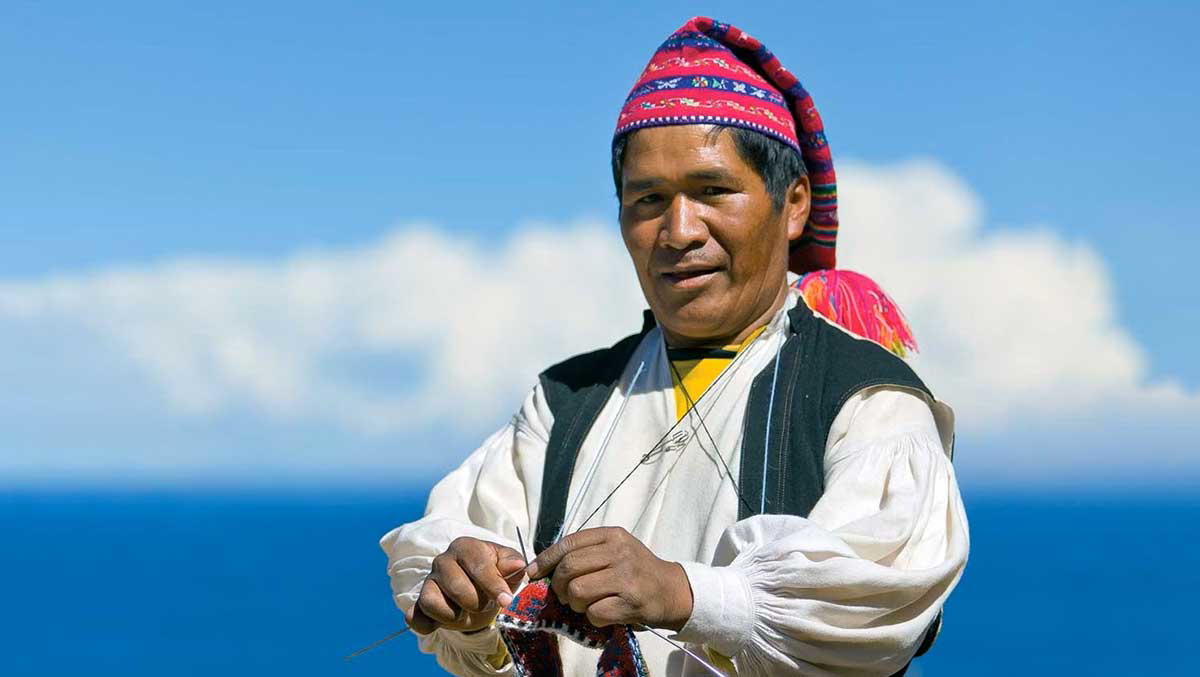
Knitting on Taquile is reserved almost exclusively for colorful hats and one style of hat in particular that any visitor to the Andes will recognize: the ch’ullu or chullo. Ubiquitous among tourists, chullos are intricate knit caps with earflaps and often tassels or pom poms, with distinctive motifs knit into them using a stranding technique: one color is used to knit a stitch while the unused color is carried along the wrong side until it needs to be used again. This creates a warm double layer of fabric that is particularly helpful in cold climates. Though the earflap hat is perhaps the most well-known, on Taquile, this style is actually primarily reserved for the elder leaders; younger men’s hats don’t have earflaps.
The knitting technique used, in which the knitter works from the wrong side of the fabric and the yarn is tensioned around the back of the neck, sometimes called Portuguese knitting, was first introduced by the Spanish and remains most prevalent among hand knitters in South America today. Taquile’s knitters work at an extremely fine gauge, uncommon by modern hand knitting standards, as tight as 22 stitches per inch of fabric—though items produced for tourists are often worked more loosely. Also uncommon: the knitters are all men.
Knitting and Masculinity
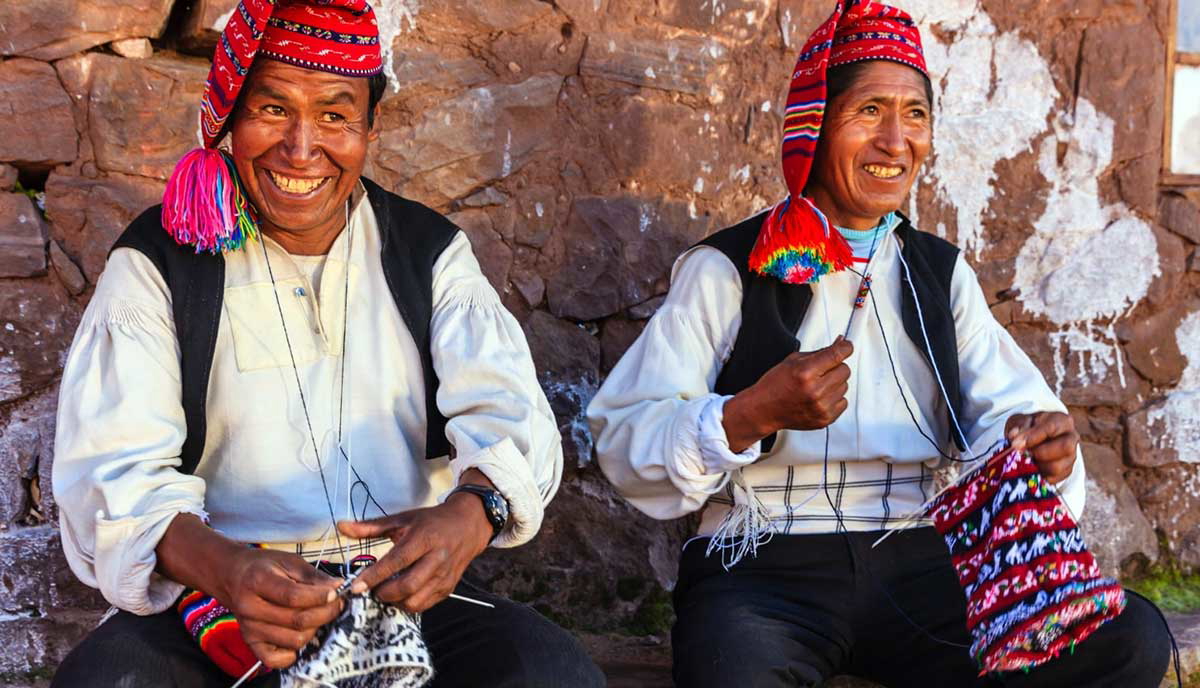
Far from the stereotypical “grandma in a rocking chair” depiction that the word “knitting” often conjures up, Taquile’s knitters can often be found stitching away while walking its narrow stone streets or gathering in public areas. Knitting has long been considered “women’s work” in the Western world. Though at one time exclusive guilds employed only men to knit garments for elites, for the last several hundred years, it has been largely associated with older women and domestic work. Yet, the exact opposite is true on Taquile: only the men knit; not as a hobby, but as a way of life. Perhaps even more unique, it is their knitting skill that helps to define their place in the world.
Beginning at age 8, male children are taught to knit the iconic chullo by their fathers or other male relatives and will go on to knit many throughout their lives. They practice for years to be able to produce hats knit so tightly they can hold water, sometimes using cactus spines or bicycle spokes as needles. They also learn the traditional and family motifs that decorate the hats; while modern hand knitters use charts, these designs are worked from memory and handed down through generations, often incorporating plants and animals native to the island.
The tight gauge at which their hats are worked also allows for the creation of detailed and intricate images, and together, these two elements result in hats that can take months to knit. With so much care taken, it’s no wonder the hats hold so much meaning. The colors used in the hat can reflect the wearer’s marital status (white for single men, red for married), and the position of the long crown—pointed to the left, right, or back—is sometimes used to indicate the wearer’s mood!
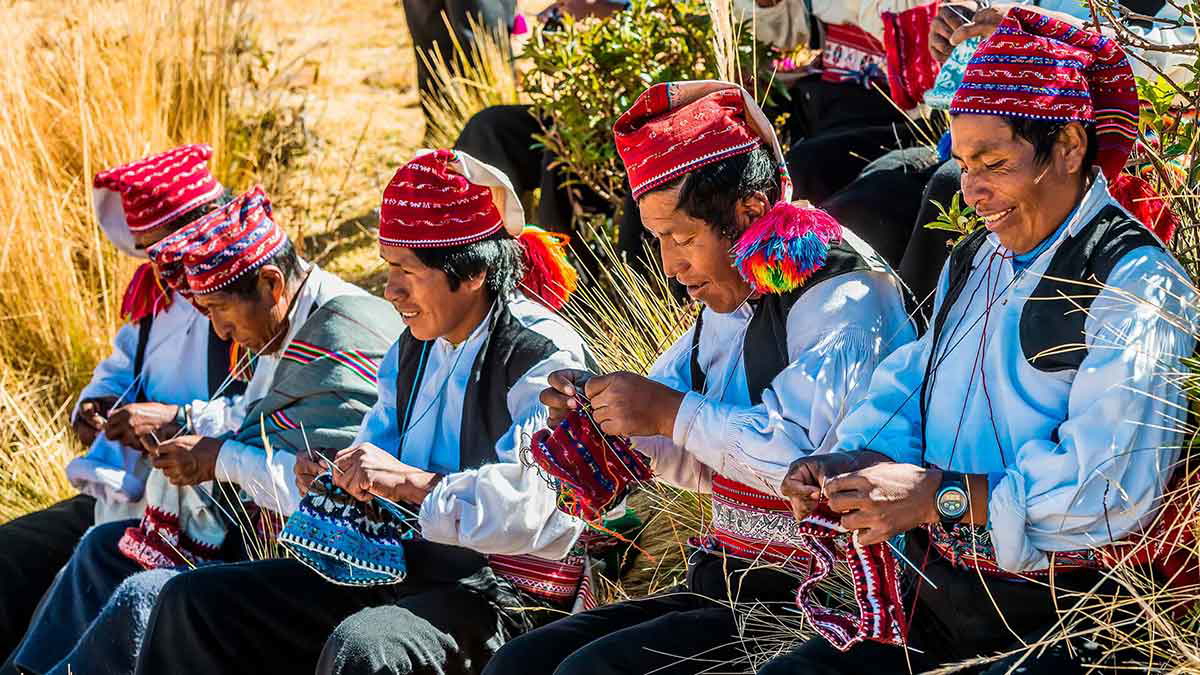
Knitting can even be the catalyst for starting a family. The island’s women judge their potential mates by their knitting prowess, as demonstrated in their hats. When courting, a man may present a handknit hat to his potential father-in-law so he can see for himself that it’s watertight. If his work is approved, the wedding can go forward. Then for his wedding, a man will knit himself a special new hat, a pintay, which his father-in-law will present to him on the big day. New hats are also knit to mark other special occasions, particularly as men age and occupy new positions of leadership or status on the island. As their families grow, the men knit caps for their children as well—baby caps feature a distinctive ruffle around the brim.
While women weave the distinctive traditional chumpis, incorporating their own hair into special belts for their new husbands to commemorate their weddings, do the island’s men also knit for their wives? It would seem the answer is no; women do not wear hats, but rather a woven black or dark navy head covering to indicate they are married.
Preserving Taquile’s Cultural Heritage
In 2008, Taquile was added to UNESCO’s Representative List of the Intangible Cultural Heritage of Humanity. Though it remained relatively isolated until the mid-20th century, today, Taquile’s economy relies heavily on tourism, as well as the sale of its famous textiles. Despite the increasing number of tourists, islanders have sought to maintain their traditional lifestyle. Its people still live by the ancient Inca moral code: ama sua, ama llulla, ama quella, meaning “don’t steal, don’t lie, don’t be lazy.”
Visitors who choose to stay overnight are housed with families rather than in hotels. They arrive by motorboat, but once on the island, they get around on foot—there are no cars. Solar panels provide limited electricity for tourists to recharge their cell phones and the like, but most homes still have none. However, the demands of the tourist industry and increasing interest in these textiles have put additional strain on the island’s resources, with the result that some traditions are being replaced with modern conveniences. For example, though many still spin yarn by hand, commercial yarns have also begun to be used, including synthetics. Several knitting machines have also made their way to the island.
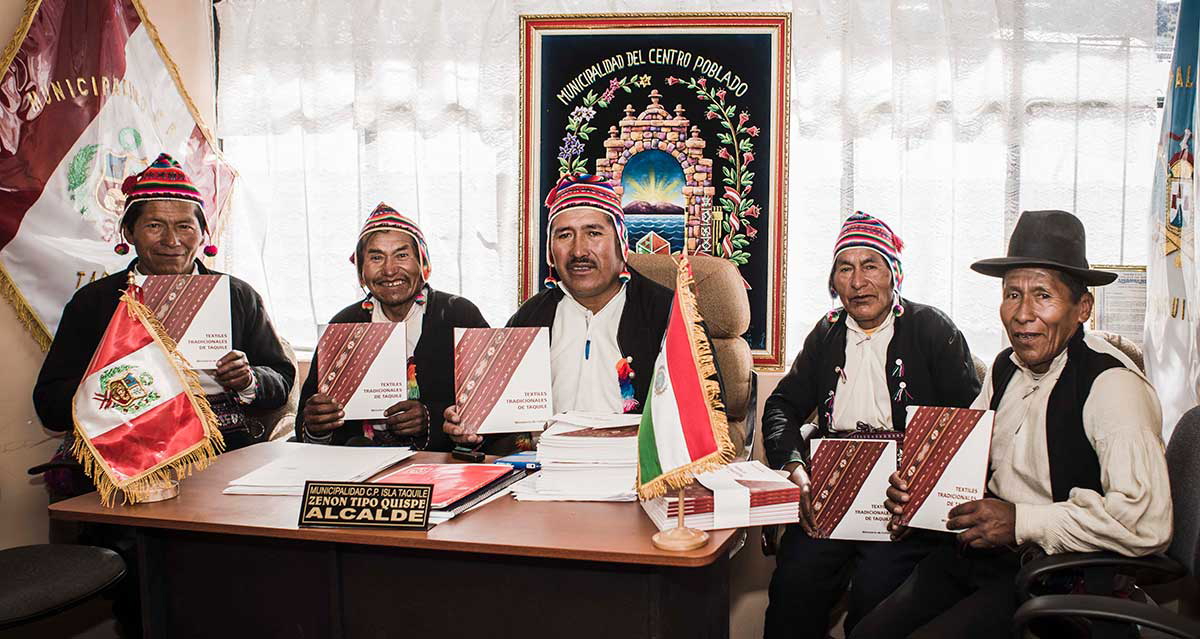
In 2015, Peru’s Ministry of Culture published a book, Traditional Textiles of Taquile, commemorating the island’s ancient textile traditions and creating an organized record of the different styles of traditional garments produced. In addition, a school has been founded to teach traditional weaving methods in order to both preserve cultural traditions and help meet the demand for these unique, high-quality textiles.