Alexander Pushkin is a well-known and internationally recognized Russian writer whose life was filled with political upheavals and romantic scandals. Despite being continuously suppressed and censored by tsarist Russia, Pushkin stayed committed to free speech and changed the literary landscape of Russia. Pushkin’s poetry, drama, and prose have left a lasting legacy that serves as a cornerstone of contemporary Russian literature.
Early Life of Alexander Pushkin

Alexander Pushkin was born on June 6, 1799, in Moscow, Russia. His father, the nobleman Sergei Pushkin, was a representative of an old aristocratic family. From the mother’s side, Pushkin had African roots. His mother, Nadezhda Pushkina, was the granddaughter of Abram Gannibal (1696-1781), an Abyssinian living as a slave at the Sultan’s palace in Istanbul. Then, Abram Gannibal was brought to Peter the Great as a gift. The tsar, fascinated with Gannibal’s intellectual abilities, adopted him and sent him to Paris, France, to study. Abram Gannibal would later become the leading general of the Russian Army.
Alexander Pushkin, inspired by the history of his great-grandfather, took pride in African ancestry, dedicating a novel titled The Negro of Peter the Great (1827) to Abram Gannibal.
Arina Rodionovna Yakovleva cared for young Pushkin and his sister and brother. From his nurse, Pushkin acquired a love for Russian folktales and peasant language. Young Pushkin spoke French fluently, as did most 19th-century Russian aristocratic families.
Being from an aristocratic background, Pushkin was exposed to several languages and cultures from a very young age. His visits to France and Switzerland further heightened his natural curiosity. These experiences instilled a deep interest and appreciation for culture, art, and philosophy.
At the same time, Pushkin had firsthand experience with the injustices and unfairness ingrained in the aristocratic ruling class of the Russian Empire. This exposure greatly impacted young Pushkin, inspiring him to employ his literary talent to address the need for social reforms. He sought to address the struggles of ordinary people while challenging the corruption and injustice within the Russian Empire’s government.
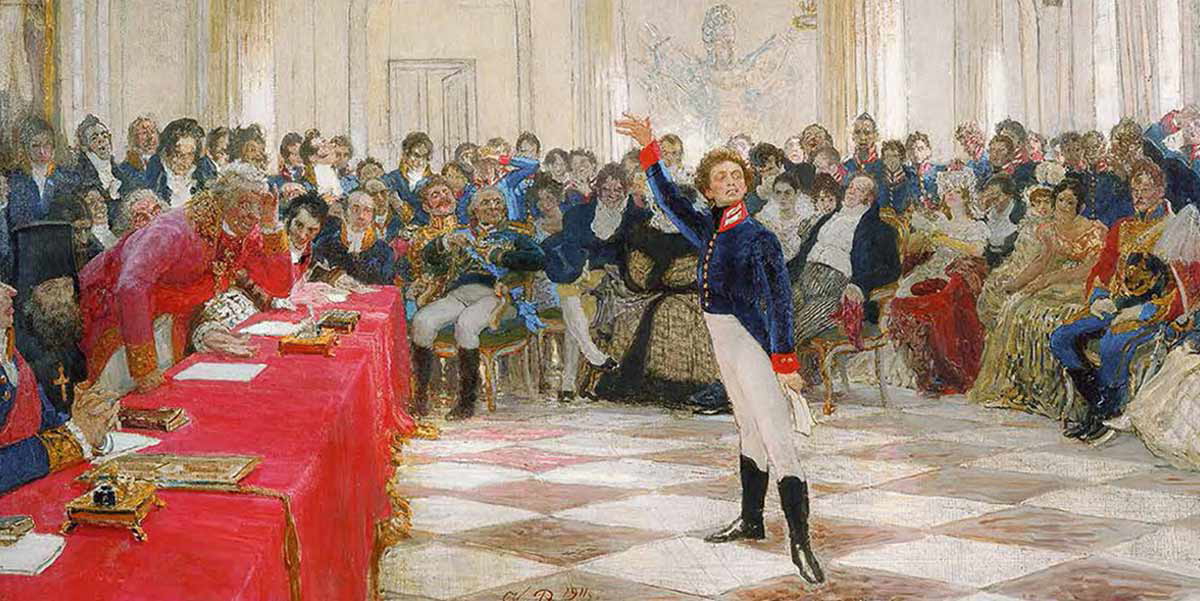
Pushkin enrolled in the Imperial Lyceum at Tsarskoye Selo in 1811 when he was 12 years old. Later, the school would be renamed Pushkin’s Lyceum in honor of its well-known student. Pushkin debuted his writing career at the Lyceum, and his first poetry epistle, To My Friend, the Poet, was published in 1814.
Alexander Pushkin’s early works were influenced by the romantic poets of that time, K.N. Batyushkov and V.A. Zhukovsky, as well as 17th- and 18th-century French poets, such as Vicomte de Parny.
Relocation to St. Petersburg & Pushkin’s Political Career
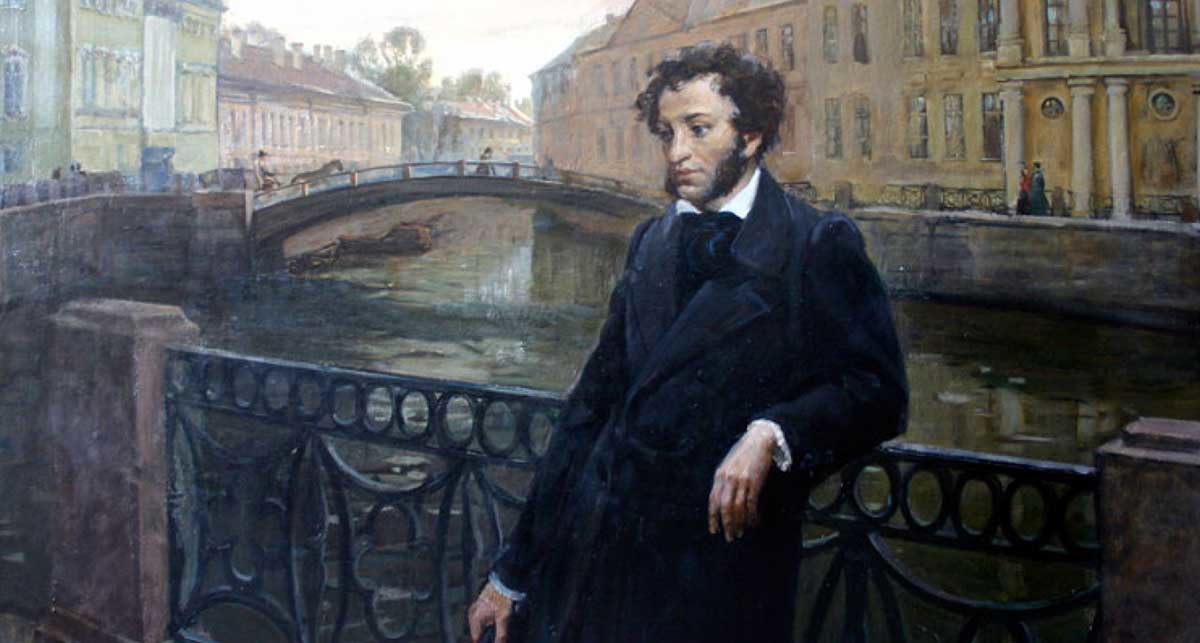
Alexander Pushkin graduated from the Imperial Lyceum in 1817. The same year, Pushkin relocated to St. Petersburg, pursuing a career in politics and working at the Collegium of Foreign Affairs.
In Saint Petersburg, Alexander Pushkin immersed himself in the cultural and social life of the cultural center of the Russian Empire. Eighteen-year-old Pushkin was frequently noticed visiting theaters and operas, as well as drinking and gambling in bars.
In Saint Petersburg, Pushkin became a member of the exclusive literature circle Green Lamp Association—a discussion platform on literature and history. The Green Lamp Association was a branch of the secret society Union of Welfare. The members of the society, mainly political liberals, were supporters of the Russian revolutionary ideas and reforms. Most of the members of the society would actively participate in the Decembrist Uprising in 1825 against the rule of Tsar Nicholas I.
The social circle and its activities in Saint Petersburg greatly influenced Alexander Pushkin. Despite never being published, his works from this era were defined by the Decemberists’ political beliefs and are referred to as the “revolutionary” poems. The ode Freedom, The Village, created between 1817 and 1820, for example, perfectly embodies his liberal views.
Alexander Pushkin’s Life in Exile
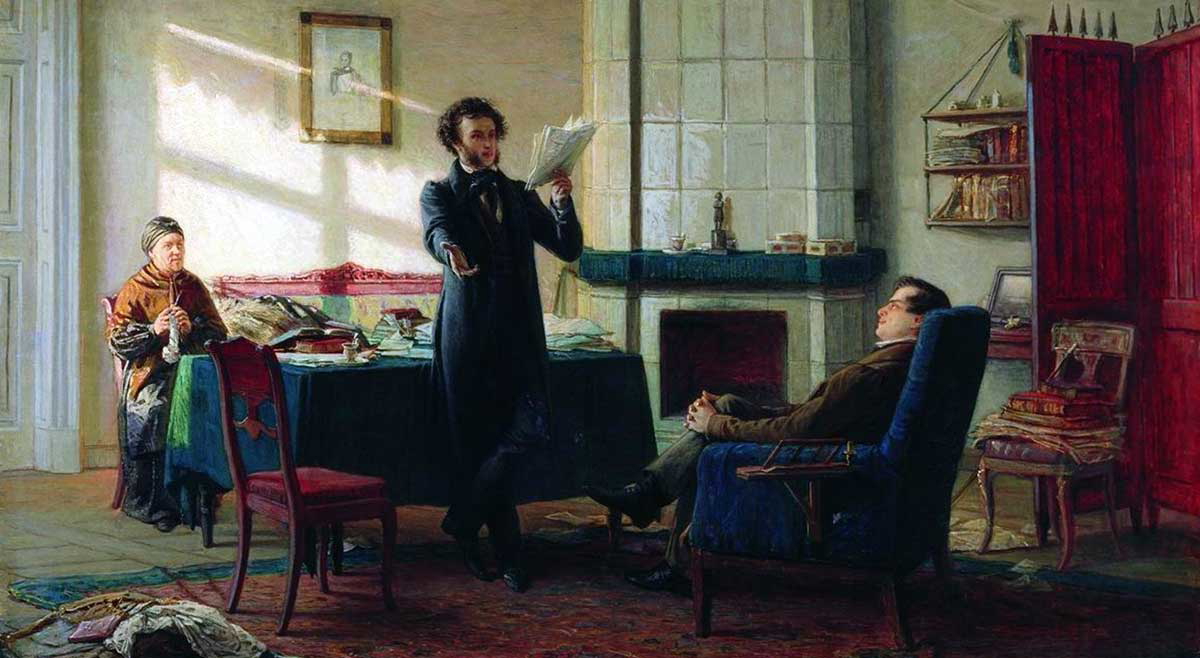
Alexander Pushkin’s outspoken political views did not remain unnoticed. In April 1820, the Petersburg governor-general began interrogating him due to his alleged role in inspiring rebellious sentiments among the youth through his works.
The interrogation resulted in Pushkin’s exile to southern Russia, under the supervision of General-Lieutenant Ivan Nikitich Inzov, the administrative head of the Committee on Foreign Residents/Migrants of the southern region of Russia.
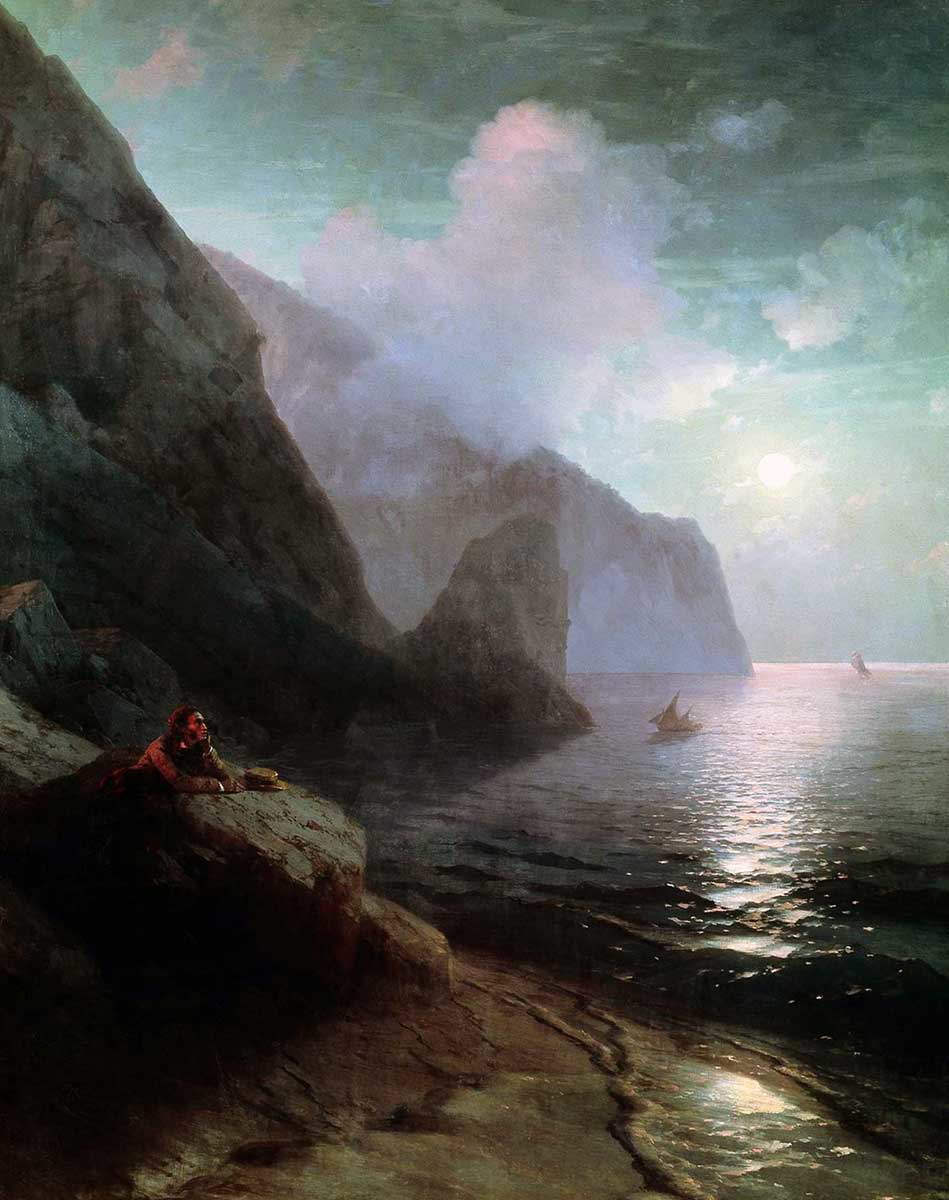
Pushkin remained in Southern Russia until 1823, traveling to the Caucasus and Crimea with General Nikolai Nikolaevich Raevsky and his family.
It is believed that the older son of General Aleksandr Nikolaevich, who pursued political liberalism, inspired Pushkin to write poems such as Demon and Angel (1824).
Instead of mitigating his political ideals, the exile bore the opposite results. Indeed, this period marked the creation of Alexander Pushkin’s most government-opposed works, condemning tyranny and censorship. During 1820-1821, Pushkin worked on the first Byronic verse tales, The Prisoner of the Caucasus (1820-1821), The Bandit Brothers (1821-1822), and The Fountain of Bakhchisaray (1821-1823). During this time, Pushkin also started working on the first chapter of Eugene Onegin.
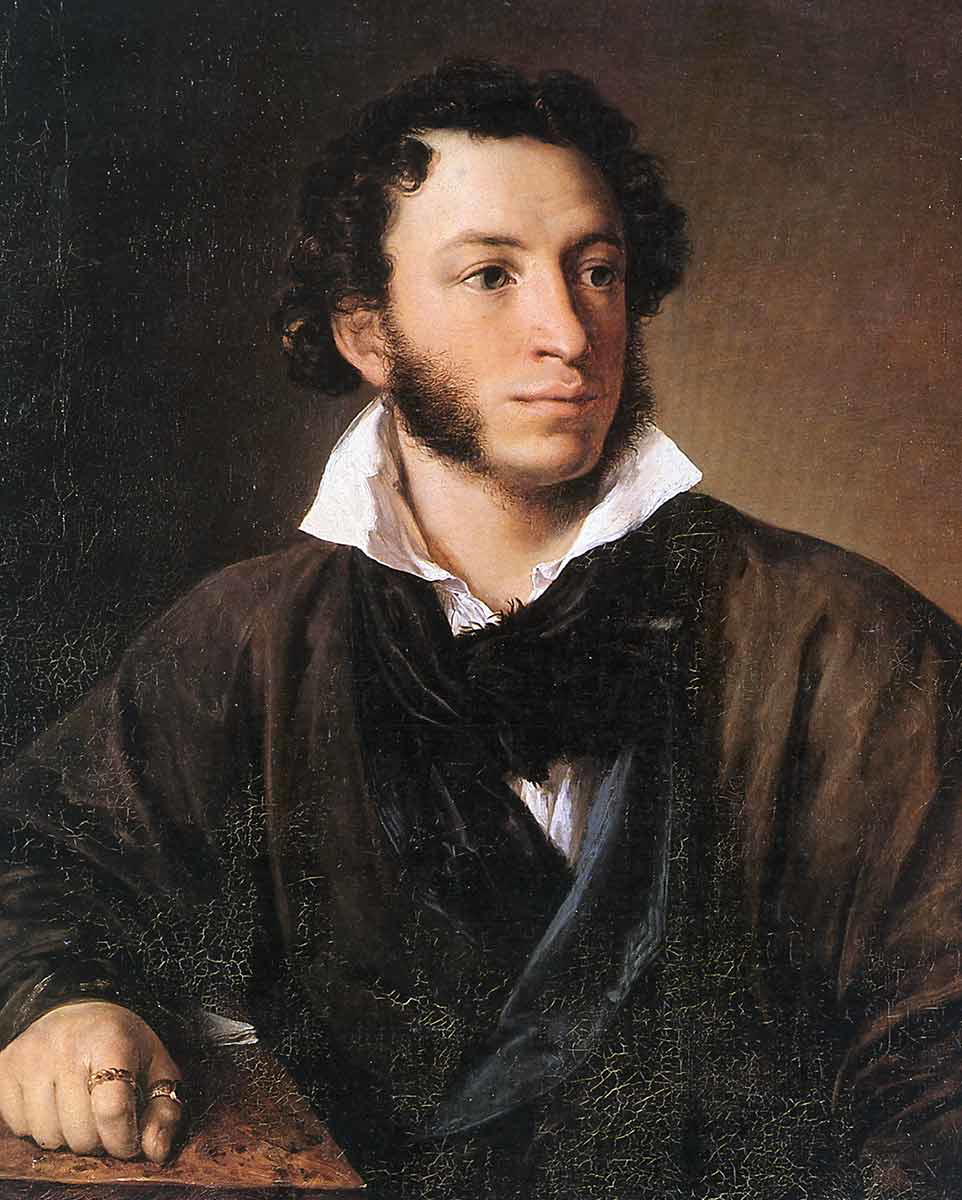
Pushkin was able to move to Odesa in 1823 with the help of his influential friends. There, he was supervised by Count Mikhail Semenovich Vorontsov, the governor-general. He maintained a lavish way of life in Odesa, frequently visiting theaters, pubs, and restaurants. His writings were infused with religious and political ideals, attracting unnecessary attention from the government.
Under further examination, one of the postal workers obtained Pushkin’s letter, in which he provided a delicate defense of atheism. In the same year, the Russian authorities once again exiled Pushkin. This time, he was sent to Mikhaylovskoe, his mother’s estate in northern Russia.
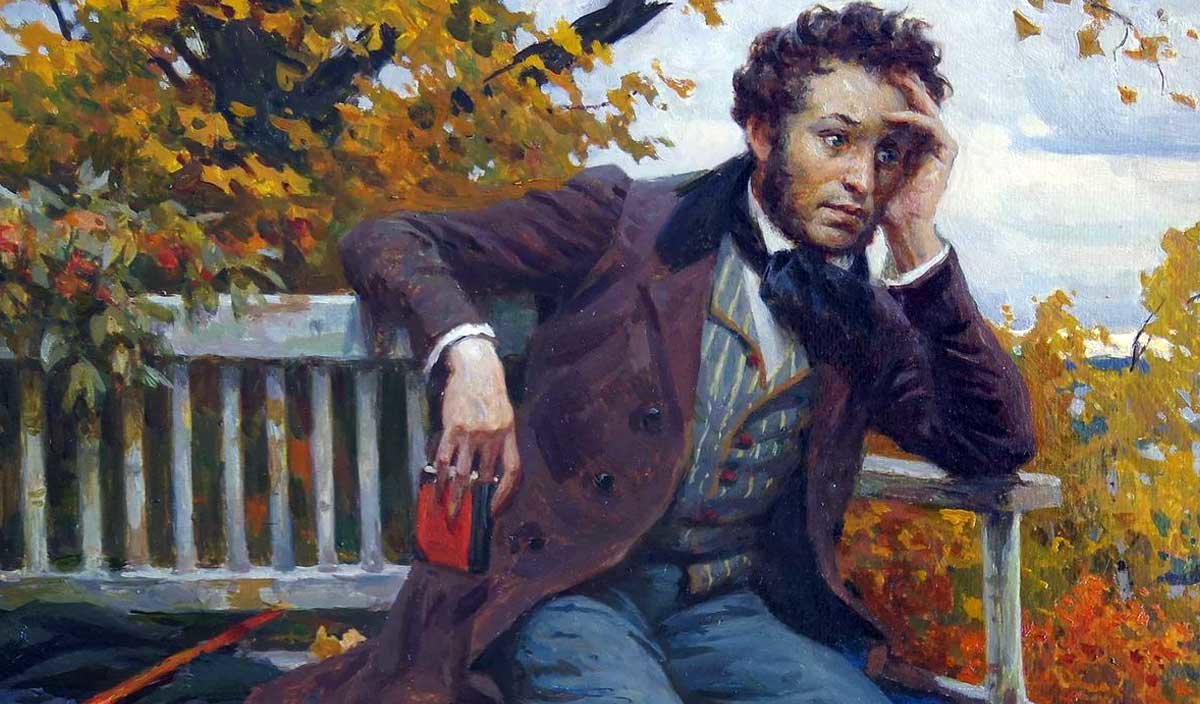
Despite being closely monitored and living far from the city, Alexander Pushkin was able to draw inspiration from the peaceful village life. Between 1824 and 1825, Pushkin wrote The Gypsies, Graf Nulin, Boris Godunov, and the second chapter of Eugene Onegin.
Alexander Pushkin found Mikhailivskoye both remote and boring. “Melancholy and rage” are the most frequent terms running through Eugene Onegin, an almost autobiographical work describing Pushkin’s exile in the countryside in winter:
“What can one do in the backwoods at this tide?
Go for a walk? At this time, the countryside
Cannot fail to bore the eye
With its bare monotony.
Gallop on horseback over the empty plains?
Yet the horse, its shoe blunted yet again,
Stubs the ice, and all falls too.
Then sit under your deserted roof.”
The Decemberist Uprising
The Decemberist Uprising arrived in the Russian Empire on December 14, 1825. During this time, Pushkin was in exile in Makhaylovskoe and could not participate in person. Nevertheless, the authorities found copies of his earlier political poems held by democrats. To avoid conviction and escape the consequences of the revolt, Pushkin destroyed the works he thought might not be safe to hold, including his diaries.
By the spring of 1826, the Russian authorities had executed several of the Decembrists and exiled hundreds. Pushkin waited almost a year after the uprising; however, instead of pursuing a humble life, he asked the tsar for release from exile in 1826. On September 8, Pushkin was free to leave Makhaylovskoe and granted the freedom to publish in journals and travel.
The reality, however, appeared different. Count Benkendorf, Chief of Gendarmes, was in fact appointed as Pushkin’s censor, limiting his freedom of action by requiring advance permission to publish his works or travel.
Pushkin’s Romantic Life & Duels
Alexander Pushkin’s life was full of love affairs, scandals, and romances, which often translated into his romantic works.
A Guardian article, published in 2010, remarks:
“Almost everything about Pushkin was paradoxical. He was at once urbane and mischievous, a man who had affairs with some of the most beautiful women of his day, yet always thought of himself as ugly.”
The first person Pushkin fell in love with was Aleftina Lopukhina. Despite Pushkin’s serious intentions, the relationship failed due to the disapproval of Aleftina’s family. This traumatic experience would greatly influence Pushkin’s future romantic relations.
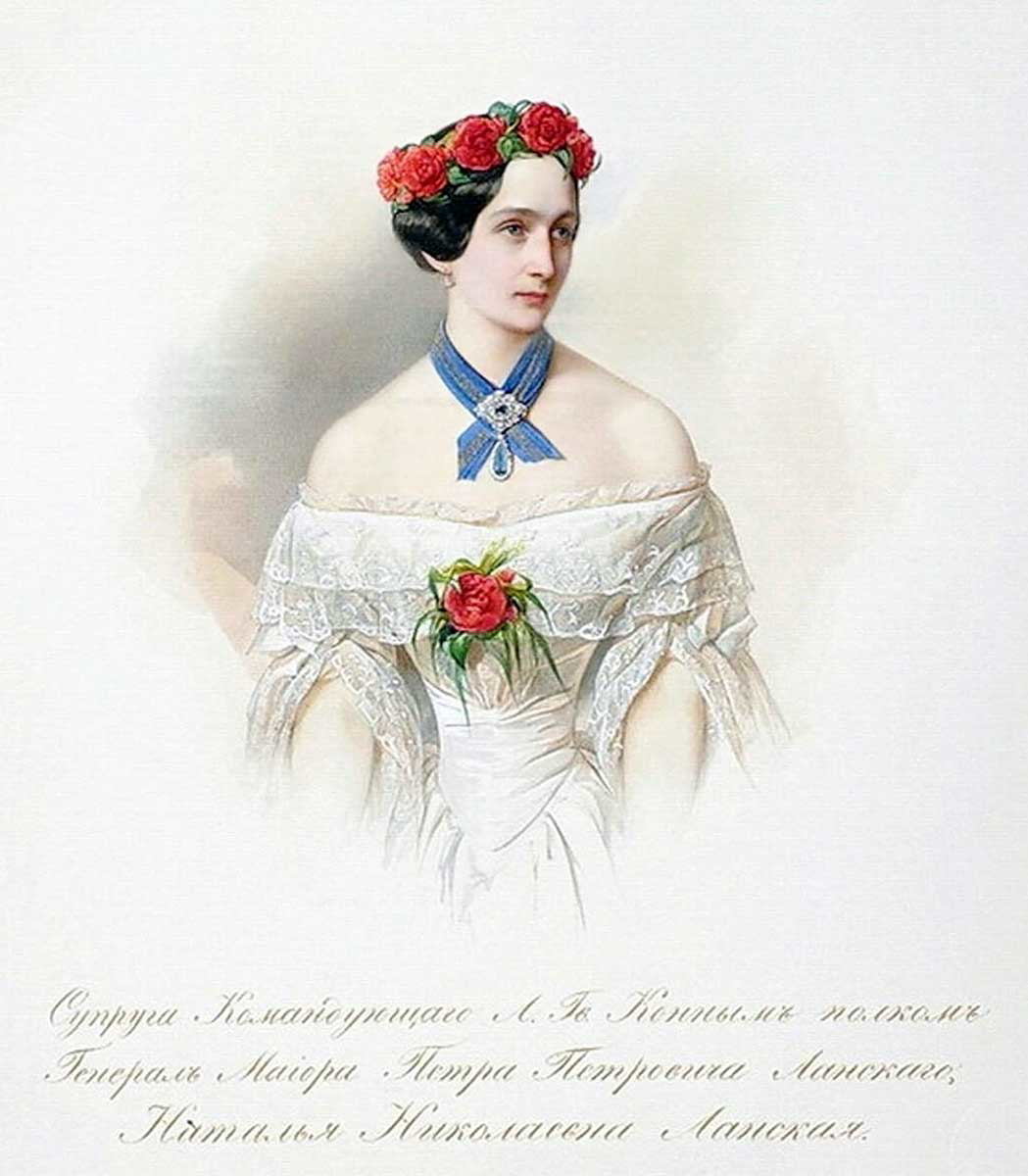
In 1831, Alexander Pushkin married Natalia Goncharova in Moscow. The couple had four children. Natalia was known for her beauty, which fascinated many. George D’Anthès-Heeckeren, the adopted son of the Dutch ambassador to the Russian capital, was one of the many trying to pursue Natalia.
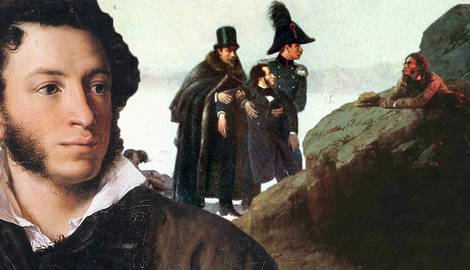
Georges d’Anthès himself was married to Ekaterina Goncharova, the sister of Pushkin’s wife. Nevertheless, in 1828, rumors emerged that Georges d’Anthès was having an affair with Natalia; however, historians think that the fact was not true. Feeling anger and betrayal, Pushkin challenged Georges d’Anthès in a duel under extremely harsh conditions. Instead of the standard 25-30 steps between the duelists, in this instance, only ten steps were allowed.
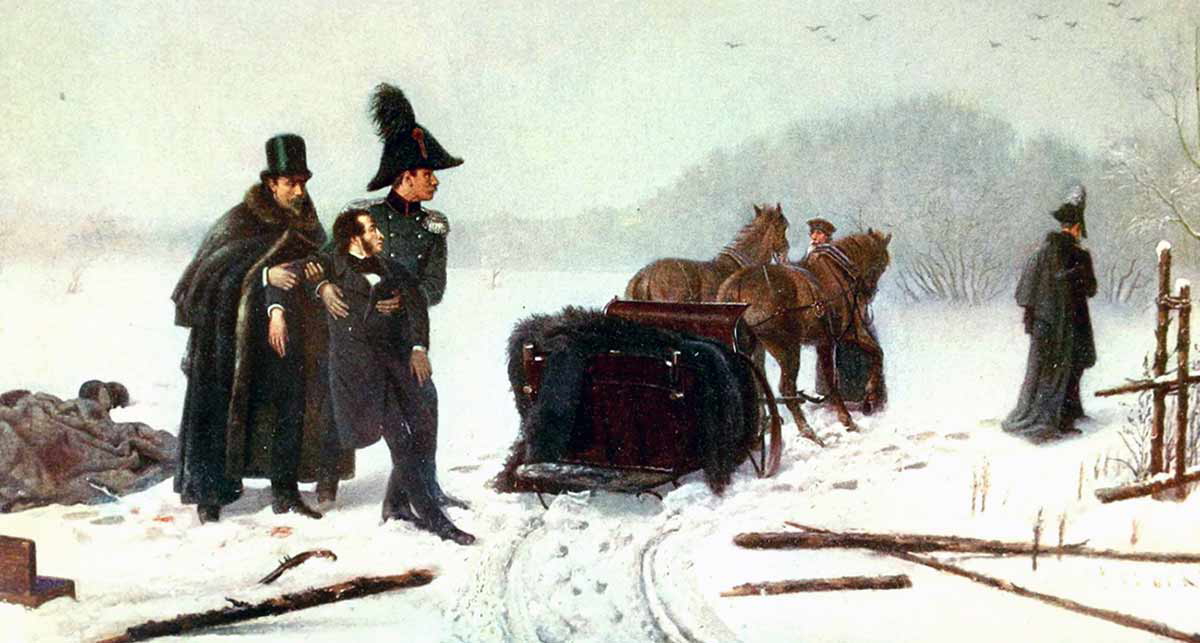
The duel took place in the rural area of Saint Petersburg, at Chernaya Rechka. D’Anthès shot first, wounding Pushkin in the stomach. Pushkin fired back, but his wound was fatal. At 38 years old, Pushkin died on February 10, 1838, two days after the duel.
Duels were prohibited in Russia, and while the court and authorities were on the side of D’Anthès, the Russian public mourned Pushkin. His funeral was held in a small church with limited attendance. Pushkin was buried next to his mother at Svyatye Gory Monastery.
Many believed that Natalia was responsible for Pushkin’s death. Russian poet Marina Tsvetaeva remarked regarding Natalia:
“A beauty and nothing else, just a beauty, without a brain, a soul, a heart, or any talent. Nude beauty, striking like a sword. And she struck.”
The Legacy of Alexander Pushkin

Despite his early death, Alexander Pushkin lived an exceptionally vibrant and adventurous life. He retained his dedication to writing and freedom of expression in spite of the difficulties he encountered in his personal and political life, being under authoritarian control and continuous censorship. Drawing inspiration from the socio-political fabric of the Russian Empire as well as Russian folklore and history, he is regarded as the father of modern Russian literature.
Pushkin’s creative approach to literature served as an inspiration to numerous other well-known Russian authors, including Fyodor Dostoevsky, Leo Tolstoy, and Anton Chekhov, who all left a rich literary legacy for Russia.
Russian scholar, social critic, and journalist N. G. Chernyshevsky remarked that:
“The role of Alexander Pushkin is extremely prominent. It was due to him that thousands of people got the literature education. … He was the first to give the Russian literature the status of the whole nation’s matter. He became the first poet, who in the eyes of Russian people took that high place, which a great poet should take in his country.”