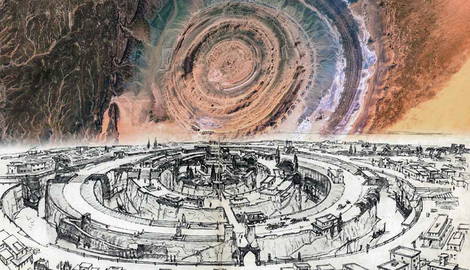
There are countless theories about where the legendary city of Atlantis was located. While most scholars believe that the story was purely an allegory, invented by Plato, if we embrace the idea that it could have been based on a real historical civilization, then where was Atlantis? While many assume that Atlantis represents a distorted account of the Minoan civilization, which fell at the end of the Bronze Age, other theories exist. One popular theory is that Atlantis was located in the Eye of the Sahara, near the western end of Africa’s Sahara Desert. What is the evidence to support this seemingly bizarre theory?
Atlantis as the Eye of the Sahara Desert
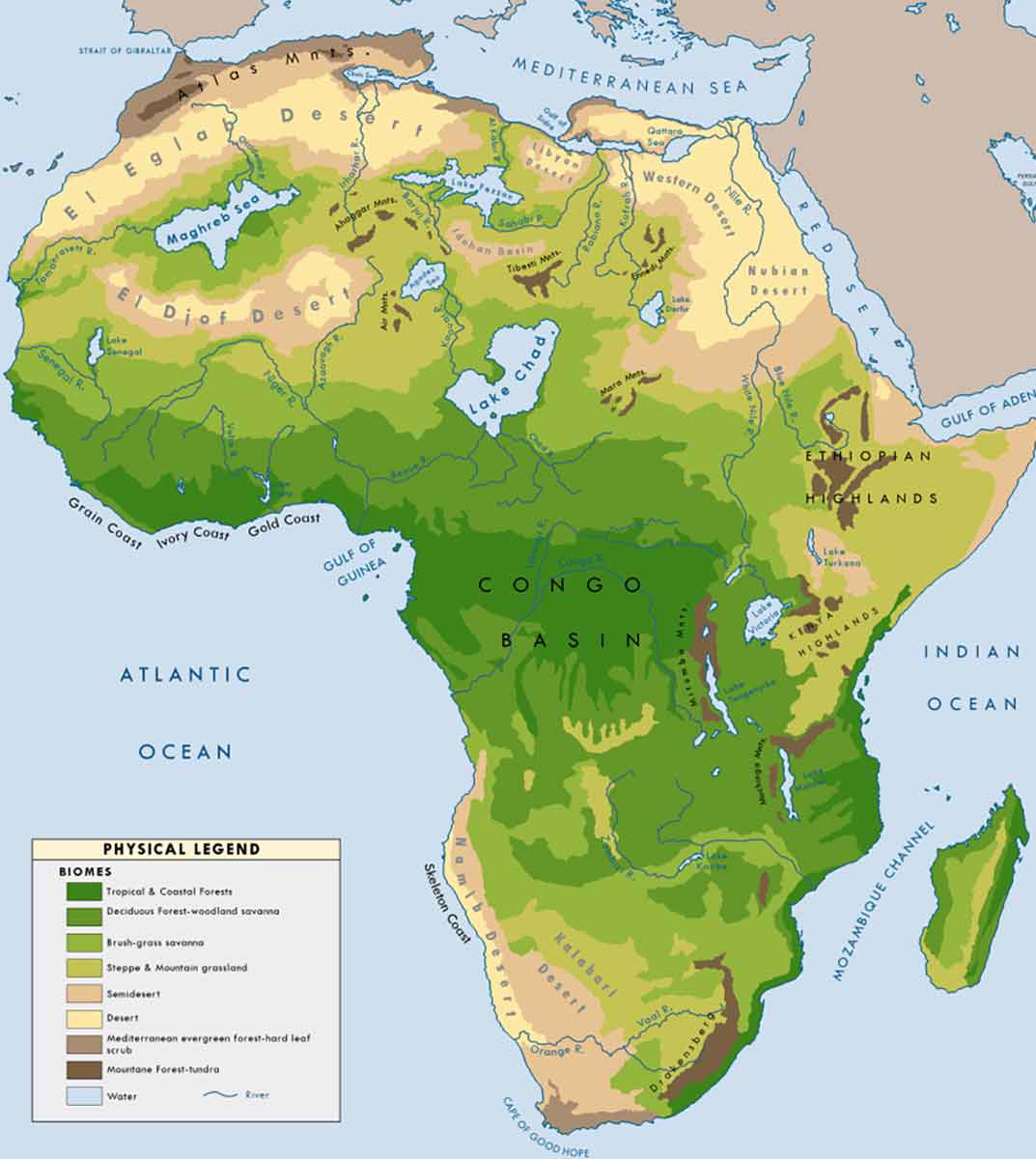
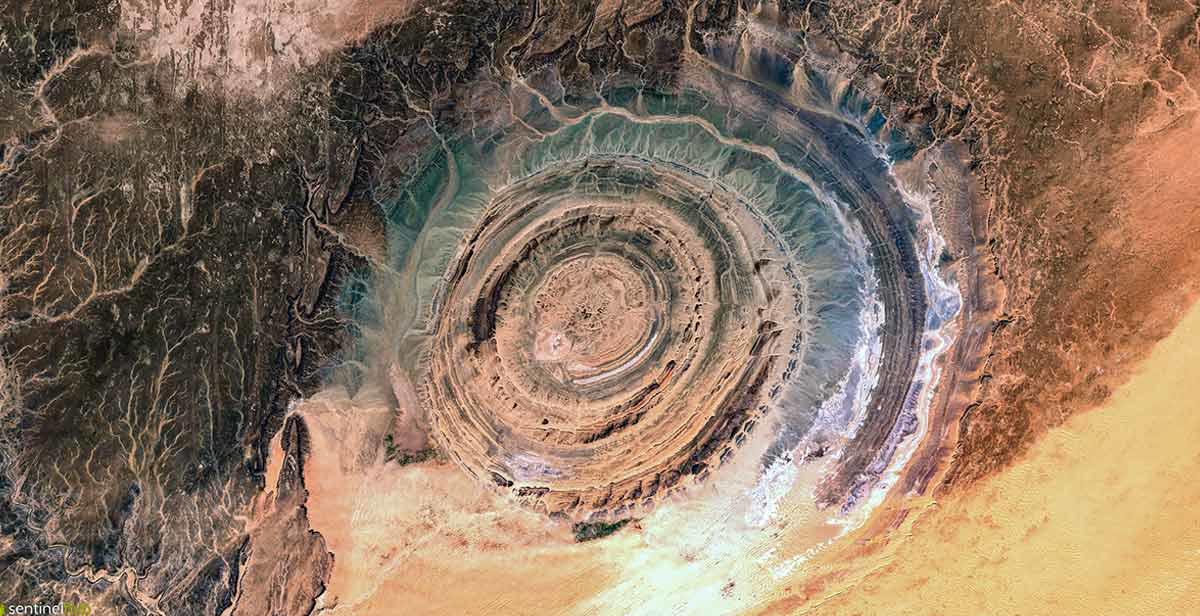
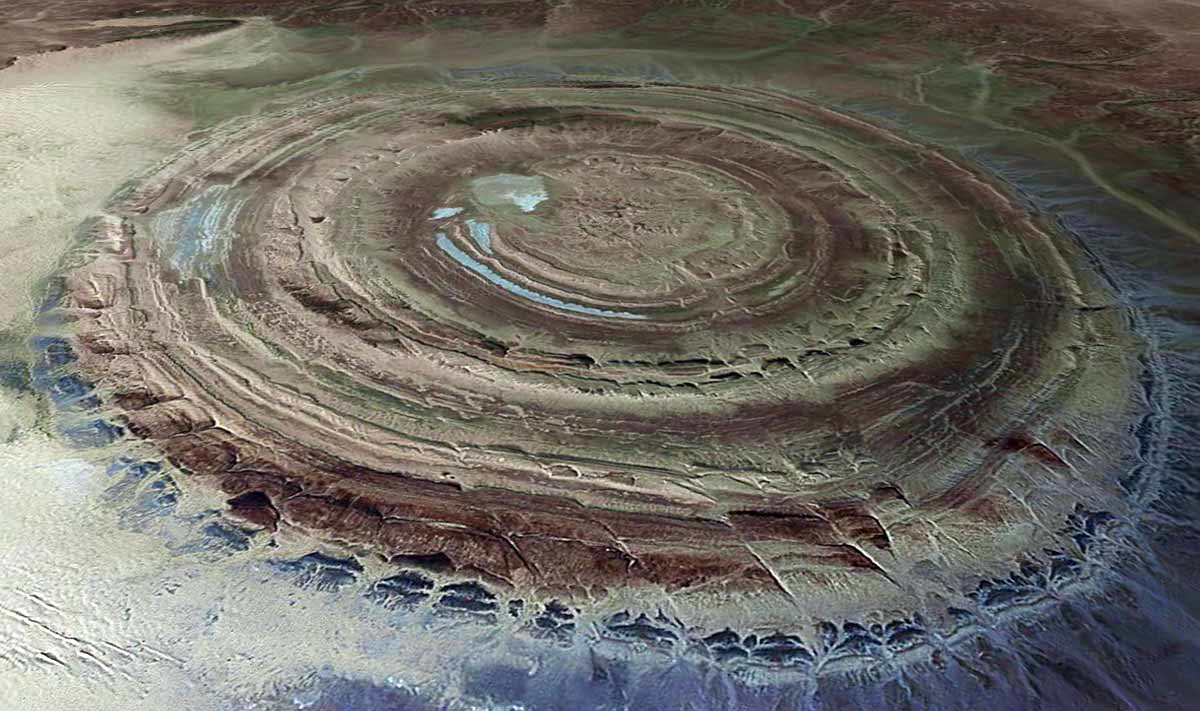
First, where is the Eye of the Sahara? This is a geological structure in the Sahara Desert in the modern country of Mauritania. It is composed of ridges and depressions which form several concentric circles, the total diameter being about 40 kilometers, or 25 miles. It is due to this strange circular shape in the desert that it is known as the Eye of the Sahara. It was once thought to be the result of an impact from a meteor. However, it is now understood to be the result of a geologic dome experiencing varying rates of erosion due to the differing composition of the rock in different parts of the dome. This erosion has left behind the distinct ridges that characterise the Eye of the Sahara, also known as the Richat Structure.
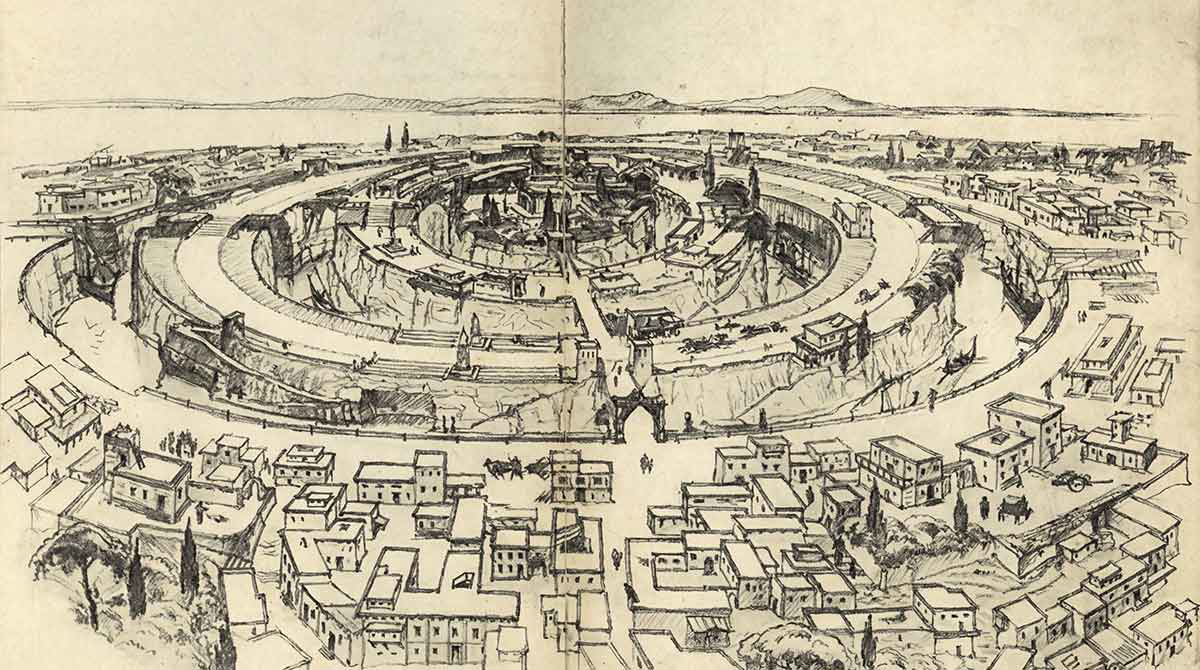
What reason is there for concluding that Atlantis was located at the Eye of the Sahara? The main reason is that the concentric ridges bear a strong similarity to Plato’s description of Atlantis in his Critias dialogue of the 4th century BC. In that dialogue, Plato explained that the main metropolis of Atlantis was composed of a small central island. This was surrounded by a zone of water, which was in turn surrounded by a ring of land. This pattern repeated to create three distinct rings of land surrounding the central island, with each zone of land separated by water. If the depressions in the Eye of the Sahara were filled with water, it would bear a striking resemblance to Plato’s description.
How Could the Eye of the Sahara Have Been Atlantis?
Of course, for this theory to be even remotely plausible, we need to address the fact that the Eye of the Sahara, far from being an island, is in the middle of the desert. How could this possibly be harmonised with the fact that Plato definitely described Atlantis as an island, using the Greek word “nesos”? Proponents of this theory offer two explanations.
The first is that the northwest corner of Africa was at sea level some 11,000 years ago, when the legend of Atlantis is ostensibly set. By comparison, the coast of West Antarctica is rising by about 4 centimeters per year at the moment. Over the course of 11,000 years, this would result in an increased elevation of 440 meters. This is somewhat less than the peaks of the ridges forming the Eye of the Sahara. On this basis, proponents of this theory claim that the Eye of the Sahara could have been at sea level in the distant past, with the peaks of the structure forming islands, thus fitting Atlantis. Deposits of salt within the structure are used as supporting evidence of this.
The second explanation is that Plato was not referring to an actual island when he used the word “nesos.” Rather, he was referring to an area in a region of lakes and rivers. This would apparently fit that region of Africa 11,000 years ago, when the Sahara Desert was not a desert at all but was a lush, well-watered region.
Other Supporting Evidence
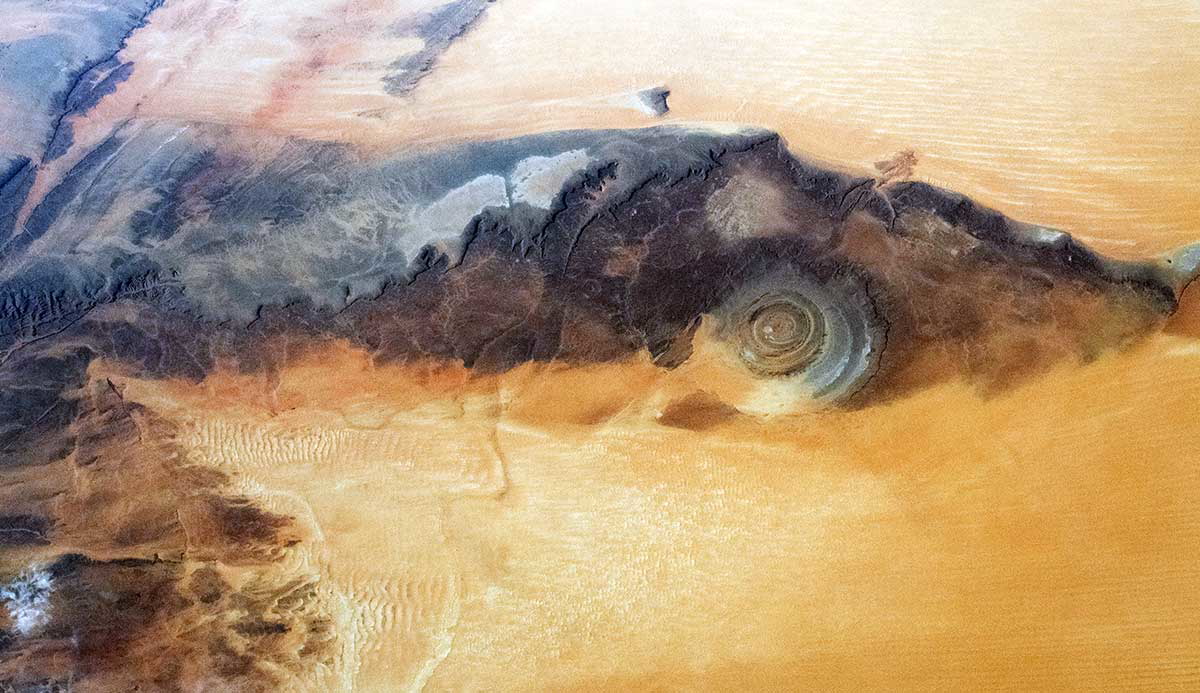
This is not the only evidence used to support this theory. The surrounding region also supposedly matches the descriptions of Plato. For example, Atlantis was said to have had a large, fertile plain just next to the main metropolis. The Eye of the Sahara is just next to an extensive open area of desert, which could have once been a fertile plain. Furthermore, satellite images of that region of the Sahara Desert make it look as if an enormous tsunami once swept across the land. This would account for the cataclysm which was said to have destroyed Atlantis.
Historical evidence has also been presented to support the theory. For instance, maps based on the description of the world by Herodotus, a Greek historian from the 5th century BC, appear to show “Atlantes” very near the location of the Eye of the Sahara. This, supposedly, confirms that the ancient belief was that Atlantis was in that very area.
Additionally, Plato describes how the first king of Atlantis was a certain Atlas. It was from this king that the kingdom received its name. This appears to match the fact that, according to Greek legend, the first king of Mauretania in Africa was named Atlas. At first glance, this looks like strikingly strong support for the conclusion that Atlantis must have been in that general region, even if it was not the Eye of the Sahara in particular.
Problems With This Theory
Does this evidence really stand up to scrutiny? First, could the Eye of the Sahara really ever have been described as a “nesos,” as per Plato’s description of Atlantis? The evidence that the entire northwest portion of Africa could have once been at sea level relies on the rate at which parts of Antarctica are rising today. However, Antarctica is rising due to the continual loss of ice, thus meaning the weight pressing down on this land mass is constantly decreasing. We cannot use this as an estimate for how much any other continent could have risen over time, since the same process would not apply.
The fact that salt is found inside the Eye of the Sahara does not mean that this was once filled with the ocean’s saltwater. Rivers, which did formerly exist across the Eye of the Sahara’s ridges, would have brought salt down from the rock into the depressions, where the salt is now found. If this salt were a trace of the whole region once having been at sea level, we would expect to find it in the entire surrounding area as well, not just within the Eye.
What about the alternative idea that Plato’s “nesos” could have referred to a well-watered region, full of lakes and rivers, rather than an actual island? This is categorically refuted by Plato’s explicit references to Atlantis being in the sea, using the Greek word “pelagos.” He also mentions the custom of sailing through the sea from Atlantis to several other islands and on to the opposite continent. Therefore, there is no doubt whatsoever that Plato was describing an actual island.
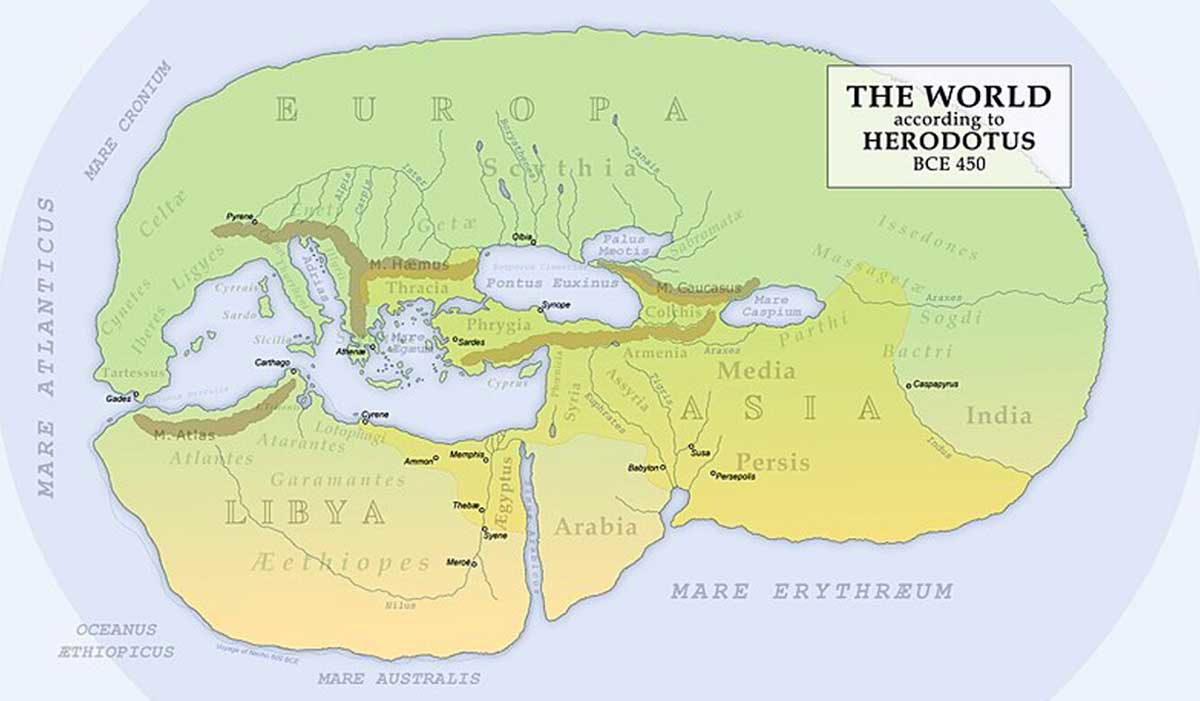
As for the historical evidence presented in support of this theory, this does not stand up to scrutiny either. Consider the supposed evidence from maps based on the descriptions of Herodotus. The “Atlantes” that Herodotus referred to is not the name of a place. Rather, it is the name of a people. In his description of Africa, he referred to this nation as the people who lived near Mount Atlas, and it was for that reason that they were called by that name. This presents two problems for the Eye of the Sahara theory.
First of all, the Atlas Mountains are hundreds of miles away from the Eye of the Sahara. Secondly, these mountains were named after Atlas the Titan, since he was believed to have lived here. However, there is strong evidence that, as recently as the time of Homer and Hesiod, the 7th century BC, Atlas was imagined to have lived just west of Greece. As the Encyclopædia Britannica explains:
“Atlas seems to have been a marine creature who supported the pillars that held heaven and earth apart. These were thought to rest in the sea immediately beyond the most western horizon, but later the name of Atlas was transferred to a range of mountains in northwestern Africa.”
Therefore, the connection between Atlas and northwest Africa significantly postdates the supposed origin of the Atlantis legend.
Can We Place Atlantis in the Eye of the Sahara Desert?
These are just some of the many objections that could be brought against this theory. There is also the fact that there are no archaeological traces of any major civilization in the area. Furthermore, the era in which Atlantis must have existed, according to this theory, does not coincide with any major civilization in Greece, the enemy of Atlantis according to the legend. Even from this brief overview of the theory that Atlantis was the Eye of the Sahara Desert, we can see that it is fraught with problems. The evidence that is commonly used to support it does not stand up to scrutiny.