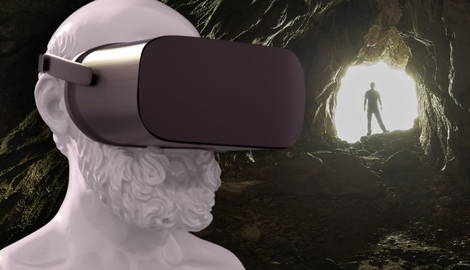

Consider being stuck in a cave for your entire existence, where all you see are shadows dancing on a wall, and believe that’s all there is. This was a thought experiment proposed by Plato more than 2,000 years ago. If we turn our minds to the current day, we can see that this allegory is more relevant than ever before, only in the digital space. Are we stuck in the cave of the metaverse, and do we really want to get out of it? Or are we just making our shiny new caves more addictive?
What Was Plato’s Cave All About?

First, to understand how Plato’s theory applies to us today, we should start with an analysis of what the Allegory of the Cave means. It is one of the most famous philosophical “tales.”
Plato describes a hypothetical situation: imagine that you and others have been imprisoned inside a cave since you were born. When you turn your head to look around, you see only walls and shadows flickering on them. They come from objects situated behind you and are illuminated by a fire. But you cannot understand that these are shadows. You see them as reality itself.
Now, let’s imagine a situation where one of the cave’s “prisoners” breaks free. At first, of course, he is temporarily blinded by the bright sunlight. But then, he starts to see things more clearly and understands that all his life in that cave was an illusion. He understands that there is so much more in the real world, not just walls with shadows.
When he returns to the cave, he tells what he discovered to others. He says that they can also walk free into a new world. But the response? Contempt. All those people have been living in that cave for their whole lives. They have adapted to this life and are afraid of what might be beyond their perceptions of the shadows.
What was Plato trying to say? People are often fooled by false images. Not everything that you see is like you see it. It may have another meaning. So, the philosopher believes that it is important to be brave enough to step into the light and find out what is really happening. Only in this leap is it possible to discover the real truth.
Enter the Metaverse: Shadows on a Digital Wall

So how does Plato’s allegory apply to us today? Plato would have said that we are living in another type of cave, a digital one. And it is formed in the metaverse.
In simple terms, the metaverse is like a digital playground. Here, you can create an avatar, build your own digital world, and live inside it. Created by tech company Meta, it is a project of the future. It predicts that in this digital world, we could hang out with friends virtually, do business, or even shop without leaving home.
But let’s analyze this situation in the context of the cave. Here, you don’t see anything but the avatars of people you want to meet. Yes, you can visit different rock concerts with them. You can even climb the highest mountain—something that you could never do in real life.
Still, all the “rooms” where you “hang out” with your pals are just algorithms. They are nothing more than an image visualized by code running on servers. So, while we can feel free in this metaverse, we are still controlled and ruled by programmers.
Back to the allegory, like those chained-up people in the cave, we are in the same position. We think that the metaverse is everything that we have in our lives, but no… there is still a reality. We are just creating new types of caves for ourselves, and Plato would probably agree.
Freedom or Control? The Role of Tech Companies as the Puppeteers

Like the prisoners’ puppeteers in Plato’s cave, modern tech companies act in the same way. They control what we see and help shape our thoughts.
Algorithms decide for themselves what they will show us today on the feed. And all the trendy videos we see are not based on luck. They are all the result of math calculations based upon user behavior data such as clicks, views (and the length thereof), and “likes.”
All these “manipulations” occur behind the scenes. We have no idea how tech companies analyze and influence us. Plato was the one who cautioned us regarding this issue. He believed that those who can create an illusion can influence society.
This raises some significant ethical concerns. Why do these tech companies have the right to manipulate us? Who gave them these powers? Do they totally influence our daily choices and behaviors?
Plato would have said that it is not we who use such platforms, it is the digital platforms that use us for their own benefit. Perhaps realizing this may be compared to leaving the cave in Plato’s story.
Escaping the Cave Today: Can We “Unplug” From Digital Illusions?

If Plato were looking at how we live today, he would have said that we have constructed the same cave but made it bigger and more “glittering.” Yes, we do not have any shadows on the walls. But we have TikTok videos, Instagram feeds, and digital avatars. So, logging out of social media can be compared with going out of the cave.
But is it so easy to do it? Plato’s prisoners managed to get out and find the meaning of life. What about us today? We can say that it is more complicated. The reason is that “the meaning” is more elusive. And we cannot just log out. All aspects of our lives, including those involving work and friends, are online.
Nevertheless, there are methods of retreating. Here, we can take a chapter from Buddhist philosophy, which advocates mindfulness. It teaches us to be in the here and now. We should take a moment to pause and analyze our feelings. This could look like taking a break from “doomscrolling” or saying, “Why is this post making me feel this way?”
Plato thought that we should not be fed by illusions. Yes, it is difficult to log out. But we should understand how to separate the real and the digital lives. We should learn digital literacy, or just think about what is more important in our lives.
Leaving the cave is not about erasing everything. It is about perceiving two competing worlds with clarity. Just like the escaped prisoner, we can turn around to the screen and ask ourselves: Is that real, or just another shadow?
Virtual Worlds, Real Selves: Identity and the Self in the Cave 2.0

When you create your profile in the metaverse, you can be anything. You can make yourself a wizard, a robot, or just a perfect version of yourself. It may sound great, but not for Plato. For him, your inner self is something created by your actions, your truth, and your reason. It cannot be hidden by filters and avatars.
If you scroll your TikTok feed, you can see so many people using these filters and virtual masks. They just create personas that can impress others. They share triumphs, not tribulations. But there is a great distinction between being and seeming. By doing so, we are losing ourselves.
Other philosophies would support Plato in this case. Let’s take the example of an existentialist, such as Sartre. He was a supporter of the theory that we build ourselves through decisions. Buddhism takes it a step further and posits that the “self” is illusory entirely.
But what should we do with that online world? Perhaps the Metaverse allows us to highlight different parts of ourselves. Yes, that is great. But we should never lose our identity. We should not be dependent on likes or comments. We should be ourselves, flaws included.
Is Virtual Reality a New Republic—or a Digital Dystopia?

Finally, if we take a short look at Plato’s Republic, we can really envision the ideal society. It is governed by philosopher-kings who appreciate trust and justice most of all. However, the philosopher believed that only those with a profound understanding of the Forms should rule over others.
Now, let’s suppose that this theory is applied to the Metaverse. Are we ever able to create a digital world with equality and empathy? Or do we simply create virtual playgrounds that entertain us while others get the rewards?
Some may say that the metaverse is like a new type of agora. It is a digital space where people can “meet” to share ideas, create something new, and communicate with others around the world. It is quite democratic-sounding.
But Plato would urge us to be careful. He would say that we should use wisdom so as not to succumb to delusions. People want comfort rather than truth. In his cave, many of the prisoners did not wish to exit.
Digital companies today put profits ahead of people. All the algorithms work in a way that is best for them. So rather than digital enlightenment, we risk creating a new cave. It can be full of advertising, echo chambers, and fake connections.
But the future is not set in stone. If we take Plato’s thoughts into consideration, we can remake the metaverse in a better way, a way that values truth and freedom over control and profits.