Rosetta Stone - 196 BC
Rosetta Stone
Object record
Genre
Civilization
Ptolemaic Egypt
Culture
Ptolemaic Egypt
Period
Hellenistic period
Date
196 BC
About
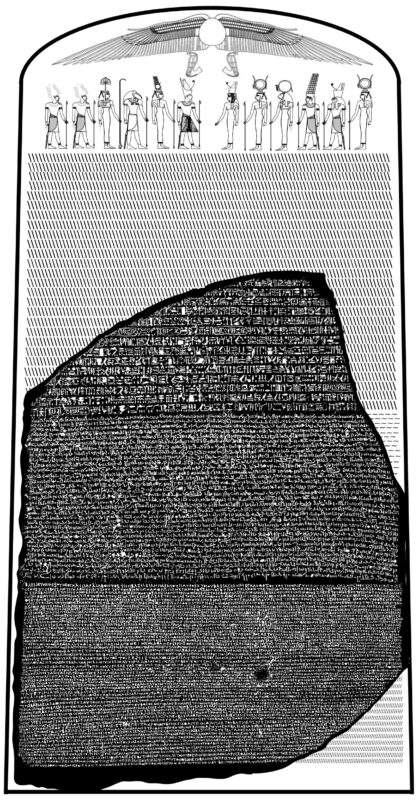
This celebrated fragment of a larger stele preserves three scripts—hieroglyphic, Demotic, and Greek—carved for a decree issued under Ptolemy V. Found near Rosetta in 1799, it became the crucial key to reading ancient Egyptian writing and remains one of the British Museum’s most visited objects.
Inscription(s)
Three inscriptions in Ancient Egyptian hieroglyphs, Egyptian Demotic script, and Ancient Greek.
Type of work
fragment, inscribed stone, Stele
Material
Granodiorite
Dimensions
H: 112.3 x W: 75.7 x D: 28.4 x Weight: 760 cm
Collection
Provenance
Found near Rosetta, Nile Delta, Egypt, in 1799 by Pierre-François Bouchard; transported to Cairo, then taken to Britain under the Capitulation of Alexandria in 1801; on display at the British Museum since 1802.
Institution
Location
London, Greater London, United Kingdom
Accession
EA 24
Copyright status
Cc
Copyright
Photo by © Hans Hillewaert, via Wikimedia Commons / CC BY-SA 4.0.
References
Tags
ancient GreekBritish MuseumDemotic scripthieroglyphsPtolemaic EgyptRosetta Stone