The classification of languages can often be simplified descriptions that omit vital parts of a language’s history. As such, the general description of English as being simply a Germanic language with French influence leaves out a massive and important part of its evolution.
The history of English is complex and includes a significant chapter on the influence that occurred as a result of the Viking invasions. The impact of this era on Anglo-Saxon society was marked by changes that shaped the development of culture, as well as language, into the English we use today.
The hybridization was so intense that while English is described as a West Germanic language, and the lexicon certainly reflects this, its syntax resembles that of Norse. This is a dynamic that begs further interrogation as to the nature of how English should be described.
The Genetic Classification of Languages and the Places of English and Norse
Classification of languages is closely linked to the history of the peoples who spoke them. There is a diachronic relatedness between languages with a related historical background, linked to the movement and the contact between the people who spoke them. Largely based on lexical factors, linguists are able to identify the evolution of a language and recognize relationships with other languages by looking at cognates, which are words with the same linguistic derivation, such as in brother (English), Bruder (German), bror (Norwegian), or even برادر (“baradar”—Persian).
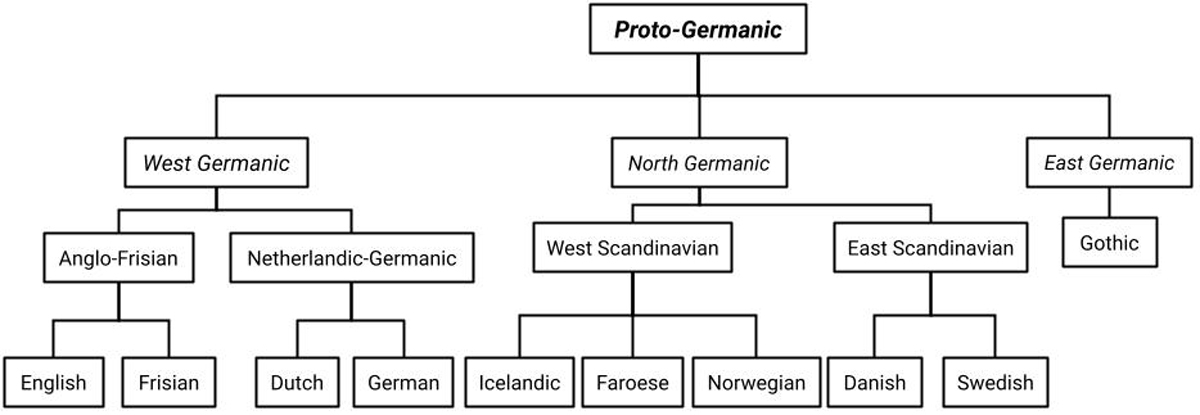
Largely by this method, European languages are classified into several distinct groups, the largest of which are the Romance languages and the Germanic languages. The Romance languages are derived from Latin, and include French, Portuguese, Spanish, Italian, and Romanian, while those whose roots are Germanic include German, Dutch, Norwegian, Swedish, Danish, Frisian, Icelandic, and English.

Germanic is further subdivided into West and North Germanic. West Germanic includes German, English, Frisian, Dutch, and Afrikaans, while North Germanic includes Danish, Norwegian, Swedish, and Icelandic. A third branch, East Germanic, contained the Gothic language and is now extinct.
The drawback of this classification system is that it does not holistically represent the combined sum of a language’s constituent parts. It omits grammatical variables such as syntax. Thus, by classifying English as a West Germanic language, it does not address the fact that around 30 to 50 percent of the lexicon is from French, nor does it address the fact that English, as it is spoken today, has a grammatical structure more closely linked to Norwegian than Old English!
As such, some linguists contend that English should be reclassified as a North Germanic language, although this position is not widely followed and is contrary to the mainstream attitude.
English and the Anglo-Saxons
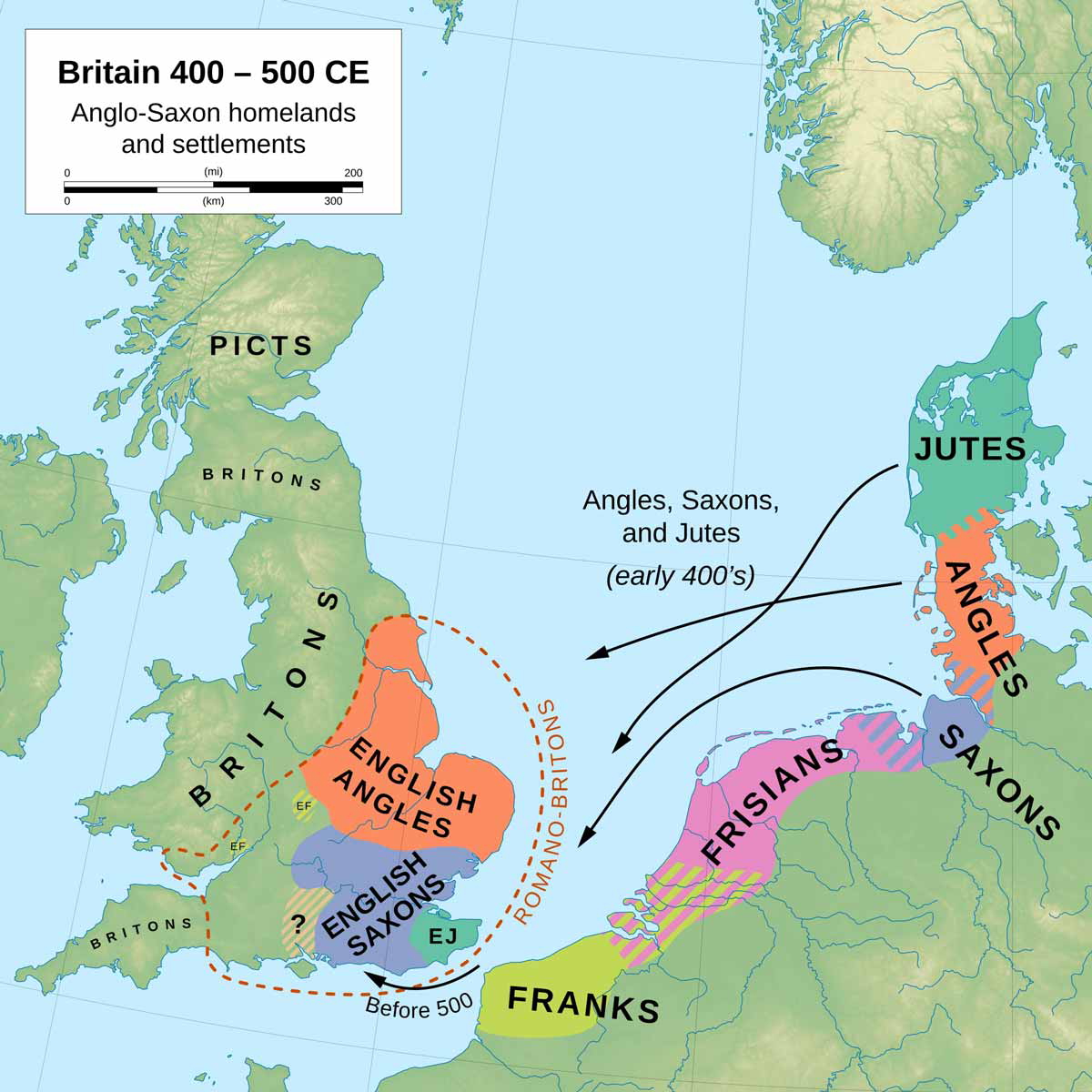
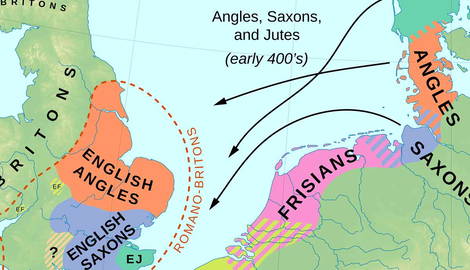
In the 5th century, after the departure of the Romans (410 CE), England played host to an increasing number of immigrants from the continent. The Angles, Saxons, and Jutes came from what is today Northern Germany and Denmark, and settled in England, warring with and displacing the Britons. With them came their cultures and languages, which ultimately merged into a single cultural-linguistic entity called “Anglo-Saxon,” with the language also being referred to as Old English.
It was an incredibly complex language. It was highly inflective, and words changed form to reflect their grammatical function regarding number and gender, case, and verb conjugation. While this aspect is much simpler in modern English, much of the core lexicon remains of West Germanic descent. Words such as “father,” “mother,” “house,” and “good” are all of West Germanic descent. However, many common words are of Old Norse descent, showing strong influence from the Norse in England. They include words such as “they,” “knife,” “trust,” “leg,” “sky,” “shirt,” “skirt,” and “skull” amongst many others. The degree of common use of words from Old Norse was high enough that it altered Old English in a fundamental way.
The Vikings Arrive

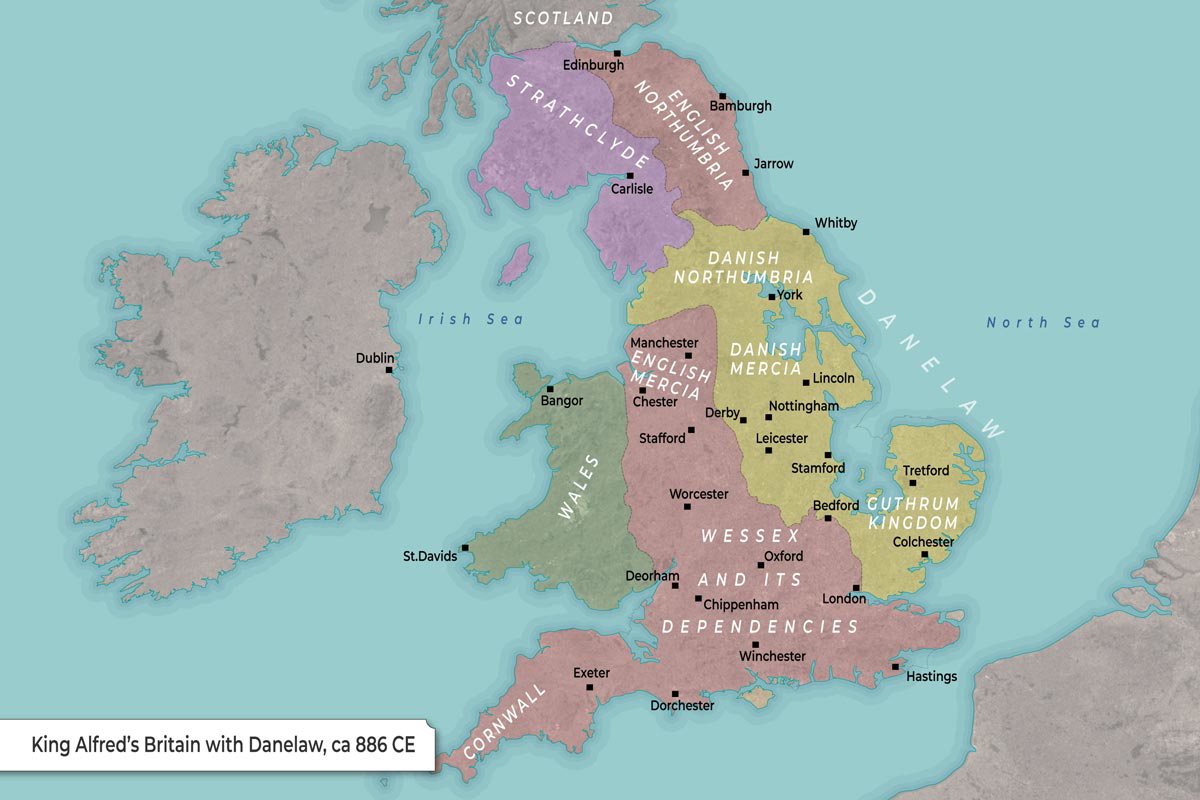
In 793 CE, Viking raiders attacked the monastery of Lindisfarne off the northeast coast of Northumbria, marking a new and very influential era in English history. Over the next decades and centuries, England was a major focus for Norse settlement. The “Danes,” as they came to be known, set up their own kingdoms and challenged the Anglo-Saxons for dominance over the island. They established the Danelaw, a region of Norse control which covered roughly half of England.
Life wasn’t all about war and conflict, however. There were periods of peace, and people from both sides of the cultural divide interacted with one another, conducting trade, getting intimate, and, of prime relevance, talking to each other. These required a significant amount of mutual intelligibility, and speakers changed the way they spoke in order to accommodate others. Although there was already a significant amount of intelligibility, the main difficulty stemmed from all the inflections used in Anglo-Saxon as well as in Old Norse. Inflection endings became obscured and were eventually abandoned in a process that could be regarded as simplification (or “inflectional decay” to be strictly academic). The gradual process of convergence was a natural result of these languages living together.
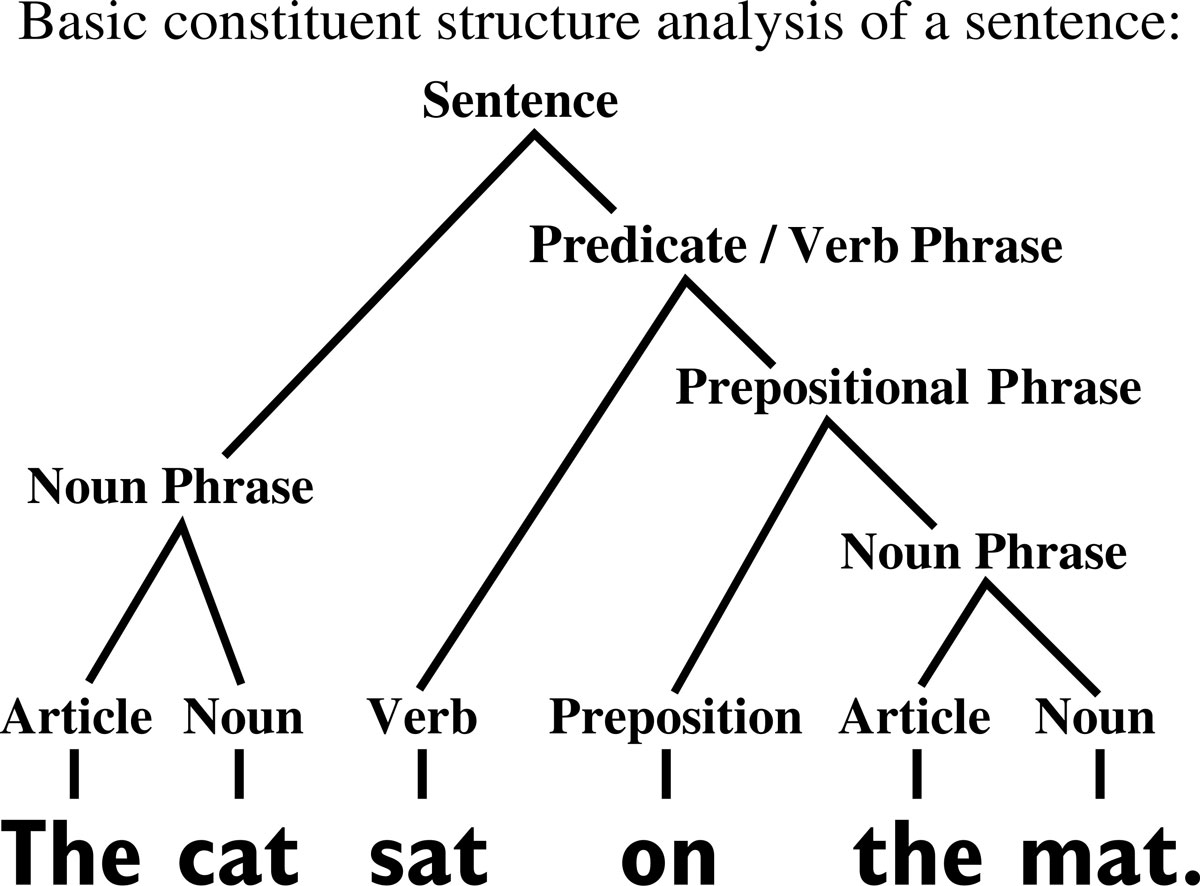
These inflections weren’t the only thing that changed. Languages can be classified typologically by word order, centering around the subject (S), object (O), and verb (V). English today exhibits the SVO syntactic format in contrast to Anglo-Saxon Old English, which used the SOV format, although it must be noted that the word order in Old English was more flexible. Of significance is the fact that Old Norse was an SVO language. This is a syntactic feature that was adopted by speakers of Old English, and as such, Old English evolved to have a more rigid structure more in line with the word order exhibited by the Old Norse language, becoming an SVO language in the process.
Thus, English today exhibits not just a lexicon infused with a major proportion of words derived from Old Norse, but also the basic syntax and word order heavily influenced by the Viking language.
English is Not Alone
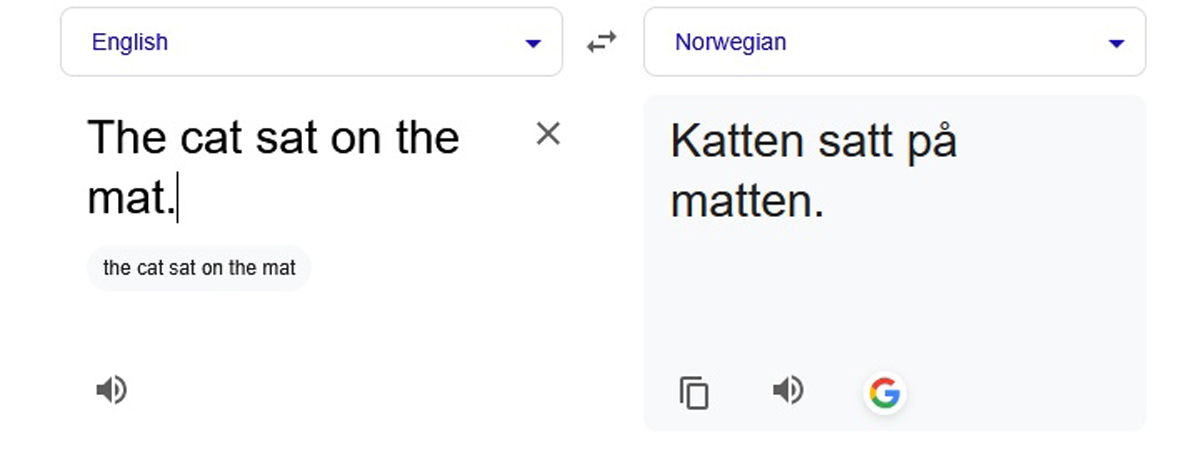
The borrowing of syntactic structure from other languages is certainly unusual, and it has raised ideas as to whether English is actually a hybrid language that is neither a direct descendant of Old English nor Old Norse, and thus exists as a creole. This is, however, a fringe theory. Whether true or not, the existence of this theory speaks to the massive impact that Old Norse had on English.
The borrowing of syntax, however unusual, is not strictly unique to English. It has happened before, and English is just one of the examples. Romanian has lexical, morphological, and syntactic influence from Slavic languages. Other languages in this geographical area, such as Bulgarian, Macedonian, Greek, and Albanian, have also undergone syntactic convergence. These languages together are known as the Balkan Sprachbund.
Another example is Maltese, a Semitic language, which has undergone syntactic change due to its proximity to Romance languages such as Italian and Sicilian. Its core syntactic features remain Semitic, yet it has syntactic features that are influenced by neighboring Romance languages.
Meanwhile, creoles exist all over the world in abundance. This is the simplification and mixing of two languages, and it would not be unusual for English to potentially be rooted in this dynamic. Of course, the admittance of this would ruffle feathers in the English-speaking world, as it would mean a significant blow to the language’s perceived prestige.
Further Evolution
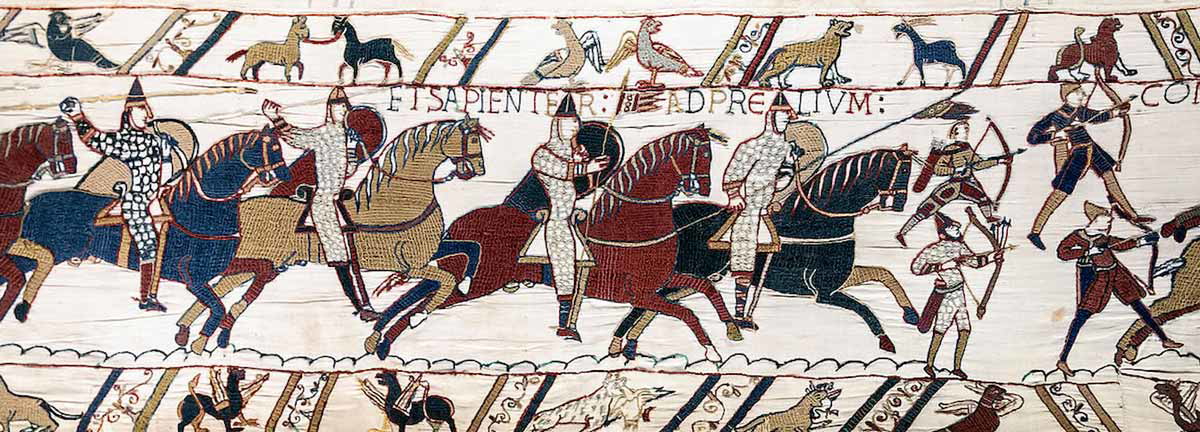
Of course, English didn’t stop evolving after the Viking Era. Massive changes happened in the centuries that followed as well. Of major note was the Norman conquest in 1066. The Normans were originally of Scandinavian descent but mixed with the French and adopted their language to form their unique dialect of Norman French. This language held sway in the noble class of England for some time, and diffused into the English spoken by the common people of England. This is why English has so many words of French origin.
As a result, Germanic words and French words existed side by side, with the same meanings. Often, one word’s meaning would change slightly given the context of its usage. Hence, the words “beef” and “pork,” both of French origin, are related to “cow” and “pig,” of Germanic origin. In French, “boeuf” (cognate with “beef”) and “porc” (cognate with “pork”) refer to the meat as well as the animal, a castrated ox or steer, and a pig, respectively. In England, the nobility, who spoke French, encountered the animal as meat on their plate, hence the slight differentiation in meaning.
As such, English evolved with incredible lexical diversity. England’s interest in the rest of the world (in a colonial fashion) also brought the language into close contact with other languages and increased lexical influences. Nevertheless, although debatable, it can be said that no language had as profound an effect on English as Old Norse.
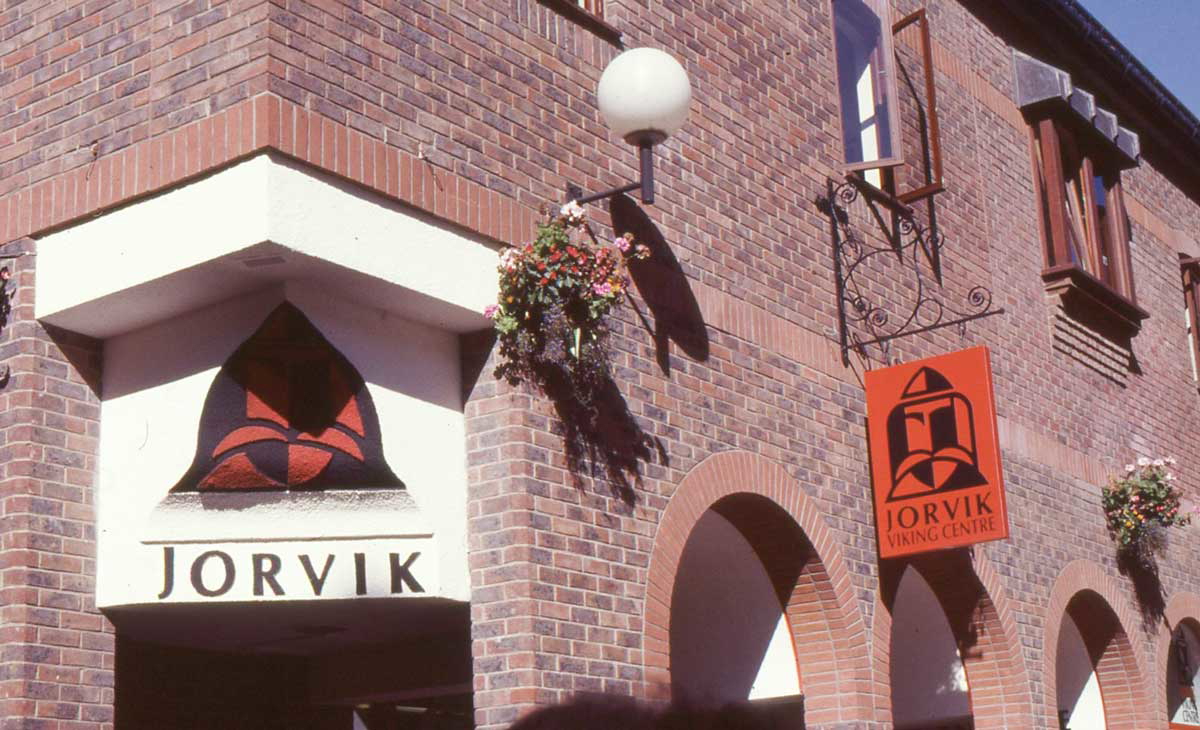
Languages are extremely dynamic tools that do not and cannot operate without the human element. They exist for communication and are shaped by the communicative needs of their speakers. English is certainly a prime example of these claims. The massive shifts that happened as a result of its contact with Old Norse form an indelible and pronounced part of the language as it is spoken today.
In fact, the impact was so significant that Norwegian is widely regarded as the easiest language for a native English speaker to learn!