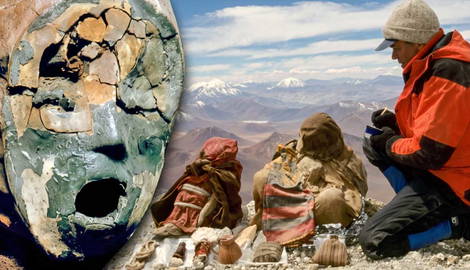

When people hear the word “mummies,” they immediately think of ancient Egypt. However, many cultures have practiced mummification and similar rituals for their dead over millennia, including the ancient peoples of modern-day Peru and Chile. The Inca unintentionally mummified some ritual sacrifices, while the lesser-known Chinchorro created the oldest artificial mummies in the world. Examinations of mummies from each culture have revealed how they lived and died, the process of mummification, and their historical importance.
South America’s Frozen Mountain Children

The Inca were among the most prominent of the pre-Columbian empires in the “New World,” occupying nearly the entire westernmost region of South America along the spine of the Andean mountains. It was within these mountains that they would carry out their sacred rituals, as mountain deities, or apus, featured prominently in Indigenous Andean beliefs. Mountain summits were the locations for the most important offerings of all: human sacrifices. It is thanks to the frigid air and the remoteness of these offerings that their graves remain as they were hundreds of years ago, despite frequent destruction of other graves of the period by Spanish conquistadores and modern-day looters.
On the summit of Llullaillaco, a 6,739m (22,110 ft) high volcano, three mummified Incan children were found in 1999 by anthropologist Johan Reinhard, making it the highest archaeological site in the world. The mummies included two girls and one boy, all sacrificed 500 years ago as part of the Inca ritual called capacocha. Not only were they remarkably well-preserved, but they were surrounded by dozens of other Incan artifacts intended as offerings as well. The mummies had been buried on a stone platform built over openings in the bedrock, placed in three separate chambers.
The Llullaillaco Maiden and the Capacocha Ritual

The most well-preserved (and oldest) of the three mummies is a 13-year-old girl dubbed the “Llullaillaco maiden.” She was found wearing a feathered headdress and draped in a tunic associated with Inca nobility. She still retains the same “sleepy” features she had when sacrificed 500 years ago, her long braided hair obscuring her face.
Chemical analyses of her hair revealed a significant change to her diet a year before her death, as she went from eating potatoes to protein-rich food and maize. This could indicate that she was selected as an aclla, a holy woman who served as a priestess to the sun god, Inti. It was also discovered that she had been drinking coca and alcohol, including the fermented corn drink chicha, for the previous year and had ingested enormous amounts of both in the weeks preceding her death. She even had a coca leaf still clenched between her teeth, suggesting she was chewing it before she died.
Sacred Death in the Andes

The other two mummies (a boy and girl) are both four to five years old. The girl is particularly remarkable, as she was found still intact despite appearing to have been hit by lightning at some point in time, earning her the name “Lightning Girl.” Her internal tissues and organs, including her heart and brain, are still well preserved despite the lightning having created a cavity in her chest. The boy was found bundled up with rope around his legs, with spare clothes placed next to him. Like the Llullaillaco Maiden, both were also found to have been well-fed during the final year of their lives and had been provided with good meals hours before they were sacrificed. But when compared to the Llullaillaco maiden, hair analysis of the young boy and girl showed they were ingesting significantly lower amounts of coca and alcohol in the weeks before their death, possibly because of their young age.
All three Llullaillaco children are believed to have been drugged before their sacrifice. In Inca rituals, coca and chicha were used to induce an altered state associated with the sacred. In turn, they also would have heavily sedated and disoriented the children as they undertook their pilgrimage to the top of the mountain. The ordeal of climbing the mountain would have undeniably led to exhaustion and possibly altitude sickness as well. It is believed that once the children reached the summit, they were placed in their respective chambers, fell asleep, and were simply left to freeze to death. Some scholars even believe that the Llullaillaco Boy may have died from altitude sickness before reaching the summit.
Learning from Accidental Mummies

The excavation and study of these child sacrifices provide important insights into the Inca civilization. According to Inca beliefs, a child chosen for sacrifice would have brought honor to their parents. The child would have been well-cared for and ensured an afterlife of bliss. The artifacts and clothing buried with them are elite and intricately made, further highlighting the extreme importance of these children and how the sacrifices were supported by the Inca at the highest levels of society. These sacrifices may also reveal how the Inca retained a level of control over the surrounding territories.
However, what makes these mummies so unique is the fact that the Inca did not purposely mummify them. Rather, the below-freezing temperatures of the mountain peak and its sheer remoteness turned these children into mummies, untouched for centuries. Thanks to their accidental mummification, they provide us with key insights into their lives and the Inca world they came from.
The Chinchorro, Ancient Fishermen

While the three Incan children may have been accidentally mummified, the Chinchorro mummies were not. The oldest known artificial mummies in the world belong to the Chinchorro, an ancient people that lived 7,000 years ago in present-day Peru and Chile. It is in the Atacama Desert where they purposely mummified their dead for 4,000 years.
The Chinchorro were not a stratified society; they were hunter-gatherers specializing in fishing and marine gathering. They lived along the Atacama Desert coast, stretching from Ilo in Peru to the south of Iquique in northern Chile. Some of their archaeological sites in the Arica and Parinacota Regions were declared a World Heritage Site by UNESCO in 2021.
Secrets of the Black and Red Mummies

In addition to being the oldest in the world, the Chinchorro mummies are remarkable for their sophistication. Their artificial mummification practices were technically skilled and visually appealing, revealing that these ancient peoples had an astonishing grasp of human anatomy. The dry environment of the Atacama Desert, in combination with the complex funerary rites of the Chinchorro, resulted in thorough preservation of these ancient mummies, enabling them to last for thousands of years.
The Chinchorro mummification process involved the use of pigments, clays, and reeds. Scholars divide the Chinchorro mummies into four types—black, red, bandaged, and mud-coated—each unique, both visually and materially. The black mummies are one of the most visually striking and are believed to be the oldest, with one dating back 6,600 years.
The beginning of their mummification process started with defleshing the body, including the scalp and hair. The bodies would be buried, then exhumed, and the bones cleaned of all remaining soft tissue. Their bones would then be reassembled with canes and ties to reinforce the skeleton. Then their body would be modeled with clay; adult mummies even had their genitalia modeled. Finally, they would re-cover the body with patches of skin—their own or an animal’s—and paint it in black manganese, hence the term “black mummy.” A short black wig and black mask were the finishing touches.

The red mummies of the Chinchorro are also visually striking. They appeared chronologically later than black mummies and were prepared differently. The body would first be disemboweled, the organs removed through careful incisions. The body cavities were then filled with different elements, such as soil and feathers. The stitched-up body would then be painted with red ochre, while the face was painted with black manganese. Unlike black mummies, red mummies have long black wigs with no mask covering their face.
The black and red mummification styles are the most elaborate of Chinchorro mummies. The bandaged mummies were a variant of the red mummy, with bandages replacing the skin. The mud-coated mummies were naturally dried bodies covered in a thick layer of mud and were the last phase of Chinchorro mummies.
Universal Grief and Sacred Heritage in Ancient South America

Something truly unique to Chinchorro mummification practices is that the oldest of the Chinchorro mummies are not high-status individuals but primarily infants, small children, and even fetuses. This suggests that these mortuary practices were born from parental grief rather than reflecting the social position of the deceased.
Regardless of the age or type of mummy, Chinchorro mummification practices are truly extraordinary. Unlike the famous mummies of Egypt, the Chinchorro did not have professional mummifiers or standardized procedures. For four millennia, bodies of the deceased were processed by individual families, combining anatomical knowledge with funerary traditions passed from generation to generation. Each Chinchorro mummy is therefore unique, highlighting how the Chinchorro truly mastered their own exceptional way of mummifying their dead.