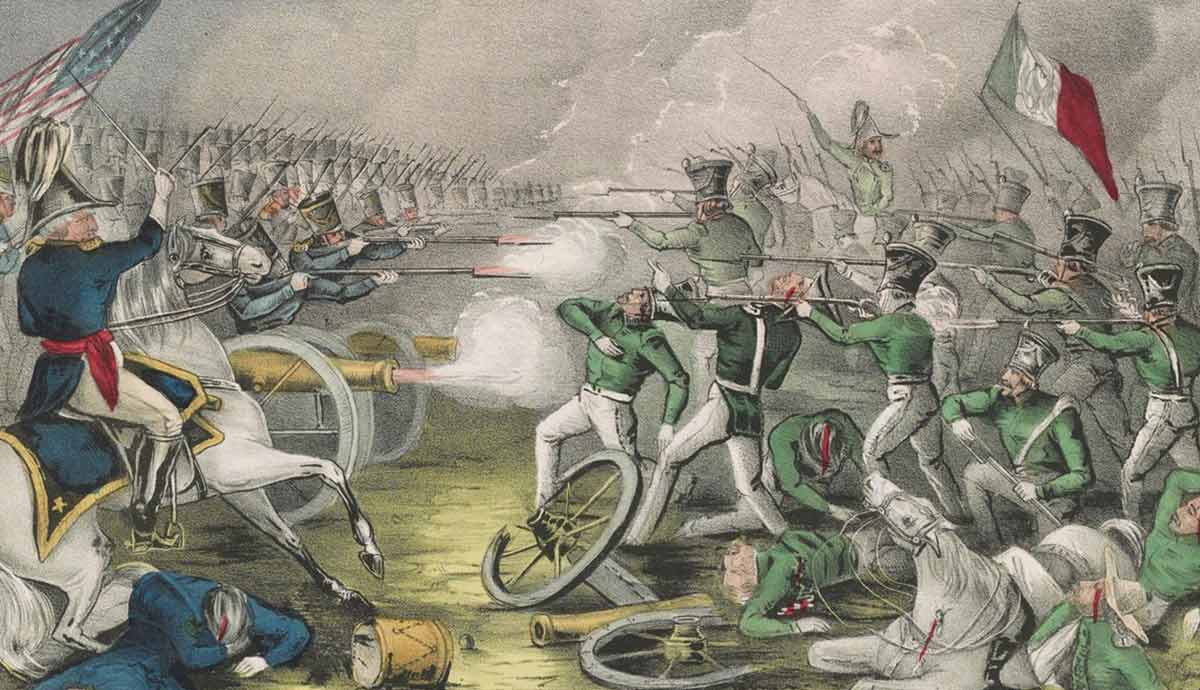

Less than 50 years after its birth, the newborn Mexican republic of the 19th century faced its greatest threat for survival: a war with the United States. At the same time, less than 100 years after its own founding, the promising young US faced a crucial opportunity that would require great sacrifices. Lasting from 1846 to 1848, the Mexican-American War was a deeply consequential event in the history of both nations. Mexico’s defeat sent the nation into spiraling chaos, while in the US, the war signified an opportunity for expansion and consolidation as a major power both in the Americas and the world. The Mexican-American War was and still is a controversial and sensitive topic in both countries. Nevertheless, it was also a consequential and fascinating affair, filled with nuance and open to further discovery.
The Violent Clash That Stripped Mexico of Half Its Territory

Before the war officially started, Mexico was already struggling, fighting rebellions throughout its vast territory and dealing with crippling political divisions. Amidst the chaos, several crucial blows were dealt to the newly independent nation. One was the Texas Revolution and its fight for sovereignty. Originally part of Mexico, the territory became populated by American settlers and immigrants, prompting a struggle for autonomy from a distant and largely ineffective authority. In 1835, the Texans rebelled. In 1842, they repelled a Mexican attempt to retake the land, and in 1845, the territory was finally annexed by the United States.
The Texas rebellion and annexation by the United States were the catalysts for a larger, bloodier conflict that ultimately led to Mexico losing more than half of its sovereign territory. Their loss was a boon to America’s expansionist wishes, however. The recently elected president, James K. Polk, had made his intentions clear: he hoped to expand the US further west, settling Oregon, California, and Texas in pursuit of the Manifest Destiny doctrine that dominated the American political psyche of the 19th century. By the conflict’s end, the United States had annexed what are today Arizona, California, Colorado, Nevada, New Mexico, Utah, and Wyoming.
Some describe the Mexican-American War as unjust and predatory on the US’s part, particularly considering how weak the Mexican nation was. Nevertheless, the territories captured by the Americans were largely neglected by the Mexican central government and were never truly a priority. Furthermore, the lands claimed by both countries were first inhabited and claimed by Indigenous populations that frequently battled both the US and Mexico, who viewed their claims as illegitimate.
A Training Ground for Future Civil War Enemies

The Mexican-American War was a deeply consequential conflict for a multitude of reasons, from those that are more historically significant, like the expansion of the US, to some smaller but equally transformative, like the thousands of Mexicans who suddenly found themselves part of the United States. But one often overlooked facet of the war was the involvement of numerous future leaders and public figures, namely, several men who would go on to play significant roles in the American Civil War.
Beyond already significant power players like General Winfield Scott, figures such as future general and president Ulysses S. Grant, as well as George Meade and George B. McClellan, participated in the Mexican-American War well before becoming leaders in the Union Army. Others, like future Generals Robert E. Lee, Thomas J. “Stonewall” Jackson, Braxton Bragg, and George Pickett, would go on to fight for the Confederacy. Still others did not participate in the fighting but saw the conflict shape their rise to greater leadership positions, like then-congressman from Illinois and future president of the United States, Abraham Lincoln. The Mexican-American War was a formative experience for all.
For Ulysses S. Grant, in particular, the war served as a real-life military training ground where he learned to command troops and gained combat experience, something impossible to obtain in the academy. Further, it shaped his general leadership style as well as his politics. Grant famously wrote about the war that he was “bitterly opposed to the measure” and considered it ”the most unjust ever waged by a stronger [nation] against a weaker nation.”
How Congressman Abraham Lincoln Challenged a War President

Although at the time American politics were dominated by expansionism and Manifest Destiny, primarily bringing the US into conflict with Native Americans as it sought to acquire their lands, the consensus for a war with Mexico was not absolute. There were a number of detractors, and support for the conflict was divided along party lines. The Democratic Party, led by President James K. Polk, supported the war, while the Whig Party, which controlled the House of Representatives, was opposed, going as far as to censure the US President for waging what they called an “unnecessary” and “unconstitutional” war.
Nevertheless, when it came to a vote, both the Senate and the House voted almost unanimously to go to war with Mexico. The Whigs voted in favor of war despite their doubts and opposition to the conflict. They believed that a lack of support for the war would mean political Armageddon for their party, similar to what happened to the Federalists in the War of 1812. Opposition to the war was not exclusive to the Whigs; some Democrats were also against it. The southern Democratic senator and slavery advocate, John C. Calhoun, opposed the war as he feared the annexation of new territory would stir up discussions about slavery and lead to more anti-slavery legislation being passed.
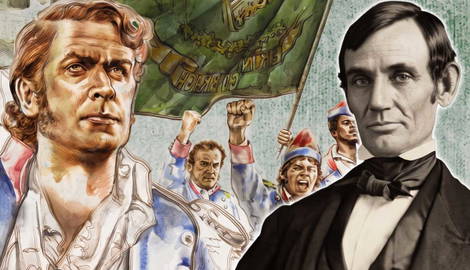
Perhaps the most adamant detractor was the freshman congressman from Illinois, Abraham Lincoln. In his “Spot Resolutions” presented to Congress, Lincoln made his case against the war. He sought the passage of eight resolutions investigating whether the war had truly been initiated as detailed by President Polk. The resolutions, however, were never adopted or even truly considered; instead, Lincoln was largely ignored, and Polk insisted that he waged a just war.
Why Irish Immigrants Defected to Fight for Mexico

At the beginning of the Mexican-American War, a group of European immigrants, primarily Irish, deserted the American Army and joined the Mexican side, forming a sort of foreign legion. They were called the Saint Patrick’s Battalion, in honor of Ireland’s patron saint, and were commonly referred to as the San Patricios. Though made up mainly of Irishmen who had fled the Irish Potato Famine, they included other nationalities as well. Most, if not all, were Catholic, sharing a faith with the Mexicans, which may have prompted them to switch sides.
Many possible reasons are given to explain why the San Patricios deserted the US Army, and it is impossible to say with absolute certainty what inspired the men, including those who were not Irish, to change sides. The letters of their leader John Riley and several field entries by senior officers point to their true motivations: a shared Catholic faith, sympathy for the Mexican cause, and the unjust nature of the war. Better financial compensation, which for poor immigrants was certainly important, may have also been a factor.
The Americans severely punished the San Patricios for treason. All in all, some 50 San Patricios were officially executed by the US Army. During the last offensive of the war, at the Battle of Chapultepec, 30 San Patricios were hanged by order of General Scott. He had instructed Colonel William Harney to hang the men at the precise moment when the American flag was raised at the Chapultepec Castle, with the San Patricios having full view of the Mexican defeat. The San Patricios continue to be remembered in Mexico, officially commemorated every September 12 but also celebrated each Saint Patrick’s Day.
The Heroic Myth and Realities of the Chapultepec Cadets

At the moment 30 San Patricios were hanged, a different legend was born. When the Americans reached Mexico City, the Mexican army prepared one last defense. General Winfield Scott led the American offensive, while the controversial Mexican figure, General Antonio Lopez de Santa Anna, led the defense. The Mexicans controlled Chapultepec Castle, a strategic location the US Army wanted to capture before attacking Mexico City. The Mexican defeat at Chapultepec gave way for the Americans to capture the capital and win the war.
It was there that a group of six military cadets gave their lives and became a myth within the collective Mexican imagination. The San Blas Battalion stood at the foot of the castle but, severely weakened by two days of bombardment, was ultimately defeated by the US Army. When the Americans advanced and reached the castle, they were welcomed by enemy fire from the small group of Mexican cadets, called into the battle as there were no other reserves. The military students, however, posed no real threat to the experienced American troops, who defeated them quickly and soundly.
The legend of Los Niños Héroes (The Heroic Boys) claims that before the Americans got hold of the Mexican flag and raised their own, one of the cadets took the Mexican flag, wrapped himself in it, and jumped from the heights of the castle so that no US soldier would defile the national symbol. Although the legend remains a powerful national myth in Mexico, the tale is largely untrue; the flag was captured by the Americans and then returned to Mexico many decades later.