In ancient times through to the present, war has been fought in many realms, from land to sea, and in the air. From the dawn of civilization, the ocean has played host to some of the most devastating engagements, where entire fleets clashed in an effort to gain supremacy. These salty battlefields heard the screams of sailors, the creaking and snapping of wood, and the crackling blazes of boats on fire.
From the whistle of arrows to the thunder of cannon, here is how naval warfare changed from triremes to galleons.
The Trireme and the Age of the Oar
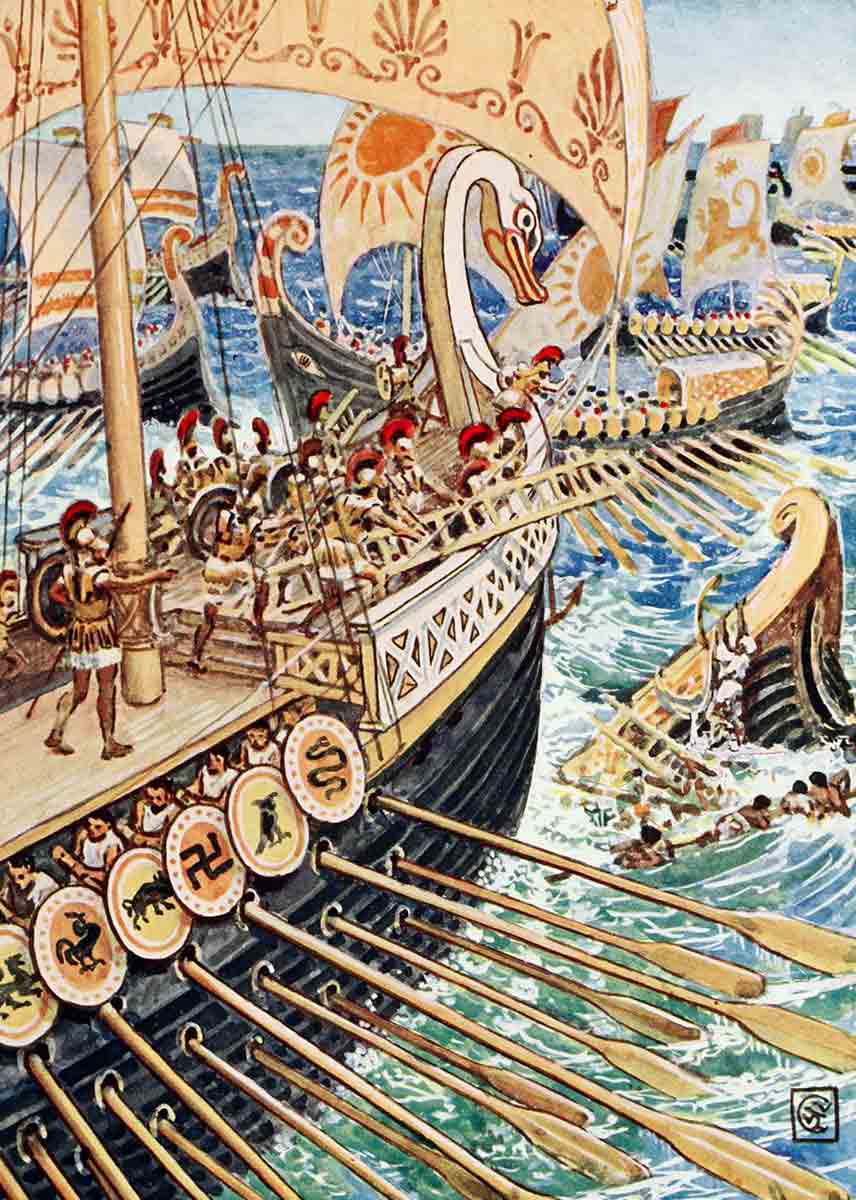
In the world of Greek antiquity, naval warfare was based on the design of sleek ships built for speed. Triremes, so named for their three banks of oars, were built of lightweight wood and were highly maneuverable. At their prow was a heavy bronze ram, designed to sink enemy ships by punching a hole below the waterline. The trireme evolved from the earlier pentekontor, which had fifty oars and room for cargo and passengers. The pentekontor’s main purpose was to ferry troops for coastal raids and boarding actions, while its ram came in useful if the opportunity arose.
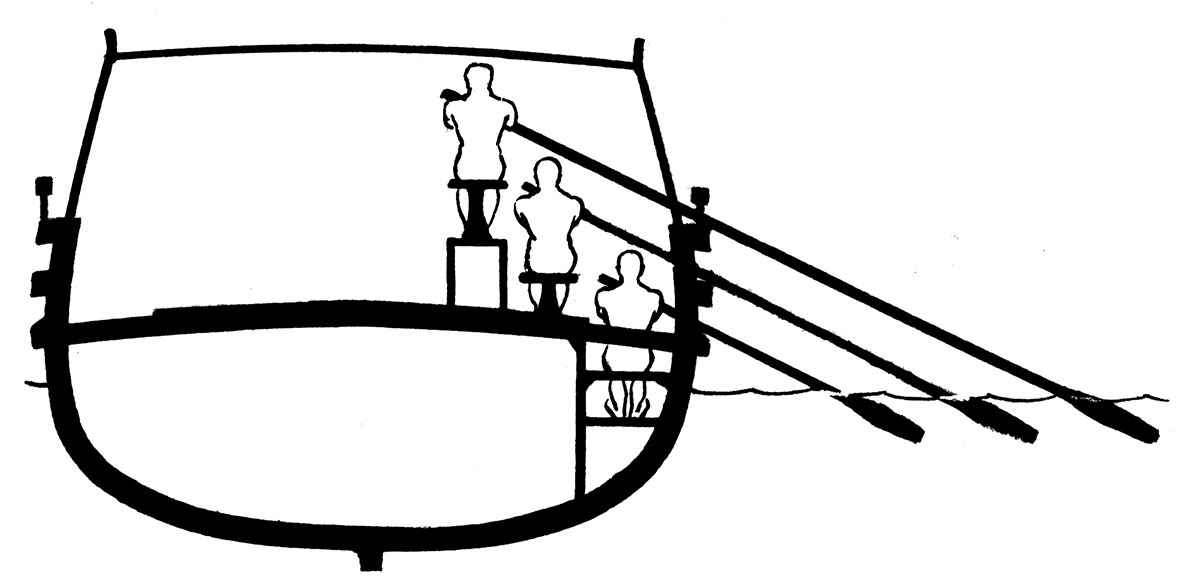
The bireme followed, with more oars, split into two banks, and reduced room for cargo, eventually followed by the trireme, with 170 oars, purpose-built for sinking enemy ships like a guided missile. Unlike the pentekontor and the bireme, the trireme’s main focus was its ram, and it was a ship purpose-built for combat rather than with any dual-purpose.
It is difficult to determine exactly where these ships originated, with some historians purporting the Egyptians or the Phoenicians to have invented them. It was the Greeks, however, who made these warships really famous. By the end of the sixth century BCE, Persia, the superpower of its day, was on its way to building a formidable navy and was able to field a massive fleet of triremes, providing impetus to Greek city-states to do the same if they wished to resist Persian expansion into the Aegean.
Administering massive fleets in battle required the skilled use of tactics on a grand scale. The Greeks employed two primary forms of attack called the diekplous and the periplous. The diekplous involved a column of ships in single file attempting to penetrate the enemy line. By sailing through the enemy line, ships would also attempt to plow into banks of enemy oars, snapping them, thus leaving enemy ships crippled. Once this was achieved, the attacker could then circle around and attack the enemy from the rear and the flanks. Periplous involved outflanking the enemy by line abreast, targeting the weak flanks, and attempting encirclement. Both tactics could be countered by employing the kiklos (cycle) or hedgehog formation, which involved forming a circle of ships that presented no weak flanks to the enemy.
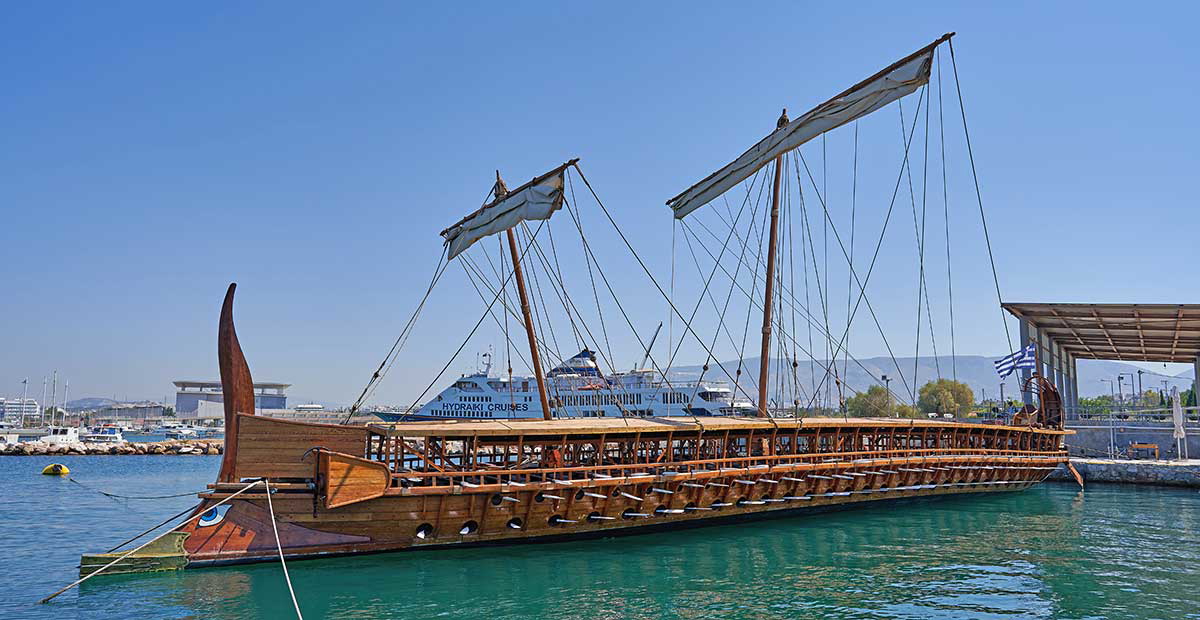
Of particular note during this era of naval warfare was the Battle of Salamis, which involved over a thousand ships, and where the Greeks soundly defeated the Persians, forcing the latter to abandon their campaign of conquering Greece.
During the Hellenistic era and the era of Rome’s primacy, triremes evolved to be bigger and more complex. The prefix on the names of these ships was determined by the number of rowers per vertical file or section. Quadremes (four), quinqueremes (five), hexaremes (six, etc.), septiremes, octereis, enneres, and deceres all sailed the Mediterranean. Even larger ships were built, but likely were not used in combat.
After the fall of Carthage, Rome’s dominance of the Mediterranean became apparent, and after the Battle of Actium, which neutered Greek and Egyptian power, Rome no longer needed a fleet that was intended for large-scale engagement. Larger ships, however, were kept on as flagships and troop transports, but the focus shifted back to smaller, more maneuverable vessels, like the liburna, for patrol and anti-piracy operations. The liburna was essentially a bireme galley, typically having 18 oars on each side.
Transition: Dromons and Cogs
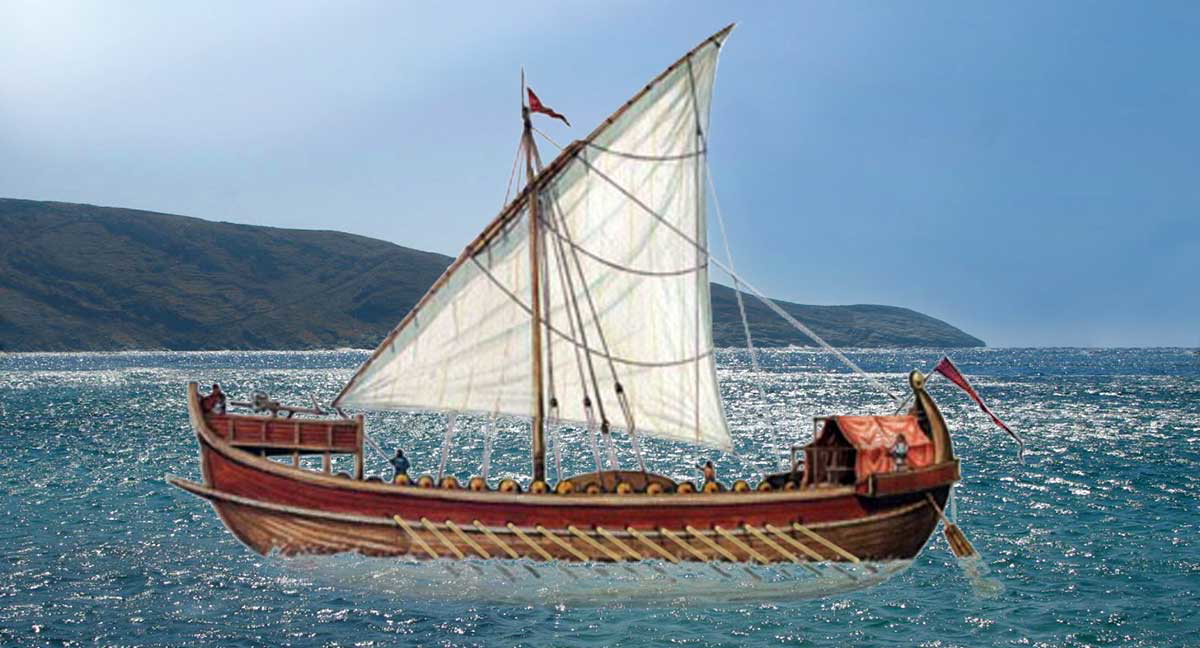
By the end of the ancient era, the dynamic of naval warfare was changing, spurred on by technological advancements that made the trireme and its direct descendants obsolete. Grappling hooks and boarding actions required more stable vessels, and ship design evolved to take this into account.
The dromon evolved out of the Roman liburna, and sported a full deck and a triangular or lateen sail. The ram was dispensed with, likely due to innovations that made ship hulls more resistant to ramming, but this was replaced with a spur, which was perfect for crushing oars, thus crippling the propulsion of enemy vessels.
A good example of dromons being used in combat was the siege of Thessaloniki, in which the Saracens besieged the Byzantine city from the water. They did this by lashing their dromons together and using the fore and aft castles as siege towers, assaulting the walls of the cities with troops, and hurling projectiles.
In other instances, the dromon served as the platform for the use of “Greek fire,” a combustible liquid that was essentially the predecessor to modern napalm, although the exact composition of Greek fire remains unknown. A siphon mounted on the front of Byzantine dromons acted as a flamethrower, engulfing enemy ships with sticky, burning fuel that was almost impossible to extinguish.
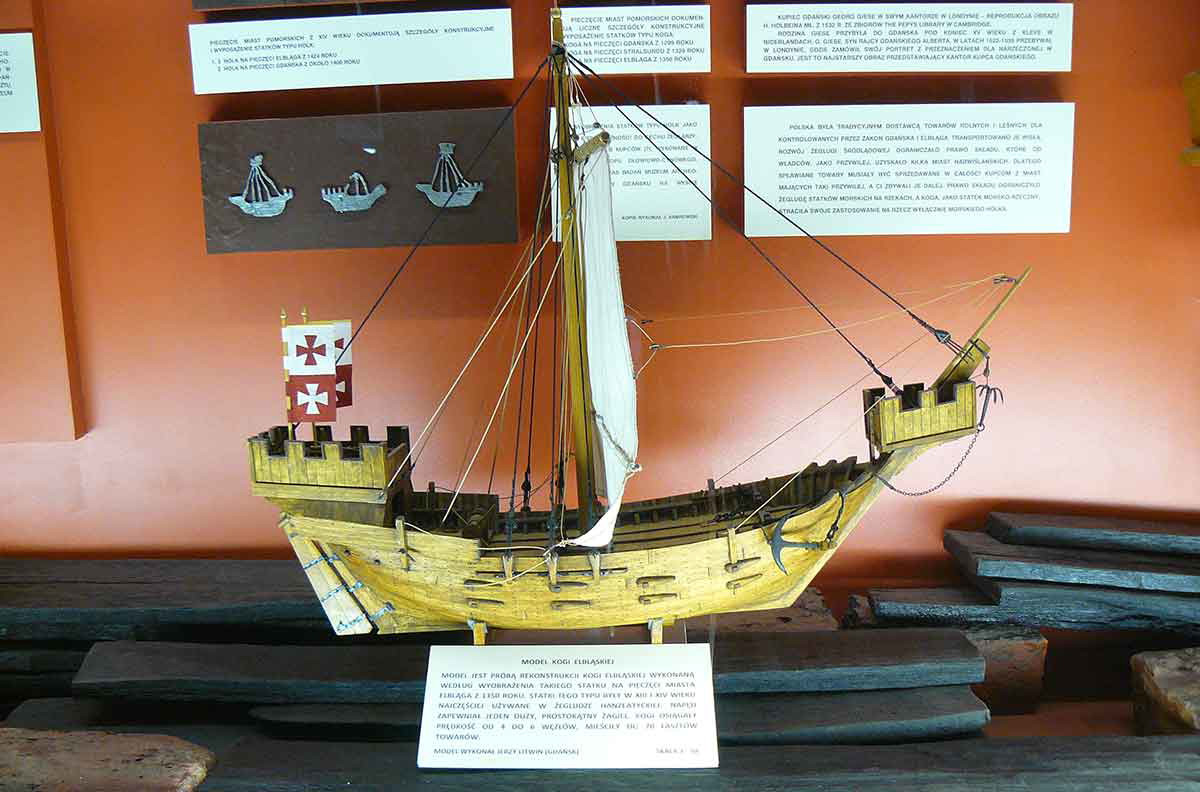
For trade and transport, round-hulled ships known as cogs were in widespread use. These vessels saw introduction around the 10th century in northern Europe. The primary purpose was as cargo ships, and these boats plied the waters of the North and Baltic seas. Naval combat was rare in this part of the world, and when needed, cogs could be outfitted with fore and aft castles to turn cogs into combat vessels. They evolved from Frisian trading craft similar to Viking knarrs with their flat-bottomed hulls, and were designed for use in shallow coastal waters, although they were quite capable of venturing further out into the sea.
Gunpowder: A Fundamental Shift in Naval Combat
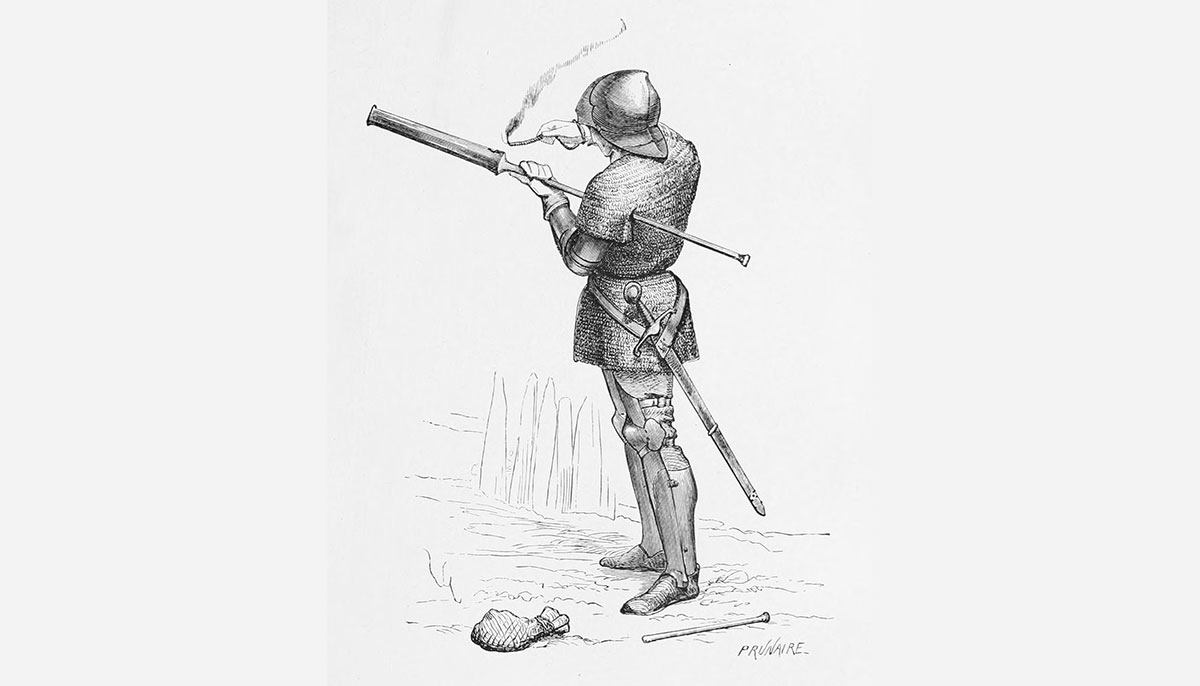
The introduction of gunpowder signaled a shift in military tactics not just on land but at sea, where it would have a devastating effect. Early usage of gunpowder on ships came in the form of breech-loading guns generally used for deck clearing rather than sinking enemy vessels. Early artillery found a place on cogs, as these ships were sturdy enough to carry primitive cannon as well as transport troops.
Evidence for this comes from 1338 in the Battle of Arnemuiden, in which the English fought against the French. The English cog Christopher mounted three cannon and a handgonne. Later in the century, cannon saw use in Asia during the Battle of Lake Poyang in China in 1363, and the Battle of Jinpo in 1380, in which the Koreans, armed with just 80 ships and equipped with cannon, defeated a Japanese pirate fleet of 500 ships.
Ship design thus evolved to take into account the need for cannon as they became the primary weapon through which naval action would take place. Initially, cannon were heavy and unreliable, and used mainly for demoralizing the enemy, but as technology improved, it became clear that the power they were capable of projecting was unmatched by any other ship-borne weapons. Eventually, warships became dedicated platforms, bristling with banks of cannon that could inflict incredible damage, not just on other vessels, but on shore defenses and settlements.
The Age of Sail
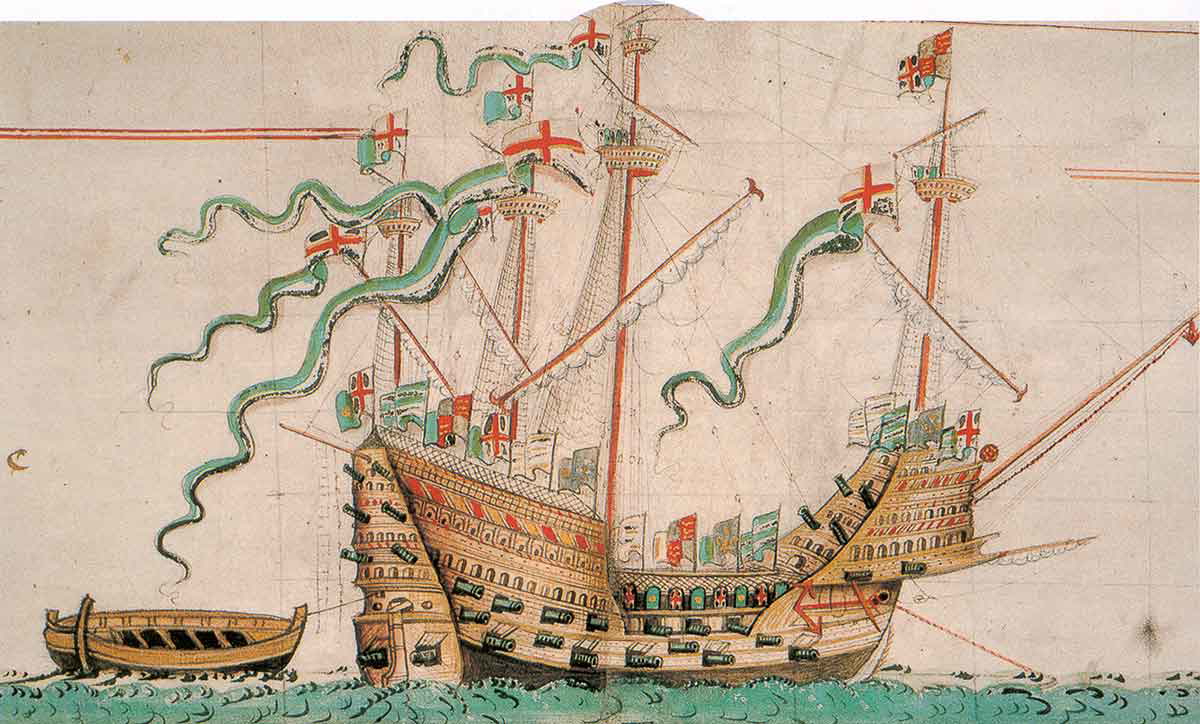
Originally, guns were mounted on the forecastle and sterncastle of warships, which aligned with the tactic of attacking head-on. They fired down at enemy ships, but their size and firepower made the ship top-heavy. This dynamic evolved quickly with more cannon being introduced to warships. To improve stability and to maximize damage, cannon placement was shifted over time, and placed lower down on the ships, and was done so in banks along the side.
Carracks were large ships designed as transport and cargo vessels. They were large enough to sport a significant number of cannon, and continued to evolve in form. Their descendant was the galleon. One of the most prominent carracks that exemplified this transition was the English Mary Rose, launched in 1511, and sunk in 1545 at the Battle of Solent, in action against the French. When it was sunk, the ship carried a total of 91 guns, including cannon and anti-personnel pieces—a clear indication of the evolution of the broadside tactic which would dominate naval tactics for centuries to come.
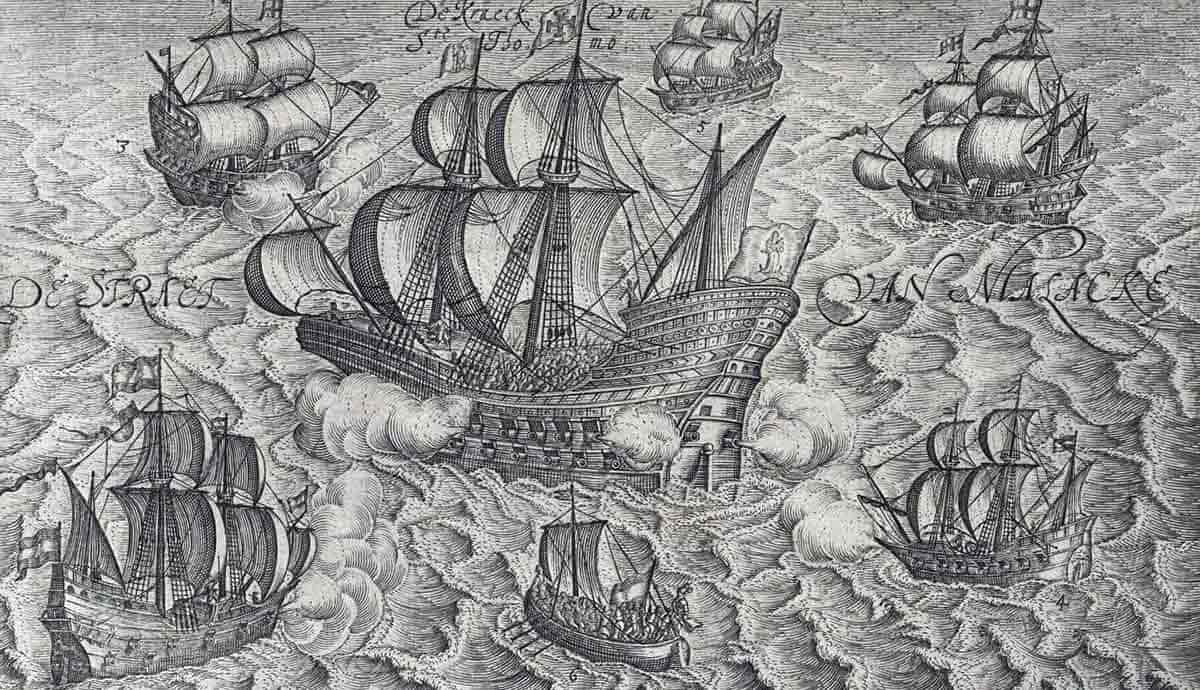
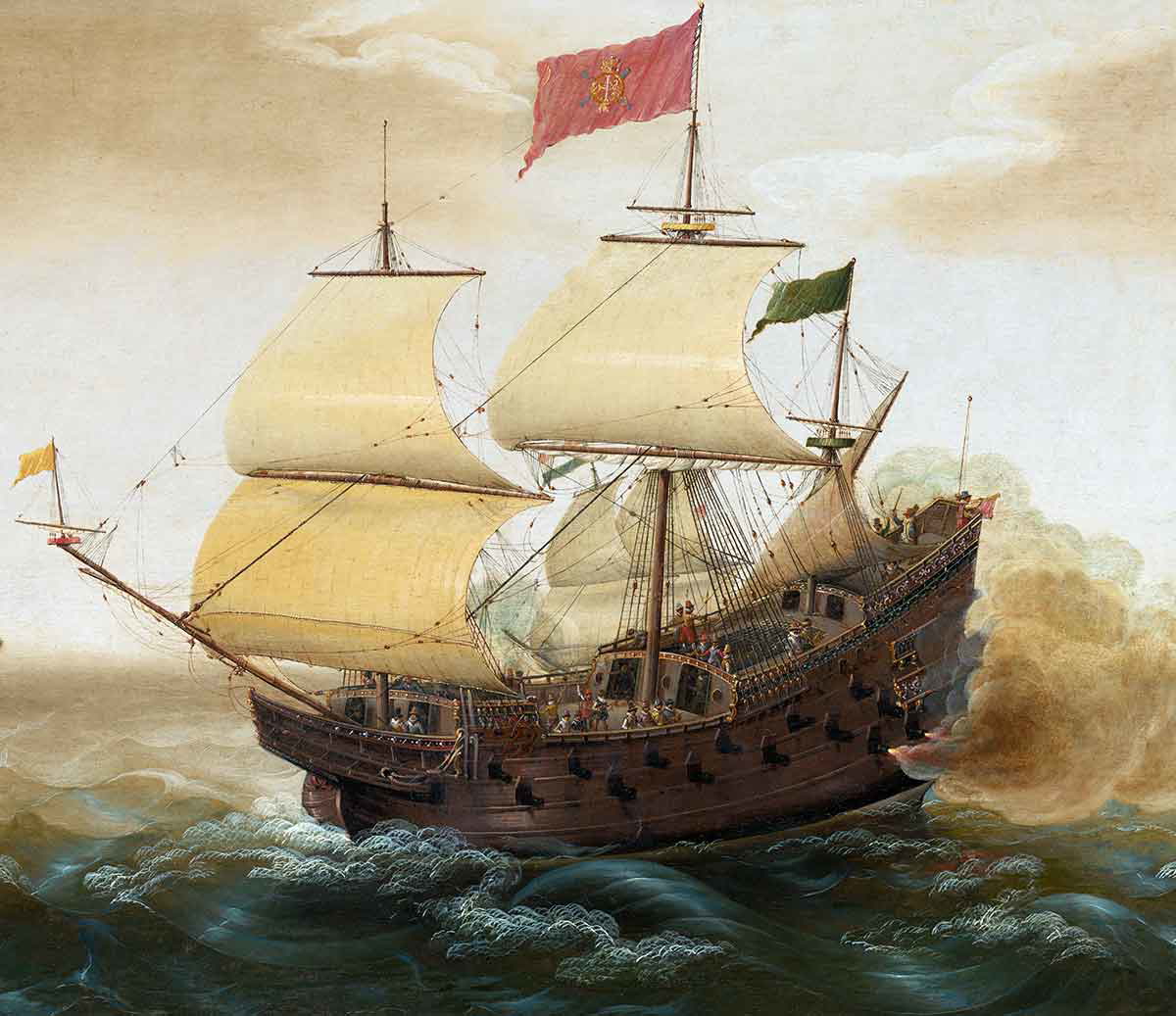
Developed in Spain and Portugal, galleons evolved from carracks and were large multi-decked ships designed for cargo transport and for war, although their primary focus was for combat. Their size meant they could carry many cannon, and they were pressed into service during the Age of Exploration from the 16th to the 17th centuries. They were also sleeker and more maneuverable than their carrack forebears.
During the age of sail, the broadside became the major tactic of naval combat. Ships presented their sides to the enemy vessels and opened fire with numerous cannon, creating a short and single attack that could cripple an enemy vessel in a single blow (if the ship was weak enough), but more often than not, the broadside was designed to weaken the enemy ship through successive waves of broadsides, smashing holes in the hull, ripping the sails and rigging, and causing casualties.
Whole fleets could form up in parallel lines and present volleys of broadsides, and thus naval combat evolved into an artillery duel in many contexts. Relying on broadside tactics meant that ships had to be mobile enough to pull off the maneuver, as well as evade enemy ships trying to do the same. Ramming and boarding gave way to long-range combat and strategic positioning. Being able to pull up right next to a ship, within grappling distance, and unleash a broadside at close range was a rare occasion, but when it did happen, it was completely devastating.
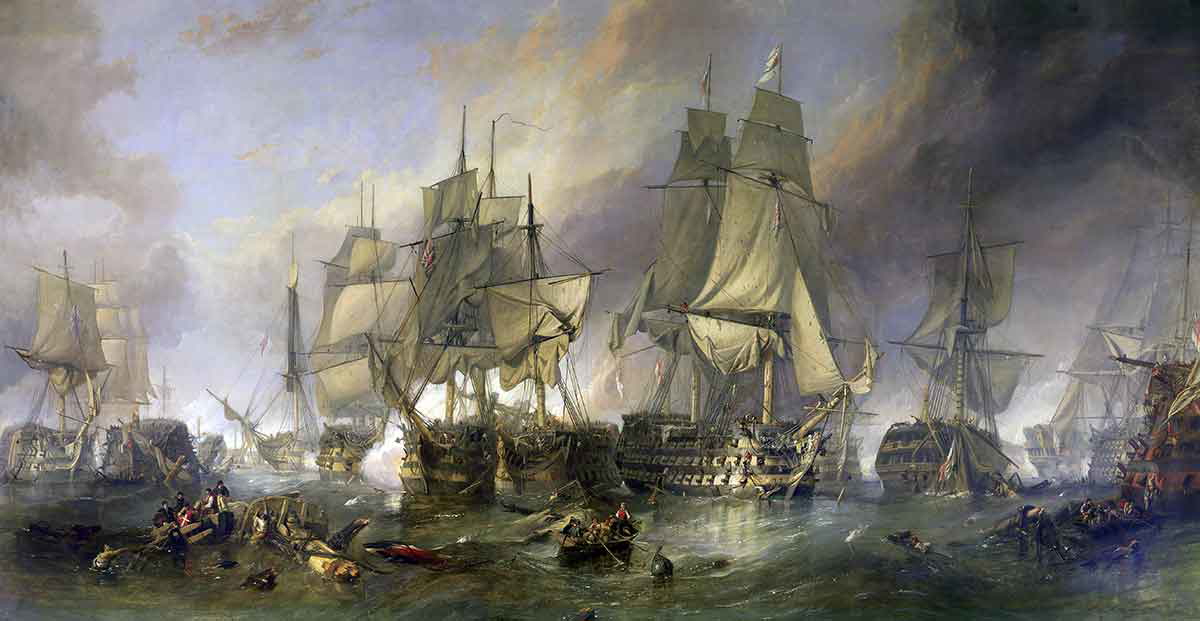
In 1805, the established tactics were changed from ships forming lines and pummeling each other with cannon. Outnumbered and outgunned, Admiral Nelson won a great victory for the British against the combined French and Spanish fleet at Trafalgar, with a tactic that was somewhat reminiscent of diekplous, although the weapons, the ship-to-ship combat, and the overall effect that was required had changed dramatically from the triremes that employed the strategy so effectively 2,000 years earlier. Instead of smashing oars (which were no longer present on boats), Nelson’s forces broke through the line at two places and cut the French and Spanish fleet in three, causing chaos and loss of cohesion. Nelson did away with the tactic of parallel lines pummeling each other with cannon, and instead “crossed the T,” a tactic which saw widespread adoption in the following decades.
For centuries, cannon broadsides were the hallmark of naval combat, but ship evolution and naval warfare did not stop evolving. Guns became more accurate. Wood gave rise to steel. Aircraft became a factor, and missiles, radar, and sonar were introduced, while submarines silently hunted their prey, all fundamentally changing how ship-to-ship combat was conducted.