In the heart of the northwestern Amazon rainforest, in a geographic region shared by Colombia and Brazil, the Yuruparí jaguar shamans are the most important spiritual and religious leaders of local Indigenous communities, grouped in a macrofamily called the Eastern Tukano people. Today, 200 of these communities are settled alongside the Vaupés River, the Pirá Paraná River, and their corresponding streams. These people comprise the Arapaso, Bará, Barasano, Desana, Karapana, Cubeo, Makuna, Mirita-Tapuya, Siriano, Tariana, Tukano, Makuna, Kotiria, Tatuyo, Taiwano and Yurutí communities.
The Cosmic Genesis of the Eastern Tukano Peoples

The region where the Eastern Tukano peoples are settled is also known as the macro territory of Yuruparí, which represents 37% of the total area of the Amazon rainforest. It covers 8.5 million acres that are home to 63 indigenous communities, 34 languages, and approximately 6,000 inhabitants.
Although there are social, cultural, and linguistic differences that distinguish one group from the other, all of the Eastern Tukano communities share similar means of subsistence, such as fishing and agriculture, with mandioca (cassava) as the primary food source. They generally reside in malocas, architectural living spaces that have a rounded base and a triangular roof with two openings, representing the structure of the cosmos. These communities also share similar rituals, dances, music, and instruments, which allow them to celebrate events among different communities that come together for economic and social exchanges.

Each group has distinct daily and ritual objects, including a specific set of Yuruparí flutes made of Paxiúba palm, representing their ancestors’ bones, sounds, and singing. These flutes represent both the mythological and actual ancestries of each community.
The common foundational myth among these communities centers on the ancestral anaconda, who penetrated the Universe (house) and swam up the Río Negro and the Vaupés River with all the ancestors of humanity inside its body, distributing them throughout territories along the river banks.
Inside the Sacred Science of the Jaguar Shamans

Among the communities of the Colombian Eastern Tukano, all men are expected to know the spiritual properties of nature and the mythical and cosmological structures of their society. Shamans are specific men among them who are believed to have special powers and esoteric knowledge. They are specialists who mediate among humans, animals, plants, spirits, objects, the natural environment, and climate phenomena.
Although most shamans are men, women’s abilities to menstruate and give birth are considered to be equivalent to shamanic male powers. This “natural” shamanic power explains why the original ancestors of these communities were created by a female figure.

Shamans, also known as payés, are experts in healing and in serving as intermediaries in the relationships between humans and animals. One of the most common ritualistic acts that these shamans direct is the blowing of tobacco smoke directly through the nose. This experience is known to be highly intense and powerful. In addition, their role as intermediaries between the terrestrial and spiritual worlds is often facilitated through the consumption of hallucinogenic substances such as yagé (a preparation made from the ayahuasca plant) and coca.
In local languages, these payés are known as yai, which means jaguar. Kumu shamans are another type of religious specialist, focusing more on the production and reproduction of mythologies and rituals. Their powers are the result of exhaustive training and practice throughout their lives. While the yai may be considered marginal in the community’s social structure, the kumu can achieve political importance.
Good vs. Evil and the Sacred Power of the Iconic Jaguar

As one of the most respected animals of the rainforest, the jaguar has widespread influence on the cultural lives of these communities. Historically, the jaguar has been identified as a mythological icon among communities throughout the American continent, including the Mayas and the Aztecs. These societies also venerated the jaguar, creating stone sculptures representing their mystical and sacred powers.
The jaguar played an essential role in the cultural development of the Amazon rainforest. Beliefs, myths, and ritualistic practices have developed around the jaguar, which is associated with natural phenomena like thunder, sun, moon, caves, mountains, and fire.
Anthropologists and archaeologists have widely recorded the association between shamans and jaguars and the assignment of mystical powers to these felines, known to be one of the most remarkable animal species of the Amazon rainforest. The figures of the shaman and the jaguar are considered interchangeable, a close relationship that suggests that their powers are similar, as is their role in nature and society.
The jaguar and the shaman represent both power and danger. Shamans can choose to wield their powers for good, by curing illness, for example, or for evil, causing chaos and death. The communities that venerate the figure of the jaguar believe that shamans can become jaguars at will or after death. In ceremonial events, the shamans dress in jaguar skins and necklaces made of jaguar teeth.
The Secret Yuruparí Flutes and Their Forbidden Sounds
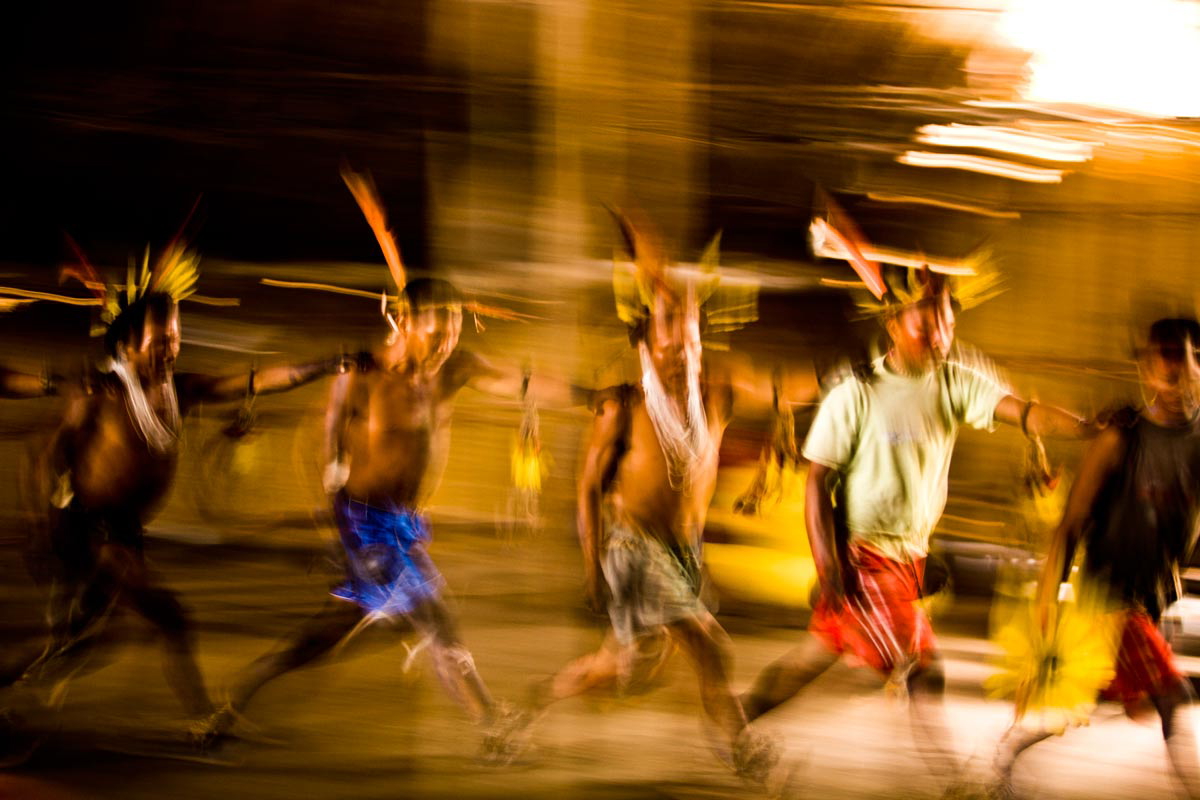
Kumu shamans specialize in the ritual of boys’ passage to adulthood, also known as the Yuruparí ritual. These rituals involve contact between living humans and the dead, known to be a dangerous practice that requires extreme care. Kumu shamans assume the role of protectors to ensure the correct execution of the ritual, which involves the appropriate use of the sacred flutes, also called the flutes of Yuruparí. This ritual has been recognized as the highest expression of religious belief in these communities, bringing together important cultural elements of ancestry, group identity, reproduction, the relationship between men and women, growth, death, regeneration, and the integration of the human life cycle with cosmological time.
When the sacred flutes of Yuruparí are played, the shaman establishes a direct connection with the bodies of the community’s ancestors, which the flutes represent. This process eliminates the separation between past and present or between the dead and the living.
The sacred flutes can only be played by men, reflecting a historical tension between women and men. The myth of Yuruparí claims that initially, it was women who controlled the flutes, while men were in charge of household duties and childcare, and were even capable of menstruating. This changed when men stole the flutes and inverted the gender-designated natural and societal roles.
Preserving Indigenous Culture Through Isolation

Today, the region where the Eastern Tukano communities reside serves as an excellent example of how social and geographic isolation have allowed the forest to preserve its natural and cultural richness. Reaching the malocas that still exist alongside the Pirá Paraná River, where the Eastern Tukano communities live, is difficult. One must travel to the small Colombian city of Mitú, in the middle of the rainforest. From there, the only transportation available is a small boat that takes a week to reach the malocas.
This region has historically been incredibly inaccessible, even during the massive rubber exploitation at the end of the 19th century, which attracted merchants and settlers from neighboring countries as well as Europe. Today, there are still research expeditions to record yet-unknown plant and animal species, facilitating contact between Indigenous communities and people from other regions of the world.
Social isolation has allowed the local Indigenous communities to preserve the myths and rituals surrounding the Yuruparí, with the jaguar shamans being the primary gatekeepers. In 2011, their knowledge was recognized by UNESCO and included on the Representative List of the World’s Intangible Cultural Heritage as the “Traditional knowledge of the jaguar shamans of Yuruparí.” Since the establishment of protections for Indigenous peoples’ beliefs and rituals, recognition of their knowledge as an essential pillar of the Amazon’s cultural, biological, and ecological importance for the world has become more widespread.
The beliefs and practices surrounding the Yuruparí are of great interest to people seeking to study and understand the Amazon rainforest’s mystical dimensions. The myth and practice have survived years of persecution, during which different colonial and economic powers have prioritized foreign interests at the expense of local communities. As with many other dimensions of the cultural life of Indigenous communities of the Amazon rainforest, the Yuruparí and its jaguar shamans offer deep wisdom regarding how different beings can inhabit the forest in balanced and reciprocal ways—knowledge that has great importance in contemporary times, when such natural environments are being damaged by commercial exploitation.