Tiziano Vecellio, who is remembered in the history of art as Titian, was born in the final decade of the 15th century in the Republic of Venice. His family was of privileged status, and thus, he had an opportunity to receive quality artistic education after discovering his initial interest in painting. He was a skilled and innovative artist who took a step away from strict religious dogma towards a more subjective and expressive artistic vision. Read on to get familiar with seven important works by Titian.
1. Titian’s Self-Portrait, 1567
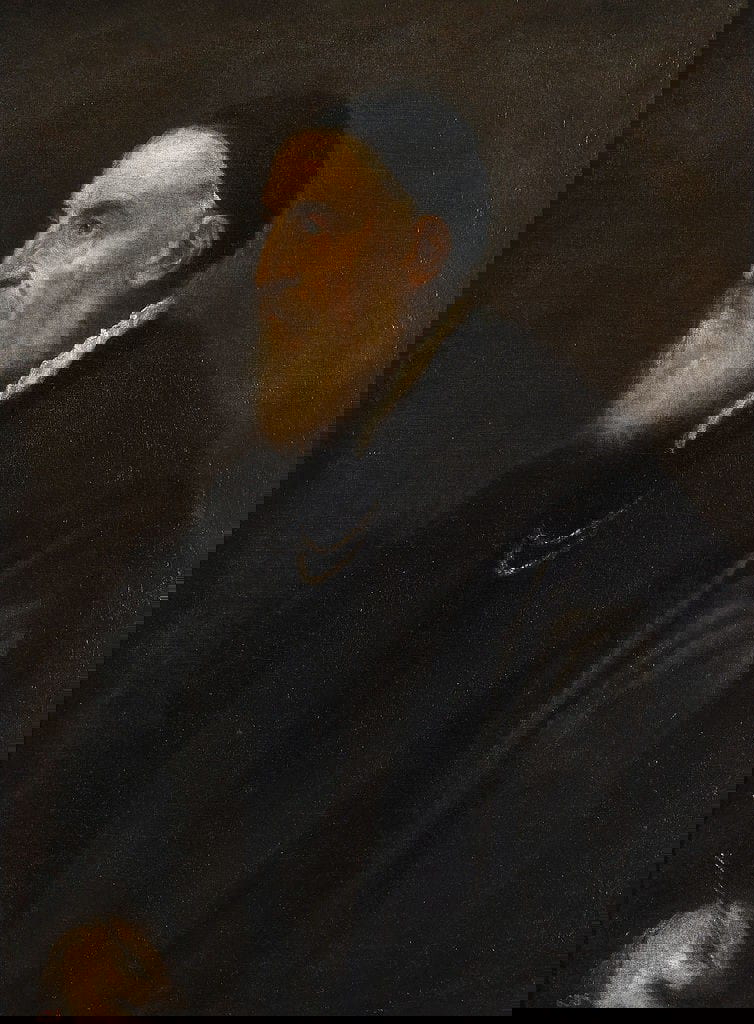
Both in his lifetime and today, Titian is regarded as one of the founders of the Venetian painting school and the Renaissance style of painting in general. Like many successful artists of his era, Titian was not only a gifted painter but also a hardworking and skilled businessman. He managed a large workshop with numerous apprentices and assistants. In a typical Renaissance workshop, the artist in charge of the workshop was directly involved only with the most expensive commissions. In many cases, the famous painter would paint only the faces of their models, leaving the figures and dresses to their numerous assistants, each of whom had a specific specialization.
Only two self-portraits of Titian have survived, and the 1557 version is the second one. At the time, the artist was in his seventies. Titian painted himself dressed in an expensive, yet modest black suit, positioning himself as a skilled and respected professional with no penchant for flashy gestures.
2. Assumption of the Virgin, 1518
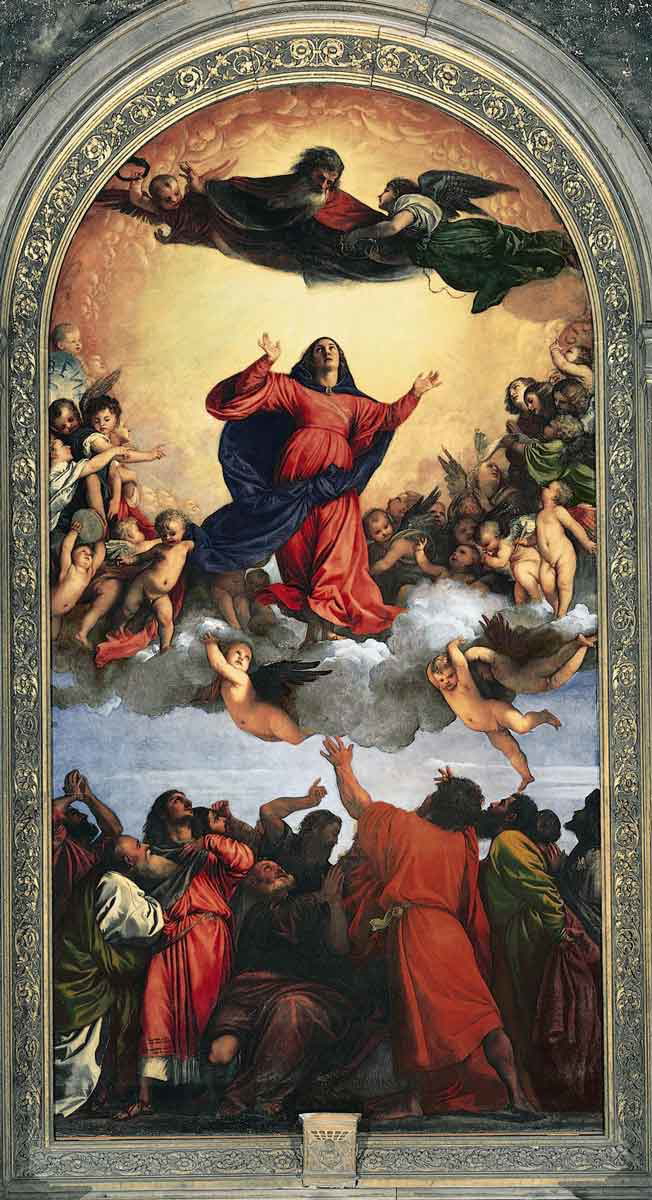
Assumption of the Virgin was one of Titian’s masterpieces, painted at the very beginning of his mature artistic period. It depicted the highly revered yet controversial scene from the Bible, the assumption of the Virgin Mary into Heaven. Unlike in Orthodox Christianity, in Catholic tradition, it is assumed that at the end of her life, the Virgin Mary was taken to Heaven entirely with her soul and body, without actually dying or being buried.
Titian’s Assumption of the Virgin was both an aesthetic and religious revolution of sorts. Many art historians view it as the first instance of an artwork diverging from official doctrine. Titian’s painting acted not as a passive expressive tool for religious doctrine, but as an emotional and aesthetic statement of its own. He added emotion and expression, which is atypical for traditional Assumption iconography. His Mary looked nervous and even slightly scared by her own fate, building an emotional connection to the viewers.
3. Sacred and Profane Love, 1514
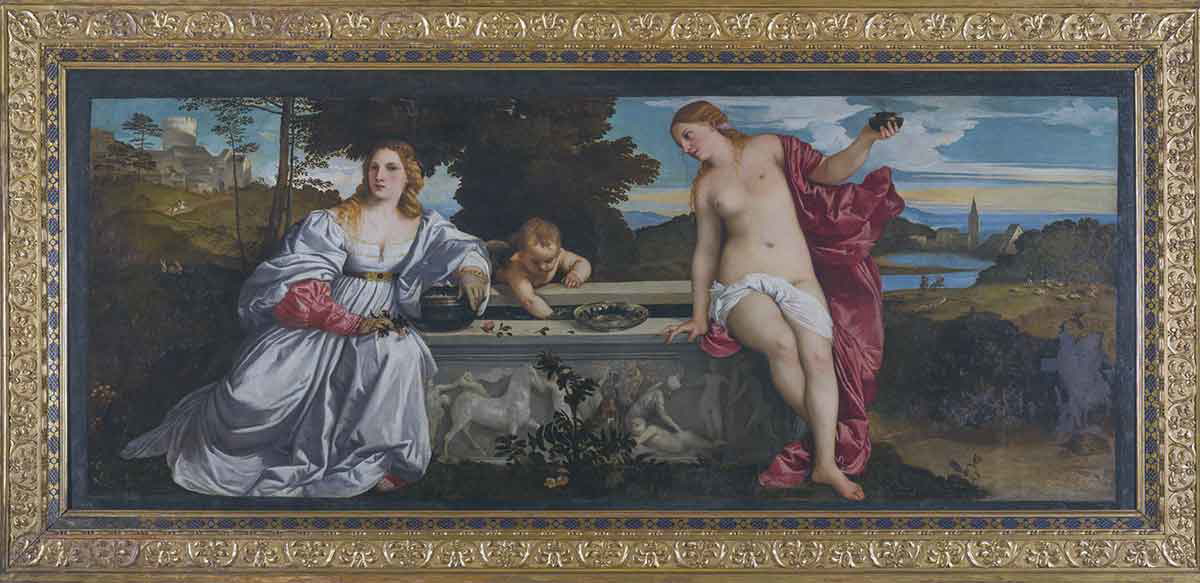
Sacred and Profane Love was a work from Titian’s early period that brought him recognition. The work was intended as a wedding gift from the husband, a wealthy and influential secretary of the Venetian government, to his new wife, a recently widowed woman from Padua. The painting was also likely a gesture intended to signify the long-awaited peace between the two families. The bride’s recently deceased husband was, in fact, executed by the Venetian government for treason. It is possible that the union was based not on genuine and sincere love, but on the desire to end the feud between the two clans.
Titian’s painting represented the two types of love: the sacred and pure, associated with beauty, philosophy, and wisdom, and the profane, related to physical desires. These two types of love were expected to coexist inside a successful union of a husband and a wife. The two figures painted by Titian as allegories of the sacred and profane love were most likely painted from the same model. The composition also incorporated numerous symbols of erotic desire and passion, such as the scene of hare-hunting in the background. Most art historians agree that the complex allegorical composition, filled with symbols, was designed by the commissioner, not Titian. The artist preferred more direct and simple subjects, choosing emotional intensity over allegorical depth.
4. Venus of Urbino, 1538
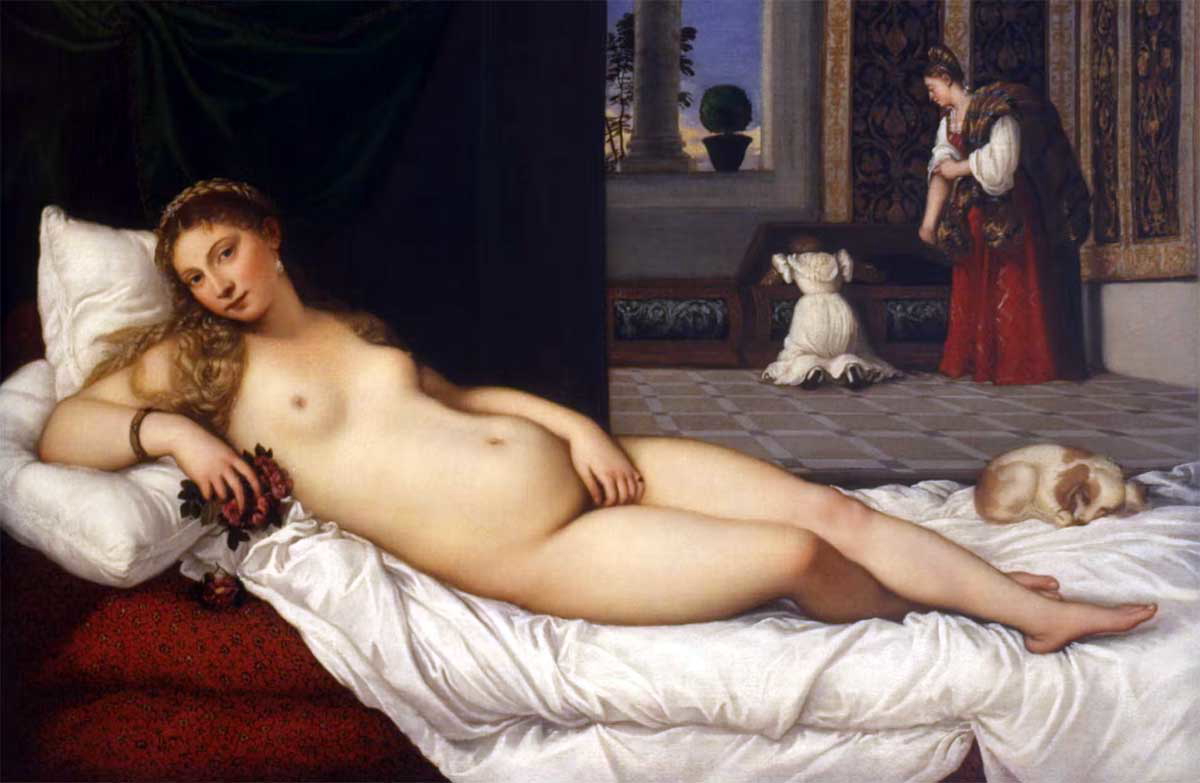
The Venus of Urbino is undoubtedly the most famous painting by Titian, which has been celebrated since its unveiling. Over the centuries, the painting has caused controversy and speculation, not least due to the position of Venus’s hand, which suggests not modesty but a playful, eroticized gesture. Despite the morals of Titian’s era, such a painting was not deemed scandalous, most likely because it was intended as a gift to a newlywed couple.
Venus of Urbino became the main inspiration for another iconic painting, the scandalous Olympia by Edouard Manet. Manet was known for borrowing compositions and figures’ positions from the Old Masters’ paintings, and particularly favored Titian. However, his version of Venus caused a wave of scandal that still forms the painting’s reputation. Instead of an allegory of spousal love and fertility, Manet painted a sex worker with her maid, staring intently at the viewer. The critics who first saw Olympia were appalled not just by the figure’s unmistakable position on the social ladder, but by her direct gaze devoid of shame. Olympia was revolutionary due to its radical approach to the dynamic between the painted body and the viewer, yet it had its roots in the revered painting from the Renaissance era.
5. Danaë and the Shower of Gold, 1544-60
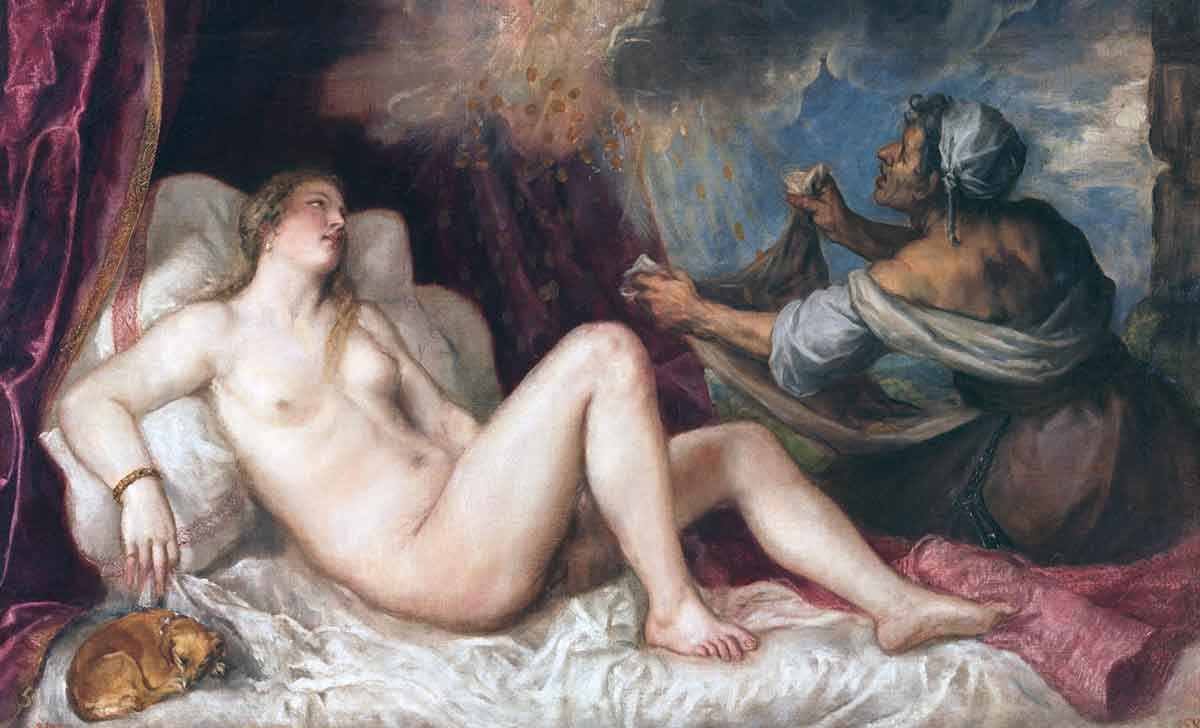
Titian was particularly known for his treatment of subjects from ancient Greek and Roman mythology. Apart from being treated as a pinnacle of Western culture and aesthetic harmony, these scenes allowed for nudity and sensuality that would be impossible in non-allegorical or non-mythological artworks. In the Renaissance era, nudity was seen as the natural state of human beings in its aesthetic and symbolic perfection.
The subject of Danae, the princess of Argos and the mother of hero Perseus, was favored by Titian, who painted it at least six times. Danae’s father, King Acrisius, heard an oracle’s prophecy that he would be killed by his daughter’s son. Willing to escape his fate, Acrisius locked Danae in a tower. However, the god Zeus, who notoriously struggled to manage his personal life, transformed himself into a cloud pouring golden rain. The rain leaked through the tower’s roof and left Danae pregnant with half-god Perseus. Titian enjoyed painting the stark contrast of lavish surroundings and isolation, the presence of gods, and the sensuality of a young woman.
In 1545, Michelangelo visited Titian’s studio and saw one of the versions of Danae. According to Giorgio Vasari, although Michelangelo praised the master’s use of color and tone, he nonetheless believed that Titian did not have a perfect understanding of composition for such a complex work.
6. Pesaro Madonna, 1519-26

The famous Pesaro Madonna was a painting commissioned by the wealthy Pesaro family for their private altar in the Venetian Basilica di Santa Maria Gloriosa dei Frari. The multi-figured image featured the Pesaro family members kneeling on the right side of the panel, alongside Saint Francis of Assisi, the infant Jesus, and the Virgin Mary. Titian broke the traditional rules of altarpiece composition: instead of positioning the figures of the Virgin and Jesus in the center, he shifted them to the side, giving dynamism and complexity to the scene.
Instead of hiring a model for the Virgin, Titian relied on the help of his wife, Cecilia Soldano. For years, Cecilia was Titian’s mistress and housekeeper, who gave birth to two children out of wedlock. After Cecilia nearly died from an illness, the artist finally decided to marry her, mostly to financially and socially protect their children. By all accounts, the marriage was a happy one, but it did not last long. In 1530, just a few years after Titian finished his Pesaro Madonna, Cecilia passed away.
7. Allegory of Age Governed by Prudence by Titian
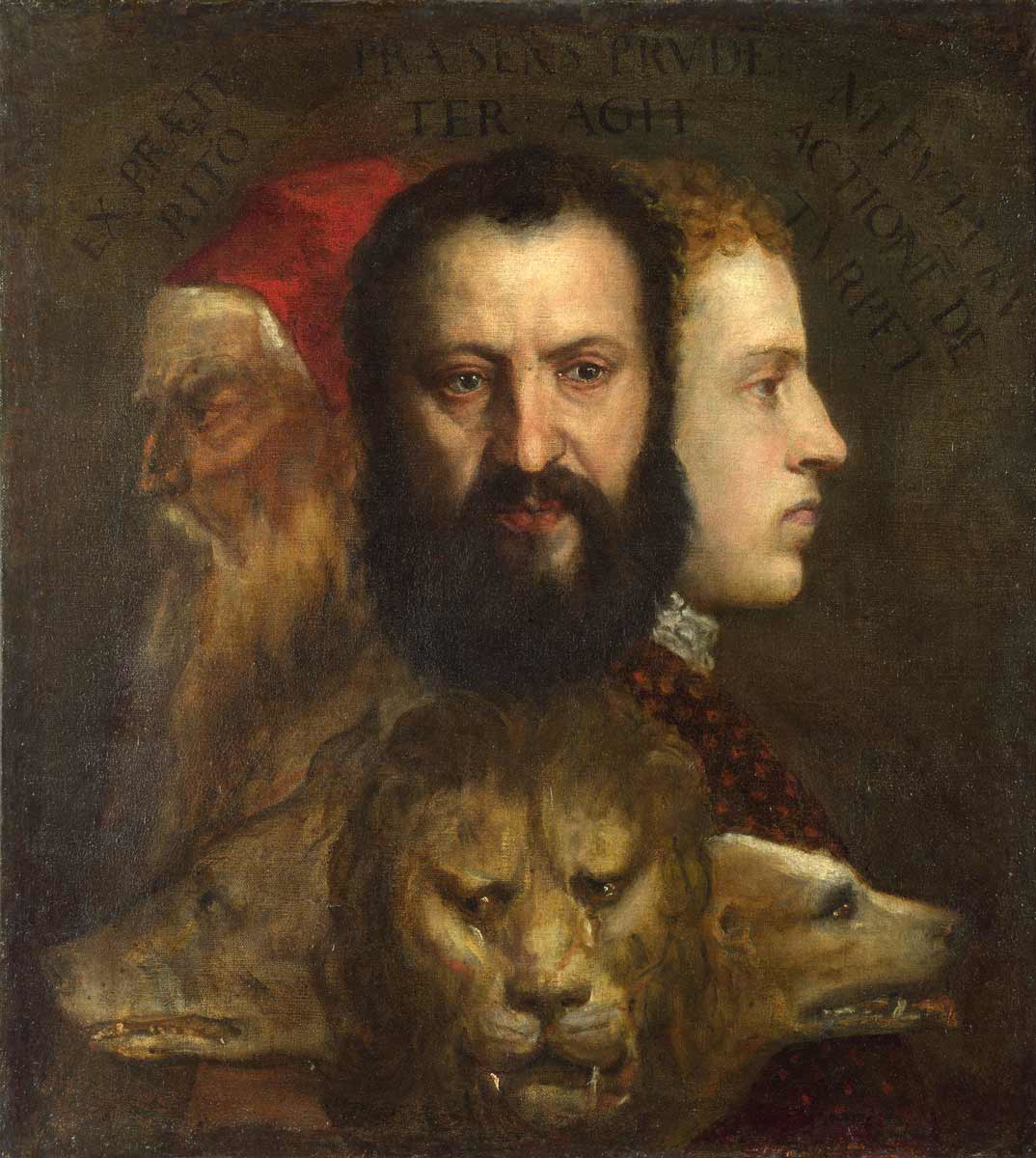
The strangest yet one of the most famous works by Titian featured six heads: three of humans, and one each of a dog, a lion, and a wolf. The composition seems almost Surrealist, and does not seem to make sense at first. However, this work was a rather direct yet deeply personal allegory. The human heads represented youth, maturity, and old age, as well as the past, present, and future. They were also modeled from Titian’s young nephew Marco, his son Orazio, and the artist himself, respectively. Both Marco and Orazio were employed as Titian’s assistants and were supposed to continue his business. The most common interpretation of the painting explains it as Titian’s instruction to the younger generation to value the experience of the past and learn from his mistakes and deeds.