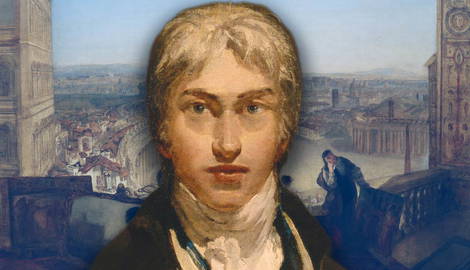
JMW Turner’s Romantic paintings have gone down in art history as a lifelong revolutionary project. Yet, a visit to Rome in 1818 inspired one of his most complex images, which paid tribute to the Renaissance master Raphael. This enormous canvas honors several teachings from the classical canon of art. At the same time, Turner’s image evinces a tension with that canon, and his irrepressible need to innovate.
JMW Turner’s Reputation

The artistic reputation of Joseph Mallord William Turner (1775-1851) is assured as one of the pioneers of Romanticism in painting. His art came to be synonymous with the painting of dramatic light effects—of shipwrecks, the vortices of stormy seas, and sublime sunrises. So much was this his concern that his exploration of light later on verged on an abstraction that would not develop in art until the early 20th century. Hence, the justified modern perception of Turner as a revolutionary within his field.
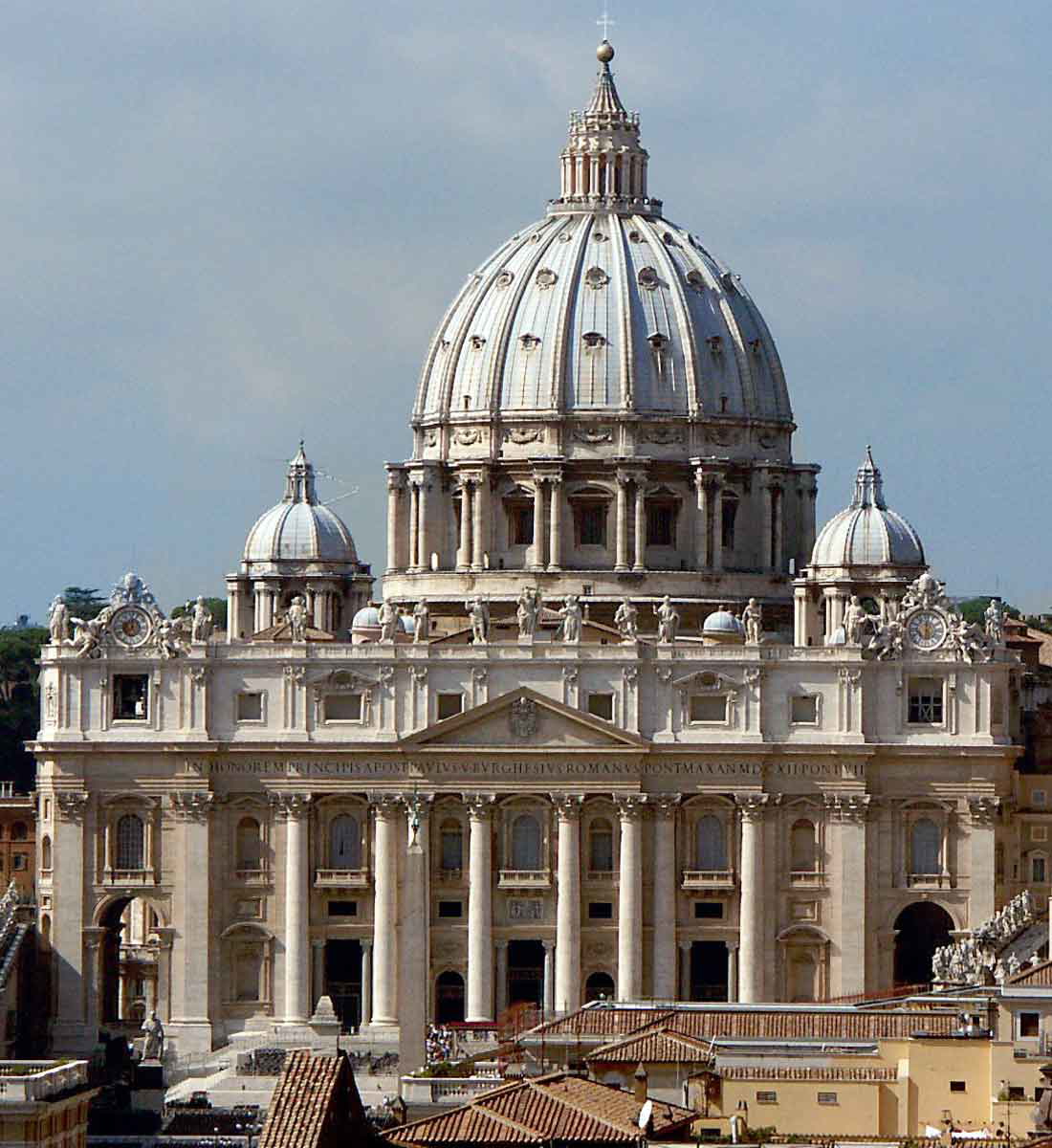
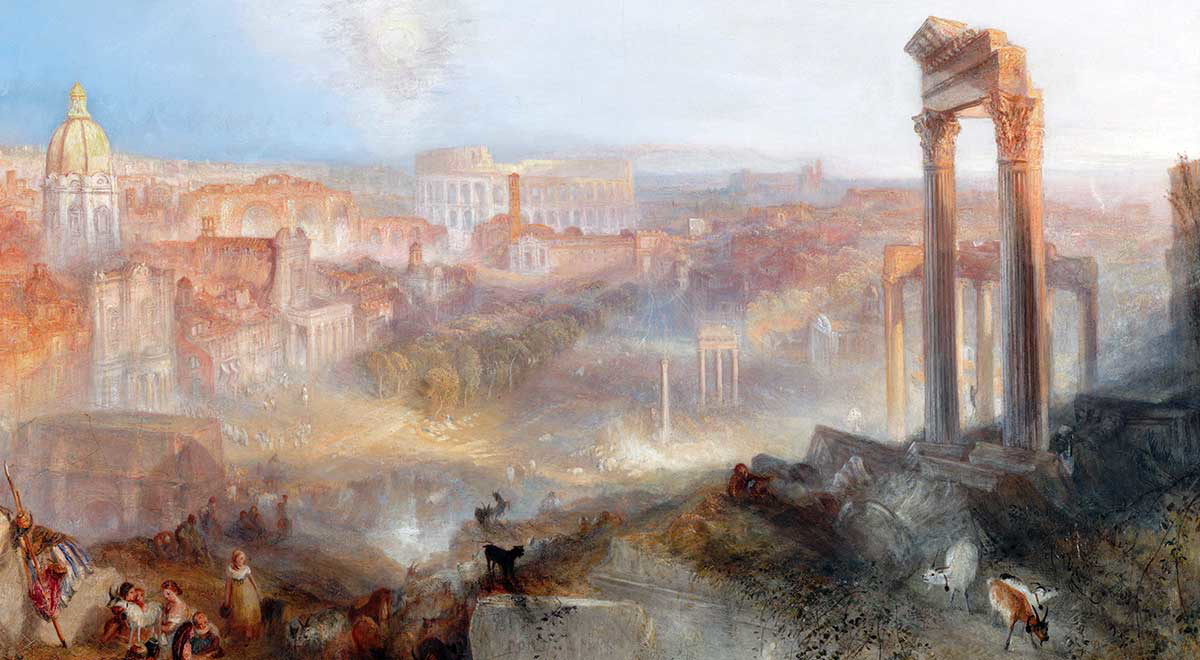
However, this modern account is not the whole story, despite the fact that this Romantic Turner became the entire “Turner.” In 1818, the painter made a pilgrimage that in itself points to the influence of tradition on him, particularly the classical tradition. He went to Italy to study the artworks and monuments of the Renaissance and antiquity. While in Rome especially, Turner felt at home—there he made about 1,500 sketches and watercolors, mostly on the spot rather than in his studio.
On his return to England in 1820, Turner painted a huge image that would seem to encapsulate a tribute to classical artists of the Renaissance, his own relationship with Rome, and his relationship with the tradition which he so admired and would innovate beyond. Rome from the Vatican. Raffaelle, Accompanied by La Fornarina, Preparing his Pictures for the Decoration of the Loggia, more than any other image in Turner’s oeuvre, is evidence of his wish for status within the classical tradition. Yet, it also evinces his own unquenchable will to innovation. The picture defies categorization by genre or the strict boundaries of a school. It is an intensely personal tribute to a tradition which could not contain his art, and to the city that for artists of the early 19th century most embodied that tradition. As one scholar has put it, Turner was “as devoted to the artistic tradition as he was to formal innovation.”
Reception of View of Rome From the Vatican
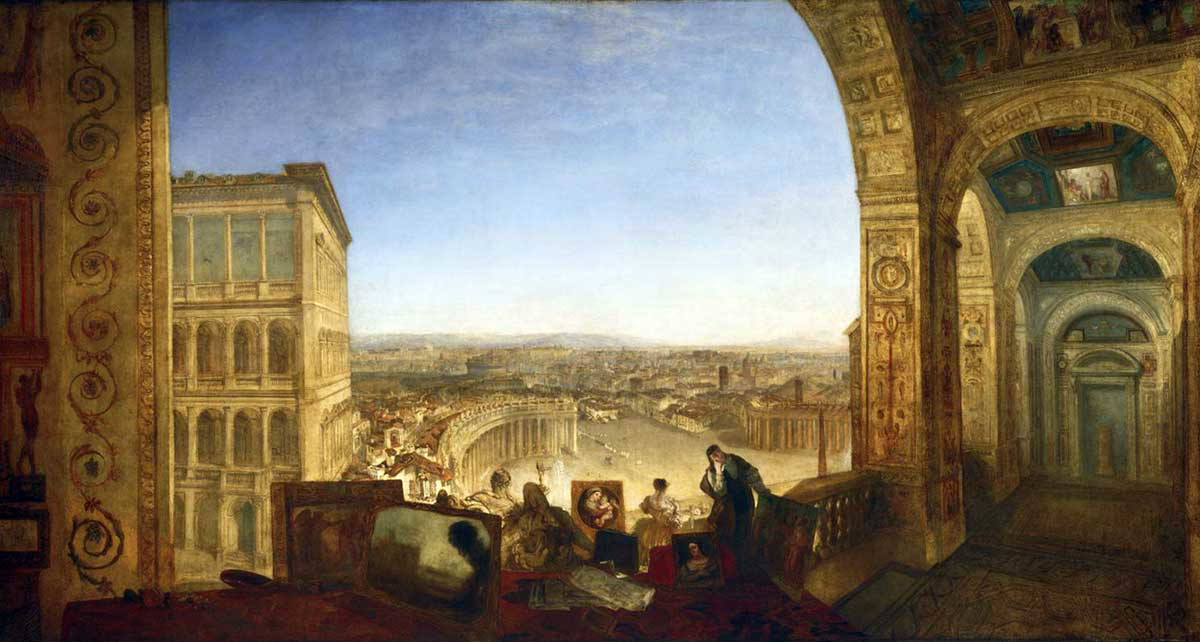
Art historian Gerald Finley has noted that the View of Rome canvas was Turner’s first history painting, and a symbolic treatment of the artist’s views on history and art. The contemporary reception of the work in 1820 was divided. One applauded that it was all of a piece with the “magical effects, the clear and natural atmosphere, and the glorious lights which give such a beauty and a charm to all his compositions.” On the other hand, another was to write that, before his Roman sojourn, Turner was “natural, simple and effective,” while subsequently “artificial, glaring and affected.”
Contemporary scholarship has been kinder than the latter review. In addition to Turner’s acclaimed mastery of light and atmosphere, scholars have uncovered deeper iconographic and structural significance that bolsters the artist’s tribute to Raphael and exemplifies his respect for the classical tradition on his own terms.
Idealization
Ostensibly, the subject of Turner’s painting is the status of Raphael as artist-genius. Yet, the view in the painting is Turner’s. The city is filtered through Turner’s artistic sensibility also. The image is not done in the style of Raphael, and Turner was a noted copyist of, for example, the pacific landscapes of Claude Lorrain, and would have been capable of a stylistic tribute. View of Rome is clearly not of the later Turner either. The painting is not yet exclusively “for the eye.” It is replete with iconography, an assemblage that demands readerly interpretation.
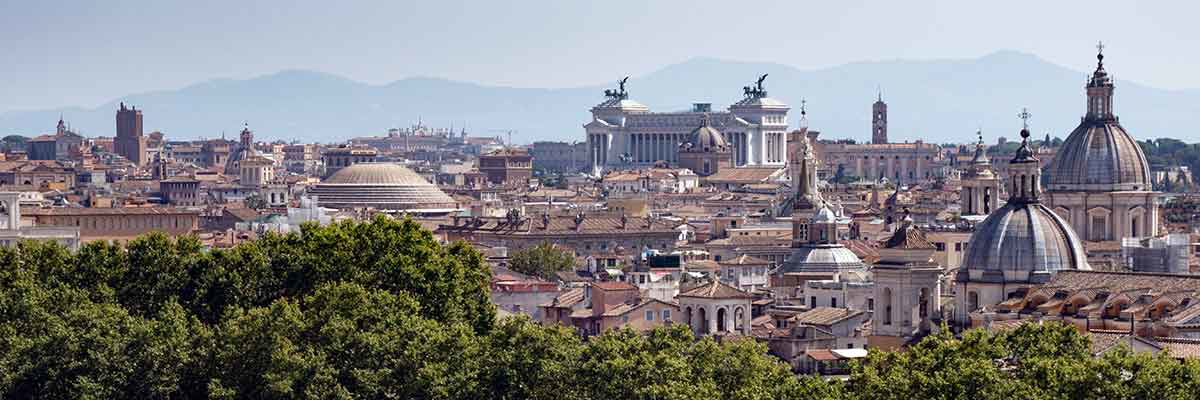
In a letter recommending that Turner make a visit to Rome, his friend Thomas Lawrence, while there, wrote: “the subtle harmony of this atmosphere, that wraps everything in its own milky sweetness…can only be rendered, according to my belief, by the beauty of [Turner’s] tones.” The “milky sweetness” in question is especially in evidence in Turner’s canvas’s interaction of color and light between the sky and the piazza of the middle distance and along the bays of the loggia to the right, giving the effect of a golden haze. This effect could equally be characterized as true to nature or as idealization.
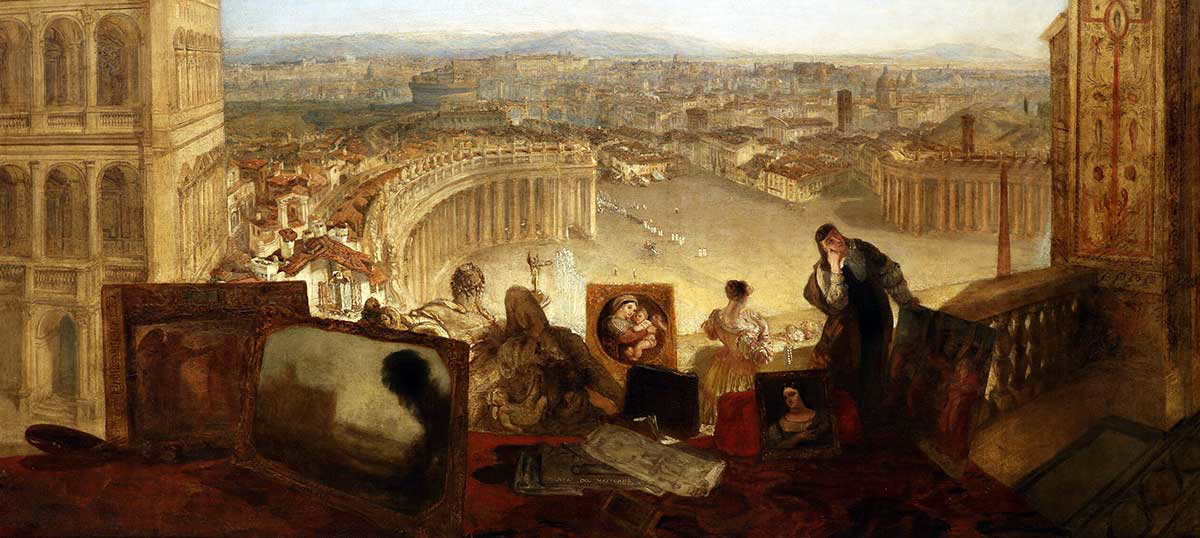
Either way, it caters to the classical ideal of a perfected and serene beauty. Yet, Turner achieves this through color and light. The classical stipulation of beauty had traditionally applied to the drawn form, especially the human form. But both of Turner’s opportunities for painting a perfected figure are refused by him in the painting. The forms of both Raphael and his lover and muse, the Fornarina, are diminutive in the composition when contrasted with the huge scale of the vista and the foreground vaults. The Fornarina, in particular, is more distant from us than Raphael. With her back turned, she looks out over the Roman cityscape and is an active spectator herself, rather than a mute embodiment of classical beauty.
Raphael holds in his hand his Building of the Ark and looks up reflectively at the Sacrifice of Noah. Turner has clearly identified his hero with the biblical patriarch, and not just as a literal architect: as Noah built his vessel, Raphael builds his compositions, which in turn proved to be central to the subsequently constructed European post-Renaissance artistic canon. Raphael was both a foundational figure of enormous influence by Turner’s time and the transmitter of the ideals of a spiritual classicism.
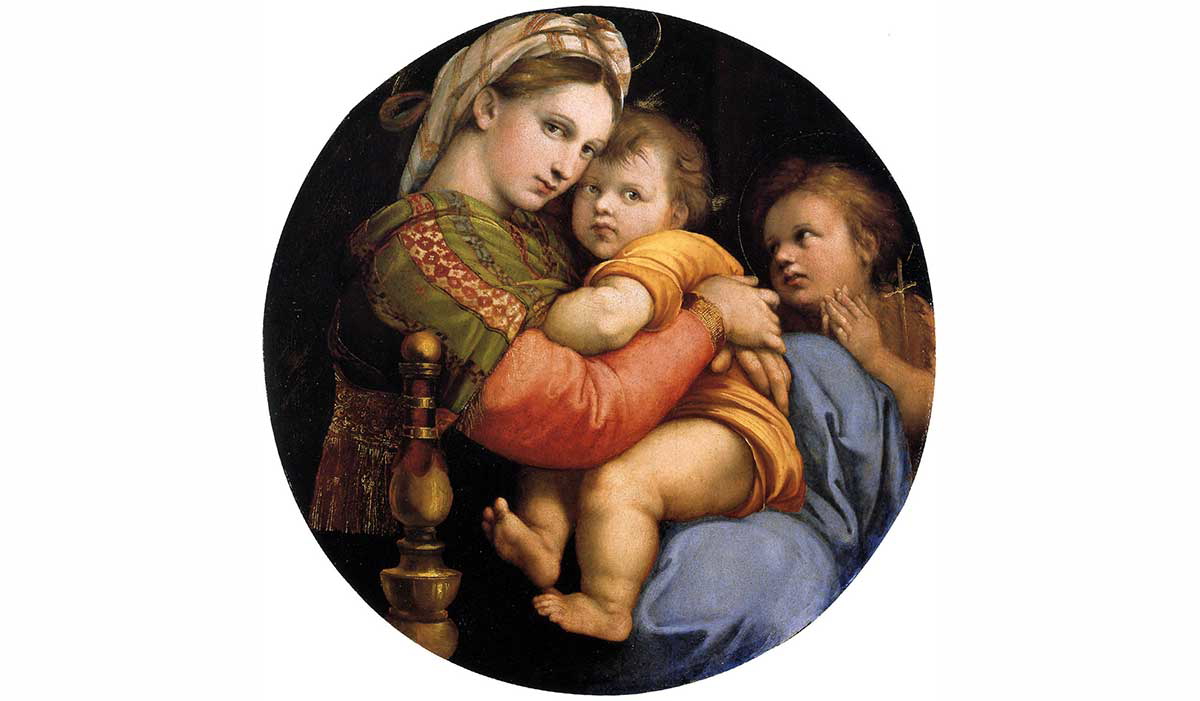
In the center of the image is Raphael’s famed Madonna della Sedia of 1513-4. If this is a portrait of the Fornarina as it was rumored to be in Turner’s time, it is a spiritualization of romantic love. His beloved becomes the archetypal Christian figure of devotion. Just as Raphael turns earthly love to a generalized ideal of expression, gesture, and form, Turner furthers its idealization by compositional centrality and the bathing of the portrait in his gilded light.
The Fornarina is placed beside the Madonna, and this perhaps can be related to the Neoplatonic conception that physical beauty reveals a deeper spiritual beauty. The Fornarina looks out at Rome and is richly dressed, denoting a certain worldliness. At the same time, the Madonna faces inwards to the realm of contemplation, of the psychic interior. The form of the Madonna is swathed in robes, and her face is the essence of devotion. As such, her form is dematerialized—the physical pointing beyond itself to pure soul. The combination of the Fornarina having her back to us and the Madonna facing us shows Turner referencing them as two aspects of a single entity, body and soul.
Imagination
The miniature scale of the Madonna della Sedia in Turner’s picture, together with its placement at the center, shows Turner’s attitude to be rather one of tribute than of emulation. But there are elements that point to Turner at least imagining ambitions for his own art that parallel Raphael’s achievement. For example, Turner—already signifying the Renaissance artist as the supreme architect (holding The Building of the Ark)—makes a bold “architectural” move himself. He extends and twists the central bay of the loggia, which allows our vision of Rome. This is an unnatural-looking and almost disorientating device. The dizzying height of the loggia and the view down to the piazza, in addition to this, conveys the headiness of artistic imagination, generally and in the cases of Turner and Raphael.
Gerald Finley sees in the image a Christian metaphor for the transmutation of reality, writing that Turner’s Raphael “transform[s] this imperfect reality and thereby discover[s] something of that perfection and harmony which had existed before the Fall.” As evidence for this interpretation, Finley notes the brightly lit picture of Adam and Eve to the right on the loggia.
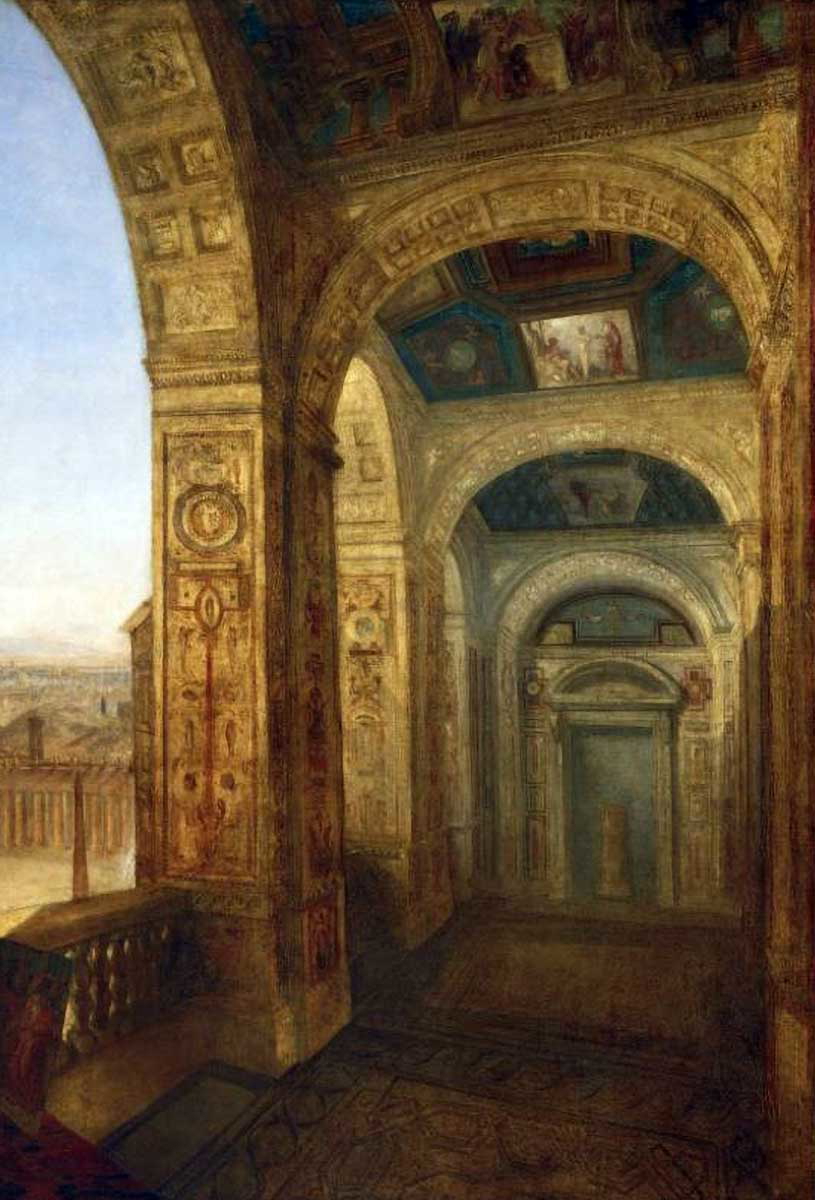
Concord with the visual world, however, is both embraced and subverted by Turner. The views of Rome and of the arcade to the right are faithfully imitated and beautified by Turner’s sensitive light. This satisfied the twin classical tenets of mimesis (imitation) and idealization. Yet, Turner subverts mimesis also in the twisting expansion of the central bay. This cannot be described as classical but more as a Romantic and idealist dictation of the artistic judgement that does not contradict Finley’s argument. Turner is making physical reality subordinate to his conceptual relation of grandeur and the intellectual and artistic greatness of Raphael. He is using nonclassical means to express the eternal significance of Rome, and by extension, the classical tradition—ancient and modern. Joshua Reynolds, the history painter whose theoretical Discourses on Art influenced Turner, wrote that history must be “made to bend to the great idea of art.”

Robert E. McVaugh’s ascription of an “additive process” to the image is apt. It describes the contents of the foreground, which is in the guise of the artist’s studio. Also, it refers to the mental process of artistic decision-making, entailing also subtraction and synthesis. This culminates in the contemplative gesture and gaze of Raphael. Raphael’s art is deliberate and therefore intellectual for Turner here. By the early 19th century, and due in no small part to the theoretical teachings of the new academies of art, the scholarly study and artistic emulation of classicism was enshrined. All classical art from the antique to the contemporary was seen to uphold and exemplify the power of the intellect.
Turner’s Classicism
Such was the status of Raphael in the early 19th century that Samuel Rogers was to write in 1815 that the Loggia frescoes “surpass all the pictures in the world.” This was written five years before Turner exhibited his View of Rome from the Vatican and demonstrates Raphael’s assimilation to the core of the classical tradition for all time. Elements of Turner’s image that are classicizing include his precise draughtsmanship of the loggia and the city, and the depiction of a central protagonist. But there are also elements that mark Turner’s critical distance from or perhaps innovation within an overtly classicizing painting. The “hero” is not afforded the focus of attention, which is divided between the Madonna, the vista, and the arcade to the right. The “hero” is not in action but in contemplation. Also, the foreground, presented as the artist’s studio, is realistically muddled and haphazard and thereby lacks the classical virtue of clarity.
Finley sees in Turner’s representation of the reclining river god and the Madonna della Sedia a temporal continuity of Roman civilization from the antique to the Renaissance and beyond: “Turner believed strongly that the continuity of artistic ideas and traditions was beneficial.” This conviction includes perhaps an aspirational continuity from Raphael to Turner. But Turner’s traditionalism is unconventional and far from undeviating formal imitation. He imports disjunction, juxtaposition, and an element of spatial confusion. These characteristics are more attributable to his own time and the nascent period of Romantic expression and rupture. Turner’s classicism, intentionally confused in parts as it is, incorporates this confusion and is therefore organically alive in this image, rather than being an exercise in dry imitative academicism.
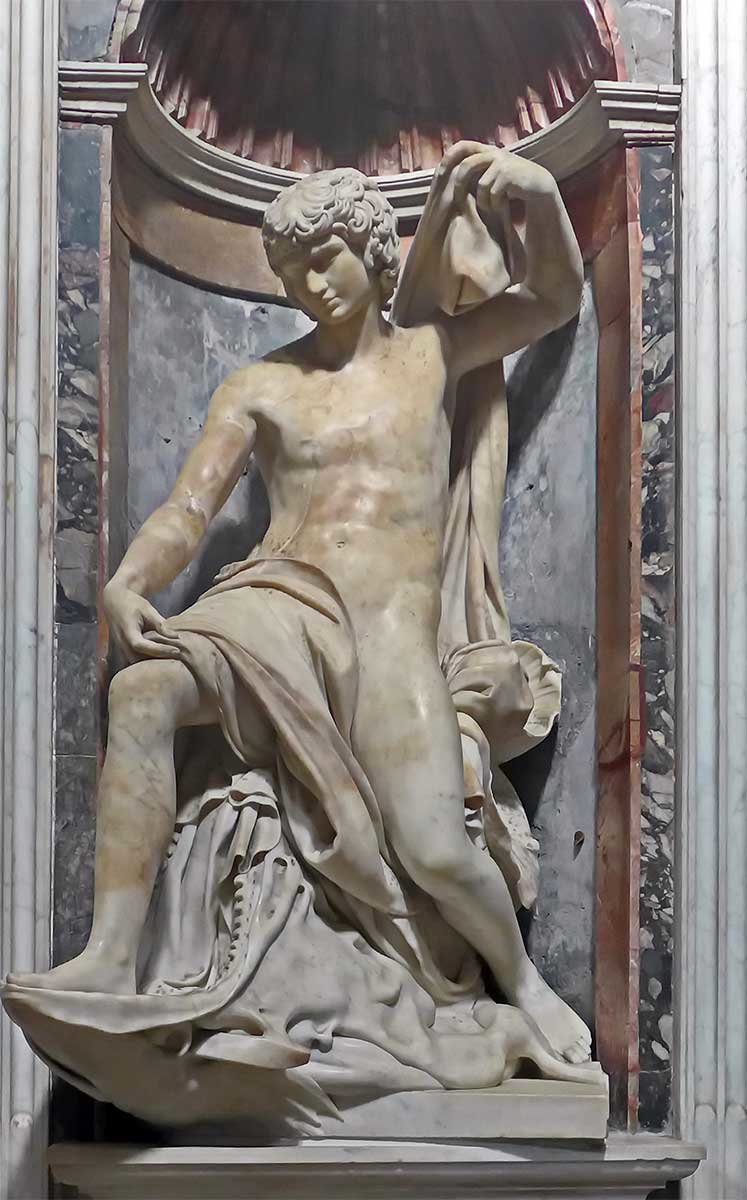
Turner clearly paints Raphael as the universal artist. As McVaugh unequivocally states: “For Turner, it was Raphael’s genius that haunted the Eternal City.” John Gage relates this to the diversity of the foreground, which contains the architectural plans for the Vatican as well as paintings of various genres, and the sculpted reclining river god. (Incidentally, Gage relates the river god to Raphael’s statue of Jonah in the Chigi Chapel of Santa Maria del Popolo in Rome.) Gage also thinks that Turner is making a similar claim for himself in his image. This is supportable by Turner’s painting’s own defiance of genre categorization. It is a history painting, containing portraiture, landscape, architecture, and architectural drawing, and even a still life depicting the implements and ephemera of the artist’s studio. In showing the artistic versatility of Raphael, Turner exhibits his own.
Space and Time
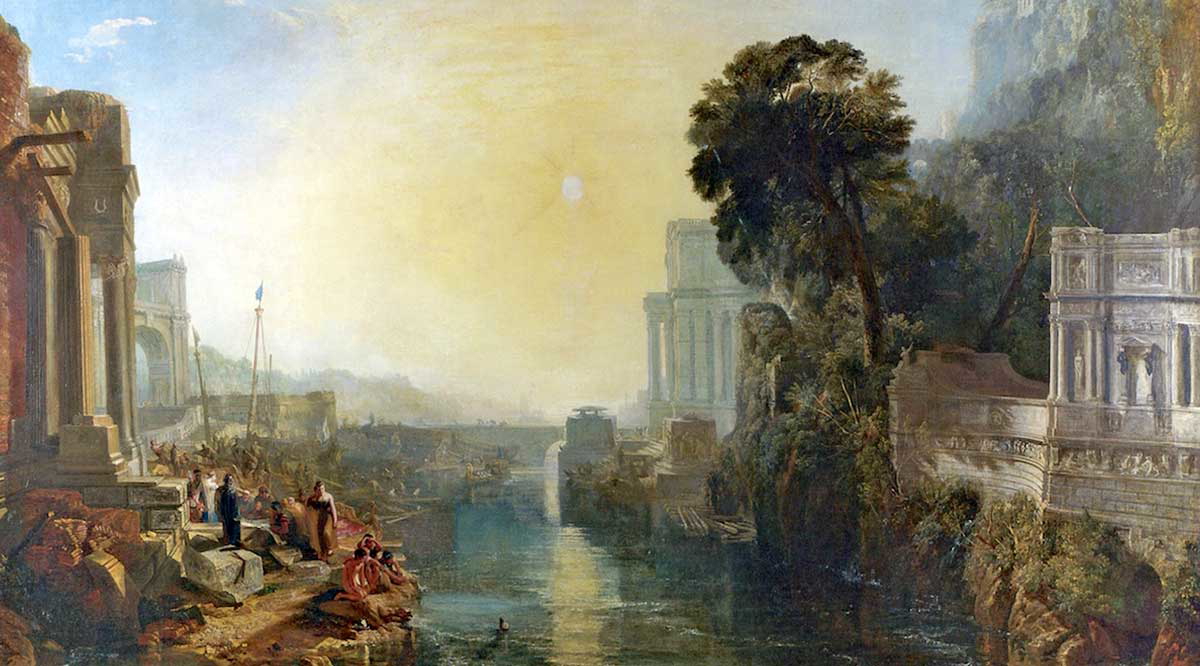
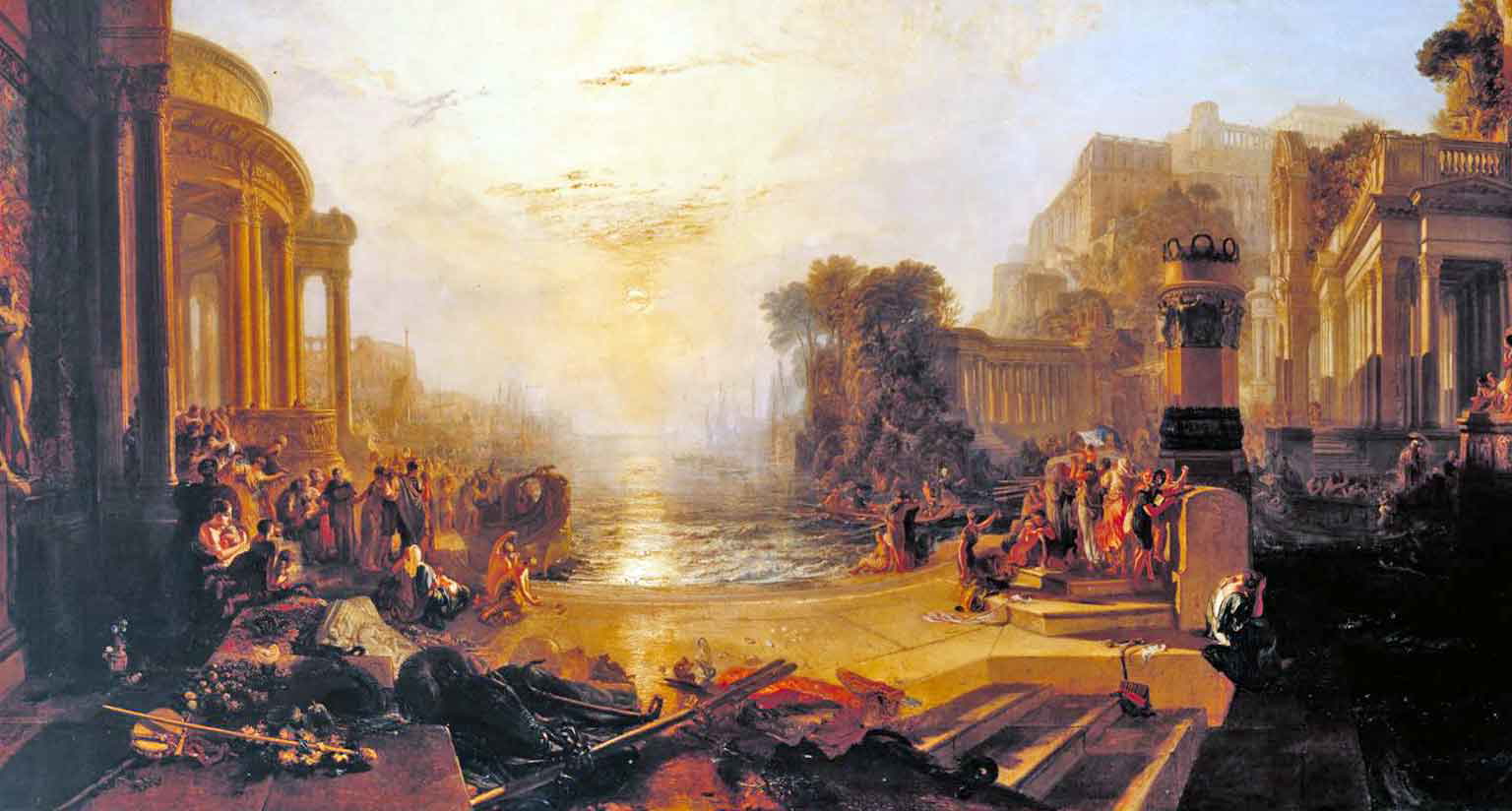
Finley remarks on Turner’s echoing allusions to his other pictures in this canvas on the theme of time. Pictures like Dido Building Carthage and The Decline of the Carthaginian Empire chime, for Finley, with this image of Rome in terms of the rise and fall of civilizations. Rome, he maintains, is “Europe’s most daunting cautionary lesson.” He also maintains that Turner held a cyclical view of history, composed of organic stages of growth, death, and revival, that was related to the Christian trope of Fall and redemption. As such, Finley believes that history had a “providential character” for Turner. The painter’s conceptual panoramas of artistic inspiration certainly don’t contradict this contention. Earthly love in the persons of Raphael and the Fornarina is transmuted to spiritual adoration in the Madonna della Sedia. Raphael’s temporal success with papal patrons is tempered by the Christian iconography of salvation. But in this, Turner simultaneously places the master both within time and outside of it.
Not only is the picture physically huge, but so is Turner’s overall conception and the iconographically dense program that encompasses Earth and Heaven. In depicting, among other things, his artistic contemplation and inspiration, Turner presents the result of his own, which is tonally beautiful and faithful to Lawrence’s “milky sweetness” of Rome. It is also vastly sublime, locally cluttered in the foreground, and richly significant. The painting is both visually arresting and profoundly readable, and thereby satisfies two further specifications for perfect classical history painting.
McVaugh largely shares Finley’s account of Turner’s view of history, except for the Christian element. He writes of the modern segregation of past from present and future as being meaningless for Turner. In the picture, Raphael and the Fornarina are present, rather than the artworks of Raphael. Turner celebrates the artistic relics of the master but also conjures him “physically,” making him as alive as his works.
McVaugh also rationalizes the “wrench” of the central bay as entailing “the turn of one’s head rather than a stationary point of view.” He also cites the scale and clutter of the foreground, the vacillation of the foreground rug, and sees “optical confusion.” Yet the foreground, while certainly not organized, is not as confused as McVaugh thinks it is. In fact, to the left, and supporting the two standing canvases, is a table whose right-hand corner terminates just below the statue of the reclining river god.
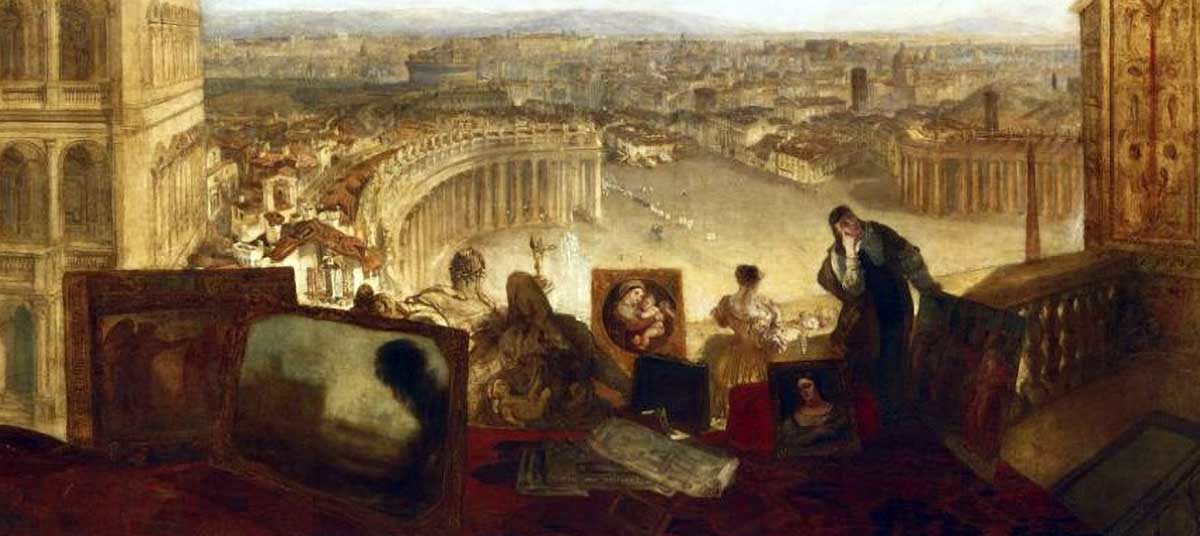
Turner’s idea of there being no separation between past and present is largely rightly referred to by McVaugh. But this must be qualified because Turner can be seen in his image to be obeying the classical narrative convention of the so-called “pregnant moment,” although in typically idiosyncratic fashion. In doing so, he makes a temporal as well as spatial divide between the formal “island” around Raphael and the rest of the image. In the background are the eternal achievements of the highest Roman art—not least Bernini’s 17th-century sweeping colonnade. In the right foreground are Raphael’s panel decorations of the Loggia.
In the left foreground are the two easel paintings by Raphael, and the compositional crescendo is the central Madonna della Sedia. However, on Raphael’s “island” there is flux and jumble. It is as if a manifold of sensations and thoughts prevail in his mind as he contemplates them, before his synthetic power of intellect distils them to their essential and idealized form. The “island” thus becomes the classical salient and centralized moment of narrative and of the process of picture-building itself. Therefore, that local jumble as an externalization of the furniture of Raphael’s mind is momentary and about to be lent purposive classical form.
Turner’s description of the mental machinery of the artist who gives form to the chaotic maelstrom of perception becomes analogous to the first act of the Christian generative God. McVaugh would seem to corroborate this idea of the “pregnant moment” when he says that, for Turner, “the moment of reflection [is] the salient aspect of artistic production.” Turner thereby is further inscribing classicism within the interaction between Raphael and his patron-popes (Leo X and Julius II) and the formal perfection of the universal artist’s aesthetic vision.
As a final touch, McVaugh observes that the classical river god holds aloft a winged figurine—perhaps Nike—standing on a globe, which holds out to Raphael the wreath of victory. McVaugh sees the river god as a personification of the Tiber and therefore a proxy for Rome itself. So, Turner here seems to equate Rome with the legacy of the master and also signals Raphael’s early 19th-century status as the pinnacle of all classical art, perhaps peered only by Michelangelo.