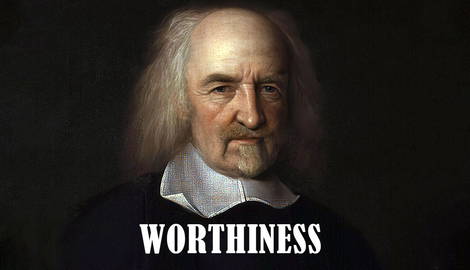
Hobbes challenges the idea that it makes sense to question the worth of those in power. Here, we look at how doubting the worthiness of someone in power might make as little sense as doubting the value of an item sold at auction. After all, if we judge value by how much someone with money will pay, is not worthiness something similar? That is, however much someone with the power to confer the status of “worthiness” will confer. In short, is someone worthy of their position simply by having it?
Thomas Hobbes
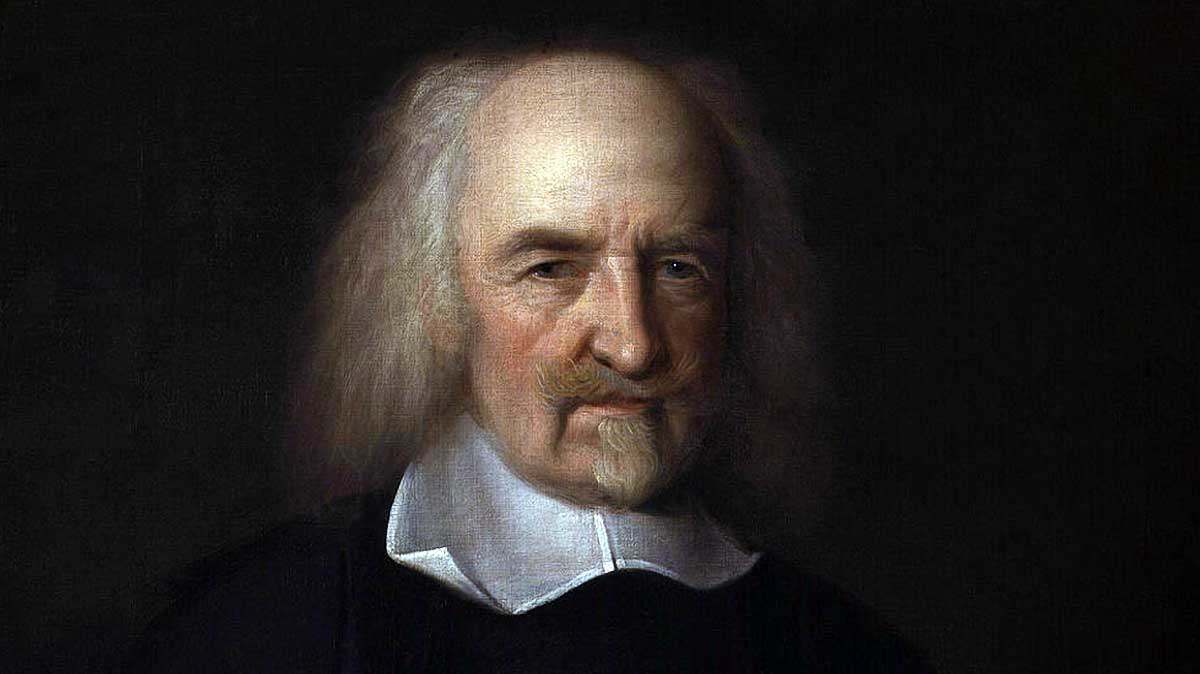
Thomas Hobbes is an English political philosopher best known for his description of life in what he termed the hypothetical state of nature: “solitary, poor, nasty, brutish and short.”
Hobbes was born in Wiltshire where his father was the local vicar. Despite what one might expect from a vicar, Hobbes’ father had a quick temper and was exiled from the town in disgrace after getting into a fight on the church doorstep. His son, Thomas, was just five years old at the time. Along with his mother, brother and sister, Hobbes went to live with his uncle in Malmesbury.
Thanks to his uncle, Hobbes was well-educated. After university, where he studied a number of subjects including logic and mathematics, he took a job as tutor to the son of William Cavendish, Baron of Hardwick. Thus began a long relationship with the Cavendish family. Through this connection, Hobbes had the opportunity to travel and meet with influential intellectuals. For a short time, he worked as a scribe for Francis Bacon, and he also met Galileo who was under house arrest in Florence.
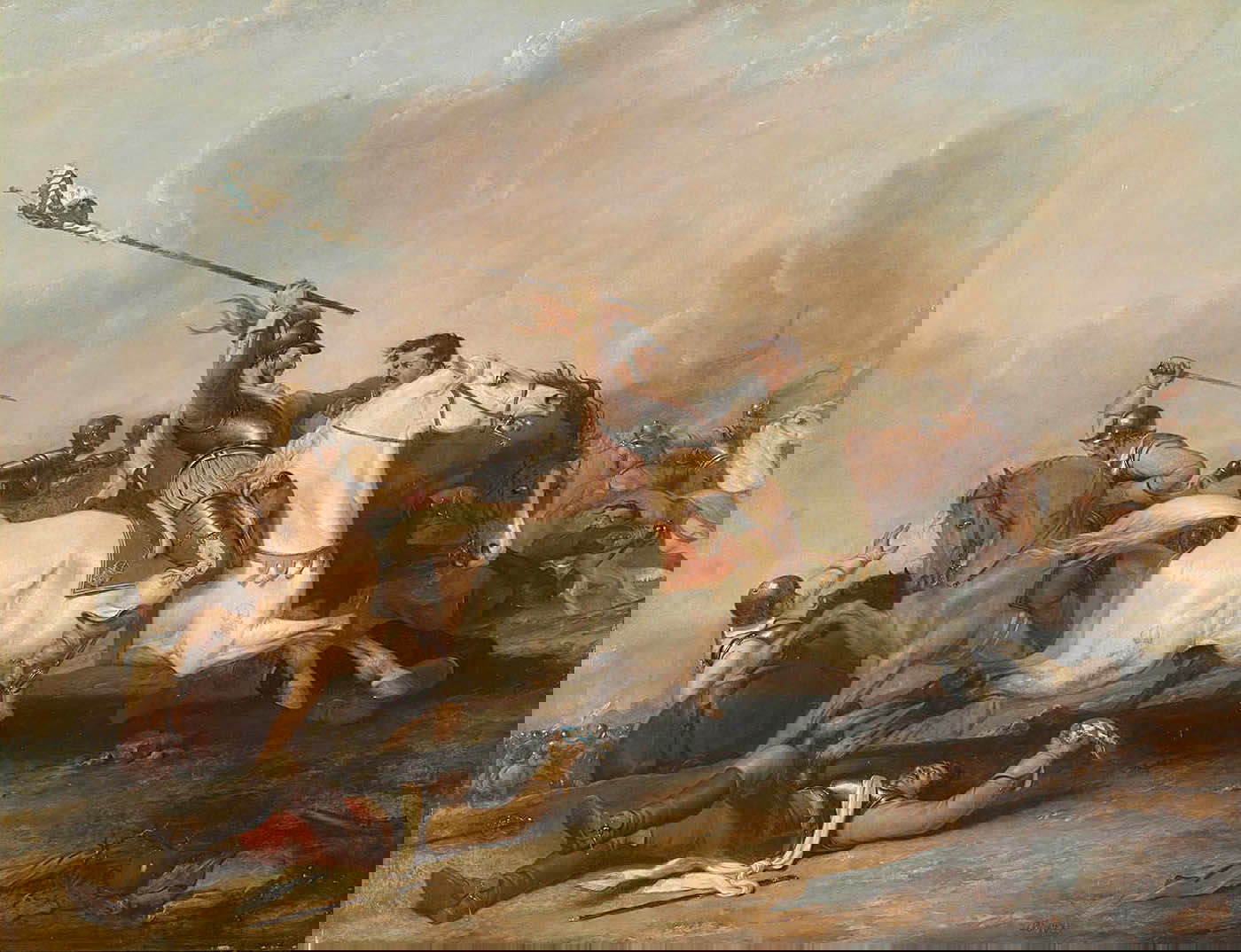
Hobbes was in Paris when the first of the English Civil Wars broke out. Due to his connections with the Cavendish family, who sided with the Royalists, Hobbes was considered a supporter of that side of the dispute. Many of those in England with Royalist sympathies were fleeing the country and Hobbes decided to stay abroad. Apart from some brief visits, Hobbes stayed away from England for the duration of the conflict.
Hobbes was greatly troubled by the upheaval of the civil war and his political masterpiece Leviathan can be read as an attempt to counter the kinds of thinking about power and legitimacy that brought about the wars. However, as we shall see, there is a surprising amount of wriggle room for rebellion within the text. Our focus is on Hobbes’ concern with “worthiness.” In particular, the idea that someone in power is not worthy of having that power.
The Leviathan
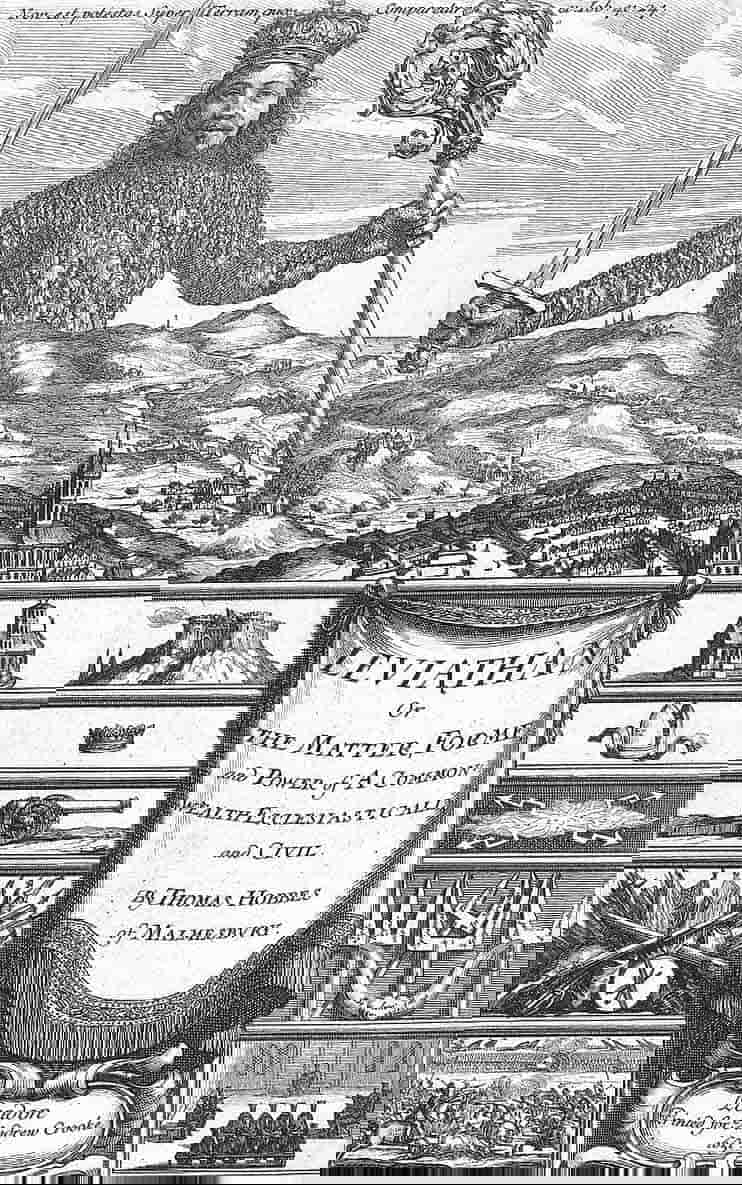
In Leviathan Hobbes argues for a social contract and rule by an absolute sovereign. Here Hobbes makes use of a social contract argument in order to defend his position. In short, he imagines a hypothetical “state of nature” in which human beings roam free, unbounded by any laws, institutions, or social traditions. People are free to do whatever they want, whenever they want. However, there is a problem. The freedom of others to do whatever they want will severely limit what it is possible for an individual to do. For example, other than relying on your own brute strength or cunning, there would be nothing to stop others from taking anything you manage to find or create for yourself. In addition, if you attempt something that requires teamwork, there is nothing to hold anyone to their promises to help or to demand a fair share of the product.
Far from being some kind of idyllic, pre-societal paradise of self-sufficient individuals (as Jean-Jacques Rousseau would later imagine), life in the state of nature for Hobbes would be “solitary, poor, nasty, brutish and short.” For him, the only way out of this terrible situation is for individuals to voluntarily give up some of their freedoms and agree to be subjected to an absolute ruler. This ruler would have the power to make people keep their promises. Hobbes believed that human beings would willingly enter into this agreement not only because they could rationally see the benefit of doing so but because it is in our natures to do so.
Hobbes believed he had located some key features of human nature. These are dispositions and traits we all share to varying degrees. Leaving the state of nature, i.e., entering into civilized societies, will not make these traits disappear but will rather control them or channel them into something productive rather than destructive.
Human Nature and Natural Laws

For Hobbes, humans are motivated by three “drives” (this is a later term but useful here) that bring us into frequent quarrels with one another. These are competition, diffidence, and desire for glory.
By competition, Hobbes refers to the scarce resources available in the state of nature. Yes, there is food and drink out there in the wild, but it is difficult for humans to acquire. We do not live in the Garden of Eden. Our food must be earned through toil and sweat. As hunter-gatherers, humans will always compete with each other for resources.
Today, diffidence refers to timidity or bashfulness. However, the meaning of diffidence has changed over time. Hobbes’ use of the word refers to an older sense in which the diffident person has mistrust in others. What he is driving at is the idea that we cannot trust each other.
The desire for glory is key to survival. In the state of nature, for obvious reasons, we need others to think of us as capable of defending ourselves.
As well as these drives, there are “laws of nature” that Hobbes believed humans capable of discerning. The first is that perpetual war of all against all is a bad thing. Therefore, peace is to be desired. A rule that seems naturally to follow from this Hobbes puts in Latin: “quod tibi fieri non vis, alteri ne feceris.” In English: “What you do not wish to be done to yourself, do not do to another.”
Was Hobbes a Rebel?

Hobbes is most well known today as an advocate for absolute sovereign rule. Which, as we have seen, he certainly was. Following his argument from the state of nature we can see that, if Hobbes is correct, what human beings most need if they want to live long and peaceful lives is a strong leader. However, within his state of nature argument lies an implicit argument for rebellion.
On the face of things, rebellion seems to be the last thing that Hobbes would allow. After all, our freedom from the state of nature is dependent upon submission to an absolute ruler. For Hobbes, a return to the state of nature—or something like anarchy or total chaos—is a frightful possibility. According to him, we voluntarily give up some of our freedoms in return for a better life outside of the state of nature. However, if the absolute ruler we end up submitting to makes our lives worse than the anarchy of nature, then it stands to reason that we are better off returning to it. As we have seen, Hobbes’ philosophy is heavy on a rational defense of submission. At the time of publishing, a people’s deference to their leader was deemed to be ordained by God, not by reason. Hobbes’ Leviathan was, then, a very radical text.
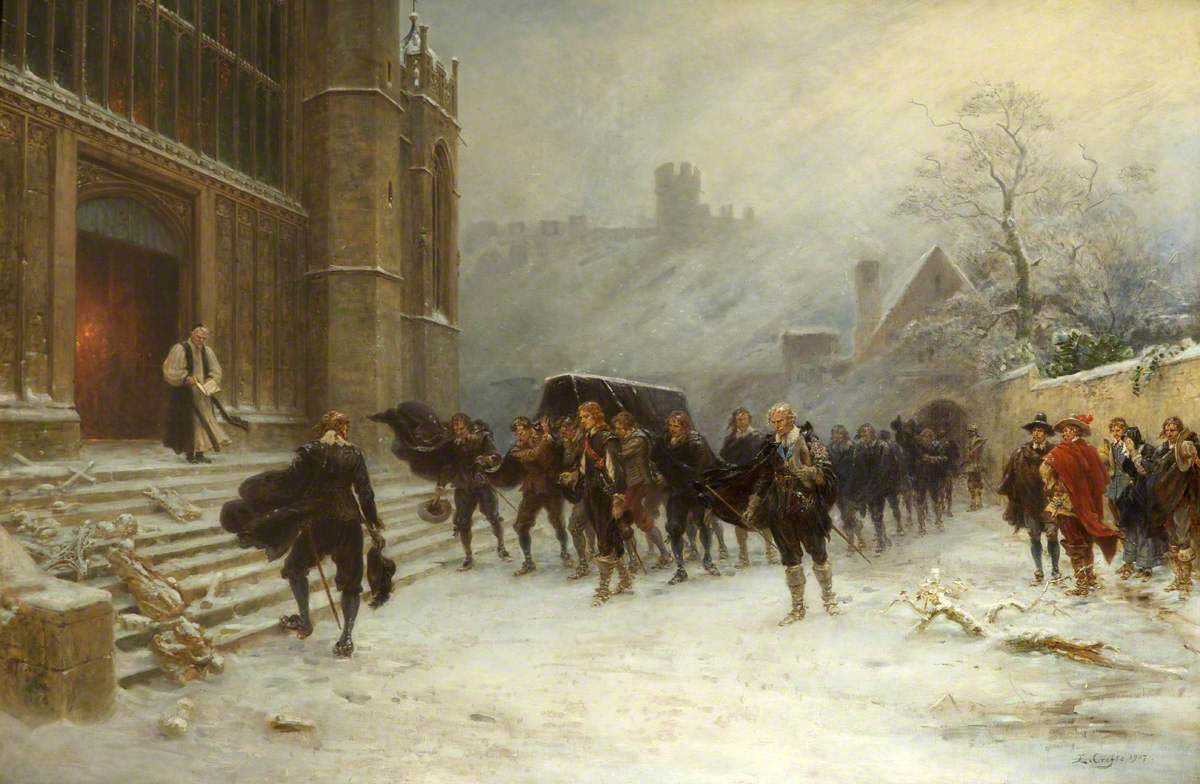
What we seem to have with Hobbes is a justification for rebellion. Put very simply, if obedience to the state is preferable because it allows an individual to survive and thrive, what happens if the state demands of a person that they seriously endanger or sacrifice their lives? We saw above that the idea of “do unto others…” was seen to be a fundamental natural law, but what if your sovereign demanded that you ignore this law? A careful reading of Leviathan seems to suggest that in these cases rebellion is the rational response.
Hobbes and Worthiness
Despite any potential wriggle room for rebellion in Leviathan, Hobbes clearly saw rebellion as a dangerous thing. Accordingly, much of his account of power in the state is aimed at legitimizing those in power. Why? Because the first impulse behind rebellion is the idea that someone who has power, has it illegitimately. Exactly three hundred years after the publication of Leviathan, Albert Camus wrote in The Rebel (1951) that a rebel is someone who realizes that another person has overstepped the boundaries of their authority. For Hobbes, the way to prevent rebellion is to prevent people from believing that those with power have power illegitimately.
Here enters the idea of “worthiness.” It would not be too far-fetched to think that everyone reading this article has encountered someone in a position of power and authority that they do not believe deserves this position. The classic example is that of the boss’s child, put into a management position simply by virtue of their familial relationship to the person in charge. These people have enormous power but most of the people under them do not believe them worthy of their position.
As we consider this, remember the three drives that Hobbes believes motivated all human beings. We begin with competition. In our struggle to outdo others, we do not believe “the boss’s son” has fairly won out over us. Due to diffidence, we do not trust this person with the power they have and desire their removal from power. Finally, we desire glory for ourselves and cannot swallow glory being simply handed to this individual by virtue of their blood connection to the leader.
Imagine the character of Iago from Shakespeare’s Othello. Not only does he plot against someone promoted over him, but he himself has a position of power. What of all the people who work under Iago? Would they believe him to be worthy of power and respect?
Worth Is Given
Hobbes believes that submission to an absolute authority is the way out of the state of nature. He also believes that the state of nature is a terrible way to live. It is “solitary, poor, nasty, brutish and short.” However, we have also seen how Hobbes allows for rebellion. However, his concern is not with rebellion but with preventing claims against power. In this, he has a big problem: submission to those who have power but whom most of us consider to be undeserving. The example we saw above was the stereotype of “the boss’s son.”
In section ten of Leviathan, Hobbes draws out his idea of power. Here, he lists various types of power, such as that derived from a reputation for success, nobility, and eloquence. But the real value of a person, for Hobbes, is their “price.” That is, how much others estimate their value. Hobbes points out that we all generally consider our worth to be quite high—yet the true measure is how highly others value us. In short, according to Hobbes, the worth of a person is how much others consider that worth to be.
Hobbes argues for something similar to the idea that the value of an object is how much someone will pay for it. Suppose you had a baseball card that two different people wanted for their collection. The “worth” of this card is exactly how much someone is willing to pay. In short, Hobbes is claiming that you cannot see the worth given to another person and dispute it. The very fact that they have this worth is evidence of their value. You might think a baseball card is worthless but as long as people are prepared to pay money for it, it is worth that amount. The same goes for our leaders.