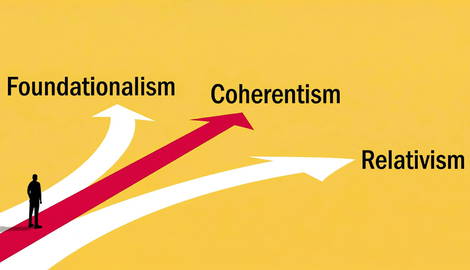

We are more or less certain that we know things that we have learned in school, from our parents, siblings, or friends. We also gain knowledge from overhearing conversations, watching movies, reading books, and many other sources. Is there a source that can be considered the most reliable one? Moreover, how can we cope with the fact that we hold different, and often contradicting, beliefs about the same things as other people? Whose beliefs are justified and why? Philosophers working in the epistemology cluster in three positions, Foundationalism, Coherentism, and Relativism, depending on their answers to these questions.
Epistemology and the Problem of Knowledge

Epistemology is a branch of philosophy that investigates how beliefs attain the status of knowledge, rigorously questioning their justification, truth, and the limits of human understanding.
To practically illustrate the issues, imagine believing that the Sun rotates around the Earth. Imagine also building a framework of knowledge on this piece of information, so that all you know is now grounded on and in compliance with the fact that the sun rotates around the earth. The Geocentric model of the universe was held roughly up to the 16th century, when Copernicus first, Galileo second, and Kepler finally proposed evidence that disproved it in favor of the now universally accepted Heliocentrism. It follows that even the knowledge that is thought of as unshakable remains so only to the day that it is unquestionably disproven. If this is the case for Geocentrism, what grounds would we have to object that it could be the case for any other truth we hold, no matter how certain and universally accepted?
However, questioning all the truths we hold at all times is also undesirable and is likely to significantly slow, if not stop completely, any further development in research and knowledge. Hence, the role of epistemology is to develop a system that ensures the knowledge we hold is sufficiently grounded to be relied upon with certainty.
Epistemological Positions

While epistemology lacks a universally accepted framework for defining and verifying knowledge, several competing positions offer rigorous accounts of the epistemic warrant for knowledge. Foundationalism, Coherentism, and Epistemic Relativism continue to drive the debate over the conditions under which a belief can be objectively justified. Within this debate, a belief is understood as a propositional attitude that serves as a candidate for knowledge. According to the traditional tripartite account, for a belief to graduate to knowledge, it must be both true and sufficiently justified. A belief that fails the test of verification is not false knowledge, but rather an epistemic error to be discarded.
Consider the empirical proposition that it is raining. To establish justification, one might rely on sensory perception by observing precipitation through a window. To increase the degree of warrant, one might seek independent corroboration by stepping outside to confirm the tactile sensation of water. In this context, previous experience functions as a conceptual framework that allows the subject to interpret raw sensory data. Whether this justification is sufficient depends on one’s adherence to reliabilism, the idea that our senses are a dependable truth-tracking mechanism, or a more skeptical internalist critique of sensory fallibility.
Foundationalism

Foundationalism seeks to resolve the regress problem of justification by proposing a hierarchical structure for knowledge. The position claims that most empirical beliefs are inferential, meaning their justification is derived from other supporting beliefs in a linear chain. In this model, belief A is warranted by belief B, which in turn finds its epistemic grounding in belief C. Under a purely linear framework, this structure risks infinite regress, that is, a logically untenable position where justification is deferred indefinitely. Another risk is that of circularity, where the chain eventually loops back upon itself.
Consider the rain example through a foundationalist lens: The proposition “It is raining” is justified by the immediate sensory belief “I am currently experiencing wetness.” This, in turn, is supported by the recollection that these specific tactile sensations of cold and dampness correspond to the concept of ‘water.’ To avoid a bottomless chain, the foundationalist argues that this series must terminate in properly basic beliefs. These are non-inferential foundations, such as raw sensory data or self-evident logical axioms, that are considered indubitable or self-justifying.
Critics argue that labeling a belief as basic to halt the regress is often an arbitrary move that begs the question. If a basic belief is to provide a secure foundation, it must possess a unique epistemic status that exempts it from the requirement of further proof. Yet, there is no consensus on what qualifies for this status.
Coherentism

Coherentism emerged as an alternative to the linear constraints of Foundationalism by adopting a holistic rather than an atomistic view of justification. This framework rejects the chain metaphor in favor of a web of belief, a conceptual model popularized by W.V.O. Quine and J.S. Ullian. In this view, beliefs are not discrete units supported by prior links. Rather, they are nodes within a vast, interconnected network. Justification is not derived from a unidirectional flow but is a product of the mutual consistency and explanatory power shared by the entire system.
By conceptualizing knowledge as a web, Coherentism bypasses the need for the properly basic beliefs required by Foundationalism. Where the foundationalist demands an indubitable, non-inferential base to stop the regress, the coherentist argues that the system’s stability arises from the interdependence of its parts. A single belief is warranted insofar as it coheres with the pre-existing web, and the web as a whole is justified by the internal logical harmony of its constituent propositions.
Critics, drawing on Quine’s own admission of the underdetermination of theory by evidence, argue that it is possible to construct a perfectly coherent web of beliefs that is entirely detached from external reality. If the web is supported only by its own internal links, it lacks an anchor to the empirical world. Consequently, objectors maintain that without some form of foundational input or basic belief to ground the web in objective fact, the system remains a beautiful but epistemically untethered fiction.
Epistemic Relativism

The third position discussed here, known as Epistemic Relativism, operates as a meta-epistemological critique, positing that the structural pursuits of both Foundationalism and Coherentism are predicated on a flawed assumption: the existence of a mind-independent, objective standard for truth. The relativist argues that knowledge is inextricably situated. Under this framework, epistemic justification is not absolute but is contingent upon the social, cultural, and historical contexts that determine what counts as evidence and what constitutes a valid inference.
From this perspective, the quest for a God’s-eye view of unshakable basic beliefs is a misguided endeavor. Because human cognition is mediated by diverse cultural and religious frameworks, a universal consensus on a single correct epistemic system is unattainable. The relativist maintains that any attempt to establish an objective hierarchy of knowledge is merely a performative act of power, an imposition of one cultural framework over another without a neutral, trans-cultural basis for the choice.
However, Epistemic Relativism faces a self-refutation objection. Critics argue that by asserting “All knowledge is relative,” the relativist is making a universal, absolute claim that contradicts their own premise. If the statement is true, it must be relative to a specific system and therefore not universally applicable; if it is universally applicable, then absolute truths do exist. Furthermore, many in the field view this position as an epistemic surrender. By dismissing the possibility of objective truth, relativism risks collapsing into radical skepticism that renders the search for knowledge and the field of epistemology itself obsolete. Critics contend that accepting such a stance does not solve the problem of knowledge but merely abandons the intellectual responsibility to distinguish between valid justification and mere cultural consensus.
The Award for the Best Position Goes to…
Having examined these three prominent positions in Epistemology, the question remains whether a superior alternative exists. As the preceding analysis has shown, while each position has significantly advanced our understanding of how knowledge is justified, they all remain vulnerable to rigorous objections. These criticisms challenge the internal consistency and the practical application of each theory.
Consequently, selecting a single position may be impossible or even counterproductive. It is up to the inquirer to engage with the ongoing debate between these positions. By weighing their conceptual strengths against their structural flaws, one can determine which position best captures the complex nature of human knowledge.
This lack of consensus should not discourage the search for a universal account of knowledge, though. On the contrary, the current absence of a perfect solution highlights the need for intellectual pluralism. Rather than sticking to a single doctrine, the student of epistemology should explore the field in all its complexity. A truly comprehensive understanding of knowledge requires an appreciation of the constant tension between these competing perspectives.