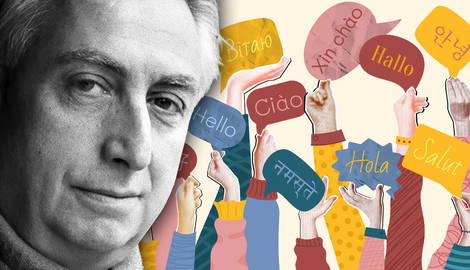

In this article, we explore the French philosopher and literary theorist Roland Barthes’ search for a way of using language without ideological or cultural influence. We will see how he used a branch of science known as semiology in his quest and how he came to think of language as something like human skin.
Who Was Roland Barthes?

Roland Barthes (1915-1980) was a literary theorist, philosopher, essayist, and critic. Born in the Normandy town of Cherbourg, he was raised by his mother, aunt, and grandfather after his father was killed in the First World War. The family moved southwards to the city of Bayonne, near the Spanish border, before moving to Paris.
A bright child, Barthes went on to attend the Sorbonne in the late 1930s, where he earned a license in classics. It was during this period, unfortunately, that he suffered from health complications, including tuberculosis. Due to his poor health, Barthes was exempt from military service during the Second World War. Ill health also prevented him from taking some academic qualifications. In 1941, aged 26, Barthes was awarded a diplôme d’études supérieures (broadly equivalent to a master’s degree) for a thesis on Greek Tragedy.
After the war, Barthes found teaching positions in various places in France, Romania, and Egypt. As well as teaching, he wrote and contributed articles to Combat, a left-leaning newspaper that was originally a clandestine publication produced by the French Resistance during the War. In 1953, Barthes published his first full-length work, Writing Degree Zero (Le degré zéro de l’écriture). This was a work of literary criticism in which Barthes, in a series of essays, lays out a kind of literary manifesto on writing itself. Here, he is interested in writing devoid of ideological or stylistic influences, hence the reference to approaching writing at ‘degree zero.’
At the time of publication, Barthes was in his first year at the Centre National de la Recherche Scientifique, where he would remain until the late 1950s. It was during this period that Barthes wrote a series of articles for the literary journal Les Lettres Nouvelles. These would later be republished as Mythologies (1957), the text for which Barthes is most well-known today.
Mythologies

Mythologies is a collection of fifty-three essays written by Barthes between 1954 and 1956. The title refers to the author’s interest in modern myth-making. In these essays, we see Barthes explore the process by which myths are created.
The work is a collection in two parts. The first section covers a wide range of topics. For example, the first essay is on all-in wrestling and the last is on The Lady of the Camellias, a novel by Alexandre Dumas. In between, we have essays on such disparate things as soap powder and detergents, toys, steak and chips, striptease, and plastic. In the second section, Barthes offers us eleven essays on myth today. These include essays on myth as a semiological system, myths on the left, myths on the right, and the necessity and limits of myths.
We saw that in his first published work, Writing Degree Zero, Barthes was interested in writing devoid of cultural and ideological influences. In Mythologies, he explores how seemingly everyday things can be vehicles for ideological ideas. Here is where the science of semiology comes in.
Semiology is concerned with signs that communicate meaning. Anything can be a sign: a box of Omo detergent, a toy train, a steak served rare, dancers at the Moulin Rouge, a plastic bucket, or a professional wrestling match. In Mythologies, Barthes explores how these everyday signs are used to create modern myths. What is of interest here is how, for example, a steak cooked in a particular way can mean more than simply how long a piece of meat was cooked for. To understand this, we will take a closer look at semiotics.
Semiotics

Semiotics is the study of signs. A sign can be a symbol, a point of focus, a colour, almost anything that helps us make sense of everything that is all around us. When something, whatever that thing might be, communicates meaning to us, whether intentional or unintentional, it is a sign. Activities and processes that involve signs are known as semiosis, and the study of these is semiotics.
Think of a scarf produced by the luxury fashion brand Burberry. With its distinctive ‘Burberry check’ pattern, the scarf is easily recognized as a sign of luxury. Typically made from cashmere and selling for not much shy of $600, these scarves are intended to signify something more about their owners than a desire for a warm neck. When someone steps out in a Burberry scarf, the scarf is a sign from which we can draw meaning. There are, in fact, two kinds of meaning available: the denotation or literal meaning (a Burberry scarf) and the connotation or associated meaning (this person is sophisticated and well-to-do).
However, the connotations from the sign (in this case, a Burberry scarf) will be affected by many factors, including the viewer’s social class, prevailing ideology, and so forth. Interestingly, in the early 2000s, the Burberry check became associated in the UK with working-class football hooliganism. This led to people wearing the distinctive pattern being denied entry to certain locations. An upper-class woman attempting to enter a North London wine bar to order a glass of Chablis would not find her Burberry scarf an obstacle to entry. However, a working-class man wearing an almost identical scarf looking for a pint of beer in an East London pub might find his entry barred. What this example shows is that signs are polysemic, that is, they can be read in many different ways.
Signifiers, the Signified, and Signification

In Mythologies, Barthes uses three technical terms in order to discuss the semiology of myths. These are: the signifier, the signified, and the signification. In this section, we will look at these in relation to the Burberry check pattern.
Look at the image above. It shows comedian Neil Bratchpiece in character as ‘The Wee Man.’ From his clothes, UK audiences can easily recognize the Wee Man as intended to be an antisocial, lower-working-class youth. The clearest sign is the Burberry baseball cap. Compare this image to the one from the previous section. Here, fashion influencer Mina Habchi wears a modern Burberry suit and carries an expensive handbag. Her outfit signifies not only membership of an elite class but also her status in contemporary fashion. We would expect to see a picture like this in the fashion pages of a glossy magazine or the society pages. At the same time, we would expect to see a picture of someone like The Wee Man in a story on petty crime or an advertisement for a comedy show.
The signifier in these images is the Burberry check pattern. The signified is what the pattern means to us. In the image of Habchi, the ideas signified are those of luxury fashion, social elitism, aspiration, and so on. In the image of Bratchpiece, what is signified are ideas of criminality, low social class, contempt, and mockery.
Barthes also talks of signification. These images are not just signs to convey meanings of social class, contempt, and respect, but they also reinforce ideological concepts. To grasp their meaning, which most of us can do easily because the ideas are so familiar, we must already ‘buy into’ ideas that clothes make the man and the value of aspiration.
But what has all this got to do with language being like a skin?
A Lover’s Discourse: Fragments
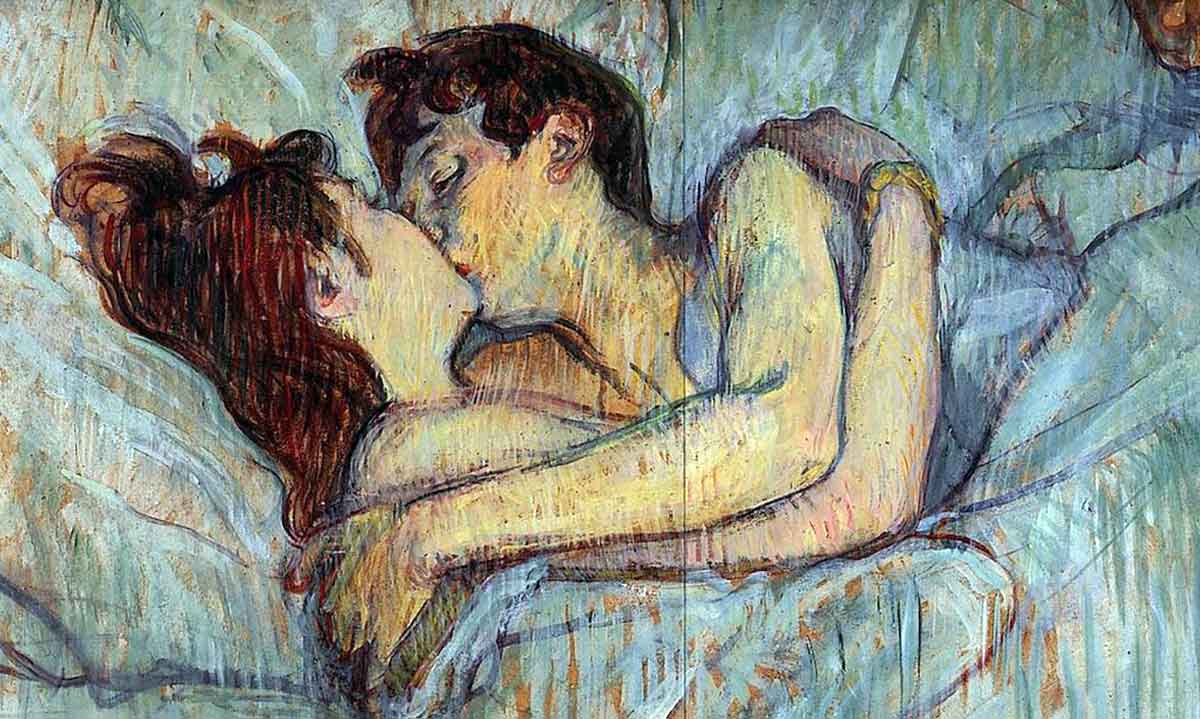
In 1977, Barthes published A Lover’s Discourse: Fragments. He was still concerned with finding a way to write that was neutral and free of ideology or style. The text is a kind of love story, but without the story. In fact, there is no narrative whatsoever.
Despite the success of Mythologies, Barthes was worried that even this work still made use of words loaded with social context. Lover’s Discourse is the product of Barthes’ continued work in this area, and it is here that we find his reference to language being like a ‘skin.’ It is a strange text and certainly not an easy read. However, this is to be expected from an author consciously searching for a way of writing that is uninfluenced by the official and the unacknowledged systems of meaning upon which cultural ideas are absorbed!
The subtitle is ‘Fragments,’ and the text is indeed fragmentary. In one fragment, in a section on ‘talking’ or ‘discourse,’ we find the following:
Language is a skin: I rub my language against the other. It is as if I had words instead of fingers, or fingers at the tip of my words. My language trembles with desire. The emotion derives from a double contact: on the one hand, a whole activity of discourse discreetly, indirectly focuses upon a single signified, which is “I desire you,” and releases, nourishes, ramifies it to the point of explosion (language experiences orgasm upon touching itself); on the other hand, I enwrap the other in my words. I caress, brush against, talk up this contact, I extend myself to make the commentary to which I submit the relation endure. (Barthes, 1978, A Lover’s Discourse: Fragments, p. 73)
Barthes says that no one speaks of love unless it is for someone. What does he mean by this?
Speaking for Someone
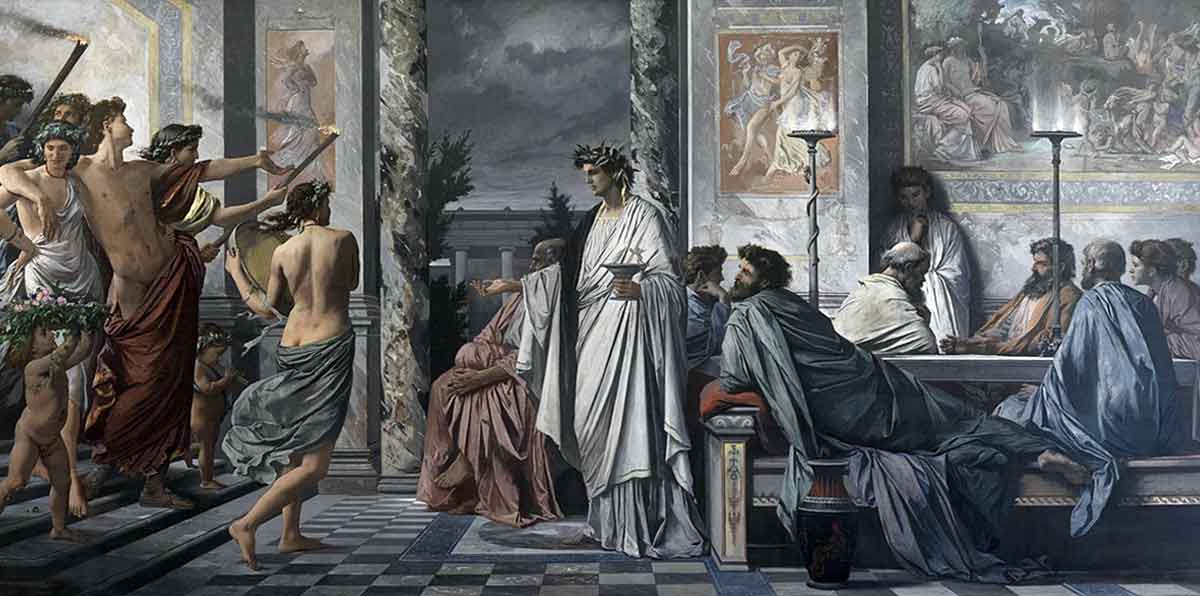
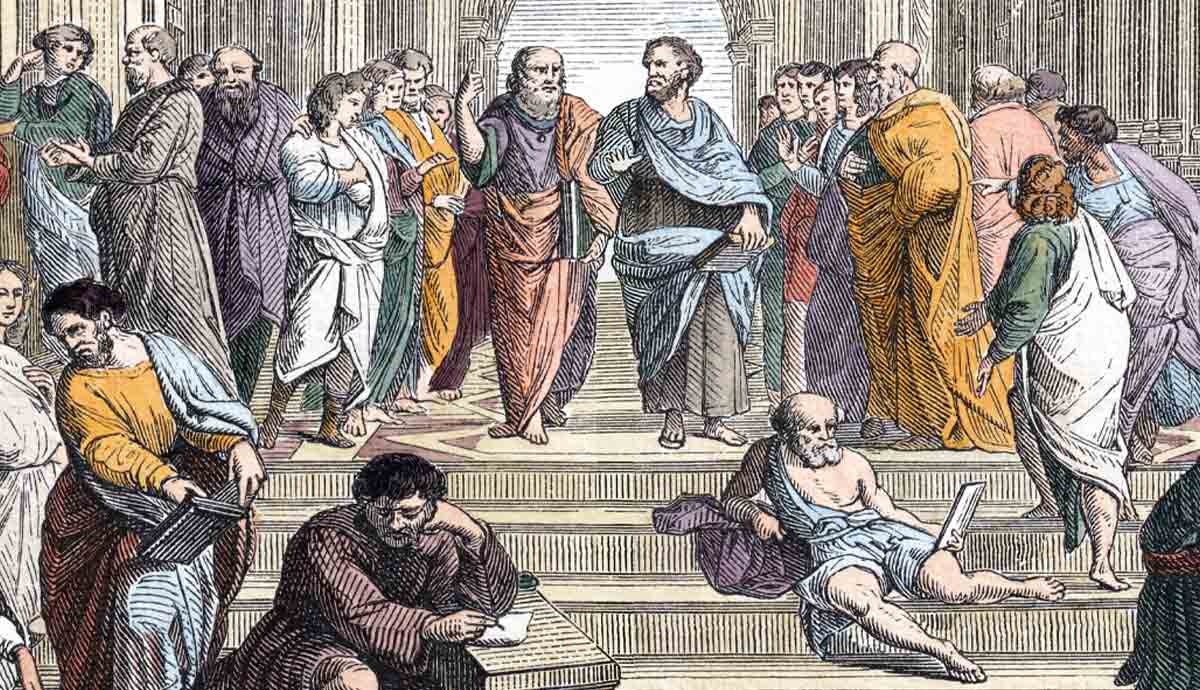
In the fragment immediately following the one cited above, Barthes refers to Alcibiades’ interruption of a symposium on love in Plato’s Symposium. Alcibiades, a drunken, adventuring military officer, arrives at the end of the symposium and delivers a speech on love. All present are there to make speeches on love, but he is unprepared and made under the influence of drink. In Plato’s text, Alcibiades addresses Socrates, but Barthes suggests he may actually be talking to someone else at the gathering, the host Agathon.
The idea here is that there is no neutral, abstract discourse on love. Whatever kind of discourse we have (philosophical, lyrical, text in a novel, etc.), there is always a person whom the writer is addressing in some way. In the Symposium, according to Barthes, Alcibiades is speaking about love, but for Agathon. The person one is speaking for might not yet be known, or could be just a vague idea of a possible person. Nevertheless, for Barthes, there is always someone for whom discourse on love is made.
We can now see more clearly the idea of language as a skin. One does not simply use words as signs to convey meaning, but as a way of reaching out and touching someone, of wrapping them up in meaning. What we also see here is a far more nuanced and sophisticated understanding of semiology than that which we encountered in Mythologies. Barthes is interested in the motivation of language, the intention behind the use of signs, signifiers, and the signified.
For sure, his ideas are complex and difficult to grasp, but what can be easily appreciated is the idea that, for him, writing is always for someone. There is no neutral writing. Language is a skin we inhabit, and discourse is an intimate skin-on-skin contact.