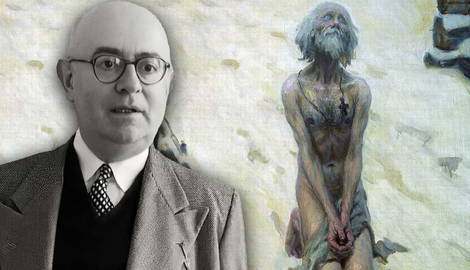

Along with his colleague Max Horkheimer, Theodor Adorno coined the term ‘Culture Industry’ to refer to the mass production of low-brow media, which he claimed was designed to keep the masses docile and accepting of the status quo. According to Adorno, popular culture not only creates a psychological dependence on simplicity, but also reinforces the idea that the status quo is legitimate and simply the way things are and ought to be. Adorno challenges a key idea promoted by mass media that simplicity is good and intelligence bad.
Who Was Theodor Adorno?

Theodor Adorno was born in Frankfurt in 1903. His father, Oscar Wiesengrund, was a wealthy wine merchant, and his mother, Maria Calvelli-Adorno, was an accomplished singer. She was from a devout Catholic background, whereas Adorno’s father was of Jewish descent but had converted to Protestantism. The young Theodor was given the double-barreled surname Adorno-Wiesengrund; however, due to the rising antisemitism in Germany, the family dropped the Jewish-sounding ‘Wiesengrund.’ When Adorno moved to the United States to escape further antisemitic persecution, he arrived using the name we now know: Theodor W. Adorno.
As a child, Adorno was a precocious learner with an interest in philosophy and music. He regularly read Kant and other philosophers and could play Beethoven’s pieces on the piano by the age of twelve. Music was very important to Adorno. Throughout his student years, he would continue working on his music, including attempts to compose pieces. Ultimately, however, his interest in philosophy was stronger, and this took precedence in his life, although he maintained a lifelong interest in music.
Adorno attended university in Frankfurt and, in 1924, earned his doctorate with a dissertation on Husserl. Five years later, he began work on his Habilitationsschrift under the supervision of Paul Tillich. Here, his thesis was on Kierkegaard. This was completed by 1931 and published in 1933. Fatefully, this overlapped with Hitler’s seizure of power in Germany.
Due to his Jewish heritage, Adorno was banned from teaching by the Nazis, which precipitated a move to Oxford in the United Kingdom. In 1938, Adorno moved again, this time to the United States. He did not return to Germany until 1949. Here, in Frankfurt, Adorno became a leading figure in the Institute of Social Research. The Institute was a hub of German intellectualism that came to be known as The Frankfurt School.
The Frankfurt School
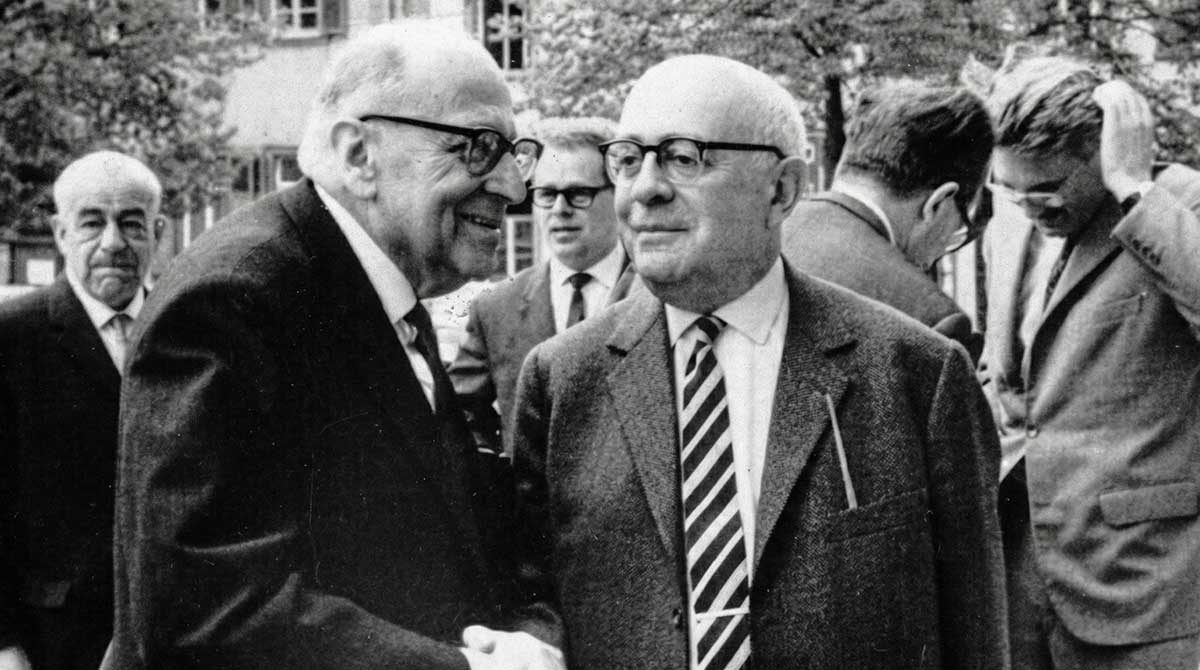
When we talk of ‘the Frankfurt School,’ we are talking about a school of thought rather than a physical building. That is, it is an intellectual perspective shared by a group of thinkers who share a particular vision or viewpoint. However, the Frankfurt School is also closely associated with the Institute of Social Research, which is based at Goethe University in Frankfurt (hence the name of the school).
As well as Adorno, significant figures associated with the Frankfurt School include Max Horkheimer, Herbert Marcuse, Walter Benjamin, and Jürgen Habermas. What they have in common is an interest in human freedom approached from a position perhaps best described as an attempted fusion of Marxism, psychoanalysis, and sociology.
We saw in the previous section the impact on academic inquiry caused by the Nazis. The Institute of Social Research was already very left-leaning prior to the advent of Hitler and relocated to the United States in 1933. The Institute of Social Research continued in exile under the leadership of Max Horkheimer until returning to Frankfurt in 1949.
Adorno had become friends with Horkheimer whilst studying under neo-Kantian philosopher and psychologist Hans Cornelius. In the United States, they collaborated on a text that was published in 1947 under the title Dialectic of Enlightenment (Dialektik der Aufklärung). This has become one of the core texts of Critical Theory, an approach in sociology and social philosophy that is concerned with power structures within society and culture.
Another text written by Adorno during this period was Minima Moralia: Reflections from a Damaged Life (Minima Moralia: Reflexionen aus dem beschädigten Leben). Published in 1951, this short book was written as a gift to celebrate Horkheimer’s fiftieth birthday. It is in this text that we encounter Adorno’s views on holy fools.
The Dialectic of Enlightenment

The Dialectic of Enlightenment is concerned with the relationship between the individual and society. In particular, Adorno and Horkheimer were interested in what they saw as the failure of the Enlightenment to prevent the rise of fascism, Stalinism, consumer capitalism, and the culture industry.
Traditionally, the Enlightenment is seen as a great cultural and intellectual advance for humanity. Overlapping with the Scientific Revolution, the Enlightenment introduced and popularized ideas concerning intellectual and religious freedom. Empiricism and rational thought were prized over religious superstition and authoritarianism as intellectual tools for progress and advancement. However, in their Dialectic of Enlightenment, Adorno and Horkheimer argue that, contrary to this popular belief, the Enlightenment led to totalitarianism and social domination.
It is in this text that Adorno and Horkheimer coin the term ‘culture industry.’ Their claim is that popular culture, mass media, and similar products are churned out to the public in a manner similar to factory-produced consumer goods for mass consumption. A distinction is being made between what we might call ‘high’ and ‘low’ art, but there is more to Adorno and Horkheimer’s critique than this. They believe there to be something more nefarious behind the culture industry.
They argue that the culture industry, through its products, creates a psychological need in people to consume mass media. The movies, television shows, radio broadcasts, and other media are a mind-numbing distraction designed to keep people docile and less willing to challenge the status quo. In addition, the media products consumed all day, every day, reinforce the idea that the status quo is normal, natural, and the way things ought to be.
We can see here how Adorno is concerned with assaults on people’s intelligence and thinking skills. With this in mind, let us turn now to the idea of ‘Holy Fools.’
Holy Fools

In his First Letter to the Corinthians, St. Paul writes: “We are fools for Christ, but you are so wise in Christ! We are weak, but you are strong! You are honored, we are dishonored!” (1 Cor 4:10)
Elsewhere in the letter, he says that what passes for wisdom in this world is seen as foolishness by God and that He is pleased by the foolishness of what was preached to save those who believe. Here we have two ideas, holiness and foolishness, that come together to form the idea of ‘the holy fool.’
From the 13th-century Russian saint Basil, Fool for Christ, to Dostoevsky’s Prince Mishkin, there are many and various examples of ‘holy fools’ in literature and the wider culture. It is therefore difficult to pin down exactly what it takes to be a holy fool. There is a sense of blessedness, that is, the state of ‘foolishness’ is the product of divine intervention, a gift given by the creator. But, in the sense that St. Paul was using the idea of foolishness, there is an element of conscious decision. That is the fool chooses to be foolish.
It is this choice to be ‘foolish,’ or at least the choice not to engage one’s critical faculties and to remain in a state of ignorance, that Adorno objects to. He saw in society a tendency to praise the choice to prioritize feeling over thinking and to seek pleasure in simplicity rather than to engage intellectually with the world. As we saw, Adorno thought that the success of what we call ‘low-brow’ culture, such as television shows and Hollywood movies, over the high-brow arts, such as classical music and fine art, arises from a widespread avoidance of intellectual engagement.
A key passage on these ideas is aphorism 127 of Adorno’s Minima Moralia (1951).
Minima Moralia

Aphorism 127 is titled, in English, ‘Wishful thinking.’ Adorno begins by saying that “Intelligence is a moral category.” Clearly, he believes that there is something wrong with attempting to avoid thinking. This opens a discussion of the separation of feeling and understanding, and of the idea that holy fools are to be praised and admired (“free and blessed are the knuckleheads”).
What Adorno objects to is the idea that simplicity is best and that one ought to choose between head and heart, with a preference for the latter. Rather than suppressing feelings or understanding in order to tackle our problems, Adorno says we ought to be striving to make both these sides of ourselves cohere.
Adorno argues that thinking counters evil, and so intelligence should not be avoided in favor of simplicity. The cause of evil, he says, is “blind prejudice in the contingency of what is one’s own.” In other words, for him, evil arises from a lack of thought about our likes and dislikes as well as a lack of awareness of things in our lives that are the result of chance.
We must bear in mind that Adorno is advocating for a balance of intelligence and emotion, not the domination of one over the other. This means that for him, the opposite of the holy fool is just as bad. Here, a person would attempt to ignore their feelings and to understand the world purely in terms of intelligence. It was this type of thinking Adorno believed was prized by the Enlightenment thinkers, and which he and Horkheimer criticized in their Dialectic of Enlightenment.
So, Adorno would not suffer Holy Fools lightly, but he would not treat what we might call, ‘Intellectual Fools’ too kindly either.