
Towards the end of his career, Camus looked back on his first published essays, collected in The Wrong Side and the Right Side, and concluded that the work started here was still in the process of becoming in his present work. What we find expressed in these short essays can be considered the source material of all his subsequent work. Naive yet beautiful, these essays are worth reading in their own right but are also tremendously useful for those seeking a deeper understanding of Camus’s philosophy of life.
Background to the Essay Collection
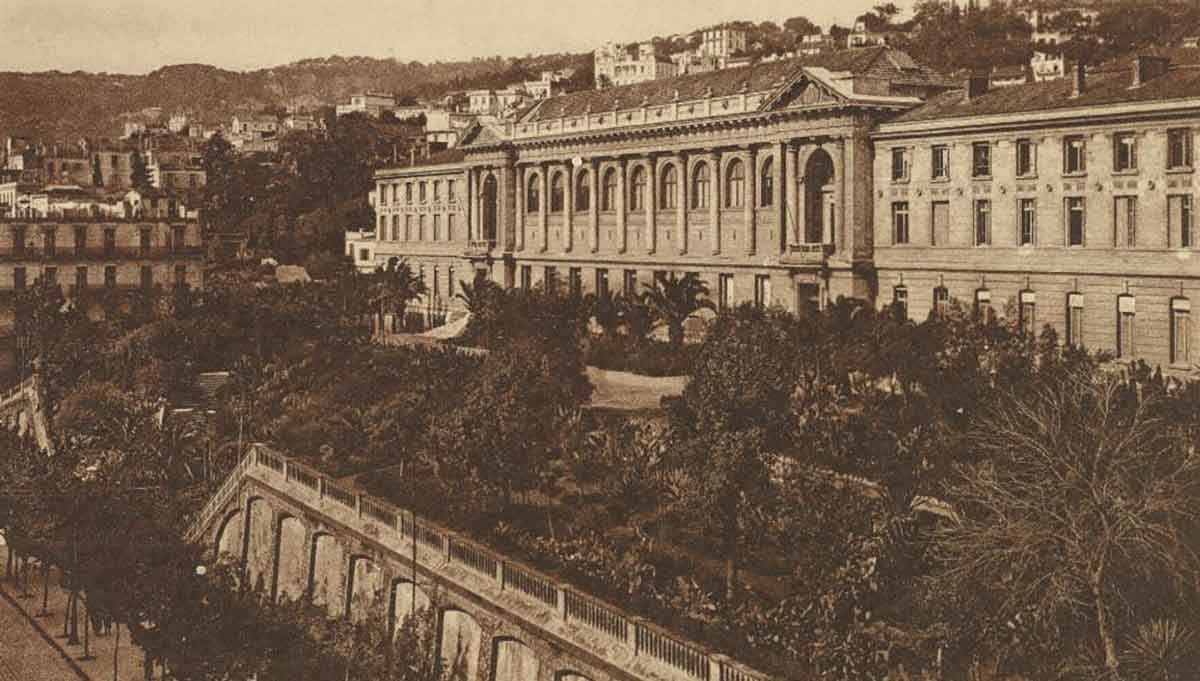
Albert Camus (1913-1960) published The Wrong Side and the Right Side (L’Envers et L’Endroit) in 1937. The book is a collection of five lyrical essays, based mostly on Camus’s own experiences and his reflections on life in Algiers. However, one of the essays, ‘Death in the Soul,’ is about a trip to Prague, and another, ‘Love of Life,’ is set in Palma. Camus was just twenty-two years old when he began work on the essays collected in this volume and was entirely unknown in literary circles. Later, in 1958, the collection was reissued with a preface written by the now world-famous Camus.
Although Camus had yet to find his voice, these early essays offer fascinating insights into the development and character of his thought. For sure, we can see a youthful Camus struggling with new ideas that he would later expand and build upon, but there is also a strange beauty in the prose that makes each of these essays still worth reading in their own right. That is, this collection is of more value than simply a record of Camus’s youthful ideas.
There is a charming naivety to the work. As we read, we witness the trailing off of lines of thought, abrupt shifts in tone and sentiment, and a sense of awkwardness in the writing. However, taking all of this into account, there is something else in the text that reveals more than the writer’s inexperience.
There is freshness to The Wrong Side and the Right Side, even if we are familiar with some of the ideas contained within the essays. It is clear that Camus is struggling to express something new in a language of ideas that differs from that normally used. His topic, about which each of his essays is concerned in some way, is ambiguity and uncertainty.
Both Sides of the Coin
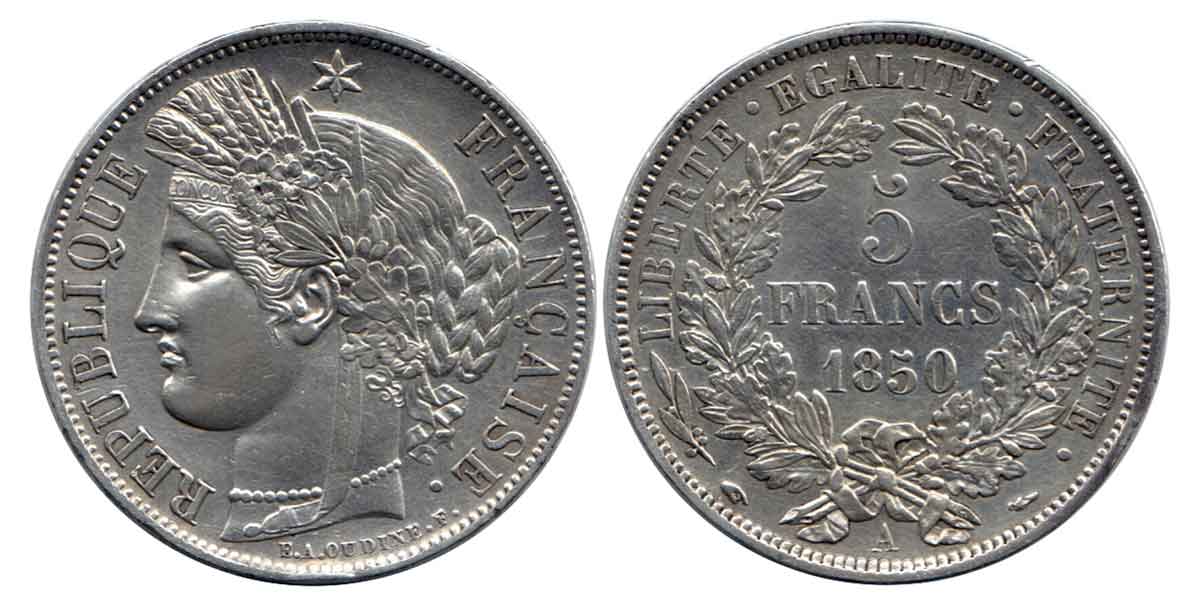
L’Envers et L’Endroit is a difficult title to translate into English. Today, we most commonly find it as “The Wrong Side” and “The Right Side,” but “Betwixt and Between” is sometimes used. It is possible to translate L’Envers et L’Endroit as “Both sides of the coin,” which also makes sense. Indeed, while not perfect, it would make more sense in terms of the ideas Camus was attempting to grasp.
In French, L’Envers et L’Endroit can refer to both sides of a piece of fabric. In a similar way, we can imagine both sides of a coin. In his essays, Camus captures both sides of a story or idea. Consider a standard coin with two sides commonly referred to as heads and tails. ‘Heads’ normally depicts someone’s actual head, and ‘tails’ depicts some important idea related to the state. In numismatics, heads are referred to as the obverse and tails the reverse. The principal side is the obverse, and the reverse is the back of the coin. Why is this relevant to our discussion?
It concerns the suggestion to prioritize ideas. Using a coin metaphor to talk about ideas, there is the suggestion of a main or principal idea and then a secondary or reverse way of seeing things. It is akin to acknowledging the existence of another point of view, but one carrying less weight. However, this is not quite what Camus is driving at. He is not saying that there are two ways of seeing things and we can pick one, but rather that you cannot have one without the other. To have a coin is to have both sides.
Considering ‘Sides’ in The Wrong Side and The Right Side
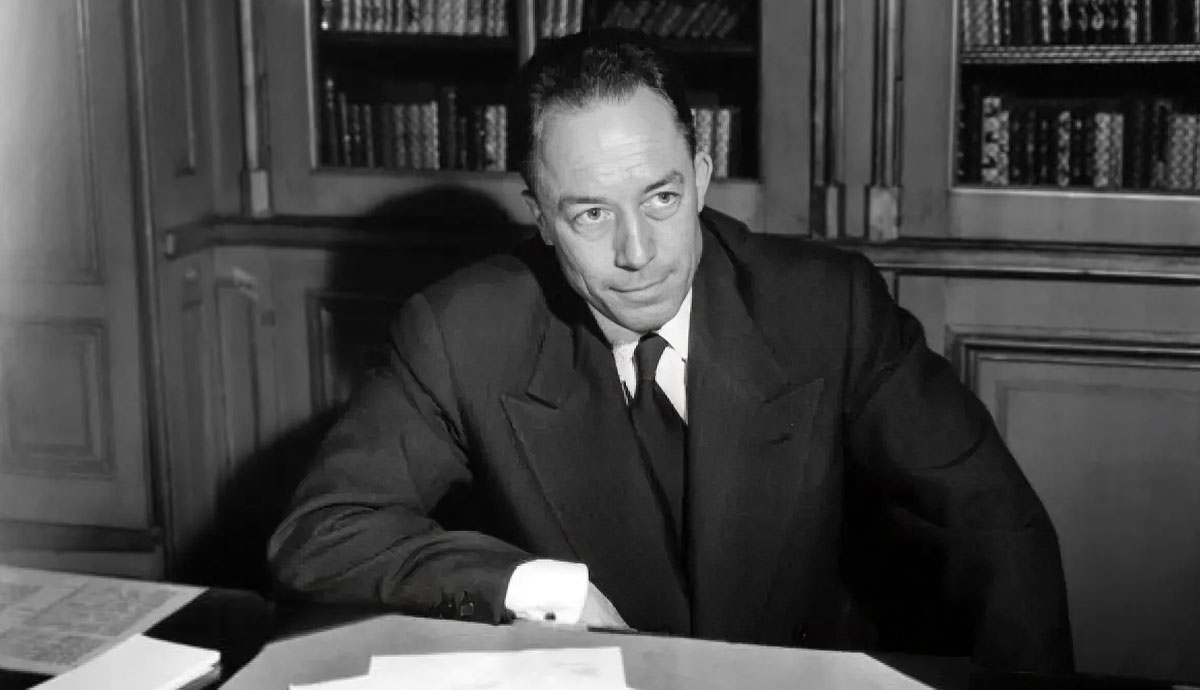
In light of the discussion above, translating L’Envers et L’Endroit as The Wrong Side and the Right Side seems to further encourage the idea that we ought to prioritize one point of view over another. We have seen that this is not what Camus is attempting to convey. However, we will continue to use this translation because it is currently the most well-known. Moving on.
Consider the following ideas:
- God exists, or he does not exist.
- It is not possible to have light without dark.
We can think of 1) as two opposing ideas: that God exists and the opposite view that he does not exist. Here, someone may argue for the former and someone else might argue for the latter. It would not make sense, however, to say that God both exists and does not exist. Consider this strange phrase: “you must accept the existence of God along with his non-existence.” Now, with that in mind, let us look at 2).
If we think of darkness as the absence of light, then we need light to exist in order for there to be darkness. The same goes for happiness: to be happy, we need there to be periods of unhappiness (or at least periods of being neither happy nor sad). It makes sense to say of life, “you must accept that without bad times, there would be no good times.” Of course, you may not agree with the idea, but it is possible to make sense of it nevertheless.
For Camus, life consists of light and dark, and in order to live, we must accept the presence of both. Just as to have a coin, you must accept that it comes with an obverse and reverse.
“Irony”
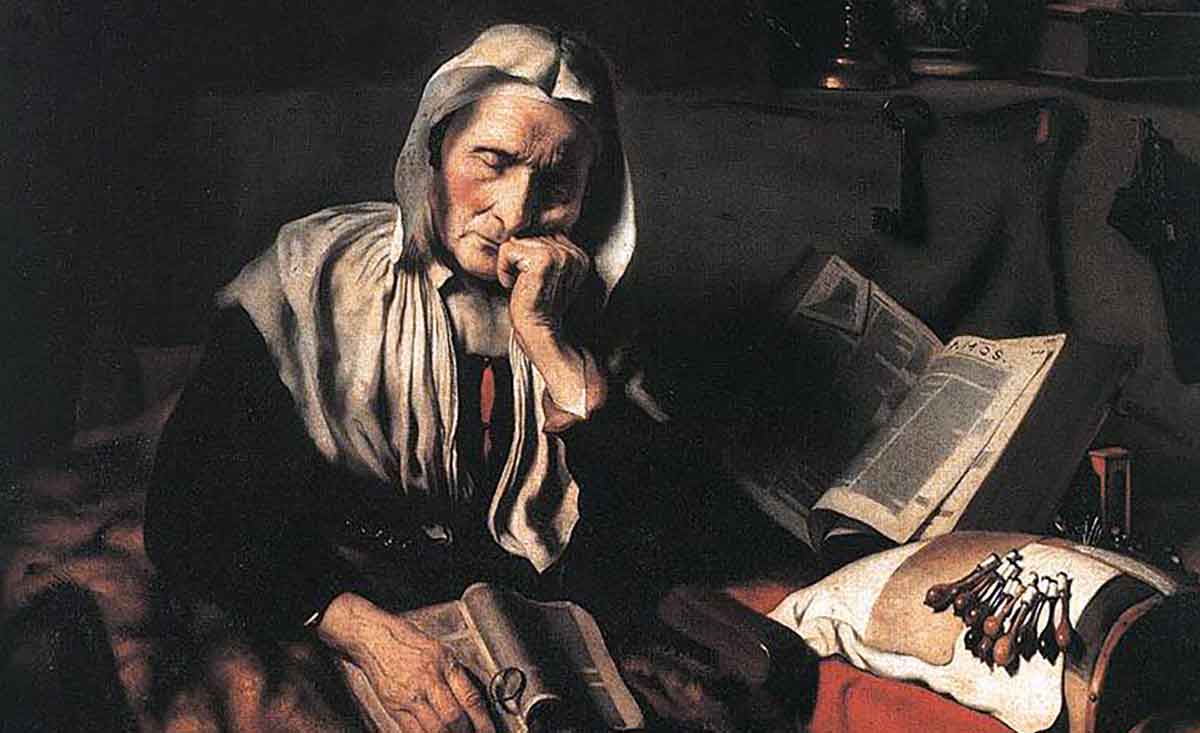
The first of the essays in The Wrong Side and the Right Side is a piece reflecting on old age titled ‘Irony.’ Camus begins by describing the unhappy situation of a partially paralyzed elderly woman he once knew. Her age and her condition had reduced her from vibrant and chatty to a silent and immobile old woman. A deeply religious person, she is accompanied by a lead statue of Christ and a stucco statue of Joseph carrying the infant Jesus.
Camus describes a visit to the home where she lived with her daughter. He and others are meeting there for dinner before going to the cinema to see a comedy movie. The old woman is ignored, sitting silently in her chair. She cannot even join in the meal because of her digestive problems. Camus takes pity on her and tries to talk to her. Afterwards, he is continually aware of her silent presence in the room.
When the group goes to leave, he shakes the old woman’s hand. She will not let him go. Crying, she does not want to be left alone. But they do leave her. Outside, he looks up at the window and sees that the light is out. Her daughter reports that her mother prefers to sit in the dark when alone.
In the essay, Camus also offers vignettes of two other elderly figures: an elderly man whom no one listens to in the bar and his own grandmother. The old man is continually trying to get the attention of the younger men in the bar. He tells tall tales and increases his buffoonery to keep people interested. Everyone, including the old man, becomes increasingly embarrassed by his display.
Camus also discusses his grandmother’s domineering and histrionic behavior. Of particular interest is his fear of appearing insincere by weeping at her funeral: a central idea in The Stranger.
“Between Yes and No”
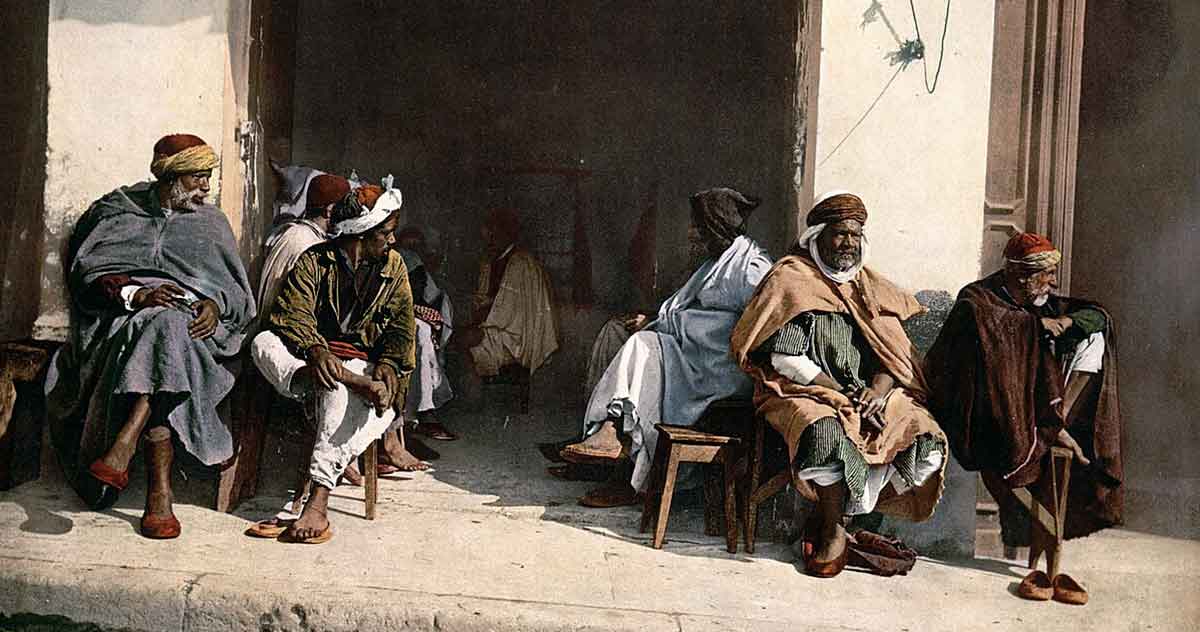
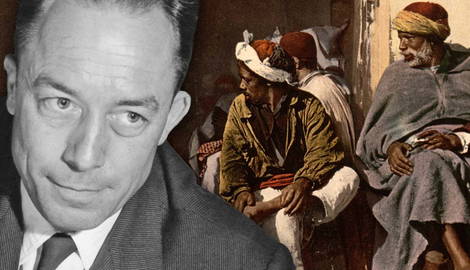
Camus is in a Moorish café in Algiers. It is the evening, and he is reflecting upon memory and happiness. An old Arab man is crouched in the doorway, and his breathing seems to be matched by the sounds of the sea. Camus forms an impression of the universe’s peaceful indifference. A memory from childhood comes to mind. He recalls living in the poor district, the darkness of his unlit house, and the fear of cockroaches scurrying at night.
He remembers his mother sitting silently in her chair. People would often ask what she was thinking about, and she would reply, honestly, “nothing.” He recalls staring at his silent mother and feeling an enormous sense of pity for her. He wonders: “Is this the same as loving her?”
Camus also remembers his grandmother, whom we met in the previous essay. This memory in particular is of the whip she carried to enforce discipline in her household. “Don’t hit them on the head,” is all his mother would say when her mother used the whip on Camus and his brother.
Sitting in the café, Camus compares the indifference of the world around him with the indifference of his mother. He feels neither regret, loss, love, nor happiness at the idea. He simply feels alive, in the moment between yes and no.
His thoughts turn to the macabre. He recalls coming home to discover his mother had been attacked and assaulted by a stranger. And of a cat whose litter of kittens died and rotted one by one. He recalls the cat crouched motionless, watching him clean away her decaying offspring.
Finally, he recalls a banal, limited conversation between himself and his elderly mother. All these memories he experiences with judgment suspended, between affirmation and rejection. Between yes and no.
“Death in the Soul”
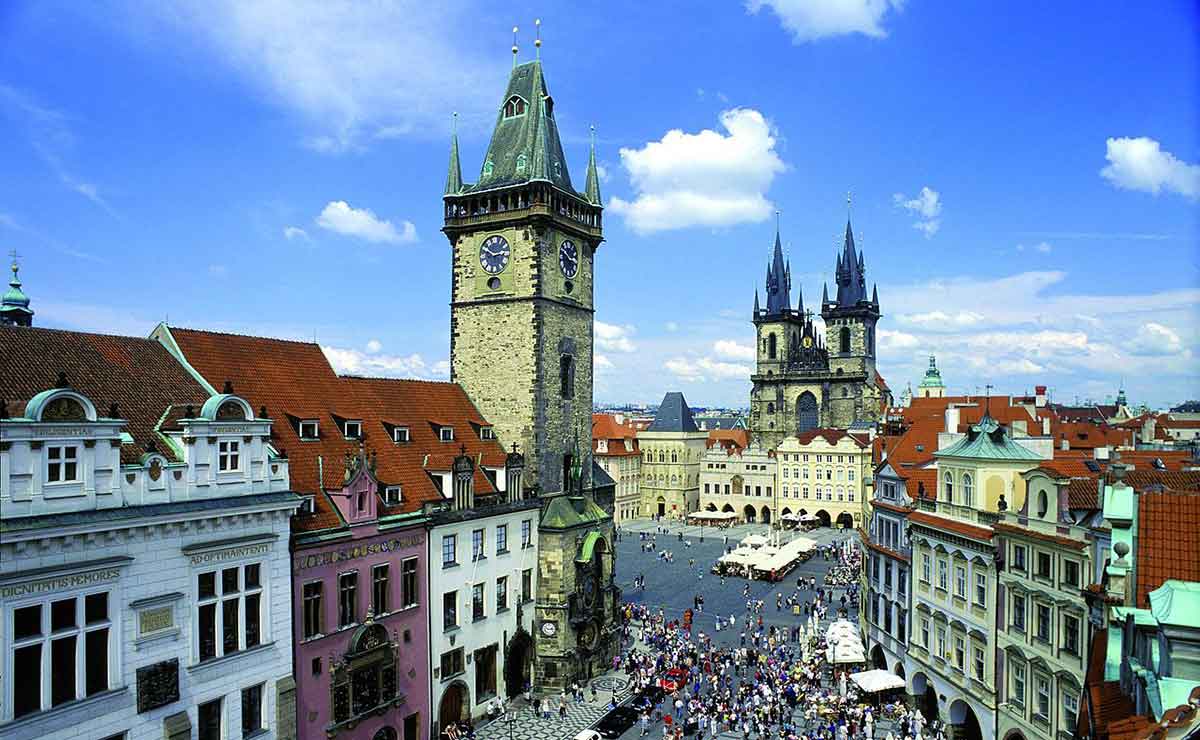
The essay begins with Camus arriving in Prague. He is thousands of miles from home, does not speak the language, and must survive alone, on very little money, for almost a week before being joined by friends. He manages to find a hotel that appears to be in his price range, but upon seeing his room is dismayed to discover that it costs twice as much as he had budgeted for.
Now, he must really scrimp on his spending.
Looking for somewhere cheap for dinner, Camus finds a place in a dingy cellar frequented by prostitutes. Not able to understand the menu, he orders at random and ends up with a meal of porridge and meat covered in cumin. One of the prostitutes is called to his table, and Camus buys her a drink.
Over the next few days, Camus returns to the same restaurant because it is at least familiar, and he is greeted with a nod or a smile. Camus attempts to fill his days, but without speaking the language and being all alone, he feels detached from his surroundings.
One day, he discovers that a man in the room next to his has been found dead. Not suicide but old age. Dead and alone.
It is at this point that Camus is, at last, joined by his friends. Shortly afterwards, they travel together to Italy. Here, Camus shows the stark contrast between his experiences alone in the dingy city of Prague and with friends in the sunny city of Vicenza.
Now, when Camus reflects on both experiences, he says, “Both are dear to me, and I find it hard to separate my love of light and life from my secret attachment to the experience of despair that I have tried to describe.” We see clearly, here, both sides of the coin.
“Love of Life”
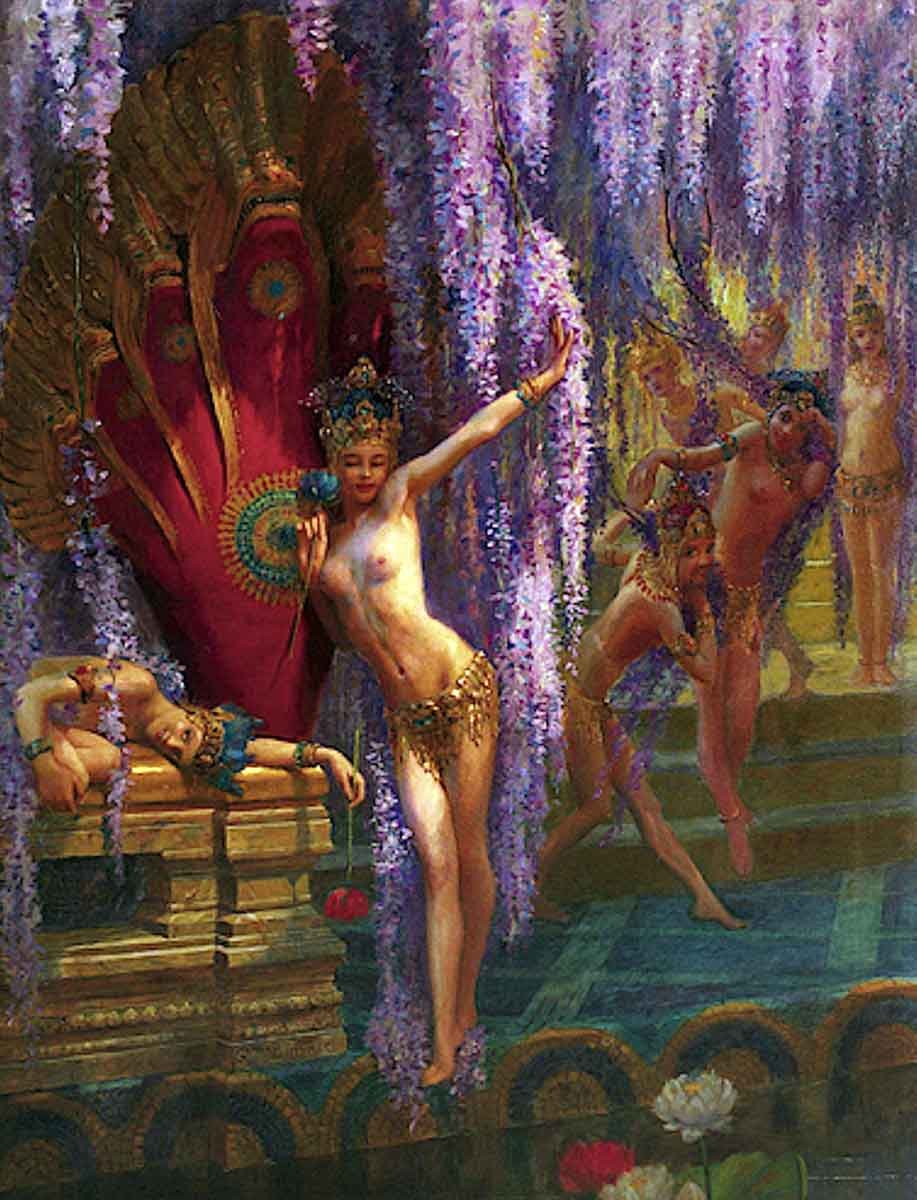
This essay is set in Palma. Camus is in a small restaurant, the walls decorated with pink garlands and with tiny red light bulbs in the ceiling. Despite the size of the venue, it has an orchestra and a well-stocked bar. The restaurant is packed, shoulder-to-shoulder. At Camus’s table is a drunken naval officer, an “ageless dwarf,” and some others.
There is a clash of cymbals, and an enormous woman in her early twenties appears on stage. She performs an erotic dance, which is extremely well-received by the clientele. Camus regards her as a symbol of life itself.
Camus then reflects upon how foreign travel denies us the comfort of the familiar and habitual. He refers to being “stripped of props” and “deprived of masks.” He contrasts the drunken eroticism of the bar with the peaceful tranquillity he experiences sitting in the cloister of the Basilica of San Francisco. Here, the idyllic surroundings also provide symbols of life itself.
What is important to note is that Camus provides no explanations. For example, he does not say why or how the woman dancing in the bar or the pigeons flapping their wings over the cathedral symbolize life. Camus’s point is that these things do not answer questions about life but rather render those questions superfluous. He also observes the ephemeral nature of experiences and the impossibility of making the world one’s own.
We can also note various recurring themes: the contrast of experiences, the inability to express and comprehend strong emotions, alienation and detachment from life, eroticism and death, the passing of time, and the suspension of judgement (being between yes and no).
“The Wrong Side and the Right Side”
The final essay of the collection introduces us to a “lonely” and “peculiar” woman. We learn that she believes she is in close contact with the spirit world. She even avoids members of her own family who “have a bad reputation” in the other world.
The story begins with this woman receiving an inheritance of five thousand francs from her sister. This money proves to be more of an inconvenience than a boon. Small fortunes are more difficult to handle than large ones. An additional problem is that the woman is already nearing the end of her life, and so any long-term investment would be meaningless to her.
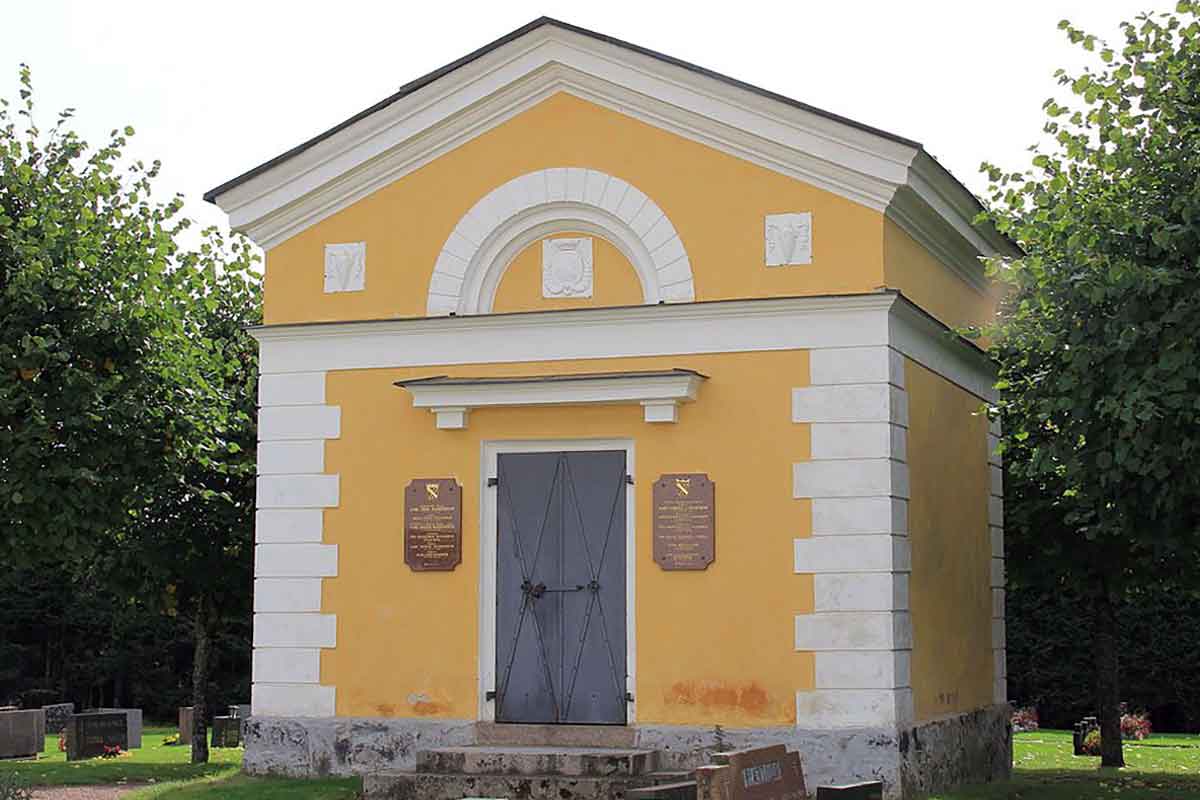
The solution arrives in the opportunity to purchase an expired lease at the local cemetery. For four thousand francs, she is offered the plot that comes complete with a black marble tomb. The woman makes the purchase and has the interior of the tomb kitted out, ready to receive her remains when the time eventually comes. She also has her own name carved into the black marble in gold letters.
Every Sunday, the old woman “visits herself,” entering her tomb and kneeling alone on the prie-dieu. It is her sole form of entertainment and the only time she leaves her home. On one occasion, she arrives at the cemetery to discover someone has laid flowers at her tomb. A kind-hearted person, seeing a grave unadorned with flowers, has left some of their own. For all intents and purposes, this woman who visited herself every Sunday is already dead; in her mind and the minds of others.
This last story of a neglected old woman, alone at the end of her life, bookends the collection along with the old woman whose story we read in Irony.