In the 1920s, an era of glitz, glamor, and abundant growth, artists pushed aesthetic boundaries, experimenting with abstraction and modern subject matter. Now, in the 1930s, with the country mired in a severe depression, artists shifted to a compassionate chronicling of the suffering of their fellow Americans. Many regionalist painters lionized hard work both on the land and in the factory, while photographers captured scenes of deprivation and endurance, and Mexican muralists suffused their capacious works with strains of socialism. The material culture of the 1930s is sometimes overshadowed by the decade’s political and economic trials and triumphs. Still, these artists’ ability to witness, sympathize, celebrate, and immortalize ordinary Americans makes them worthy of our attention.
1. Walker Evans (1903-1975)
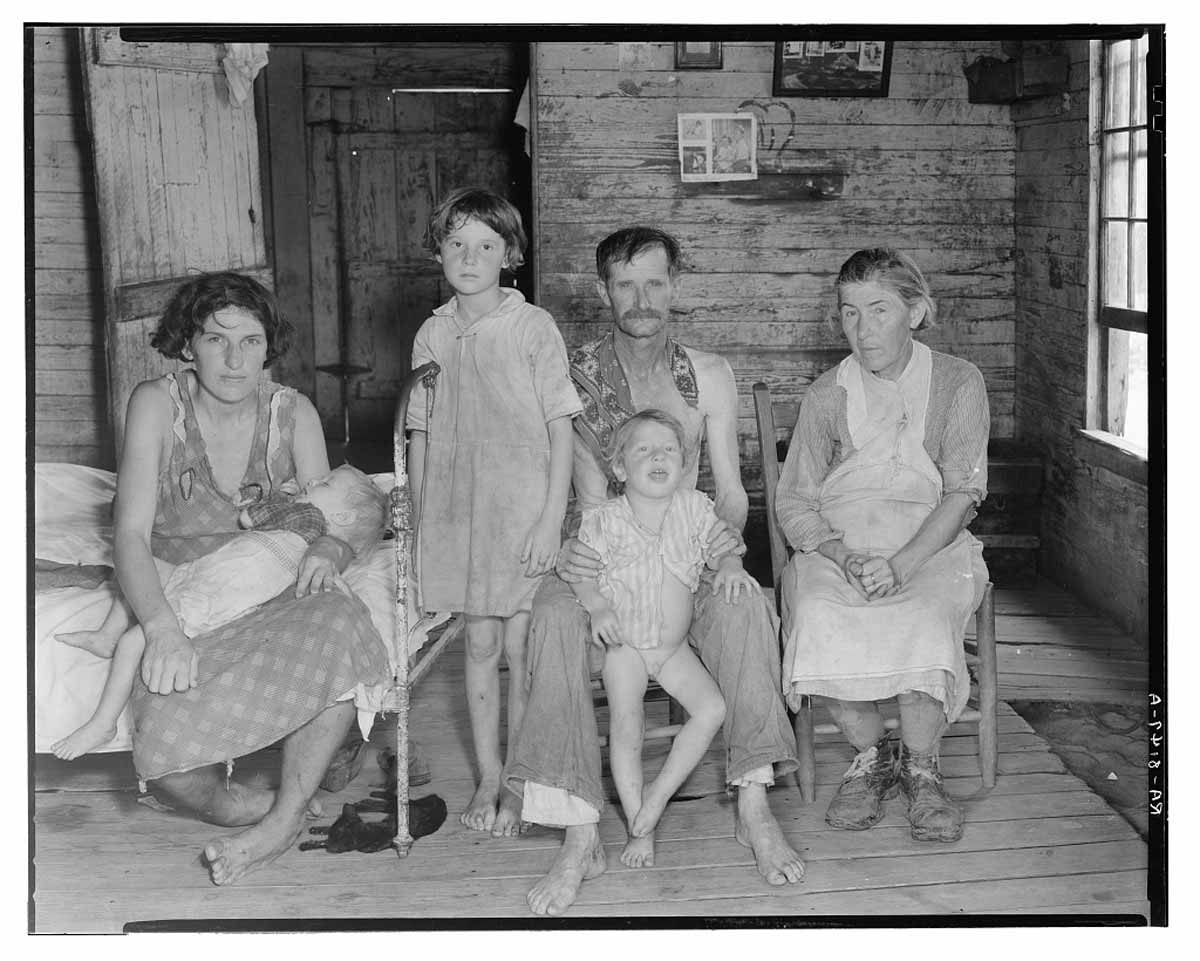
Walker Evans and James Agee’s work 1941, Let Us Now Praise Famous Men, which set Evans’ photos alongside Agee’s prose to tell the stories of struggling Alabama tenant farmers in the 1930s, is one of the most famous works of documentary history in the 20th century. Evans’ images of derelict, one-room shacks, children in dirty smocks next to their parents with haunted eyes, listless sharecroppers, and decaying farms revealed just how hard hit the farmers were. The image of Bud Fields and his family is one of the most well-known of the series, depicting a family that maintains connection and dignity even amidst the squalor.
Evans was also a photographer of city life. He captured how people ate, dressed, traveled, and entertained themselves, all amid one of the most difficult times in the nation’s history. His direct and sincere images of the American vernacular were profoundly influential for later documentary photographers such as Lee Friedlander, Gordon Parks, Garry Winogrand, and more.
2. Isaac Soyer (1902-1981)
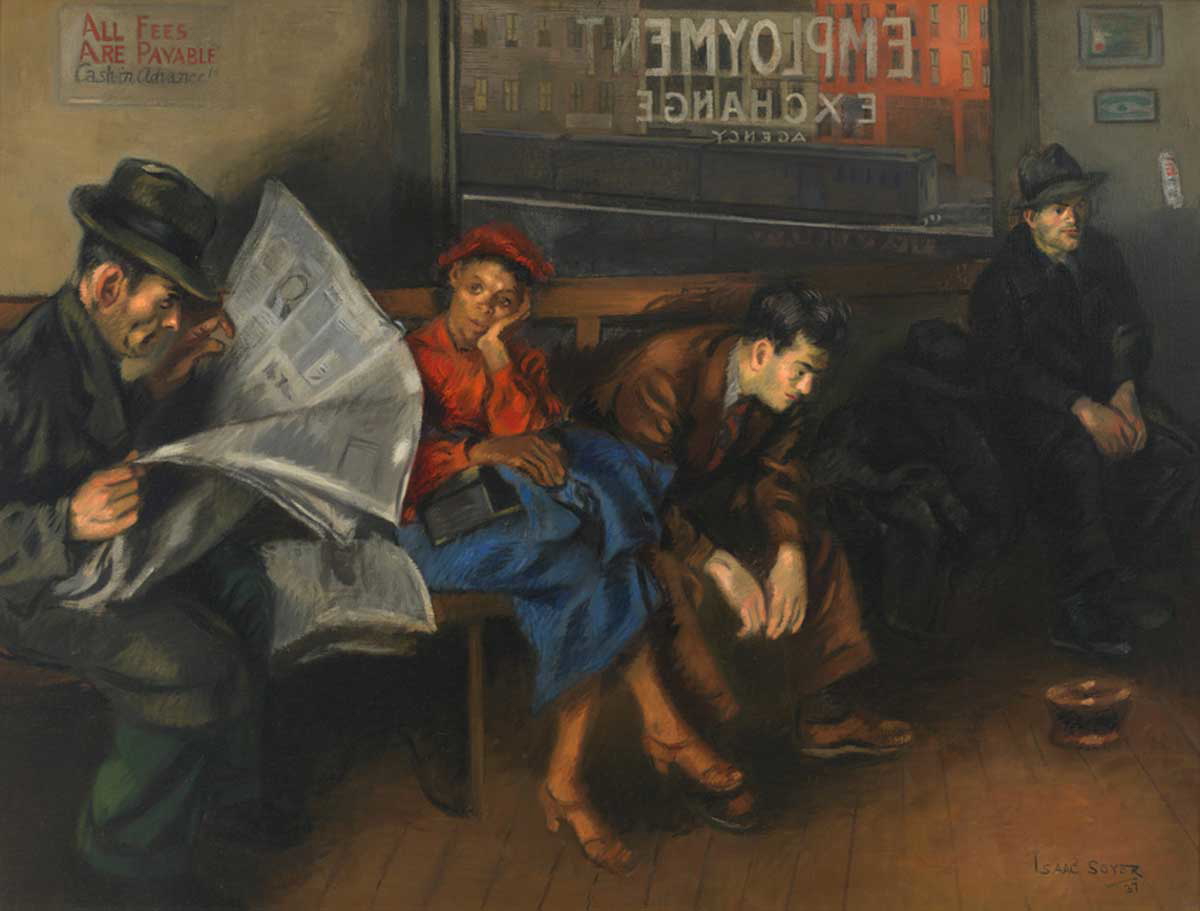
The Russian-born Isaac Soyer, along with his brother Raphael Soyer, was known for his paintings of working-class Americans. Shoeshine boys, laundresses, and construction workers populated his canvases, all rendered in a humble, realistic style.
In his Employment Agency from 1937, Isaac Soyer gives us four job-seekers whose expressions and body language attest to their weariness and anxiety. Our eye is first drawn to the Black woman in the center, woefully leaning her head in her hand, her thoughts somewhere outside the confines of the room. One man slumps over, staring at the ground; another sits quietly, hands clasped, and yet another buries his head in a newspaper, perhaps scanning for jobs or taking in the latest economic forecast. It’s a glum, dispiriting scene. Soyer’s palette of mostly brown, black, and gray—the notable exception being the woman and her ironic color palette of patriotism—captures what many Americans felt as they searched for economic relief.
3. Dorothea Lange (1895-1965)
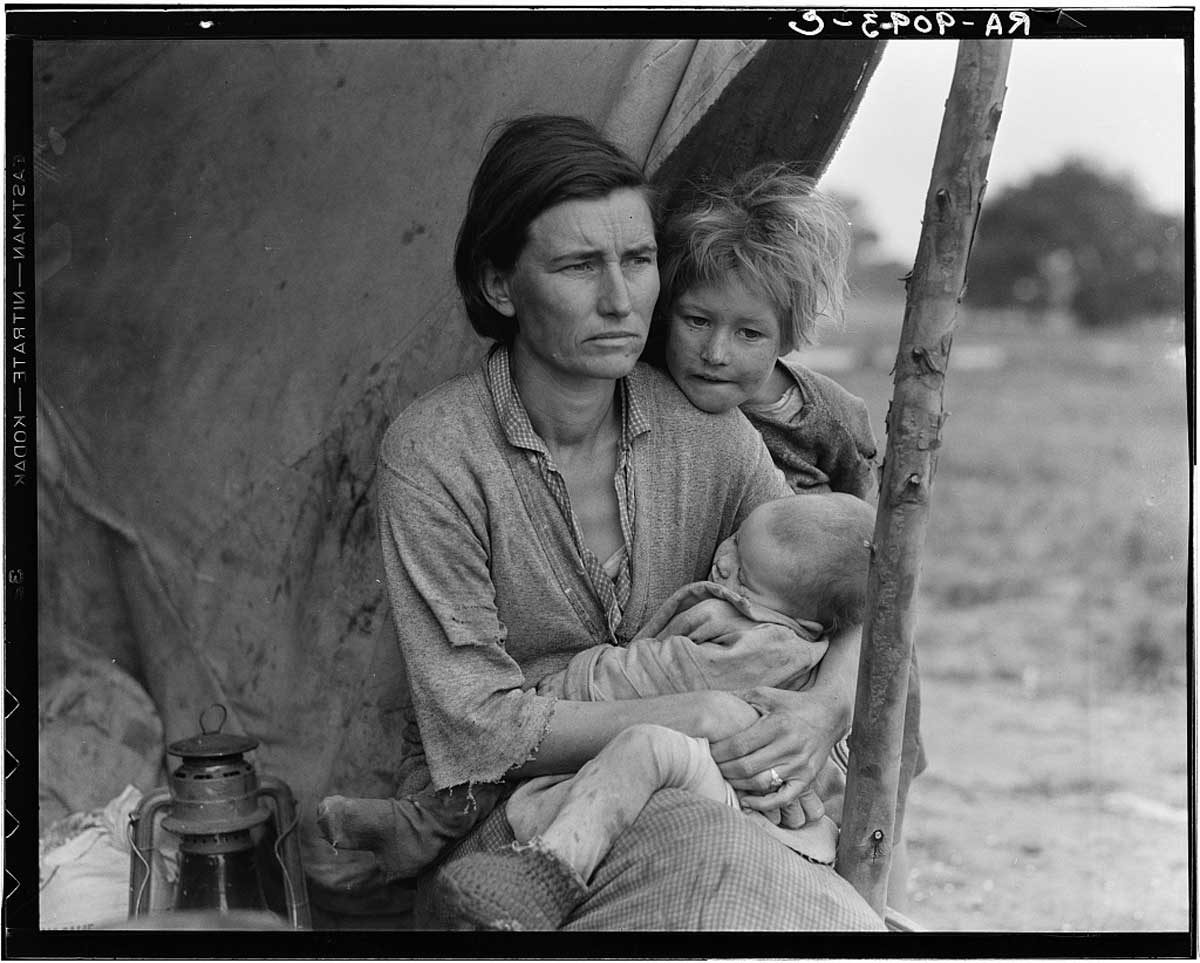
Arguably one of the most famous chroniclers of the Depression, Dorothea Lange brought empathy and elegance to images that were often gut-punchingly heartbreaking. She got her start in commercial photography, but that work dried up during the early years of the Depression. Her real preference was to document real people and their experiences, however, so she took work with a New Deal program called the Resettlement Agency (its name later changed to the Farm Security Administration).
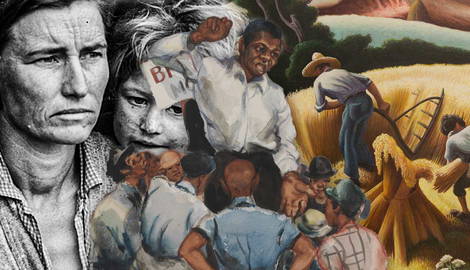
It was for the RA that she took a series of photographs of a beleaguered mother, Florence Owens Thompson, and her children, whom she encountered at a pea-pickers’ camp in Nipomo, California. Lange said she “saw and approached the hungry and desperate mother, as if drawn by a magnet,” and learned “that they had been living on frozen vegetables from the surrounding field and birds that the children killed.”
Owens Thompson’s drawn brows, pursed mouth, and staring eyes conveyed a welter of emotions—worry, sorrow, hopelessness, and abiding love for her children, who, in some images, cling to their mother. Lange’s work is raw but never exploitative; her subjects are first and foremost human beings, and instead of being “othered,” they are made manifestly familiar.
4. Thomas Hart Benton (1889-1975)
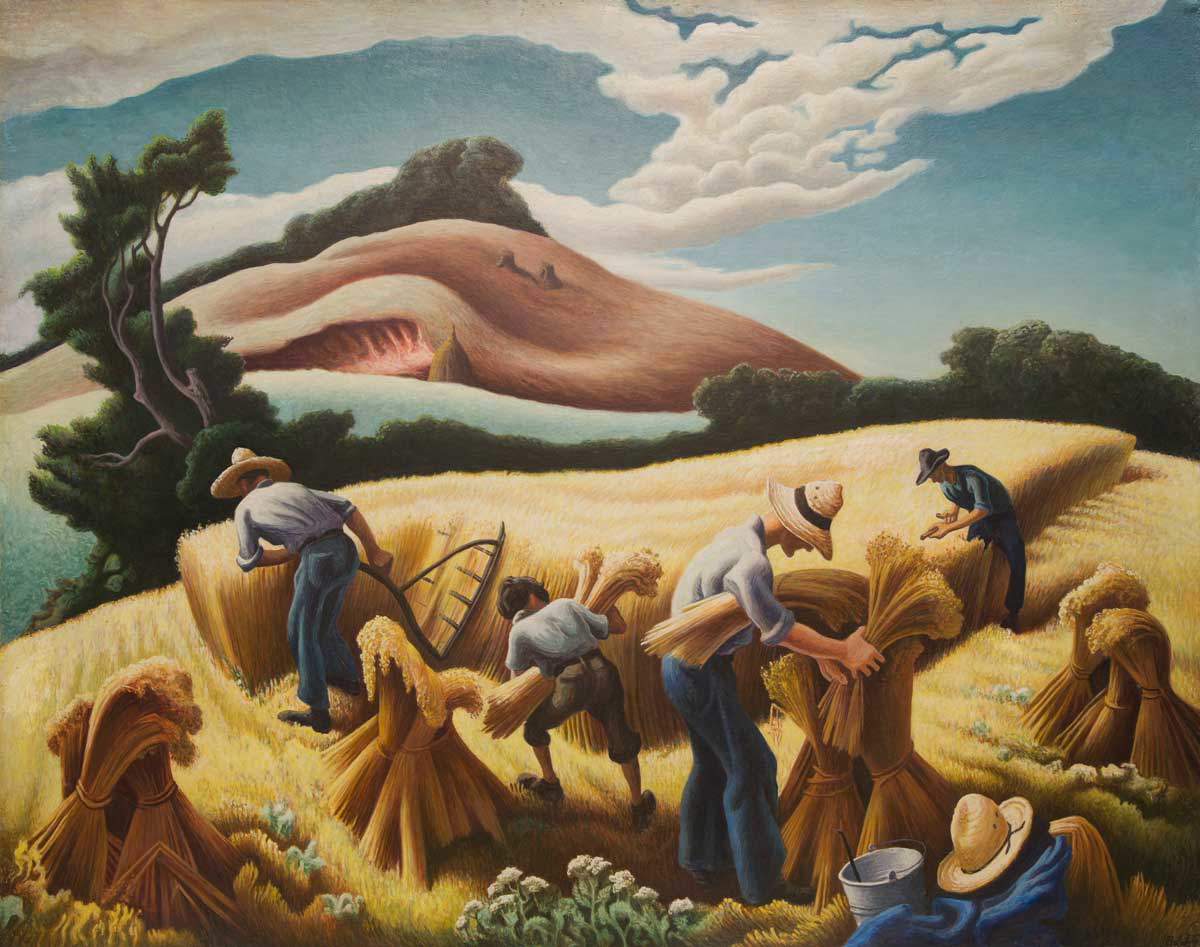
In the story of modern American art, Benton is usually first mentioned as abstract expressionist painter Jackson Pollock’s influential teacher, but his work is worth considering for its own merits rather than simply his inculcation of the talent of others. Indeed, Benton’s monumental paintings of regional life in America during the 1930s—his subjects farm, tame horses, play the fiddle, attend church, labor in factories, and try to survive the Dust Bowl—are more than just aesthetic statements, but are also meditations on American identity and values. Benton imbues his ordinary scenes with heroism, celebrating fortitude, resilience, tenacity, and hope in the face of seemingly intractable trials and tribulations.
Cradling Wheat (1938) is an apt example of Benton’s concerns. Here, five people, likely field hands, are gathering wheat under a bright blue sky. One is a young boy, demonstrating the collective need for work and the transmission of values from the older generation to the younger. The harvesters bend and curve and lean and stoop, putting in the work they need to in order to survive. Their sinuous forms are echoed in the undulating clouds and landscape, suggesting an accord between man and nature.
5. Reginald Marsh (1898-1954)
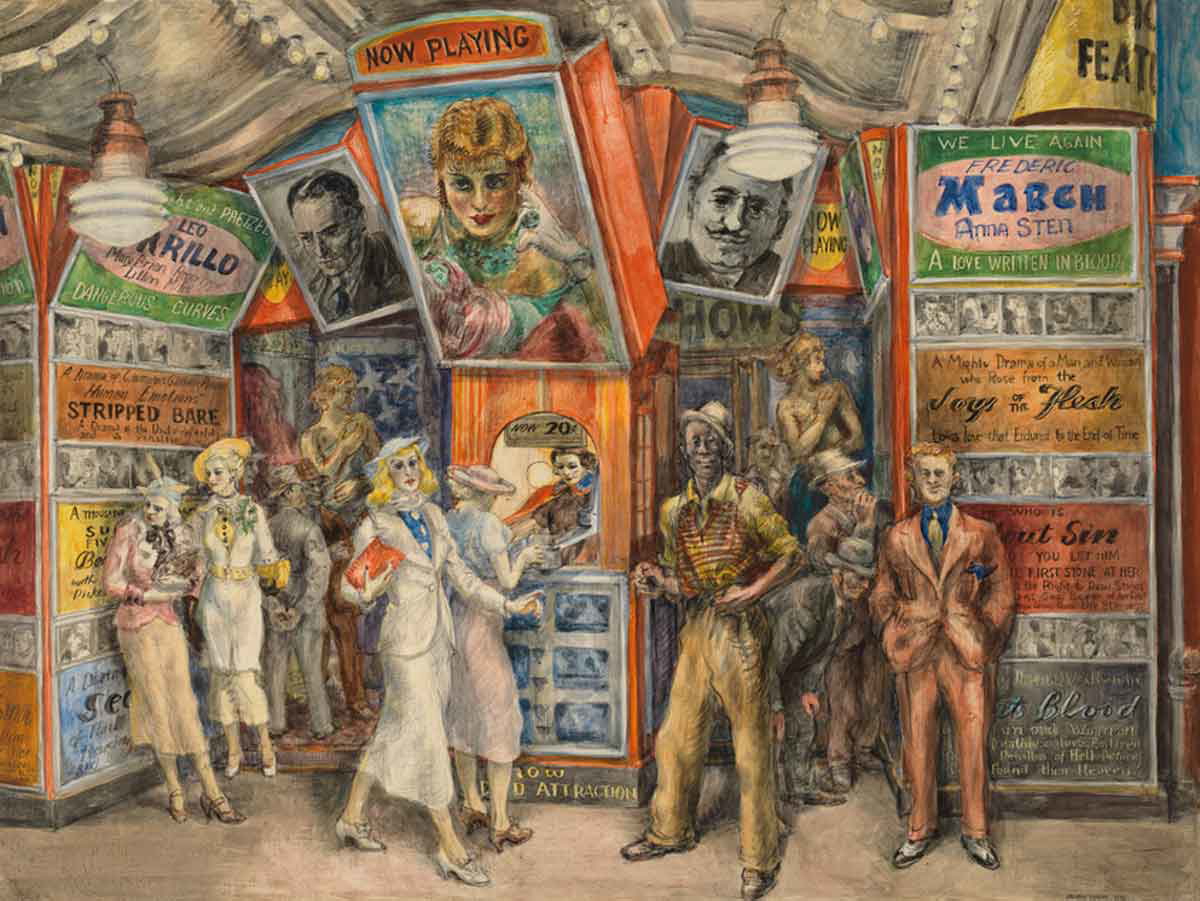
Though Reginald Marsh was painting his city scenes around the same time as Edward Hopper, the differences between the contemporaries are stark. Instead of solitary figures, Marsh delights in loud, jostling crowds. Instead of meditative scenes with a touch of the uncanny, Marsh paints raucous scenes at Coney Island, movie theaters, vaudeville shows, and street corners. His colors are oftentimes dirty grays and browns, other times glaring reds and gaudy chartreuses.
His subjects are regular people, or even a notch below—Bowery bums, showgirls, leering men, subway vagrants. Marsh isn’t judgemental; his open, capacious view of human life is tinged with amusement, sympathy, and delight. Some of his scenes and certainly some of his stylistic choices (the egg tempera introduced to him by Thomas Hart Benton, his close friend, created the rather shabby effect) may be sordid, but they’re slices of life, tableaus of what people did to ameliorate some of the effects of the Depression.
One of Marsh’s most well-known pieces is Twenty Cent Movie, a funny and mildly salacious view of the Lyric Theatre and its current showings. The films advertised are far from highbrow, cheekily advertising “The Joys of the Flesh,” “Dangerous Curves,” and “A Love Written in Blood.” A few men loiter off just inside, peering at the wares within, while others stare out smugly at the viewer. A handful of women are on the opposite side, purchasing tickets or leanly coyly against the signs. Their clothes are flashy, their faces made up, their hair bleached by peroxide. Marsh is abundantly honest about what sort of entertainment many people were seeking but doesn’t finger-wag—times were tough in the 1930s. Then, as now, cinema, sex, and the anonymity of the city were refuges.
6. Diego Rivera (1886-1957)
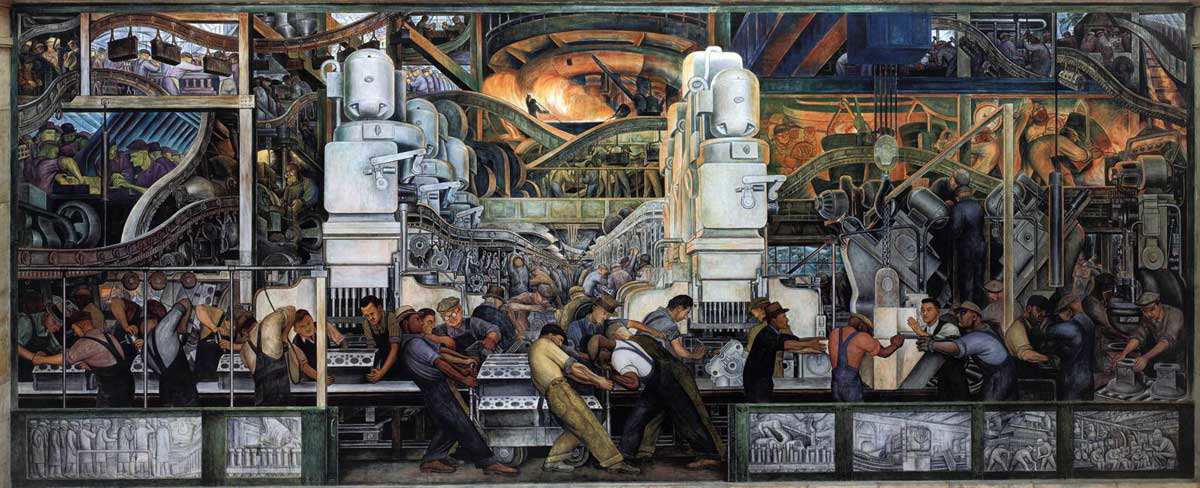
The mural tradition in Mexico in the 1920s and 1930s was both traditional—Renaissance frescoes—and modern—Europe’s current avant-garde—and the subject matter spanned both history and the present as well. After political tensions in Mexico intensified, the muralists began taking commissions in America.
These muralists, who included Diego Rivera, Jose Clemente Orozco, and David Alfaro Siqueiros, were arguably as significant as the American regionalist painters in both depicting and shaping the consciousness of the Depression-era worker. They implicitly and explicitly embedded socialist themes in their monumental works, excoriating the wealthy capitalist classes and upholding the virtue of the working man. At the same time, though, many of them also celebrated technological and industrial progress, setting their scenes inside factories.
One of Rivera’s most well-known works is Detroit Industry, a commissioned piece for the Detroit Institute of Art’s Garden Court. What was eventually expanded to four murals includes scenes promoted by the Ford Motor Company, one of the funders of the piece. Rivera toured and sketched the company’s plant, and his finished work centers on the technological marvels of the automobile industry of Detroit. The piece is remarkably complex, and its scenes include the relationship between man and industry, the benefits and pitfalls of that industry, the movement from agriculture to mechanization, the daily life of a worker, other industries in Detroit beyond the automobile, and more. Though it initially received some backlash for being inappropriate for its site and not “American enough,” the museum unequivocally supported it, and the controversy faded, leaving the work a revered contribution to Detroit’s—and America’s—art scene.
7. Berenice Abbott (1898-1991)
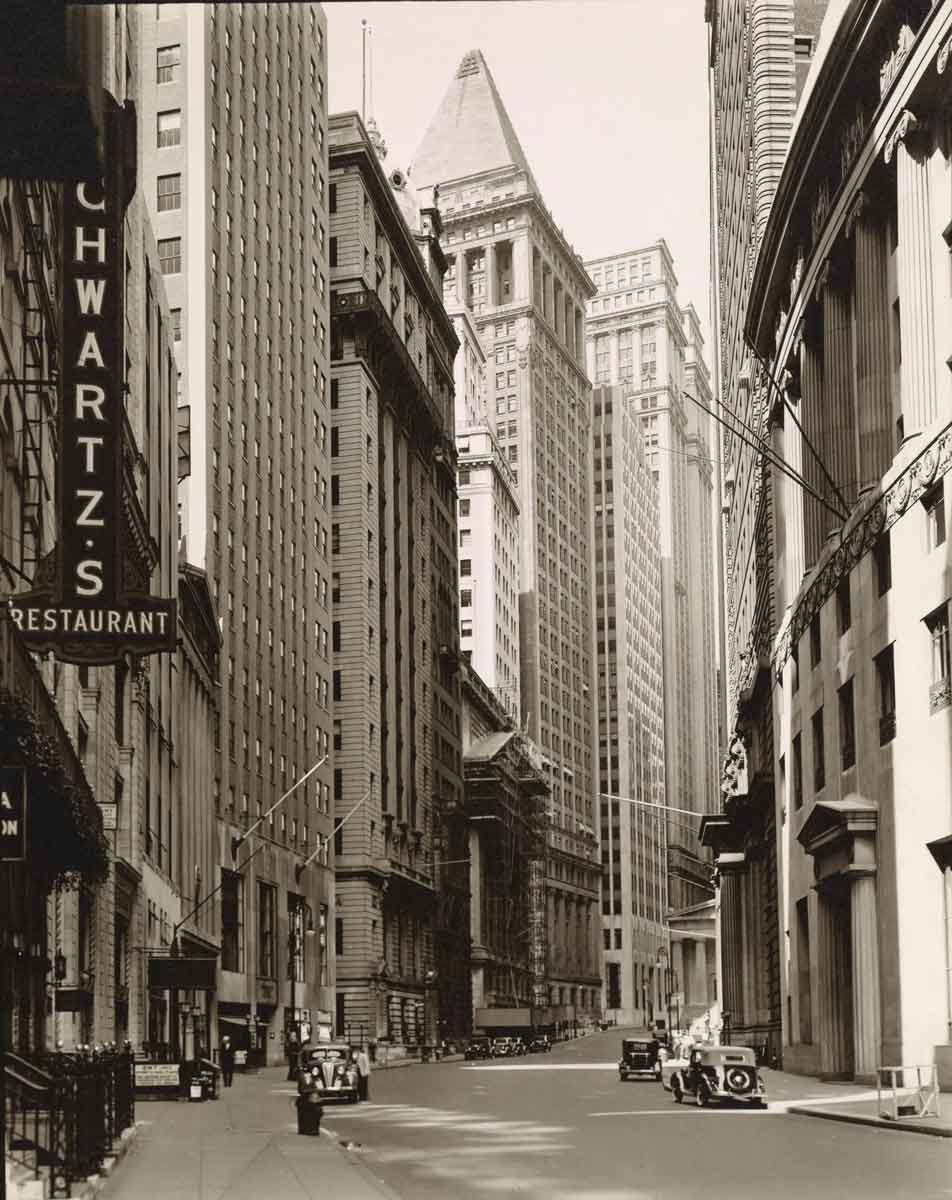
Berenice Abbott was one of the most accomplished chroniclers of New York City in the 20th century. In her book of photographs, Changing New York, her images of soaring skyscrapers, narrow streets and long avenues, bridges, building façades, scaffolding, signs, and bustling people showed the city negotiating the old and the new. Tenement buildings with lines of laundry hanging out to dry abut the most modern of buildings. Brick contrasts with steel. Trains, trolleys, and automobiles rumble through the streets and across the gleaming bridges. Small shopkeepers pose in front of their humble storefronts; traders rush towards the Stock Exchange.
There’s a sense of an older New York tenaciously holding on amid tremendous change, but it’s clear that it won’t be there much longer. Abbott explained that she felt compelled to document this change, for “the city is in the making and unless this transition is crystalized now in permanent form, it will be forever lost… The camera alone can catch the swift surfaces of the cities today and speaks a language intelligible to all.”
Abbott’s work isn’t specifically about the Depression, but she was supported by the New Deal’s Works Progress Administration (WPA) and it is about urban life during the Depression. New Yorkers, just like everyone else, experienced disruption and despair when the stock market crashed (and it crashed right there, in their own city!), but they had to continue going about their business. Though in most of Abbott’s photos, people are either absent or diminutive when they are present, they’re fully alive—working, walking, building, ruminating, chatting. They’re not only keeping the city going but also adding to its grandeur; for example, the Empire State Building, for a time the tallest building in the world, was completed in 1931. Abbott may not be explicitly chronicling the country’s trials and tribulations in the 1930s, but she’s still showing how people lived and endured.
8. Grant Wood (1891-1942)
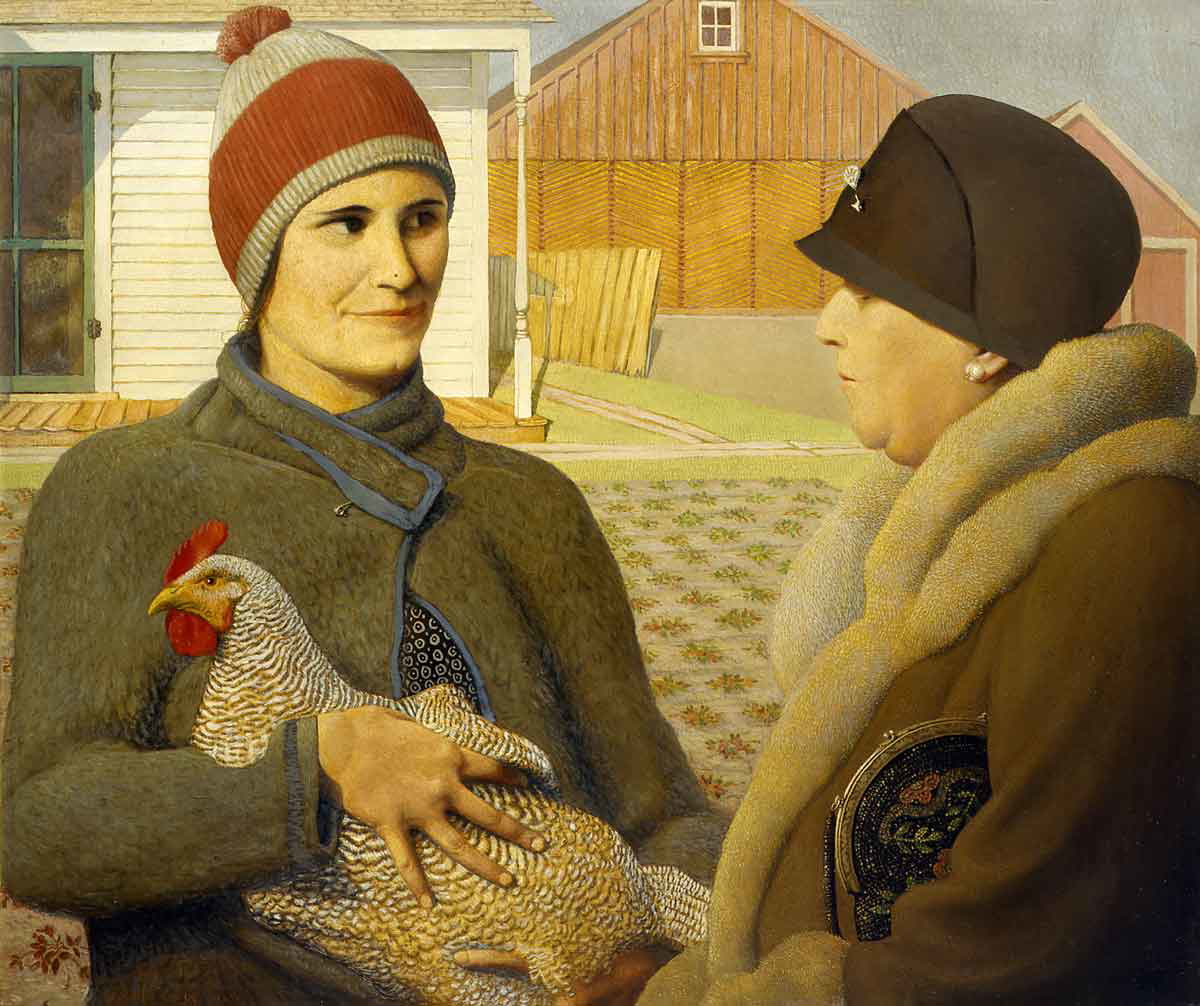
Grant Wood’s presence on this list can easily be attributed to his most iconic work, American Gothic, but the rest of his oeuvre is just as compelling in its evocation of small-town Midwestern life during the Depression. Born and raised in Iowa, Wood nourished his artistic proclivities in Europe and then moved back home, where he founded an art colony and later became a professor at the University of Iowa. His European sojourn had given him a deep appreciation for the work of Northern Renaissance painters. Consequently, his own works, many of them portraits, featured invisible brushstrokes and hard-edge modeling of figures, almost unearthly light, crystalline colors, and an overall naif appearance occasionally subtly infused with elements of the uncanny or the mystical.
In Appraisal, two women fill almost the entire picture plane, one dressed in more rural attire—a knit hat, a roughly textured green coat, and a patterned blouse—and the other clad in luxurious clothing that indicates she is from the “big city.” The city woman is looking at a large chicken in the other’s hand, “appraising” it most likely for her meal. The rural woman, by contrast, appraises the city woman and, by her expression, clearly seems to find her wanting.
9. Dox Thrash (1893-1965)
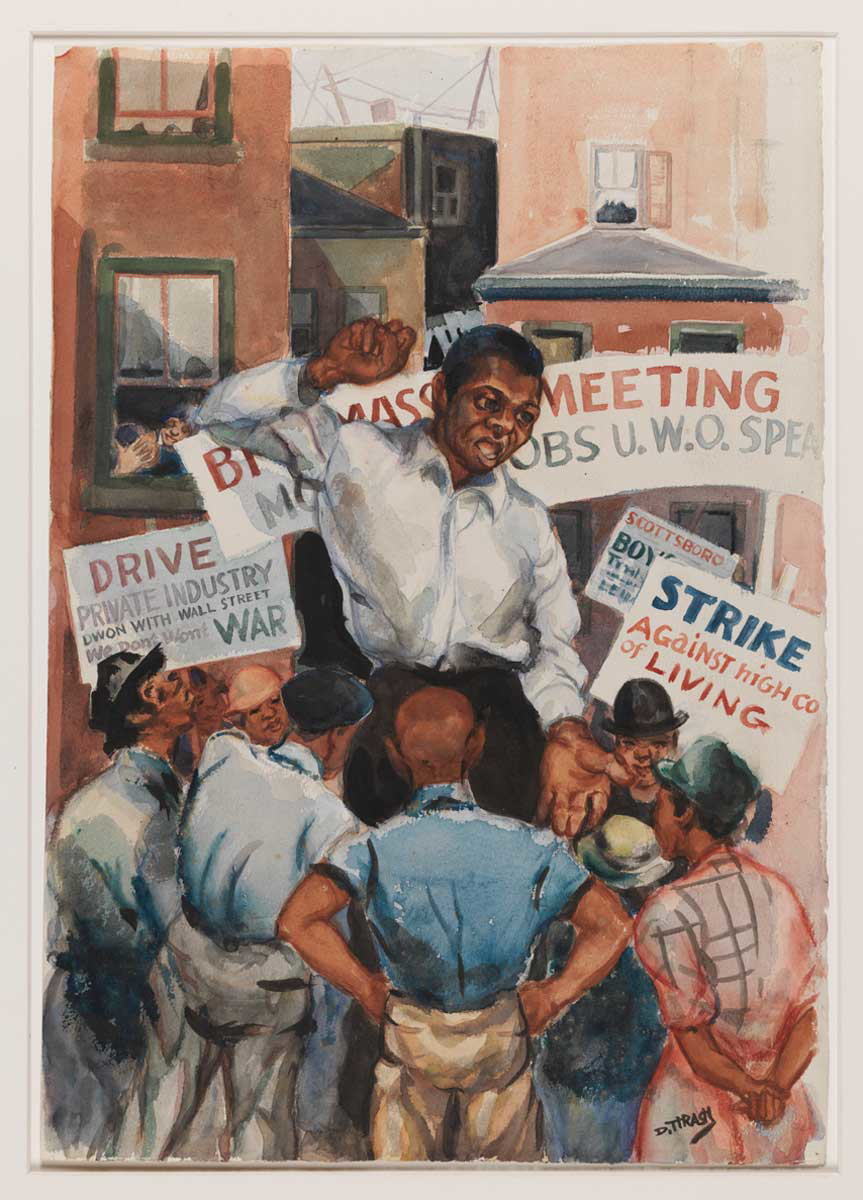
Dox Thrash is far from a household name, which is a shame since his works are some of the most insightful images that came out of the Works Progress Administration’s Federal Art Project. An African-American artist, he chose to highlight some of the struggles that his Black brothers and sisters faced. Though most Americans struggled with finding work and keeping it, Black Americans were the first fired and the last hired, not to mention the frequent targets of racialized violence when their behavior challenged the entrenched white supremacy of the era.
In Untitled (Strike), circa 1940, a Black man with a raised fist stands above a crowd of Black laborers whose backs are mostly turned to the viewer. They look up at the shouting man, trying to decide if his calls for unionization, better wages, and avoiding going to war are ideas they want to embrace.
In 1937, at the Philadelphia Fine Arts Workshop under the support of the WPA, Thrash was one of three inventors of the carborundum print process, which consists of grinding up the carborundum (a synthetic silicon carbide) onto a copper plate before inking it and subsequently creating images exquisite black and white gradations. A new printing process hadn’t been created in a hundred years, and Thrash called it the “Ophealiagraph” after his mother. He went on to create stunning images of Black life: the cabin in rural Georgia where he grew up, portraits of his Philadelphia neighbors, grim city slums, and, later, when the war did come, Black workers helping to keep the country’s production high.
10. Augusta Savage (1892-1965)
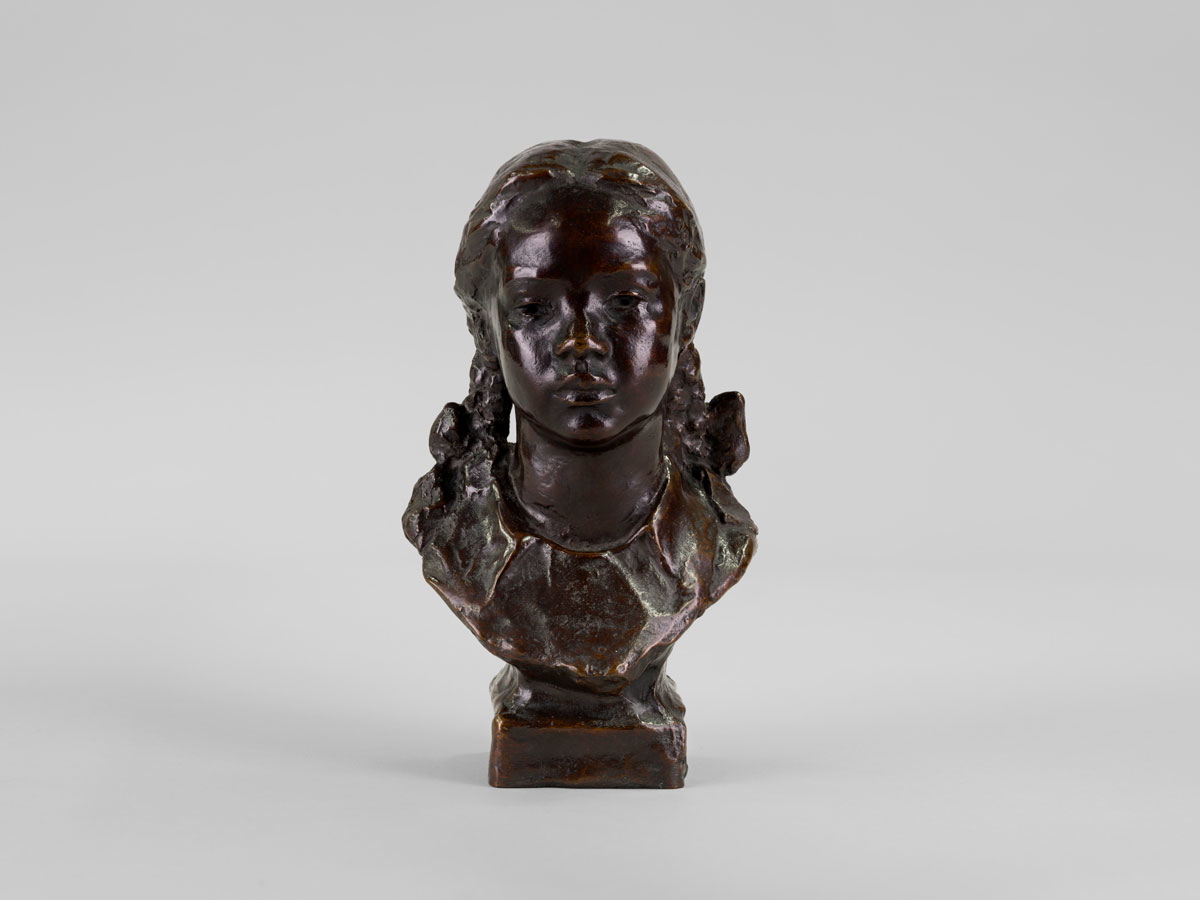
Like Dox Thrash, Augusta Savage chronicled Black life during the Depression, turning her skillful and sympathetic eye to her neighborhood of Harlem, which she’d moved to in 1921, the beginning of the Harlem Renaissance. Her preferred medium was sculpture, particularly bronze, and among her subjects were friends, children, and Black community leaders like W.E.B. DuBois and Marcus Garvey. She created her work with compassion and skill; the bronze busts like that of the Girl with Pigtails are realistic but also imbued with beauty and grace.
Savage was also known as a teacher. She co-founded the Harlem Arts Workshop in 1935, was a founding member of the Harlem Artists Guild, and worked for the Works Progress Administration from 1936-1937, directing the Harlem Community Art Center. Her students included such notable artists as Jacob Lawrence and Norman Lewis. She humbly said, “I have created nothing really beautiful, really lasting, but if I can inspire one of these youngsters to develop the talent I know they possess, then my monument will be in their work.”