
At some time in the 8th or 9th century, the epic poem Beowulf was first written in Old English, having likely existed in some form through the oral tradition for many centuries before.
In 1939, a team led by archaeologist Basil Brown unearthed a ship-burial beneath Mound One at the site of Sutton Hoo. Taken together, Beowulf and Sutton Hoo help to illuminate one another and give us a rich and colorful insight into an otherwise dark age.
Context
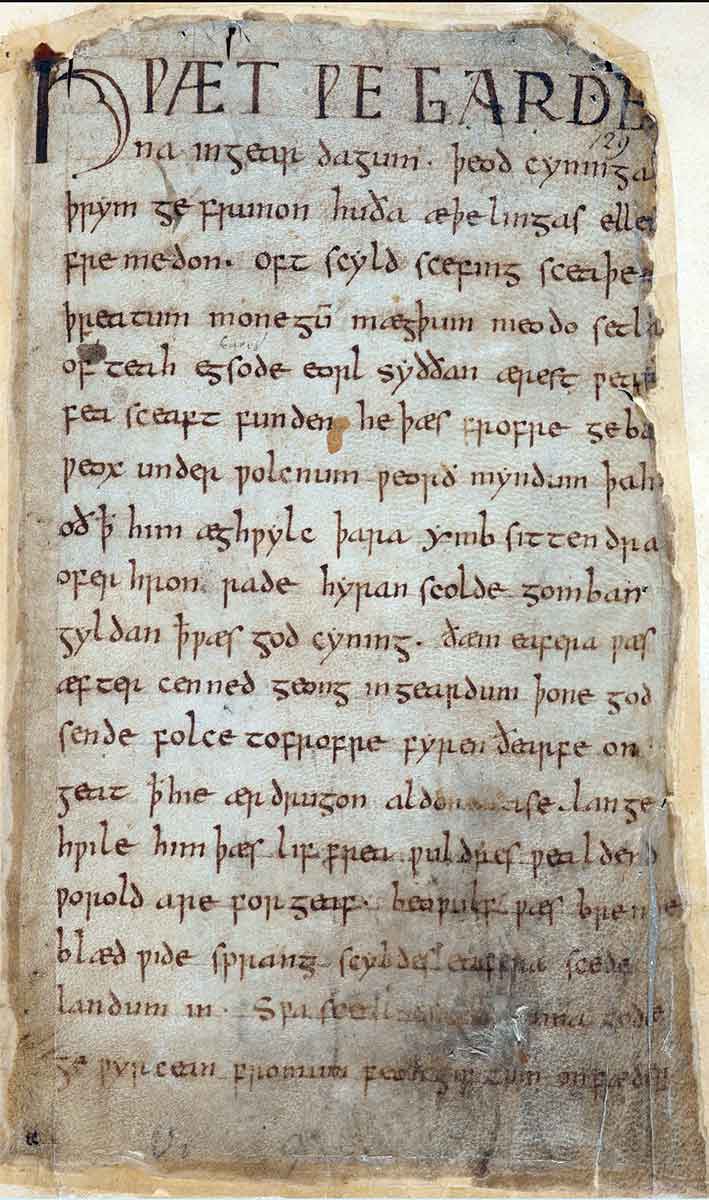
There is some scholarly debate as to when Beowulf was written. The manuscript we have dates from the 11th century, but most scholars estimate that the epic was first penned before this, in the 8th or 9th centuries. What is even more difficult to deduce is when, if ever, the events of the poem might be imagined to have taken place. Scholars are able to identify certain characters as real historical figures, like Beowulf’s uncle Hygelac, King of the Geats, who is mentioned by the 6th-century chronicler Gregory of Tours. It seems fairly certain that the Beowulf poet tells us about a world inspired by the post-Roman age, in the 5th and 6th centuries AD.
This period is often dubbed the “heroic age,” largely because we have almost no literary sources for Northern Europe in this period, and thus most of the information we have about this era comes from stories told later, in which semi-mythical heroes bestride the world and do battle with monsters and with one another. The stories of King Arthur were imagined to have taken place in a similar time period.
Excavations in Lejre, Denmark, revealed the remains of several large wooden halls, with some dating from the 6th century. These findings have, of course, drawn parallels with Beowulf’s Heorot and suggest that the broad outlines of the setting of Beowulf may have had foundations in historical reality.
Excavations at Yeavering in Northumbria also revealed the centrality of the immense wooden long-hall for kings in the 6th and 7th centuries. It seems that the post-Roman age was one in which the mead-hall was central to the exercise of kingly authority and to the forging of bonds between them and their people.
The king that most scholars believe to be the man buried beneath Mound One at Sutton Hoo was Raedwald of East Anglia, who lived at the end of the 6th and beginning of the 7th centuries, dying in around 624.
Raedwald lived towards the end of the “heroic age,” as the spread of Christianity and of literacy across the Anglo-Saxon kingdoms was transforming society. Whether or not the individual beneath the mound was Raedwald, scholars are confident in dating the burial to the early-to-mid 7th century, not least because the presence of Merovingian coins in the grave indicates the Frankish kings who were on the throne around the time of the burial.
The setting of Beowulf, to the extent that it reflects any historical reality, is likely a world that is older than the Sutton Hoo ship-burial, though not significantly older. The centrality of warrior culture and the mead-hall, the fascination with animals and beasts, the importance of finery, and more all suggest that these two worlds would have understood one another and shared a good deal in common.
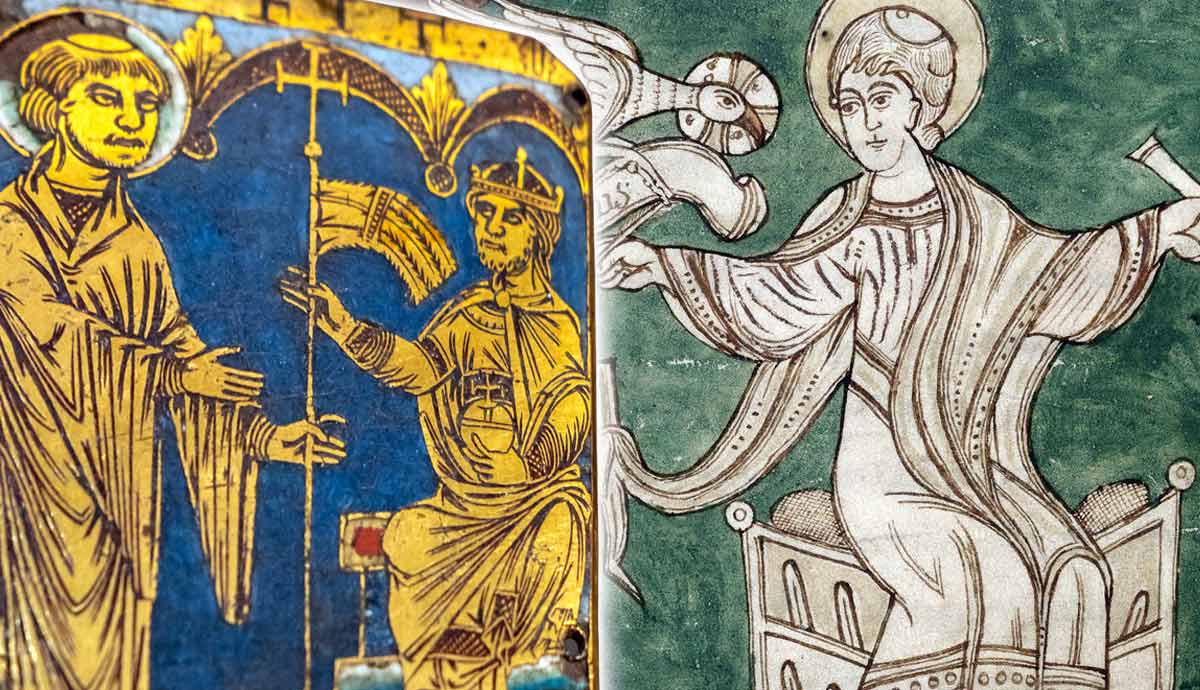
Another similarity is that the world of Beowulf and that of Sutton Hoo are both pagan. Although in the case of the latter, this was on the verge of changing. The first Christian Anglo-Saxon king, Aethelbert of Kent, died eight years before the death of King Raedwald of East Anglia, and according to Bede, Raedwald had himself converted to Christianity, though he seems to have renounced this later in his life (or at least not let go of his pagan deities).
Geography
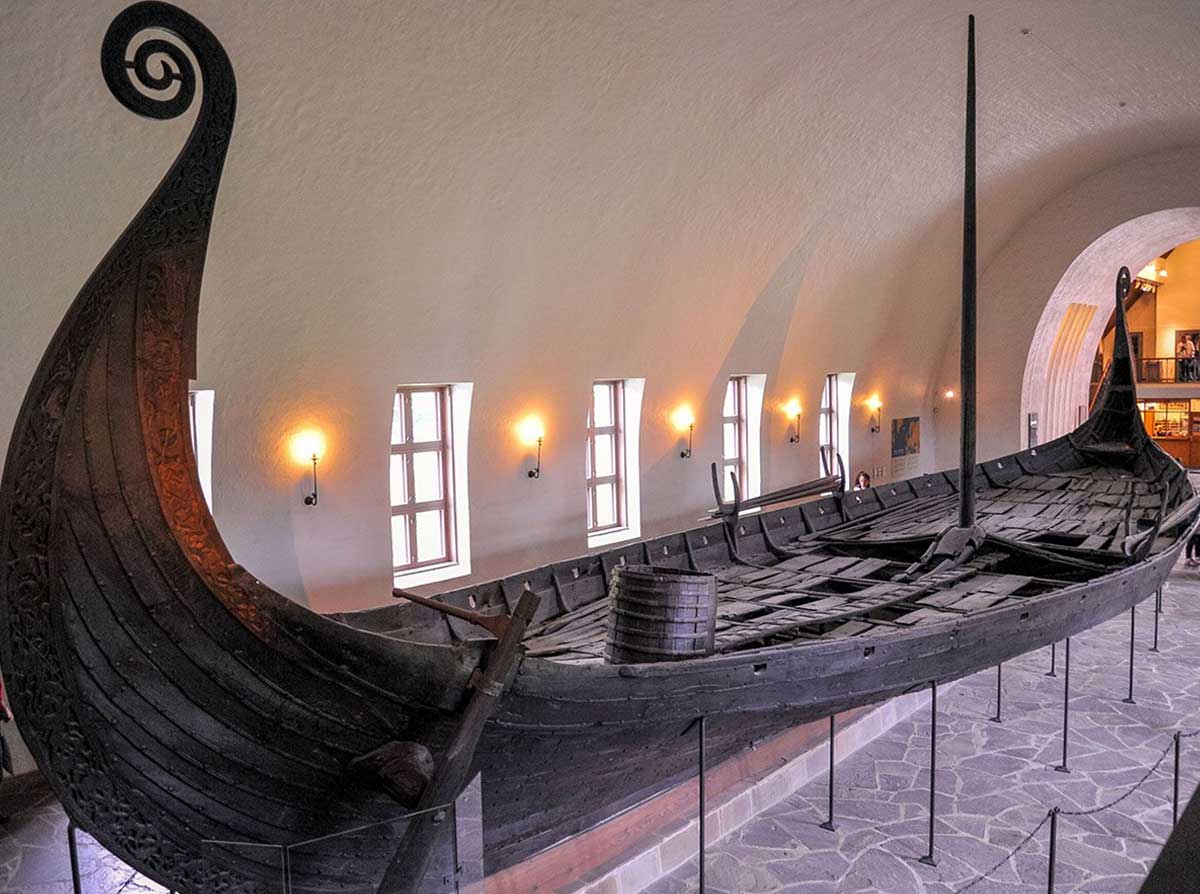
Beowulf takes place in Scandinavia, in a world in which various peoples surrounding the North Sea interact and come into conflict with each other. Beowulf himself is a Geat, a tribe based in southern Sweden. In the poem, he travels to the land of the Danes. Other tribes that are mentioned include the Swedes, the Franks, the Heathobards, and the Frisians. All of these people inhabited lands that border the North Sea, and they are described as deeply interconnected, warring with and marrying each other continuously. Beowulf travels across the sea from southern Sweden to Denmark in order to offer his help to King Hrothgar at the start of the poem.
Where does Sutton Hoo come into this? Firstly, it should be understood that the Anglo-Saxon audience of the poem traced their ancestry to northern Germany and Scandinavia. The poem would likely have been understood as speaking of a past to which the audience’s ancestors had some connection.
Indeed, there are multiple kings mentioned in Beowulf who were claimed as ancestors by various Anglo-Saxon dynasties. These were legendary figures to whom early medieval dynasties were eager to trace their lineage. An example is Offa, who is mentioned in Beowulf as a king of the Angles. The great 8th-century Mercian king, also called Offa, claimed this king as an ancestor. Beowulf also mentions a Hengest, who may be a reference to the legendary Hengest, who Bede tells us led the first North Sea peoples across to Britain in the 5th century.
Sutton Hoo lies next to the river Deben, not far from the North Sea coast. In the early 7th century, it would have been easier to travel to Scandinavia from Sutton Hoo than to travel across Britain to the west coast. Sea travel was far easier than travel across the interior in this period. It is no surprise, therefore, that the person beneath Mound One was buried in a great ship, one that would have been well capable of voyaging across the North Sea. Beowulf himself travels across the North Sea in his own vessel.
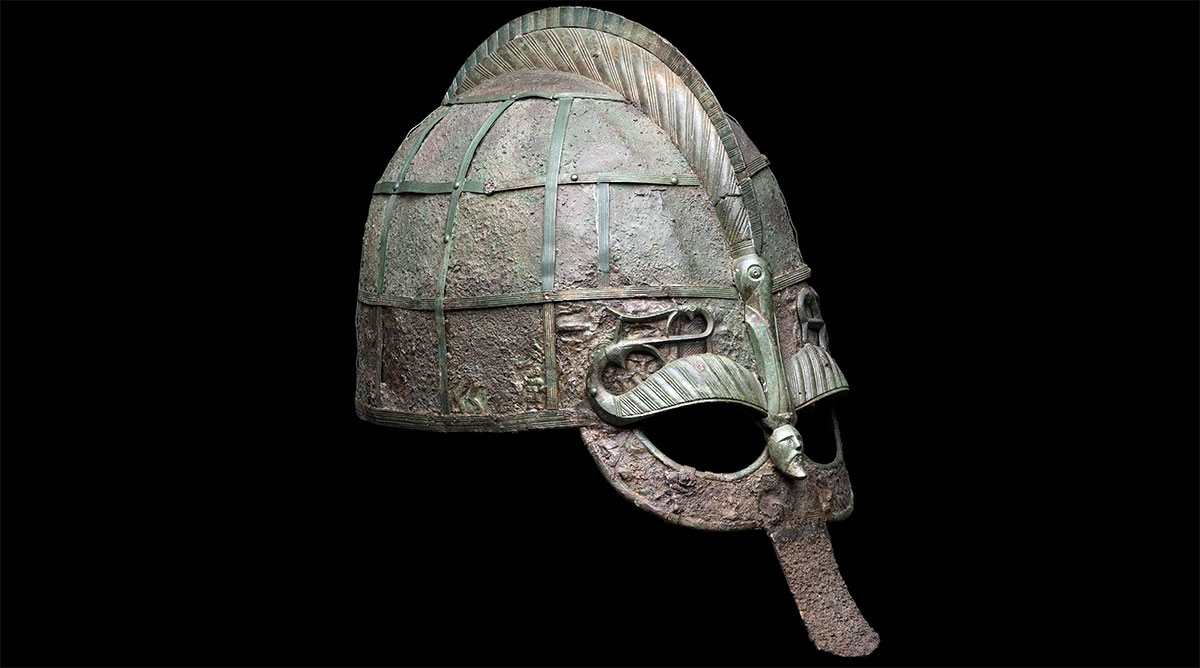
The burials that resemble the goods found at Sutton Hoo most closely are found on the eastern coast of Sweden, from the Vendel Period (which covers approximately AD 550-800). The Sutton Hoo helmet in particular resembles those found from the Vendel Period, as do the decorations on the shield and the burial of a ship. Ship burials are otherwise very rare in England, but far more common on the Swedish coast.
Sutton Hoo’s links across the North Sea help us to understand Beowulf’s setting in the North Sea world, yet its composition for an English audience. The burial beneath Mound One underlines just how close the connections were between the elites of Anglo-Saxon society and the Scandinavian world from which they traced their origins.
Bringing Beowulf to Life
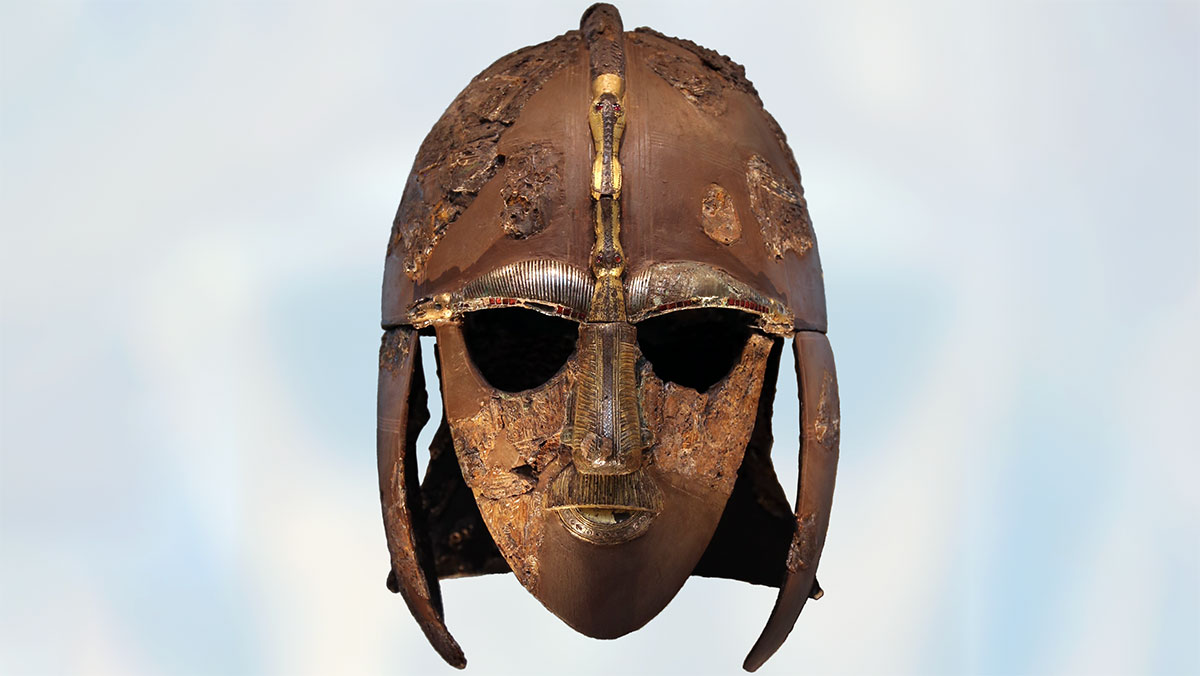
Before the unearthing of the Sutton Hoo ship burial, it was not always clear to what extent Beowulf reflected a historically accurate past. The centrality of monsters in the poem made it easy to put Beowulf firmly into the fantasy genre, and view the world of the poem as one largely imagined by later writers looking back at a mythical “heroic age.” The understanding of the Early Medieval Period in Northern Europe before Sutton Hoo was one of darkness and decay. Yet, Beowulf is a poem filled with glittering treasures, magnificent weapons, giant halls, and exquisite craftsmanship.
The treasures of Sutton Hoo in their abundance, intricacy, magnificence, and creativity seemed to breathe color into the descriptions of Beowulf, and demonstrated to archaeologists and historians that the early-medieval world contained great riches and splendor. More straightforwardly, the burial beneath Mound One had close similarities with many of the descriptions in Beowulf.
For example, early in the poem, the poet speaks of the death of a great king of the Danes, Scyld Shefing. The poet described how a mound of treasures from all across the world, along with weapons and armor, was stowed into the king’s vessel, amongst which the king himself was laid to rest. The person buried beneath Mound One at Sutton Hoo was also laid in the middle of a great ship, into which treasures were placed, including coins from Francia and silver plates and spoons from Byzantium.
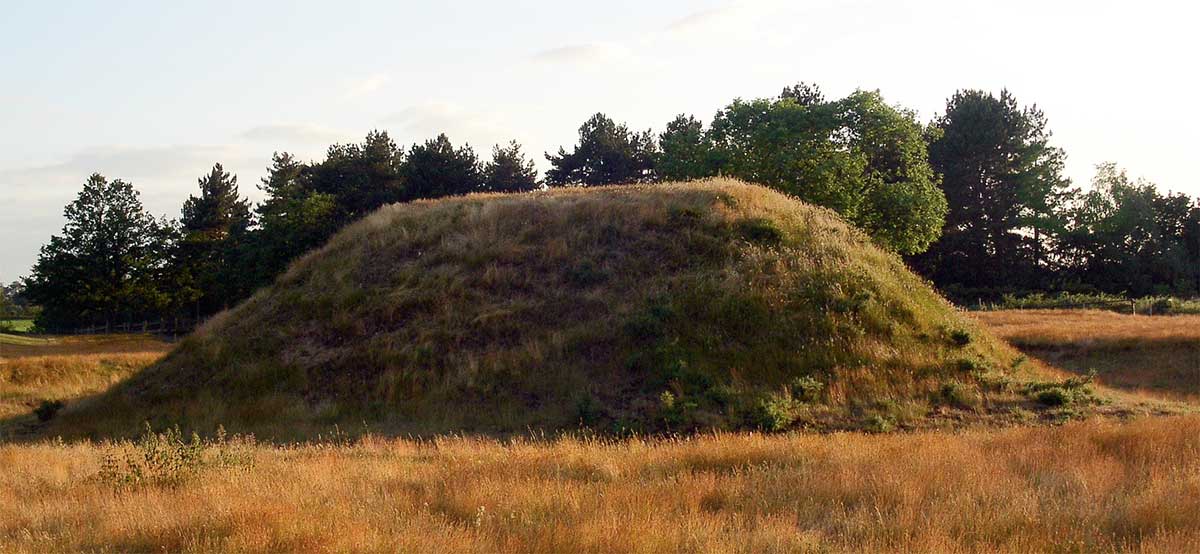
At the very end of Beowulf, the poet describes how the eponymous hero is buried beneath a mound on the cliffs overlooking the sea, so that seafarers passing by will be able to see the memorial. The burial mounds at Sutton Hoo sit atop a hill beside the River Deben, just a few miles upstream from the North Sea. Ships traveling back and forth would have had a clear view of the mounds beneath which the great rulers of the Wuffing Dynasty were buried.
The mounds at Sutton Hoo also call to mind the barrow guarded by the dragon in the final part of Beowulf. The barrow stands near the coast and is filled with treasure buried by an ancient dynasty, just as the mounds at Sutton Hoo contain countless treasures belonging to a dynasty that long-ago ceased to exist.
When a piece of treasure is stolen from the barrow in Beowulf, its dragon guardian burns the local settlements in revenge. Unfortunately for us, the mounds at Sutton Hoo were unguarded, and many were plundered in the 16th and 17th centuries as a result.
One of the most memorable locations in Beowulf is the great hall of Hrothgar, king of the Danes, known as Heorot. Heorot is described as an immense wooden mead-hall, beneath which great numbers of Hrothgar’s people feast and make merry. Amongst the many items found in Mound One were a large cauldron along with a length of metal chain. By measuring the length of the chain, archaeologists have been able to calculate that the beams of the hall from which the cauldron would have hung would have been many feet above ground level, conjuring images of a mead hall of great size akin to Hrothgar’s Heorot.
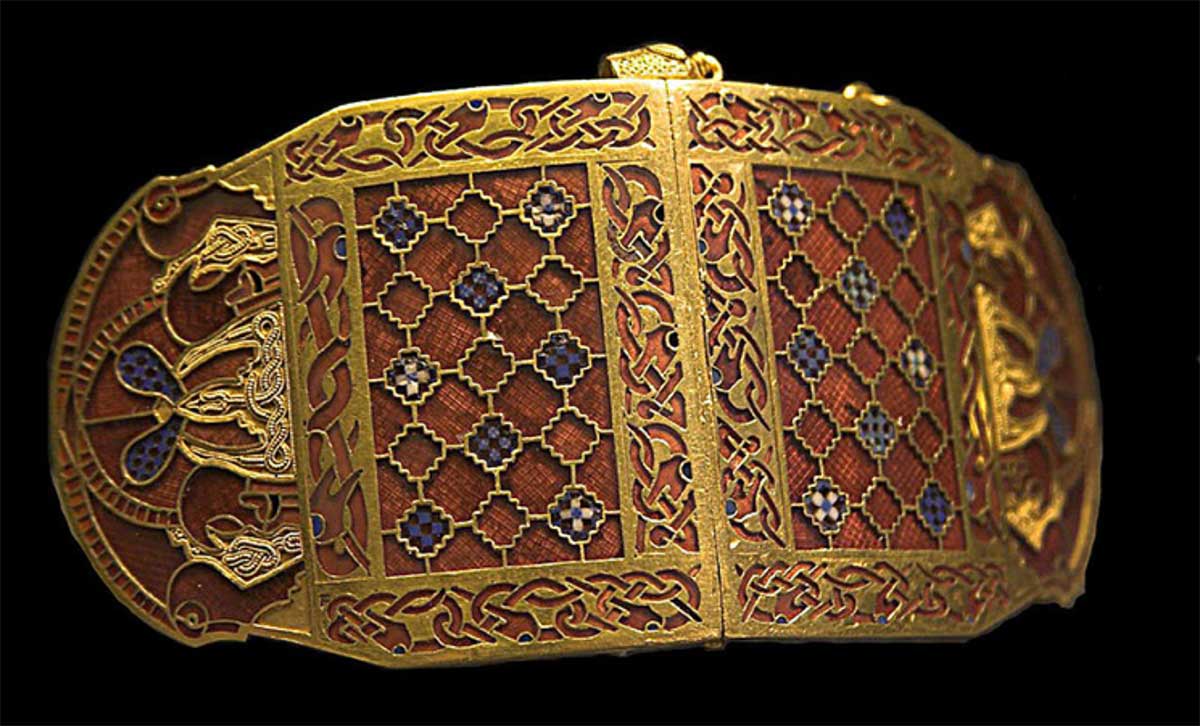
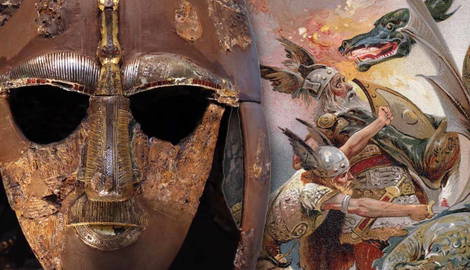
Beowulf portrays a world teeming with mythical beasts. There are demonic creatures like Grendel and his mother, as well as a dragon, and these creatures are locked in violent conflict with humans. The items found at Sutton Hoo reveal an artistic and warrior culture in which animals and beasts play a central role. The iconic Sutton Hoo helmet has a metallic dragon running along the top of the helmet and down to form the nose guard, with its spreading wings becoming the helmet’s eyebrows.
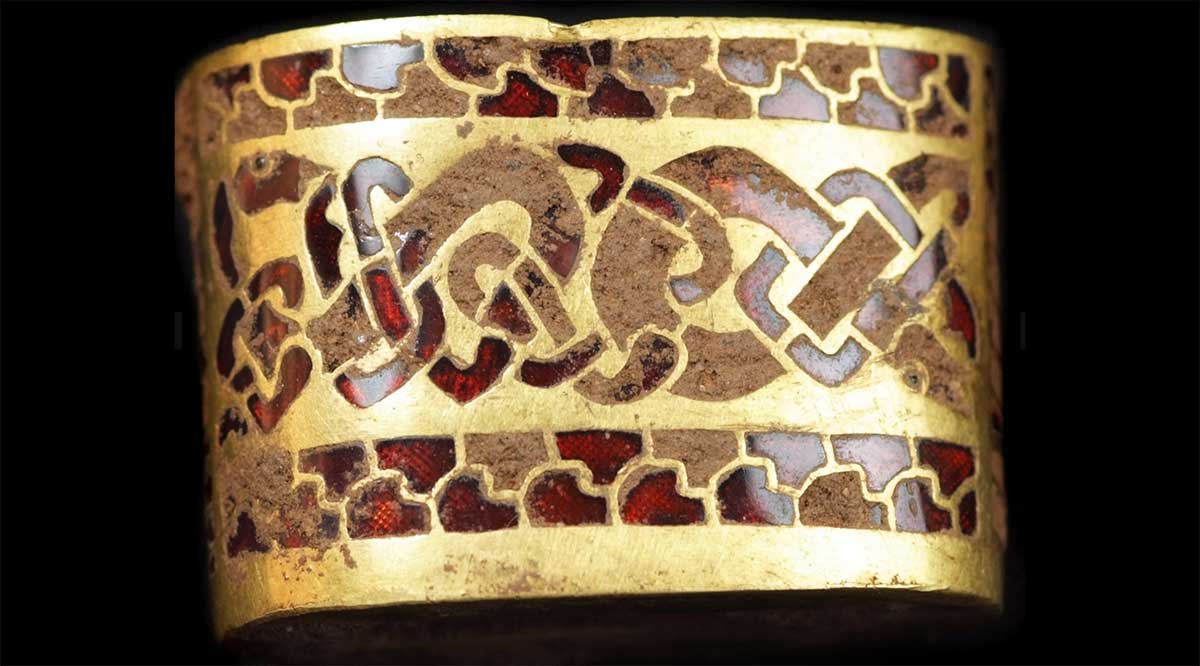
The hoard’s many treasures are decorated with interweaving beasts and animals, depicted as both elegant and sometimes fearsome. We sense from Sutton Hoo a world in which fantastical creatures are felt to be very real, and they form a central part of the expression of power and of martial prowess. Just as Beowulf proved himself by battling demons and dragons, so the warrior buried at Sutton Hoo would have entered into battle with a dragon glaring out at his enemies.
One of the many items found beneath Mound One was the fragmentary remains of a lyre. It is enticing to imagine the possibility that that very instrument might have been used to sing the story of Beowulf in the great hall of King Raedwald. In Beowulf, the Danish king Hrothgar fills his hall with harp songs, and we are told how the harp was used to aid storytelling and the recounting of bygone glories.
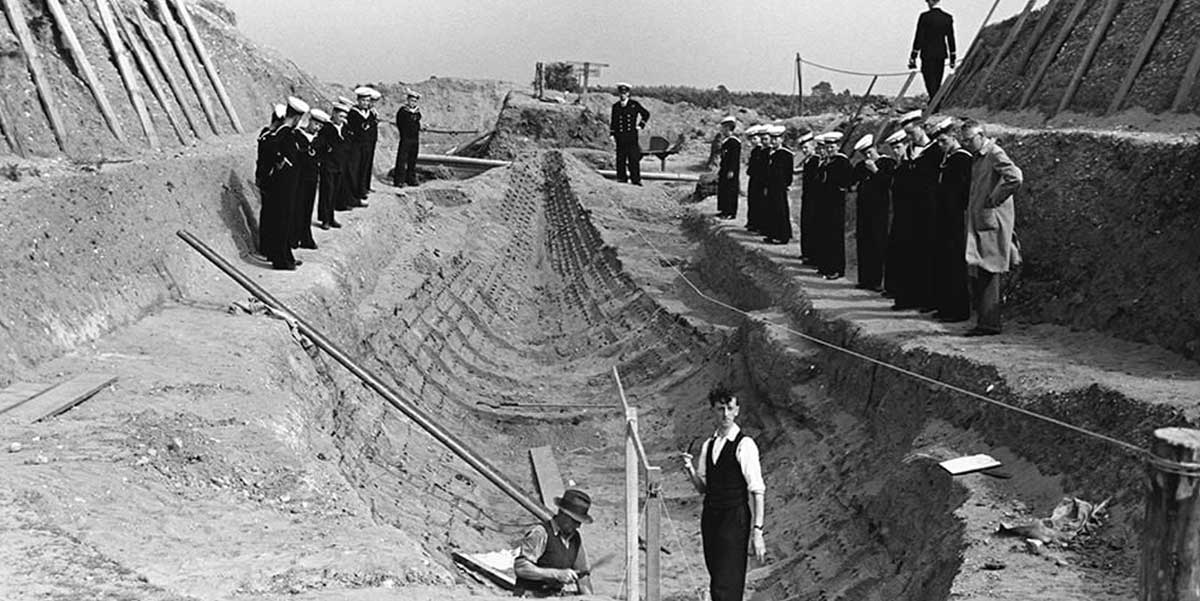
Ultimately, the discovery of the burial chamber beneath Mound One at Sutton Hoo and the epic poem Beowulf shine a thin light on what remains a dark period of history in Northern Europe. Taken together, they help to breathe life into one another.
The discovery at Sutton Hoo helped to bring Beowulf out of the realm of purely fantasy and fairytale to be taken seriously as an insight into the North Sea world of post-Roman Europe. It made the descriptions of the poet tangible and real. Meanwhile, the epic poem helps us to understand the significance of the items contained in the burial chamber at Sutton Hoo, and provides an insight into how and why the individual was buried there.