
Claude Monet captured time by working in series—Haystacks, Poplars, Rouen Cathedral, and Water Lilies—painting the same motif across seasons and times of day. With several canvases at hand, Monet followed shifting light and used complementary contrasts so the eye “mixes” color, revealing change. The result is time made visible on canvas.
Time Studies Begin with Claude Monet’s Haystacks
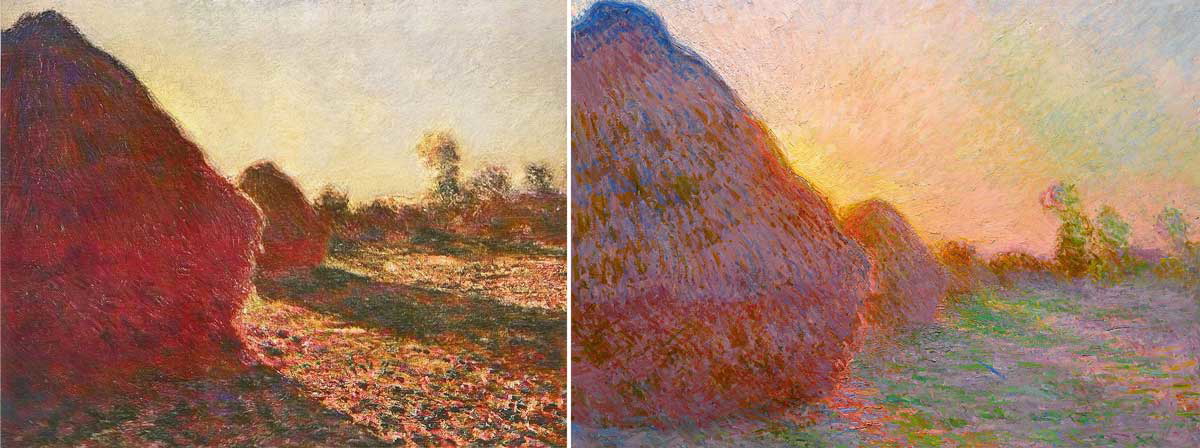
In 1883, 40-year-old Claude Monet, the leader of French Impressionism, relocated to Giverny, Normandy. His art took a unique turn in 1890 when he devoted himself to painting what would become several famous series. This artistic period began with Haystacks, a series consisting of more than twenty paintings. As early as 1888, Monet began to paint the haystacks near his Giverny home. The goal of this repetitive series was to show the different effects of light and atmosphere during various days, seasons, and weather conditions. With this new goal, Monet abandoned landscapes. He started focusing on fragments of the landscapes instead.

These paintings perfectly illustrate the Impressionists’ perception of color. Knowing that every color has an opposite, Impressionist painters paired each tone with its complementary color to highlight it. The eye, then, on its own, reduces the disturbance of contrast and operates an optical mixture based on complementary tones. This allows the painter’s palette to disappear, with the eye performing the mixing of colors itself. This idea was theorized by French scientist Michel-Eugène Chevreul in his law of simultaneous color contrast, which inspired both Impressionists and Pointillists.
Haystacks: Light by the Hour
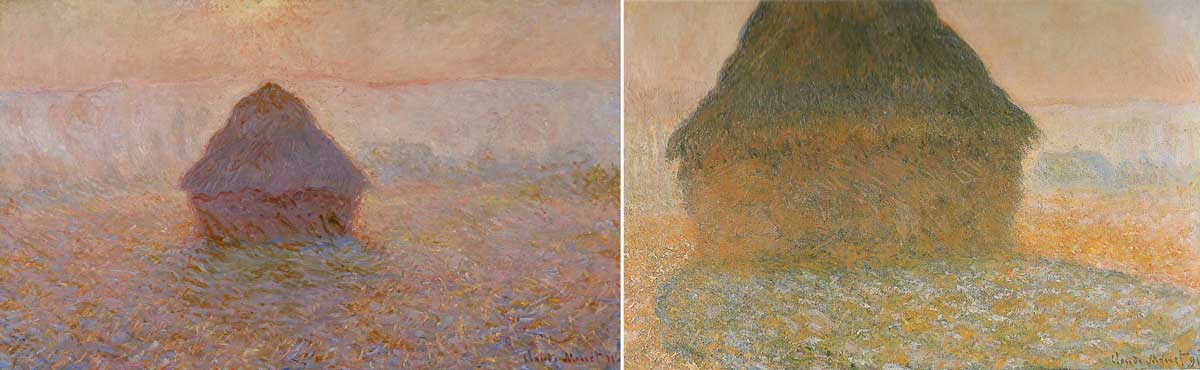
Painting serially allowed Monet to experiment with color theory. He studied the variations in light throughout the day: the morning glow, afternoon sunbeams, and the evening sky. In some paintings, Monet also painted the effects of light and colors specific to each season and weather condition. In Grainstacks (W1273), the application of Chevreul’s color theory is undeniable. The blue used for the haystack’s tip in the shadows complements the various orange tones used to represent the sun’s rays and their reflections.
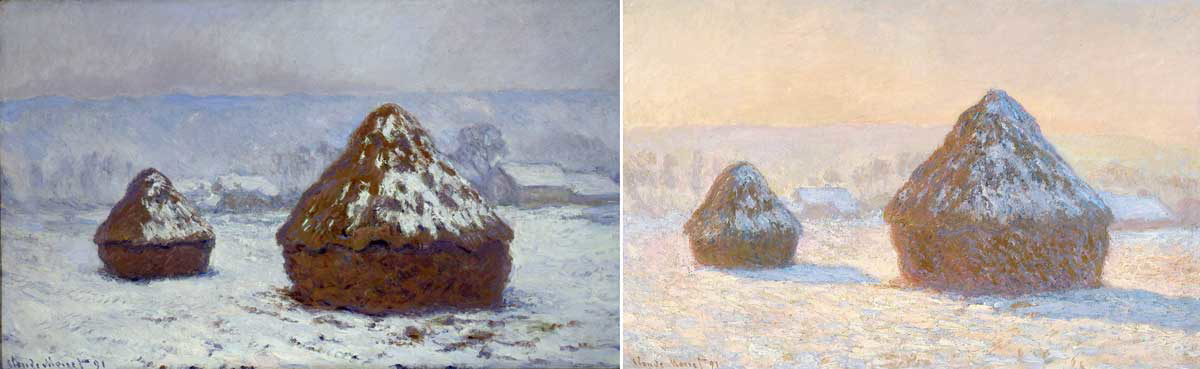
Some canvases still retain a certain degree of naturalism, a fidelity to painted reality, as in the first painting in the series, Haystacks, End of Summer (W1266). But over time, Monet’s technique begins to reject volume and detail, becoming solely interested in tactile and luminous effects. The brush strokes thicken and the forms dissolve.
Seasons on a Single Riverbank in Monet’s Poplars
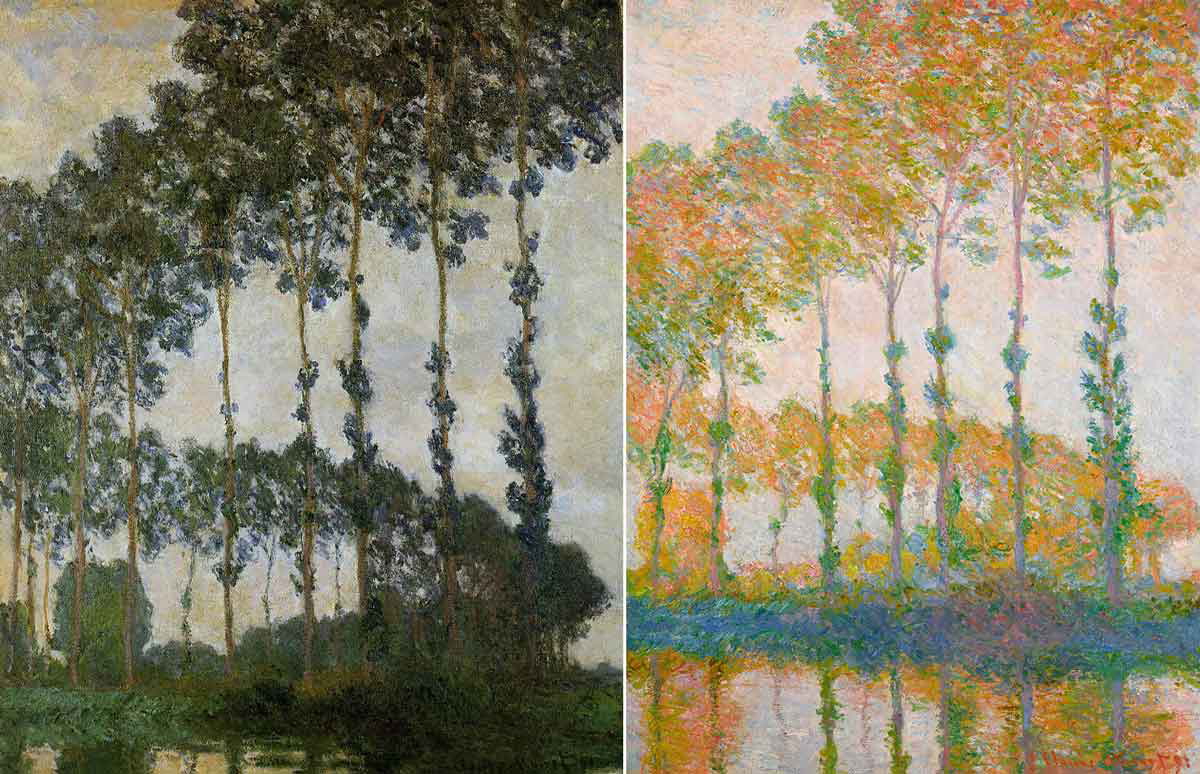
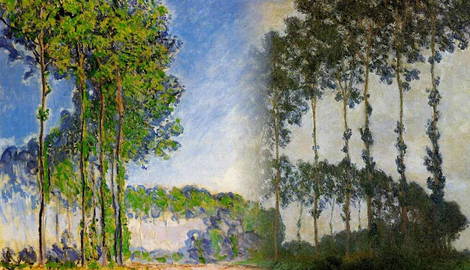
Between the summer and autumn of 1891, one year after Haystacks, Monet produced a new series of twenty-three paintings called Poplars. While the Haystacks series varied considerably in terms of angles, framing, and canvas formats, this series is much more consistent. The canvases emphasized the trees rising to the sky.
Like Haystacks, this new series picks up the Impressionist principles that Monet never ceased to defend and to illustrate: open-air painting in which one could draw directly from the subject at a given moment. Monet sought to capture the moment in this series by painting shadows, marking the sun’s movement, and expressing the cycle of days and seasons through variations in color.
Effects of Light and the Ephemeral Moment in Monet’s Poplars
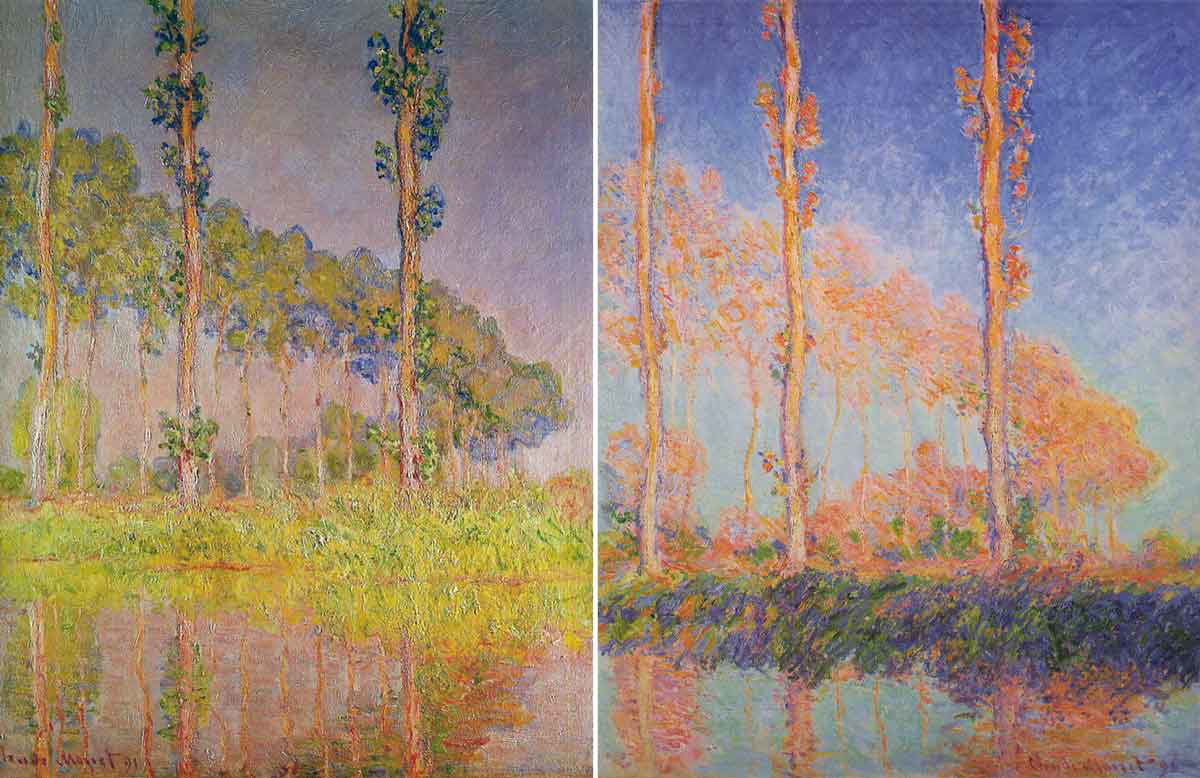
By observing the changing hours, days, and seasons in his series, Monet focused on what captivated him the most: the effects of light. By trying to paint these effects, he sought to capture the ephemeral. This is why the subjects he chose were always simple and why details were absent from his paintings. Only light and color mattered. The subjects can even appear blurred, and a few brush strokes were sometimes enough to sketch a shape.
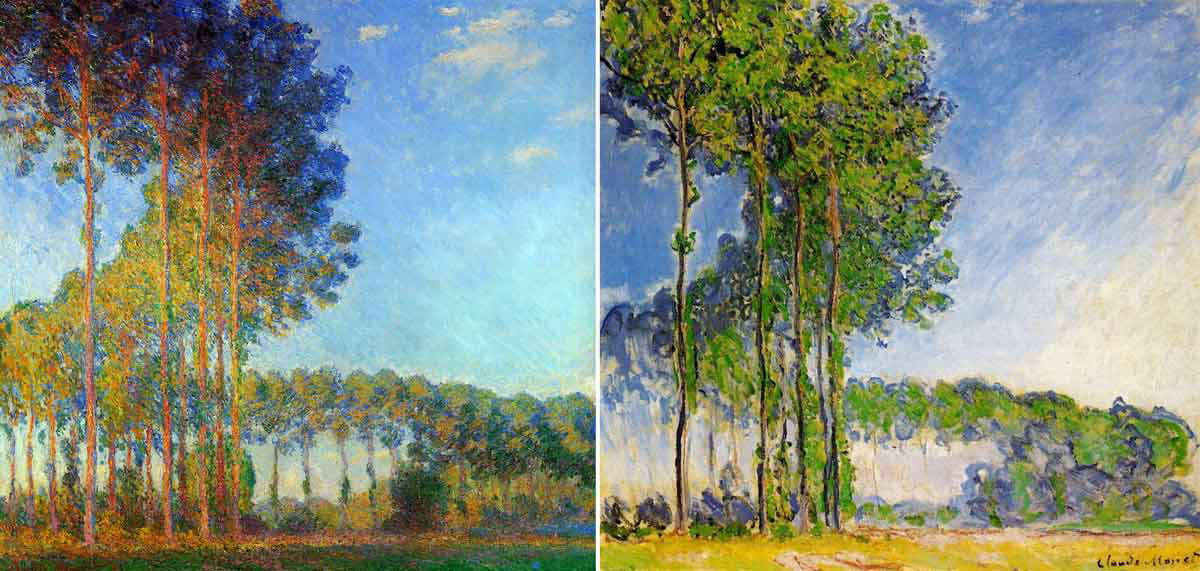
For Monet, a landscape is not immutable but subject to infinite atmospheric variations. He explained this to Dutch librarian Willem Byvanck in 1891: “Here is what I proposed to myself: above all, I wanted to be true and exact. A landscape, for me, does not exist as a landscape, since its aspect changes at every moment; but it lives by its surroundings, by the air and the light, which vary continuously […]. You have to know how to seize the moment of the landscape at the right time, because that time will never come back and you will always wonder if the impression you captured was the real one.”
The Changing Light of the Cathedral in Rouen
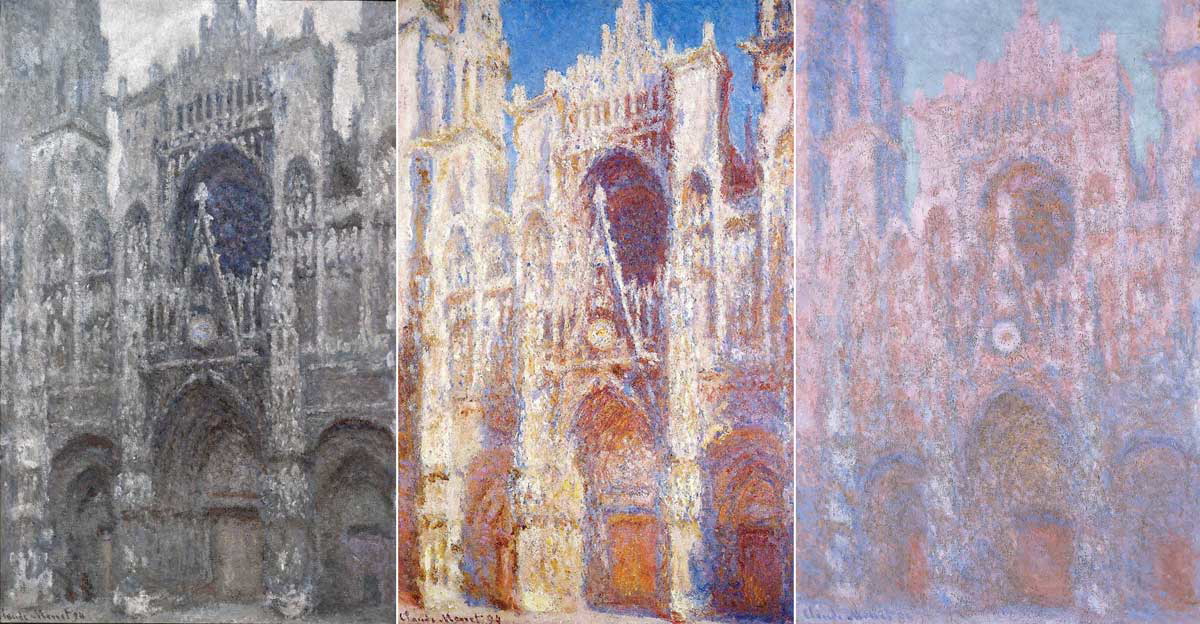
The Rouen Cathedral series comprises 30 paintings by Claude Monet, executed between 1892 and 1894. He mainly painted the western portal of the Notre-Dame de Rouen Cathedral, from different angles and at different times of the day. Monet wanted the paintings of the cathedral to be seen together, as an ensemble.
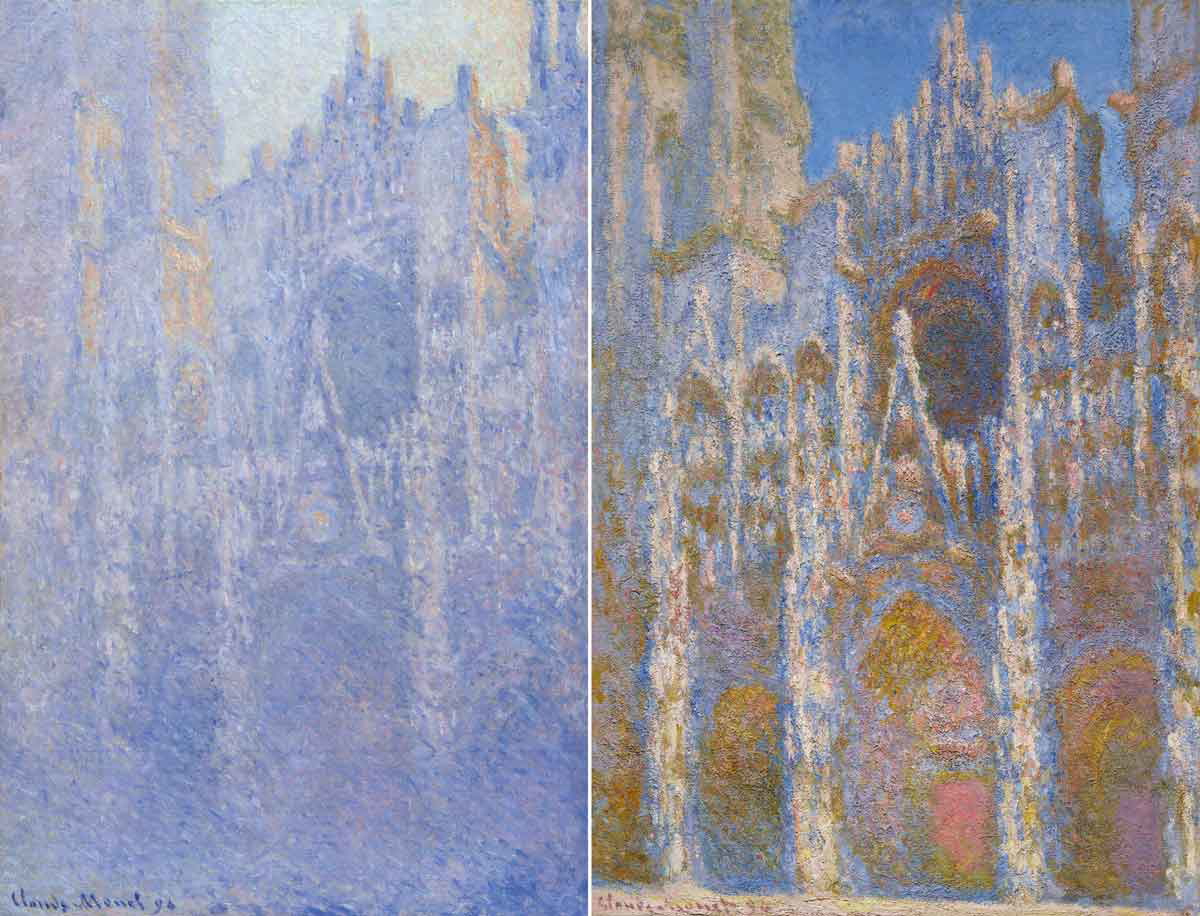
In 1895, Monet selected 20 of these works to be exhibited in his art dealer’s gallery in Paris, as he had done with Haystacks several years before. Monet’s choice to study and paint the facade of Rouen Cathedral, a very elaborate and complex piece of architecture, seems unusual. He generally preferred sticking to simple subjects, devoid of detail, to devote himself to the study of light and color.
In London
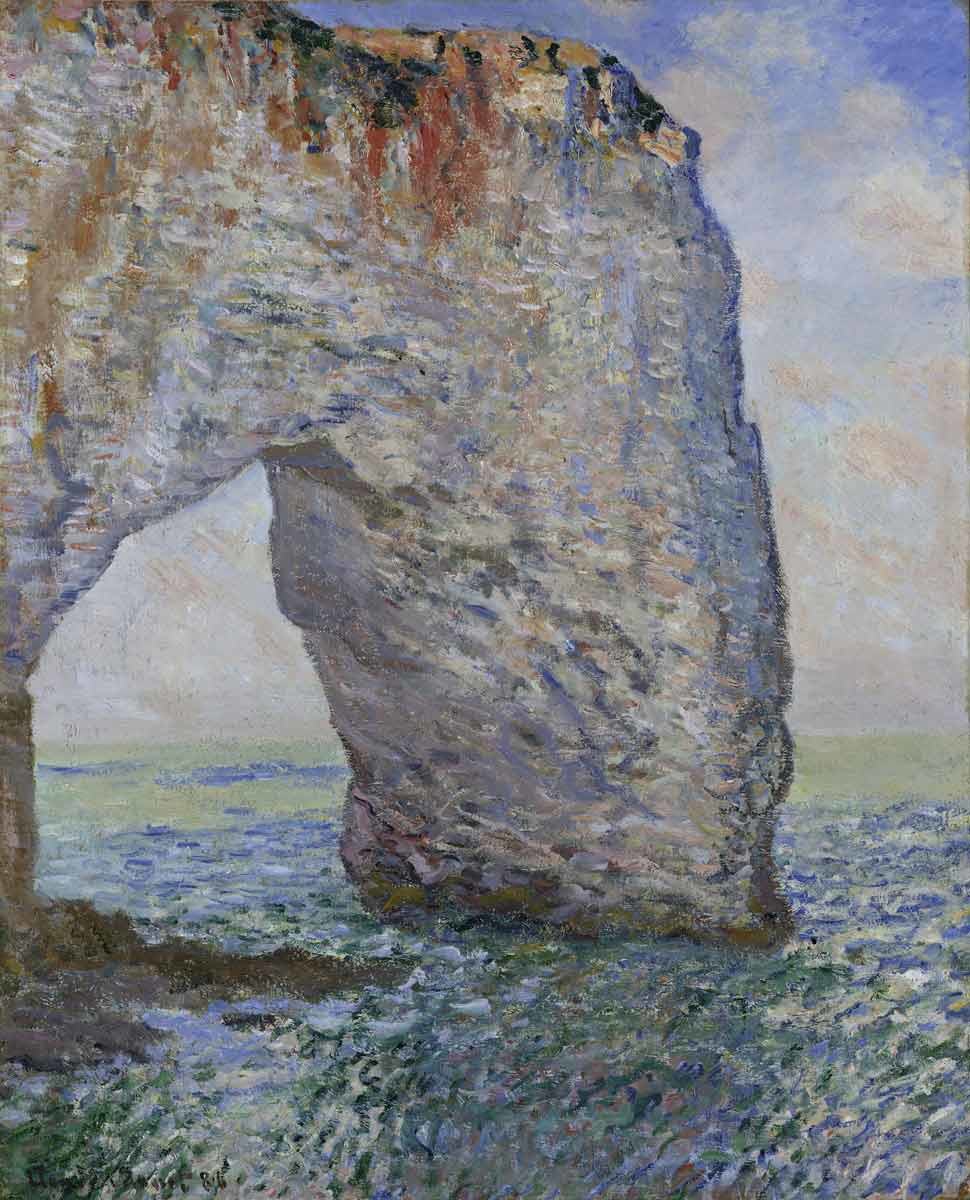
These paintings, however, recall the way Monet treated the chalk cliffs of Étretat a few years earlier. To capture the atmosphere and light hitting the stone surface, Monet experimented with pigments to achieve the desired colors. The facade of the Cathedral was carved from monochromatic stone, but Monet’s paintings display many colors, ranging from shades of mauve and green to pink and orange.
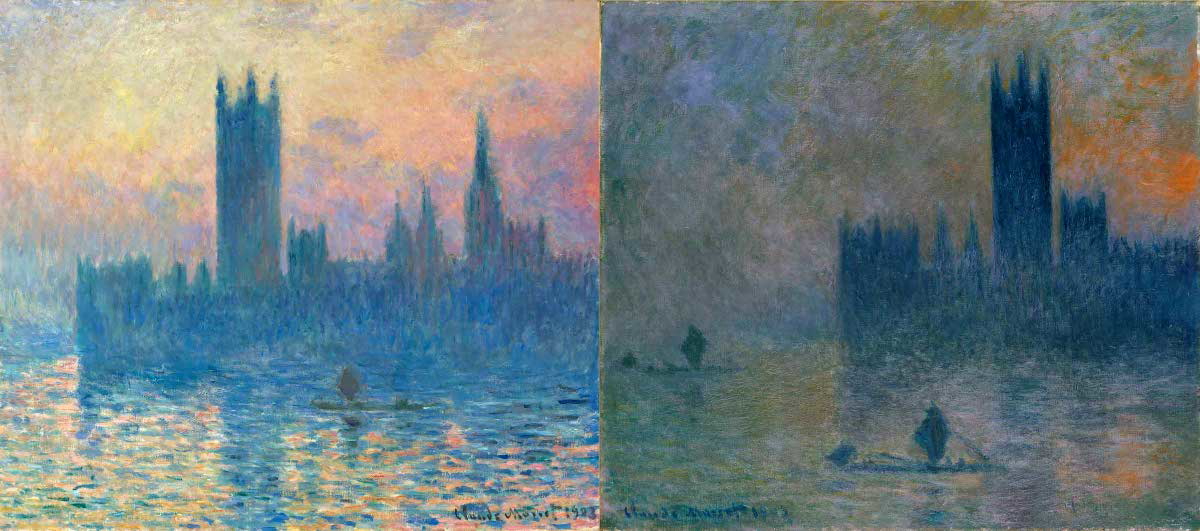
A few years after the Rouen Cathedrals, Monet once again put aside rural subjects and chose the Parliament of London as the motif for a new series of 19 paintings. These two series are his most in-depth studies of light and color in architecture.
Obsession with Water Lilies
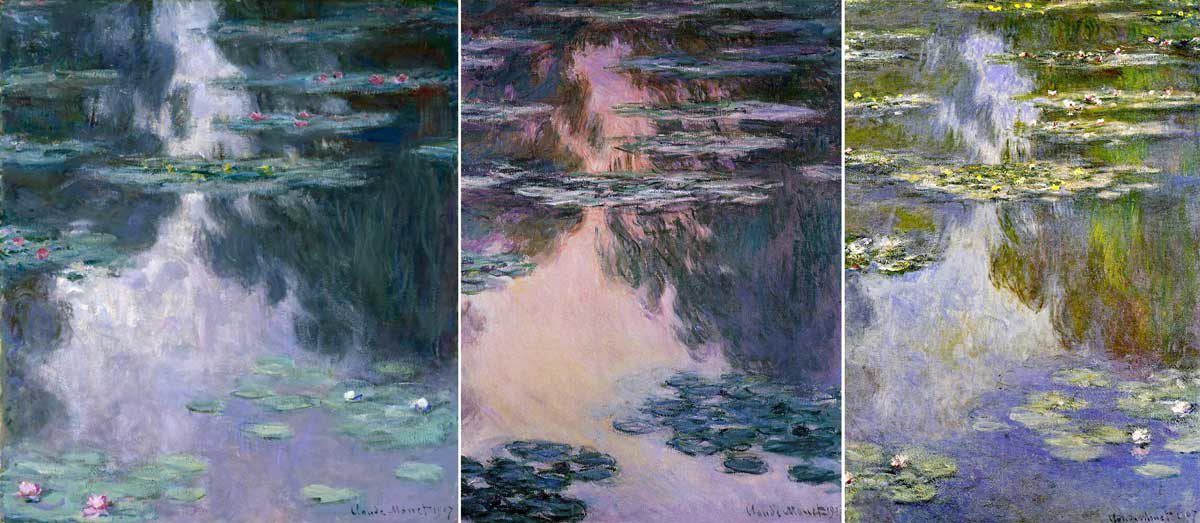
Following Japan’s opening to Westerners in 1853, a wave of Japonisme swept Europe. Monet’s prolonged interest in serial painting was at least partially inspired by his keen interest in Japanese ukiyo-e woodblock prints and paintings. The Japanese artist Hokusai, for example, notably produced the series Thirty-six Views of Mount Fuji between 1831 and 1833.
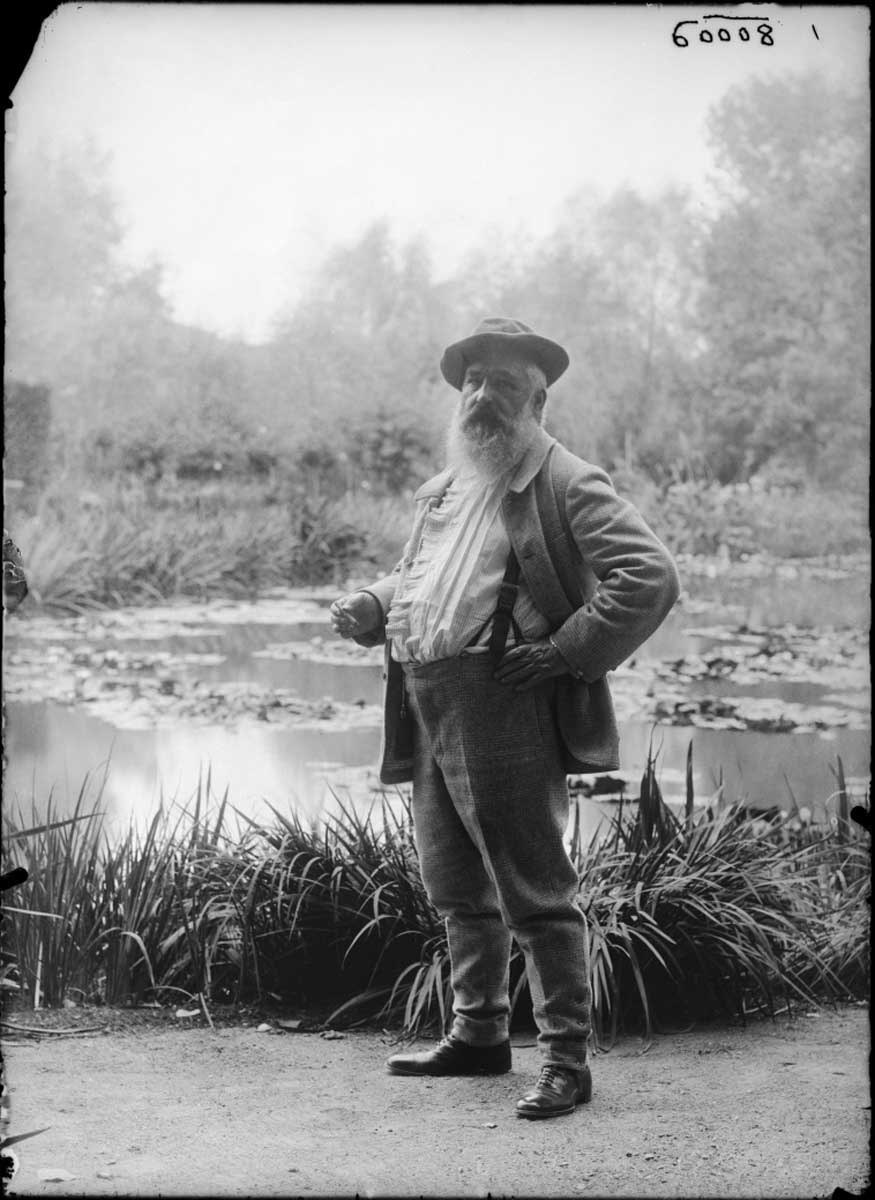
Water Lilies is a series consisting of approximately 250 oil paintings produced by Monet during the last 31 years of his life. Water Lilies is also the final and largest project of his life. These paintings show the pond of water lilies from the flower garden of Monet’s house in Giverny, which now houses the Claude Monet Foundation. Designed by the painter himself, this garden serves as a testament to his love for Japanese culture, featuring a wisteria-covered footbridge, water lily ponds, weeping willows, and bamboo forests.
Monet explored the full potential of reflections in water. But the real subject of these paintings is, again, light. Monet painted it with a rich palette of colors that brought its reflections in the water to life. He juxtaposed complementary colors like yellow and purple, which accentuated the sensation of a luminous radiance and expansion of space in the spectator’s eye.
Monet’s Late Water Lilies
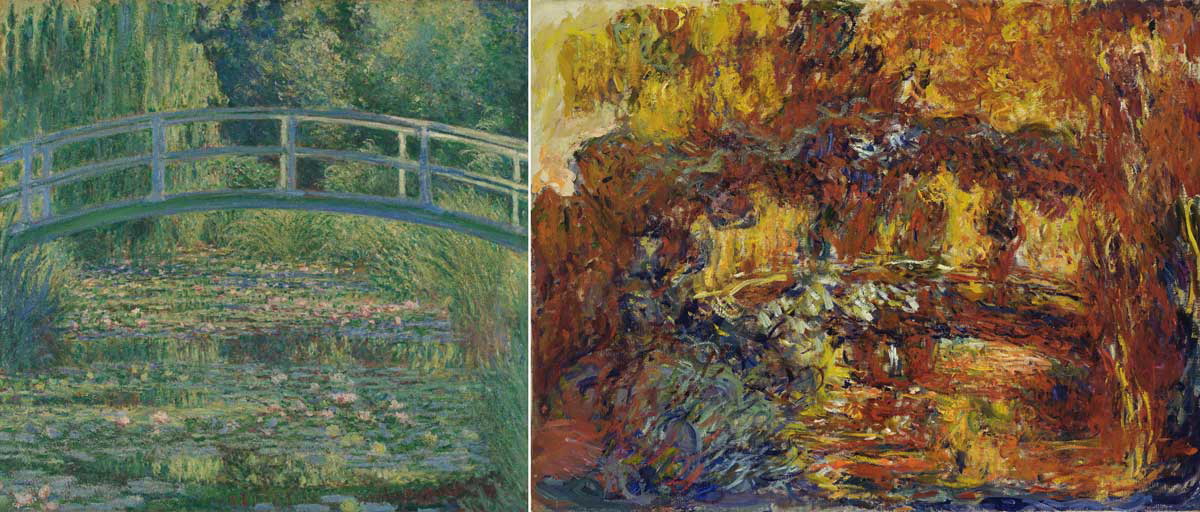
As in the Haystacks series, the initially figurative Water Lilies paintings became increasingly abstract over the years. Many of these canvases were painted while Monet was suffering from cataracts and slowly losing his eyesight. His increasingly cloudy vision produced paintings that were unreal and dreamlike. His garden’s Japanese footbridge was the subject of many of his paintings, but the way he depicted it changed considerably over time.
In 1899, Monet painted a very realistic version of the bridge in The Water Lily Pond (W1516) with serene shades of green. The Japanese Footbridge, Giverny (W1932), painted about twenty years later, on the other hand, shows an amalgam of bright red, orange, and yellow shapeless colors in which the spectator can hardly make out the shape of a bridge.
Echoing his Impressionist theory that landscape painting should focus on the correlation between light and color, Monet could no longer see the details of the subjects he was painting. In his Water Lilies, the strength of his creative gesture and the broad treatment of the entire canvas without distinguishing different planes.