
For an artist hailing from late 13th-century Siena, Duccio di Buoninsegna left an impressive written record behind. Although he was an apprentice artist under the tutelage, it is thought, of Guido da Siena and perhaps too, the great Cimabue, the records left behind do not always refer to his artistic career. A litany of fines from city authorities tells of a rebellious character, unafraid to challenge authority. It was this determination to follow his own path that led Duccio to challenge the status quo within Byzantine and early Italian art.
From Byzantine Blue & Gold: Duccio Emerges
In the 12th century, Siena became a republic. Widely known for its wool trade, Siena’s pivotal position for some of the busiest trade routes in Western Europe and beyond, into the Byzantine Empire, meant it flourished both politically and economically. In line with its commercial success, the city-state was home to an artistic revolution.
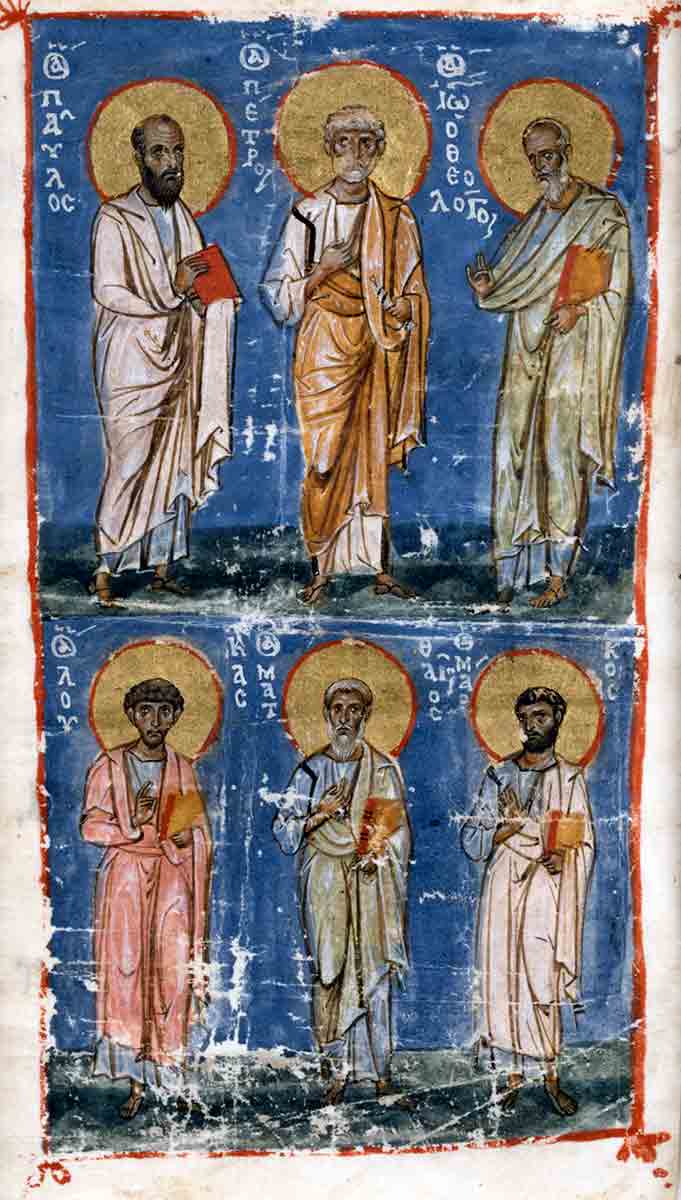
Much like the medieval Gothic French and the icon-led Byzantine, art in Siena in the late 12th and early 13th centuries reflected the evolution of Europe as a whole. Countries and states were forming, and visual culture was a key identifier for those living through the turmoil. In amongst this metamorphosis, what we now call Italian art was beginning to take shape. Duccio was at the forefront of these changes.
Duccio’s earliest works were commissions for ledger covers, recorded as being painted in 1278 when he was 23 years old. However, he quickly moved on to more illustrious work. His paintings were recognizably influenced by early Christian art. He continued to paint the Madonna and Child throughout his career, but his style evolved. From the ultramarine and gold of the Byzantine and the stiffness of the painted icon, Duccio began to develop a style marked by a softness and emotional realism never seen before in art.
1. The Crevole Madonna
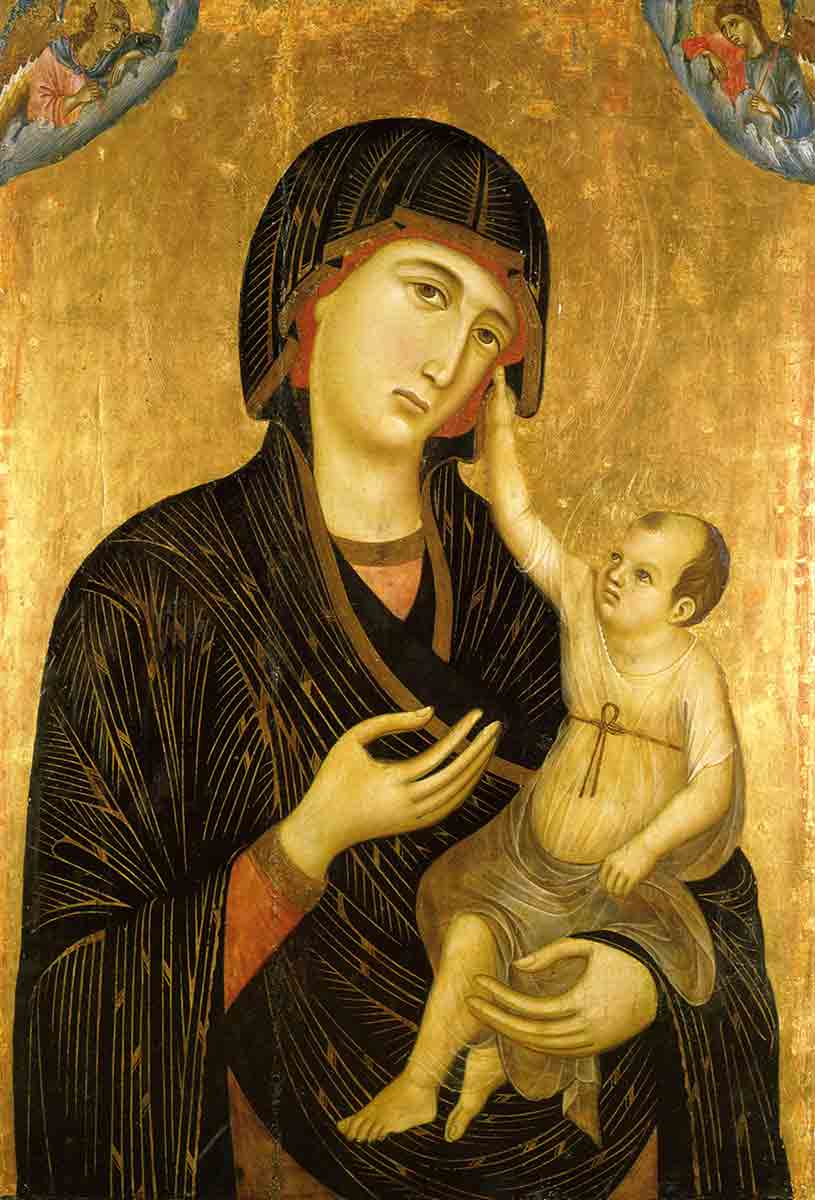
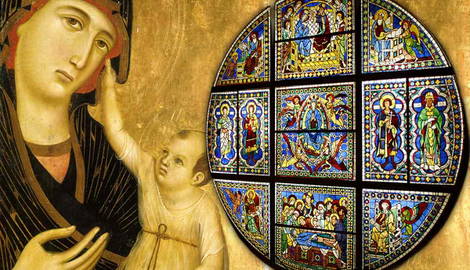
One of Duccio’s first attributed paintings, The Crevole Madonna, is believed to have been commissioned for the church of San Pietro e Paolo of Montepesci before being moved to the hermitage of Montespecchio. The monks of Montespecchio must have seen the Madonna as a talisman, as in the 17th century she accompanied them to their new home, the church of Santa Cecilia in Crevole.
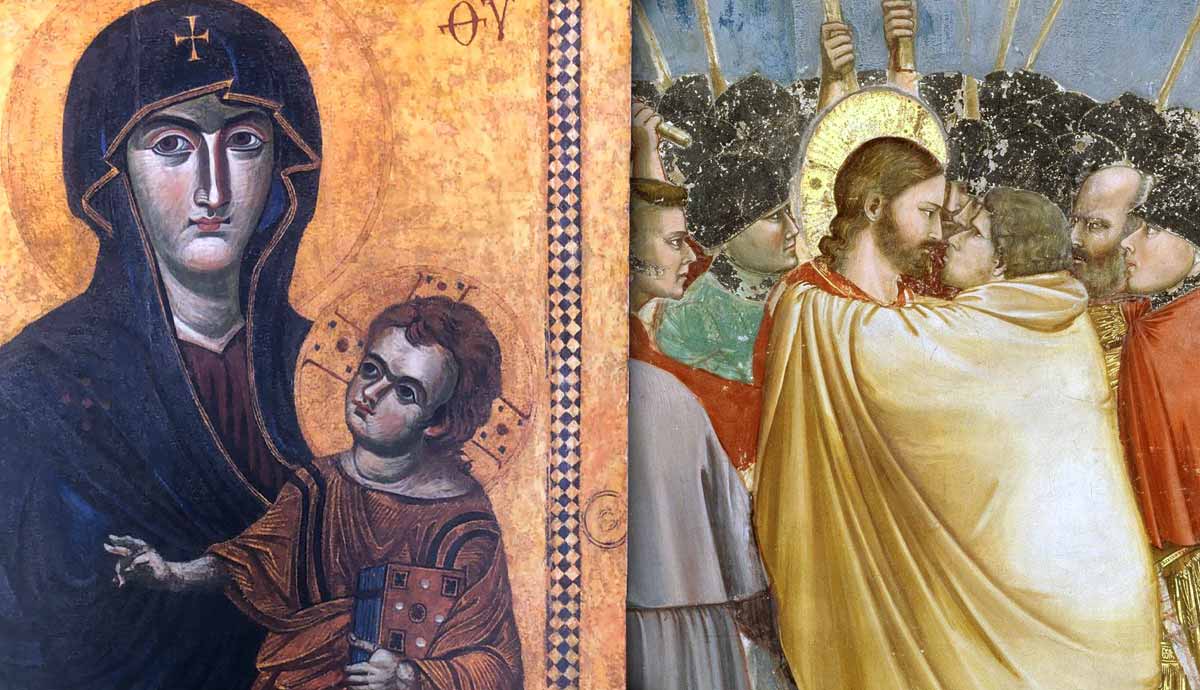
Painted in 1283, she is emblematic of the art of the icon, the prime motif of Byzantine art. The Virgin is depicted wearing her customary ultramarine robe, with Duccio reflecting Eastern influences through the gold delineation of the draped fabric. Her face is expressionless, though Duccio has attempted to create a certain naturalism in her skin. By later artistic standards, the Christ Child is out of proportion and appears older than one would expect. This aging of the Child was a standard device for conveying Christ’s wisdom.
The painting’s background is entirely gold. With no landscape or interior, the focus is entirely on the Madonna and Child. It is a devotional piece, not intended, as paintings would be in later centuries, for decoration. In effect, Duccio has painted a Byzantine icon with a touch of Sienese flair, a style that he would develop further and that would become synonymous with early Italian art.
2. The Rucellai Madonna
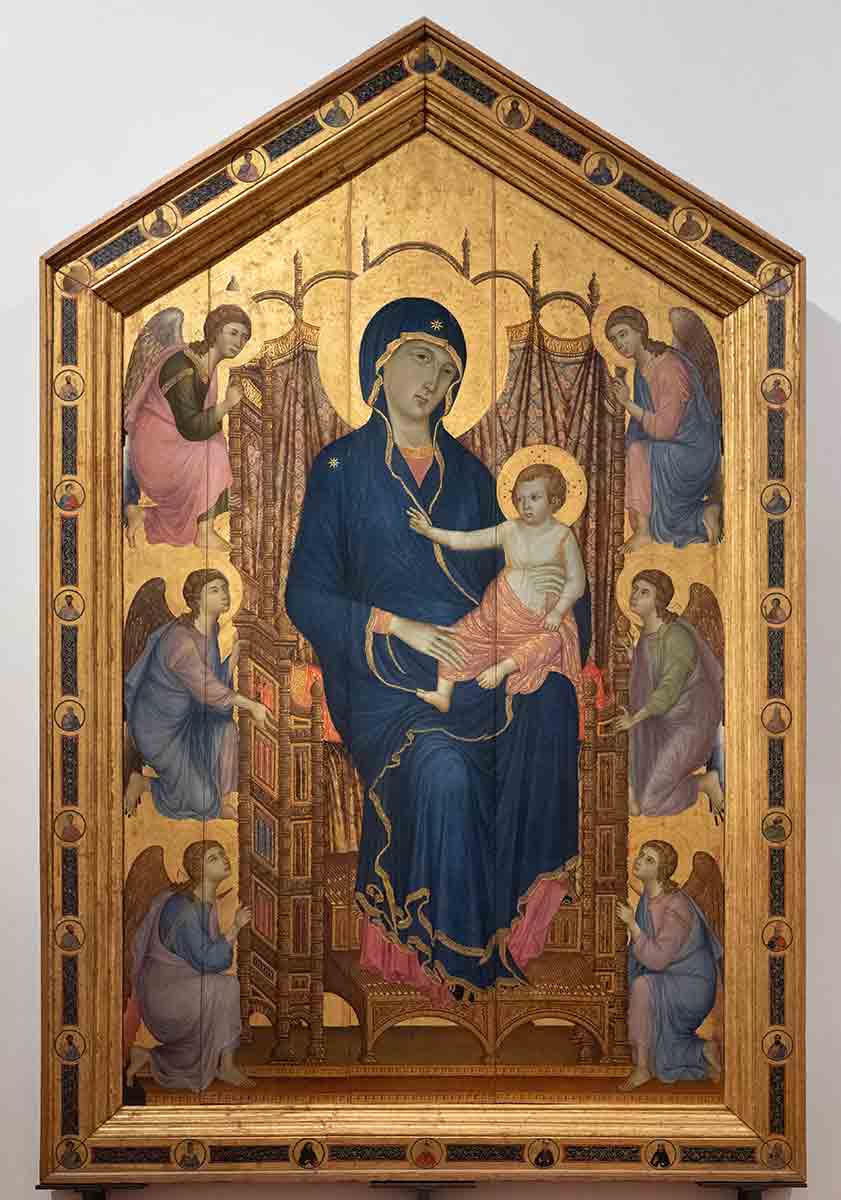
The year after he finished painting the Crevole Madonna, Duccio was commissioned by the Laudesi confraternity to paint a Madonna and Child with angels to adorn their chapel in the church of Santa Maria Novella in Florence. The finished work occupied several sites within the church before finally being installed in the Rucellai family chapel in 1591, where it remained until 1937.
The fact that a Florentine confraternity commissioned a painting by a Sienese artist was significant in early 13th-century Siena. The city-states of Florence and Siena were arch-rivals in every sense. Florence was already developing a reputation as a center for European banking, a role that Siena strongly challenged. The two city-states were also rivals in the Guelph-Ghibelline conflict, with the discord resulting in Siena’s victory at the Battle of Montaperti in 1260.
In contrast with the Crevole Madonna, the Laudesi painting was monumental in size. The earlier work measured only 35 by 24 inches. The Laudesi’s commission was intended to impress. At approximately 14 feet 9 inches by 9 feet 6 inches, the Rucellai Madonna was a significant devotional painting. The contract for the work survives and confirms that the Laudesi demanded the best for their new chapel. It specifies that Duccio should not work on any other commissions until their Madonna is finished. The artist was also expected to pay for the costly gold and ultramarine himself, although the Laudesi reserved the right to refuse the painting if they weren’t happy with the result.
Compared with the Crevole Madonna, the later work showed significant developments in Duccio’s style. The sharp gold lines of the first work are gone, making way for a softly draping robe for the Virgin. Although the background remains essentially gold, the painting’s overall effect is that of a gentler, more maternal Madonna. With the Rucellai Madonna, we begin to see the beginnings of the Italian painting style to come. The advent of naturalism is clear, even though the shimmer of Byzantine style still glitters.
3. Rose Window at Duomo of Siena: A Material Change
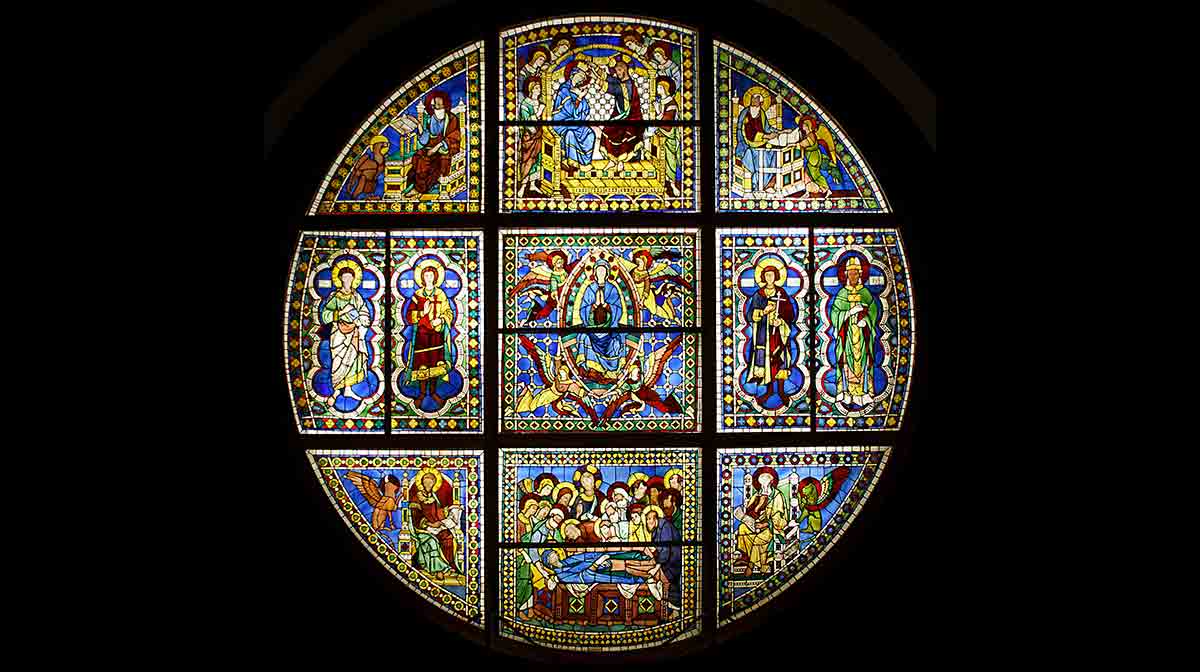
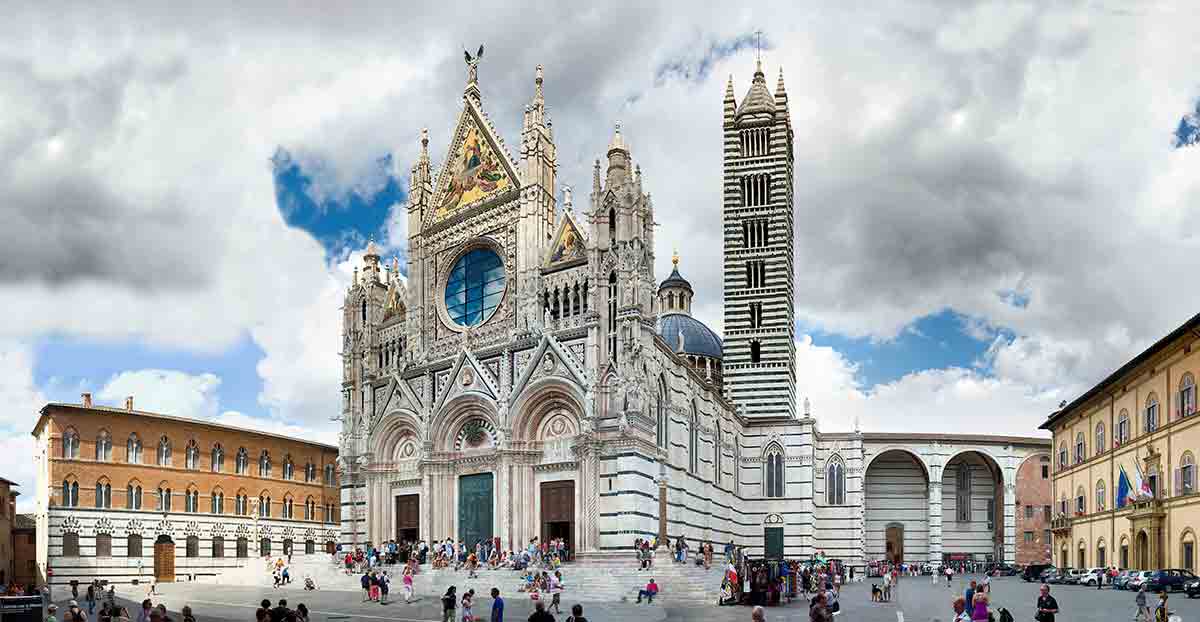
At over 16 feet in diameter, it seems impossible that visitors to the Duomo in Siena could overlook the rose window high above, casting shards of colored light upon them. The Duomo’s very structure features works by masters such as Donatello’s statue of Saint John the Baptist, Pisani’s pulpit, and Michelangelo’s four saints adorning the Piccolomini altar. These elements alone are enough to distract from the stonework’s already striking monochrome striping.
In 1288, Duccio was commissioned to provide drawings for the window. This, in itself, has been proven to be a bold and unusual move by the Commune of Siena. Stained glass was rare in this part of Europe; it was more common in northern European churches. It seems that the magnificence of the Duomo’s architecture commanded an oculus of corresponding dimensions of style and presence.
Duccio’s design depicts landmark points in the life of the Virgin, likely influenced by Duccio’s assumed Master, Cimabue’s wall paintings in the Basilica of Saint Francis in Assisi. Although the Marian tradition was at its height in the Middle Ages, Cimabue’s influence on Duccio is inescapable.
Whatever the reasons for its commission, this grand glass artwork, one of the oldest in the cathedral, remains one of the least known of Duccio’s masterpieces. The original is now housed in the Duomo museum, at eye level so that visitors can appreciate its complexity and luminous beauty. A copy, mounted in the original space, now floods the church with color.
For centuries, following his cartoons for the rose window, the most popular of devotional images, the Virgin and Child, was central to Duccio’s art. With what has become known as the Stoclet Madonna, Duccio moved from the monumental Rucellai Madonna and the Duomo’s rose window to a single panel of 11 by 8 inches.
4. The Stoclet Madonna – A Masterpiece of Private Devotion
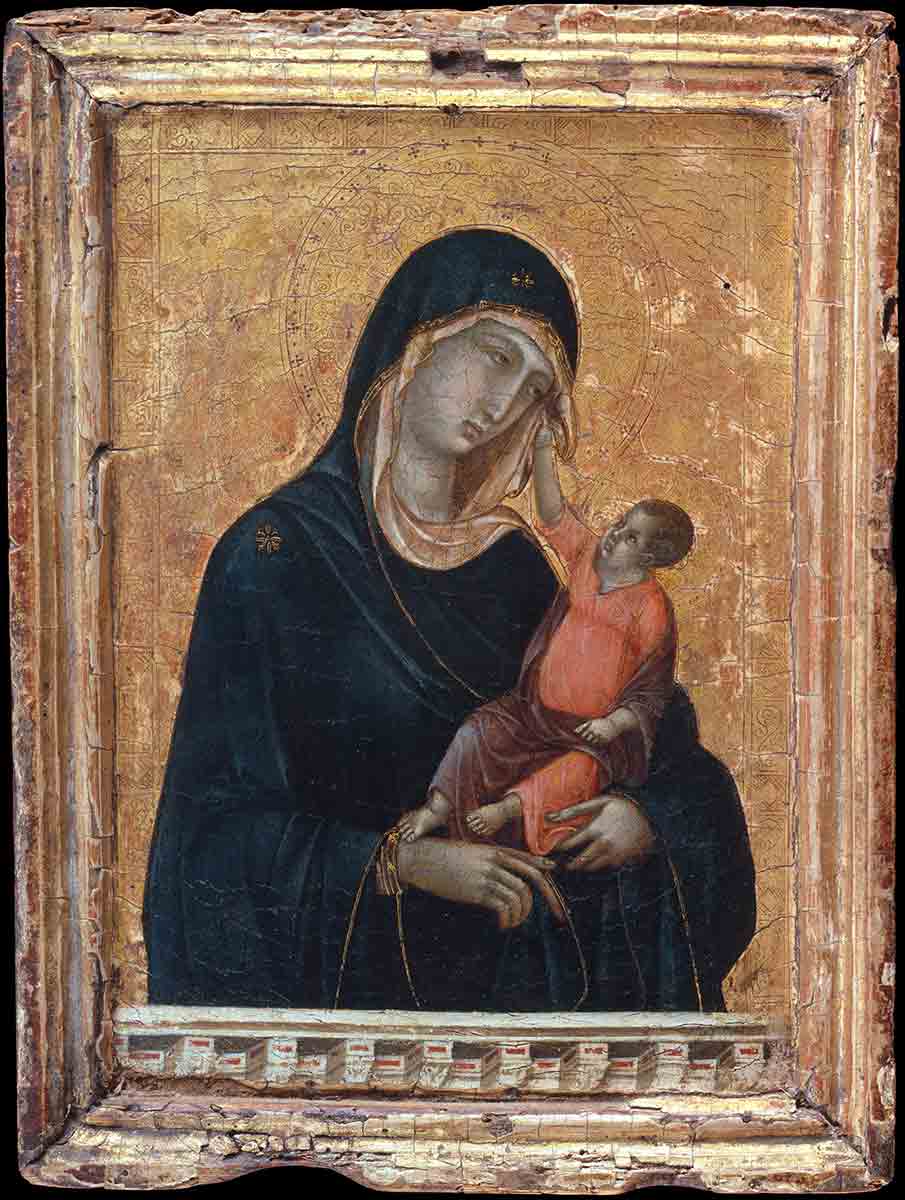
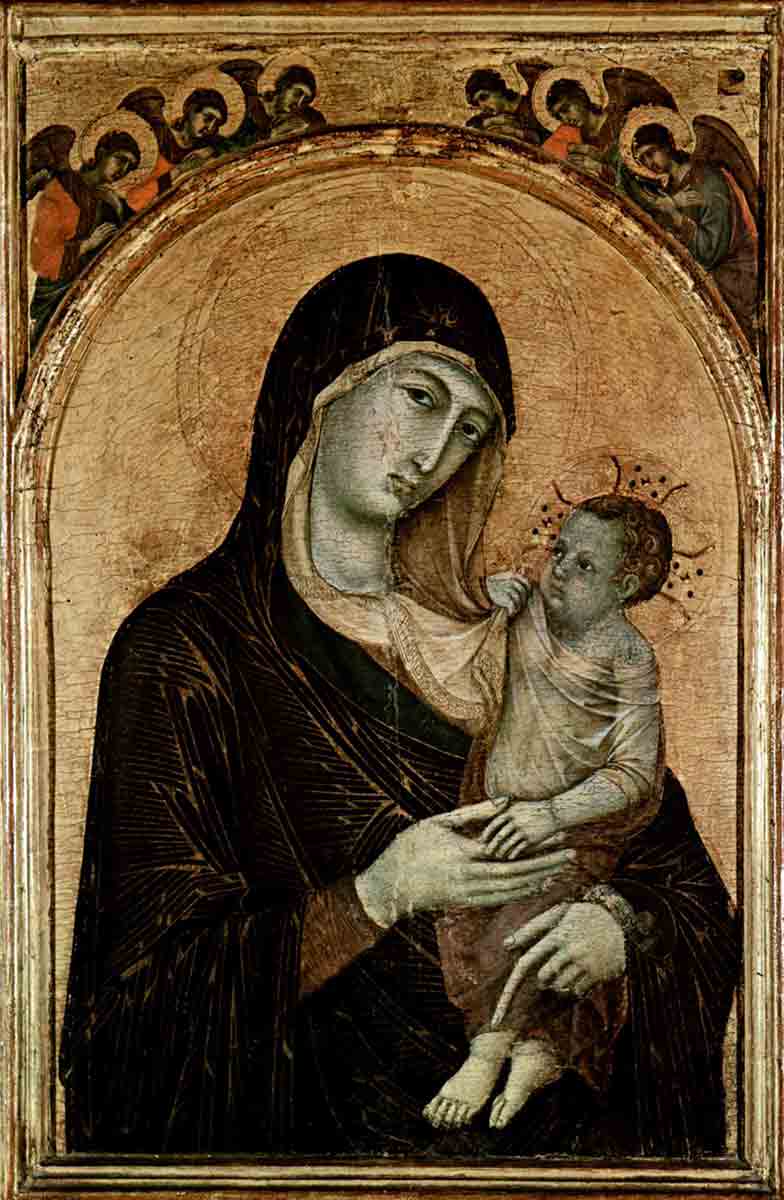
Although the Stoclet Madonna cannot be precisely dated, it is believed to have been painted following Duccio’s completion of Siena’s rose window but before his celebrated masterpiece, Maestà. Duccio has returned to the Madonna with this diminutive panel, not thought to belong to a larger cycle. This Madonna, though, shows an incredible stylistic development by the artist when compared with the angular delineation of the Crevole Madonna, painted approximately a decade earlier. Gone are the graphic gold lines accentuating the Virgin’s robes. In their place, the fabric flows, a feature emphasized by the way Christ gently moves his Mother’s veil aside. There is softness and humanity in the Virgin’s gaze as she looks upon her Child, not the flat, emotionless stare of the Byzantine-influenced Crevole Madonna.
A feature easily missed in this work is the painted parapet in the foreground. This device is evidence of Duccio’s growing interest in and skill at depicting spatial depth in his work. If ever Duccio’s reputation as an innovator in Italian painting was in doubt, this tiny panel with its inches-deep parapet has the power to silence the cynics. Duccio’s often overlooked advances were the forerunners of Brunelleschi and Alberti’s theories of perspective in art.
5. Maesta: Duccio’s Masterpiece
“On the day on which it was carried to the Duomo, the shops were locked up and the Bishop ordered a great and devout company of priests and brothers with a solemn procession, accompanied by the Signori of the Nine and all the officials of the Commune, and all the populace and all the most worthy were in order next to the said panel with lights lit in their hands, and then behind were women and children with much devotion; and they accompanied it right to the Duomo making procession around the Campo, as was the custom, sounding all the bells in glory out of devotion for such a noble panel as was this.”
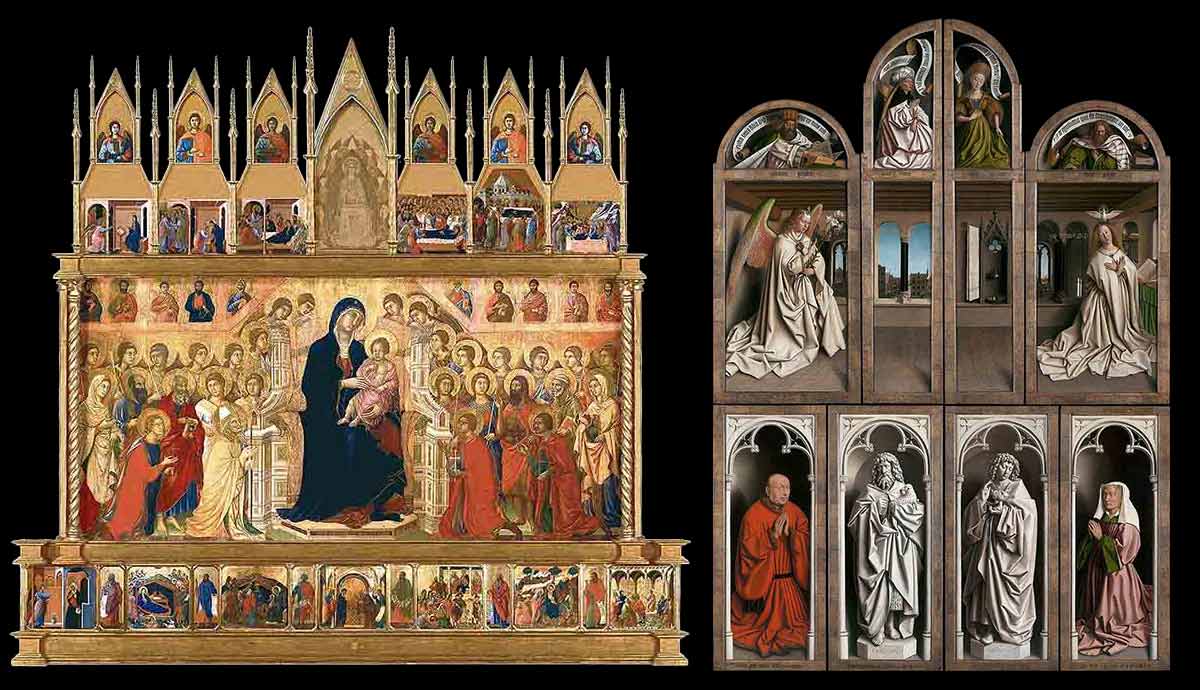
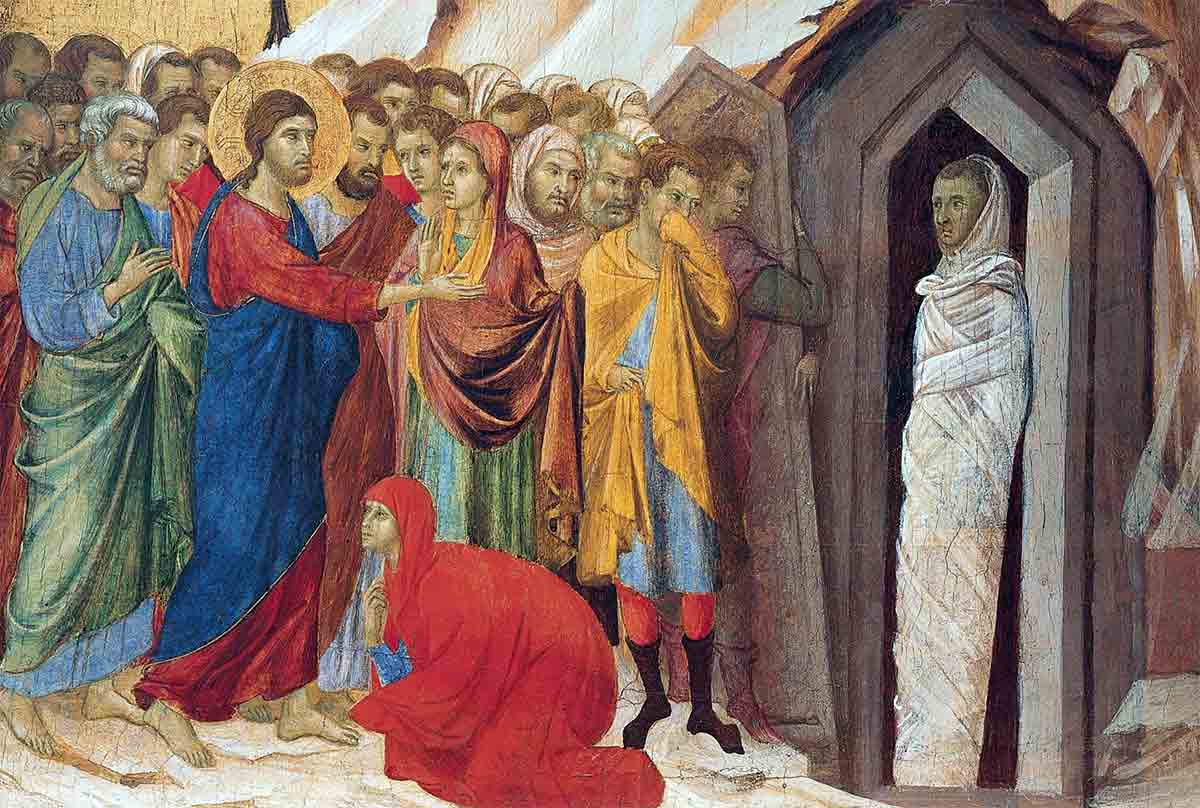
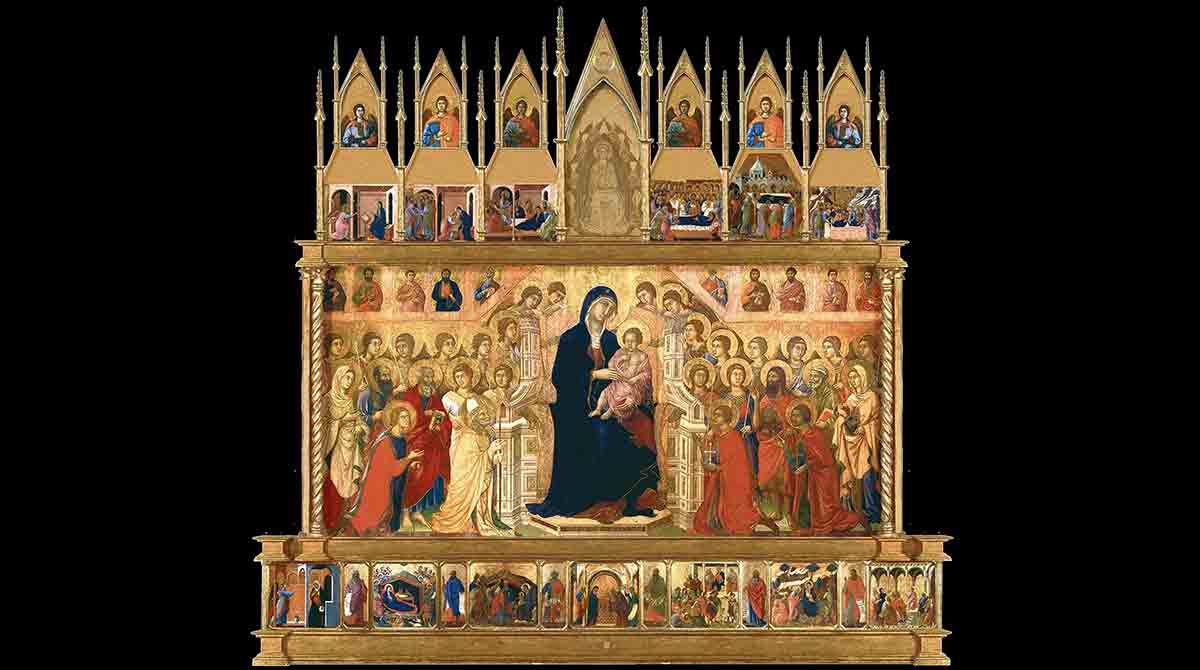
These are the words of an anonymous eyewitness on the day that Duccio’s finest masterpiece, Maestà, arrived at the Duomo in Siena. This was a big day for Duccio and his majestic polyptych. It was the first altarpiece to have paintings on both sides: the front for the benefit of the congregation and the rear for the private devotions of the clergy. The front panels depict the Madonna and Child along with a voluminous array of saints and angels. The front predella details the childhood of Christ, beginning with the Annunciation scene.
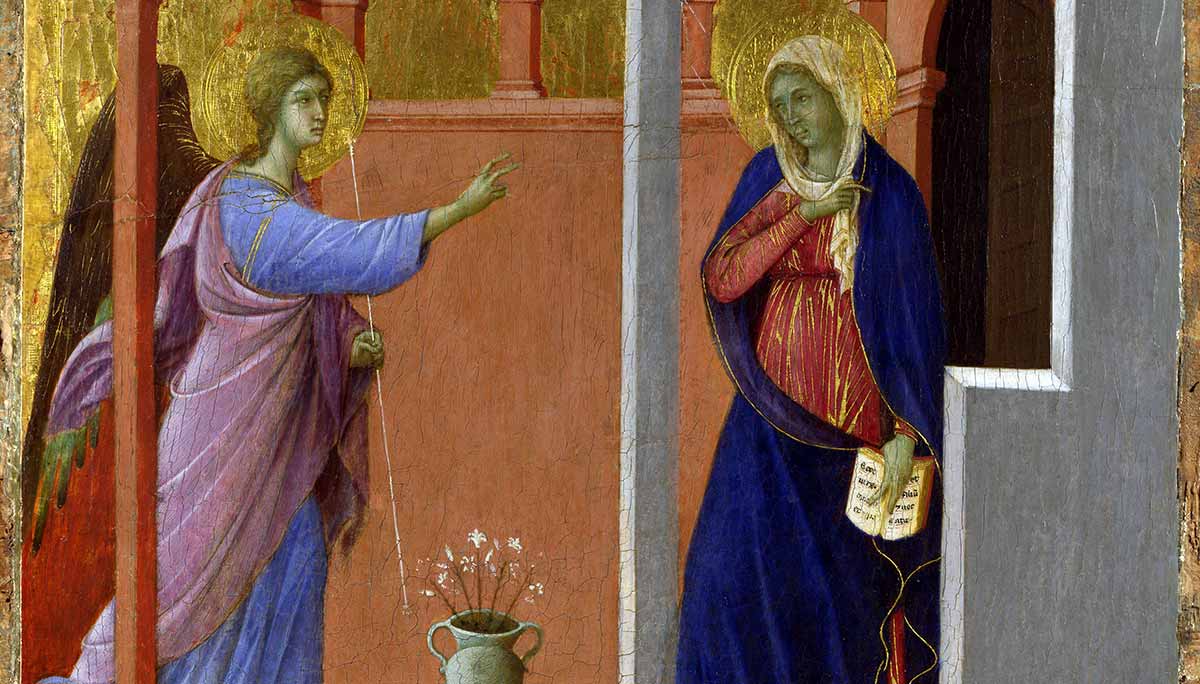
The reverse of this enormous altarpiece consisted of 43 small panel paintings of the life of Christ and the life of the Virgin. A further set of paintings showing individual saints is situated on the Gothic-style arches at the top of the piece. The sheer number of elements in the Maestà dictated that its overall dimensions were impressive. At over 6 feet 7 inches high and almost 16 feet 5 inches wide, it dominated the altar of the Duomo.
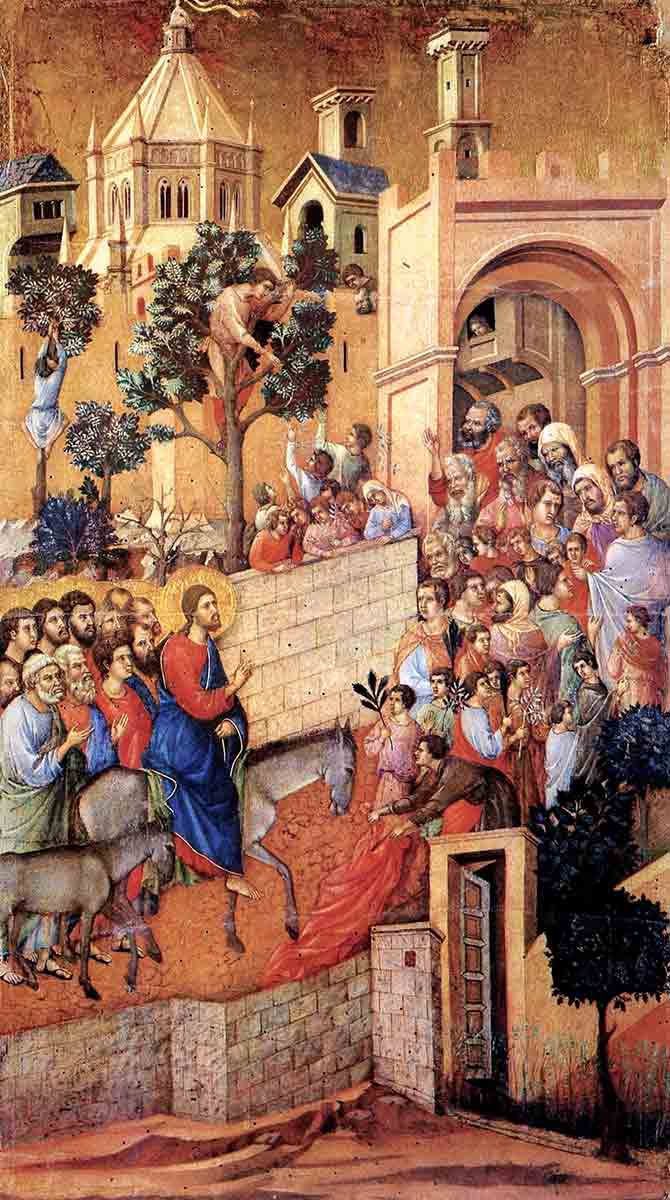
Duccio’s trademark Italo-Byzantine style, with its traditional gold and ultramarine color scheme, was evolving. The Maestà shows how the artist was further developing the naturalistic, realistic style he had introduced in earlier works. The fabric of the clothes depicted and the facial expressions on his cast of characters are softer and exquisitely detailed, even in the smaller rear predella panels, unseen by most people. Duccio grasped the importance and status of the altarpiece in Siena’s Duomo, and his work reflects his deep respect for the location and subject matter.
Duccio: A Master in the Shadow of His Pupils
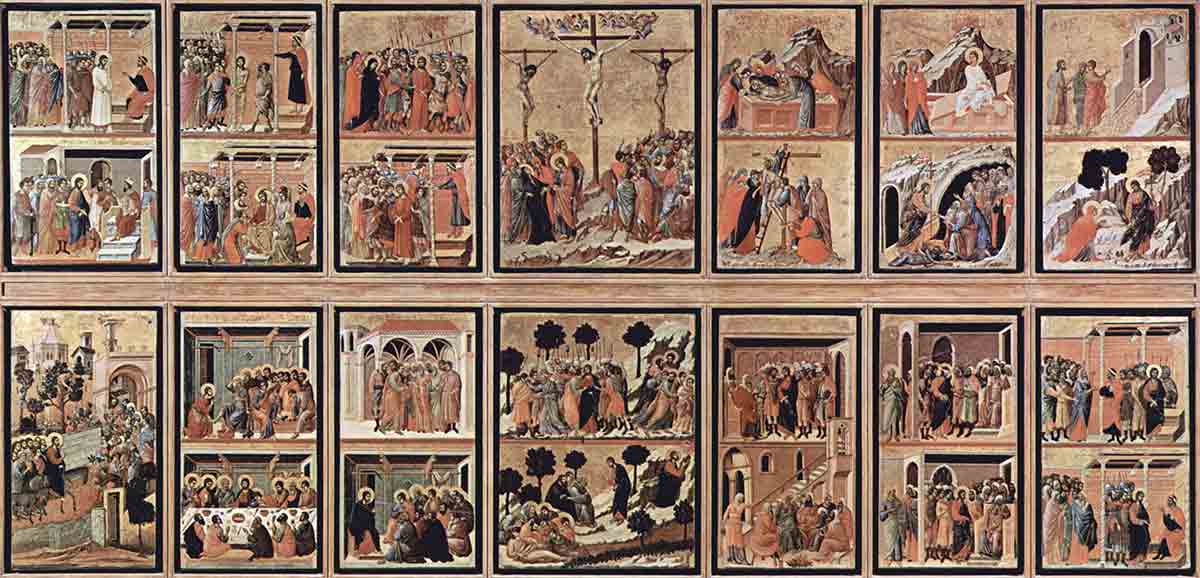
Few artists’ reputations or works last forever, and it is a matter of some import that so many of Duccio’s more impressive artworks survive to this day. Individual panels, such as the Rucellai and Crevole Madonnas, have remained mainly unscathed over the centuries. Maestà, however, suffered the indignity of dismemberment in 1771, having remained in its original home, Siena’s Duomo, since 1311. With the altarpiece sawn up, irreparably damaged, and elements of it sold off around the world, it is a miracle that so much of it remained. In the mid-20th century, a major reconstruction and restoration took place, giving us the work we see today in the Duomo Museum in Siena.
Duccio’s masterpiece and indeed all of his extant works illustrate the scale of his influence on Italian Renaissance painting in later centuries. His alleged pupil, Giotto, may have risen to greater fame than his master, but he stands on the shoulders of Duccio. Perhaps Duccio’s secret was to have been born in the right place; at the crossroads of Western and Eastern trade, Siena. Influences from Byzantium flooded into the city in addition to the more local styles of Florence and France’s Gothic. We may never fully appreciate the extent to which his progressive attitudes towards naturalism and realism in painting influenced Italian art. Duccio di Buoninsegna is quite possibly the most extraordinary artistic genius that you never heard of.