Oscar Claude Monet is a renowned Impressionist painter known for works such as Water Lilies, Haystacks, and Rouen Cathedral, and he produced more than 2,000 paintings. The 19th-century French artist founded the Impressionist movement, named for one of his works. He painted the people and landscapes around him, sharing his impression of the familiar. He also developed a serial approach to his subjects, switching canvases as the light or his interest shifted. This article looks at ten Claude Monet paintings that every art lover should know.
1. Impression, Sunrise (1872) by Claude Monet
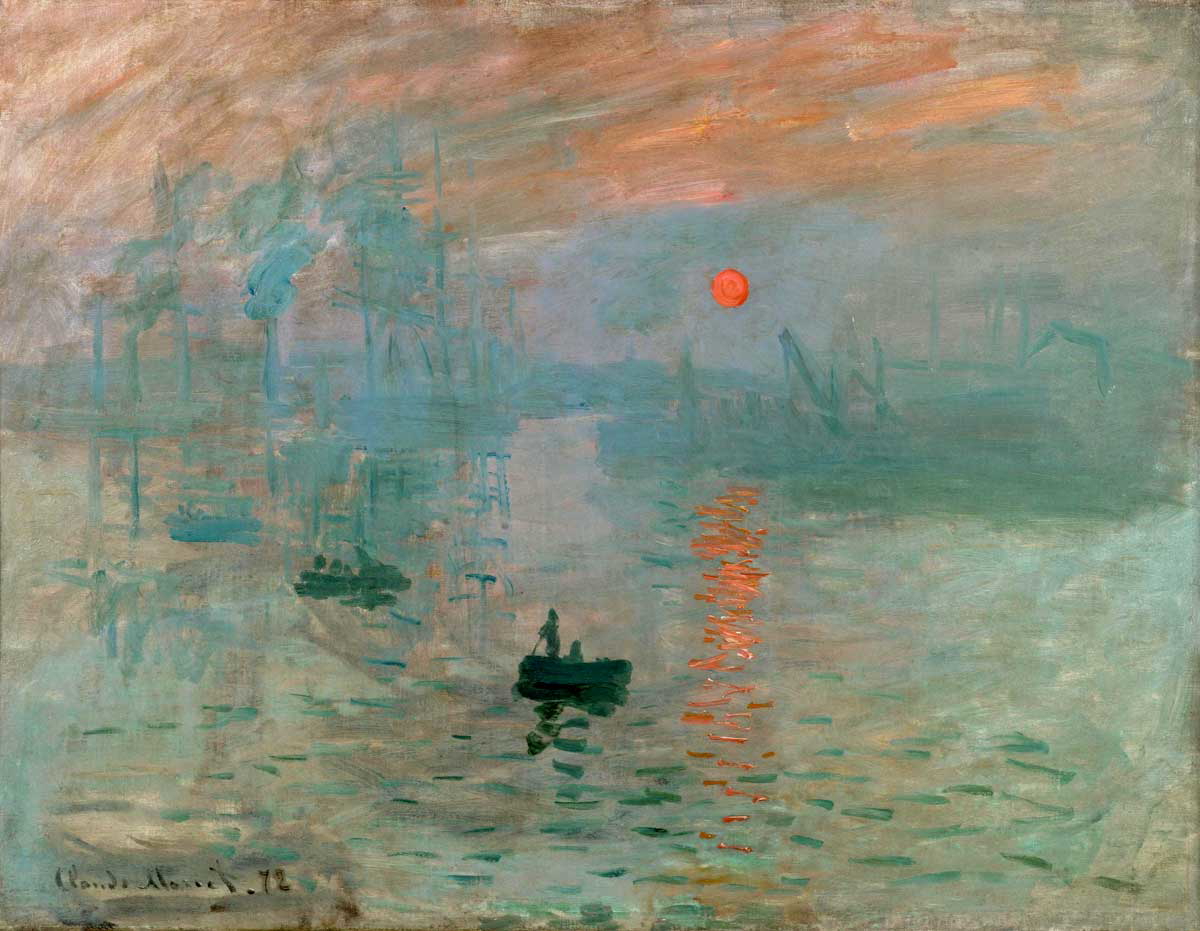
One cannot discuss Claude Monet’s art without looking at Impression, Sunrise, one of his most notable pieces. Not only was it the centerpiece of Impressionism in terms of technique, but it also served as inspiration for the term Impressionism itself. It was this painting’s title that prompted Louis Leroy, an art critic, to use the word Impressionists when referring to the artists who participated in the 1874 exhibition, in which Monet and other artists rejected from Royal Academy exhibitions displayed their work independently. Although Leroy did not use the term positively, the painters and the audience adopted it to describe the style. Ultimately, Impression, Sunrise became the starting point of Impressionism.
So, what is it that makes this painting such a pivotal piece in the development of this movement? First, it was executed en plein air (outdoors), a technique preferred by the Impressionists. Secondly, the paint was applied in loose brushstrokes, which captured the impression of a fleeting moment. The work is painted in an almost abstract way, which made it look unfinished at the time.
- Why it matters: The canvas that named and defined the Impressionist movement: light, speed, and atmosphere over finish.
- Look closer: Hazy harbor, flat orange sun cutting through blue-gray mist; brisk strokes that feel “unfinished” by design.
2. Woman With a Parasol (1875)
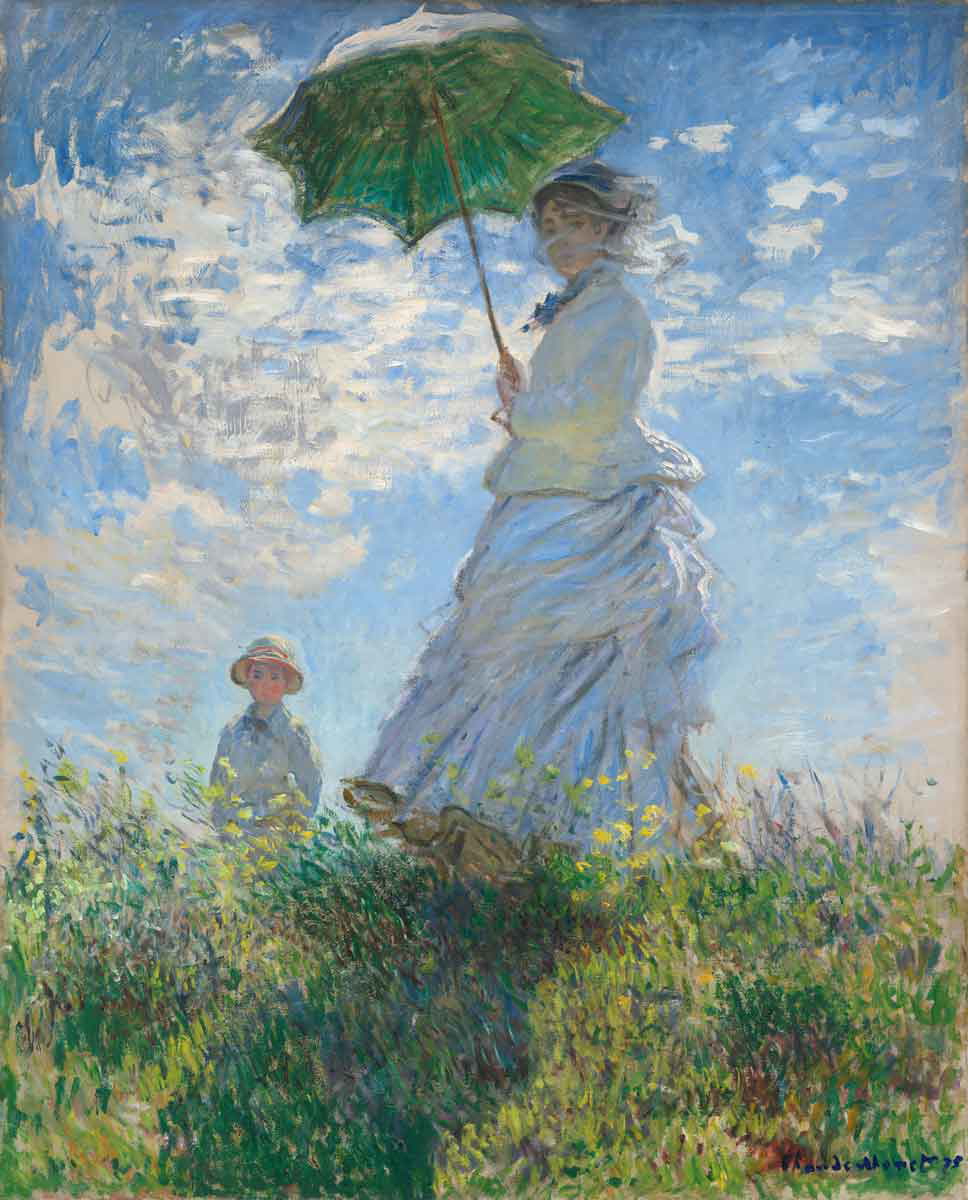
Monet’s painting Woman with a Parasol captures Camille and Jean Monet, his wife and son, going for a walk. Like other artworks signed by the artist, Woman with a Parasol is an excellent embodiment of the way Impressionists experimented with light, shade, and color. In addition, this particular painting depicts the playful nature of the wind, which can be noticed in the waving grass and Camille’s dress. The work has a strong upward perspective, with the sky and the clouds making up most of the background. The bright and vivid colors are applied in spontaneous, animated brushstrokes, thus providing the painting with a casual touch.
- Why it matters: Turns a family scene into a study of wind and daylight; portraiture as atmosphere.
- Look closer: Upward viewpoint; fluttering white dress and green parasol; broken color in grass and clouds.
3. The Magpie (1868-1869)
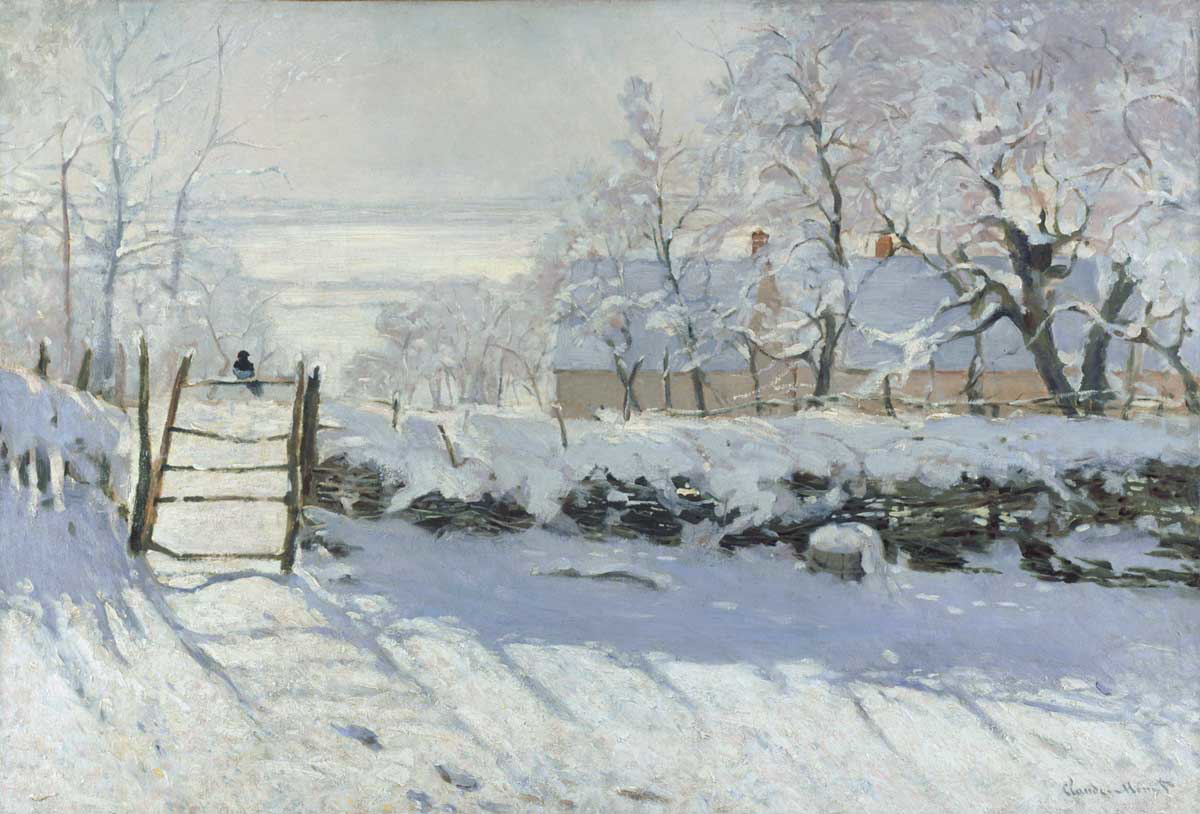
Out of roughly 140 snowscapes signed by Monet, The Magpie is probably the most famous. It is also the largest snowscape he ever painted. At the time, Monet was in Normandy, near Étretat, where Louis Joachim Gaudibert, his patron, helped him find a house where he could raise Jean, his newborn son.
The Magpie demonstrates Monet’s masterful recreation of sunlight and shadows. We see a magpie perched on a gate with its back to the sun, which shines upon the snow. Traditionally, shadows are painted using black colors. Here, however, one can observe a slightly colored, bluish shadow on the snow. Monet relied on the effect produced by the blue-yellow complementary colors, which, combined with short brushstrokes, created an effect of bluish-violet shadows. This method would later become a typical Impressionist way of portraying the changing nature of light.
- Why it matters: Rewrites winter color: blue-violet shadows in snow replace academic black.
- Look closer: Luminous snow fields; tiny magpie anchoring a near-monochrome composition.
4. The Woman in the Green Dress (1866)
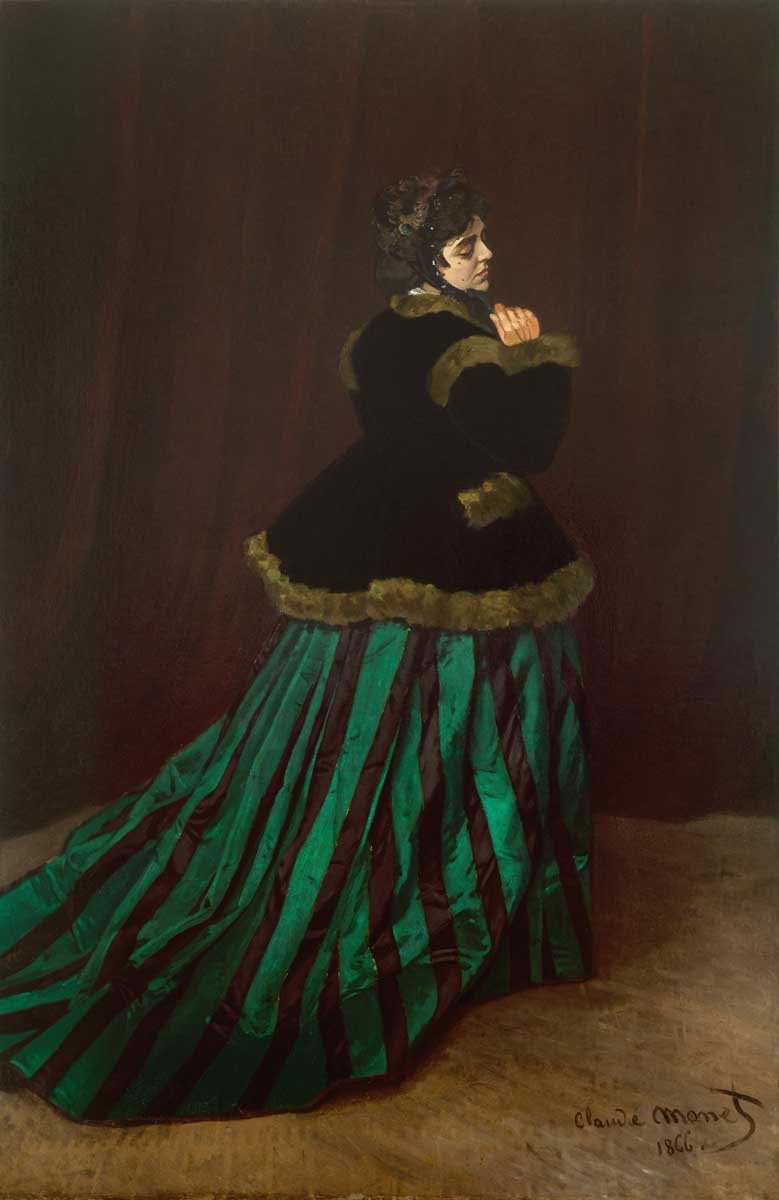
The Woman in the Green Dress is also known as simply Camille. It was executed in 1866, and it shows Monet’s future wife wearing a long, green, black-striped dress and a furry, black jacket. She is also shown wearing yellow leather gloves with her hair tied in a bun.
Although it seems like a typical portrait at first, one can notice that just like in Woman with a Parasol, Monet tried to depict a fleeting, casual moment. First of all, we cannot see the dress fully, as it’s cut on the left edge, thus creating the impression of movement. The folds of the dress suggest liveliness as well. Camille has her head slightly turned backward and looks downward as if she were contemplating something. Unlike his later works associated with Impressionism, The Woman in the Green Dress was well received by the public and the critics.
- Why it matters: Early success that tests modern cropping and movement before Monet’s full Impressionist turn.
- Look closer: Cropped hem implying motion; satin folds modeled with energetic, directional strokes.
5. Garden at Sainte-Adresse (1867)
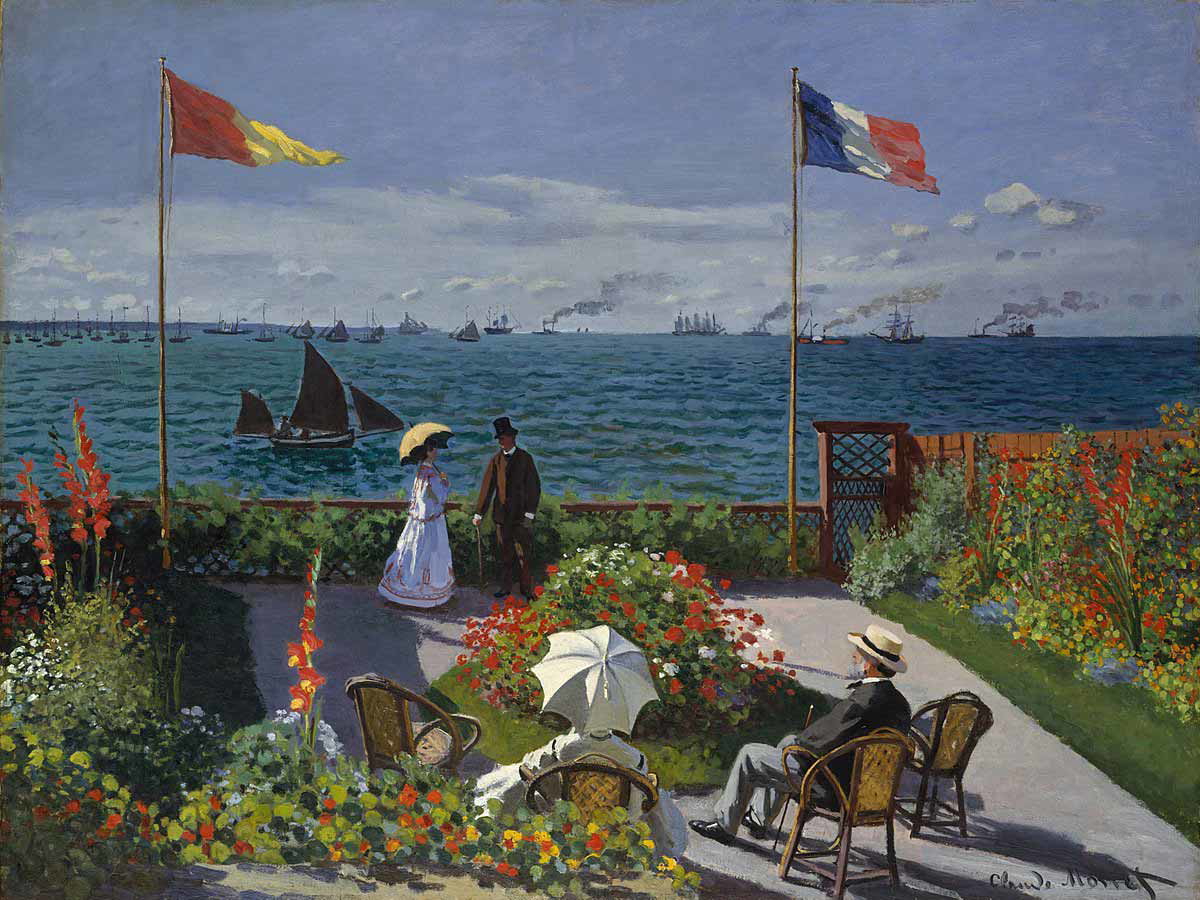
Garden at Sainte-Adresse was finished in 1867 and exhibited at the 4th Impressionist Exhibition in 1879. It shows the garden in Sainte-Adresse overlooking the English Channel with the Honfleur commune on the horizon. Once again, the viewers can notice the creative play of light and shadows. Interestingly, the figures are depicted quite realistically and in detail, which isn’t typical of his later works. Nonetheless, we can still see the vibrant colors of the flowers applied in short brushstrokes.
This painting often comes up when we think of the influence of Japanese wood prints on Impressionism. Pierre-Auguste Renoir actually called this particular artwork “the Japanese Painting.” It is thought to have been inspired by the Japanese print called Turban-shell Hall of the Five-Hundred Rakan Temple by Hokusai. The influence can be seen in three horizontal planes of the composition, which appear to be parallel rather than depth-induced.
- Why it matters: Bridges detailed figuration with Japonisme’s flat bands—key to Monet’s evolving composition.
- Look closer: Terrace/sea/sky as three parallel planes; flags and blossoms as bright color notes.
6. La Japonaise (1876)
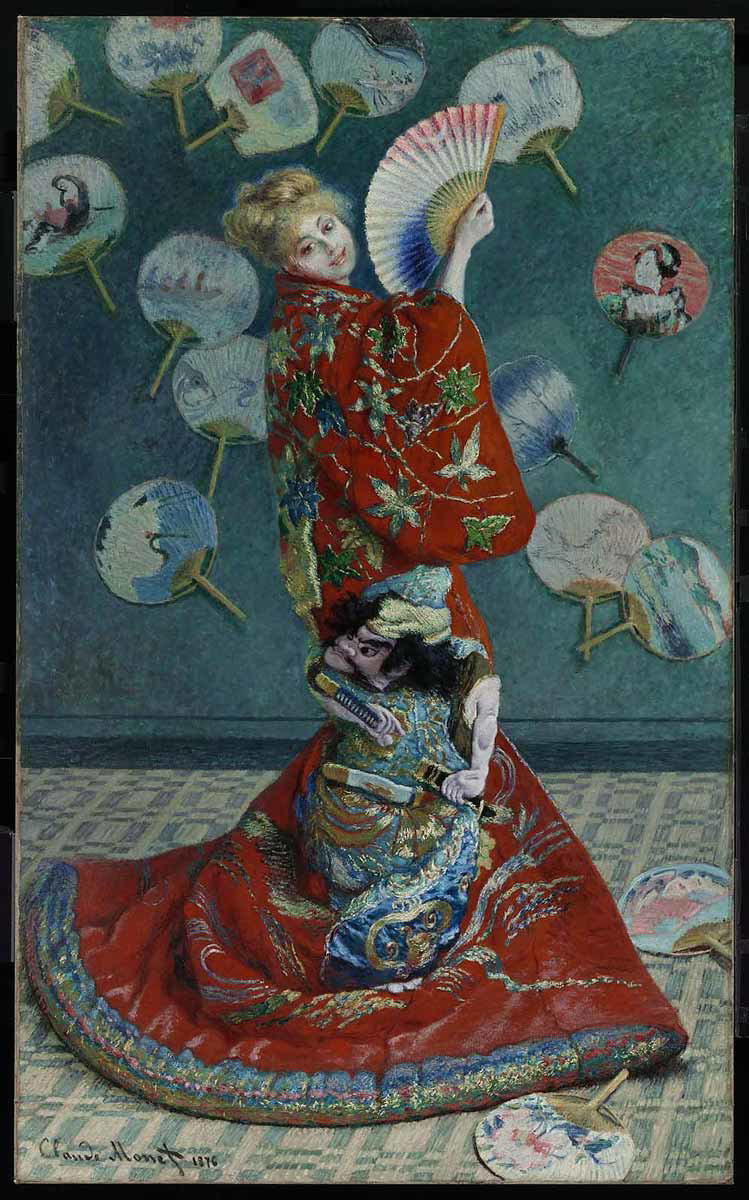
La Japonaise shows a European woman (Monet’s wife, Camille) wearing a red Japanese kimono. She holds a hand fan and stands on a tatami mat in front of a wall covered in Japanese fans. Camille has her head turned toward the viewer, an element inspired by Japanese dance. But hers is not the only face we see in this painting, since the red kimono contains the face of a samurai.
After his son was born, Claude and Camille were in great financial trouble, so executing and selling a painting with Japanese elements seemed like an excellent idea, considering the popularity of Japonisme in France at the time. However, what began as a simple way of earning some money turned into a superb experience for the artist. Shortly after he began working on the painting, Monet realized what a pleasure it was to paint detailed kimonos.
After La Japonaise was put on display at the 1876 Impressionist Exhibition, many critics pointed to its erotic symbolism. More precisely, they discussed the placement of the samurai’s head, as well as the woman’s flirty facial expression. Apparently, Monet was embarrassed by the effect the painting had on the audience. He allegedly withdrew the painting from the exhibition himself and told people that it had been sold to an anonymous buyer.
- Why it matters: A frank embrace of Japonisme and surface pattern that expands Monet’s palette and staging.
- Look closer: Ornate kimono motifs; wall of fans flattened into a decorative backdrop.
7. The Studio Boat (1876)
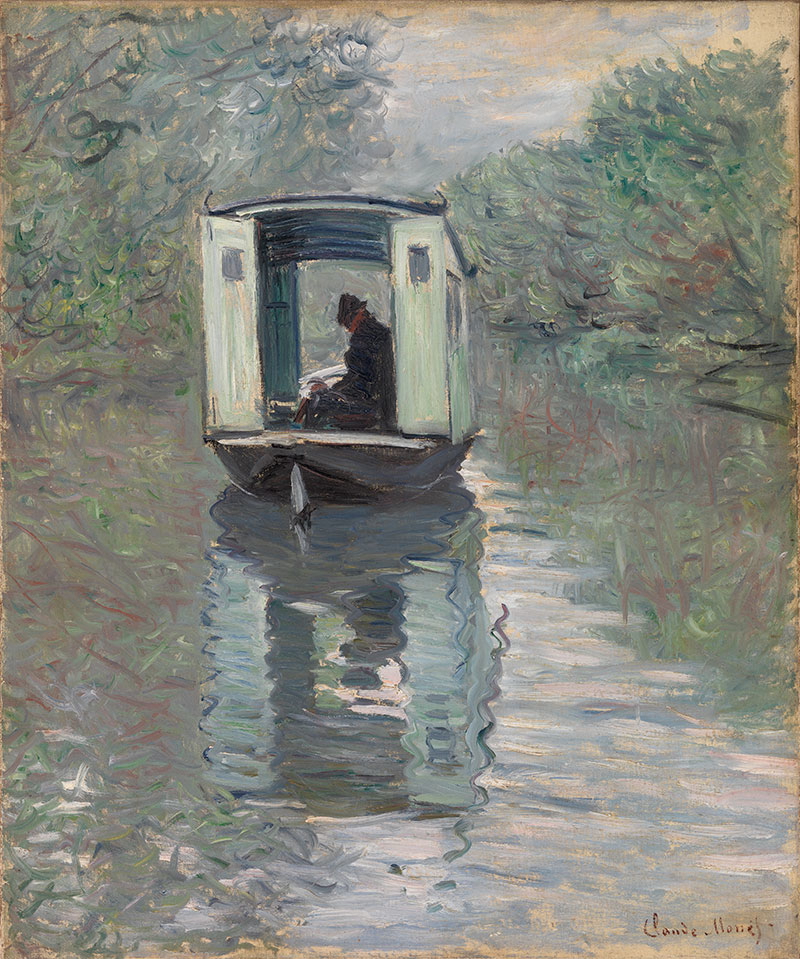
Did you know that Monet bought a boat (that soon became his studio) so that he could experience the en plein air painting technique at its fullest? In The Studio Boat, Monet portrays himself working in his remote working place—the boat floating on the Seine. Although Monet made several other paintings featuring his studio boat, this one has been of particular interest to critics. It pointed indirectly to the fact that Monet was slowly alienating himself from portraying urban industrial scenes.
- Why it matters: Monet builds mobility into his method, making process and subject inseparable.
- Look closer: Portable easel and cabin on water; reeds and reflections turning the Seine into a moving studio.
8. The Artist’s Garden at Giverny (1900)
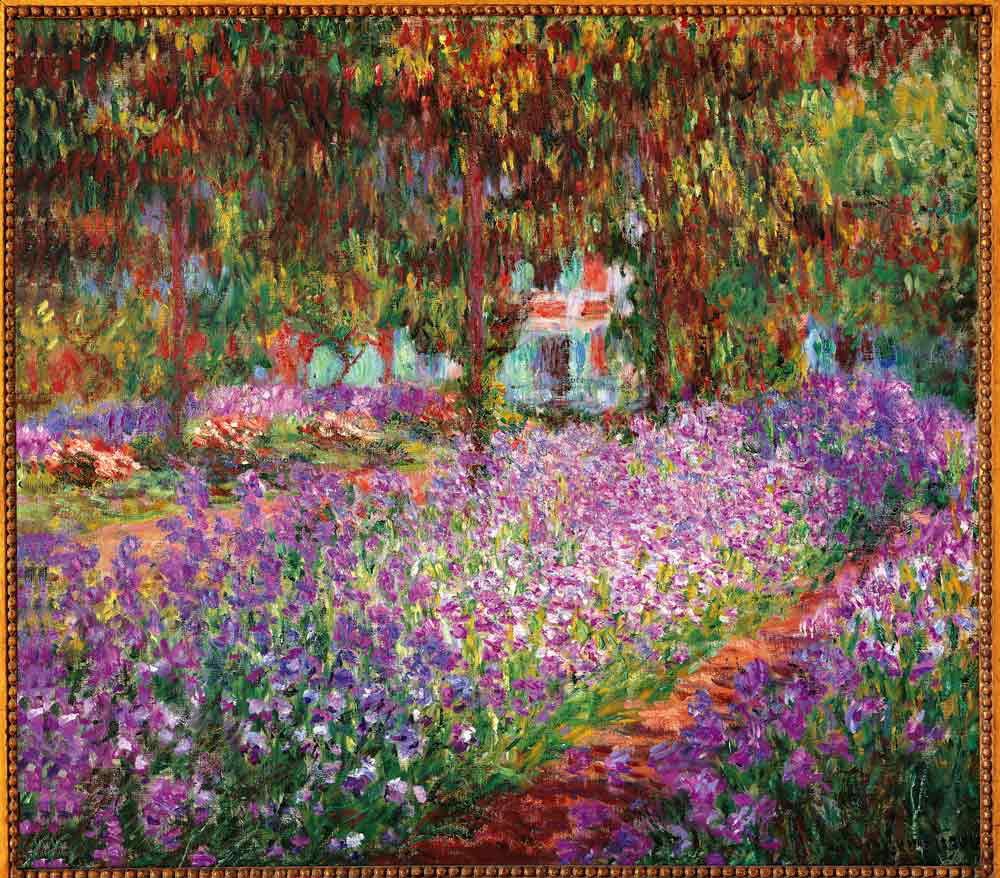
Claude Monet was very passionate about gardening, and his estate in Giverny became his heaven in this regard. He spent years and years caring for his garden and, at the same time, depicting it on hundreds of canvases. Therefore, we cannot neglect this iconic painting, which testifies to the love Monet devoted to cultivating his Giverny garden. In fact, the garden still exists, and it welcomes thousands of visitors every year.
Monet was 60 years old when he painted The Artist’s Garden at Giverny. The painting depicts diagonal rows of brightly colored irises, and you can almost see the flowers moving in the wind. He executed it the same year he started working on his most famous series, Water Lilies.
- Why it matters: Giverny becomes Monet’s lifelong laboratory; gardening feeds the painting, and vice versa.
- Look closer: Diagonal iris rows; close cropping that turns beds into bands of color and light.
9. Water Lilies (c. 1916)
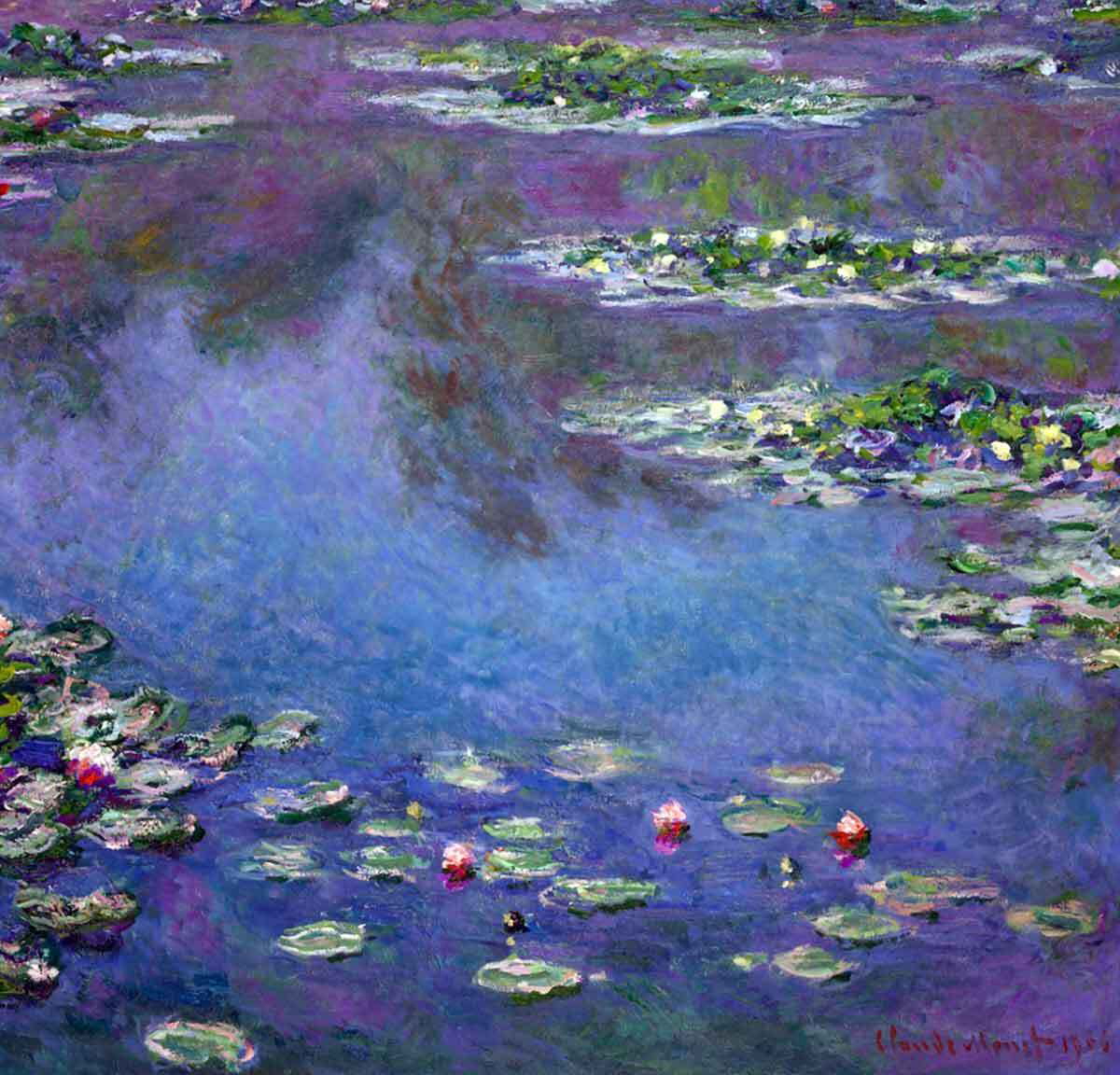
Claude Monet began creating various images of a water lily pond in 1899. By this time, he was already famous for his series of paintings, including Haystacks and Rouen Cathedral, but the artist dedicated 20 years of his life to capturing the water lily pond, producing almost 300 paintings of the scene, each an individual impression.
The Water Lilies series is usually divided into two compositional groups: one that depicts the pond and vegetation, and the other that portrays the water surface, the flowers, and reflections. At first, the paintings were executed on smaller canvases. In 1914, however, everything changed when Monet’s son, Jean, died. This seemed to give the artist the impetus to take on larger canvases. The biggest painting from the series, now exhibited at the Musée de l’Orangerie, Water Lilies, The Two Willows, measures 55 by 6.5 feet.
- Why it matters: Monumental, horizonless panels that push toward abstraction and pure perception.
- Look closer: Floating pads and blossoms interlaced with sky reflections; no horizon to anchor the eye.
10. Rough Weather at Étretat by Claude Monet (1883)
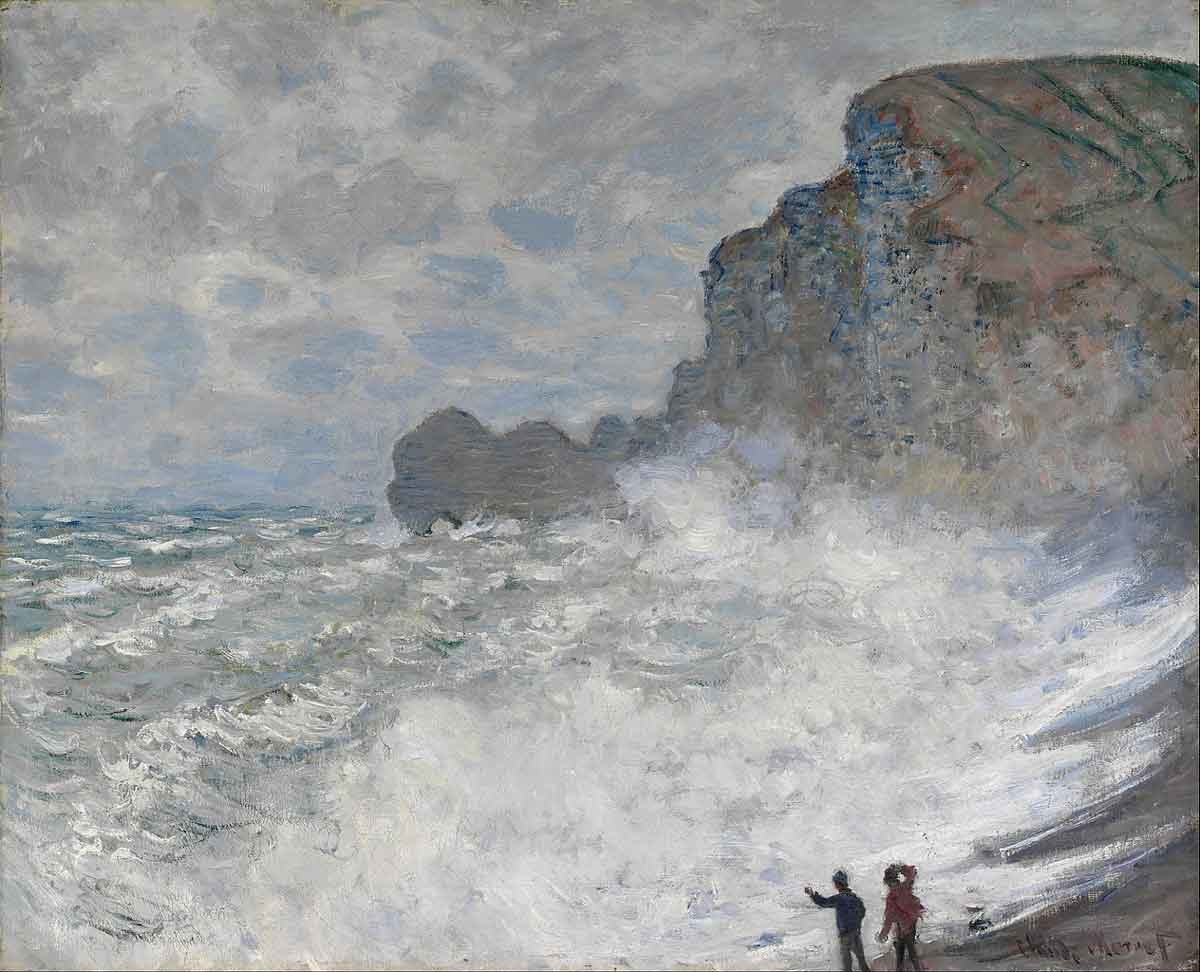
Although not as famous as his Water Lilies, Monet was particularly interested in painting en plein air seascapes. Art specialists found a grain of sand embedded in the surface of Rough Weather at Étretat, which is direct proof that at least that particular paint was applied on the shore. Here, Monet emphasized the magnificent strength of nature. He applied colors in loose brushstrokes, outlining a fleeting moment when big waves strike.
- Why it matters: Captures nature’s force in situ, an on-the-spot seascape that trades polish for immediacy.
- Look closer: Scumbled strokes for spray and surf; cliff forms as anchors amid crashing waves.