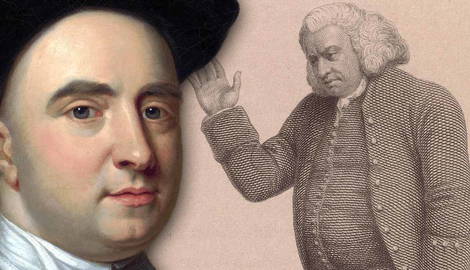

Dr. Johnson’s violent rebuttal of Berkeley’s arguments for idealism, which is based on the non-existence of matter, has gone down in philosophical history. Kicking a large stone so hard he literally bounced off it, Johnson famously said, “I refute him thus!” This impulsive act has lent Johnson’s name to a particular philosophical fallacy known today as “the appeal to the stone.”
Dr. Johnson Kicks a Stone
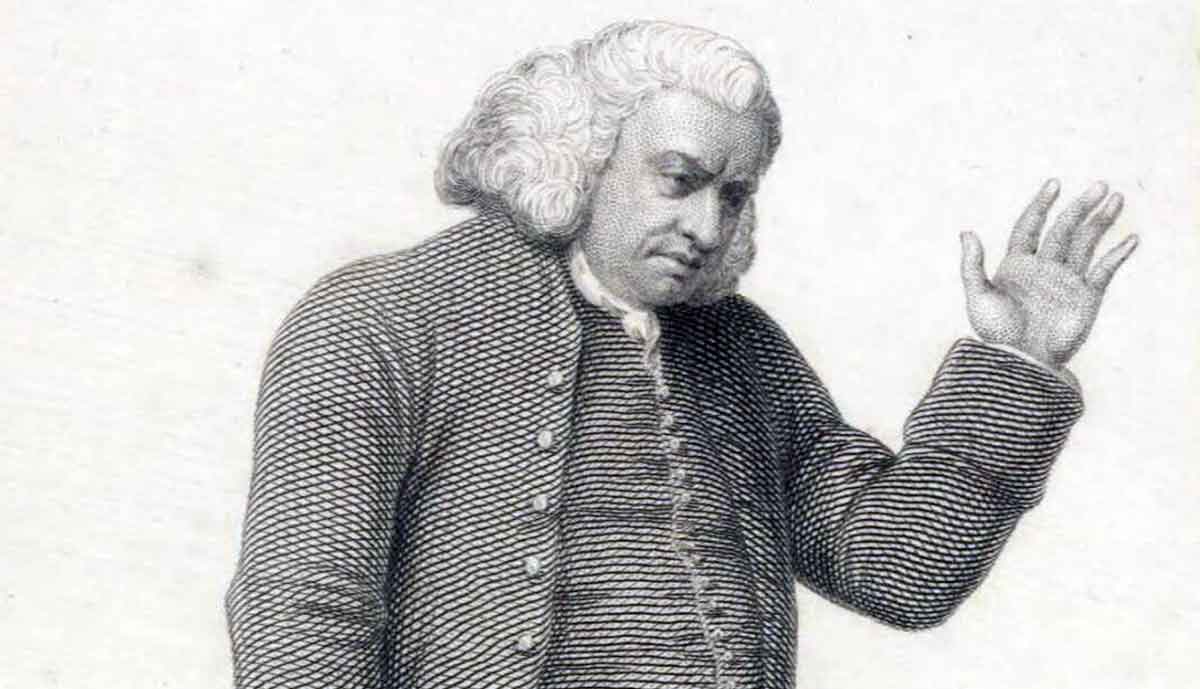
One Sunday, after leaving church, Dr. Johnson struck up a conversation with his friend and future biographer, James Boswell. The friends discussed the ideas of the Irish Bishop George Berkeley. Berkeley held that matter did not exist, that all the physical things we perceive in the universe are ideas alone. This view was known at the time as ‘immaterialism’ but would later become much more well-known as ‘subjective idealism.’ On hearing Berkeley’s arguments for this position from Boswell, Johnson famously kicked a large stone so hard he rebounded off it and cried out, “I refute it thus!”
Like all good philosophical anecdotes, there is a little more to the story than is often told. Let us take a brief dive into the details to see what exactly is at stake here. First of all, who was Dr. Johnson?
Born in 1709, Samuel Johnson was an English thinker who excelled in many fields. He was a playwright, a poet, a man of letters, and a literary critic, amongst other things. Today, he is most famous for his dictionary. Johnson’s Dictionary was published in 1755 and was considered the most respected dictionary of English until the arrival of the Oxford English Dictionary in 1884.
Johnson was a celebrity of his day, known as much for his eccentricities as for his intellectual achievements. He suffered from various tics that have been posthumously diagnosed as symptoms of Tourette’s syndrome. His dramatic response to Berkeley’s idealism, powerfully kicking a stone whilst shouting, would certainly not be out of character for Johnson.
When we talk about Johnson’s stone-kicking response today, it is typically to give an example of a misunderstanding of Berkeley’s argument. As we shall see, Johnson’s reply is no real objection to subjective realism. However, as said, there is more to the story than is often presented.
Esse Est Percipi (To Be Is to Be Perceived)
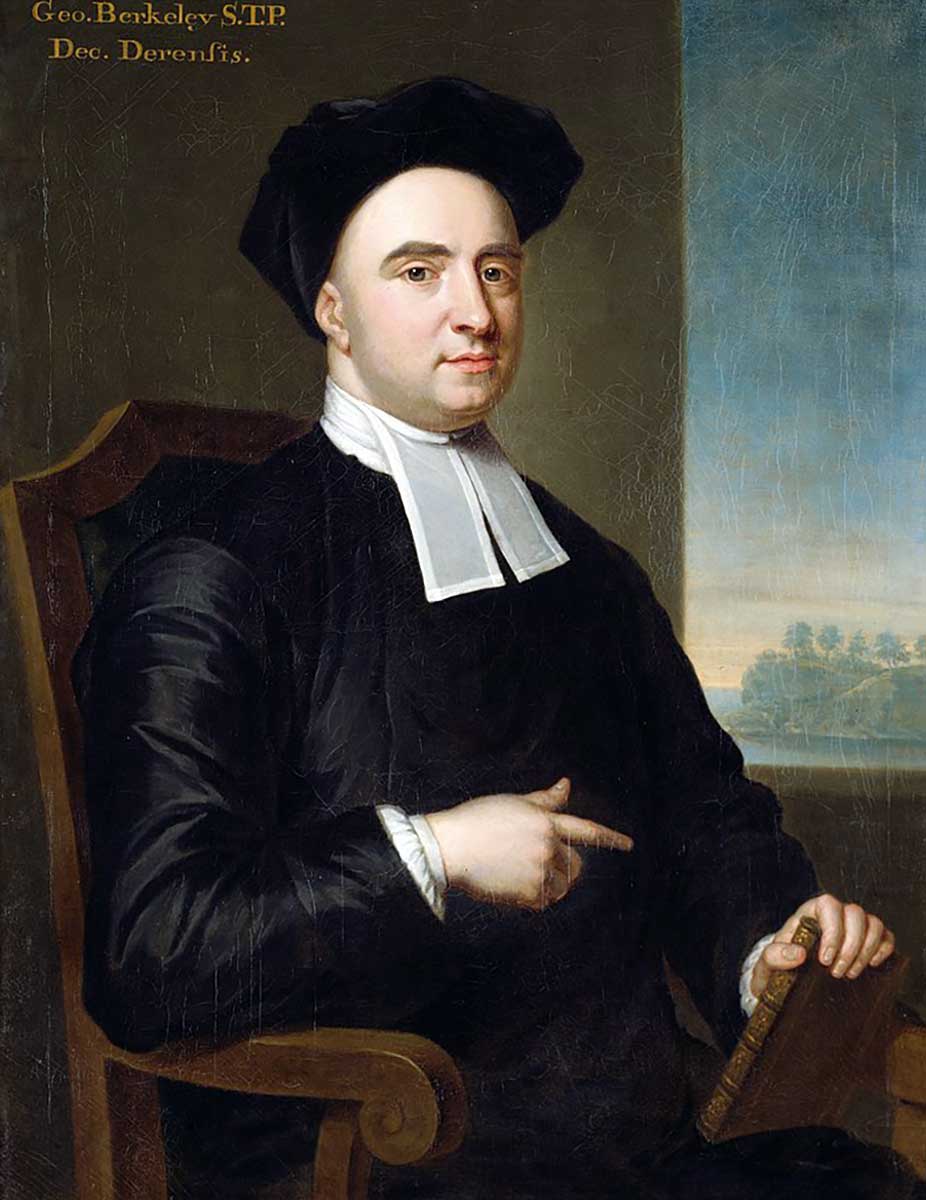
Berkeley’s key idea, the one that so enraged Dr. Johnson, is neatly summed up in his neat Latin phrase: Esse est percipi (to be is to be perceived). He argues that for anything to exist, it must be perceived by someone. Put simply, an object that no one is aware of through their senses simply cannot exist. This is because everything that exists exists only as an idea. There is no physical matter in the universe.
The mind can create ideas or receive ideas. Consider the difference between simply imagining a table and actually going to look at one. In the case of imagination, you choose to ‘see’ the table with your mind. It can appear exactly as you want, and when you no longer want to see the table, you can think of something else. However, when you go and look at a table, you can only see an image of that particular table. In the first instance, you created the image of the table, but in the second, you passively received it. If both tables are merely ideas and one was created by you, where did the second idea come from? The answer for Berkeley is God.
Thus, there are two kinds of ideas. Those we create and conjure up when we dream or hallucinate, as well as when we remember, reminisce, and imagine things. And those created by God. These are far more stable, enduring, and consistent. Unlike a memory of a table or an imaginary table, what we would normally call ‘a real table’ is, according to Berkeley, an idea created by God.
When Dr. Johnson kicked the stone, he was trying to make the point that this solid piece of rock could not be merely an idea but rather a physical object.
Primary and Secondary Qualities
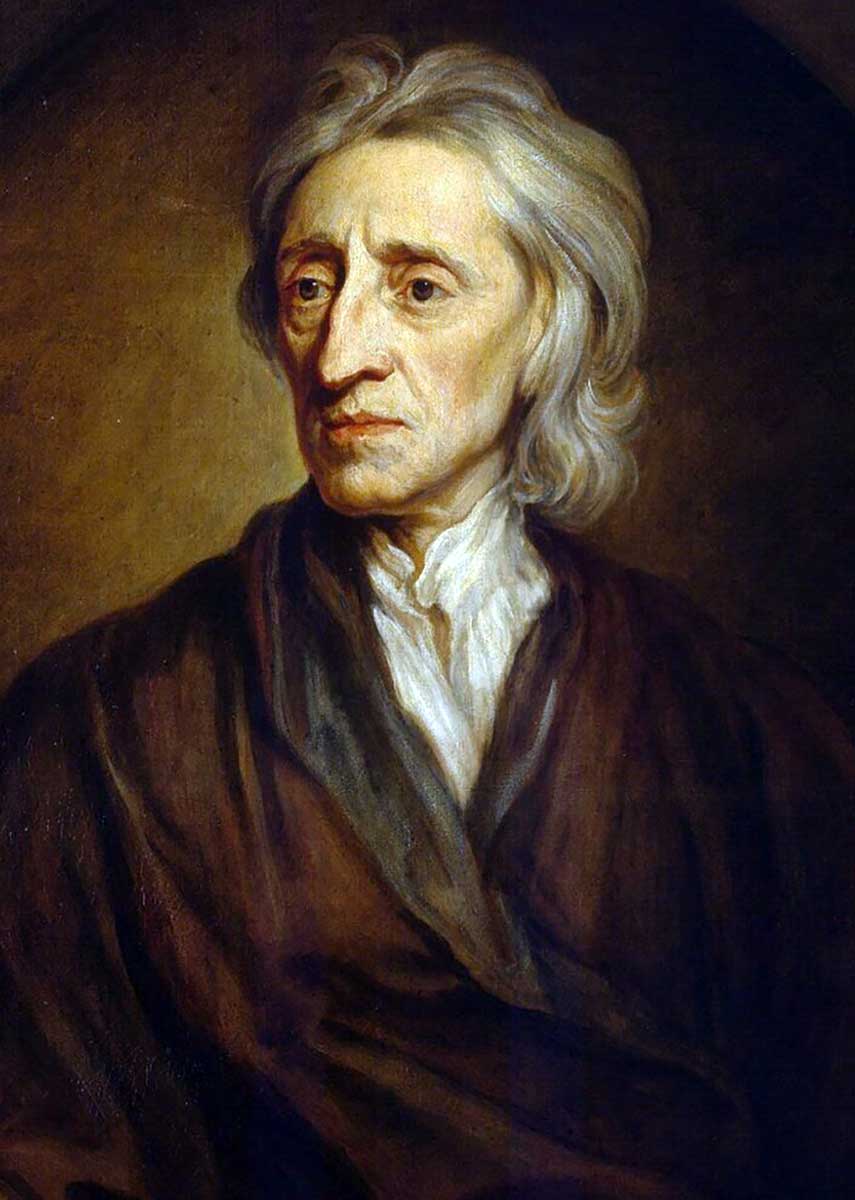
Berkeley’s ideas might outrage common sense, but they are not easily refuted. He had read John Locke’s Essay Concerning Human Understanding (1689) and was taken with the idea of primary and secondary qualities. Berkeley’s position is that there are no such things as primary qualities. To see how this is so, let us take a look at Locke’s idea.
Primary qualities are those things we can say about an object that are independent of any observer. These include whether it is a solid, liquid, or gas; how much space it takes up; what shape it has; and whether it is moving. The idea here is that no matter whether anyone is looking or not, objects possess these qualities in some form. Think of the question: if a tree falls over in the woods and no one is around, does it make a sound? Locke would say (and most of us would agree) that the tree was certainly solid, that it was tree-shaped and took up a tree’s worth of space, and that it was moving as it fell.
Secondary qualities are properties that produce sensations in an observer. Here, things like the color of the tree, the texture of its bark, whether it was warm or cold, and the sound it makes falling to the ground are all secondary qualities.
There is an experiment that you can do to experience secondary qualities for yourself. Fill a large bowl with tepid water. Then hold onto something cold with your left hand and something hot (not too hot) with your right. After a few minutes, put both hands into the bowl of water. The water will feel warm to your left hand but cold to your right hand. Water cannot be both warm and cold at the same time; therefore, this cannot be a property of the water itself.
Against Abstraction

Berkeley’s philosophy seems difficult to take seriously at first. However, what we experience of the world are the secondary qualities of objects. And these are all of the mind or ideas. Berkeley would argue that the notion that matter does not exist should be easier to believe than the thought that it does.
Imagine picking up a stone from the street and holding it in your hand. What color is it? Perhaps it is a pale sandy brown or dark grey, almost black. Color is a secondary quality. If it were a primary quality, then it would be a feature of the stone that is always present, whether or not it is observed. But we know that dogs, for example, see colors differently from us. A stone in your hand would be one color to you and a different one to your dog.
Now imagine feeling the texture of this stone. Is it smooth or rough? You might be imagining a smooth stone, but for a much smaller creature, a tiny insect, the surface of the stone would seem much rougher than it does for you.
We have already seen how hot or cold the water appears to you depends on you, the observer; thus, this is a secondary quality.
For now, however, keep picturing the stone in your hand. Now, without mentioning its color or its texture or whether it is hot or cold, describe what the stone is ‘really like.’ Remember, you can only perceive its secondary qualities. What is the stone like when no one is around to perceive it?
Berkeley would point out that this ‘unperceived stone’ is a very strange object indeed. If we are going to appeal to common sense, is not the idea of matter existing outside of perception a more peculiar idea?
Divine Perception
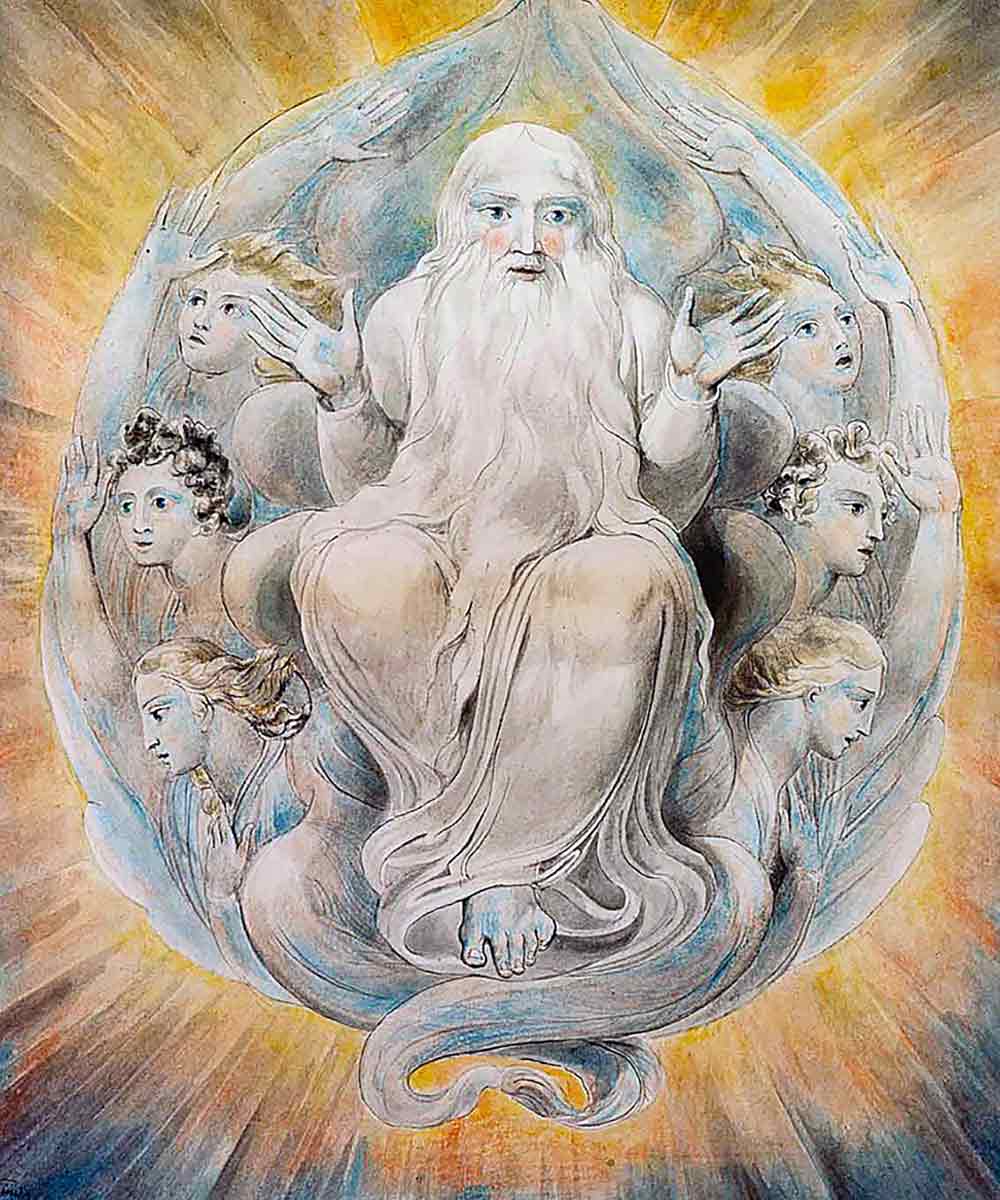
As noted above, Berkeley claims that there are two kinds of ideas in the universe: those we create and those we receive. We saw that imagined ideas are of a weaker kind than objects we see ‘in real life,’ so to speak. Those objects, the things we perceive in the world around us, are ideas created by God. Because he is all-powerful, the ideas he creates are naturally more powerful as well. Berkeley’s appeal to God gets him out of a potentially difficult objection to his theory. Let us briefly examine the problem.
One of the hardest concepts to believe is that everything in the universe only exists if there is someone to perceive it. This seems to suggest that when I am alone in my room and I leave, then everything in the room ceases to exist. Suppose I leave my music playing while I go and make myself a cup of coffee. When I return, the music will still be playing, but further into the track by exactly how long it takes me to make coffee. If everything ceases to exist when no longer perceived, how and why does it come into existence in exactly the right place when I return?
Berkeley’s solution is through an appeal to a divine perceiver. God is all-powerful and perceives everything in the universe. Therefore, there is always a perceiver to maintain the stability and consistency of these ideas. This, for Berkeley, is the nature of reality.
Appeal to the Stone Fallacy

What we call an ‘appeal to the stone’ fallacy is a kind of faulty reasoning that seeks to show something is false simply by saying that it is absurd. The fallacy gets its name, of course, from Boswell’s account of Dr. Johnson kicking a stone supposedly to refute Berkeley’s philosophy.
Appeals to the stone are not valid arguments in that they are not really arguments at all but rather outright dismissals of an opponent’s position. Suppose someone wanted to argue for the existence of aliens currently living on this planet in secret. Someone else might simply respond, “That is an absurd idea, it simply cannot be true!” This is not an argument but a refusal to engage in the debate. Sometimes this approach is perfectly reasonable. If someone were attempting to argue that tomorrow is yesterday or that bachelors are married, you can reasonably dismiss their ideas as absurd. But you have not argued for your position.
Something often omitted in the retelling of this philosophical anecdote is that, according to Boswell, Johnson kicked the stone more out of frustration than demonstration. Both he and Johnson considered Berkeley’s ideas to be at odds with common sense. But try as hard as they could, neither of them could come up with a way of disproving Berkeley’s arguments. They were absolutely convinced that Berkeley was wrong and annoyed that they could not vindicate common sense. This is why Johnson kicked a large stone so hard he “rebounded off it” as Boswell tells us.
After all, who with a throbbing sore foot would really believe the stone to be merely an idea?