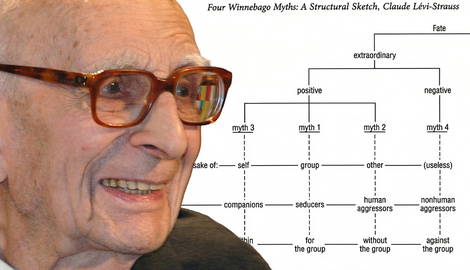

Of all the architects of the foundational social sciences and literary methodology that came to be known as structuralism, few have been such a prolific master builder as the Belgian-born Lévi-Strauss (1908-2009). If old-school structuralism today is often deemed passé in a 21st century dominated by semiotics, deconstruction, and other post-structuralist theories, anyone wishing to dig into their origins can not overlook Lévi-Strauss’s cornerstone contributions.
Who Was Claude Lévi-Strauss?

As a singular testament to his reputation, following the 1981 death of the renowned existentialist writer/philosopher Jean Paul Sartre, 600 French scholars voted Claude Lévi-Strauss the most influential intellectual in the country. While his standing in contemporary academia is not what it was then, he was nonetheless instrumental in the crucial post-World War II ethnological shift that sought to universalize social mythologies between those so-called “primitive” societies and those from so-called “civilized” ones.
He was certainly a trailblazer in criticizing and condemning what would be known as Western “ethnocentrism” vis-à-vis native, non-technological societies. Furthermore, whatever their source, Lévi-Strauss’ notion that social/cultural myths both predate and circumscribe the individual was a first great leap in post-structuralism’s watershed evolution that would reject the bedrock Cartesian affirmation (“I think, therefore I am”) of the autonomous, free-thinking human subject. In 2026, Lévi-Strauss remains high in the pantheon of postwar French academicians, along with such cranial heavyweights as Roland Barthes, Michel Foucault, Jacques Lacan, Gilles Deleuze, and Jean Baudrillard.
In Search of Myth

That said, reading Lévi-Strauss is not for the faint of heart. His prolific output of scholarly tracts, from his Brazilian travelogue Tristes Tropiques (1955) to The Raw and the Cooked (1964) and The Savage Mind (1962), can be tough going—not unlike traveling up a serpentine Amazon by canoe—especially when he traces in voluminous detail the manifold vagaries of a particular South American kinship or totemic myth. Lévi-Strauss was fond of using musical metaphors to describe his technique for deciphering the “real meaning” of a myth, as opposed to its literal or surface meaning. A myth, he said, should be interpreted as a complex musical score of sorts, which calls for attentive “listening” to all the various orchestral parts working together, not as separate notes, as well as any recurring leitmotifs underscoring the overall melody.
“Myth” here means those popular traditional stories, usually of a historical nature and passed through generations, in a society or culture that serve to illustrate or explain the world in some fashion. For instance, the ancient Greek myth of Oedipus tells the gruesome tragedy of a young man who unwittingly murders his father, the king of Thebes, and then goes on to marry his own mother, becoming king himself. Sigmund Freud, of course, used the myth as a metaphor for his theory of the Oedipus complex, in which a boy has an unhealthy dependence on his mother, all at the risk of his future maturity—and the wrath of his father. It’s also a tale that serves as a pointed warning with regard to the incest taboo central to nearly all societies. On a much more rudimentary level, the fictionalized American myth of George Washington and his youthful chopping down of a cherry tree was meant to convey the first U.S. president as a person of unimpeachable honesty (“I cannot tell a lie … I did it”) and moral responsibility.
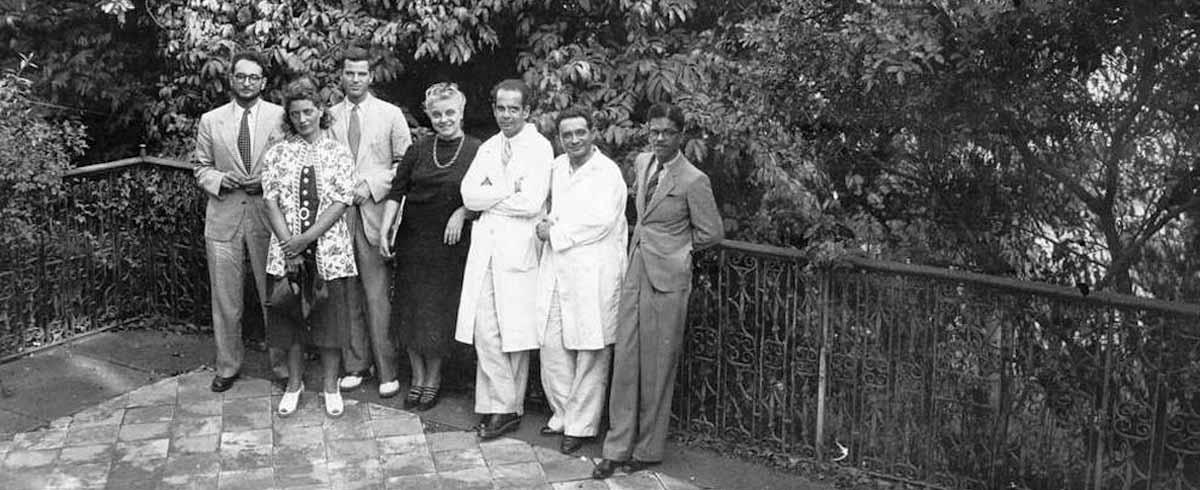
The most formative part of Lévi-Strauss’ life was likely his time in Brazil in the late 1930s, when he accepted a professorship of sociology at the University of Sao Paolo. There, he undertook several expeditions to the hinterlands for anthropological research among the Indigenous tribes, including the Bororo. He made a brief return to France during the war years, but, as he was Jewish, to the United States and New York City, where he became very much taken by the “structural linguistics” of the Russian-born émigré Roman Jakobson, who had begun teaching at the New School of Social Research.
The Binary Mind

One might say Lévi-Strauss had a “eureka!” moment when he began integrating Jakobson’s theories and conclusions into his own anthropological ones. Of course, the key term here is “structure.” As opposed to prior thinking that social or tribal myths were opaque, parochial, or even meaningless, Lévi-Strauss set out to demonstrate that such myths are not only culturally resonant but also deeply entrenched in the human capacity for apprehending the world. Yes, these narrative myths attempt to “explain” certain phenomena; yet critically, those explanations tend to allay and smooth over the contradictions, enigmas, and unresolved questions of life. Perhaps the “ur” example of an age-old human enigma is the question of what happens after death. Almost every society and culture has tried to answer that question, often in religious or mythical terms.
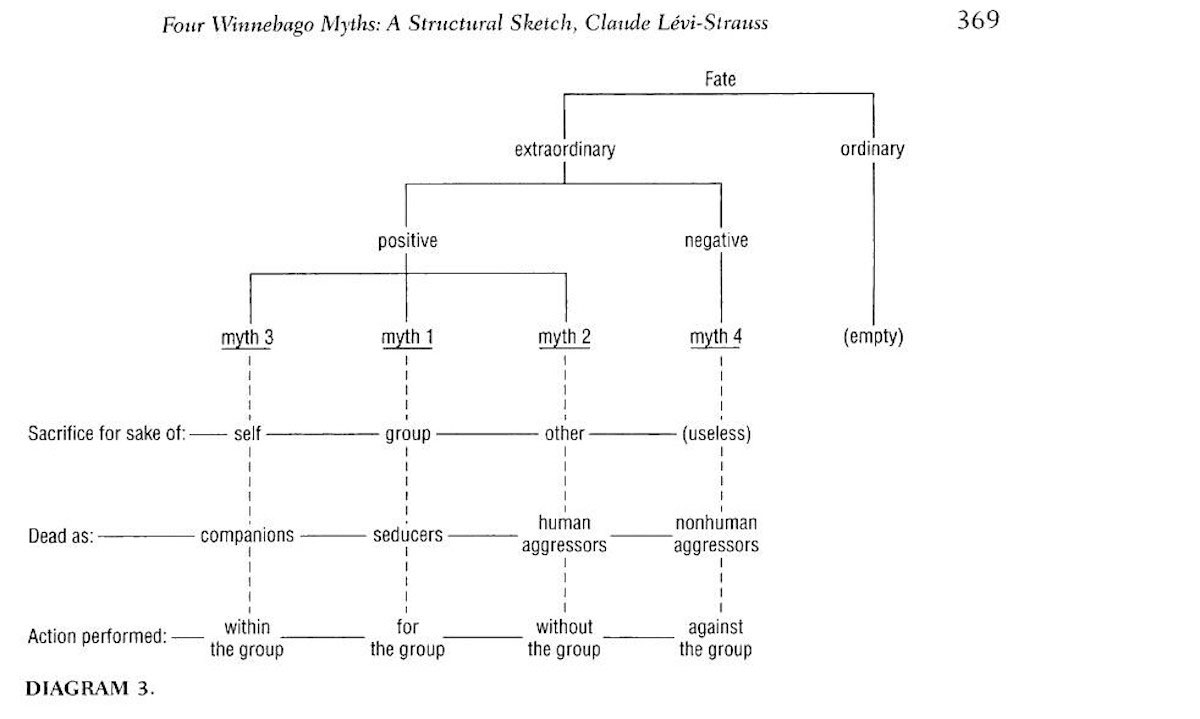
From Jakobson, Lévi-Strauss borrowed his key concept of binary oppositions, again reflecting how the human mind operates, i.e., in a dualistic way. In any myth, especially a complex one, on rigorous examination there appears a pattern of binary values (events, personages, places, techniques, etc.) that seemingly oppose each other. Over the course of the narrative, typically one set of oppositions wins out or is shown to be superior. In many myths—including narratives from popular culture—one can see, for instance, binaries set up in gender and gender roles.
The Western Genre as Myth
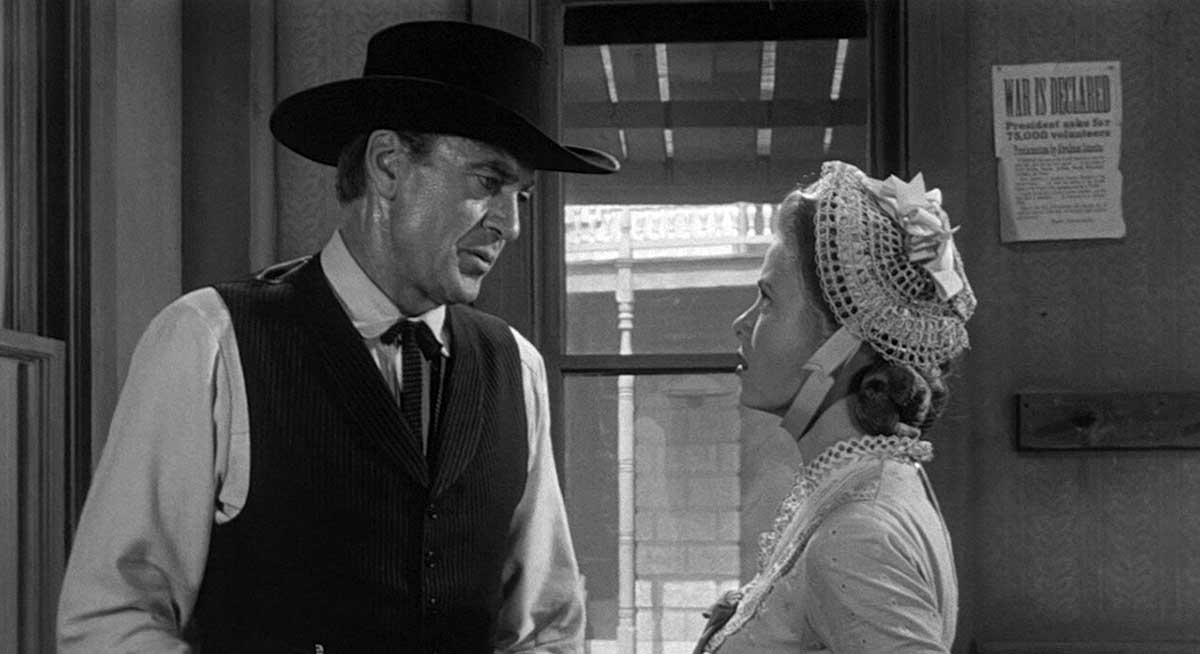
Take the classic U.S. Western, which surely has a mythical standing: more than one has tapped into familiar oppositions that dialectically contrast the male hero’s attributes (e.g., active, rugged, laconic, self-reliant, rootless, violent, nature/wilderness, a “Westerner”) with a prospective female romantic partner (passive, feminine, verbal, loving, social, domestic, culture, an “Easterner”).
The great Western High Noon (1952) is exemplary. Gary Cooper plays a marshal about to wed a young Quaker woman (Grace Kelly) and leave town with her, but bravely decides to stay and face the four gunslingers coming to town to kill him for revenge. Despite his gnawing sense of duty and valor, his pacifist bride pleads with him to forgo violence. Ultimately, he shoots it out with the villains, a “happy ending” made possible because his bride doesn’t forsake him. Not only do the marshal’s manly actions win the day, but his bride’s values are essentially discounted or seen to be naive. Yet this particular resolution has its own contradictions since the townspeople are shown to be cowards and not worthy of the marshal’s moral stature. The movie has long been interpreted as a symbolic allegory of Hollywood’s complicity with the McCarthy-era communist “witch-hunts.”

Only half-jokingly, Lévi-Strauss argued that a student of social myths must take the vantage of an “observer from another planet” and dismantle them “like a clock.” It is thus a scientific operation; one can picture these deep structures as a skeleton that propels the human body in much the same way, regardless of all the surface variables (race, age, stature, gender, etc.). This facet summons up a deep criticism of the Lévi-Strauss method, its reductive nature, which tends to be dismissive of the uniqueness or anomalies in the story’s specific elements. For example, consider one remarkably atypical genre scene in High Noon, when the marshal sits all alone in his office, abandoned by almost everyone, including his deputies. In a private moment, he puts his head down on his desk and appears to briefly sob.
Despite all the various criticisms of Lévi-Strauss’s means and methods in the decades since the 1960s (including that his actual fieldwork was sketchy and built toward a priori conclusions), structuralism can still be a valuable tool in analyzing myth and narrative, including in popular culture. For another, more modern example, consider the Oscar-winning blockbuster “disaster” movie Titanic (1997), which remains one of the most financially successful films ever made, despite (or perhaps because of) its exorbitant costs.
Upstairs/Downstairs in “Titanic”
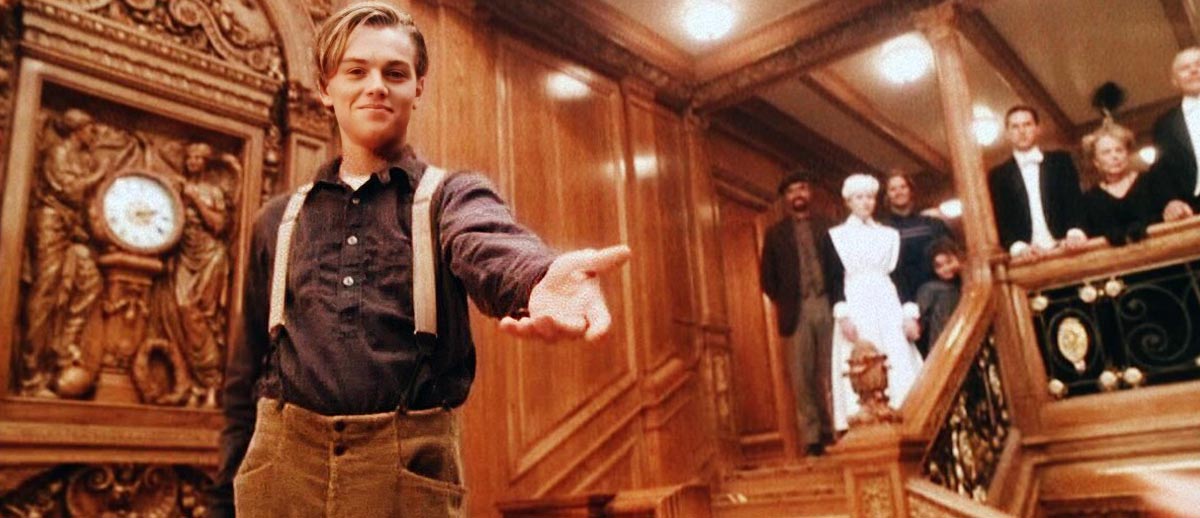
On the surface, so to speak, Titanic is a fictionalized historical romance based on the tragic sinking of what was called the “unsinkable” luxury ocean liner on its maiden voyage from Great Britain to New York in January 1912. To this historical template, writer/director James Cameron foregrounds the star-crossed relationship between Jack (Leonardo DiCaprio), a penniless American drifter and aspiring artist, and Rose (Kate Winslet), a refined young lady sailing with both her wealthy fiancé and domineering mother. The film’s legions of worldwide fans (many who claim dozens of viewings) no doubt know the plot backwards and forwards, which in some ways sets sail as a Romeo and Juliet-type tragedy. Over the course of the three-hour-plus length, Cameron parallels the budding love affair with the ship’s doomsday rendezvous with an iceberg in the North Atlantic. Unlike that unforeseen iceberg, readers on this voyage should note here a spoiler dead ahead.
One could picture Lévi-Strauss munching on popcorn in the audience and asking, “What is this movie really all about?” and “What explains its popularity?” One can argue that, indeed, there is a “deep structure” in Titanic, and it has to do with the physical and symbolic orders representing the social tiers of the “upper” and” lower” classes. Throughout, Cameron contrasts in stark binary ways the events and qualities of the upper regions of the ship vs. the lower. Of course, the upper decks are home to first-class passengers, basking in their luxury accommodations, meals, furnishings, and the freedom of the open air. Far down below is third-class or steerage, confined, no-frills accommodations primarily for poor immigrants en route to America, often ethnic ones. The first-class passengers and officers above are invariably upper-crust white Anglo-Americans.
Jack is alone in negotiating between the upper and lower worlds. Unlike the other steerage passengers, he seems to freely travel to the upper decks and promenades (not likely historically), as part of his efforts to win over Rose, his lofty but captive “princess.” In two telling scenes, a tuxedoed Jack first dines with Rose and her mother sitting with their buttoned-up, stuffy, smug Edwardian guests; in the next, Jack escorts Rose down into a joyful, jumpin’ steerage cabin where the plebian passengers dance a fancy jig or two, including Rose, who daringly flings off her constricting shoes.
As the plot proceeds full-steam, their love affair does too, culminating in an amorous tryst in the back seat of a newfangled “horseless carriage” they luckily discover in one of the cargo holds. Jack is not only the catalyst for Rose’s liberation from her subordinate 19th-century gender role, but he is also a figure of modernity at the dawn of the century of technological marvels and the women’s suffrage movement.
Happy Endings?
Nevertheless, the bugaboo of Lévi Strauss’ sticky contradictions haunts Titanic. Can Jack and Rose live happily ever after? Typically in a classic Hollywood movie they would, but Cameron revises his mythmaking both to account for history and for today’s plunging faith in fairy-tale endings. After all, the Titanic did catastrophically sink, with at least 1,500 dead, and most of the victims were either steerage passengers or members of the crew. In another vein, a feminist critic might also argue that Jack is nonetheless the active, decisive agent in “freeing” Rose, i.e., not Rose herself.
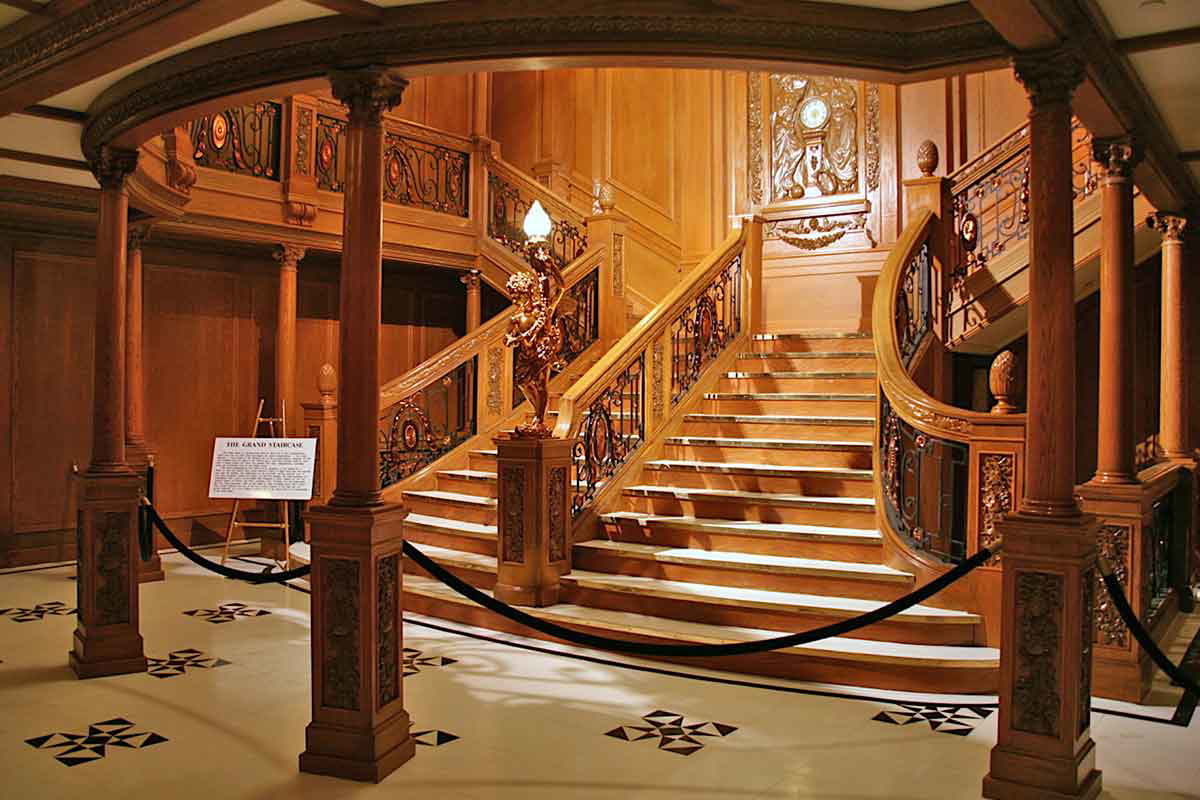
Structurally, Cameron’s story coda is also significant. In a framing device, a present-day, elderly Rose is shown sleeping in bed, surrounded by photos of her younger self (including one boldly boarding a biplane). Perhaps she dreams, perhaps she has passed away, but Rose is supernaturally transported down into what remains of the actual Titanic shipwreck, which in turn magically morphs into its glorious, pre-iceberg existence, with all hands on deck, including a beatific Jack welcoming her atop a grand stairway. For Rose, heaven is an egalitarian Eden far under the sea.