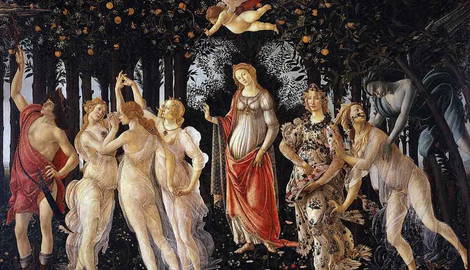

Sandro Botticelli’s Primavera stands as one of the Renaissance’s most captivating artworks. Celebrated for its poetic beauty and mythological symbolism, the painting portrays a world where philosophy and nature converge. Each plant and person carries layers of meaning, echoing classical literature and Neoplatonic thought. Here are the narrative, allegorical, and philosophical dimensions of Primavera.
Who Was Sandro Botticelli, the Man Behind “Primavera”?
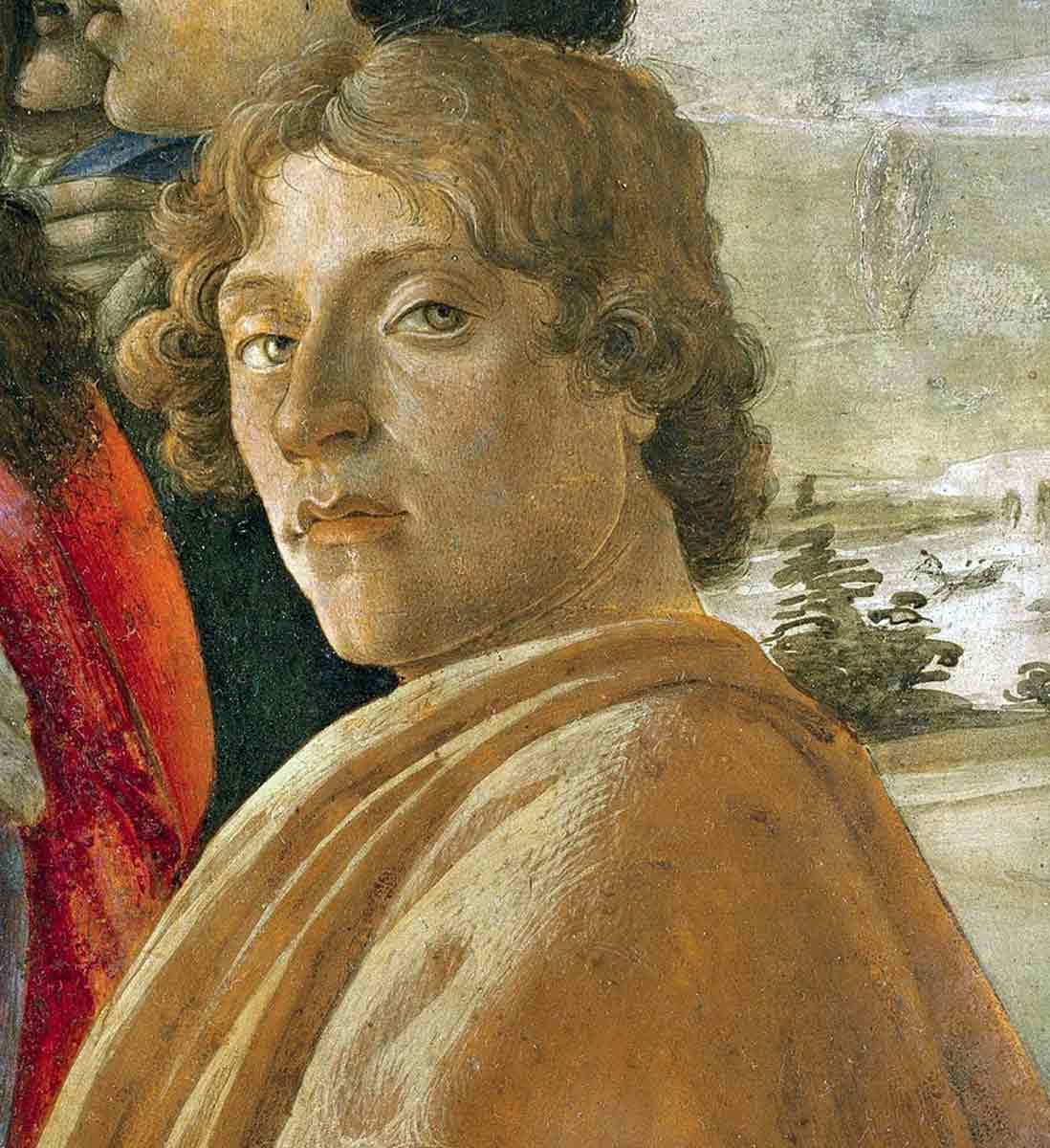
Alessandro Filipepi (1445-1510), known as Sandro Botticelli, was born in 1445 in Florence’s Borgo Ognissanti district, the youngest son of Mariano Filipepi, a tanner, and his wife Smeralda. His nickname Botticelli (“little barrel”) is likely derived from his elder brother Giovanni’s epithet, Botticello, referring to his stout build.
In the early 1460s, Botticelli apprenticed with Filippo Lippi, a painter who was known beyond Florence via major commissions and Medici patronage. 1478-1481 marks Botticelli’s artistic maturity; his workshop was well established, and through his connections with the Medici, he likely engaged with the Neoplatonic philosophers of the Platonic Academy of Careggi. In 1482, after completing the frescoes of the Sistine Chapel, he returned to Florence, where Roman experience and ties to Lorenzo il Magnifico proved decisive.
In 1483, Antonio Pucci commissioned him to paint four panels for his son Giannozzo’s wedding chamber, depicting episodes from Nastagio degli Onesti of Boccaccio’s Decameron. Despite being painted by assistants, these panels reflect Botticelli’s designs and foreshadow the ethereal, almost fairy-tale quality of Primavera, the work that would soon be commissioned by Lorenzo di Pierfrancesco de’ Medici.
What Is Depicted in Botticelli’s “Primavera”?
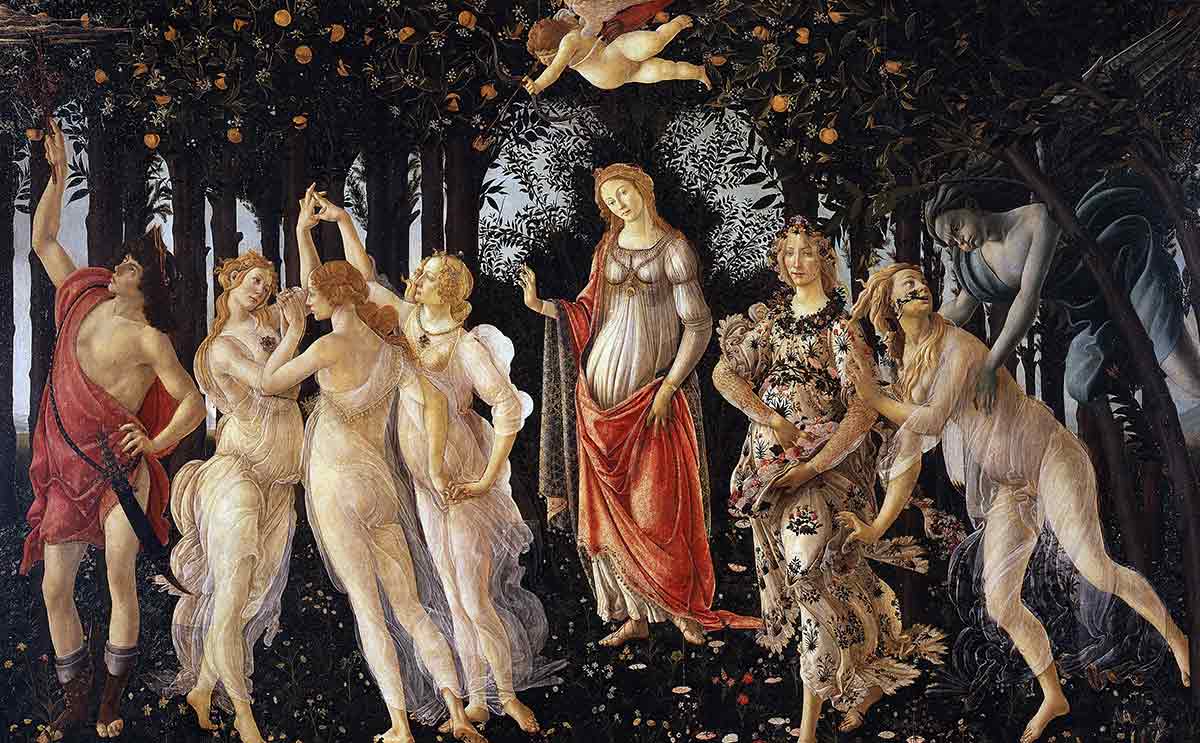
The Primavera (meaning Spring) is a tempera painting on panel, dated to ca. 1481-82, now located in the Uffizi Gallery in Florence. Within an ethereal, dreamlike setting, Botticelli stages a gathering of mythological figures who evoke the renewal of nature and the power of love.
At the center stands Venus (Aphrodite), before a myrtle bush (her sacred plant) indicating that the scene unfolds in her garden, a mythological paradise of eternal spring. Above her hovers Cupid, blindfolded, about to shoot one of his arrows towards the Three Graces, who dance in a circle. To their left, Mercury (Hermes) raises his caduceus to dispel a few passing clouds, asserting his role as guardian of Venus’ domain.
On the right, Zephyrus, the spring wind, blows toward the nymph Chloris. Frightened, she turns away as flowers pour from her mouth, an action that signifies her transformation into Flora, the goddess of flowers. Behind the figures, a dense grove of orange trees forms a decorative backdrop, while the figures themselves seemingly hover above a carpet of grass, dotted with hundreds of individually-painted flowers.
Venus and Her Divine Companions
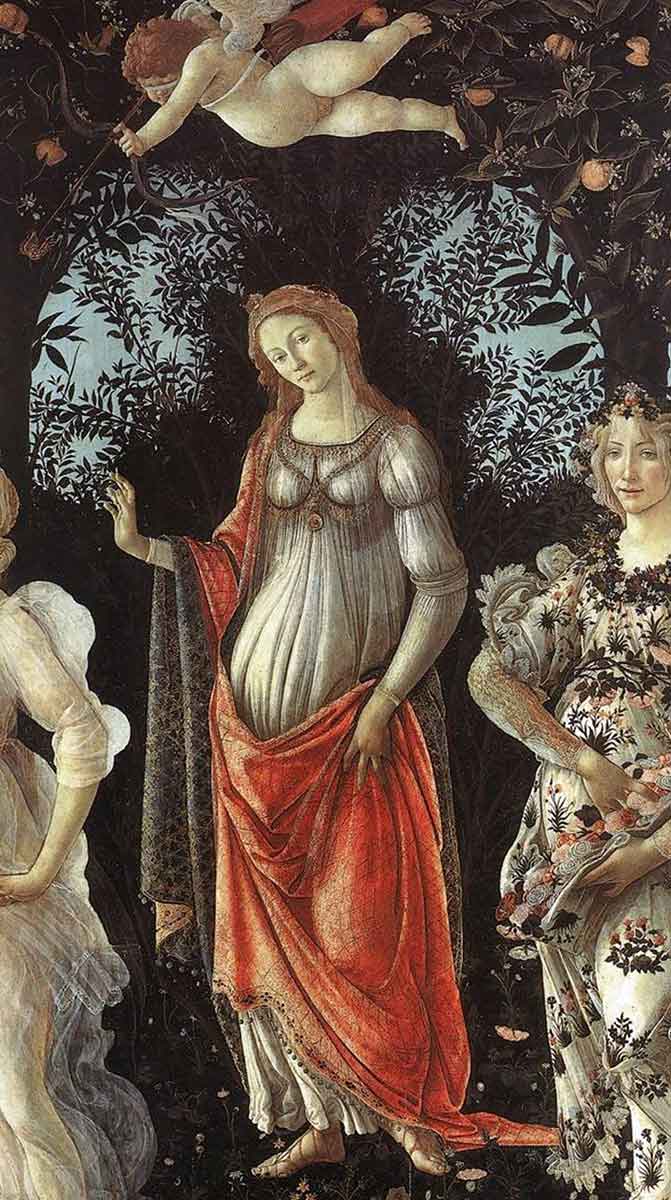
Although Venus appears with unusual modesty, Giorgio Vasari correctly identified her as the central figure. She alone faces the viewer, inviting us into her garden with a gentle gesture. According to Hesiod, Venus was born from the sea when Uranus’ seed fell upon the waters. Rising from the waves within a shell, she clothed her nakedness with myrtle, making it a sacred symbol. Botticelli likely drew inspiration from this myth for The Birth of Venus.
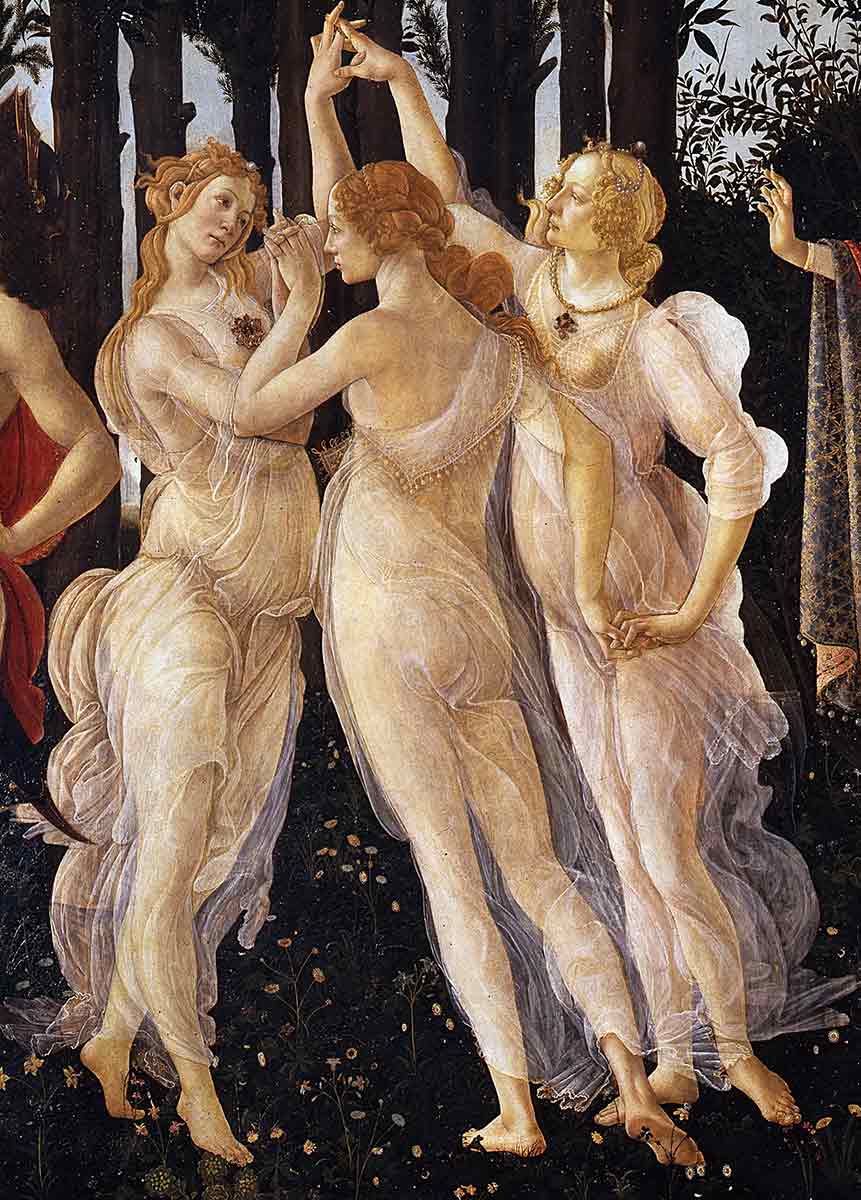
Behind Venus the foliage opens slightly, revealing a semicircular halo of sky, interpreted by some scholars as a reference to Christian iconography, paralleling Venus with the Virgin Mary. Hovering above her is Cupid, her playful son, whose arrow symbolizes the burning passion of love. To her left, the Three Graces dance hand in hand. Ancient sources give them a variety of names, including Chastity, Beauty, and Love; Giving, Receiving, and Returning Blessings; or Splendor, Youth, and Abundant Joy. Their beauty made them a favored subject for Renaissance artists, yet their precise meaning remained ambiguous. Botticelli’s depiction demonstrates his mastery of anatomy, presenting the human body in motion from three distinct perspectives.
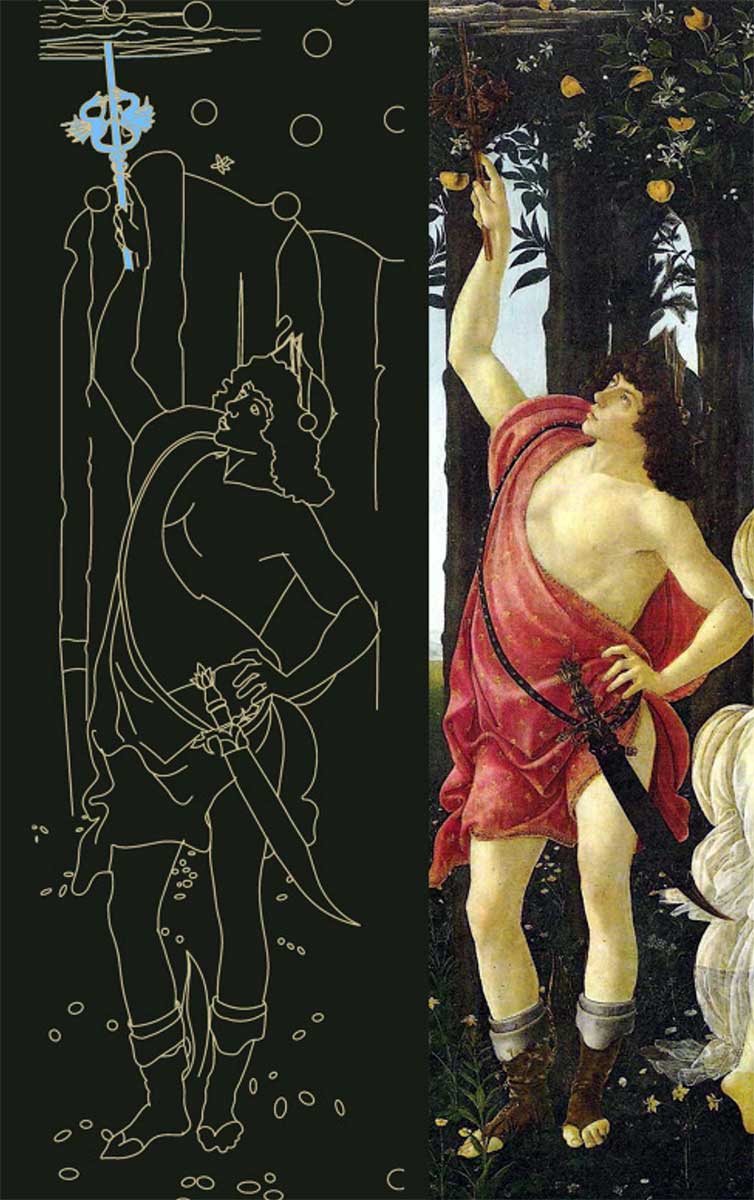
Beside them stands Mercury, the winged messenger of the gods. In classical myth, he separated two fighting serpents with his staff (caduceus), making it a symbol of peace. In Primavera, he disperses clouds threatening Venus’ garden, while his sword reinforces his role as guardian.
Zephyrus, Chloris, and Flora
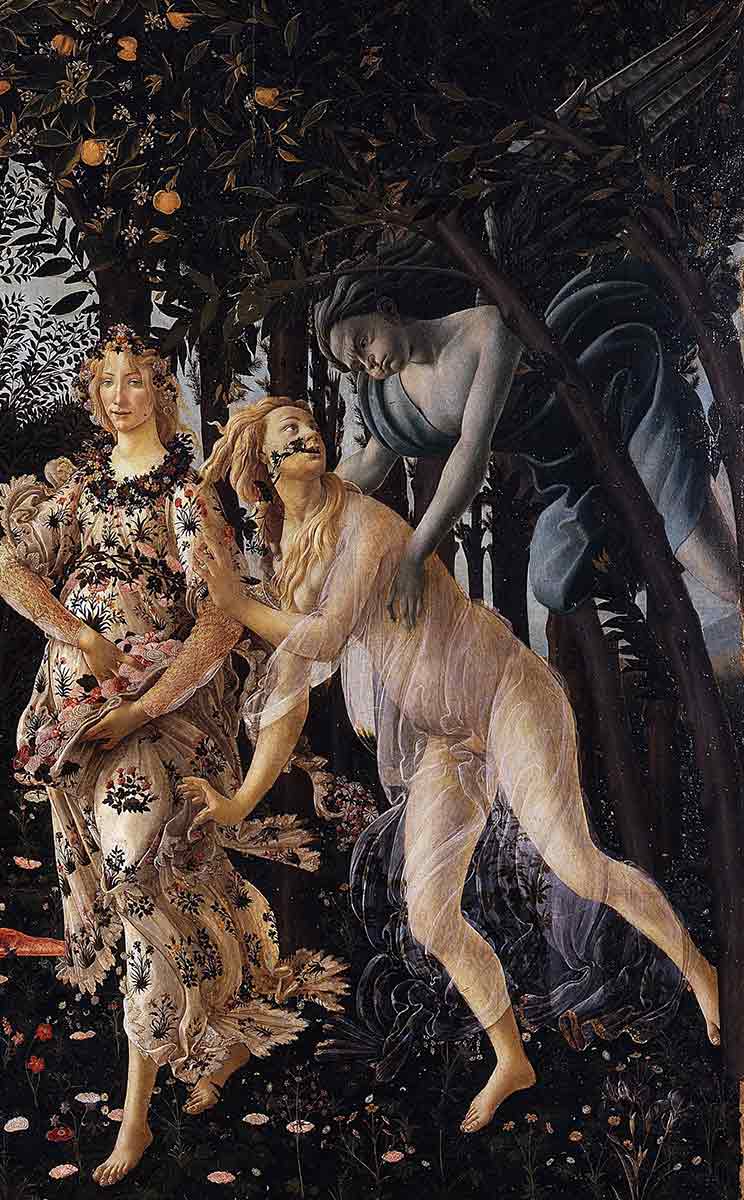
The group on the right—Zephyrus, Chloris, and Flora—represents the advent of spring, drawing from Ovid’s Fasti (Book V). The nymph Chloris attracts the west wind Zephyrus, who pursues her. As she flees, flowers pour from her mouth, and she transforms into Flora, goddess of blossoms. Botticelli translates Ovid’s narrative: Once I was Chloris, who am now called Flora (Fasti V). The directions of their garments indicate two distinct moments in the story, reflecting the transformation process.
This trio embodies the season’s renewal and the dynamic interplay between divine forces and nature. The scene also conveys motion and progression, demonstrating Botticelli’s skill in narrative composition and his ability to visualize poetic and literary sources with precision. The group may also draw on Lucretius’ De Rerum Natura, which celebrates the energizing influence of spring and the west wind:
“When once the face of the spring day is revealed and the teeming breeze of the west wind is loosed from prison and blows strong… thou dost strike fond love into the hearts of all, and makest them in hot desire to renew the stock of their races.”
Multiple Interpretations of “Primavera”

From Giorgio Vasari to the present day, Primavera has inspired a multitude of interpretations. While certain iconographic elements are generally accepted, scholars have proposed divergent readings regarding different aspects of its meaning. This diversity of ideas attests to Botticelli’s intellectual sophistication. Even five centuries later, Primavera draws in an extraordinary range of conflicting yet complementary scholarly perspectives.

According to Leon Battista Alberti’s treatise On Painting, the composition of a historia—a narrative scene—is “the highest form of painting.” Botticelli seems to have followed Alberti’s humanist precept, drawing upon the ancient poets and writers as sources of inspiration. As Alberti advised, knowledge of the classics could “inspire the invention of a story in which imagination reigns supreme.” Indeed, Botticelli’s theme is an invented synthesis: no surviving classical text unites all nine figures seen in the painting.
The Primavera operates simultaneously on two levels. On one hand, it is a mythological narrative, representing the arrival of spring through divine action; on the other, it is a philosophical allegory, illustrating how love and beauty elevate the human soul from physical desire to spiritual enlightenment. Ultimately, all scholars agree on one essential point: Primavera is a multilayered allegory whose meaning unfolds through endless possibilities of interpretation.
More Philosophical and Allegorical Readings for Primavera
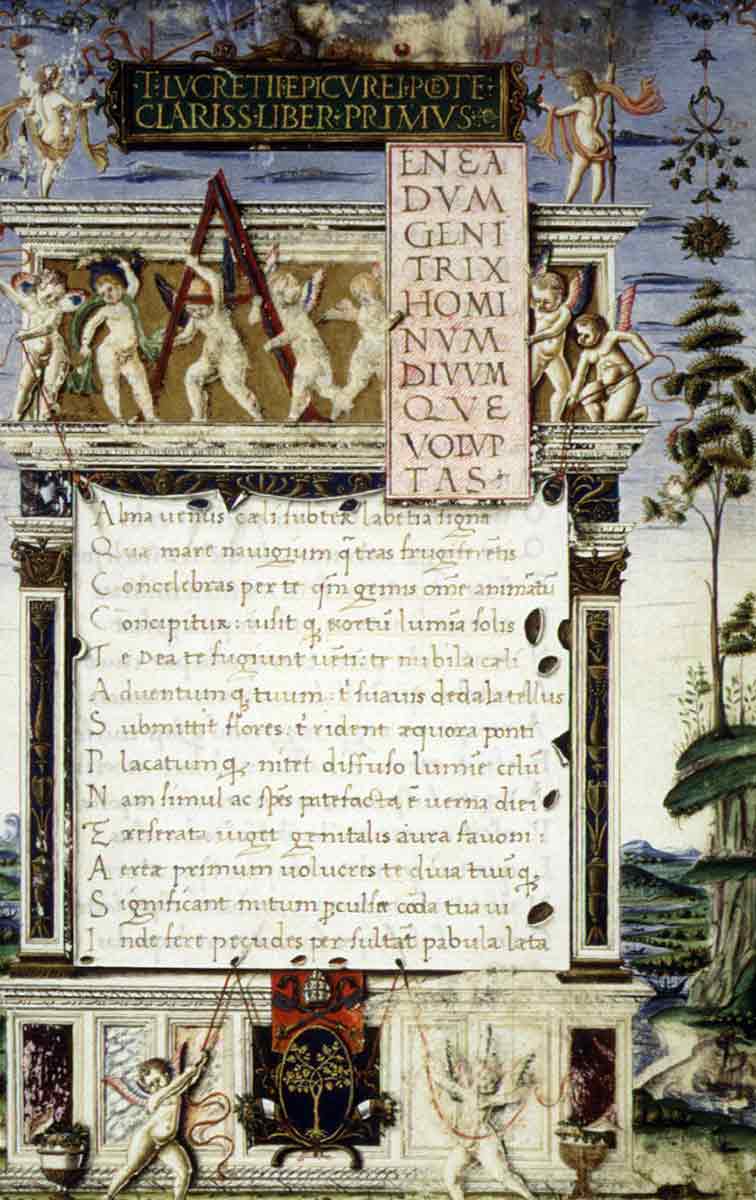
Art historian W.R. Lightbown interprets the composition as symbolizing love culminating in marriage: the serene beauty of the virgin bride and the joy of the young wife.
The group on the right narrates the mythic union of Zephyrus and Chloris, whose transformation into Flora signifies fertility and renewal in nature. While Ovid’s Metamorphoses may provide the narrative framework, art historian Barbara Deimling suggests Lucretius’ De Rerum Natura as a primary literary source:
“Spring goes on her way and Venus, and before them treads Venus’ winged harbinger; and following close on the steps of Zephyrus, mother Flora strews and fills all the way before them with glorious colors and scents… Thou, goddess, dost turn to flight the winds and the clouds of heaven.”
This interplay of myth and literature reinforces the allegorical dimension, where the arrival of spring represents both natural and spiritual regeneration, emphasizing Venus’ role as a guiding principle in the harmony between human and divine realms.
In Neoplatonic philosophy, Venus embodies both earthly (Venus Pandemia) and divine love (Venus Urania). Clothed and adorned, she represents Humanitas, the civilizing force guiding humans toward virtue. Mercury disperses clouds with his caduceus, symbolizing reason and intellect.