
Chinoiserie refers to the use of Chinese motifs such as pagodas, dragons, and an abundance of flora and fauna in European artistic styles. It was based on how Europeans imagined China—a faraway civilization few knew much about. The exotic nature of Chinoiserie heightened its appeal in the 17th and 18th centuries. At the peak of its popularity, even European royals decorated their palaces in such ornate style. From the Trianon de Porcelaine in France to the Palazzina Cinese in Italy, here are six examples of Chinoiserie architecture in Europe.
1. Europe’s First Chinoiserie Building: Trianon de Porcelaine (Versailles, France)
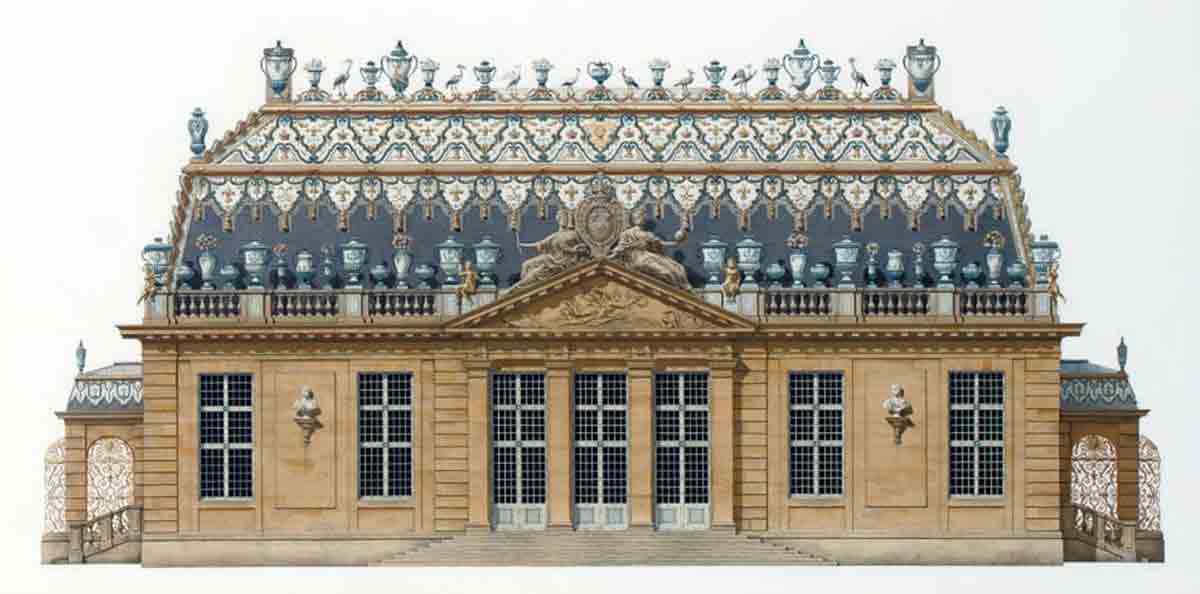
In 1670, Louis XIV of France ordered the construction of what was to become Europe’s first Chinoiserie building, the Trianon de Porcelaine. Located near the Palace of Versailles, the Trianon de Porcelaine was a banqueting house and a rendezvous for Louis XIV and his mistress Madame de Montespan. The main central pavilion was reserved for the king, while the remaining four were used by guests and for other service functions. The structure was surrounded by vast gardens of perfumed flowers for the viewing pleasure of Louis XIV and his distinguished guests. The lush display of flowers also earned the Trianon de Porcelaine the name “Pavilion de Flore.”
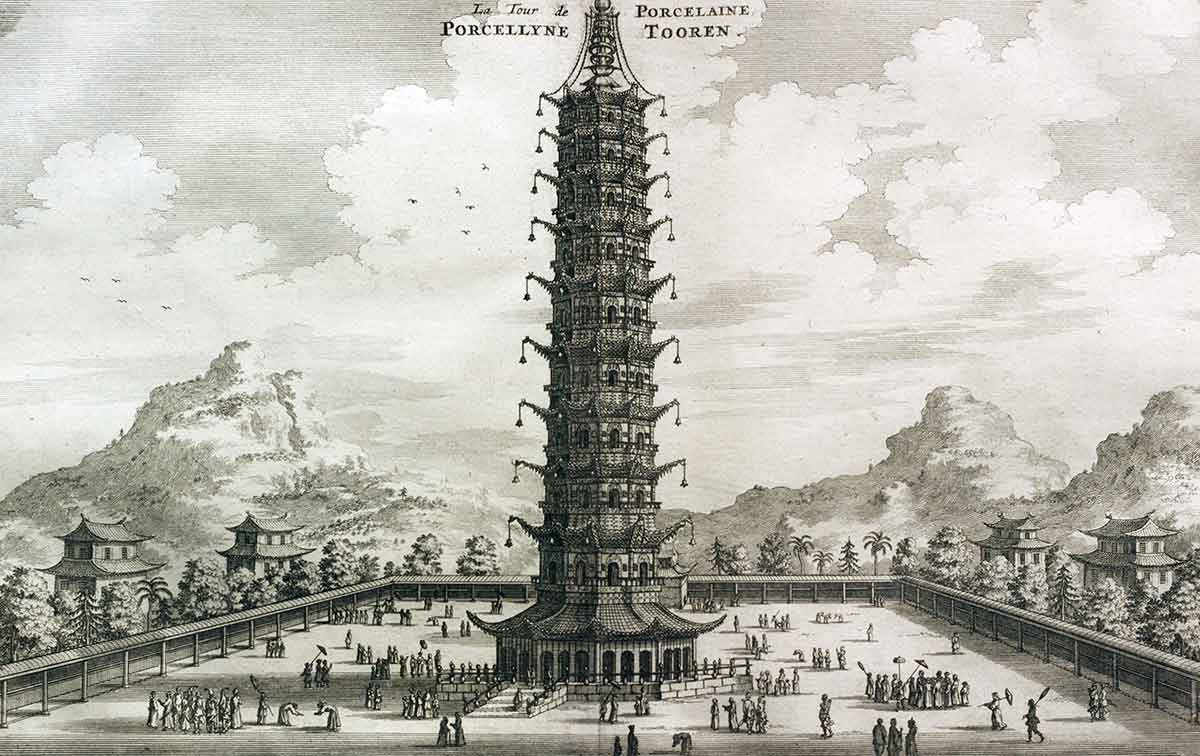
Entrusted with the design of the building, renowned French Baroque architect Louis Le Vau chose the Chinoiserie style that was in vogue. His design paid homage to the Porcelain Tower of Nanjing in China, which was the source of inspiration for many Chinoiserie buildings in Europe. Early European travelogues and publications often contained illustrations and descriptions of the Porcelain Tower of Nanjing, which were widely referenced by designers and architects across generations. An example of such publications is the 1665 An Embassy from the East-India Company of the United Provinces… by Dutch explorer Johan Nieuhof.
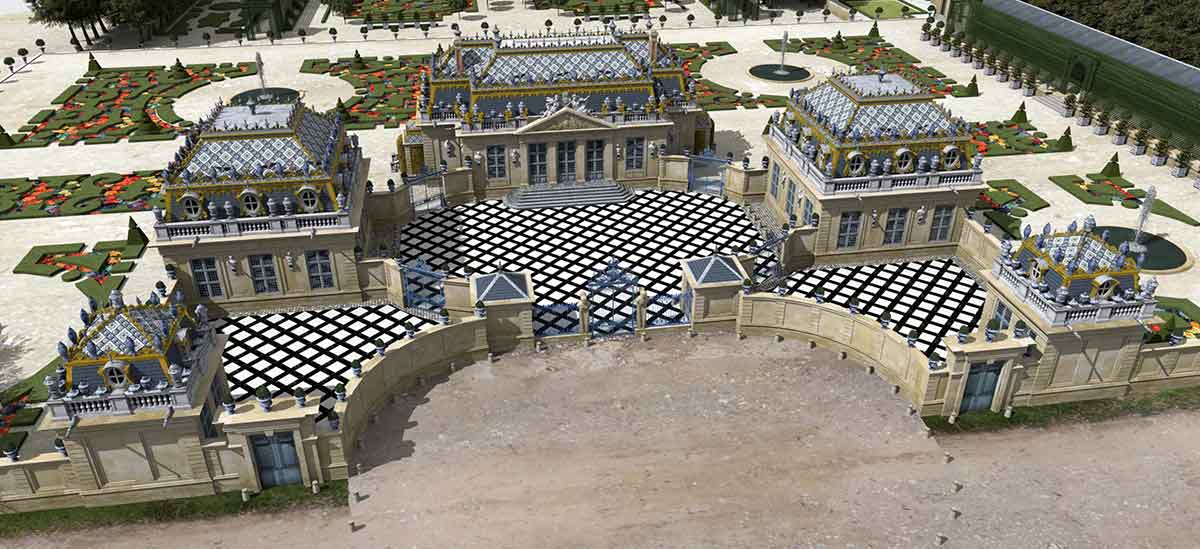
True to its Chinoiserie style, the Trianon de Porcelaine was decked out in lavish blue-and-white ceramic tiles. Interestingly, the tiles were not actually porcelain because, at that time, Europe had yet to master the revered Chinese technology. As such, European builders had to rely on faience tiles with blue glaze produced by French and Dutch potters. These decorative tiles would not survive years of wear and tear, and by 1687, it was clear that much of the building was in poor condition. With the end of his affair with Madame de Montespan, the king ordered the demolition of the building.
2. Chinesisches Haus (Potsdam, Germany)
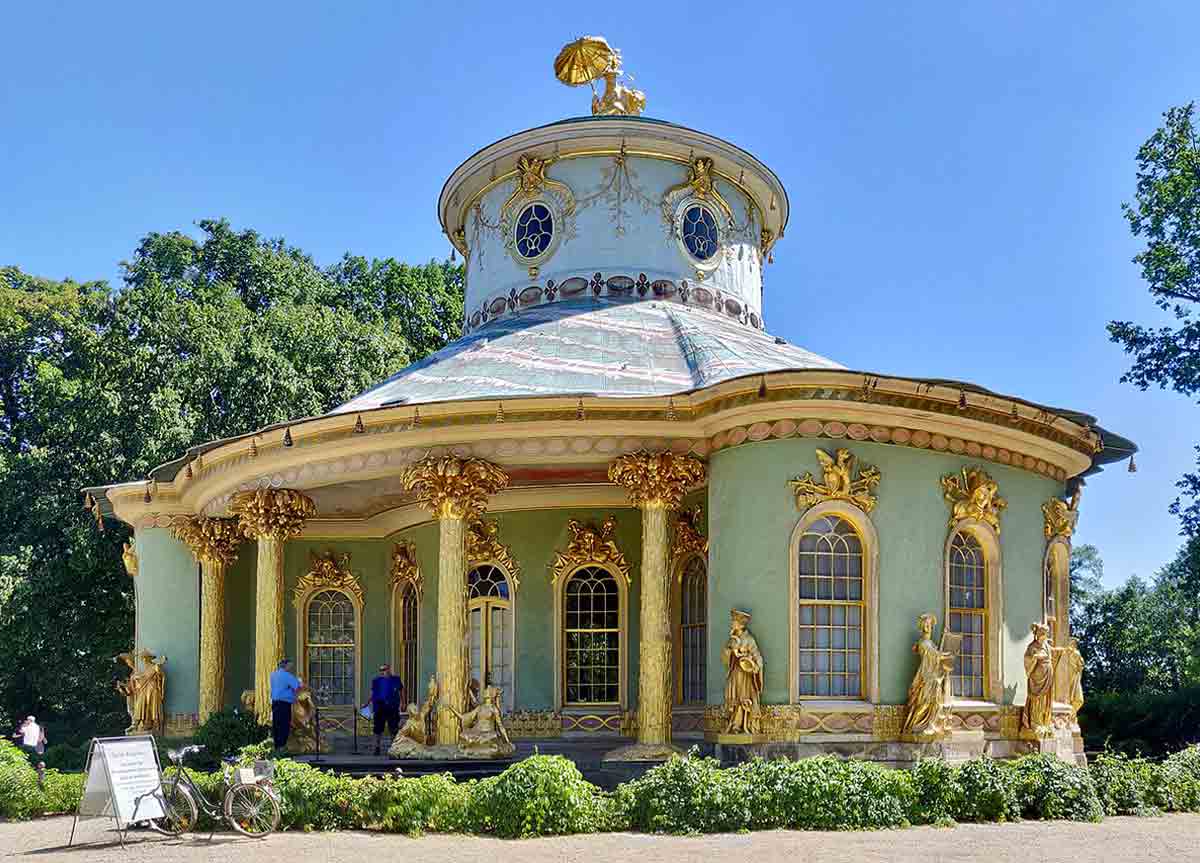
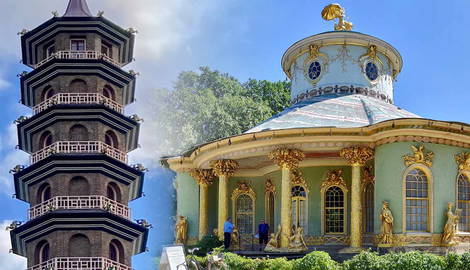
Located in the Sanssouci Park, the Chinesisches Haus (“Chinese House”) in Potsdam, Germany, was built between 1755 and 1764. Commissioned by Prussian king Frederick the Great, the project was headed by German master builder Johann Gottfried Büring. The Chinese House is characterized by its trefoil shape, which was inspired by the Maison du Trèfle at the Palace of Lunéville in Lorraine. Its exteriors feature four prominent gilded sandstone columns alongside several playful, life-sized gilded sculptures of Chinese musicians and tea drinkers. These were the works of German sculptors Johann Melchior Kambly, Johann Gottlieb Heymüller, and Johann Peter Benckert.
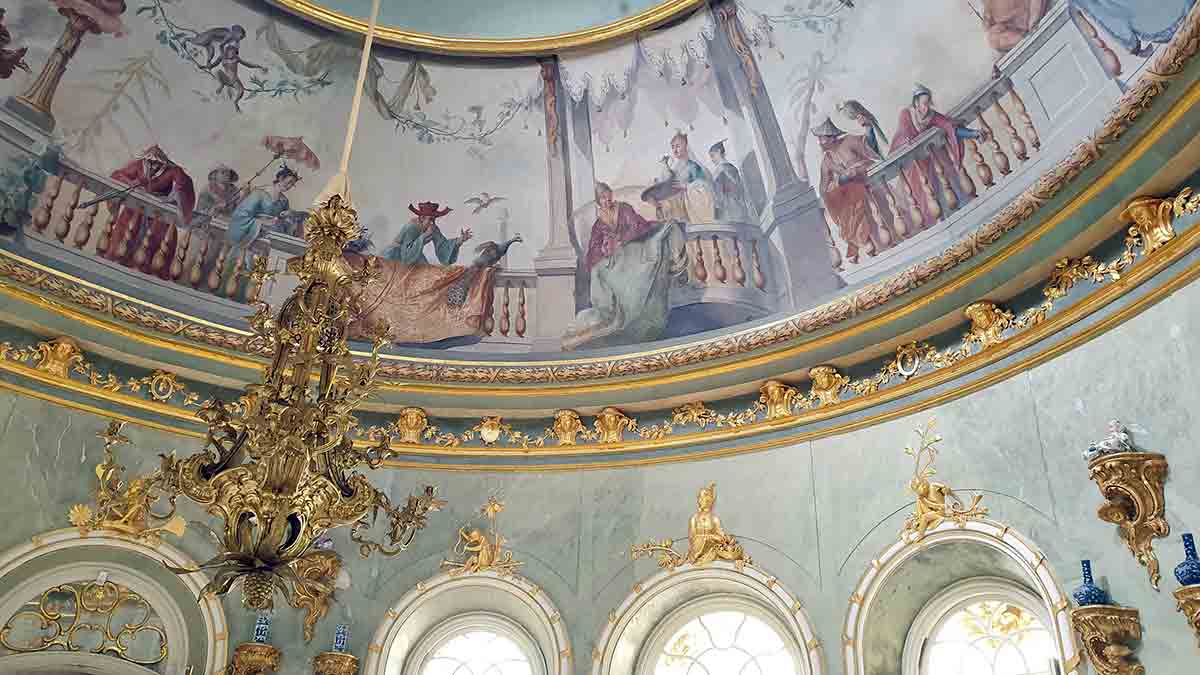
The Chinoiserie style continues in the building’s interiors with a vast collection of 18th-century porcelain and a large fresco depicting a whimsical gathering. It features numerous Chinese men standing behind a balustrade, some glancing around and others engaged in conversation. In the surroundings, there are peacocks, parrots, monkeys, statues of Buddha, and many other Chinoiserie motifs. Frederick the Great, as a fervent admirer of Chinoiserie, would later follow up with two additional Chinese-style structures. One was the Chinese Kitchen, located just a stone’s throw from the Chinese House, and the other was the Drachenhaus (“Dragon House”), located at the northern part of the Sanssouci Park.
3. Drachenhaus (Potsdam, Germany)
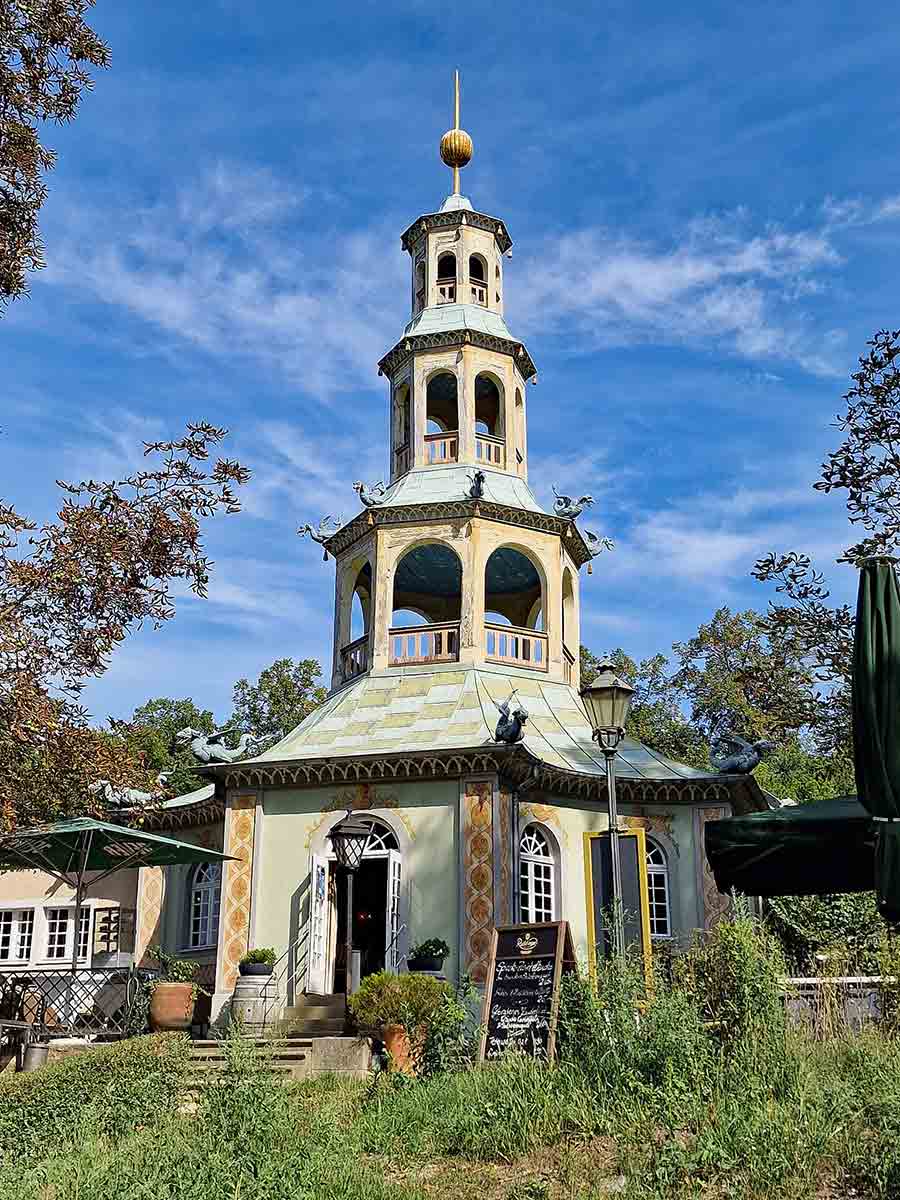
A few years after the completion of the Chinese House, Frederick the Great commissioned German architect Carl von Gontard to design a pagoda-inspired building. The Prussian king was said to have been enamored by the design of the Great Pagoda at Kew Gardens in London and sought to replicate it in Potsdam. With his vision and Gontard’s expertise, the Drachenhaus (“Dragon House”) was erected in Klausberg, just next to Sanssouci Park, in 1772. A four-story building, it was constructed on an octagonal plan, with sixteen stunning dragons lining the edges of its concave roof.
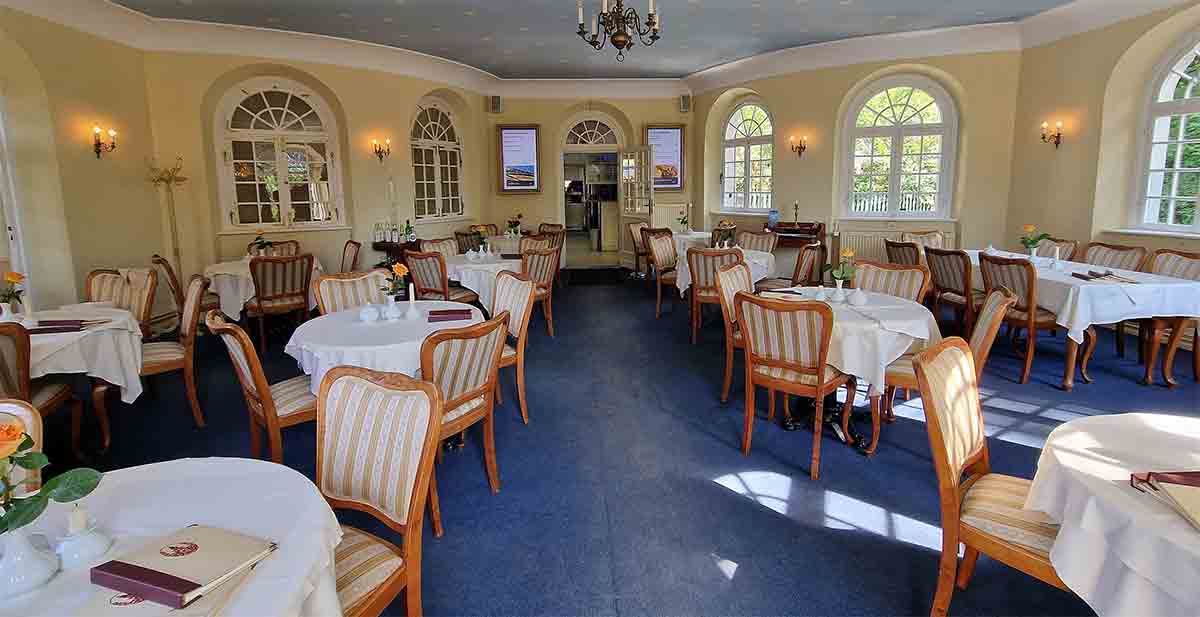
From its original design, only the first floor was functional, with a hallway, two rooms, and a kitchen that were meant for the royal winemakers. However, they did not move into the building eventually, and it was left unoccupied and unmaintained for the next decade or so. A timely restoration in 1787 saved the structure from further decay and allowed it to regain its luster, as well as its function as a residence. Over the years, the building was expanded on multiple occasions to include larger kitchen facilities. Since then, the building has been occupied by several food establishments, and today stands as a popular restaurant and café serving German cuisine.
4. Great Pagoda (London, England)
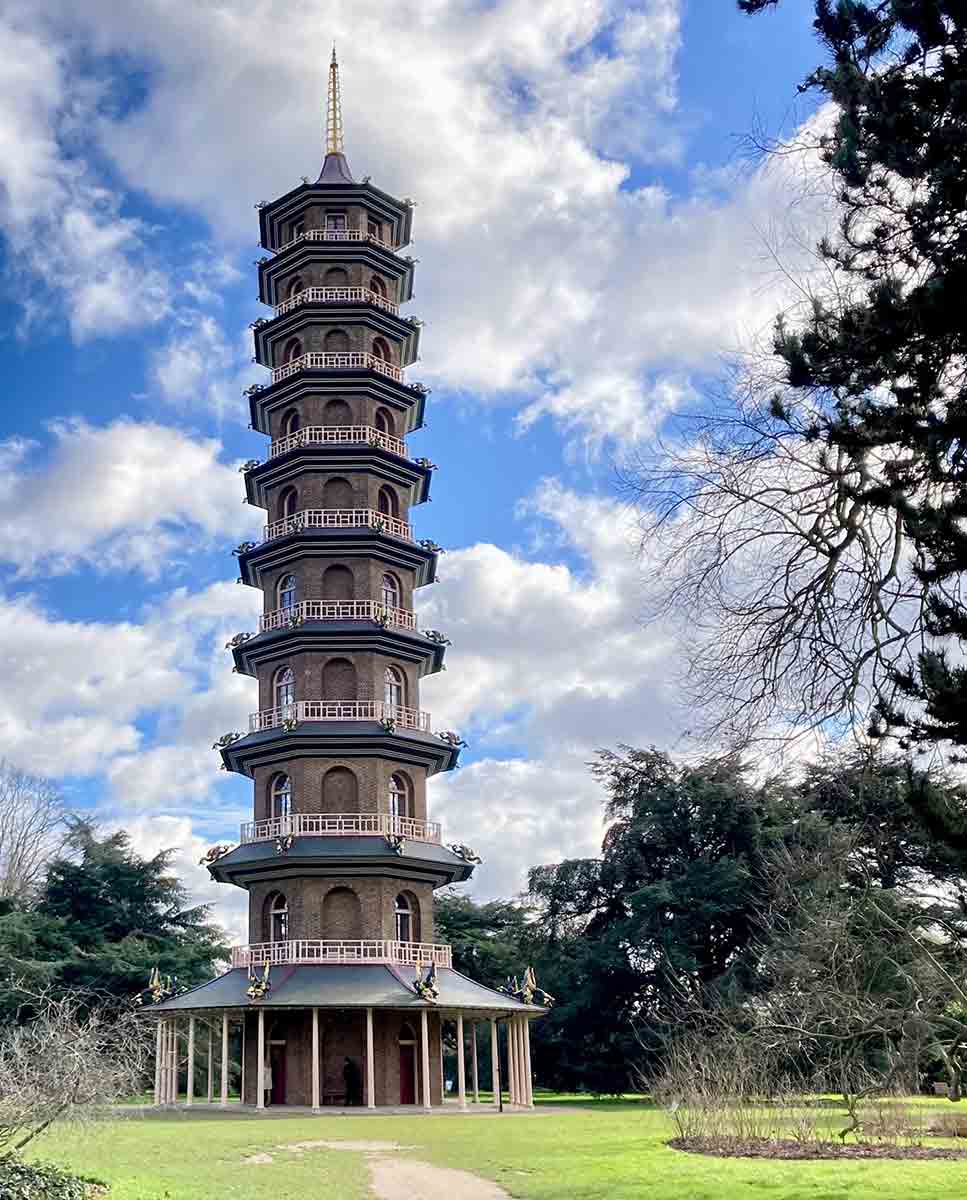
Often hailed as one of the finest examples of a Chinoiserie building in Europe, the Great Pagoda in Kew Gardens, London, was completed in 1762. Princess Augusta, the Dowager Princess of Wales, founded the Gardens and wanted to landscape the Gardens according to the fashionable design trends at the time. She commissioned the great Swedish-Scottish architect Sir William Chambers, who built the Great Pagoda as a gift for her. Chambers, deeply inspired by his visits to China, modeled the Great Pagoda after the Porcelain Tower of Nanjing in China. Made of grey bricks, the 10-story tall pagoda measures about 163 feet in height and comprises some 253 steps to the viewing gallery.
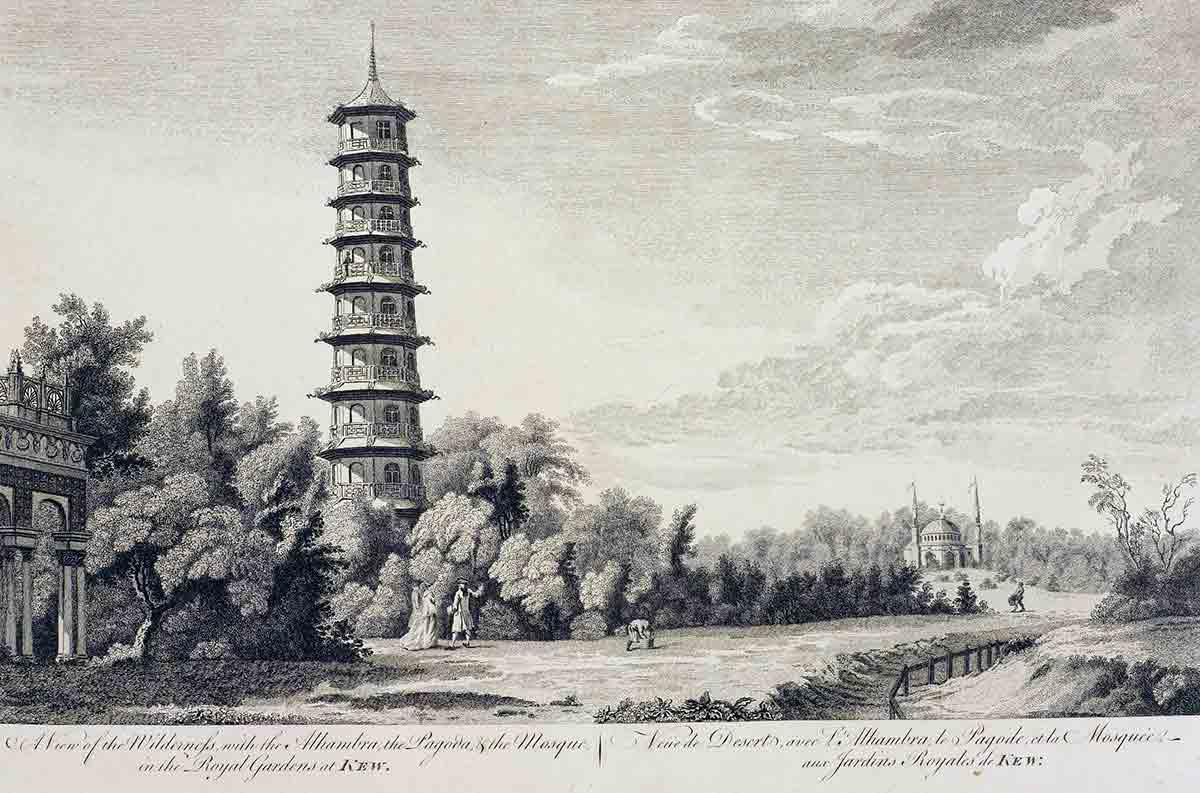
Used as a munitions test site, the Great Pagoda played a crucial role during World War II. As an enclosed high tower, it was an ideal location for smoke bombs to be dropped, with holes opened up through each floor. In 2018, the Great Pagoda underwent an extensive restoration, hailing the return of the 80 glided wood dragons that had initially adorned the roofs. Rumor has it that they had been removed and sold in 1784 to repay the mounting gambling debt of King George IV. However, there was little evidence proving this, and most experts believe that the wooden material had naturally decayed.
5. Palazzina Cinese (Palermo, Italy)
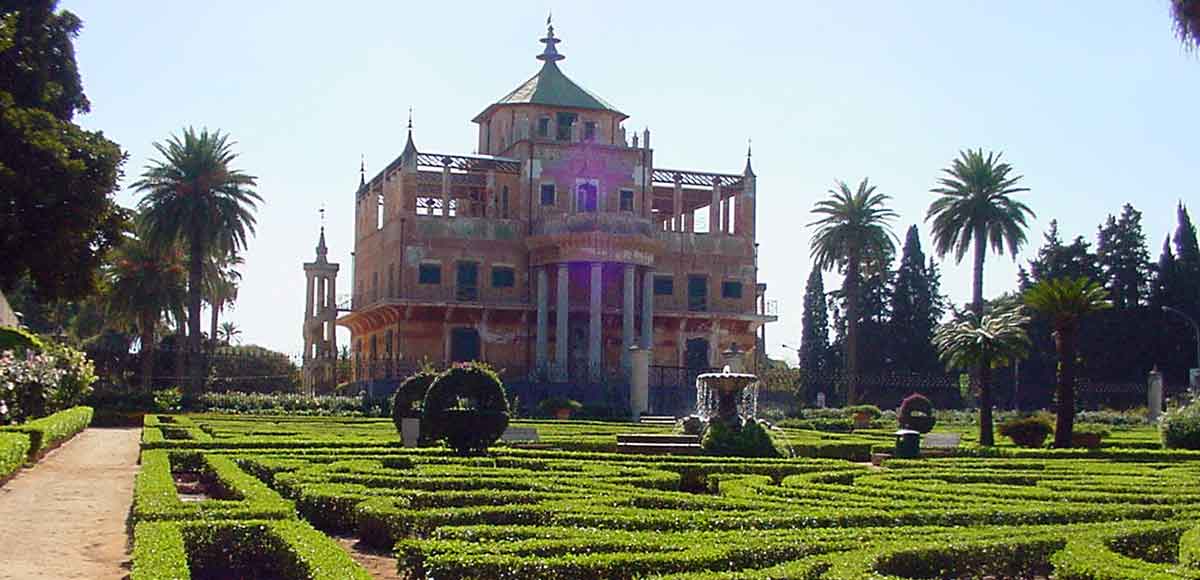
Nestled within the La Favorita park in Palermo, Italy, the Palazzina Cinese (“Chinese Palace”) is a former royal residence of the House of Bourbon-Two Sicilies. Completed in 1806, the building with eclectic Chinoiserie and Sicilian influences was designed by Italian architect Giuseppe Venanzio Marvuglia. Interestingly, Marvuglia was also the designer of the original, smaller building that was owned by Baron Benedetto Lombardo. When he was in exile in Palermo, King Ferdinand III of Sicily chanced upon and was impressed with the charming architecture. He swiftly bought the property and the land around it and commissioned Marvuglia to give it a royal facelift. The building later became the property of the House of Savoy in 1861 with the Unification of Italy. Today, it is home to the Ethnographic Museum of Sicily.
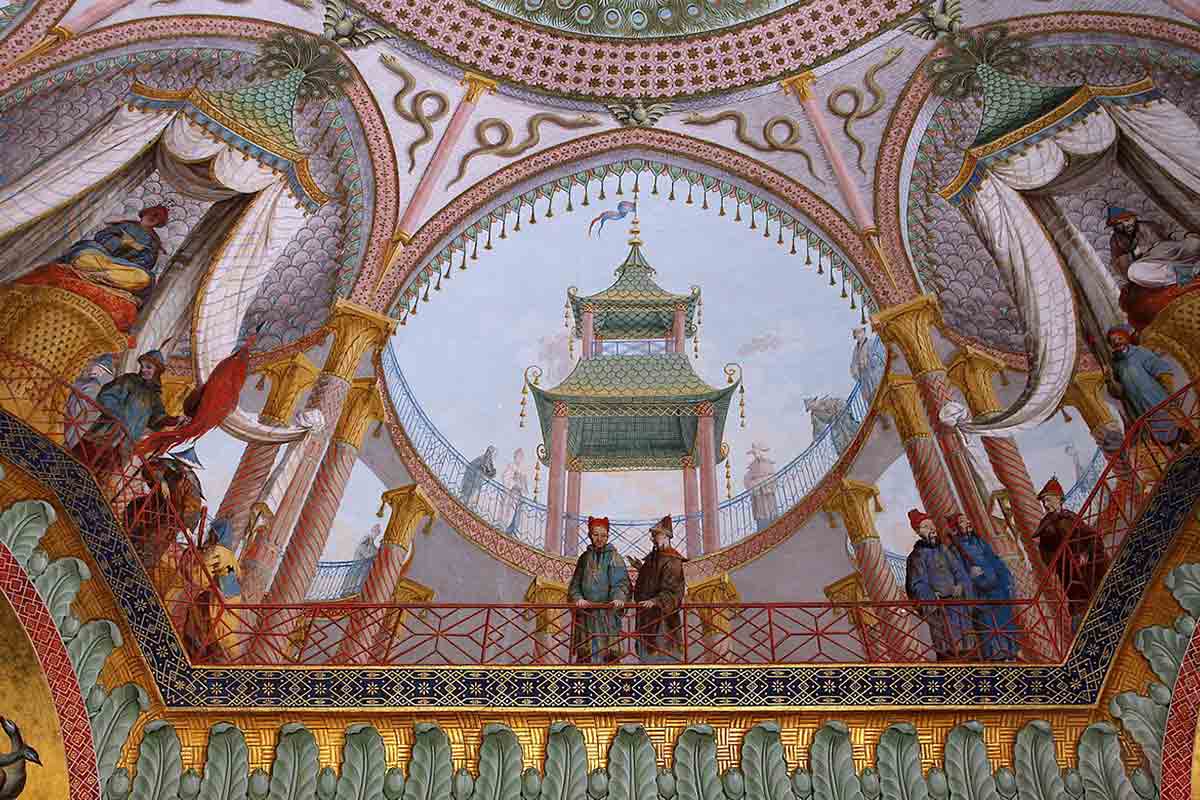
The palace’s exteriors feature a quintessential pagoda on the top, along with intricately carved wooden beams and whimsical spiral staircases. Inside, the ground floor houses the entry hall, an office, a dining room, and, most importantly, the king’s bedroom. The second floor, noticeably humbler in its design, was reserved as servants’ quarters. The third floor opens to the reception hall and the private chambers of Queen Maria Carolina of Austria, complete with an unobstructed view of the beautiful gardens in the surroundings. Adorning the ceilings of the royal apartments is a breathtaking series of Chinese-themed frescoes by Italian painters Giuseppe Velasco and Vincenzo Riolo.
6. The Ultimate Chinoiserie Fantasy: Chinese Village (Tsarskoye Selo, Russia)
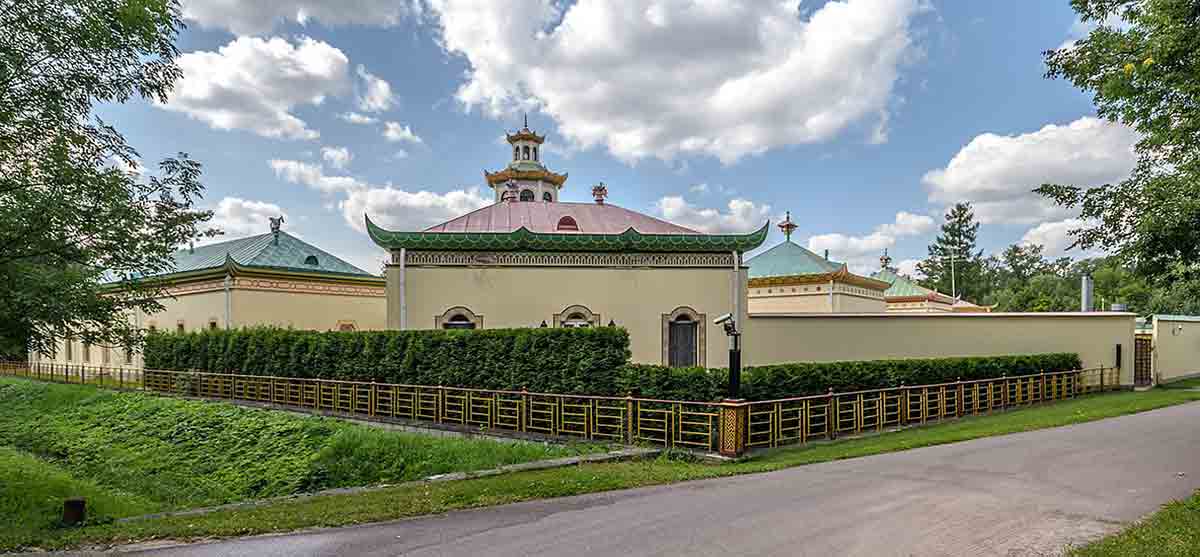
Located in the Alexander Park of Tsarskoye Selo, Russia, the Chinese Village is quite possibly one of the most extravagant manifestations of the Chinoiserie craze. Keen to ride the wave of building Chinese-style palaces like her European counterparts, Catherine the Great ordered the construction of 18 Chinese royal houses in the 1780s. It was said that the empress had originally intended to hire a Chinese builder but to no avail. Instead, Italian architect Antonio Rinaldi and Scottish architect Charles Cameron were eventually engaged to see to the grand project. Among the 18 planned structures, however, only ten were completed as building plans were halted due to depleting funds and the death of Catherine the Great.
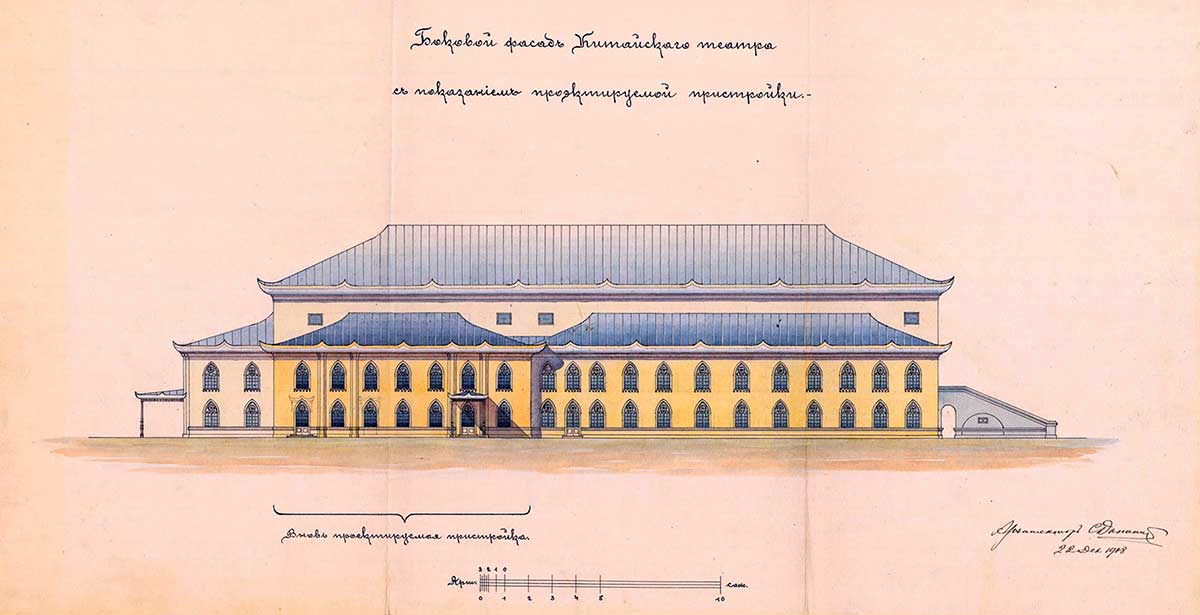
There are three stunning Chinese-style bridges that lead to the Chinese Village. The Cross-Shaped Bridge was built in 1779, while the other two—the Dragon Bridge and the Large Chinese Bridge—were built in 1785. Near the Chinese Village, there once stood a Chinese Opera Theatre, which was constructed in 1779 by Rinaldi. It was a celebrated venue where Russian royals previewed up-and-coming operas. Leo Tolstoy’s famed play The Fruits of Enlightenment also premiered here in 1893. Sadly, the theater was razed to the ground in 1941 as a victim of Nazi bombardment during World War II.