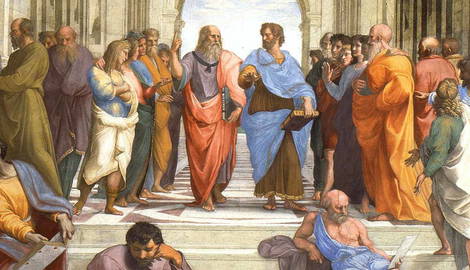

In The School of Athens, Raphael combines classical philosophy with Renaissance ideals, depicting philosophers, scientists, and artists in a grand composition. The fresco symbolizes the pursuit of truth, bringing together figures such as Plato and Aristotle as representatives of intellectual tradition itself. Each figure within the artwork reflects a facet of the body of knowledge that has shaped the world we live in today.
| Figure(s) | Location | Attributes & Symbolism |
| Plato | Center (Left) | Gesturing upward toward the heavens (idealism); holding the Timaeus; wearing purple and red (symbolizing air and fire). |
| Aristotle | Center (Right) | Hand extended toward the earth (empiricism); carrying Nicomachean Ethics; wearing blue and brown (symbolizing water and earth). |
| Socrates | Upper Left | Engaged in debate with a small group, likely using his “Socratic method” to count out points on his fingers. |
| Pythagoras | Lower Left | Shown busily writing in a book; a pupil nearby holds a tablet displaying his harmonic scales and mathematical theories. |
| Heraclitus | Center-Left (Foreground) | Depicted in solitary contemplation, leaning on a marble block; represents the “Obscure” philosopher of constant change. |
| Diogenes | Lower Center | The Cynic philosopher lounging on the steps in rags; his posture shows his trademark indifference to the surrounding grandeur. |
| Euclid or Archimedes | Lower Right | Leaning over a slate with a compass; demonstrating a geometric theorem to a group of captivated students. |
| Zoroaster | Lower Right | Standing with his back to the viewer; holding a celestial sphere (symbolizing astrology and the cosmos). |
| Ptolemy | Lower Right | Facing Zoroaster; holding a terrestrial globe, often shown with a crown due to historical confusion with the Ptolemaic kings. |
| Raphael | Far Right | A self-portrait of the artist looking directly at the viewer, placing himself among the greatest thinkers of history. |
| Sodoma or Perugino | Far Right | Standing beside Raphael; representing the contemporary artists who contributed to the Vatican project. |
| Averroes & Zeno | Lower Left | Part of the group around Pythagoras; Averroes is often identified by his turban, leaning over to see the mathematical work. |
| Alcibiades & Xenophon | Upper Left | Members of Socrates’ circle; Alcibiades is typically identified by his military armor. |
Who Was Raphael, the Creator of “The School of Athens”?
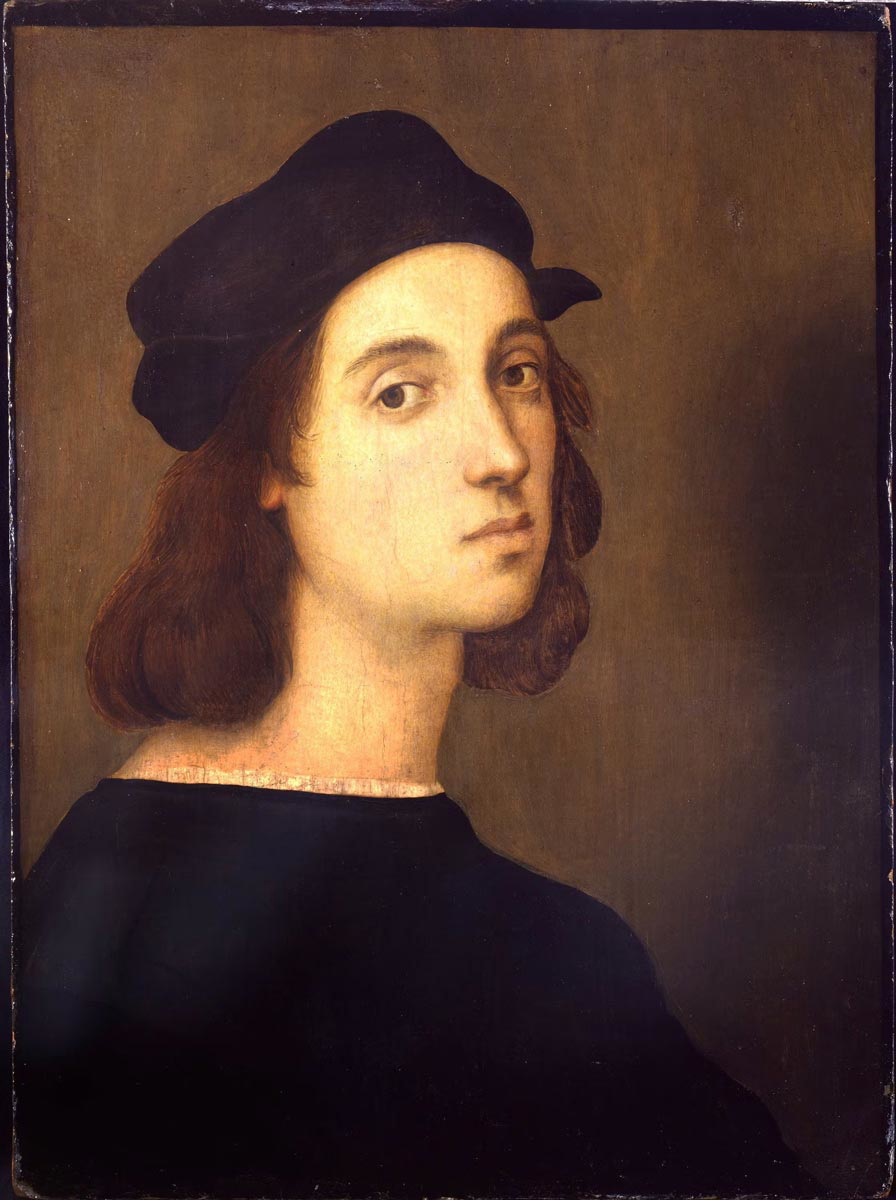
Raphael Sanzio (1483-1520) was born in Urbino, Italy on April 6, 1483, the son of Giovanni Santi and Magia di Battista Ciarla. His father, a painter, oversaw his education in close connection with the court of Federico da Montefeltro. The combination of growing up in this center of Renaissance culture and the upbringing via an established artist catalyzed Raphael’s artistic career.
His apprenticeship under Pietro Perugino, one of the most renowned painters of the period, also contributed to Raphael’s style. Around 1501, having completed his training, Raphael established his own workshop. He soon began producing commissioned works and quickly gained widespread esteem. At the age of 23 he moved to Florence, the home of Leonardo da Vinci and Michelangelo.
According to art historian Vasari, Raphael enjoyed particular admiration in Florence among members of the wealthy urban elite. His departure for Rome is thought to have been linked to Pope Julius II’s invitation to decorate several rooms in the southern wing of the Vatican Palace. It was in these very rooms that Raphael would have the opportunity to demonstrate the full measure of his genius, culminating in the creation of The School of Athens.
Where Is “The School of Athens” Located?
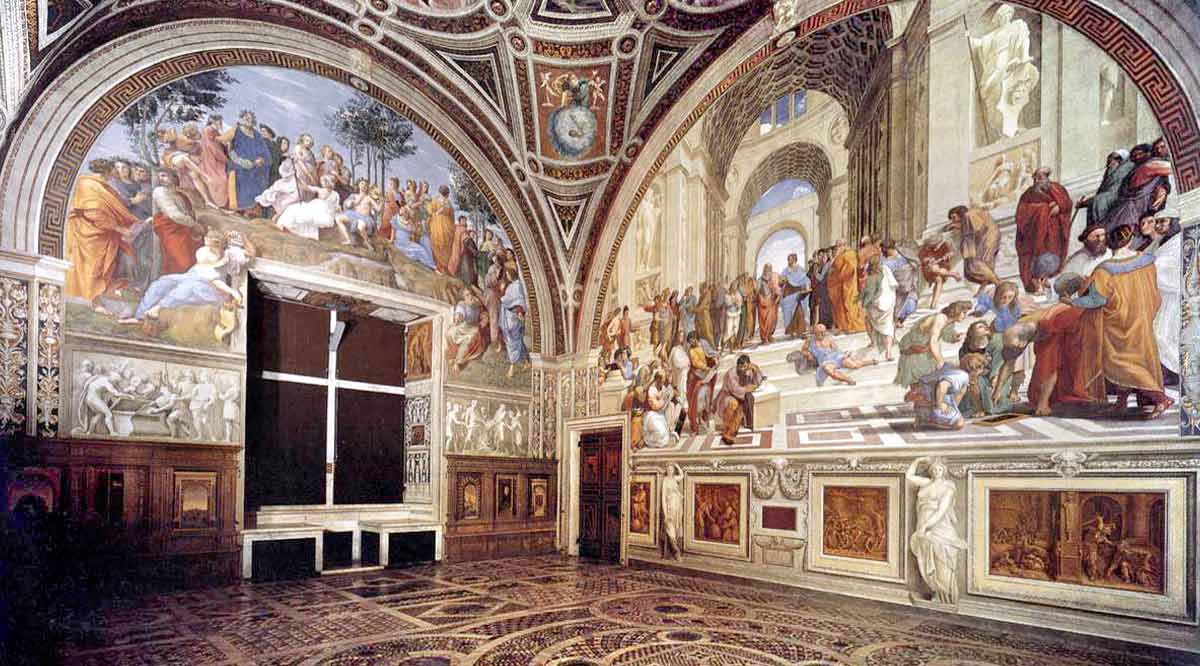
The School of Athens (1509) is located in the Stanza della Segnatura and is the second mural completed by Raphael in the room, following The Disputation of the Holy Sacrament, painted on the opposite wall.
The Stanza della Segnatura served as the study for Pope Julius II’s library. Raphael’s works address themes such as theology (La Disputa), philosophy (School of Athens), and literature (Parnassus), providing a fitting backdrop for a papal study. The subject matter chosen by Raphael reflects the Renaissance Humanists’ belief in the intellectual harmony between Christian teaching and Greek philosophy. The theme of wisdom was especially appropriate for this room, as it was here that most of the papal documents of major significance were signed and sealed.
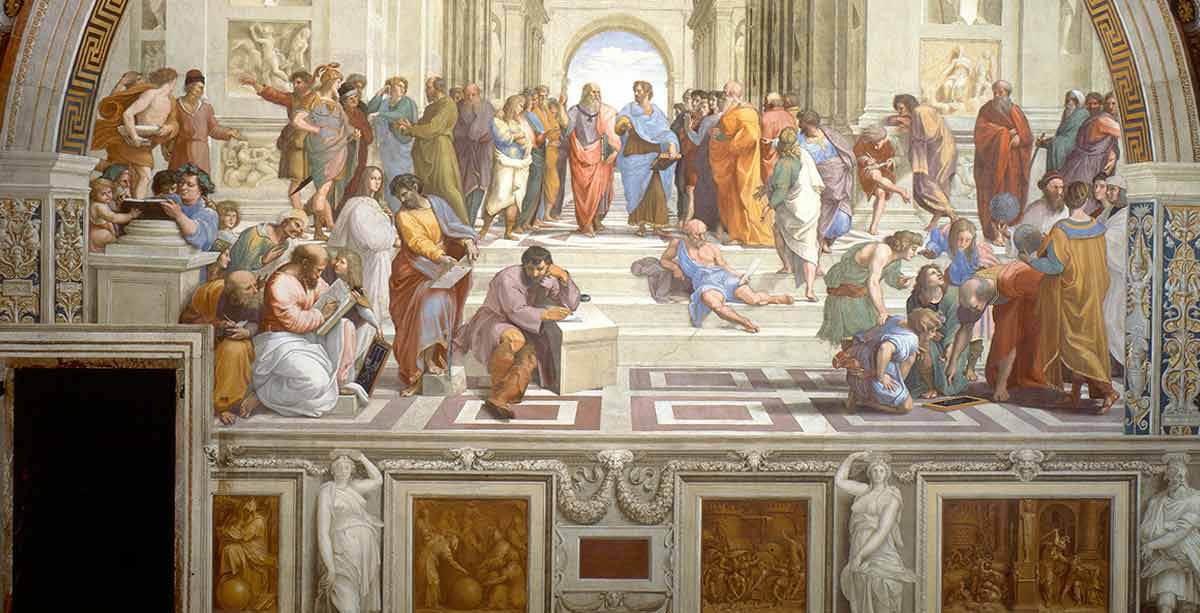
The title, The School of Athens, was not given by Raphael himself; the fresco’s actual theme is Philosophy, or more precisely, Ancient Greek Philosophy. Above the fresco, Raphael inscribed the two words Causarum Cognitio, “to know the causes.” This philosophical maxim is drawn from Aristotle’s Metaphysics and Physics.
It is believed that every major philosopher of antiquity is represented in the fresco, but identifying each one is a point of contention within the scholarly community, as Raphael left no records indicating the identities of the figures. Making matters worse for art historians, Raphael developed a unique iconographic system, portraying thinkers he had studied but never seen represented in art.
The Central Figures: Plato and Aristotle
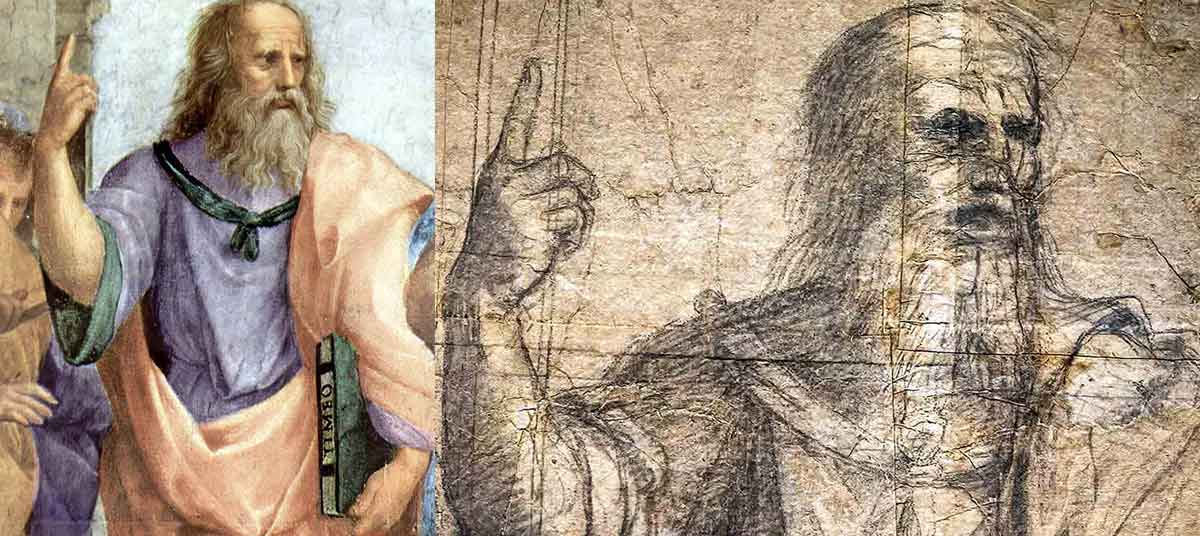
The composition incorporates Roman architectural elements, yet it is organized in a semicircular layout, with Plato and Aristotle at the center, and all other figures orbiting around them. At the center, the elderly Plato is depicted on the left, gesturing upward toward the heavens, and bearing the facial features of Leonardo da Vinci. For Plato, the observable world is not truly real but a reflection of another, higher reality, grounded in ideas and mathematics.
Beside him stands his student Aristotle, with his right hand extended toward the earth, indicative of his philosophy, which is rooted in the observable and tangible. Plato holds his work Timaeus, while Aristotle carries Nicomachean Ethics, highlighting the philosophical differences between the two thinkers.
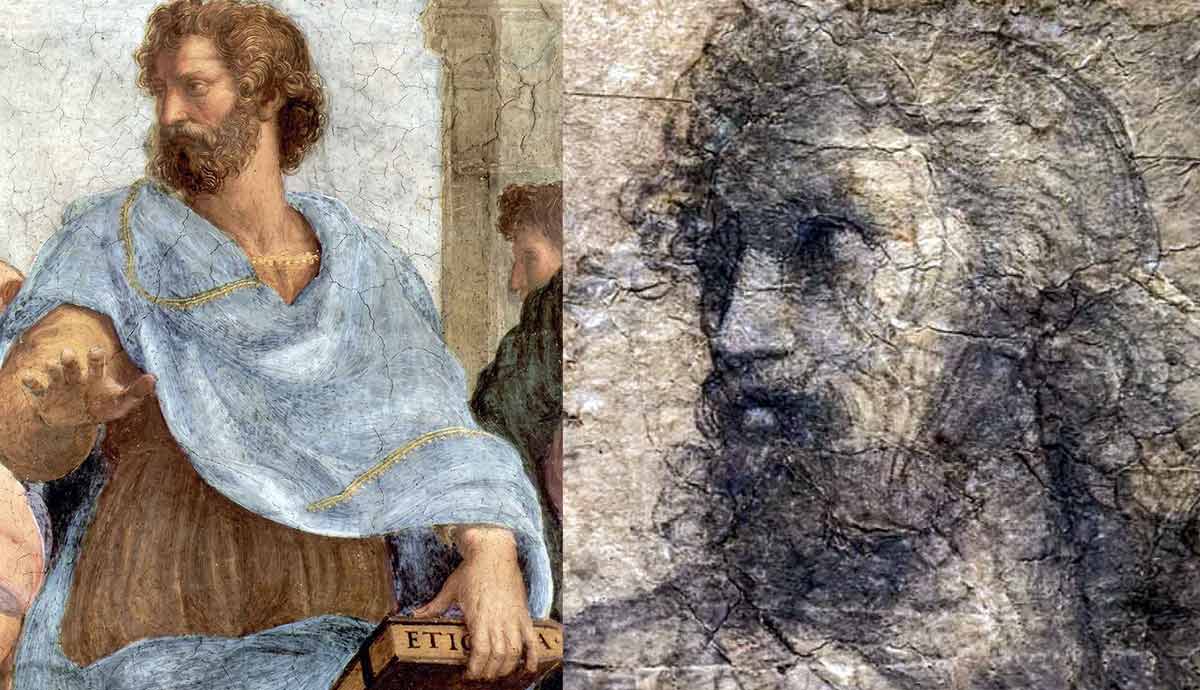
The colors of both their robes further symbolize their teachings: Plato wears purple, associated with the sky, and red, associated with fire. Both elements are weightless. Aristotle, in contrast, is clad in blue and brown, colors linked to water and earth, pulling downward.
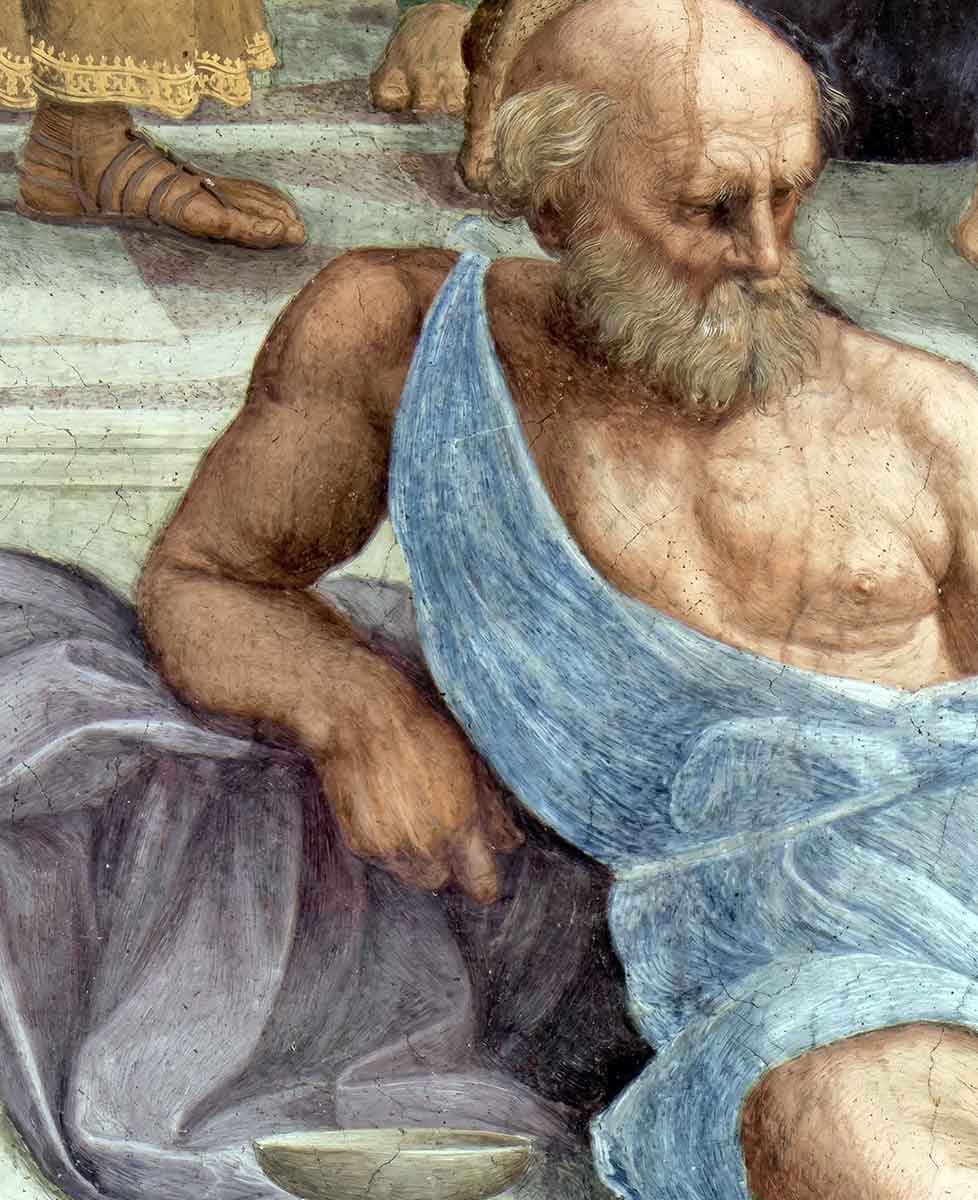
At a lower level, near Aristotle, the Cynic philosopher Diogenes is shown in sparse clothing and a posture suggesting indifference, contrasting with the grandeur of the surrounding space.
The Figures on Plato’s Side
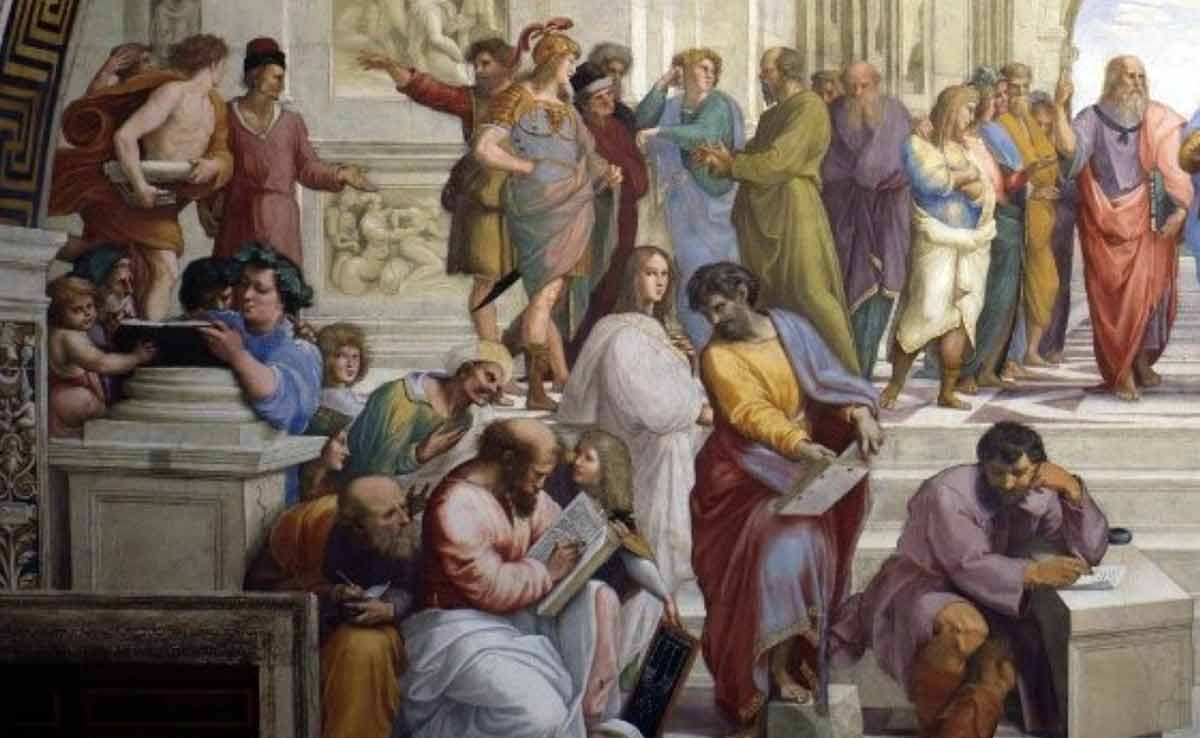
On the left side of the fresco, aligned with Plato, are Socrates, Xenophon (the biographer of Socrates), and the ancient statesman and military leader Alcibiades, dressed in armor. The identities of the remaining figures in this group remain uncertain.
Directly below Socrates’ group, it is universally agreed that the old man who is sitting and writing is Pythagoras, the founder of the mathematical school. A kneeling pupil holds the harmonic tables he invented. Other figures around him include possible identifications such as the medieval Arab philosopher Averroes, the elder Eleatic philosopher Zeno, and potentially Epicurus, Democritus, or Plotinus.
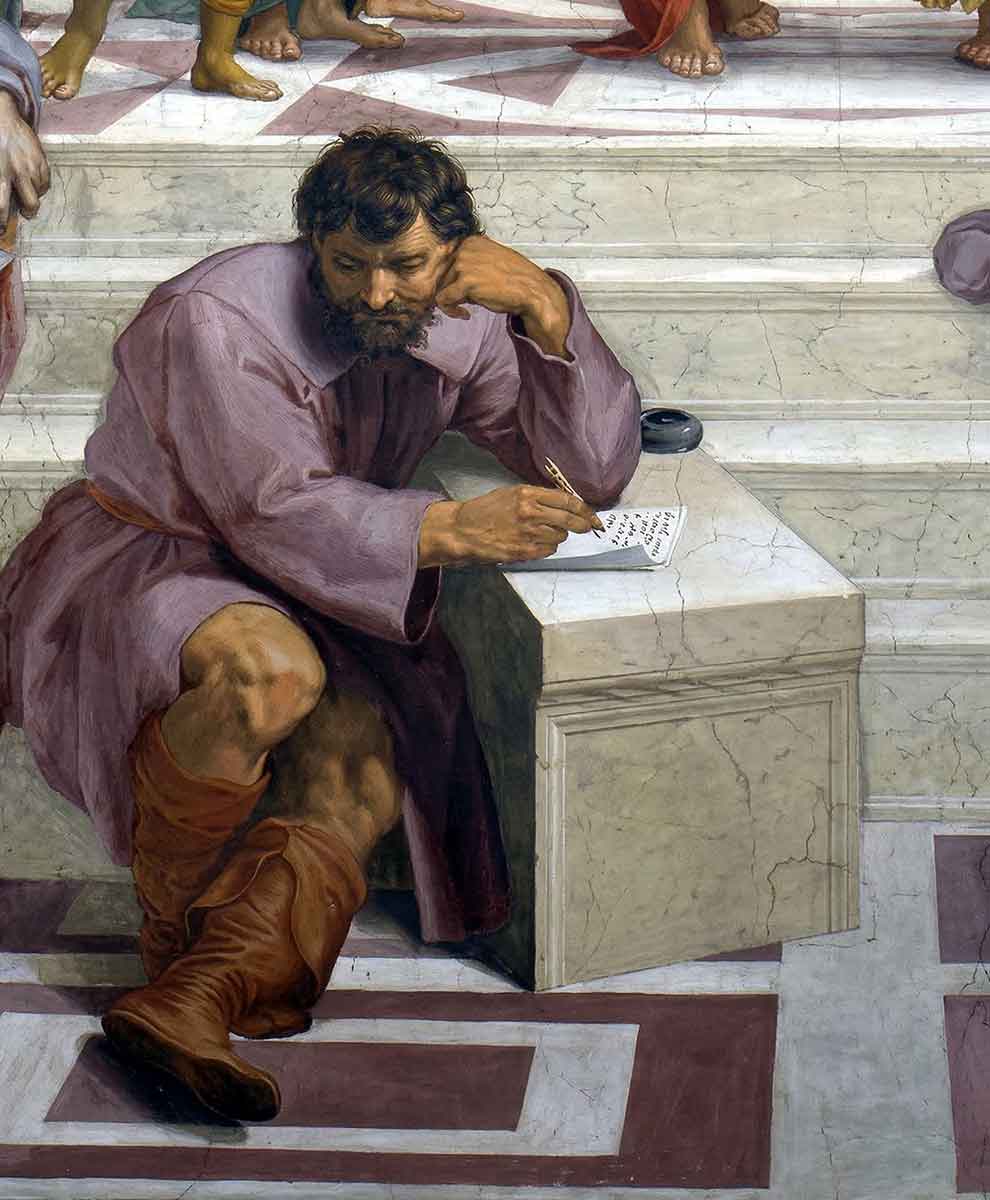
In the central section of the fresco, but still on Plato’s side, sits Heraclitus. It is said that Raphael placed him here, inspired by a work of Michelangelo Buonarroti, which is why the painted philosopher bears the facial features of this painter and sculptor. A close examination of the fresco shows that he was the last figure painted, completed in 1511.
Heraclitus is famous for the adage “No one can step into the same river twice,” meaning that the river constantly flows and human nature continuously changes. His awareness of life’s fleeting nature is reinforced by the fact that almost none of his writings survive, earning him the nickname “The Obscure.”
The Figures on Aristotle’s Side
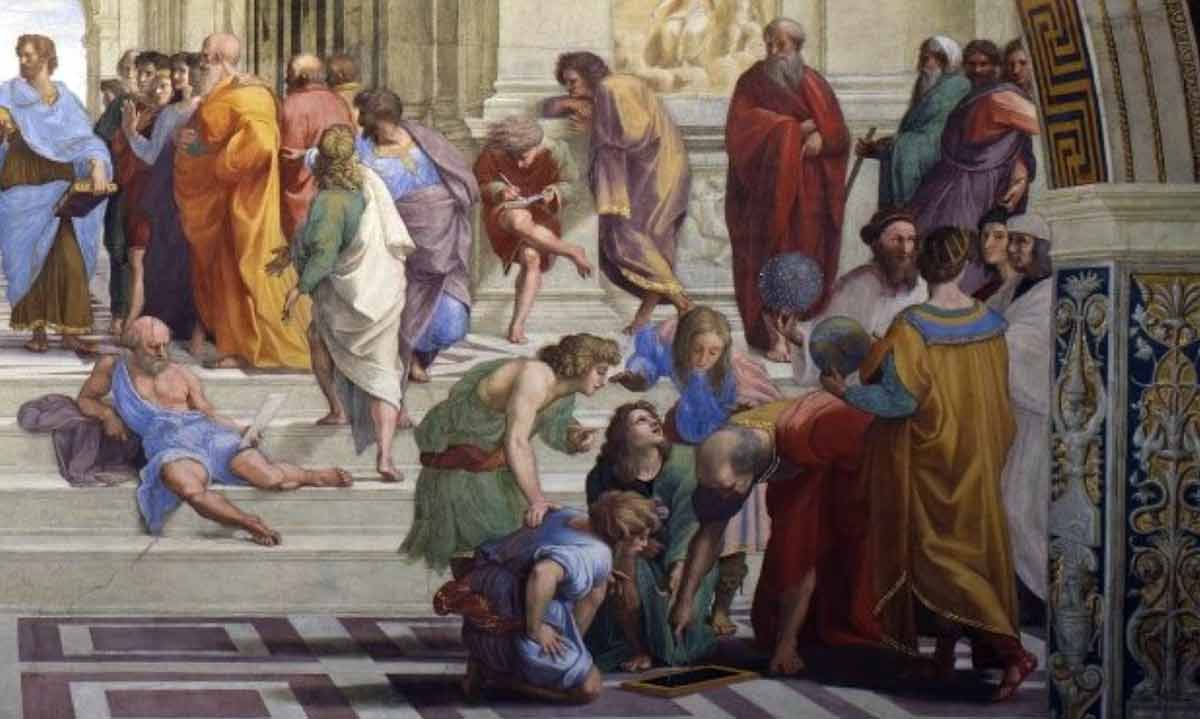
On the right side of the fresco, beside Aristotle, are members of the Peripatetic school. At the lowest level on this side, Euclid or Archimedes leans over a tablet in the foreground, holding a compass and explaining geometrical theorems to his audience, much like Pythagoras does on the left side.
To the right are two figures: the bearded man facing the viewer is the Persian philosopher and religious leader Zoroaster, holding a blue celestial sphere, symbolizing his association with astrological and cosmological beliefs. With his back to the viewer stands the Alexandrian astronomer and geographer Ptolemy, often depicted by artists with his globe and a royal crown, reflecting his perceived connection to the kings of the Hellenistic Egyptian realm.
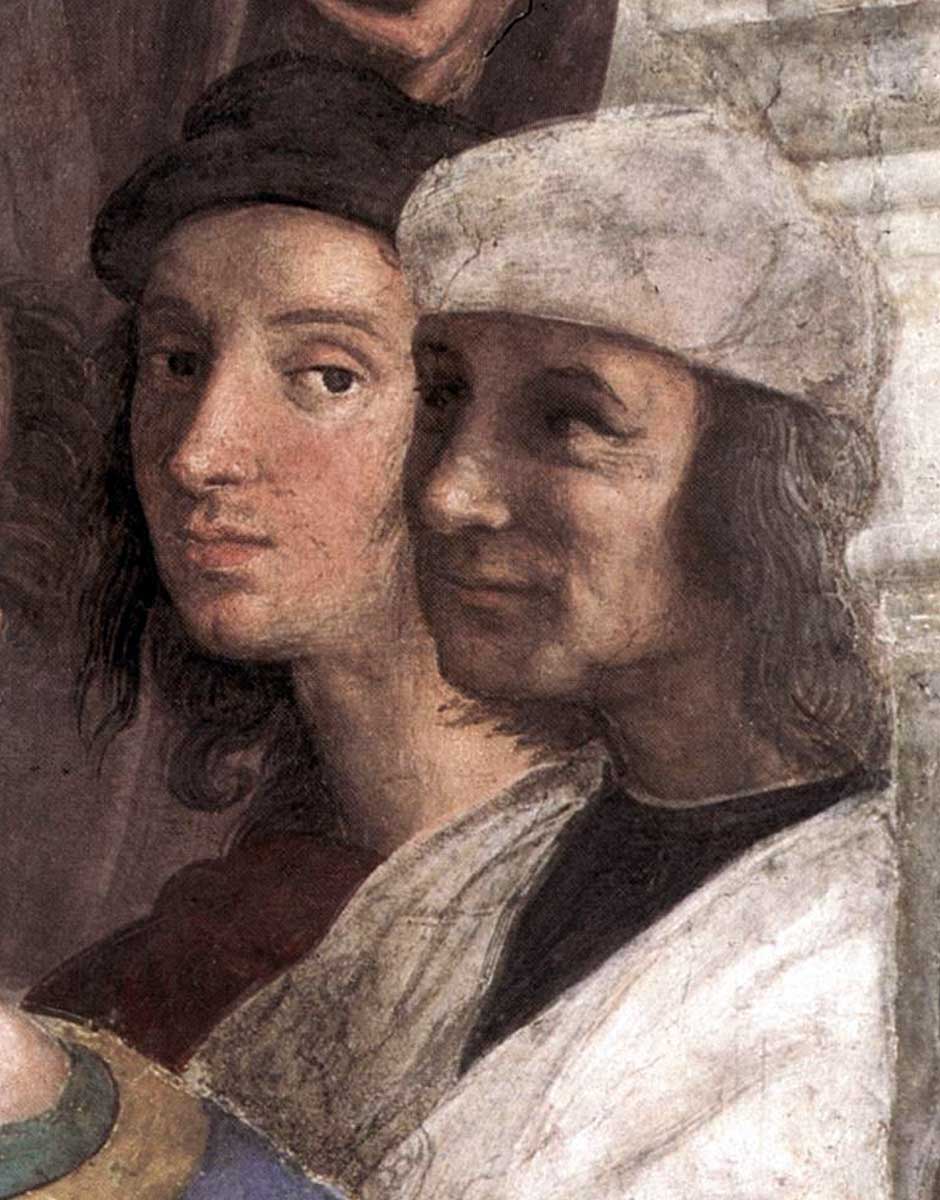
Further to the right, Raphael himself is depicted looking out toward the observer. His features correspond to those in his self-portrait, in which he is depicted in a three-quarter pose. Beside him potentially stands his colleague Sodoma, who had contributed preparatory work in the same building that Raphael would ultimately complete. However, the figure might also represent Perugino, the veteran chief of the Umbrian school.