We know the names of more than 2,000 different deities from ancient Egypt, but few were more popular and important than Hathor. The cow goddess had more temples than any other goddess in ancient Egypt. Her popularity meant that she absorbed attributes of lesser goddesses and was incorporated into the myths of other deities, where she did not originally belong. The result is a highly complex deity whose presence touched almost every aspect of ancient Egyptian life.
Who Was Hathor? A Celestial Goddess
While we think of ancient Egypt as a mighty empire unified under the pharaoh, it started out as a series of independent cities, each with its own gods and religious practices. As the region became unified under a single ruler, the multitude of deities was brought together into an expansive pantheon of gods. The nature of the gods changed over the millennia of Egyptian civilization as different regions rose in importance and elevated their favorite gods, similar deities were syncretized, and popular gods adapted to explain a changing world. This explains the complexity of the Egyptian gods.
Hathor is no exception when it comes to complexity. She was considered a mother goddess linked with fertility and kingship, but she was also a sky goddess, and was associated with music and dancing, alcohol, beauty, and artistry.
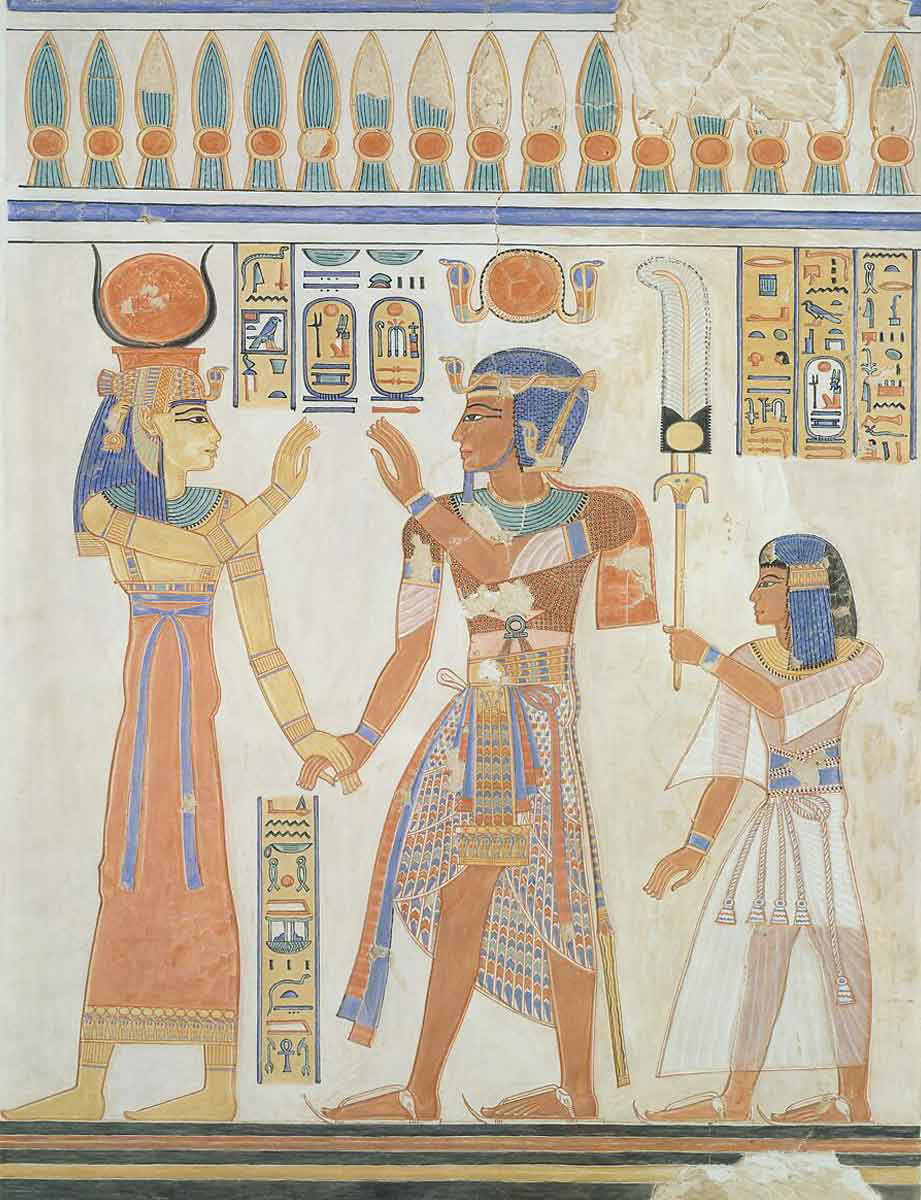
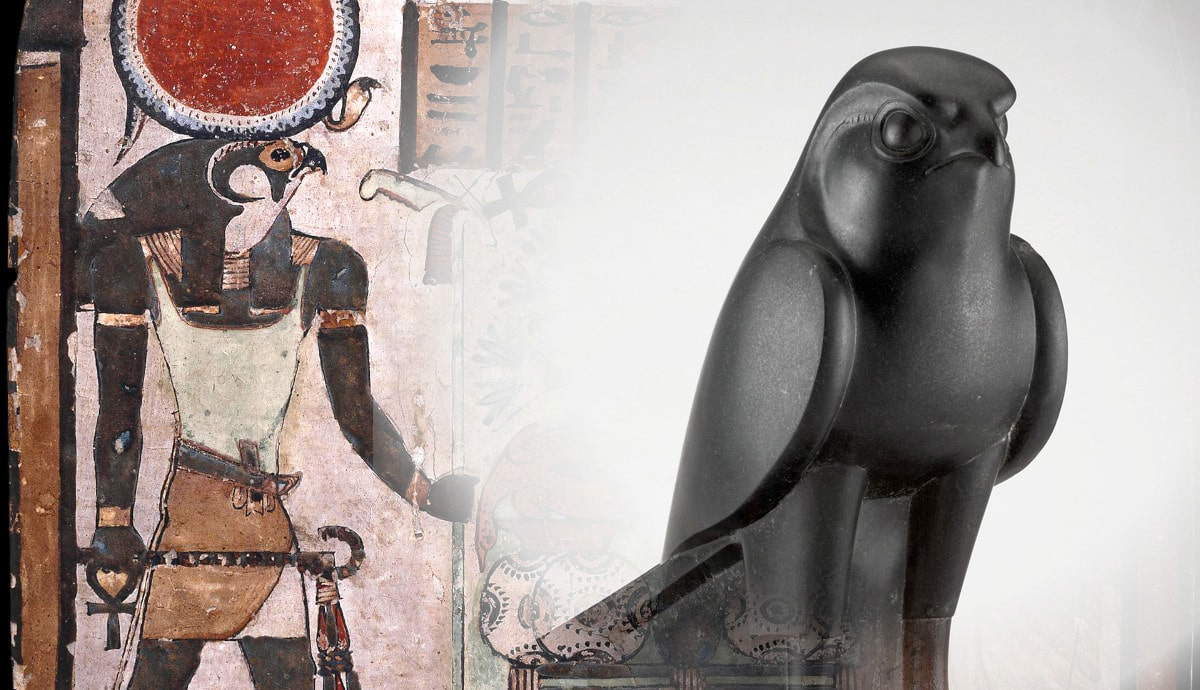
The name Hathor means “House of Horus,” a falcon-headed god of the sky. She was considered the mate of Horus the Elder, an ancient primordial sky god considered an early patron of the pharaohs. He is a distinct god from the more familiar falcon-headed Horus, the son of Isis and Osiris, but the two inevitably became closely associated over the millennia. This association made Hathor an early goddess connected with the queen and the royal family, responsible for the production of heirs and stability through a strong line of succession. She was often depicted as the mother of the pharaoh, feeding him from her breast.
She was also sometimes considered the consort of the sun god Ra as he rose in popularity during the Old Kingdom. Later, in one creation myth, she was described as the consort of the creator god Khonsu, giving birth to the city of Thebes while he gave birth to the gods of Thebes. This reflects an idea of Hathor as the principal divine feminine.
Because Hathor was such an important goddess, she was syncretized with many lesser goddesses, whose attributes the more popular Hathor absorbed. This often blurs her identification and interpretation. Later, many of Hathor’s aspects would be absorbed by the increasingly popular and important goddess Isis in the 1st millennium BCE, though Hathor would also remain important.
Hathor’s Cow: A Fertility Goddess
Hathor is among the oldest Egyptian goddesses, with evidence of her worship documented as far back as pre-dynastic times. Originally, she was the Milky Way personified and was associated with the night sky, personifying the expanse through which the gods moved. In this capacity, she was called the “House of Horus” or the “Mistress of the Stars.”
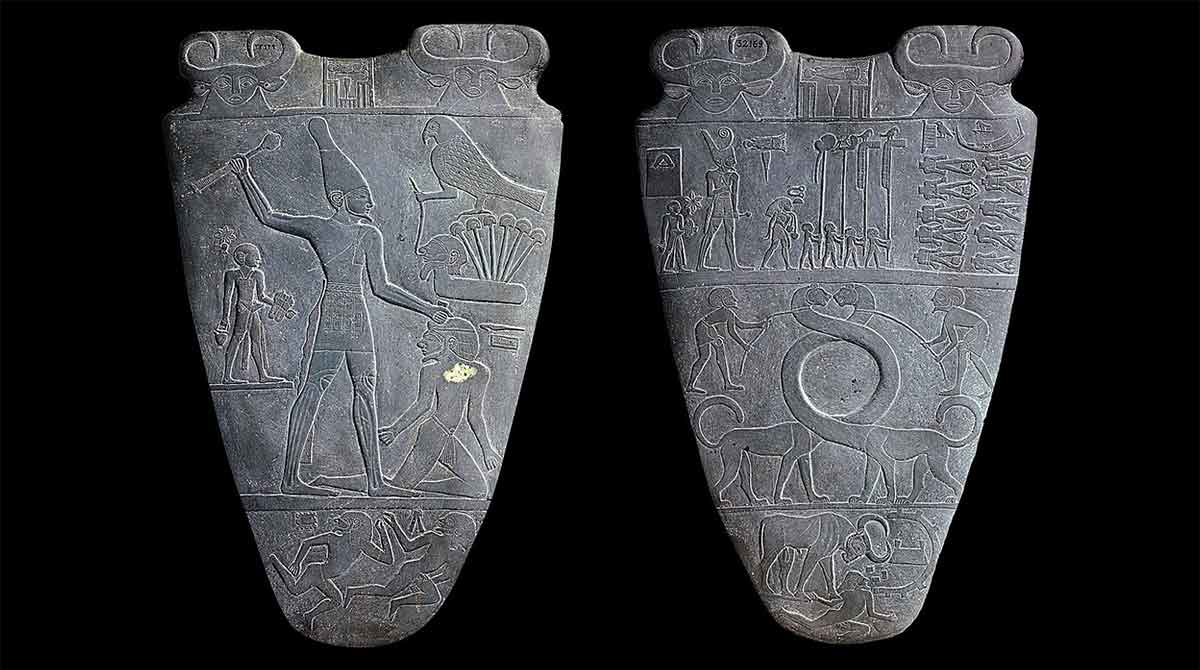
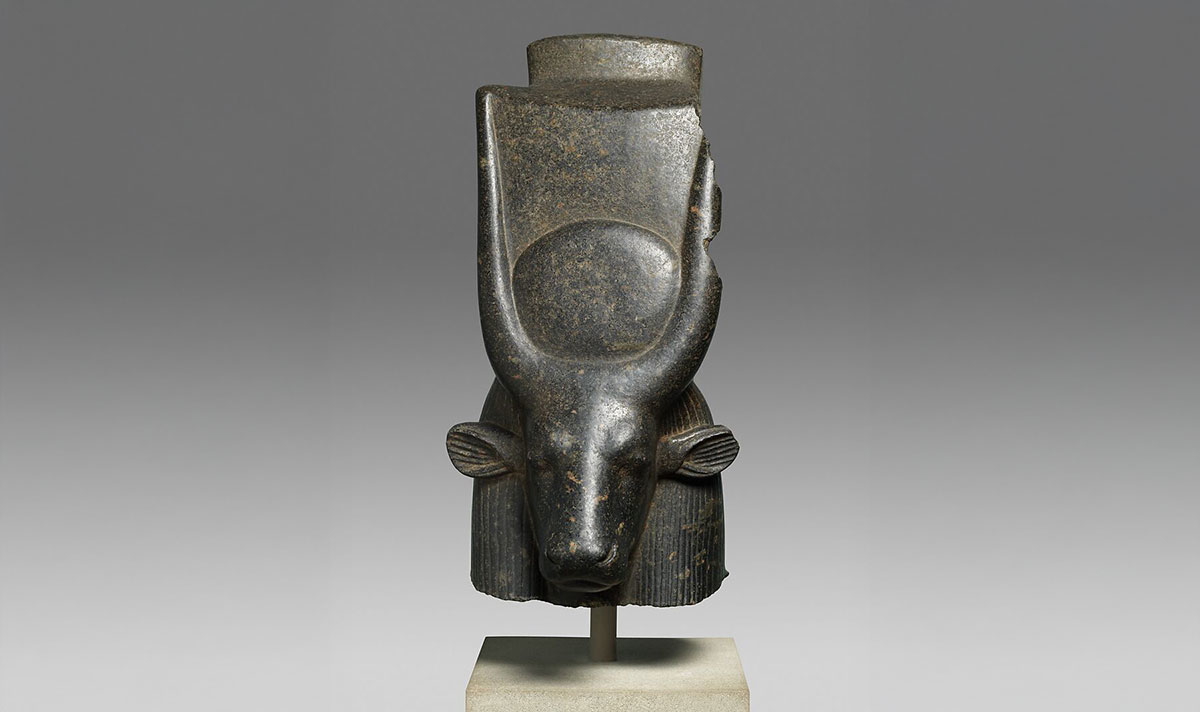
She was closely associated with the cow. On the famous Narmer Palette, associated with king Narmer or Menes from Egypt’s 1st dynasty in the 4th millennium BCE, two cow heads appear at the top on both sides of the palette. However, some scholars believe that this is not Hathor, but Bat, another cow goddess later absorbed into Hathor. The cow is believed to embody both the goddess’s celestial and material aspects. Her horns enclose the stars, while the milk of cows was associated with fertility.
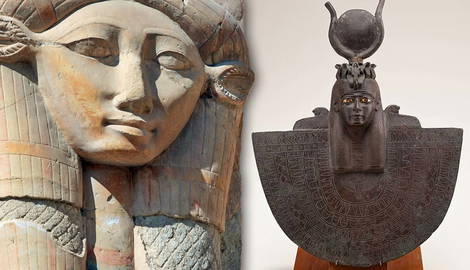
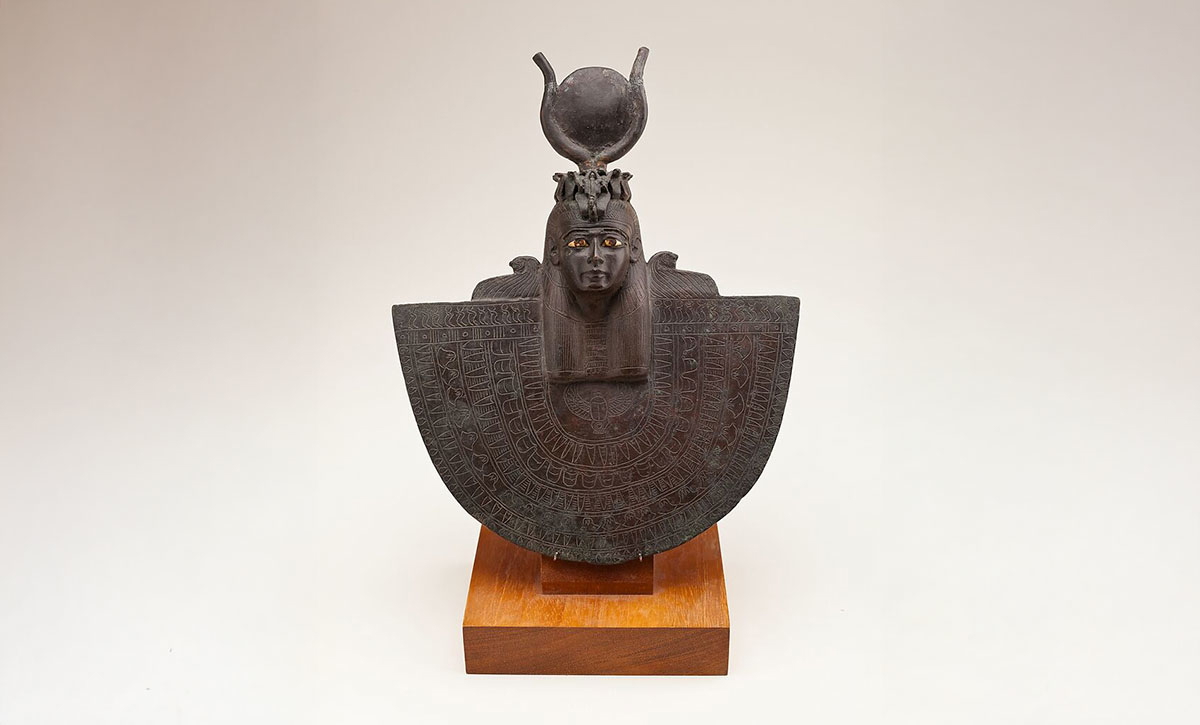
In contrast to Greco-Roman deities, but like many other ancient Egyptian gods, Hathor was often depicted in animal form as a cow. Also, like other Egyptian gods, she was sometimes depicted with the body of a woman and the head of a cow. However, she was most often depicted as a woman wearing a crown with cow horns enclosing a sun disk.
Goddess of Fate: A Generous Benefactor
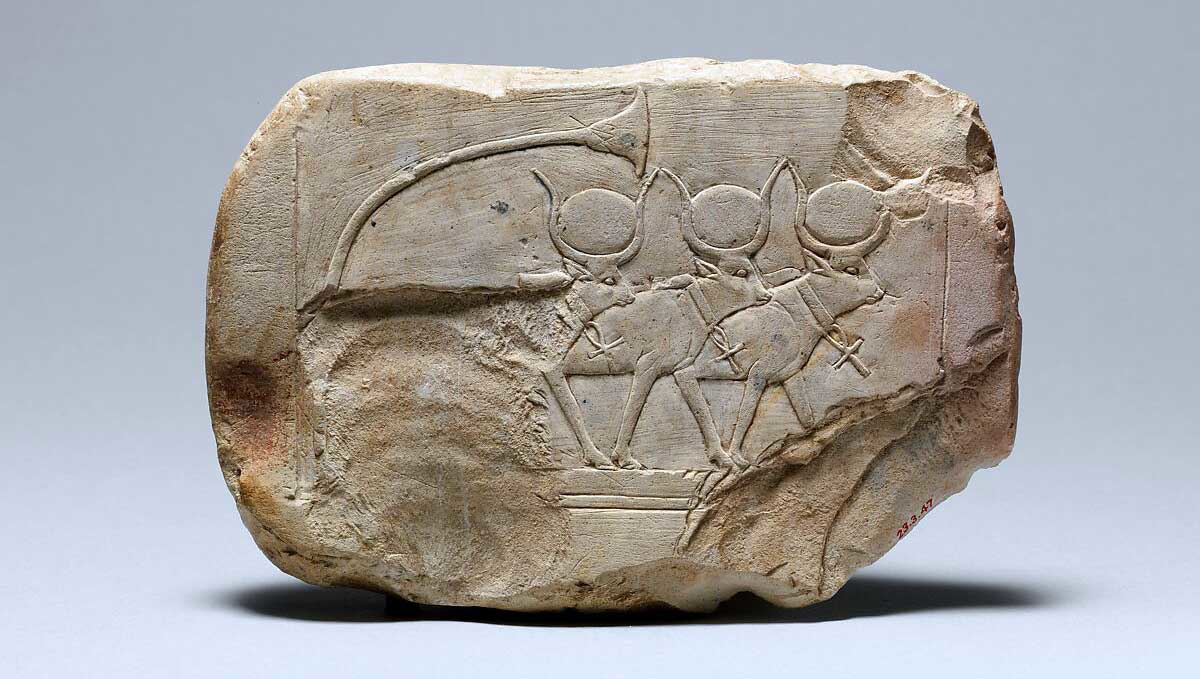
Hathor was generally portrayed as a beautiful, generous, and benevolent goddess who bestowed her gifts on humanity. Thus, she was given the title of “mistress of life.” While she was concerned with beauty, she was never portrayed as vain or envious, though mirror handles were often made in the shape of Hathor’s face. As a fertility goddess, she oversaw love, marriage, and childbirth, and women would pray to her to cure infertility. As a generous and caring mother, Hathor was also often depicted helping the newly deceased find their way into the afterlife.
Because Hathor was so multifaceted, she was sometimes called the Seven Hathors, suggesting her different aspects. Less commonly, there were even more Hathors, as many as 362. As this multi-goddess, Hathor was linked with fate and was said to know the length of life and the fate of every child born. She had priests residing in seven cities throughout Egypt who acted as oracles. They were highly sought after in matters related to childbirth, fortune telling, artistic inspiration, protection against evil, and other matters that concerned the Egyptian mind. In a way, the Seven Hathors were a proto version of the Oracle of Delphi and the three Fates in Greek mythology.
A Bloody Temper: Hathor & Sekhmet
For all of her benevolence, Hathor also has a violent side. In one myth, the sun god Ra becomes angered at humanity for ignoring the gods and sends Hathor to bring death and destruction on the ungrateful population. She descends from the heavens, smashing cities, destroying crops, and massacring everyone she finds. During the wave of devastation, she transforms into the lion-headed goddess Sekhmet, a bloodthirsty being that showed no mercy to her victims.
Initially pleased with Hathor, Ra and the other gods became distressed as Sekhmet/Hathor was too effective. If she went any further, there would be no humans left, and then there would be no one left to make offerings. Sekhmet showed no signs of stopping, so Ra had a particularly potent pot of beer brewed. It was then dyed red to resemble blood. The literally bloodthirsty goddess saw the beer and drank it, falling asleep in a stupor. She woke up with a personality reset and is no longer Sekhmet but Hathor the Benevolent. Sekhmet was sometimes considered a separate being from Hathor, and was prayed to by warriors for courage before a battle.
Eye of Ra: Protector of Order and Joy
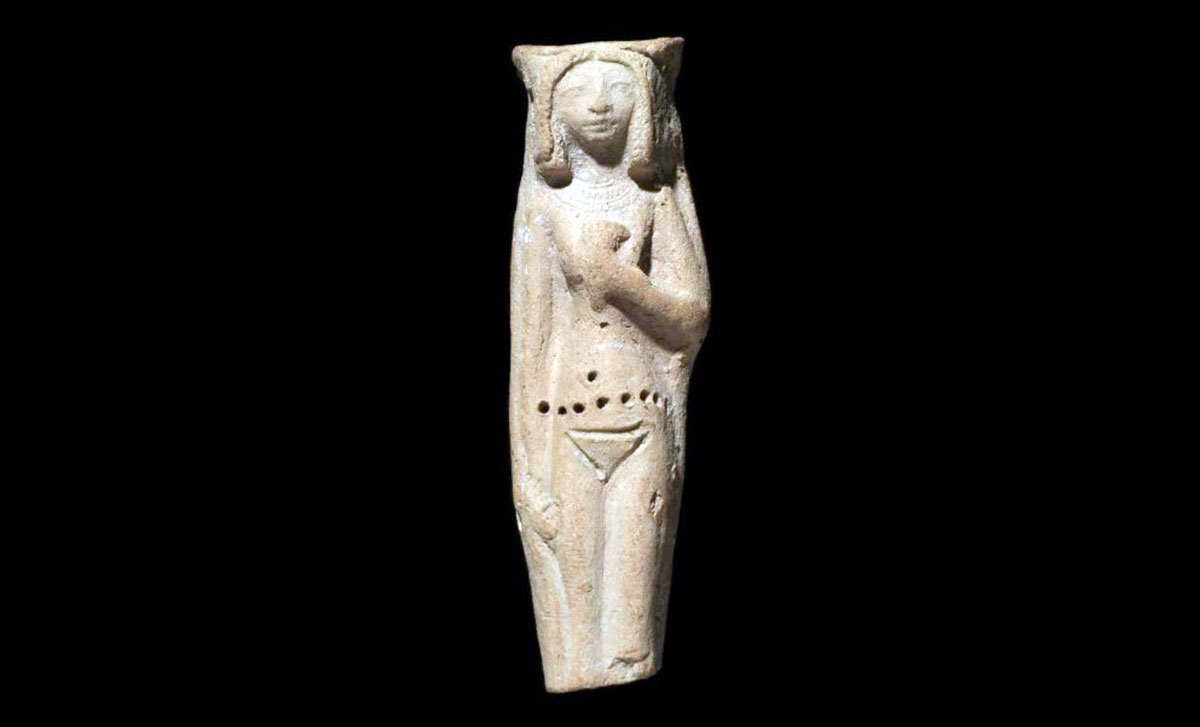
Hathor was a joyful goddess associated with music, dance, and other happy activities. In a pivotal tale, the evil god Seth killed Osiris, who became king of the Underworld. His consort, Isis, however, still managed to become pregnant with his child, Horus, who challenged Seth for leadership of the world. In one version of the tale, the confrontation is a competition between the two deities, overseen by Ra. He became despondent over the proceedings and fell into a depression. In order to help him recover, Hathor danced for him, accidentally, or maybe not so accidentally, showing her genitals. Ra began to laugh, and his mood restored, he was soon able to continue with the trial. Some modern scholars believe that this can be interpreted as the divine feminine balancing and assisting the divine masculine.
But as well as helping humans find joy, she had cosmic responsibilities. Among the gods, she was responsible for maintaining cosmic order. In the Egyptian belief system, there are constant battles between opposing forces, such as light and darkness, and order and chaos. In another tale, she stands on the prow of a ship, keeping watch for Apophis, the god of chaos, who attacks the sun barque of Ra each night. Her watchful gaze prevents catastrophe from sneaking up on the gods. Consequently, she is sometimes referred to as the “eye of Ra,” or the “eye of Atum.”
Attributes of Hathor: Beauty & Music
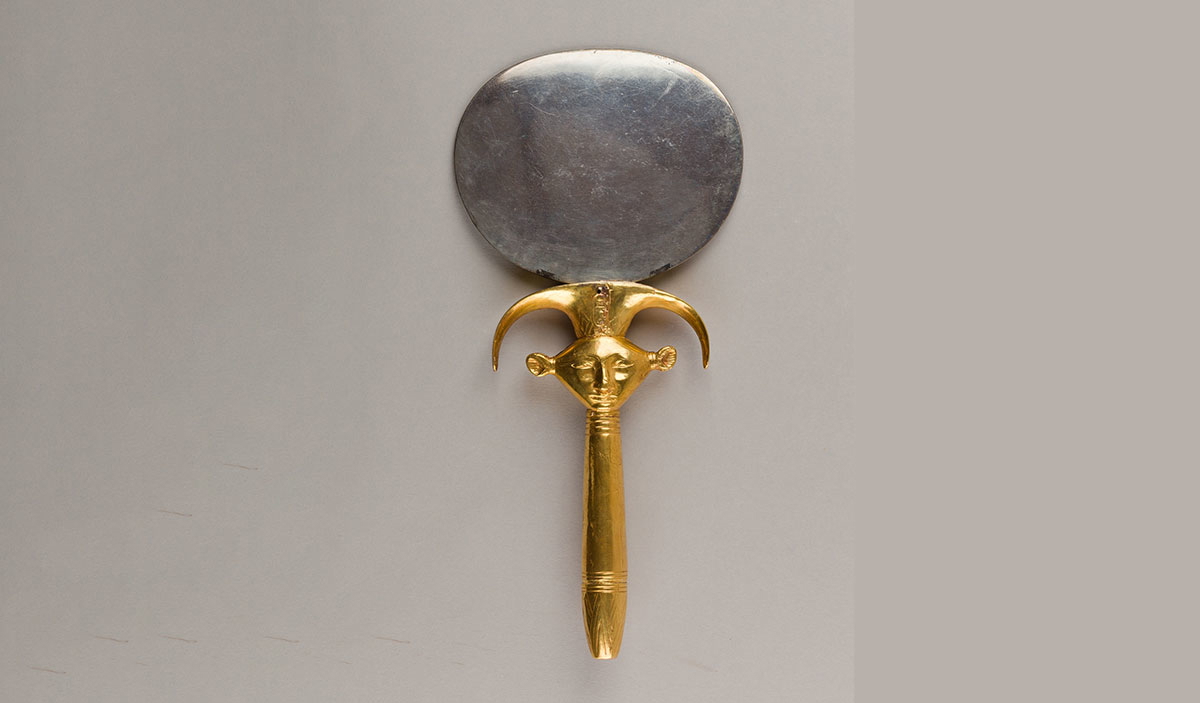
Due to the goddess’s association with femininity and beauty, she was associated with makeup, such as kohl. She was depicted on mirrors and cosmetic palates, often made of precious and semi-precious materials such as gold, copper, turquoise, and especially malachite, a green mineral that was believed to prevent and treat eye infections. This also made Hathor a healing goddess. Offerings of myrrh were also used in her worship.
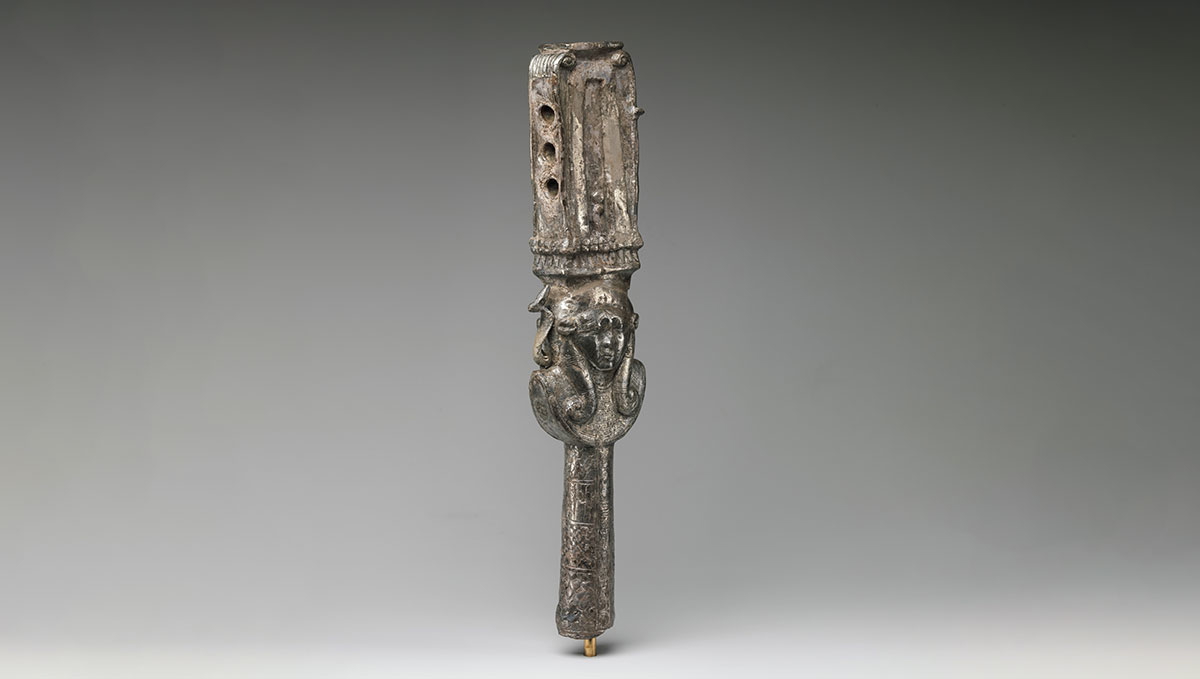
She was also associated with music, and her sacred instrument was the sistrum. This was a U-shaped piece of metal with metal rods driven through the loop. When shaken, it would act as a sort of rattle. Unsurprisingly, this instrument was closely linked to fertility rituals. Her worshipers would also wear jewelry, especially the menat necklace, which was a necklace that features a prominent plate, usually made of gold or copper, shaped in a bar or half circle. It may have also been used as a percussion instrument, giving the jewelry a dual purpose.
The Temples of Hathor: Widespread Worship
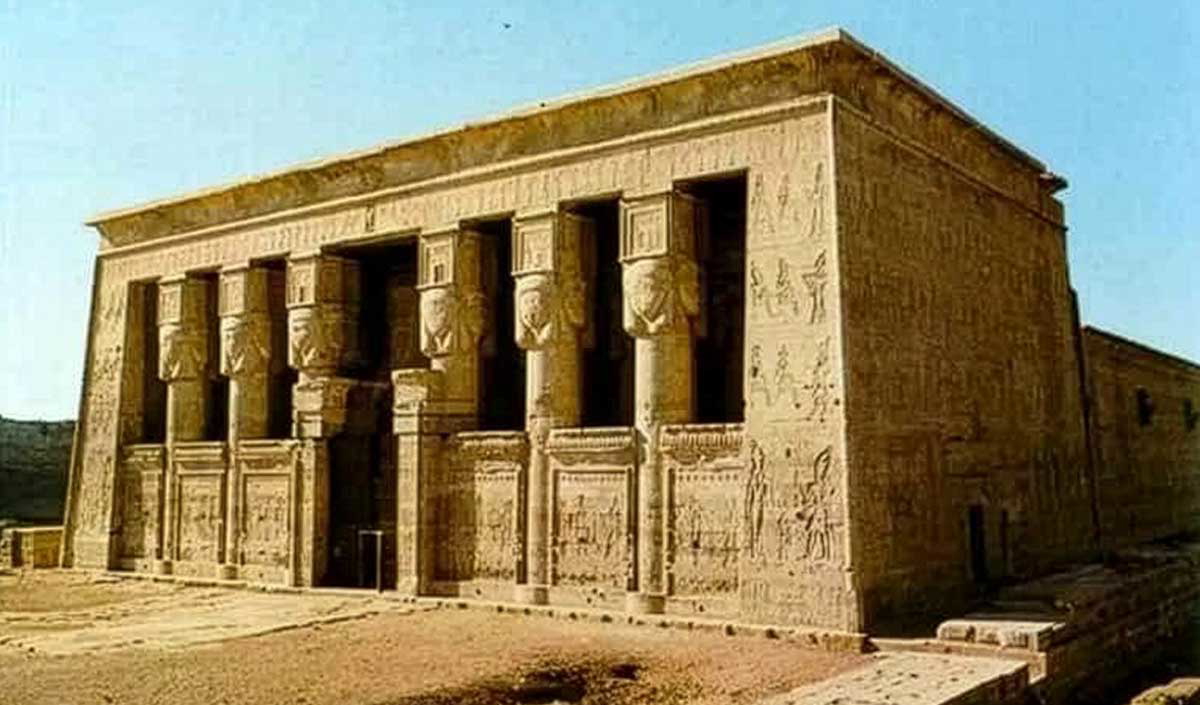
More temples were devoted to Hathor than to any other goddess in ancient Egypt. For most of Egyptian history, her main temple was at Memphis, where she was considered the daughter of their patron deity, Ptah. She was known as Hathor of the Sycamore, and a sycamore tree stood near many of her sanctuaries. Her oldest known temple was at Dendara, dating from at least the 4th dynasty, and it would surpass her Memphis temples in importance.
Unlike the other deities, whose priests matched the sex of the god, male priests for Horus, female priestesses for Isis, Hathor had both male and female priests. In addition to praise and worship, they would also act as dancers, singers, artists, and other professions that added vibrancy and beauty to the lives of Egyptians. Her worship also extended outside of Egyptian-controlled lands and could be found in Ethiopia, Somalia, Libya, and the Levant.