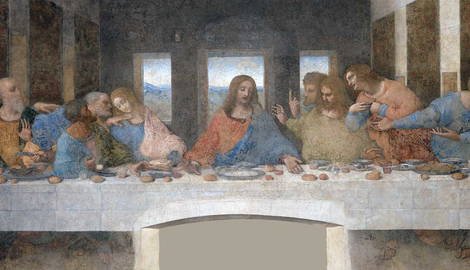

Created between 1495 and 1498, The Last Supper stands among the most admired achievements of the Renaissance, revealing Leonardo da Vinci’s remarkable control of perspective and human expression. Painted on the refectory wall of Santa Maria delle Grazie in Milan, it immortalizes the moment Jesus reveals his impending betrayal, capturing the apostles’ vivid reactions. Here is the drama and symbolism that makes this work timeless.
The Author of “The Last Supper”: Leonardo da Vinci
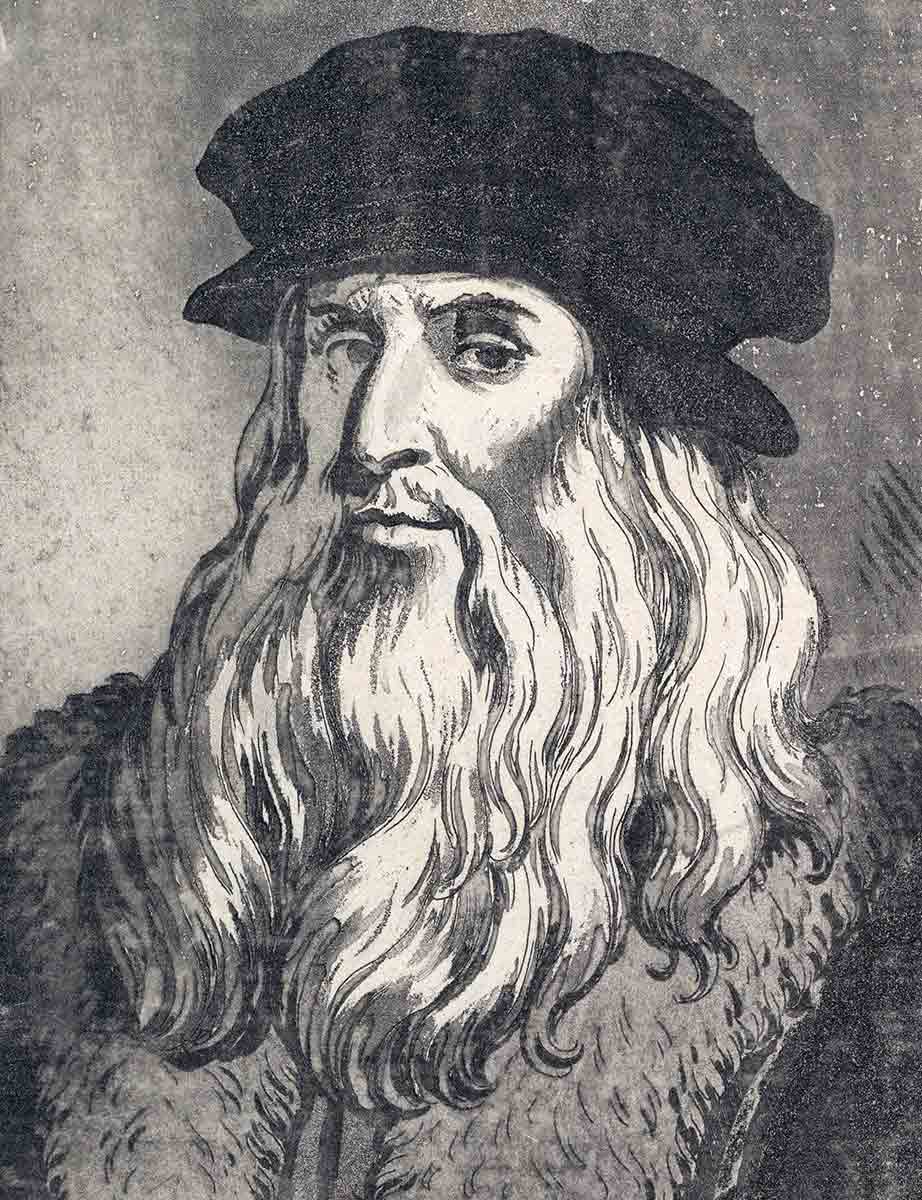
Leonardo da Vinci (1452–1519), the Florentine polymath, stands as the quintessential genius of the Italian Renaissance. Born in the Tuscan town of Vinci, the illegitimate son of the notary Ser Piero, he trained in the workshop of Andrea del Verrocchio. According to Vasari, Leonardo painted one of the angels in The Baptism of Christ, creating a figure so beautiful that Verrocchio reputedly abandoned painting thereafter.
Leonardo remained in Florence until around 1481-82, when he moved to Milan to serve Duke Ludovico Sforza, under whose patronage he executed The Last Supper. After the fall of the Sforza court in 1499, he led a peripatetic life between Florence, Rome, and Milan before accepting an invitation from Francis I of France in 1516. He spent his final years at Cloux, near Amboise, where he died in 1519.
The Last Supper: Commission and Subject
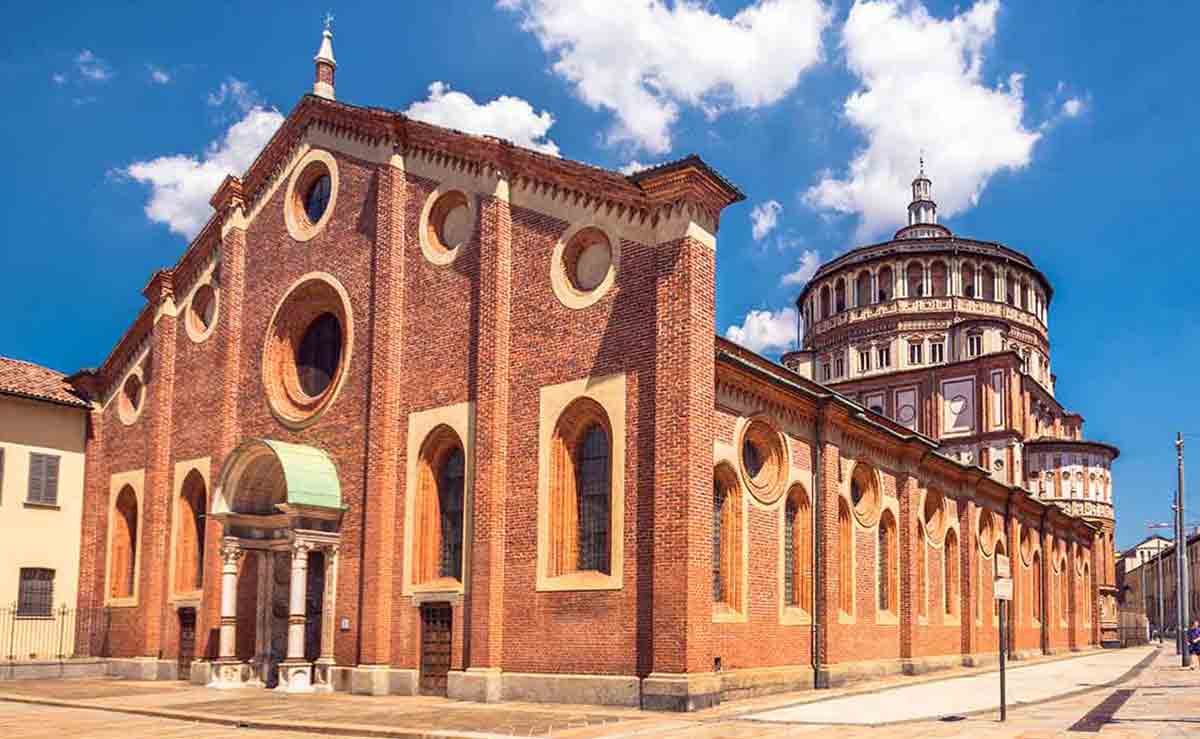
One of the most iconic works of Leonardo’s Milanese period is the mural The Last Supper, which dominates the refectory of the monastery Santa Maria delle Grazie. The setting in the picture is a continuation in perspective of the real room, so that Christ’s table seems to be in the refectory itself. The work was likely finished by 1498, as suggested by the dedicatory letter to Ludovico that prefaces Luca Pacioli’s De Divina Proportione.
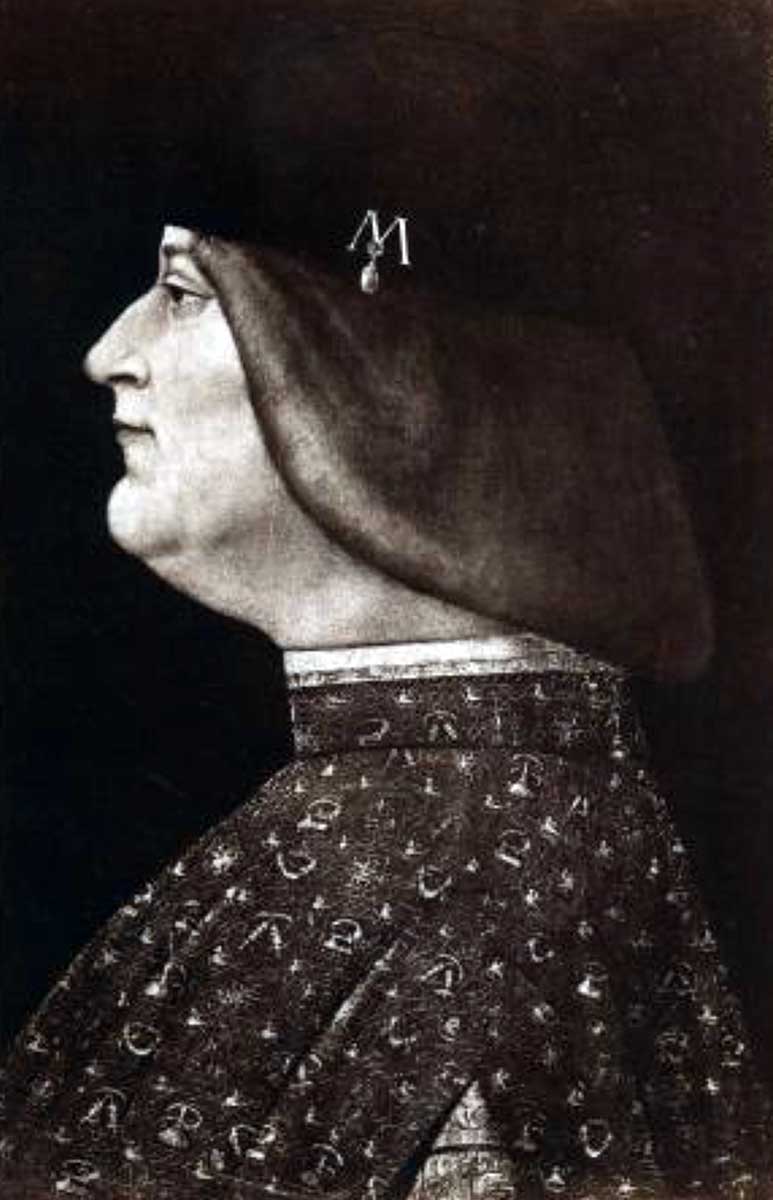
Leonardo chose to depict one of the most dramatic moments in the Gospel narrative: the instant Christ declares, Truly I tell you, one of you will betray me (John 6:70-71). The artist brings life to these words through his use of gesture and expression.
Shock ripples through the disciples as they react to Christ’s revelation. Through their faces, bodies, and hands, Leonardo conveys an intricate spectrum of human emotion. In his Treatise on Painting, Leonardo specifies: “The movement of men are as varied as are the emotions which pass through their minds…”
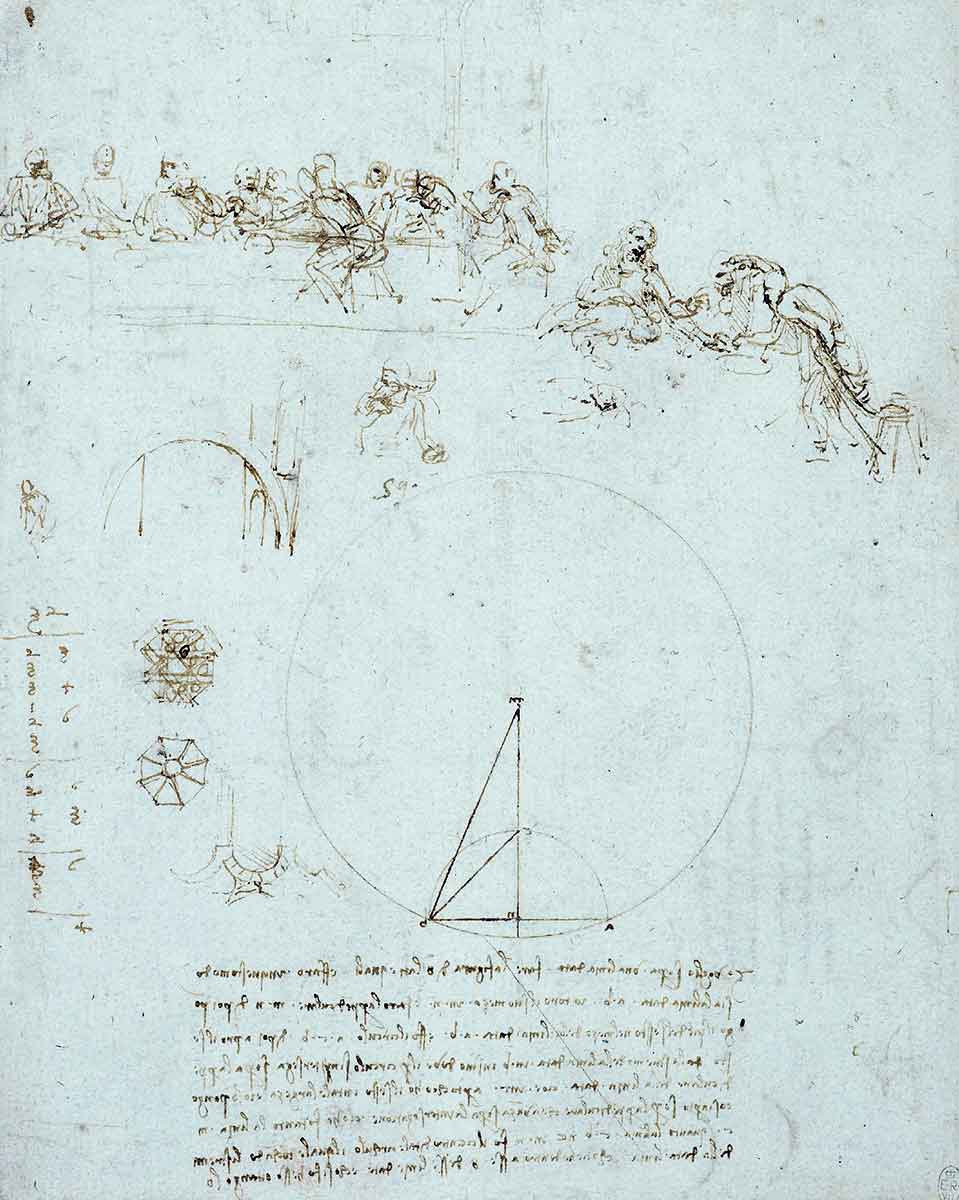
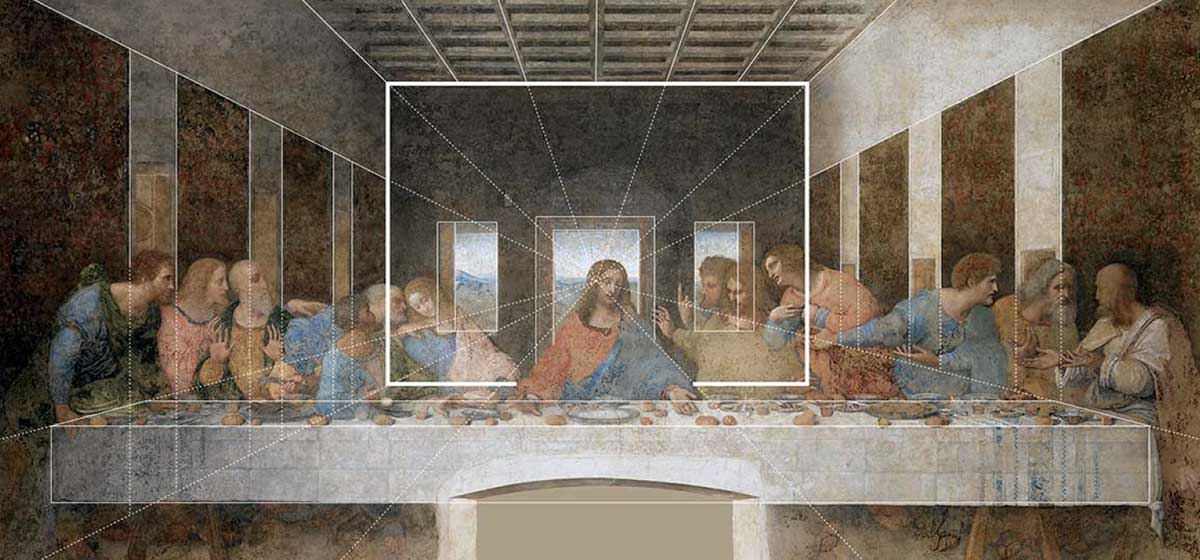
In an early preparatory sketch by Leonardo for The Last Supper, the twelve apostles are already identifiable, with nine labeled by name in his own handwriting. In this study, Judas is depicted on the opposite side of the table, isolated from the others. In the final mural, however, Leonardo integrated him into the group, maintaining narrative clarity while heightening psychological tension. Despite the emotional intensity, the composition remains harmonious. The twelve Apostles are arranged in four groups of three, symmetrically on either side of Christ.
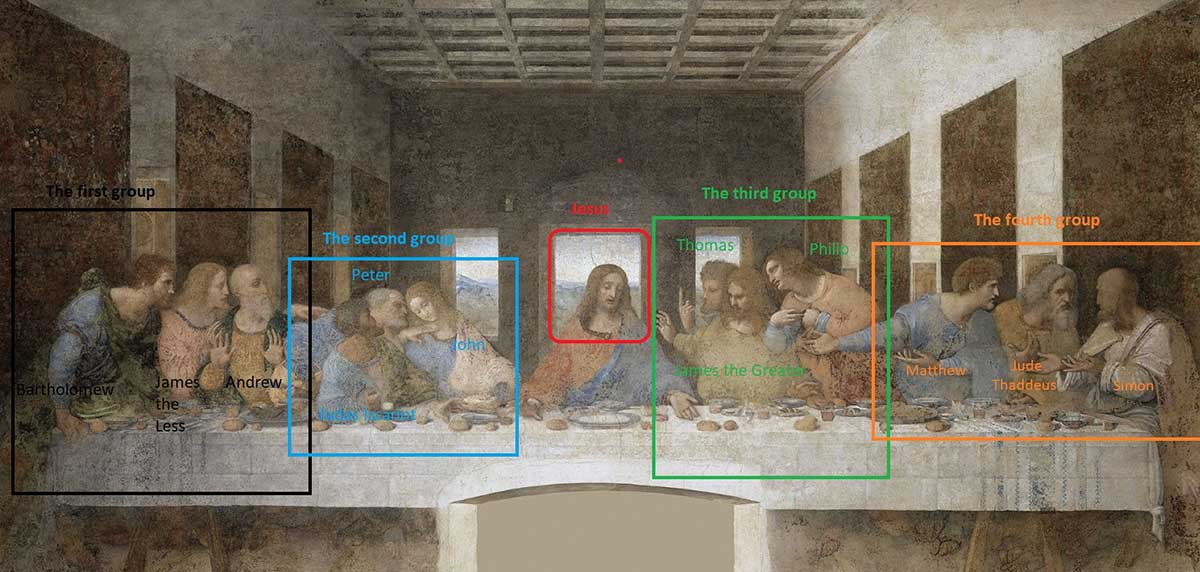
From left to right (from the viewer’s perspective), the first group consists of Bartholomew, James the Less, and Andrew; the second of Peter, John, and Judas Iscariot; the third of Thomas, James the Greater, and Philip; and the fourth of Matthew, Jude Thaddaeus, and Simon the Zealot.
The Unusual Painting Technique
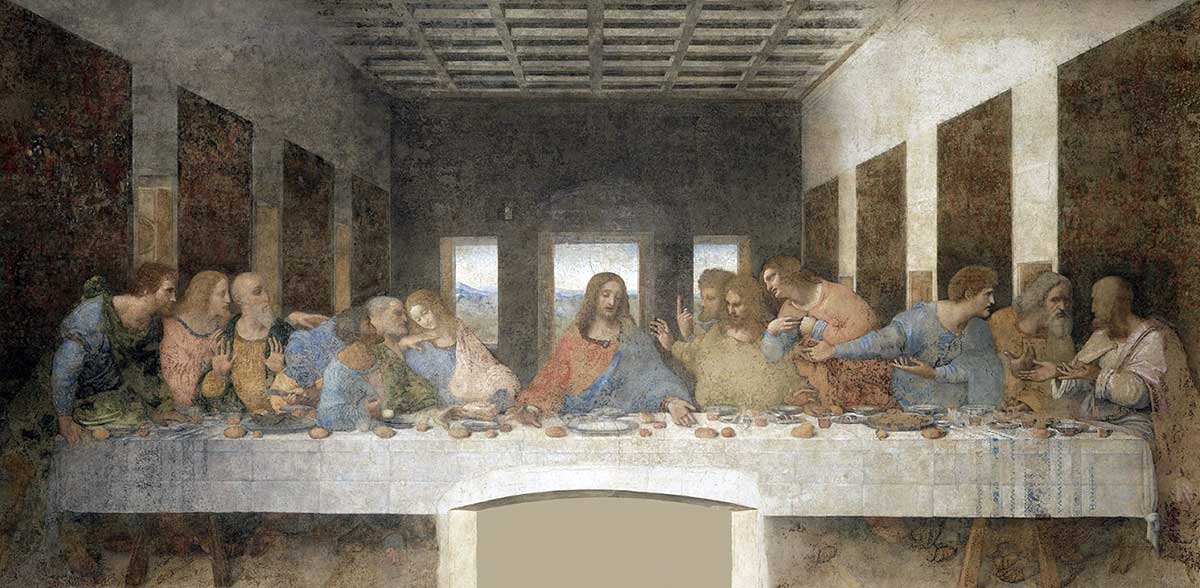
Rather than working in the standard buon fresco technique, Leonardo experimented with a secco process, mixing oil and tempera on a dry plaster wall. This approach let him refine details gradually, but also caused the painting to deteriorate more quickly. This innovative choice allowed him to work slowly and precisely, but it also proved disastrous for the mural’s durability.
Leonardo sought a medium that could accommodate his subtle transitions of tone and light, particularly the delicate gradations of sfumato. He certainly did not imagine the rapid deterioration the work would undergo as a result of his choice of technique. Over the centuries, the mural suffered further damage from humidity, pollution, and misguided restoration attempts, as well as from the vibration caused by wartime bombing. Due to this, today, visitors enter the refectory in small, timed groups in an effort to control the environment of the space.
Jesus: The Central Figure of the Last Supper
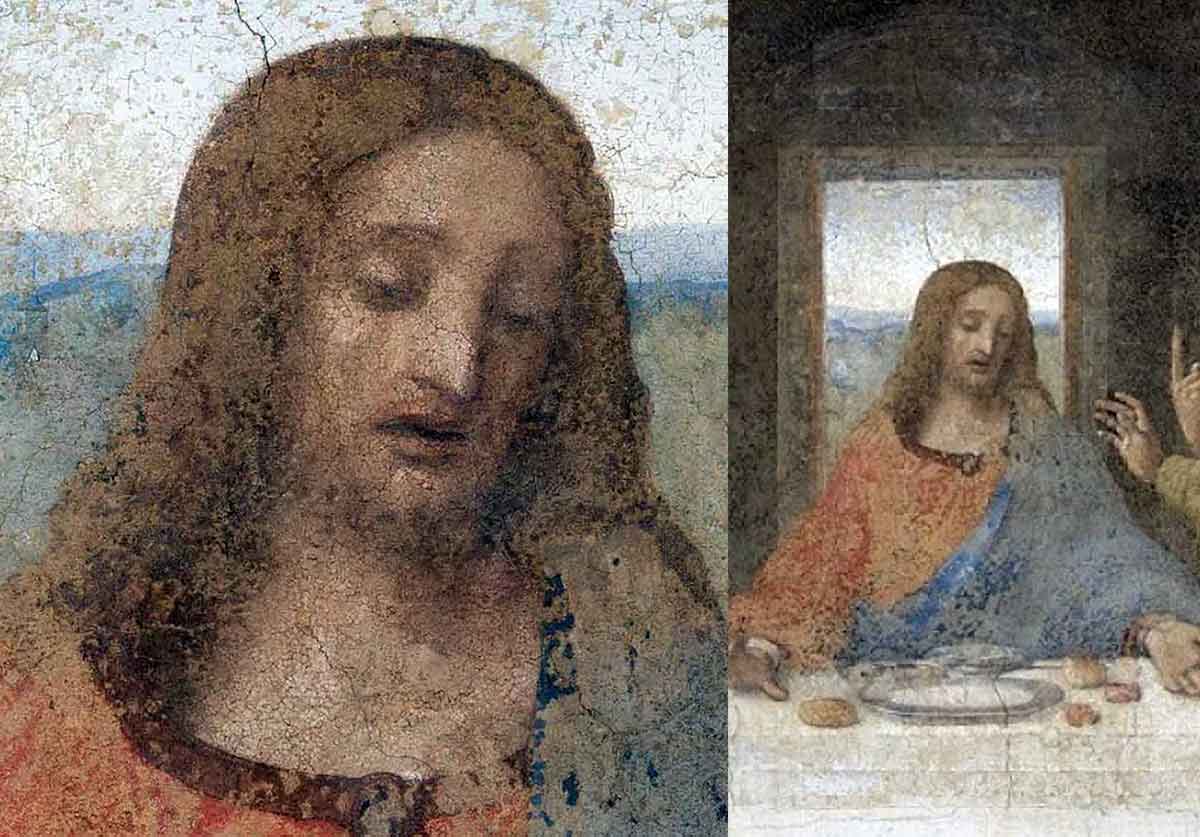
The figure of Jesus dominates the center of the composition. The triangular space created by his placement emphasizes his significance. Unlike many Renaissance versions that idealize Christ and the apostles with halos, Leonardo presents them without overt signs of divinity, emphasizing their humanity and emotional realism.
In The Last Supper, bread and wine become the essence of the Christian faith: the body and blood of Christ. Jesus instructs his disciples to participate in this sacred ritual, an act of remembrance of his ultimate sacrifice. This ritual, known as the Eucharist, forms the foundation of Christian worship, signifying both unity with Christ and a profound engagement with his teachings, particularly his sacrificial death.
Although Jesus’ attention is focused on the bread and wine, there is a profound sadness in his expression. His gaze seems absorbed in these symbols of his impending sacrifice, almost ignorant of the dramatic reactions of his disciples around him. The perspective of the composition establishes Jesus as the focal point of the entire scene.
The natural center (sensus communis) lies at the top of Christ’s head, at which the lines of the table, floor, and ceiling converge. Art Historian Pietro C. Marani mentions that Christ’s head is slightly smaller than the others, so as to define the vanishing point of the perspective and accent the spatial depth of the image. The walls, receding dramatically, guide the viewer’s eye toward the distant back of the room, where the windows reveal hills and sky beyond. The daylight streaming through them enhances the calm centered on Christ.
The horizontal presentation of the image, with the symmetrical arrangement of apostles on each side of Jesus, both contribute to Leonardo’s solution to the challenge of creating the illusion of a three-dimensional space on a flat surface.
On the Right of Jesus: Bartholomew, James the Less, and Andrew
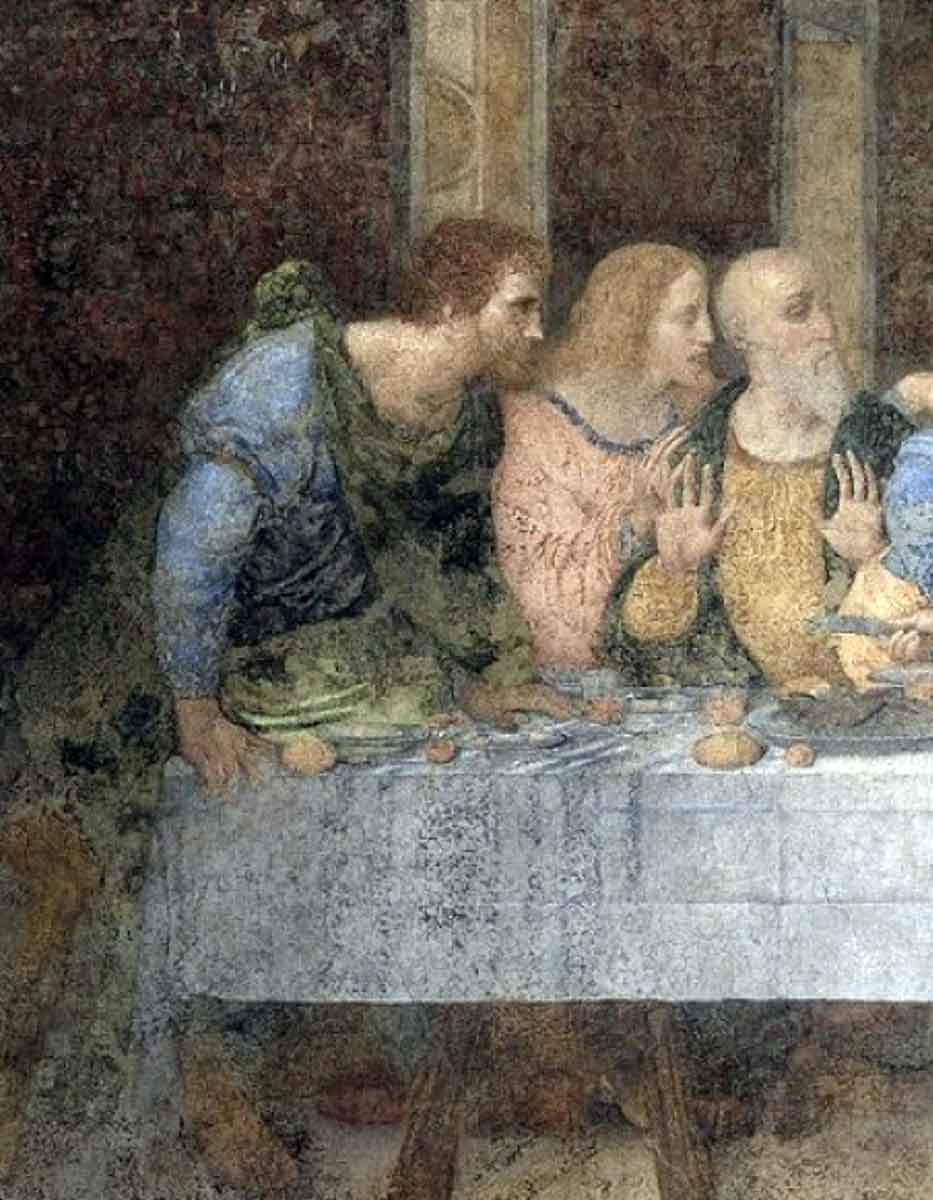
Bartholomew is never mentioned as a character in any Gospel narrative. What is known about him is limited to his inclusion in lists of the twelve apostles found in the Synoptic Gospels and the Acts of the Apostles. In Michelangelo’s Last Judgment in the Sistine Chapel, Bartholomew is depicted holding his own flayed skin, symbolizing his martyrdom. James the Less, also called James the Just, is traditionally considered the author of the First Epistle of the New Testament and is held to have played a prominent role in the early Christian community in Jerusalem. According to Saint Paul, he witnessed the Resurrection of Christ. Andrew, the elder brother of Saint Peter, was a fisherman from Bethsaida by the Sea of Galilee. According to the Gospel of Matthew, Jesus saw Andrew and Peter fishing and called them to become his disciples, fishers of men.
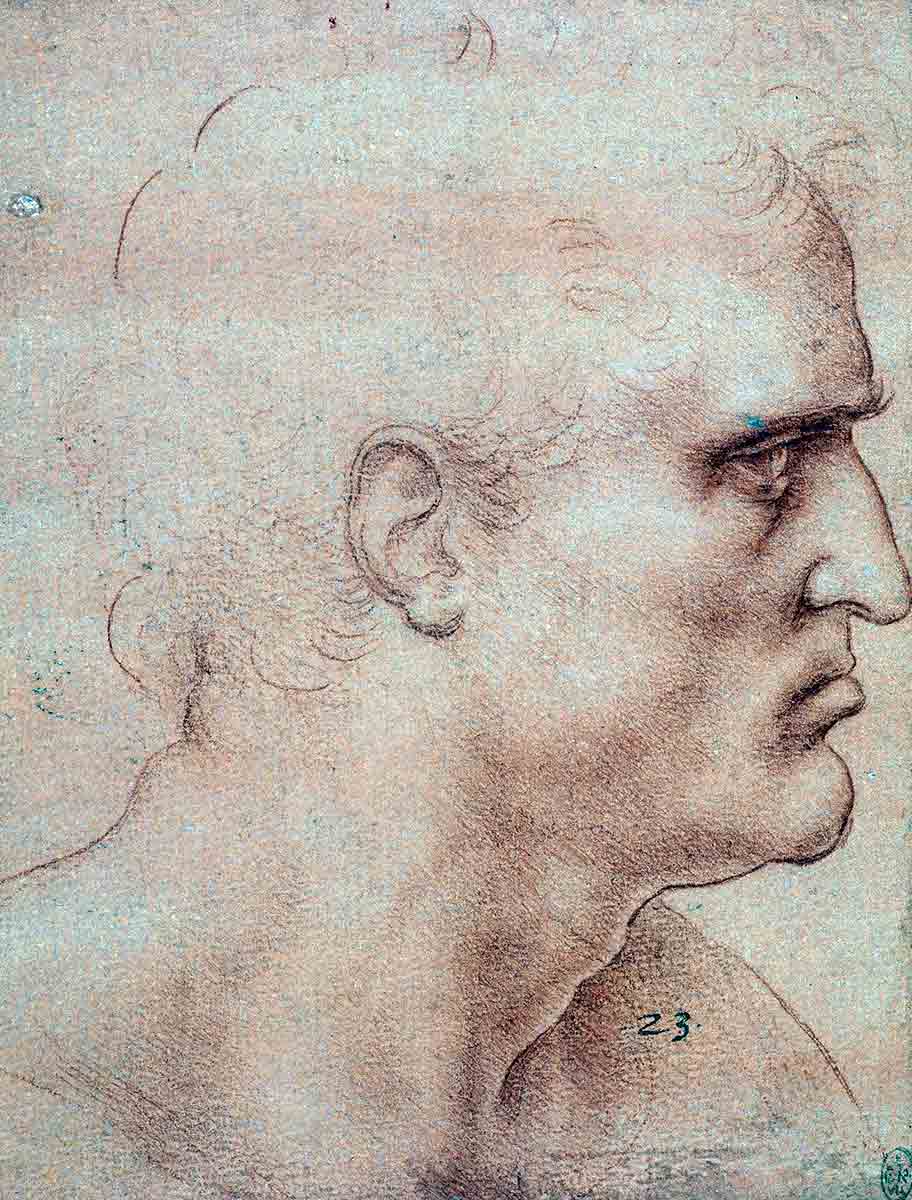
A preparatory sketch of Bartholomew’s head with red chalk shows in detail the face and neck of the model, but the back of the head is indicated with a few simple strokes. In the mural, Bartholomew appears leaning on the table, his hands directing attention toward Christ. The left hand of James the Less also points toward Jesus, while Andrew’s raised arms, almost comically expressing astonishment, underline the group’s amazement. Being the group furthest from the center of action, they seem to ask in anxious wonder: “What did he say?” “What is happening?”
Peter, John, and Judas Iscariot
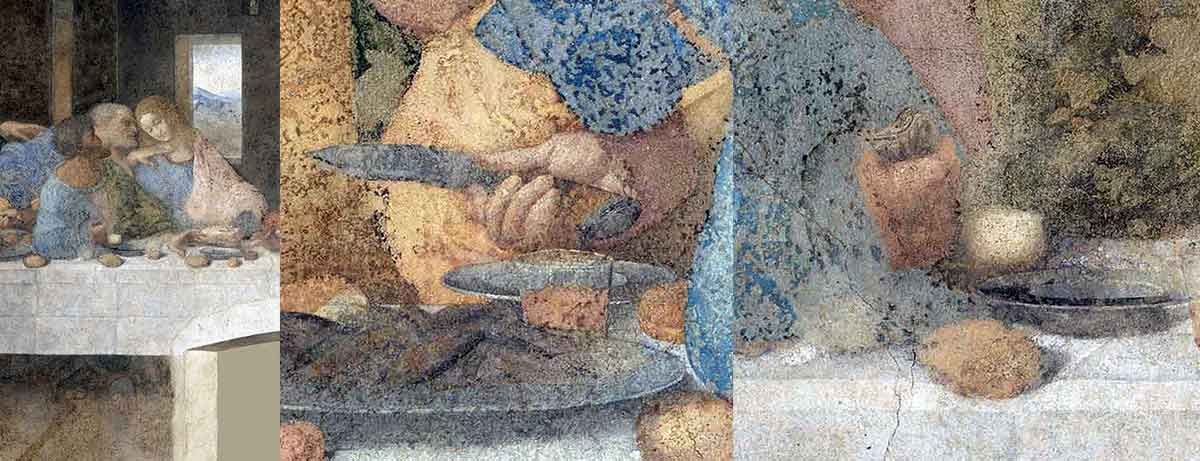
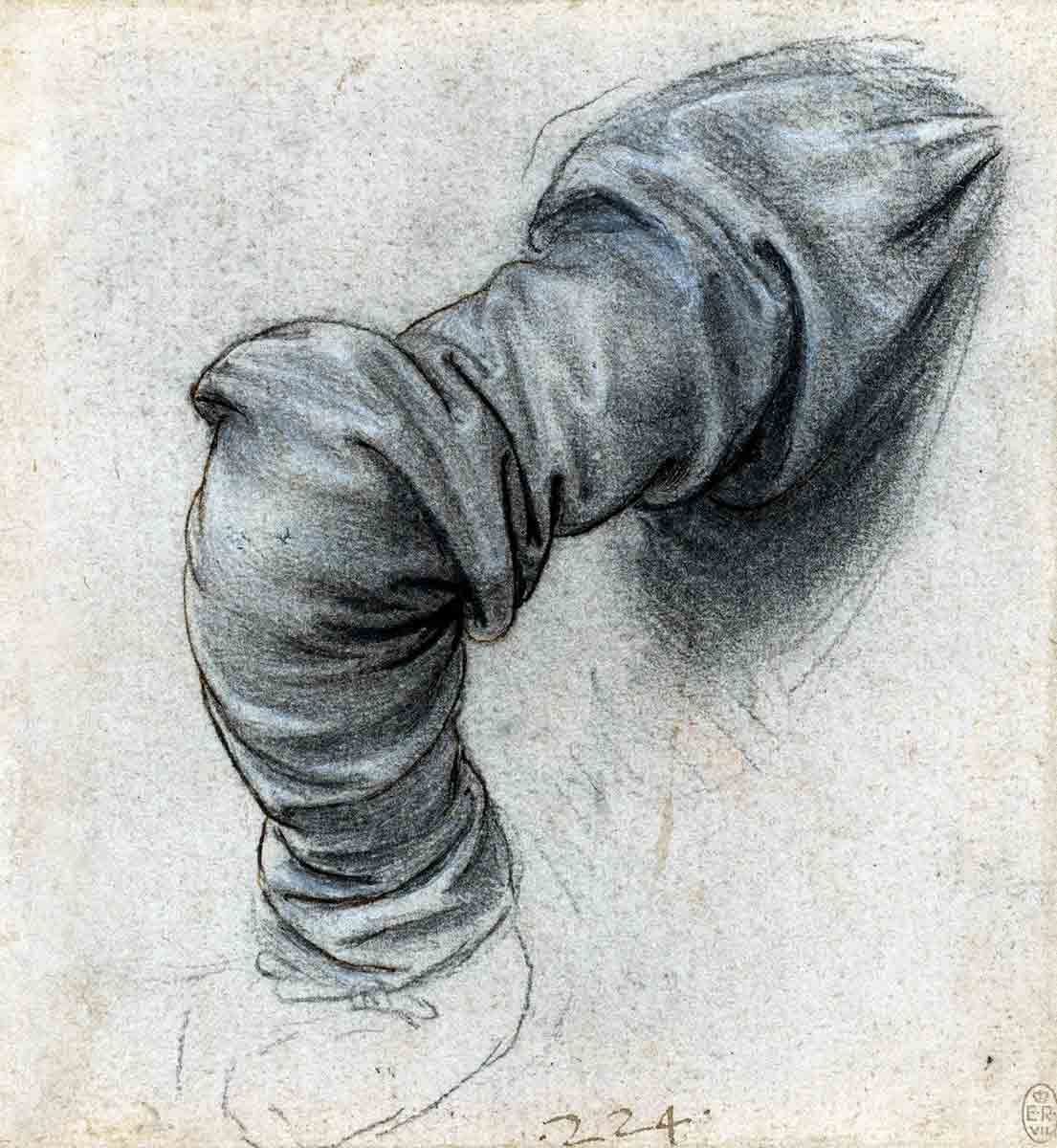
Peter was from Bethsaida and, together with his brother Andrew, worked as a fisherman in Galilee. He is regarded as the chief of the apostles. A preparatory sketch of Peter’s right arm is the only surviving study of drapery for The Last Supper, showing his hand twisted behind his back as he leans over Judas’ shoulder. In the mural, Peter appears to hold a dagger, foreshadowing the violent act he would later commit in the Garden of Gethsemane, when he cut off a soldier’s ear (John 18:10).
John and Peter were the only apostles sent by Jesus to prepare for the Last Supper. During the meal, John sits next to Jesus (John 13:23) and is depicted fainting slightly, leaning toward Peter. Some historical speculation suggested this figure might be Mary Magdalene, but art historians have conclusively identified him as John, portrayed with Leonardo’s characteristic androgynous features also seen in other works. Author Ross King wrote that there would not have been a reason for Leonardo to disguise Mary Magdalene as an apostle.
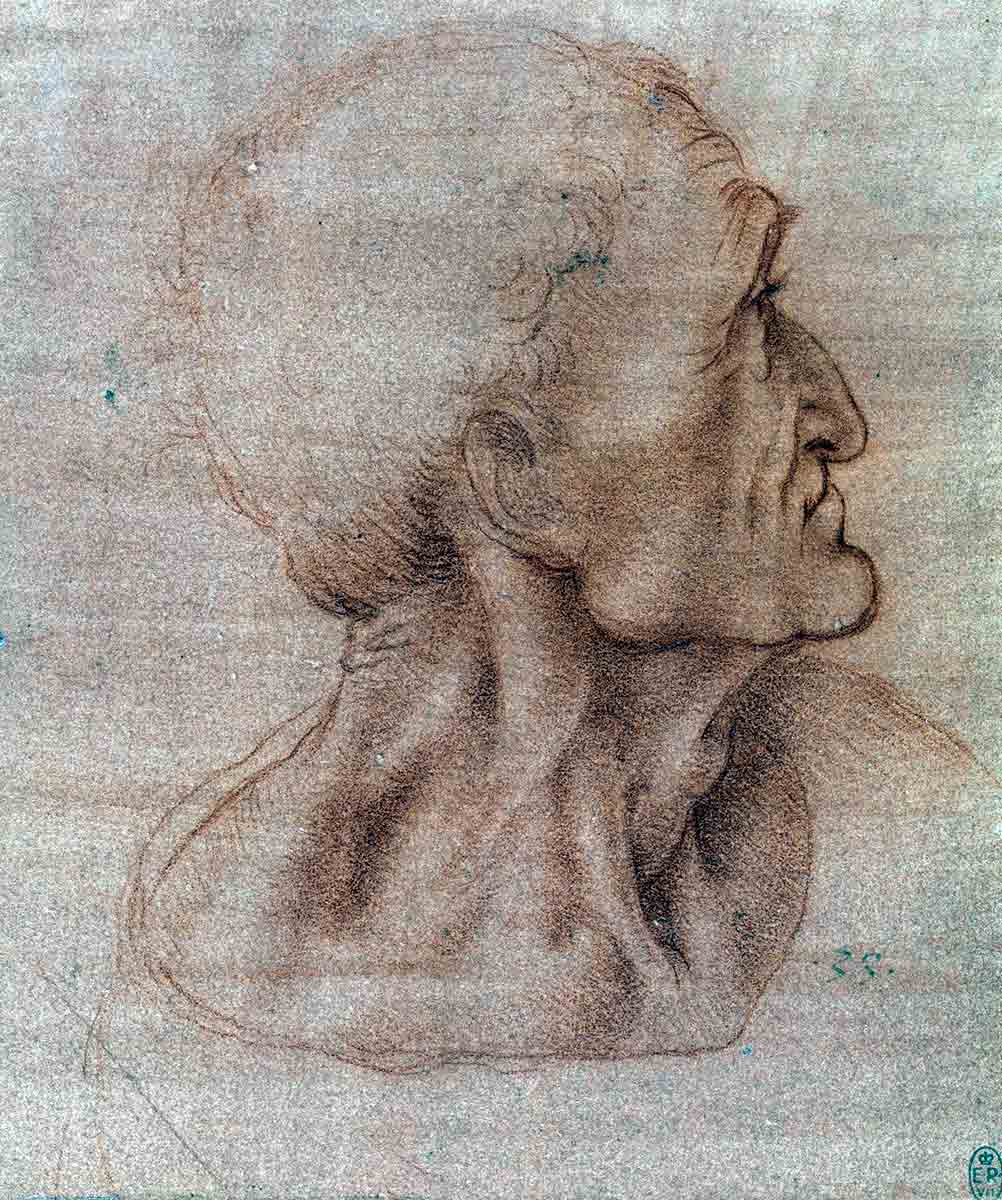
Judas Iscariot was one of Christ’s disciples. The Bible records that Judas was the treasurer for Jesus’ ministry and was present at several important events. Throughout the Gospels, Jesus repeatedly foretold his betrayal (John 6:70-71), which culminates during the Last Supper and in the Garden of Gethsemane. A preparatory sketch of Judas’ head shows him turned slightly away in profile, with a hooked nose, closely set lips, and a muscular neck. Leonardo did not intend Judas to appear physically repulsive, though later restorations may have altered his features.
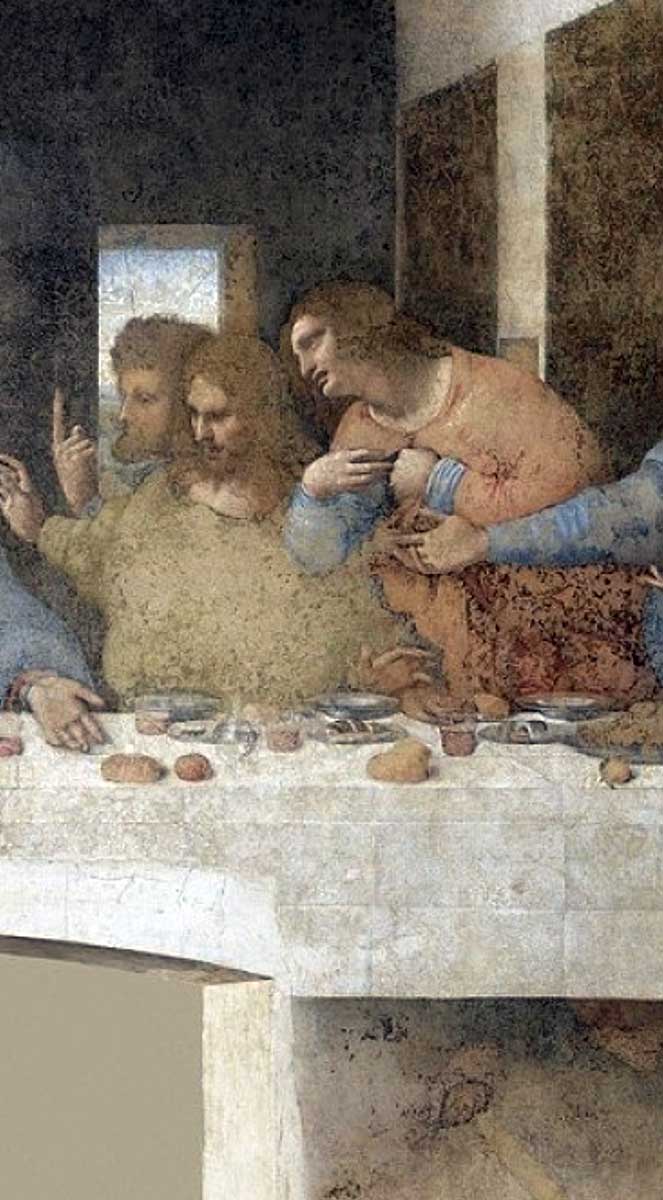
In the mural, Judas clutches a small purse—an allusion to the thirty pieces of silver—and accidentally overturns the salt, a subtle symbol of betrayal and misfortune that deepens the tension of the scene. He wears red, blue, and green garments and is the only figure cast in shadow, with his elbow on the table and seated lower than the other apostles, emphasizing his isolation.
The Third Group of Apostles: Thomas, James the Greater, and Philip
Little is known about the early life of Thomas, and the Gospels do not recount how he became an apostle of Christ. He is famously known as Doubting Thomas for questioning Christ’s resurrection (John 20:25–29).
James the Greater, son of Zebedee, was one of Jesus’ first disciples. A preparatory sketch of James the Greater, in red chalk and ink, captures his shock and disbelief. In the mural, his outstretched hands express astonishment. Leonardo’s subtle shading of the eyes enhances the power of his gesture, almost allowing the viewer to hear James’ gasp.
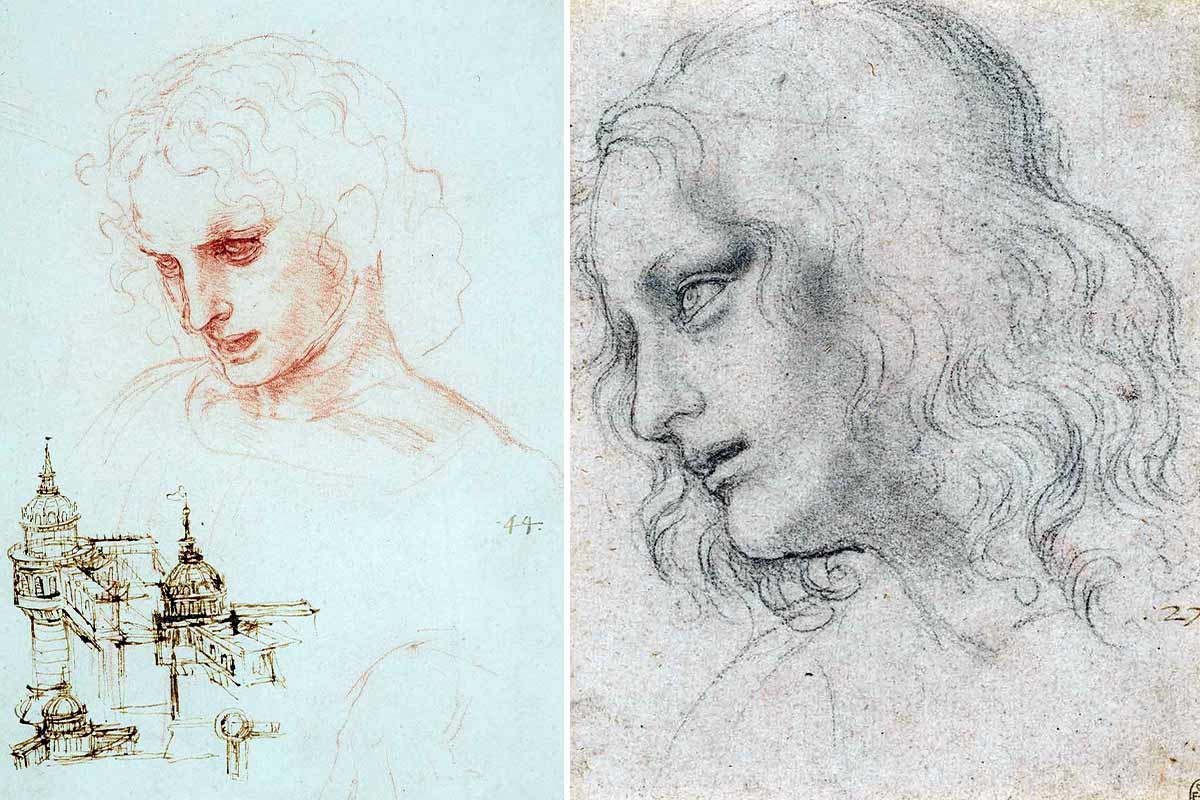
Philip, also called Philip the Evangelist, was among John the Baptist’s earliest followers before joining Jesus. A preparatory study of his head shows a young man with long, wavy hair, slightly leaning forward and away from the viewer, eyes raised in observation of Christ with wonder. In contrast to the spontaneity of James’ sketch, Philip’s head is meticulously rendered.
The Fourth Group of Apostles in “The Last Supper”
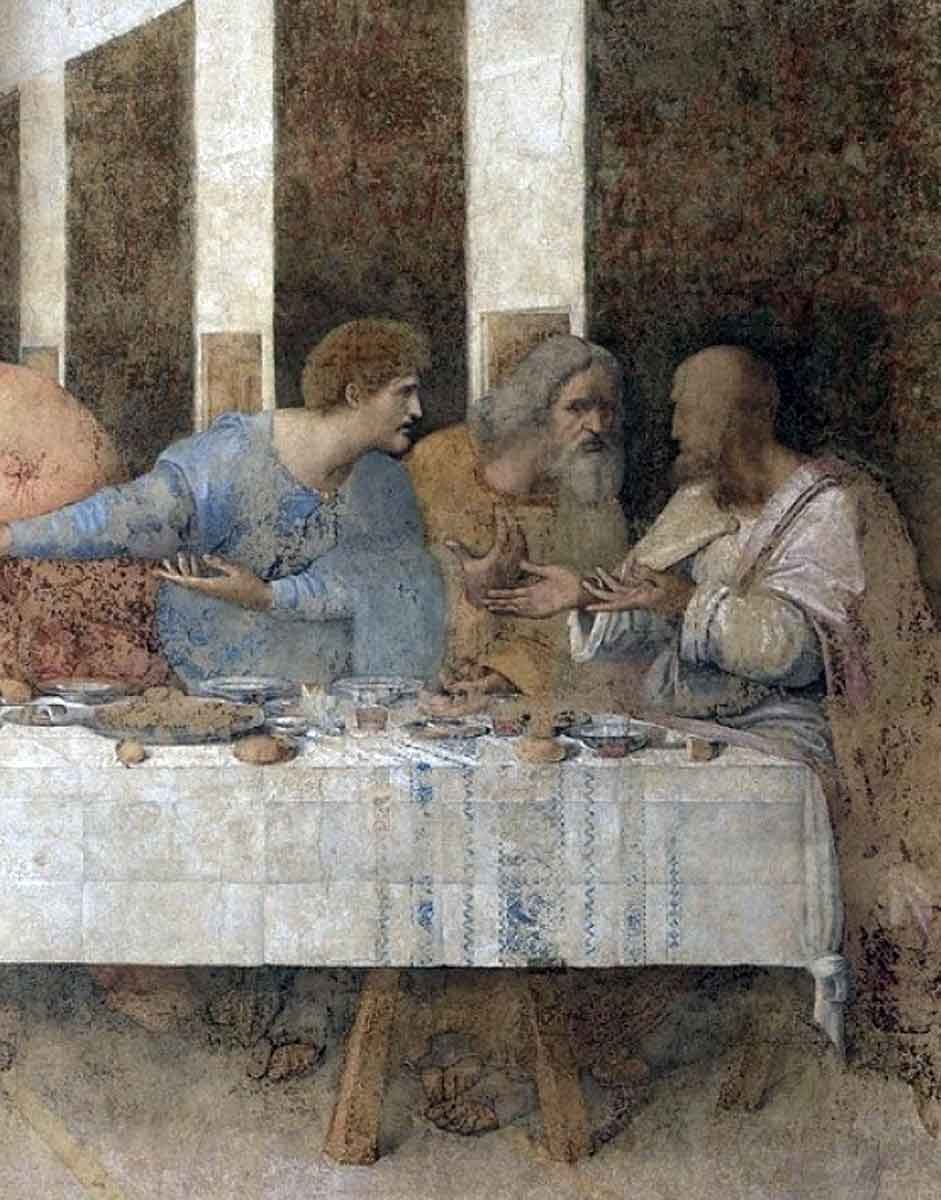
Little is known about Saint Matthew, aside from his profession as a tax collector, which was widely despised in Jesus’ time. According to the Gospel, Matthew was working at a tax booth in Capernaum when Jesus called him to follow Him (Matthew 9:9-13). He became one of Jesus’ disciples, and the first Gospel is traditionally attributed to him.
Saint Jude, also known as Thaddaeus, was the brother of James the Less. In the lists of apostles in Matthew 10:3 and Mark 3:18, his name appears as “Jude” and “Thaddaeus,” which led early Christians to identify him by both names.
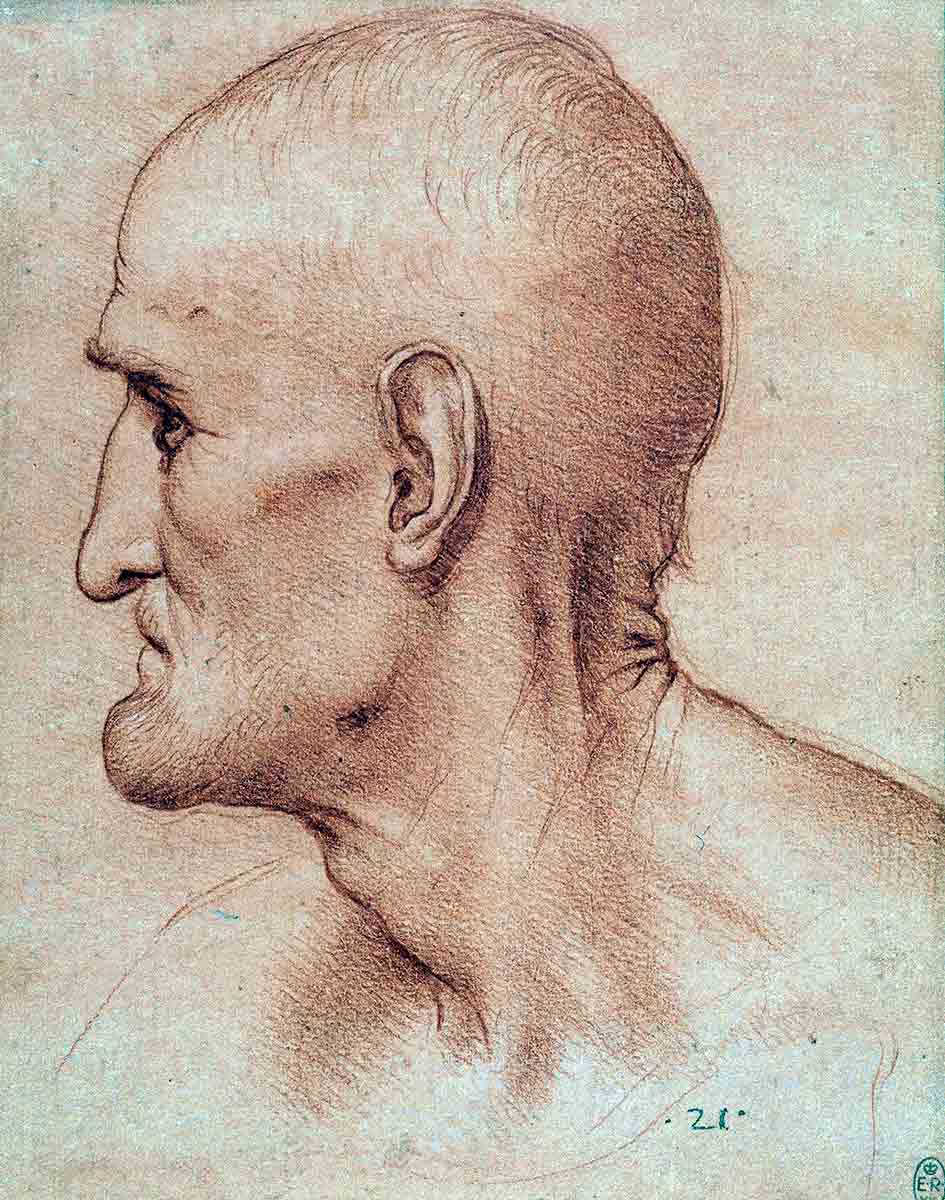
In the Gospel of Matthew, Simon the Zealot is described as one of the Lord’s relatives, perhaps a cousin of Jesus. In Luke and Acts (Luke 6:15; Acts 1:13), he is called the Zealot, suggesting he was formerly a member of a revolutionary political group. While the exact nature of a Zealot is uncertain, he is generally considered a former insurgent. In a copy of a lost study drawing by Leonardo, probably by his associate Cesare da Sesto (1477-1523), the head of the man, turned in profile to the left, corresponds to that of the disciple Simon.
In Leonardo’s mural, Simon appears stern, with his hands raised to chest height, reacting to the astonished questions of Matthew and Jude. Matthew points toward the center, as if asking Simon for clarification, while Jude also directs his attention to Jesus. The gestures and positioning of the figures at both ends of the table guide the viewer’s gaze towards the Eucharist. Each hand gesture, expression, and pose reinforces the psychological tension and narrative focus of the scene, drawing attention to the impending revelation of Christ’s betrayal.